ß
S
-Haplotypes in sickle cell anemia
patients from Salvador, Bahia,
Northeastern Brazil
1Laboratório de Patologia e Biologia Molecular,
Centro de Pesquisas Gonçalo Moniz, FIOCRUZ, Salvador, BA, Brasil 2Fundação Hemocentro da Bahia (HEMOBA)/SESAB, Salvador, BA, Brasil 3Hospital Professor Edgar Santos, 4Laboratório de Biologia Molecular,
Departamento de Toxicologia e Análises Clínicas, Faculdade de Farmácia, and 5Instituto de Matemática, Universidade Federal da Bahia, Salvador, BA, Brasil M.S. Gonçalves1,4,
G.C. Bomfim1, E. Maciel1, I. Cerqueira1, I. Lyra2, A. Zanette2, G. Bomfim3, E.V. Adorno1, A.L. Albuquerque1, A. Pontes4, M.F. Dupuit4, G.B. Fernandes5 and M.G. dos Reis1
Abstract
ßS-Globin haplotypes were studied in 80 (160 ßS chromosomes) sickle
cell disease patients from Salvador, Brazil, a city with a large popula-tion of African origin resulting from the slave trade from Western Africa, mainly from the Bay of Benin. Hematological and hemoglobin analyses were carried out by standard methods. The ßS-haplotypes
were determined by PCR and dot-blot techniques. A total of 77 (48.1%) chromosomes were characterized as Central African Repub-lic (CAR) haplotype, 73 (45.6%) as Benin (BEN), 1 (0.63%) as Senegal (SEN), and 9 (5.63%) as atypical (Atp). Genotype was CAR/ CAR in 17 (21.3%) patients, BEN/BEN in 17 (21.3%), CAR/BEN in 37 (46.3%), BEN/SEN in 1 (1.25%), BEN/Atp in 1 (1.25%), CAR/Atp in 6 (7.5%), and Atp/Atp in 1 (1.25%). Hemoglobin concentrations and hematocrit values did not differ among genotype groups but were significantly higher in 25 patients presenting percent fetal hemoglobin (%HbF) ≥10% (P = 0.002 and 0.003, respectively). The median HbF concentration was 7.54 ± 4.342% for the CAR/CAR genotype, 9.88 ± 3.558% for the BEN/BEN genotype, 8.146 ± 4.631% for the CAR/ BEN genotype, and 4.180 ± 2.250% for the CAR/Atp genotype (P = 0.02), although 1 CAR/CAR individual presented an HbF con-centration as high as 15%. In view of the ethnic and geographical origin of this population, we did not expect a Hardy-Weinberg equilib-rium for CAR/CAR and BEN/BEN homozygous haplotypes and a high proportion of heterozygous CAR/BEN haplotypes since the State of Bahia historically received more slaves from Western Africa than from Central Africa.
Correspondence
M.S. Gonçalves Laboratório de Patologia e Biologia Molecular
Centro de Pesquisas Gonçalo Moniz Rua Valdemar Falcão, 121 40295-001 Salvador, BA Brasil
E-mail: [email protected]
Research supported by PAPES-FIOCRUZ (No. 0250250304) and CNPq (No. 521201/96-1).
Received January 28, 2002 Accepted July 4, 2003
Key words
•Beta(S)-haplotypes •Fetal hemoglobin •Sickle cell anemia •S hemoglobin •Brazilian population
Introduction
Sickle cell hemoglobin (HbS) is the result of a single nucleotide change (GAG→GTG) in the ß-globin gene, where valine replaces glutamic acid (ß6 Glu→val) at the sixth amino
acid position of the ß-globin chain (1). Sickle cell anemia is caused by homozygosity of the ßS-gene and has a worldwide distribution.
back-ground and geographic region of origin (2). Milder clinical symptoms have been de-scribed in patients presenting α-2 thalas-semia and high levels of fetal hemoglobin (HbF), related to the presence of specific haplotypes (3,4). ßS-Haplotypes are of
dif-ferent ethnic and geographic origins: the Benin type (BEN) originated in Midwestern Africa, the Bantu (CAR) type in South-Cen-tral and Eastern Africa, the Senegal (SEN) type in Atlantic West Africa, the Saudi Arabia-India type on the Indian subconti-nent and the eastern Arabian peninsula, and the Cameroon type along the west coast of Africa (5).
Sickle cell disease affects millions world-wide, and occurs in one of every 500 Afri-can-American births, and in one of every 1000 to 4000 Hispanic-American births. In Brazil, the largest country in South America, the sickle cell trait is found at frequencies ranging from 6.9 to 15.4% of individuals of African descent (6). High immigration in-fluxes have produced a population of signifi-cant cultural, social, and ethnic heterogene-ity. Salvador is the capital of Bahia, a state in the Northeast region of Brazil, with 2.7 mil-lion people (7). The population has a high racial admixture with 85% of the African component (8). Historical data describing the slave trade in Bahia indicate the presence of slaves from central Africa (predominantly CAR haplotype) and from Western Africa (BEN haplotype), with a predominance of the latter. However, haplotype characteriza-tion has reported conflicting frequencies of CAR (9) and BEN (10) haplotypes.
The historian Verger (11) described the Nagô-Iorubá influence in Bahia State brought by Africans from the Benin Gulf region. In contrast, the rest of Brazil received large influxes of slaves from Congo and Angola (primarily CAR haplotype). In addition to a period of illicit slave trafficking, Bahia had four official periods of slave trading: a Guinea cycle during the XVI century, an Angola and Congo cycle during the XVII century, a Coast
of Mine cycle during the XVIII century, and a Bay of Benin cycle between 1770 and 1850. Florentino (12) emphasizes that Ba-hia, beginning in 1815, was the only Brazil-ian state that restricted slave traffic through Ecuador, a fact that explains the correlation between genotype frequencies found in Ba-hia and Western Africa, principally the Bay of Benin region.
The unusual ethnic composition of Sal-vador, which was a transfer point during the African slave trade, represents an excellent opportunity to study the ßS-haplotypes and
to investigate the clinical picture of sickle cell anemia patients and the anthropological origins of the ßS-gene in this Brazilian
popu-lation.
Material and Methods
A total of 80 sickle cell disease patients (40 males and 40 females) were studied. Informed consent was obtained from all in-dividuals or responsible person prior to en-rollment and the study protocol was submit-ted to and approved by the FIOCRUZ Ethics Committee. Patients were recruited from both the Center for Hematological Studies (Fun-dação Hemocentro da Bahia, HEMOBA) and the University Hospital, Federal Univer-sity of Bahia (Hospital Universitário Profes-sor Edgar Santos, Universidade Federal da Bahia). Mean patient age was 13.17 ± 9.71 years (range: 1.6-51.5 years).
Hematological analyses were carried out using an electronic cell counter (Coulter Count T890). Hemoglobin type was deter-mined by electrophoresis on cellulose ac-etate strips at pH 8.4, and the presence of HbS was confirmed by sickling and solubil-ity tests, and by electrophoresis on agar-citrate at pH 5.3 (13). HbF was measured by alkali denaturation (13). DNA was isolated from peripheral blood leukocytes (14). ßS
second intervening sequence (IVS-II) of the
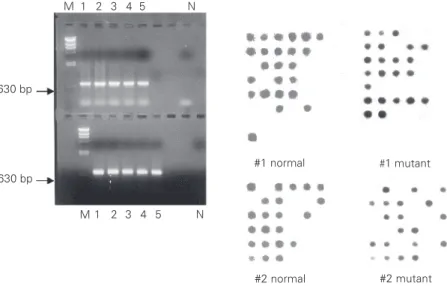
γ-globin genes (15,16) (Figure 1).
The EPI Info (version 6.04) and Statisti-cal Package for the Social Sciences (SPSS, version 6.1) programs were used for statisti-cal analyses. The effects of age category, gender, and HbF concentration ≥10% on the hematological parameters were evaluated. The level of significance was set at P < 0.05 in all analyses.
Results
The patients had a median (± SD) hemo-globin concentration of 8.369 ± 1.632 g/dl, median hematocrit of 25.044 ± 5.03%, me-dian cell volume of 88.488 ± 10.033 fl, median cell hemoglobin of 30.095 ± 4.195 pg, and median cell hemoglobin concentra-tion of 33.905 ± 1.679 g/dl. These param-eters did not vary significantly between age and gender categories. However, patients with HbF ≥10% were found to have signifi-cantly higher Hb concentrations compared to patients of the group with Hb <10% (me-dian: 7.8 vs 9.0; P = 0.002) and hematocrit values (median: 24.00 vs 28.00; P = 0.003). The hematological data and the ßS
-haplo-types/genotypes obtained for the 80 sickle cell disease patients analyzed are listed in Table 1.
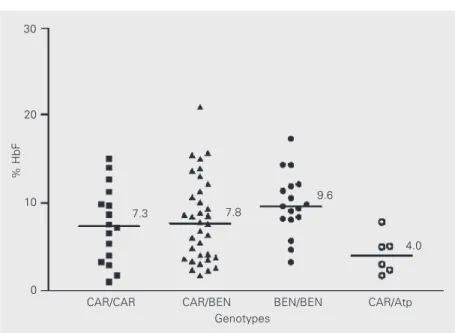
The hematological data, including the different proportions of HbF found, are re-ported in Table 2. Median age was signifi-cantly higher among the CAR/CAR and CAR/BEN genotypes. The median HbF lev-els among the CAR/CAR, CAR/BEN, BEN/ BEN and CAR/atypical (Atp) genotypes are shown in Figure 2. The patient group pre-senting HbF ≥10% consisted of 25 (31.2%) individuals; the genotype was CAR/BEN in 12, CAR/CAR in four, BEN/BEN in seven, SEN/Atp in one, and Atp/Atp in one. There was no CAR/Atp or BEN/SEN genotype in this group. In the group with HbF higher than 10%, eight subjects presented HbF ≥15%, with the genotype being CAR/CAR in one of
630 bp
630 bp
M 1 2 3 4 5 N
M 1 2 3 4 5 N
#1 normal
#2 normal #2 mutant
#1 mutant
Figure 1. Gamma-globin gene amplification and dot-blot analyses of CAR ßS-haplotype.
Sickle cell disease patients, heterozygous for the CAR haplotype, have a positive signal with normal and mutant probes. Homozygous patients have a positive signal only with a mutant probe and negative patients for this haplotype have a signal only with a normal
probe. Lanes 1-5 show a 630-bp PCR fragment from the Gγ-globin. M = λHindIII marker;
N = negative control.
Table 1. Hematological data of the 80 sickle cell disease patients (40 males and 40 females) from
Salvador, Bahia, Brazil, and ßS-haplotype
frequen-cies and genotype frequenfrequen-cies found among the 80 sickle cell disease patients.
Mean ± SD (median)
Age (years) 13.179 ± 9.715 (10.55)
Hematological data
Ht (%) 25.044 ± 5.030 (24.00)
Hb (g/dl) 8.369 ± 1.632 (8.300)
MCV (fl) 88.488 ± 10.033 (91.00)
MCH (pg) 30.095 ± 4.195 (30.00)
MCHC (g/dl) 33.905 ± 1.679 (34.00)
HbF (%) 8.253 ± 4.636 (8.20)
HbS (%) 89.876 ± 4.476 (90.00)
Haplotypes/genotypes
CAR/CAR 17 (21.25%)
BEN/BEN 17 (21.25%)
CAR/BEN 37 (46.25%)
CAR/Atp 6 (7.5%)
BEN/Atp 1 (1.25%)
BEN/SEN 1 (1.25%)
Atp/Atp 1 (1.25%)
them, CAR/BEN in four, BEN/BEN in one, SEN/Atp in one, and Atp/Atp in one. Me-dian HbS values were higher among the subjects with the CAR/Atp genotype and lowest among subjects with the BEN/BEN genotype.
Discussion
ßS-Haplotypes were established in 80
sickle cell disease patients from Salvador, a city in Northeastern Brazil characterized by a population with a large African contribu-tion (8). Azevedo et al. (6) found that the frequency of HbS ranged from 7.6 to 15.9% in different population groups of Salvador. In the present study, the CAR/BEN geno-type was predominant. Unexpectedly, the BEN and CAR homozygous genotypes were found to occur at similar frequencies, mainly considering the high presence of the CAR haplotype. Verger (11) emphasized that from 1678 to 1814, only 39 of 1770 ships that exported tobacco from Bahia went to the Congo and Angola, where they captured slaves representing a possible contribution of Africans from Atlantic Central Africa. All the other ships went to Coast of Mine ports. The slave traffic from Atlantic Central Af-rica was supposedly intensified between 1815 and 1824 (11), a fact that can explain our results. No Saudi Arabian or Cameroon hap-lotypes were identified in the study sample, and only one SEN haplotype was encoun-tered.
In the United States and Jamaica, the BEN haplotype is predominant, a result of the preference for the traffic of Midwestern Africans to these regions during the British Atlantic slave trade (4,17,18). In contrast, haplotype studies on the Cuban and Puerto Rican populations have found a predomi-nance of genes from the Bantu haplotype, suggesting a different African origin of these populations (5,19-21).
The distribution of ßS-haplotypes in the
Brazilian State of São Paulo (Southeastern
Figure 2. Distribution of median fetal hemoglobin (HbF) levels among the CAR/CAR (N = 17), CAR/BEN (N = 37), BEN/BEN (N = 17) and CAR/Atp (N = 6) genotypes in sickle cell disease patients from Salvador, Bahia, Brazil. For abbreviations, see legend to Table 2.
Table 2. Characterization of patients with the CAR/CAR, BEN/BEN, CAR/BEN and CAR/ Atp genotypes.
CAR/CAR BEN/BEN CAR/BEN CAR/Atp
(N = 17) (N = 17) (N = 37) (N = 6)
Age 16.72 ± 12.89 8.213 ± 4.651 14.34 ± 9.904 7.267 ± 1.193**
(11.05) (6.70) (10.60) (7.80)
Gender (N, %)
Male 10 (58.8%) 8 (47.0%) 17 (45.9%) 3 (50.0%)
Female 7 (41.2%) 9 (53.0%) 20 (54.1%) 3 (50.0%)
Hematological data
Ht (%) 23.67 ± 2.934 24.44 ± 5.49 26.00 ± 5.82 23.667 ± 3.79
(23.50) (24.50) (27.00) (22.00)
Hb (g/dl) 7.88 ± 0.824 8.15 ± 1.89 8.79 ± 1.79 7.867 ± 1.03
(7.950) (8.350) (8.80) (7.600)
MCV (fl) 86.29 ± 8.18 90.54 ± 12.39 86.78 ± 9.76 90.33 ± 7.23
(88.00) (91.00) (87.50) (94.00)
MCH (pg) 29.00 ± 3.21 30.91 ± 4.99 29.72 ± 4.43 30.33 ± 3.79
(29.50) (32.00) (30.00) (32.00)
MCHC (g/dl) 33.25 ± 1.49 34.18 ± 1.08 34.11 ± 2.11 33.33 ± 1.53
(33.50) (34.00) (34.00) (33.00)
HbF (%) 7.544 ± 4.342 9.882 ± 3.558 8.146 ± 4.631 4.180 ± 2.250*
(7.350) (9.600) (7.800) (4.000)
HbS (%) 90.434 ± 4.01 88.010 ± 3.66 90.005 ± 4.51 94.432 ± 2.10*
(90.530) (88.170) (90.44) (94.490)
Data are reported as means ± SD (median). Atp = atypical; BEN = Benin; CAR = Central African Republic. For other abbreviations, see legend to Table 1.
*P < 0.05 for HbF and HbS concentrations between the different genotypes (Kruskal Wallis test). **P < 0.05 for age between the different genotypes (ANOVA + chi-square test).
% HbF
30
20
10
0
CAR/CAR CAR/BEN BEN/BEN CAR/Atp
Genotypes
7.3 7.8
9.6
Brazil) and Pará (Northern Brazil) showed high frequencies of the CAR haplotype, i.e., 62.2 and 65.9%, respectively (9,22-24). Analyses of ßS-haplotypes from the Amazon
region have indicated a 60% frequency of the CAR haplotype, a 30% frequency of the SEN haplotype, and a 10% frequency of the BEN haplotype (24).
Populations with a high frequency of BEN/CAR heterozygotes, as reported for Bahia, provide an excellent cohort for the study of the effect of ßS-haplotypes on the
clinical course of sickle cell anemia. An important finding of the present study was the high concentration of HbF among indi-viduals with the CAR/CAR genotype, which normally present a median HbF value below 5.0% (4). It is well known that HbF levels in sickle cell anemia could be influenced by age, gender, α-globin gene number, ß-globin haplotype, and the X-linked F-cell produc-tion locus that regulates the producproduc-tion of HbF-containing erythrocytes (F cells) (25).
In a previous study, the F-cell production locus accounted for 40% of the overall varia-tion of HbF levels and the ß-globin haplo-type was associated with 14% of the remain-ing HbF variation; when the F-cell produc-tion influence was removed, approximately half of the variation in HbF levels still re-mained to be explained, showing the need for further studies (25). Unfortunately, we did not study α-thalassemia in theses pa-tients, but a higher frequency of this type of thalassemia was previously demonstrated among Bahian sickle cell disease patients (10), probably representing an important prognostic factor for the clinical course of
the disease.
The presence of high HbF levels in the CAR/CAR genotype could be explained by sequence variation in regulatory regions of the 5' HS2 and 5' flanking region of the γ -gene expression, as previously discussed by Lanclos et al. (26).
In addition, we also identified an indi-vidual with the SEN haplotype, a fact that may suggest that Bahia State also had a gene flow from Atlantic West Africa, as was the case for other Brazilian states (24). Internal migration is unlikely since the patient’s an-cestors were from Salvador. The low fre-quency of the SEN haplotype could be ex-plained by the absence of SEN carriers look-ing for medical care or a recent origin of the ßS SEN mutation in this population (27). The
atypical haplotypes showed different distri-butions and could be found associated with the CAR and BEN genotypes, indicating the occurrence of diverse genetic mechanisms that could be responsible for the variation of HbF concentrations among the atypical hap-lotype carriers (28-30).
The present results are relevant to the study of slave traffic routes in Brazil and of the African origins of the Bahian population. Taken together, the data indicate that studies examining the impact of the ßS-haplotypes
and of the presence of α-thalassemia on clinical outcome and HbF expression may contribute to clarifying a possible relation-ship between clinical picture, ßS-haplotypes, α-thalassemia and HbF production in sickle cell disease patients from Salvador, Bahia, identifying prognostic factors for the clinical course of the disease in this population.
References
1. Bunn HF & Forget BG (1986). Hemoglobin: Molecular, Genetic and
Clinical Aspects. W.B. Saunders, Philadelphia, PA, USA.
2. Embury SH, Hebbel RP, Mohandas N & Steinberg MH (1994). Sickle
Cell Disease: Basic Principles and Clinical Practice. Raven Press, New York.
3. Pagnier J, Mear JG, Dunda-BelKhadja O, Rego KE, Beldjord C, Nagel RL & Labie D (1984). Evidence for the multicentric origin of
the sickle cell hemoglobin gene in Africa. Proceedings of the
Na-tional Academy of Sciences, USA, 81: 1771-1773.
4. Powars DR (1991). ßS-Gene cluster haplotypes in sickle cell anemia:
clinical and hematologic features. Hematology/Oncology Clinics of
North America, 5: 475-493.
5. Nagel RL (1984). The origin of the hemoglobin S gene: clinical,
Jour-nal of Biology and Medicine, 2: 53-62.
6. Azevedo ES, Alves AFP, Silva MCBO, Souza MGF, Lima AMVMD & Azevedo W (1980). Distribution of abnormal hemoglobins and glu-cose-6-phosphate dehydrogenase variants in 1200 school children
of Bahia, Brazil. American Journal of Physical Anthropology, 53:
509-512.
7. Rede Interagencial de Informação para a Saúde (1997). Indicador e Dados Básicos. IDB97. Ministério da Saúde, Brasil.
8. Azevedo ES, Silva KMC, Silva MCBO, Lima AMVMD, Fortuna CMM & Santos MG (1981). Genetic anthropological studies in the island
of Itaparica, Bahia, Brazil. Human Heredity, 31: 353-357.
9. Costa FF, Arruda VR, Gonçalves MS et al. (1984). ßS-Gene cluster
haplotypes in sickle cell anemia patients from two regions of Brazil.
American Journal of Hematology, 46: 96-97.
10. Queiroz IMLP (1996). Características Clínicas, Hematológicas e
Genéticas em Pacientes Homozigotos para a Hemoglobinopatia S da Bahia e de São Paulo. Editora da Faculdade de Medicina da Universidade de São Paulo, São Paulo, SP, Brazil.
11. Verger P (1968). Flux et Reflux de la Traite des Nègres Entre le Golfe
de Benin et Bahia de Todos os Santos. Mouton Press, Paris, France.
12. Florentino M (1997). Em Costas Negras. Companhia das Letras
Press, Rio de Janeiro, RJ, Brazil.
13. Dacie JV & Lewis SM (1995). Practical Hematology. 8th edn.
Churchill Livingstone Press, Edinburgh, UK.
14. Poncz M, Solowiejczyk D, Harpel B, Morry Y, Schwartz E & Surrey S (1982). Construction of human gene libraries from small amounts of
peripheral blood: analysis of ß-like globin genes. Hemoglobin, 6:
27-36.
15. Lanclos KD, Öner C, Dimovski AJ, Gu YC & Huisman THJ (1991).
Sequence variations in the 5' flanking and IVS-II regions of the Gγ
-and Aγ-globin genes of ßS chromosomes with five different
haplo-types. Blood, 77: 2488-2496.
16. Gonçalves MS, Nechtman JF, Figueredo MS, Kerbauy J, Arruda VR, Sonati MF, Saad STO, Costa FF & Stoming TA (1994). Sickle cell
disease in a Brazilian population from São Paulo: A study of the ßS
-gene haplotypes. Human Heredity, 44: 322-327.
17. Schroeder WA, Powards DR, Kay LM, Chan LS, Huynh V, Shelton
JB & Shelton JR (1989). ß-Cluster haplotypes, α-gene status, and
hematological data from SS, SC, and Sß-thalassemia patients in
Southern California. Hemoglobin, 13: 325-353.
18. Wainscoat JS, Bill JI & Thein SL (1983). Multiple origins of the sickle
mutation: Evidence from ßS-globin gene cluster polymorphism.
Molecular Biology and Medicine, 1: 191-197.
19. Muniz A, Corral L, Alaec C, Svarch E, Espinosa E, Carbonell N, Dileo R, Felicetti L, Nagel RL & Martinez G (1995). Sickle cell anemia and
ß-gene cluster haplotypes in Cuba. American Journal of
Hematol-ogy, 49: 113-114.
20. Curtain PD (1969). The Slave Atlantic Trade: A Census. University of
Wisconsin Press, Madison, WI, USA.
21. Baralt GA (1982). Eslavos Rebeldes. Huracon Press, Puerto Rico.
22. Figueiredo MS, Kerbauy J, Goncalves MS, Arruda VR, Saad ST, Sonati MF, Stroming T & Costa FF (1996). Effect of alpha-thalas-semia and beta-globin gene cluster haplotypes and the
hematologi-cal features of sickle cell anemia in Brazil. American Journal of
Hematology, 53: 72-76.
23. Zago MA, Figueiredo MS & Ogo SH (1992). Bantu ßS-cluster
haplo-type predominates among Brazilian blacks. American Journal of
Physiological Anthropology, 88: 295-298.
24. Pante-De-Sousa G, Mousinho-Ribeiro RC, Dos Santos EJ & Guerreiro JF (1999). Beta-globin haplotype analysis in Afro-Brazil-ians from the Amazon region: evidence for a significant gene flow
from Atlantic West Africa. American Journal of Human Biology, 26:
365-373.
25. Chang YP, Maier-Redelsperger M, Smith KD, Contu L, Ducroco R, de Montalembert M, Belloy M, Elion J, Dover GJ & Girot R (1997). The relative importance of the X-linked FCP locus and beta-globin haplotypes in determining haemoglobin F levels: a study of SS
patients homozygous for beta S haplotypes. British Journal of
Hae-matology, 96: 806-814.
26. Adekile AD, Dimovski AJ, Oner C, Lanclos KD & Huisman TH (1993). Haplotype-specific sequence variations in the locus control region (5' hypersensitive sites 2, 3, 4) of beta S chromosomes.
Hemoglobin, 17: 475-478.
27. Currat M, Trabuchet G, Rees D, Perrin P, Harding RM, Clegg JB, Langaney A & Excoffier L (2002). Molecular analysis of the beta-globin gene cluster in the Niokholo Mandenka population reveals a
recent origin of the beta (S) Senegal mutation. American Journal of
Human Genetics, 70: 207-223.
28. Zago MA, Silva Jr WA, Dalle B et al. (2000). Atypical beta (S)
haplotypes are generated by diverse genetic mechanisms.
Ameri-can Journal of Hematology, 63: 79-84.
29. Zago MA, Silva Jr WA, Gualandro S, Yokomizu IK, Araujo AG, Tavela MH, Gerard N, Krishnamoorthy R & Elion J (2001). Rearrangements of the beta-globin gene cluster in apparently typical beta S
haplo-types. Haematologica, 86: 142-145.
30. Bordin S, Crespi VG, Duarte AS, Basseres DS, Melo MB, Vieira AP, Saad ST & Costa FF (2002). DNase I hypersensitive site 3' to the beta-globin gene cluster contains a TAA insertion specific for beta