LOSS OF HETEROZYGOSITY BY MITOTIC
RECOMBINATION IN DIPLOID STRAIN OF
Aspergillus
nidulans
IN RESPONSE TO CASTOR
OIL PLANT DETERGENT
SOUZA-JÚNIOR, S. A.,1 GONÇALVES, E. A. L.,2
CATANZARO-GUIMARÃES, S. A.3 and CASTRO-PRADO, M. A. A.1
1Universidade Estadual de Maringá, Departamento de Biologia Celular e Genética, Bloco H67, Sala 21A, Av. Colombo, 5790, CEP 87020-900, Maringá, PR, Brazil
2Universidade Estadual de Maringá, Departamento de Odontologia, Av. Mandacaru, 1550, CEP 87083-170, Maringá, PR, Brazil
3Universidade Sagrado Coração de Jesus, CPPG, Rua Irmã Arminda, 10-50, CEP 17044-520, Bauru, SP, Brazil Correspondence to: Marialba A. A. Castro-Prado, Universidade Estadual de Maringá,
Departamento de Biologia Celular e Genética, Bloco H67, Sala 21A, Av. Colombo, 5790, CEP 87020-900, Maringá, PR, Brazil, e-mail: [email protected]
Received June 10, 2003 – Accepted August 22, 2003 – Distributed November 30, 2004 (With 3 figures)
ABSTRACT
Somatic recombination in heterozygous diploid cells may be a promotional agent of neoplasms by inducing homozygosity of defective genes. Tumor suppressor genes may in this way be completely suppressed in recombinant cells. In this work, the genotoxic effects of detergent derived from the castor
oil plant (Ricinus communis) in heterozygous diploid cells of Aspergillus nidulans are evaluated.
Previous studies have evaluated the application of this substance in endodontic treatments as an irriga-ting solution. The recombinogenic potential of the compound has been studied through the
produc-tion of homozygous cells for nutriproduc-tional markers riboA1, pabaA124, biA1, methA17, and pyroA4.
Detergent was diluted to 1:10, 1:20, and 1:40, and morphologic alterations, delay in conidiophore development, and mitotic recombination occurrence were reported for the three dilutions. Although past studies have demonstrated the antimicrobial action of the detergent under analysis, our results revealed its cytotoxic effects and recombinogenic potential.
Key words: mitotic crossing-over, loss of heterozygozity, Ricinus communis, homozygotization in-dex.
RESUMO
Perda da heterozigose por meio da recombinação mitótica em linhagem diplóide de
Aspergillus nidulans em resposta ao detergente derivado do óleo da mamona
A recombinação somática em células diplóides heterozigotas pode atuar como agente promotor de neoplasias por induzir homozigose de genes deletéreos. Por meio desse processo, genes supressores de tumores podem ser completamente suprimidos em células recombinantes. O presente trabalho avaliou
a genotoxicidade do detergente derivado do óleo da semente da mamona (Ricinus communis) em células
diplóides heterozigotas do fungo filamentoso Aspergillus nidulans. Trabalhos anteriores avaliaram
antimicrobiana da solução em estudo, nossos resultados evidenciam a citotoxicidade e o potencial recombinagênico dessa substância.
Palavras-chave: crossing-over mitótico, perda de heterozigozidade, Ricinus communis, índice de homozigotização.
INTRODUCTION
The development of malignant neoplasms may be stimulated by environmental factors (physical or chemical agents) or induced by factors related to the host (genetic inheritance, sex, and age) (Ringer & Schniper, 2000).
In heterozygous diploid cells, somatic recom-bination may be a promotional agent of neoplasms by inducing homozygosis of deleterious genes. Tumor suppressor genes may thus be completely suppressed in recombinant cells. The products of these genes act mainly during the cell division process by control-ling the cell cycle and/or the programmed cell death process (apoptosis) (Fearon & Volgelstein, 2000). In mitosis, segregation of sister chromatids constitutes a basic process of cell division, in which each cell receives a copy from each chromatid. Homologous chromatids can eventually establish contact among themselves, which leads to the process of mitotic exchange when chromosomic breaks occur. The segregation of a paternal and a recombinant chromatid in the same mitotic polar region originates homozygous cells for genes located in the distal position of the exchange point (Zimmermann, 1971). Mitotic crossing-over, known for decades to
occur in Drosophila melanogaster as well as in
several other organisms such as Aspergillus nidulans,
Aspergillus niger, and mammals, is considered a common process in diploid cells (Roper & Pritchard, 1955; Debets et al., 1993; Beumer et al., 1998).
In recent years a constant search has been underway for biocompatible and organically harmless materials for use in dental procedures (Costa et al.,
1997). At the same time, the castor bean (Ricinus
communis), which is a common tropical climate plant with excellent potential for oil production, guarantees a large-scale supply of polyol and fatty acid prepo-lymers (Ferreira et al., 1999).
Obtained by hydraulic seed-pressing, the oil is the precursor of a polymer that is probably appli-cable in reconstructing and repairing bone defects. Besides, it contains a detergent compound of fatty
esters with bactericidal properties, because of which studies have been carried out to evaluate results of using this detergent as an irrigating solution in endo-dontic treatment. High biocompatibility seems to be indicated by the results. Antibacterial activity of the detergent in chemical-mechanical preparation of teeth with necrotic pulp was shown to be comparable to that of 0.5% sodium hypochlorite solution (Ferreira
et al., 1999, 2002; Mantesso, 2000).
But studies have also demonstrated the toxic effects of castor bean seeds on animals (Brito & Tokarnia, 1997). Furthermore, castor oil contains a large amount of proteins such as globulins, pro-teases, and a special type of toxalbumin named ricin (Jones, 1947).
Taking into account both the toxic effects of the extract derived from castor bean seeds, and that a product with castor oil plant detergent in its composition is commercially available in Brazil (Ferreira et al., 2002), the present work evaluates genotoxicity of this detergent in diploid cells of
Aspergillus nidulans.
MATERIAL AND METHODS
Strains
The strains UT448 and UT196 derived from Utrecht stocks (Holland) were used to form the
UT448//UT196 diploid strain: a) UT448: wA2 (II)
white conidia; riboA1, pabaA124, biA1 (I), with
requirements of riboflavin, p-aminobenzoic acid,
and biotin, respectively; AcrA1 (II) resistance to
acriflavin; b) UT196: yA1 (I) yellow conidia;
methA17 (II); pyroA4 (IV), with requirements of methionine and pyridoxine, respectively.
Culture media and genetic techniques
The culture media were: minimal medium
(MM) and complete medium (CM) (Pontecorvo et
Cytotoxicity evaluation of castor oil plant detergent
Conidia of diploid strain (UT448//UT196) were inoculated into the center of CM plates (control) and CM + detergent in the following dilutions: 1:10, 1:20, and 1:40. A total of 12 plates were inoculated and incubated at 37°C. Colony diameters were measured with a ruler once a day during four days. Results were analyzed using Student’s t test for p < 0.05.
Conidia treatment
The 2.107 conidia from the diploid strain were treated with castor oil plant detergent in dilutions 1:10, 1:20, and 1:40. After 8 hours, conidia were washed and three suspensions were prepared with saline solution (0.8%). The suspensions were diluted to 10–2, and 0.1 ml of each solution was inoculated into MM plates. Eight colonies from the diploid strain were isolated and inoculated in MM plates for the recombinagenesis test.
Measurement of mitotic crossing-over
Diploid segregants were submitted to sponta-neous haploidization in CM. Only segregants that failed to originate mitotic sectors, demonstrating genetic stability, were selected (Franzoni et al., 1997).
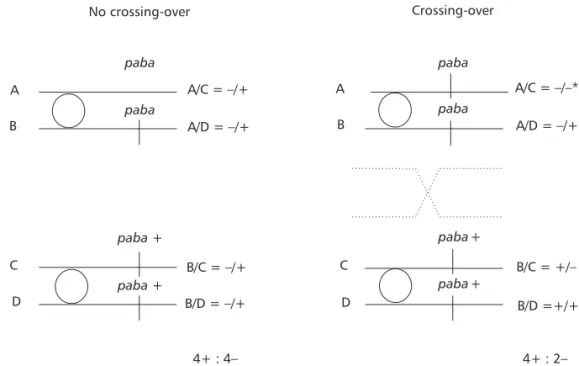
For determining the homozygosity index (HI), conidia of each haploid sector were individually transferred to 25 definite positions (5 x 5 pattern) on CM plates to establish their phenotypes. If the castor oil plant detergent induced mitotic crossing-over in the original diploid, only heterozygous (+//– or –//+) or homozygous (+//+) diploids would develop in MM. Nutritional markers would segregate in a 4+: 2– proportion. On the other hand, if the detergent did not induce crossing-over, the proportion would be 4+: 4–. It is important to remember that the initial selection process (in MM plates) limited the growth of homozygous diploids –//– (Fig. 1). When the homozygosity index [HI = number of prototrophic (+) segregants/number of auxotrophic (–) segregants] for a determined marker is 2.0, recombination has occurred. The HI values higher than 2.0 indicate the occurrence of more than one mitotic crossing-over event for a given marker. After phenotypic analyses of the haploid mitotic segregants, HI is determined for each nutritional marker (Pires & Zucchi, 1994). Results are compared by Yates’ continuity corrected chi-square test for p < 0.05.
Cytological analyses
Conidia of diploid strain were inoculated over dialysis membranes supported by solidified com-plete medium + castor oil plant detergent diluted to 1:10, 1:20, and 1:40. Plates were incubated at 37ºC and samples, stained with lactophenol cotton blue, were examined under the light microscope after 24 hours.
RESULTS
The HI values obtained in the tests carried
out with diploid strains of Aspergillus nidulans
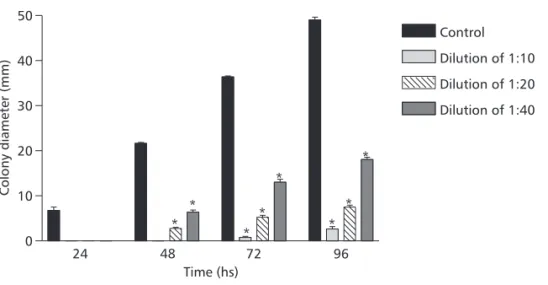
treated with castor oil plant detergent are shown in Table 1. Results indicate the occurrence of mitotic recombination in the intervals between the markers under analysis and the centromere, underscoring the recombinogenic potential of the studied detergent. In the three tested dilutions, mycelia growth of the diploid strain in castor oil plant detergent actually decreased when compared to mycelia growth in the absence of this substance. Toxic effects of the detergent during the growth of fungi were eviden-ced (Fig. 2).
Cytological analyses also showed aberrant conidiophores, with bifurcations and vacuoles, as well as conidiophores with malformed vesicles and a reduced number of metulae and phialides (Fig. 3).
DISCUSSION
The genotoxicity of castor oil plant detergent was evaluated by its capacity to induce mitotic crossing-over in a diploid strain of A. nidulans. Three dilutions of the detergent were tested in a UT448//UT196 diploid strain (1:10, 1:20, and 1:40). The viability of the treated conidia varied between 2.0% and 5.0%; the 1:10 dilution was the most toxic (results not shown). The HI values (Table 1) indicate mitotic crossing-over occurrence between the markers of the treated diploid strain. The recombinagenic effect of detergent derived from castor bean oil may be related to cell-cycle interference of the substance, which stimulates mitotic recombination occurrence.
Because of its parasexual cycle, the
filamen-tous fungus Aspergillus nidulans constitutes an
(Bergen & Morris, 1983). Therefore, the existence of two copies of each chromosome during that period of the cell cycle significantly favors a mitotic recom-bination event (Osman et al., 1993).
Aspergillus nidulans colonies cultivated in the presence of the detergent derived from castor oil in 1:10 dilution showed intense morphologic alterations,
e.g., malformed vesicles and reduced number of metulae, phialides, and conidia. The alterations were less in 1:20 and 1:40 dilutions (Fig. 3).
Delay in mycelial growth demonstrates castor oil plant detergent interference in the asexual cycle of Aspergillus nidulans, confirming the toxic effects of the substance.
Fig. 1 — Origin of recombinant diploid segregants through mitotic crossing-over. *Not grown in MM.
*Significantly different from control. Yates' continuity correct chi-square test, p < 0.05.
Genetic markers
Control Diploid 1 Diploid 2 Diploid 3 Diploid 4 Diploid 5 Diploid 6 Diploid 7
N. seg. HI N. seg. HI N. seg. HI N. seg. HI N. seg. HI N. seg. HI N. seg. HI N. seg. HI
ribo+ 33 1.2 32 4.0* 139 1.9 133 2.0 90 1.6 40 2.0 96 3.5* 68 1.3
ribo 27 8 73 67 57 20 27 54
paba+ 34 1.3 32 4.0* 141 2.0 132 1.9 90 1.6 33 1.2 96 3.5* 84 2.2
paba 26 8 71 68 57 27 27 38
bi+ 33 1.2 31 3.4* 142 2.0 131 1.9 90 1.6 33 1.2 95 3.4* 84 2.2
bi 27 9 70 69 57 27 28 38
meth+ 33 1.2 32 4.0* 139 1.9* 154 3.3* 113 3.3* 43 2.5* 91 2.4* 74 1.5
meht 37 8 73 46 34 17 38 48
pyro+ 31 1.1 21 1.1 118 1.2 102 1.0 85 1.4 36 1.5 81 1.7 58 1.0
pyro 29 19 94 98 62 24 48 64
TABLE 1
Homozygotization Indexes (HI) of nutritional markers from diploid strain UT448//UT196 exposed to detergent. In dilutions 1:10 (diploid 1), 1:20 (diploids 2-4) and 1:40 (diploids 5-7).
paba+
B/D =+/+ B/C = +/– A/C = –/+
D C B A
D C B A
paba+
paba paba
paba+
paba+
paba paba
A/D = /+–
B/C = /+–
B/D = /+–
A/C = / *– –
A/D = /+–
4+ : 4– 4+ : 2–
Fig. 2 — Growth of UT448//UT196 diploid strain in complete medium + castor oil plant detergent in dilutions 1:10, 1:20, and 1:40. *Significantly different from control, Student’s t Test, p < 0.05.
Fig. 3 — (1) Normal Conidiophore of UT448//UT196 strain obtained in CM. (2) Micelial growth of diploid strain in presence of detergent in 1:10 dilution. (3, 4) Malformed vesicle and conidiophore with branches obtained with castor oil detergent in 1:20 dilution. (5, 6) Malformed conidiophore stalk and vesicle, and reduced number of metulae obtained with castor oil detergent in 1:40 dilution. A, vesicle; B, metulae; C, phialide; D, conidia; E, conidiophore stalk; F, vacuole. Vesicle diameter: 10 µm.
0 10 20 30 40 50
Control
Dilution of 1:10
Dilution of 1:20
Dilution of 1:40
*
* *
* *
* * *
Time (hs)
Colony
diameter
(mm)
Although previous reports have demonstrated the bactericidal effect of the castor oil plant deter-gent, its recombinagenic potential and cytotoxic effects, demonstrated in this study, argue against its use as an irrigating solution in endodontic treatments. Further studies should be carried out to characterize the effects of this detergent on mammalian DNA.
Acknowledgements — Thanks are expressed to Dr. Gilberto Orivaldo Chierice (Institute of Chemistry of São Carlos, USP, Brazil) for supplying the castor oil; to Sonia A. de Carvalho and Luzia A. S. Regasse for technical assistance; and to God, once again, for supporting our efforts.
REFERENCES
BERGEN, G. G. & MORRIS, N. R., 1983, Kinetics of the nuclear division cycle of Aspergillus nidulans. J. Bacteriol., 156: 155-160.
BEUMER, K. J., PIMPINELLI, S. & GOLIC, K. G., 1998, Induced chromosomal exchange directs the segregation of recombinant chromatids in mitosis of Drosophila. Genetics,
150: 173-188.
BRITO, M. F. & TOKARNIA, C. H., 1997, Intoxicação experimental pelas sementes trituradas de Ricinus communis
(Euphorbiaceae) em coelhos. Pesq. Vet. Bras., 17: 1-7. COSTA, C. A. S., MARCANTONIO, R. A. C., HEBLING, J.,
TEIXEIRA, H. M. & KURAMA, E. M., 1997, Biocompatibilidade do polímero de poliuretana vegetal derivada do óleo da mamona em estudo comparativo com cimento de óxido de zinco e eugenol. Avaliação histopatológica de implantes subcutâneos de ratos.Odonto
2000, 1: 44-48.
DEBETS, F., SWART, K., HOWKSTRA, R. F. & BOS, C. J., 1993, Genetic maps of eight linkage groups of Aspergillus niger based on mitotic mapping. Curr. Genet., 23: 47-53. FEARON, E. R. & VOLGELSTEIN, B., 2000, Tumor suppressor gene defects in human cancer, pp. 67-87. In: R. C. Bast, D. W. Kufe, R. E. Pollock, R. R. Weischselbaum, J. F. Holland & E. Frei, Cancer Medicine. BC Decker Inc., Hamilton, Ontario.
FERREIRA, C. M., BONIFÁCIO, K. C., FRÖNER, I. C. & ITO, I. Y., 1999, Evaluation of the antimicrobial activity of three irrigating solutions in teeth with pulpal necrosis. Braz. Dent. J., 10: 115-121.
FERREIRA, C. M., ROSA, O. P. S., TORRES, A. S., FERREIRA, F. B. A. & BERNARDINELLI, N., 2002, Acti-vity of endodontic antibacterial agents against selected anaerobic bacteria. Braz. Dent. J., 13(2): 118-122. FRANZONI, M. M. G., CASTRO-PRADO, M. A. A. &
GEBARA, J. S., 1997, On the recombinogenic activity of norfloxacin in a diploid strain of Aspergillus nidulans.
Cytologia, 62: 39-45.
JONES, D. B., 1947, Proteins of the castor bean – their preparation, properties, and utilization. Journal of the American Oil Chemistry Society, 24: 247-251. MANTESSO, A., 2000, In vitro evaluation of a new intracanal
irrigating solution derived from Ricinus communis. Anais da XVI Reunião Anual da SBPqO, 1: 18.
OSMAN, F., TOMSETT, B. & STRIKE, P., 1993, The isolation of mutagen-sensitive nuv mutants of Aspergillus nidulans
and their effects on mitotic recombination. Genetics, 134: 445-454.
PIRES, L. T. A. & ZUCCHI, T. M. A. D., 1994, A new method to detect potential genotoxic agents using mitotic crossing-over in diploid strains of Aspergillus nidulans. Braz. J. Gen.,
17: 371-376.
PONTECORVO, G., ROPER, J. A., HEMMONS, L. M., MACDONALD, K. D. & BUFTON, A. W. J., 1953, The genetics of Aspergillus nidulans. Advances in Genetics, 5: 141-238.
RINGER, D. P. & SCHNIPER, L. E., 2000, Principles of cancer biology, pp. 25-30. In: R. C. Bast, D. W. Kufe, R. E. Pollock, R. R. Weischselbaum, J. F. Holland & E. Frei, Cancer medicine. BC Decker Inc., Hamilton, Ontario.
ROPER, J. A., 1952, Production of heterozygous diploids in filamentous fungi. Experientia, 8: 14-15.
ROPER, J. A. & PRITCHARD, R. H., 1955, Recovery of complementary products of mitotic crossing-over. Nature,
175: 639.
ZIMMERMANN, F. K., 1971, Genetic aspects of carcinogenesis.