Maria Teresa Carthery-Goulart Renato Anghinah
Renata Areza-Fegyveres Valeria Santoro Bahia Sonia Maria Dozzi Brucki Antonio Damin
Ana Paula Formigoni Norberto Frota Carla Guariglia Alessandro F Jacinto Eliane Mayumi Kato Edson P Lima Letícia Mansur Daniel Moreira Ana Nóbrega Claudia Selitto Porto Mirna L H Senaha Mari-Nilva Maia da Silva Jerusa Smid
Juliana N Souza-Talarico Marcia Radanovic Ricardo Nitrini
Departamento de Neurologia. Faculdade de Medicina. Universidade de São Paulo. São Paulo, SP, Brasil
Correspondence:
Maria Teresa Carthery-Goulart R. Edson 917 – sala 4 - Campo Belo 04618-034 São Paulo, SP, Brasil E-mail: [email protected] Received: 03/31/2008 Revised: 11/14/2008 Approved: 12/04/2008
Performance of a Brazilian
population on the test of
functional health literacy in
adults
Desempenho de uma população
brasileira no teste de alfabetização
funcional para adultos na área de
saúde
ABSTRACT
OBJECTIVE: To analyze the scoring obtained by an instrument, which evaluates the ability to read and understand items in the health care setting, according to education and age.
METHODS: The short version of the Test of Functional Health Literacy in Adults was administered to 312 healthy participants of different ages and years of schooling. The study was conducted between 2006 and 2007, in the city of São Paulo, Southeastern Brazil. The test includes actual materials such as pill bottles and appointment slips and measures reading comprehension, assessing the ability to read and correctly pronounce a list of words and understand both prose passages and numerical information. Pearson partial correlations and a multiple regression model were used to verify the association between its scores and education and age.
RESULTS: The mean age of the sample was 47.3 years (SD=16.8) and the mean education was 9.7 years (SD=5; range: 1 – 17). A total of 32.4% of the sample showed literacy/numeracy defi cits, scoring in the inadequate and marginal functional health literacy ranges. Among the elderly (65 years or older) this rate increased to 51.6%. There was a positive correlation between schooling and scores (r=0.74; p<0.01) and a negative correlation between age and the scores (r=-0.259; p<0.01). The correlation between the scores and age was not signifi cant when the effects of education were held constant (rp=-0.031, p=0.584). A signifi cant association (B=3.877, Beta=0.733; p<0.001) was found between schooling and scores. Age was not a signifi cant predictor in this model (B=-0.035, Beta=-0.22; p=0.584).
CONCLUSIONS: The short version of the Test of Functional Health Literacy in Adults was a suitable tool to assess health literacy in the study population. The high number of individuals classifi ed as functional illiterates in this test highlights the importance of special assistance to help them properly understand directions for healthcare.
Functional illiteracy can be understood as the inability to use printed and written information to function in society, to achieve goals and to develop knowl-edge and potential.15 Functional illiterates are likely to have signifi cant diffi culties with routine reading requirements, such as those in pill bottles, appoint-ment slips, self-care instructions, and health education brochures.8,12,13,22,24 This problem affects the health care system, because, by not managing health problems effectively, these individuals are prone to require more appointments and to have higher hospitalization rates, implying extra-costs for the system. There are several levels of functional literacy and many instruments have been especially designed with the purpose of identifying and measuring those levels.14,15
Assessing and determining levels of functional literacy is very important in the health care system to develop
RESUMO
OBJETIVO: Analisar os escores de instrumento que avalia habilidade de leitura e compreensão de materiais da área da saúde segundo escolaridade e idade.
MÉTODOS: Foram avaliados 312 participantes saudáveis de diferentes idades por meio da versão reduzida do instrumento Test of Functional Health Literacy in Adults. O estudo foi realizado entre 2006 e 2007 na cidade de São Paulo (SP). O instrumento envolve materiais como frascos de medicamentos e cartões de agendamento de consultas, avaliando a compreensão de leitura e de conceitos numéricos. Os testes de correlação parcial e de Pearson e um modelo de regressão múltipla foram usados para verifi car a associação entre os escores no instrumento, escolaridade e idade.
RESULTADOS: As médias de idade e de escolaridade da amostra foram respectivamente 47,3 (dp=16,8 ) e 9,7 (dp=5; de um a 17 anos de estudo). O total de 32,4% da amostra mostraram défi cits de alfabetização funcional/ uso de conceitos numéricos na área de saúde, com desempenho inadequado ou limítrofe no instrumento. Entre idosos (65 anos ou mais) esta taxa atingiu 51,6%. Encontrou-se correlação positiva entre anos de estudo e escores no instrumento (r=0,740; p<0,01) e correlação negativa entre idade e escores no instrumento (r=-0,259; p<0,01). A correlação entre escores no instrumento e idade não foi signifi cante quando os efeitos da escolaridade foram controlados (r=-0,031, p=0,584). Uma associação signifi cante (B=3,877, Beta=0,733; p<0,001) foi encontrada entre anos de estudo e escores no instrumento. A idade não foi uma variável preditiva no modelo (B=-0,035, Beta=-0,22; p=0,584).
CONCLUSÕES: O instrumento é adequado para avaliar a alfabetização funcional em saúde na população brasileira. O elevado número de indivíduos classifi cados como analfabetos funcionais indica a importância de adoção de medidas especiais para ajudar estes indivíduos a compreenderem corretamente as orientações para cuidados de saúde.
DESCRITORES: Adulto. Escolaridade. Compreensão. Educação. Testes de Linguagem. Questionários. Estudos de Validação. Educação em Saúde. Educação de Pacientes como Assunto.
INTRODUCTION
able to read complex materials due to their professional activities or personal interests (e.g. reading habits). On the other hand, people with few or even several years of schooling may be functional illiterates. Therefore, establishing levels of functional illiteracy and adjusting test scores according to this variable can result in better diagnostic accuracy of cognitive tests.
The Test of Functional Health Literacy in Adults (TOFHLA) was designed in 1995 to measure patients’ ability to read and understand items they commonly encounter in the health care setting using actual mate-rials such as pill bottles and appointment slips.19 It measures reading comprehension, including not only the ability to read and correctly pronounce a list of words, but also the ability to read and understand both prose passages and numerical information. Hence, it is a more accurate indicator of a patient’s reading ability and is considered an effective tool for identifying patients who have inadequate functional health literacy.3 In a study developed in two public hospitals in the United States, a third of the patients were found to be unable to read basic materials related to health and the prevalence of individuals with this diffi culty was signifi cantly higher among the elderly.24 In order to reduce TOFHLA’s time of administration, a shorter version of this test was developed.3 The S-TOFHLA had a similar reliability and validity similar to the full TOFHLA requiring a maximum time of 12 minutes to be completed.3
As a part of the research on developing or adjusting tests to cognitively evaluate individuals from a popula-tion with heterogeneous educapopula-tional background, the present study aimed to analyze the scoring obtained by an instrument that evaluates the ability to read and understand items in the health care setting according to education and age.
METHODS
We obtained permission from the author for the appli-cation of the S-TOFHLA. The English and Spanish versions of S-TOFHLA were translated and adapted to the Brazilian reality, especially the reading comprehen-sion texts as to convey information about the Sistema Único de Saúde (Brazilian Health System – SUS). When sentences needed to be modifi ed for this purpose, the same structure was kept, using stimuli in the alterna-tives which were either phonetically similar to the target or that belonged to the same grammar class.
The numeracy test evaluates quantitative literacy needed in the health care setting. It comprises two medicine bottles and two cards containing information about medicine intake, date of appointments and results of a laboratorial test. The reading comprehension test is comprised by two health-related passages with a total of 36 items (blank spaces). The fi rst text contains informa-tion about preparainforma-tion for a gastrointestinal exam. The
second is about rights and responsibilities of patients receiving health care in a hospital. Each passage has every fi fth or sixth word deleted; for each blank space, the respondent must select from a list of four words the one that best completes the sentence.
The total score of the reading comprehension texts is 72 points, and every blank space correctly completed scores 2 points. The numeric items total 28 points, and seven points are scored for each correct response. The total score of the test is 100 points. Individuals scoring between zero and 53 points are considered in the inadequate range; between 54 and 66 points, in the marginal range and between 67 and 100, in the adequate range.
Subjects were healthy volunteers recruited preferably among those who use services of a university hospital and of other hospitals that provide health services through the SUS in the city of São Paulo, in South-eastern Brazil. The study was conducted from August 2006 to July 2007. Inclusion criteria were the following: 1) age ≥ 18 years; 2) at least one year of schooling or self-reported informal acquisition of reading skills (subjects who did not attend school but were able to read were considered as having one year of schooling); 3) not suffering from neurological or psychiatric disorders or using drugs that affect cognition; 4) having a minimum visual acuity of 20/40 as determined with a pocket vision screener (Rosenbaum, Graham-Field Surgical Co, Inc, New Hyde Park, NY) and adequate hearing acuity to perform the test (correction for the defi cit allowed); 5) subjects who were older than 64 years were required to have an informant to report absence of cognitive decline or of functional impairment character-ized by a score higher than 1 at the Questionnaire of Functional Activities;20 6) not having untreated chronic conditions such as hypertension, diabetes mellitus and heart disease; 7) Not having alcoholism.
Participants were interviewed to collect information about sociodemographic data and about their health status to determine visual acuity. A structured question-naire to evaluate the educational level of parents, type of school attended and reading habits of participants was also applied. S-TOFHLA was then administered by neurologists, speech and language therapists, psycholo-gists, occupational therapists, nurses and post-graduate students. For the numeracy items, patients were given cards or pill bottles to read and subsequently asked oral questions about the information. For reading compre-hension, the texts were given to participants, who had to choose the best alternatives to fi ll in the 36 blank spaces. The maximum time allowed to completion of this task was seven minutes, after which the individual was asked to stop. When the participant preferred to
Descriptive statistics were used to summarize quanti-tative information about the total sample, and means and standard deviations for age, schooling and scores in the S-TOFHLA were determined. Calculations of the proportion of individuals who provided correct responses for the numeracy and text items and of the proportion of individuals classifi ed in the inadequate, marginal and adequate ranges were performed.
S-TOFHLA scores were submitted to a one-way analysis of variance (ANOVA) followed by post-hoc comparisons (Tukey), when signifi cant differences were detected. Chi-square test was utilized to compare the gender distribution of the groups. Pearson correlation coeffi cients were used to verify the relationship between S-TOFHLA scores and age and years of schooling. The partial correlation coeffi cient was also calculated to measure the strength of the relationship between S-TOFHLA scores and age when the effects of education were held constant and between S-TOFHLA scores and education when the effects of age were held constant.
The independent variables age and years of schooling were entered in a multiple linear regression model to assess the relative contribution of these variables to predict the S-TOFHLA scores.
A p-value of 0.05 was used to indicate statistical signifi cance.
All the analyses were performed with the SPSS 13.0 software.
The study was approved by the Ethics Committee of the Hospital das Clínicas da Universidade de São Paulo (University of São Paulo, School of Medicine Clinical Hospital). All subjects were informed about the objectives and procedures involved in the study and written informed consent was given prior to the interviews and tests.
RESULTS
The Brazilian version of the S-TOFHLA was admin-istered to 312 healthy participants (198 women and
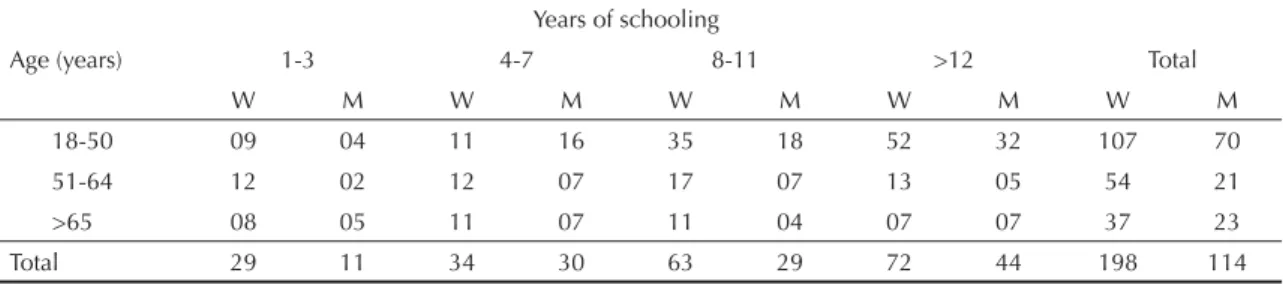
114 men) distributed in three age groups (range 19-81 years, mean 47.3, SD=16.8) and four schooling groups (range 1-17 years of schooling, mean 9.9, SD=5), as shown in Table 1.
The mean ages and standard deviations of each schooling group were respectively 1-3 years of schooling, group 1: 56.15 (SD=14.17), 4-7 years of schooling, group 2: 53.25 (SD=16.87), 8-11 years of schooling, group 3: 45.76 (SD=16.99) and ≥12 years of schooling, group 4: 42.18 (SD=15.46). The mean years of schooling for the three age groups were respectively: 18-50 years: 11.11 (SD=4.8); 54-64 years: 8.67 (SD=4.8); ≥65 years: 7.65 (SD=4.8).
There was no difference regarding gender distribution among the 12 groups (χ2=12.374, df=11, p=0.336), among the four schooling groups (χ2=5.454, df=3, p=0.141) and among the three age groups (χ2=3.133, df=2, p=0.209).
The S-TOFHLA was easily administrated and proce-dures for how to perform the tasks were easily under-stood by participants.
Performance on the S-TOFHLA according to age and years of schooling completed is presented in Table 2. S-TOFHLA mean scores signifi cantly differed in the four education groups (F(3,308)=128.266, p< 0.001). All post-hoc analyses detected signifi cant differences among the groups (p< 0.001 in all analyses) indi-cating higher mean scores for individuals in the more educated groups. Signifi cant differences in S-TOFHLA mean scores were also found in the three age groups (F(3,309)=8.789, p< 0.001). Post-hoc analyses pointed to signifi cant differences between the younger and the older groups (p< 0.001).
The proportion of individuals who provided correct responses for numeracy and reading comprehen-sion items is shown in Table 3. Forty fi ve per cent of the participants gave correct responses for the four numeracy items and 59.4% chose the correct alter-native in more than 75% of the items of the reading comprehension part.
Table 1. Distribution of individuals’ age groups, according to sex and years of schooling. City of São Paulo, Southeastern Brazil, 2006-2007.
Age (years)
Years of schooling
1-3 4-7 8-11 >12 Total
W M W M W M W M W M
18-50 09 04 11 16 35 18 52 32 107 70
51-64 12 02 12 07 17 07 13 05 54 21
>65 08 05 11 07 11 04 07 07 37 23
Total 29 11 34 30 63 29 72 44 198 114
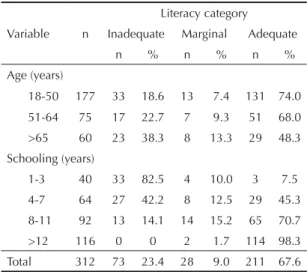
The S-TOFHLA classification according to age and years of school completed is shown in Table 4. Thirty two per cent of participants had scores in the inadequate or marginal range. The proportion of indi-viduals with inadequate/marginal literacy increased in the age groups, ranging from 26% in subjects aged 18 to 50 up to 51.6% in those older than 64 years. Almost all patients (92.5%) who completed three years of schooling or less performed in the inadequate/ marginal ranges and almost all patients (98.3%) with more than 11 years of schooling had adequate health functional literacy.
There was a positive correlation between years of schooling and S-TOFHLA scores, r=0.740 (p< 0.01) and a negative correlation between age and S-TOFHLA scores, r=-0.259 (p< 0.01). Partial correlation analysis showed no S-TOFHLA scores and age were not signifi cantly correlated when the effects of education were held constant (r=-0.031, p=0.584). There was a signifi cant correlation between the S-TOFHLA scores and years of schooling when the effects of age were held constant (r=0.718, p=0.000).
A multiple linear regression model to predict TOFHLA scores according to age and education was used. Using the Enter method, a signifi cant model emerged (F(2,309)=187.356, p< 0.001); adjusted R square=0.545. Years of schooling was a signifi cant predictor variable for performance in the S-TOFHLA (B=3.877, Beta=0.733; p< 0.001). Age was not a signifi cant predictor in this model (B=-0.035, Beta=-0.22; p=0.584). The values of tolerance (0.896) and of the variance infl ation factor (1.117) did not indicate levels of multicollinearity that could distort the regression variate.
DISCUSSION
The S-TOFHLA seemed to be an adequate tool to measure functional health literacy levels in Brazilian individuals in terms of administration. It is an ecological and straightforward test, easily understood by the individuals tested and not time-consuming (application lasting approximately ten minutes).
Table 2. Short Test of Functional Health Literacy in Adults scores according to age and completed years of schooling. City of São Paulo, Southeastern Brazil, 2006-2007.
Age (years)
Years of schooling 1-3 (n=40)
Mean(SD)
4-7 (n=64) Mean(SD)
8-11 (n=92) Mean(SD)
>12 (n=116) Mean(SD)
Total (n=312) Mean(SD)
18-50 (n=177) 24.9(15.6) 56.9(28) 79.4(19.5) 96.9(7.5) 80.3(26.7) 51-64 (n=75) 41.2(22.5) 70.7(23) 81.5(17.6) 95.4(8.7) 74.6(25.9)
>65 (n=60) 40.9(19.9) 59.6(19.6) 68.3(19.6) 87(10.4) 64.1(23.7) Total (n=312)
Mean (SD) 35.8(20.6) 61.8(24.8) 78.1(19.4) 95.5(8.6) 75.8(26.6) SD=standard deviation
Table 3. Proportion of individuals who answered numeracy and reading comprehension items correctly. City of São Paulo, Southeastern Brazil, 2006-2007. (N=312)
Numeracy items
Individuals who provided correct responses (%) Take medication every 6 hours 76.3
Normal blood sugar 84.9
Appointment slip 84.3 Take medication on an empty
stomach 61.5
Numeracy items completed correctly
0 2.6
1 8.0
2 14.7
3 29.2
4 45.5
Correct alternatives on reading passages
0-18 24.4
19-27 16.0
28-36 59.6
Table 4. Short Test of Functional Health Literacy in Adults classifi cation according to age and years of school completed. City of São Paulo, Southeastern Brazil 2006-2007.
Variable n
Literacy category
Inadequate Marginal Adequate
n % n % n %
Age (years)
18-50 177 33 18.6 13 7.4 131 74.0
51-64 75 17 22.7 7 9.3 51 68.0 >65 60 23 38.3 8 13.3 29 48.3
Schooling (years)
1-3 40 33 82.5 4 10.0 3 7.5 4-7 64 27 42.2 8 12.5 29 45.3
8-11 92 13 14.1 14 15.2 65 70.7
Almost a quarter of the participants in the present study were classifi ed as health functional illiterates by the S-TOFHLA, meaning that they can not perform basic reading tasks necessary to understand written health care information. Another 9% had marginal reading skills. The proportion of these individuals was higher in low educated groups (one to seven years of schooling) and among the elderly, where more than 50% were classifi ed as inadequate/marginal literacy level. This is particularly important for clinical and epidemiological studies on mental health in Brazil and other countries that have population with heterogeneous educational levels.
In studies conducted in the United States with the TOFHLA and the S-TOFHLA, roughly a third of patients were classifi ed in the inadequate range and the prevalence of low literacy skills was clearly higher among the elderly.3,24 Although our fi ndings support the qualitative results of other studies, a higher proportion of functional illiterates was reported in their sample compared to ours. This can be explained by the higher number of individuals with more than 12 years of schooling included in our sample compared to those studies. In this group of schooling, our study and those in the United States reported a very small number of individuals out of the adequate range.
Our results also corroborate those of another study performed in the city of São Pauloa which identifi ed among young and older adults an important proportion of individuals (32.9%) who had either a very limited knowledge of written language or a level of aptitude in this domain that did not enable them to perform simple tasks such as identifying a single item of information expressed literally in a simple short text. In that study, low literacy levels were also found mainly among subjects who had not completed eight years of schooling. Additionally, those individuals were found to belong to lower socioeconomic classes of society, performing jobs that did not require much qualifi cation.
There was a signifi cant relationship between schooling and functional literacy levels in this study. S-TOFHLA results were highly correlated with years of schooling and this correlation was still high and signifi cant when age effects were controlled.
In multiple regression models Beta coeffi cients give a measure of the contribution of each variable to the model and larger values indicate larger effects of those variables on TOFHLA scores. The results of our model indicated that schooling was a better predictor of performance than age and that for each year of schooling added there was an increase of 3.877 points in the S-TOFHLA score in average. Tolerance and vari-ance infl ation factor values pointed to low correlation
between the predictor variables (age and schooling). This is a good fi nding when trying to draw inferences about the relative contribution of each predictor vari-able to the model.
A small proportion of individuals with one to seven years of education performed in the adequate range. On the other hand, among those who completed at least eight years of education, this proportion increased substan-tially. However, it is important to emphasize that there is a great heterogeneity in performance, particularly in the groups of medium education (four to 11 years). There-fore, years of schooling alone may not be a completely reliable indicator of reading comprehension skills. In truth, it may be diffi cult to identify patients with inad-equate literacy in those groups without formal testing.
Measuring functional literacy levels can provide a better account of the reading skills of individuals receiving health care.2 Years of schooling completed alone is an inaccurate indicator of educational attainment, because it merely signifi es education attempted rather than attained.2 Literacy level is both a better indicator of a person’s ability to acquire knowledge and to cope with societal demands. It is also a better measure than years of schooling to study the relationship between education and health outcomes.2
The fi nding of low literacy skills among the elderly in our study is not surprising. From the 1930s to at least the 1950s, elementary school (four years) was still restricted to specifi c social segments. As a result, the mean education level among the elderly in Brazil is still very low, 3.4 years of schooling.b The relationship between schooling and literacy levels thus explains the high proportion of functional health illiterates among the elderly. Age was not strongly correlated with performance in the S-TOFHLA and the correlation between those variables was not signifi cant when the effects of schooling were taken into account. However, qualitative data inspection of the data shows that mean scores of older individuals in the lower educated groups were higher than the scores of younger groups in the same schooling range. Conversely, among the more educated groups the opposite pattern was observed. Lower literacy levels among middle-aged adults prob-ably refl ect the infl uence of socioeconomic factors as well (as elementary and high school have become more and more accessible, those younger individuals might have needed to quit their studies for different reasons than their older counterparts, such as the need to start working very early in life). Another possibility is related to the decreased education quality in elementary school that followed its increased accessibility. Among the elderly, the mild decline in reading comprehension
a Ribeiro VM. Letramento no Brasil. São Paulo: Ação Educativa/Fundação Paulo Montenegro; 2003.
performance may be due to cognitive changes such as reduced working memory capacity and mental processing speed, mainly among individuals older than 70 years. As metacognitive skills are preserved in the healthy elderly, those defi cits do not have a signifi cant impact in functional activities.9 A study using the S-TOFHLA in a large sample of elderly individuals found a consistent reading comprehension decline in advanced ages, even when the effects of education and cognitive impairment are controlled.10 Further studies are necessary to address these issues including a higher number of older subjects.
Other important issue about functional illiteracy in the heath care setting is the identifi cation of other factors that can predict functional illiteracy (socioeconomic indicators, reading and writing habits, and occupation, among others). It is also very necessary to investigate the relationship between functional illiteracy and cogni-tive measures. Additionally, the classifi cation using the S-TOFHLA has to be compared to other functional literacy measures to fi nd out where the cut-off scores are adequate for our population.
Some practical implications also emerge from the present study. Despite the considerable heterogeneity, Brazilian patients with seven or fewer years of schooling are very likely to have inadequate functional health literacy. Moreover, the prevalence of these individuals is higher among the elderly. Supplying special assistance to these patients may improve their ability to manage their medical conditions. These individuals may require more direct teaching and follow-up to help them take medica-tions correctly, follow diet and exercise instrucmedica-tions, and understand plans to care for their medical conditions.3 Alternative methods of health education such as videos may also be used and tested. These type of materials provide verbal and visual inputs and are, therefore, benefi cial to learning. A great proportion of those indi-viduals have access to radio and free TV channels. As a result, the development of special programs that focus on certain medical conditions may also be useful.
1. Ardila A. Cultural values underlying psychometric cognitive testing. Neuropsychol Rev. 2005;15(4):185-95. DOI: 10.1007/s11065-005-9180-y
2. Baker DW, Parker RM, Williams MV, Clark WS, Nurss J. The relationship of patient reading ability to self-reported health and use of health services. Am J
Public Health. 1997;87(6):1027-30. DOI: 10.2105/
AJPH.87.6.1027
3. Baker DW, Williams MV, Parker RM, Gazmararian JA, Nurss J. Development of a brief test to measure functional health literacy. Patient Educ
Couns. 1999;38(1):33-42. DOI:
10.1016/S0738-3991(98)00116-5
4. Bertolucci PHF, Brucki SM, Campacci SR, Juliano Y. O mini-exame do estado mental em uma população geral. Arq Neuropsiquiatr. 1994;52:1-7.
5. Brucki SMD, Malheiros SMF, Okamoto IH, Bertolucci PHF. Dados normativos para o uso do teste de fl uência verbal categoria animais em nosso meio. Arq
Neuropsiquiatr. 1997;55:56-61.
6. Brucki SMD, Nitrini R, Caramelli P, Bertolucci PHF, Okamoto IH. Sugestões para o uso do mini-exame do estado mental no Brasil. Arq Neuropsiquiatr. 2003;61(3B):777-81. DOI: 10.1590/S0004-282X2003000500014
7. Caramelli P, Carthery-Goulart MT, Porto CS, Charchat-Fichman H, Nitrini R. Category fl uency as a screening test for Alzheimer disease in illiterate and literate patients. Alzheimer Dis Assoc Disord. 2007;21(1):65-7. DOI: 10.1097/WAD.0b013e31802f244f
7. Davis TC, Long SW, Jackson RH, Mayeaux EJ, George RB, Murphy PW, et al. Rapid estimate of adult literacy in medicine: a shortened screening instrument. Fam Med. 1993;25(6):391-5.
8. De Beni R, Palladino P, Borella E, Lo Presti S. Reading comprehension and aging: does an age-related difference necessarily mean impairment? Aging Clin
Exp Res. 2003;15(1):67-76.
9. Gazmararian JA, Baker DW, Williams MV, Parker RM, Scott TL, Green DC, et al. Health literacy among Medicare enrollees in a managed care organization.
JAMA. 1999; 281(6):545-51. DOI: 10.1001/ jama.281.6.545
10. Gorenstein C, Andrade L. Escalas de avaliação clínica em psiquiatria e psicofarmacologia. São Paulo: Lemos; 2000.
11. Jackson RH, Davis TC, Bairnsfather LE, George RB, Crouch MA, Gault H. Patient reading ability: an overlooked problem in health care. South Med J. 1991;84(10):1172-75. DOI: 10.1097/00007611-199110000-00004
12. Jolly BT, Scott JL, Feied CF, Sanford SM. Functional illiteracy among emergency department patients: a preliminary study. Ann Emerg Med. 1993;22(3):573-8. DOI: 10.1016/S0196-0644(05)81944-4
13. Kirsch I, Jungeblut A, Jenkins L, Koistad A. Adult literacy in America: a fi rst look at the results of the National Adult Literacy Survey. Washington, DC: National Center for Education; 1993.
14. Moreira DA. Analfabetismo funcional: o mal nosso de cada dia. São Paulo: Pioneira Thomson Learning; 2003.
15. Nitrini R, Lefèvre BH, Mathias SC, Caramelli P, Carrilho PEM, Sauaia N, et al. Testes neuropsicológicos de aplicação simples para o diagnóstico de demência.
Arq Neuropsiquiatr. 1994;52(4):457-65.
16. Nitrini R, Caramelli P, Herrera Jr E, Porto CS, Charchat-Fichman H, Carthery MT, et al. Performance of illiterate and literate nondemented elderly subjects in two tests of long-term memory. J Int
Neuropsychol Soc. 2004;10(4):634-8. DOI: 10.1017/
S1355617704104062
17. Nitrini R, Caramelli P, Porto CS, Charchat-Fichman H, Formigoni AP, Carthery-Goulart MT, et al. Brief cognitive battery in the diagnosis of mild Alzheimer’s disease in subjects with medium and high levels of education. Dement Neuropsychol. 2007;1:32-6.
18. Parker RM, Baker DW, Williams MV, Nurss JR. The test of functional health literacy in adults: a new instrument for measuring patients’ literacy skills. J Gen Intern Med. 1995;10(10):537-41.
19. Pfeffer RI, Kurosaki TT, Harrah Jr CH, Chance JM, Filos S. Measurement of functional activities in older adults in the community. J Gerontol. 1982;37(3):323-9.
20. Roselli M, Ardila A. The impact of culture and education on non-verbal neuropsychological measurements: a critical review. Brain Cogn. 2003; 52(3):326-33. DOI: 10.1016/S0278-2626(03)00170-2
21. Spandorfer JM, Karras DJ, Hughes LA, Caputo C. Comprehension of discharge instructions by patients in an urban emergency department. Ann
Emerg Med. 1995;25(1):71-4. DOI:
10.1016/S0196-0644(95)70358-6
22. Takada LT, Caramelli P, Fichman HC, Porto CS, Bahia VS, Anghinah R, et al. Comparison between two tests of delayed recall for the diagnosis of dementia. Arq
Neuropsiquiatr. 2006;64(1):35-40. DOI: 10.1590/
S0004-282X2006000100008
23. Williams MV, Parker RM, Baker DW, Parikh NS, Pitkin K, Coates WC, et al. Inadequate functional health literacy among patients at two public hospitals.
JAMA. 1995;274(21):1677-82. DOI: 10.1001/ jama.274.21.1677
REFERENCES