227 www.scielo.br/rsbmt
Short Communication
Address to: Dra. Adriana Luchs. Núcleo de Doenças Entéricas/Centro de Virologia/ Instituto Adolfo Lutz. Av. Dr. Arnaldo 355, 01246-902 São Paulo, SP, Brasil. Phone: 55 11 3068-2909; Fax: 55 11 3088-3753
e-mail: [email protected] Received 28 May 2011 Accepted 08 August 2011
Revista da Sociedade Brasileira de Medicina Tropical 46(2):227-230, Mar-Apr, 2013 http://dx.doi.org/10.1590/0037-8682-1162-2013
Rotavirus G2P[4] and G2P[4]+[6] infections during
norovirus gastroenteritis outbreak:
summer season 2010, Brazil
Adriana Luchs[1], Simone Guadagnucci Morillo[1], Cibele Daniel Ribeiro[1], Audrey Cilli[1],
Samira Julien Calux[1], Rita de Cássia Compagnoli Carmona[1]
and Maria do Carmo Sampaio Tavares Timenetsky[1]
[1]. Núcleo de Doenças Entéricas, Centro de Virologia, Instituto Adolfo Lutz, São Paulo, SP.
ABSTRACT
Introduction: This study aimed to monitor the seasonality of rotavirus infection, and gain insight into the variability of Brazilian strains. Methods: A total of 28 stool samples were analyzed from 698 revised cases of gastroenteritis during a norovirus outbreak in the summer of 2010 in Guarujá, Brazil. Diagnosis was performed using enzyme-linked immunosorbent assay (ELISA), reverse transcription polymerase chain reaction (RT-PCR), and sequencing. Results: Rotavirus infection was detected in 17.9% (5/28) of samples; 4 samples were G2P[4] genotype, and one G2P[4]+P[6] genotype. G2 and P[4] sequences showed a genetic relationship to strains from India and Russia, respectively. Conclusions: The seasonal pattern ofrotavirus may be a consequence of human activity apart from climate factors.
Keywords: Rotavirus. Summer. Seasonality.
A key characteristic on rotavirus (RV) epidemiology is its distinct seasonal pattern1; however, the mechanism responsible for this seasonality is not clear2. In temperate climates, RV disease occurs in the cooler, dryer months of the years, and far less often in tropical areas2. In Brazil, the seasonality is distinct, with positive RV specimens appearing to peak during the winter or dry season in central and southern states that exhibit a temperate-like climate, but not in north and northern areas, where RV infections occur equally over the year3.
During summer 2010, the State of São Paulo (SP), located in southern area of the country, experienced a large gastroenteritis outbreak due to norovirus (NoV)4, a common viral pathogen associated with diarrhea, which has a marked seasonality during summer. The coastline area of SP was most greatly affected4, likely due to the increase of population density during the summer vacations and looding in conjunction with the waterborne and seafood components of NoV transmission5.
In the popular seashore City of Guarujá, atypical RV infections were observed at the time of a large NoV outbreak. The aims of this study were to contribute to the knowledge of seasonality of RV infection in tropical countries, and to perform sequence analyses to gain insight into the variability of Brazilian strains.
The increase in acute gastroenteritis cases from Guarujá was detected by the Epidemiological Surveillance Center of São Paulo (CVE)5, which receives weekly reports from sentinel sites of the Acute Diarrhea Disease Monitoring Program. An epidemiological retrospective investigation was conducted by CVE, and a total of 698 cases were analyzed5. The Enteric Diseases Laboratory tested 28 stool specimens from the 698 Guarujá patients.
Rotavirus was detected using a commercial immunoenzymatic assay (RIDASCREEN® Rotavirus, R-Biopharm AG, Darmstadt, Germany), performed according to the manufacturer’s instructions. RV-positive stool samples were typed after reverse transcription (RT) followed by semi-nested polymerase chain reaction (PCR)6 and sequencing on an ABI 3100 thermocycler (Applied Biosystems, Foster City, CA, USA). Sequence data was aligned and edited with the BioEdit Sequence Alignment Editor (version 7.0.5.2) software (Ibis Therapeutics, Carlsbad, CA). A genetic tree was constructed using molecular evolutionary genetics analysis (MEGA) software version 4.0 by the neighbor joining (NJ) method7.
Rotavirus infection was detected in 17.9% (5/28) of samples. The median age of the patients was 14.9 years; twenty percent of patients were female and 80% were male. According to the Enteric Diseases Laboratory records, NoV infection were detected in 10 (35.7%) of the 28 fecal samples, conirming the large NoV outbreak occurring during the same period4. Mixed NoV and RV infections were not observed.
228
www.scielo.br/rsbmt Luchs A et al - Rotavirus infections during summer 2010
metropolitan area of Santos during the summer periods. In addition, no RV cases from Santos were identiied in the Enteric Diseases Laboratory records during the rainy seasons. Taken together, these indings suggest that a minor RV outbreak occurred in Guarujá alongside the major NoV outbreak. RV outbreaks during the summer season are very uncommon8.The seasonal pattern of RV diarrhea cases may be a consequence of unmeasured factors apart from climate factors, including human activity and environmental factors other than the weather9.
The RT-PCR assay identiied the G2P[4] genotype in 4 samples. Recently, a high prevalence of G2P[4] has been reported in Brazil and linked with the inclusion of the G1P[8] live oral RV vaccine in the Brazilian vaccination program10, suggesting that this monovalent vaccine possibly created conditions in which G2P[4] could acquire selective advantage over P[8] genotypes. Alternatively, a temporal periodicity, within an approximately 10-year cyclic pattern of G2P[4] have been observed in Brazil11, and should be considered as an alternative explanation to the increased detection of this genotype since 2006.
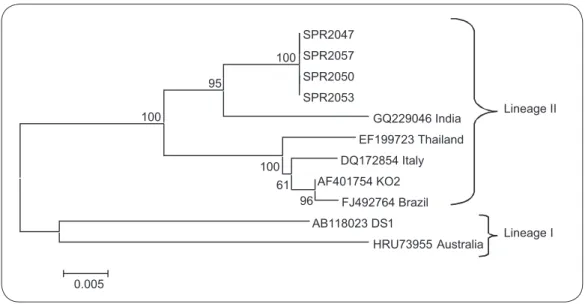
The genetic relationships between the VP7 sequences of 4 G2 RV strains: R2047 (HQ844990), R2050 (HQ844988), R2053 (HQ844989), and R2057 (HQ844987), and representative strains of the G2 genotype: DS1 (AB118023), Thailand (EF199723), Australia (HRU73955), India (GQ229046), Italy (DQ172854), KO-2 (AF401754), and Brazil (FJ492764), are shown as a distance tree in Figure 1. The SP G2 RV sequences showed 93%-97.5% similarity when compared to the representative strains, and 100% similarity between them. The analysis of the VP7 gene showed a genetic relationship with the RV strain from India, and also allowed classiication of these strains into lineage II using the Page and Steele12 classiication.
In a previous study conducted in the State of Pará, Brazil13, the phylogenetic analysis performed in G2 RV strains also grouped to lineage II.
The genetic relationships between the VP4 sequences of 3 P[4] RV strains: R2047 (HQ844984), R2050 (HQ844985), and R2053 (HQ844986), and representative strains of the P[4] genotype: Brazil (DQ857927), Italy (DQ172842), DS1 (AB118025), Brazil (FJ492780), Bangladesh (EU839950), and Russia (GU356610), are shown as a distance tree in Figure 2. The SP P[4] RV sequences showed 94.6%-99.6% similarity when compared to the representative strains, and 99.9%-100% similarity between them. The SP P[4] RV strains analyzed in this study showed a genetic relationship with the RV strain from Russia.
A P-mixed unusual infection G2P[4]+P[6] was detected in 1 sample from a 10-year-old unvaccinated male. The dual infection was conirmed by RT-PCR using speciic set of primers; however, although several attempts were made to obtain the VP4 sequences from this sample, they were unsuccessful. Thus, no data was obtained that could identify the potential origin of this strain.
The isolation of a Brazilian G2 RV strain exhibiting double P[4] and P[6] speciicity was not unexpected, suggesting that this was not the same strain circulating during this period and that there was not a common source of RV contamination. In Nigeria, a G2 RV strain displaying dual P[4] and P[6] speciicity was identiied in 200012, and in Guinea-Bissau this unusual strain was the most frequent cause of RV infections in hospitalized children in 200214. These indings may relect environmental characteristics related to tropical areas, as Brazil, Nigeria, and Guinea-Bissau share the hot and humid tropical climate characteristic of the region between the tropics of Cancer and Capricorn.
SPR2047
SPR2057
SPR2050
SPR2053
GQ229046 India
EF199723 Thailand
DQ172854 Italy
AF401754 KO2
FJ492764 Brazil
AB118023 DS1
HRU73955 Australia 96
61 100 100
95
100
0.005
Lineage II
Lineage I
229 www.scielo.br/rsbmt
Rev Soc Bras Med Trop 46(2):227-230, Mar-Apr, 2013
REFERENCES
The authors declare that there is no conlict of interest.
CONFLICT OF INTEREST TABLE 1 - Detection of enteric pathogens in stool samples from patients with
acute gastroenteritis during a norovirus outbreak in the summer of 2010, Guarujá, São Paulo, Brazil
Positive
Enteric pathogens Number Percentage
RV 4 14.3
NoV 8 28.6
RV + E. coli (EPEC) 1 3.6
NoV + E. coli (EPEC) 2 7.1
E. coli (ETEC) 1 3.6
E. coli (EHEC) 1 3.6
E. coli (EPEC) + Ascaris lumbricoides 1 3.6
Giardia lamblia 2 7.1
Giardia lamblia + Entamoeba coli 1 3.6
Negative 7 24.9
Total 28 100.0
RV: rotavirus, NoV: norovirus, EPEC: enteropathogenic Escherichia coli,
ETEC: enterotoxigenic Escherichia coli, EHEC: enterohemorrhagic Escherichi.
SP R2047
SP R2053
SP R2050
GU356610 Russia
EU839950 Bangladesh
DQ172842 Italy
FJ492780 Brazil
DQ857927 Brazil
AB118025 DS1 94
76
90
80
100 65
0.005
FIGURE 2 - Dendrogram of the VP4 gene nucleotide sequences of human rotavirus P[4] strains (SP R2047, SP R2050, and SP R2053) from Guarujá, São Paulo, Brazil. The tree was constructed using the neighbor joining method with the molecular evolutionary genetics analysis (MEGA) 4.0 software package. The numbers on each branch indicate the bootstrap values.
The inclusion of alternative P types in serotype G2 strain gene constellations may provide a means of escaping protective immunity and generating increased RV diversity12. Uncommon associations could also be related to reassortment between co-circulating RV strains15.
The outbreak investigation also attempted to investigate the bacterial and parasitological etiology. These enteropathogenic investigations were conducted through the Adolfo Lutz Institute online Integrated Hospital Management system (Sistema Integrado de Gestão Hospitalar-SIGH), and the findings are summarized in Table 1. Overall, this study recognized pathogenic agents in 75% of the examined stool samples, and this elevated rate of isolation could be an indicative of a high rate of oral-fecal exposure in this population.
In conclusion, RV was recognized as the etiological agent of a minor gastroenteritis outbreak, affecting children and adults, in the city of Guarujá during the summer of 2010. These results could improve the understanding of RV transmission in tropics, paying close attention to human and climatological variables, and its relationship to other viral gastroenteritis pathogens. A major inding in the present study was the detection of the G2 P[4]+P[6] genotype, relecting the importance of continued monitoring of RV strains circulating throughout the world.
Ethical considerations
Ethics Committee approval was granted by the Adolfo Lutz Institute, São Paulo, Brazil (Ref. 14/2005). This was an anonymous, unlinked study and informed consent was not required according to the resolution 196/96 concerning research involving human beings (Conselho Nacional de Saúde/ Ministério da Saúde, Brasília, 1996).
1. Turcios RM, Curns AT, Holman RC, Pandya-Smith I, LaMonte A, Bresee JS, et al. Temporal and geographic trends of rotavirus activity in the United States, 1997-2004. Pediatr Infect Dis J 2006; 25:451-454.
2. Greenberg HB, Estes MK. Rotaviruses: from pathogenesis to vaccination. Gastroenterology 2009; 136:1939-1951.
3. Pereira HG, Linhares AC, Candeias JAN, Glass RI. National laboratory surveillance of viral agents of gastroenteritis in Brazil. Bull Pan Am Health Organ 1993; 27:224-233.
4. Morillo SG, Luchs A, Cilli A, Ribeiro CD, Calux SJ, Carmona RCC, et al. Large gastroenteritis outbreak due to Norovirus GII in São Paulo, Brazil, summer 2010. Rev Inst Med Trop Sao Paulo 2011; 53:119-120.
230
www.scielo.br/rsbmt Brasil, Dezembro de 2009 a Janeiro de 2010. Poster presented at: EPI CVE 2010.
Conferência Internacional em Epidemiologia; 2010 Nov 29-30; São Paulo, SP, Brazil. [cited 2011 May 28]. Available from: http://www.cve.saude.sp.gov.br/ htm/hidrica/2010/Poster10_Surto_Guaruja.pdf/.
6. Timenetsky MCST, Gouvêa V, Santos N, Carmona RCC, Hoshino Y. A novel human rotavirus serotype with dual G5-G11 speciicity. J Genl Virol 1997; 78:1373-1378.
7. Tamura K, Dudley J, Nei M, Kumar S. MEGA4: Molecular Evolutionary Genetics Analysis (MEGA) software version 4.0. Mol Biol Evol. 2007; 24(8):1596-1599.
8. Marin-Casanova P, Fernández-Fatou B, García-Martós P, Martín-Hernández C, Agudo-Pérez E. Atypical epidemic outbreak of gastroenteritis caused by rotavirus. Rev Sanid Hig Publica (Madr) 1989; 63:39-45.
9. Hashizume M, Armstrong B, Wagatsuma Y, Faruque AS, Hayashi T, Sack DA. Rotavirus infections and climate variability in Dhaka, Bangladesh: a time-series analysis. Epidemiol Infect 2008; 136:1281-1289.
10. Nakagomi T, Cuervas LE, Gurger RG, Elrokhsi SH, Belkhir YA, Abugalia M, et al. Apparent extinction of non-G2 rotavirus strains from circulation in Recife, Brazil, after introduction of rotavirus vaccine. Arch Virol 2008; 153:591-593.
11. Carvalho-Costa FA, Assis RM, Fialho AM, Bóia MN, Alves DP, Martins CM, et al. Detection and molecular characterization of group A rotavirus from hospitalized children in Rio de Janeiro, Brazil, 2004. Mem Inst Oswaldo Cruz 2006; 101:291-294.
12. Page NA, Steele AD. Antigenic and genetic characterization of serotype G2 human rotavirus strains from the African continent. J Clin Microbiol 2004; 42:595-600.
13. Mascarenhas JD, Lima CS, Oliveira DS, Guerra SF, Maestri RP, Gabbay YB, et al. Identification of two sublineages of genotype G2 rotavirus among diarrheic children in Parauapebas, Southern Pará State, Brazil. J Med Virol 2010; 82:712-719.
14. Nielsen NM, Eugen-Olsen J, Aaby P, Mølbak K, Rodrigues A, Fischer TK. Characterization of rotavirus strains among hospitalized and non-hospitalized children in Guinea-Bissau, 2002 A high frequency of mixed infections with serotype G8. J Clin Virol 2005; 34:13-21.
15. Iturriza-Gómara M, Isherwood B, Desselberger U, Gray J. Reassortment