Address to: Dr. Nahid Ali. 4, Raja SC Mullick Road, Jadavpur Kolkata, 700032 West Bengal, India.
Phone: 91 33 2499-5757; Fax: 91 33 2473-5197
e-mail: [email protected]
Received 08 October 2012
Accepted 18 February 2013
http://dx.doi.org/10.1590/0037-8682-0022-2012
Review Article
Involvement and interactions of different immune cells
and their cytokines in human visceral leishmaniasis
Pradyot Bhattacharya
[1]and Nahid Ali
[1][1]. Infectious Diseases and Immunology, Indian Institute of Chemical Biology, West Bengal, India.
ABSTRACT
Visceral leishmaniasis (VL) or kala-azar, a disseminated infection of the lymphoreticular system of the body, is marked by severe defect in immune system of the host. Successful cure of VL depends on the immune status of the host in combination with the effects of the antileishmanial drugs. The rationale approach towards eradication of this disease would be to potentiate the immune functioning of the host in addition to parasite killing. This review deals with different aspects of adaptive and innate immune responses and explores their role in protection or pathogenesis of VL. IL-10 has emerged as the principal cytokine responsible for disease pathogenesis, although evidences regarding its source during active VL remain inconclusive. On the other hand, IFNγ, under the inluence of IL-12, is mostly correlated with healing of the disease. Chemokines are important in mounting cell-mediated immune response as they can prevent parasite invasion in association with cytokines. Different types of T cells like CD4, CD8 and NK T cells also contribute to the immunology of this disease. In spite of conlicting reports, the role of regulatory T cells in VL pathogenesis is important. Recently discovered Th17 subset and its different members have been reported to perform diverse functions in the course of VL and leishmaniasis as a whole. Innate immune responses, depending on the cell types, are essential in early parasite detection and subsequent development of an eficient NK cell response. Immunotherapy targeting IL-10 could be looked upon as an interesting option for the treatment of VL.
Keywords: Immunity. Human visceral leishmaniasis. Cytokines. IL-10.
INTRODUCTION
Protozoans of the genus Leishmania are obligate intracellular parasites causing a broad spectrum of diseases collectively known as leishmaniasis. This has emerged as the third most prevalent parasite-borne disease worldwide after malaria and ilariasis1. Manifestations of this disorder can range from less
severe cutaneous leishmaniasis (CL) characterized by self-resolving local cutaneous lesions and mucosal leishmaniasis (ML) affecting the mucus membranes of mouth, nose and throat to the more serious visceral leishmaniasis (VL), which is potentially fatal. An estimated 12 million people worldwide have some form of leishmaniasis, and another 350 million people are at risk. There are approximately 0.5 million new cases of VL each year and over 90% of these occur in Brazil, Bangladesh, India, Nepal and Sudan, although these numbers are likely to be an underestimation since majority of the cases are not even reported in these and many of the other 88 endemic countries2.
VL, caused by Leishmania donovani and Leishmania infantum (named Leishmania chagasi in the américas) is characterized by persistent low grade fever, hepatosplenomegaly,
cachexia, pancytopenia and hypergammaglobulinemia. The parasite resides primarily within macrophages of the liver, spleen, and bone marrow, and the course of the disease indicates an underlying defect in immune defense mechanism of the host. Earlier reports on Leishmania infection suggested that immune response in human CL3,4 and VL were associated with an
interaction of T helper 1 (Th1)/Th2 cytokines at both cellular5-8 as
well as transcriptional9 levels and depleted lymphoproliferative
responses7. This suppressive nature of the immune response
during active VL was mostly speciic to leishmanial antigens as tests for delayed-type hypersensitivity (Leishmanin or Montenegro tests) to these antigens were negative10. The
major players of this response were interferon gamma (IFNγ) and interleukin-4 (IL-4) in case of both VL and CL. However, unlike CL the effects of these cytokines were more of a mixed type in case of VL. As the immunological studies progressed IL-10 emerged as the most potent factor for VL pathogenesis which is evident from recent observations at cellular11, 12 and
messenger RNA (mRNA) levels13. The scenario, however,
remains the same for Th1 cytokines as current observations also report suppressed antigen speciic IFNγ and IL-12 production11,12
in active VL. The level of IFNγ in serum, however, remains high12,14,15, suggesting that their sources could be lymphoid
organs where the parasite proliferates. Indeed studies conirm high IFNγ mRNA expression in bone marrow16, lymph node9
and splenic13 aspirates. Thus, these studies broadly reafirm the
T cells in this disease. However, as with the earlier reports5,8,18
more recent observations19-24 also failed to distinguish these T cells
based on their protective or pathogenic role in VL. Another T cell essential for this disease is regulatory T cell (Treg). Although the effect of CD4+CD25+ T cells in disease progression has
already been reported11, the role of CD4+CD25+FoxP3+ natural
Treg cells in the disease pathology still remains a matter of debate13,25,26. Chemokines are important members of
cell-mediated immune response that exhibit antileishmanial activity through recruitment of different immune cells at infection sites (both liver and spleen). In leishmaniasis, both cytokines and chemokines interact closely to strengthen the host defense against parasite. IL-17, the signature cytokine for the recently discovered Th17 subset, was found to play a signiicant role in the migration, recruitment and activation of neutrophils. Since the neutrophils are known to have important regulatory and/or effector functions during Leishmania infection, Th17 can be looked upon as an important regulator for this disease. Indeed, there have been reports of involvement of different Th17 cytokines like IL-17, IL-2227 and IL-2128 in human VL. In
addition to adaptive immune response innate immune response involving cells like dendritic cells (DCs), macrophages, neutrophil/eosinophil etc. are essential in regulating the initial entry of parasites. They are involved not only in preventing parasite invasion but also in controlling their multiplication through the release of different cytokines. This review will examine the interplay of different components of adaptive and innate immune responses and their involvement in disease or elimination of human VL.
DIFFERENT CYTOKINES, CHEMOKINES AND CELLULAR SUBSETS: ROLE IN VL
A close look at the progressive indings in the ield of immunology of human VL suggests important roles of different cytokines in disease protection and pathogenesis. Few of the very irst reports on VL immunopathogenesis regarded upregulation of IL-48,17 and IL-105 and loss of function of
IFNγ5-7,9 as the indication of active disease. In fact IL-4 was
initially regarded as a marker for active disease8. However,
later observations exhibited its mixed response towards VL. Whereas some reports indicated lower IL-4 levels in nodal and portal areas of in situ liver lesions as well as in serum during disease14 and its corresponding enhancement after cure19, others
suggested enhancement of IL-4+ neutrophils in active VL29. As
more investigations were carried out using different samples like tissue sections20, plasma14,15,18,19,30-33, whole blood34, peripheral
blood mononuclear cells (PBMC)11,12,31,35,36, mRNA35-37 and
splenic aspirate cells38 more evidences emerged suggesting
IL-10 to be the principal contributor for VL pathology. Results from low cytometric studies of cytokines also supported this inding18,29. Post kala-azar dermal leishmaniasis (PKDL), a
disease manifestation of VL, is also characterized by enhanced IL-414,39 as well as IL-10 expression and perhaps the subsequent
masking effect exerted on IFNγ by IL-10 is apparent from a generally heightened response of this cytokine9,11,14,39-41. Like
IFNγ, IL-12 is also responsible for a protective response. In
fact it inluences the production of IFNγ6,7,11,12,20,33 and the loss
of lymphoproliferative response during active VL was formerly attributed to its lower expression6,7. As already mentioned
this loss of lymphoproliferation could be looked upon as a failure of response towards Leishmania antigen and it has been proposed that PBMCs of VL patients might consist of a non-Leishmania antigen-speciic population which fails to proliferate upon Leishmania antigen stimulation10. Although
primarily protective, IFNγ could sometimes be associated with disease exacerbating conditions as was evident in an alternate activation pathway of Th1 cells through Trp-Ser-X-1 (WSX-1) ligation which might also lead to activation of transcription factor for IL-1042.
The mechanism of the suppressive activity of IL-10 in human VL was primarily attributed to reduction in migration inhibitory factor (MIF) regulated accumulation of monocyte-derived macrophages43 and inhibition of NO generation from
macrophages resulting in downregulation of leishmanicidal activity44. Recently more insights have come up regarding
IL-10 expression and regulation where its production from macrophages infected with L. donovani is reported to be negatively influenced by glycogen synthase kinase-3β (GSK-3β). GSK-3β expression, on the other hand, is inhibited by either phosphatidylinositol-3 kinase (PI3K) or activated form of serine-threonine kinase Akt36. Another interesting observation
has suggested that intracellular network of PI3K along with mammalian target of rapamycin (mTOR) signaling pathway regulate IL-10 modulation by L. donovani45.
IFNγ and IL-10 might be the major players of VL pathology, but various other cytokines also have signiicant role in disease persistence. Some of them are traditionally known whereas others have emerged through progressive research. One such member, IL-6, was known to be associated with both active VL14,18,46 and
PKDL14 conditions. It is an important pro-inlammatory cytokine
related to Th2 differentiation47, inlammation and Th1 response48
as well as development of Th17 cells49. Thus IL-6 maintains
a balance between T cell responses during active disease. Involvement of transforming growth factor beta (TGFβ) in VL pathology was earlier reported by Saha et al.11, which later
on got conirmed by immunohistochemical observation of Kupffer cells50 and polymorphism study of a particular locus
of TGB1 gene51. Mechanism of action of TGFβ, in active
L. donovani infection, was thought to be associated with overexpression of ubiquitin-editing enzyme A20 through tyrosine phosphatase response ensuring transient activation of inlammatory signaling pathways in macrophages52. It was also
known to contribute towards PKDL manifestation11,14.
Another important cytokine tumor necrosis factor alpha (TNFα), known for exerting cytotoxic effects on invading pathogens, along with its receptor TNFR is also closely associated with VL pathogenesis and PKDL manifestation. This was previously reported by Medeiros et al.53 and further
supported by more recent observations18,32,38,41,46,54-57 in both VL
Chemokines, which are chemotactic cytokines, also play crucial roles during Leishmania infection. They help in eliciting antileishmanial activity by promoting cell-mediated immune response through recruitment of different subsets of leukocytes at infection site and subsequently stimulating them. Members of the chemokine family involved in this process depend on the stage of infection and pathogens involved; the cell populations recruited at the early stage are essential in deining the outcome of the disease58. In one study elevated
levels of chemokines, chemokine (C-X-C motif) ligand 9 [CXCL9] and CXCL10, were reported in serum during active infection and it was suggested that these chemokines along with IFNγ play an important immunopathogenic role during disese30. Since not many reports are available regarding the
role of chemokines in human VL we will mainly discuss the importance of different chemokines in experimental VL models where they are known to mount a Th1 response through their inluence on IFNγ production. Indeed L. donovani infected mice lacking chemokine receptor chemokine (C-C motif) receptor 5 [CCR5] or its ligand macrophage inlammatory protein (MIP) 1α exhibits a low antigen-speciic IFNγ production during the initial phases of infection59. The higher expression of MIP-1α
along with chemokine (C-C motif) ligand 2 [CCL2] in liver cells of L. donovani infected mice during early stages of infection is responsible for the recruitment of monocytes. Monocytes thus recruited could produce Th1 mobilizing chemokine CXCL10 under the inluence of IFNγ at the late phase of infection enabling hepatic granuloma formation and lymphocyte recruitment60.
L. donovani infection could also downregulate CCR7 expression, thereby impairing DC migration to draining lymph nodes and facilitating disease progression61. The scenario is
somewhat different in spleen cells of L. infantum infected mice where Th2 type response predominates over Th1. This response is regulated by persistent CCL2 expression suggesting that there is an invasion of macrophages rather than T cells in the spleen62.
Investigations are also being carried out to determine the source of these various cytokines so that particular cell types could be attributed to VL infection. Previously CD4+8 and
CD8+ 5,63 T cell populations were reported to be major contributors
of disease manifestation. They still remain so, however, further observations identify different CD4 sub-populations like chemokine receptor-5 (CCR5)+CD4+64 andCD2lowCD4+65 to
be the markers of active VL. Human immunodeiciency virus (HIV) co-infection has emerged as a potent threat in VL patients and their involvement with different T cells is established with reports of higher CXCR4, a co-receptor of HIV, expression on CD4+T cells66 and lower CD8+ T cell count67 in patients with
HIV-VL. Subpopulations of CD8+ T cells also become important
as lower expression of bone-marrow CD8+CD18+CD45RO+
lymphocytes can be looked upon as the biomarker of acute VL68.
NK T cells (CD3+CD161+Va24-), formerly known for clearance
of parasite from liver by direct and indirect lysis54 and playing
a regulatory role in VL69, are also reported to produce IFNγ in
response to L. donovani antigens at the disease site70.
Further exploration of the cellular origin of cytokines led to the discovery of a distinct T cell subset known as regulatory T cells (Treg). Elemental role of Treg cells include homeostasis
and prevention of excessive inlammation mostly due to IL-10 production71. These can be broadly divided into two categories:
thymus derived CD4+CD25+FoxP3+ natural Treg (nTreg) cells,
and inducible Tregs that are derived from periphery and are either FoxP3+ (iTreg) or adaptive FoxP3- type-I Treg cells (Tr1).
There are contradictory reports regarding the role of nTregs in VL progression. Whereas some observations downplayed the importance of nTregs as the population responsible for IL-10 secretion and disease pathogenesis13,26, others suggested
it to be the source of IL-1025. Role of CD4+CD25+ T cells
in PKDL pathogenesis was reported by Saha et al.11 This
observation was further extended in reports of enhanced lesional CD4+CD25+FoxP3+ expression in PKDL patients23.
More conclusive evidences came from the demonstration of accumulated nTreg cells at infection site with a correlation of both IL-10 and nTreg levels with parasite burden, thus implying their role in disease severity in PKDL72.
TH17 CELLS: SIGNIFICANCE IN PROTECTION AND PROGRESSION OF LEISHMANIASIS
Th17 subset of T cells was only identiied in 2005 and mainly associated with different autoimmune diseases like psoriasis, multiple sclerosis (MS), rheumatoid arthritis (RA) and inlammatory bowel disease (IBD) as well as allergic reactions including asthma73. Th17 cell lineage development is induced by
cytokines such as IL-6, IL-23 and TGFβ49 which in turn activate
the signal transducer and activator of transcription (STAT)3 pathway74 leading to the expression of the transcription factor
retinoic-acid orphan related receptors (ROR-α and ROR-γt)71.
Th17 cells mainly produce IL-17A and IL-17F cytokines, in addition to other cytokines such as IL-21 and IL-2275. IL-17
performs an important function in neutrophil development and since neutrophils are regarded as an important effector during Leishmania infection, it would be possible that Th17 cells might have a signiicant role in this disease76. However,
the exact function they perform in this disease depends largely on the parasite species and the genetic background of the host.
First report of the involvement of Th17 subset in human VL came from studies of Pitta et al.27 when they suggested that
IL-17 and IL-22, along with Th1 cytokines, play complementary roles in protective response against VL and any defect in this mechanism could increase the risk of this disease. More recent observations, however, indicate IL-21 to be the part of a feedback control mechanism that could lead to the expansion of IL-10-producing T cells thereby representing its role as a disease-promoting cytokine28. Increased lesional expression
of IL-17 and IL-23 in PKDL patients and their subsequent downregulation following cure establish the importance of Th17 cells in this disease41.
like IL-10, IFNγ etc. was observed in both IL-17positive and depleted mice whereas reduced neutrophil recruitment was reported only in IL-17 deicient mice77, thereby establishing
the association between increased neutrophil recruitment and severity of disease.
Conlicting roles of IL-17 in disease pathology was also evident in other Leishmania species. Whereas studies with experimental models of L. braziliensis78 and L. panamensis79
infections exhibited induction of healing in association with elevated IL-17 as well as IFNγ levels, reports from human ML suggested that IL-17 was involved in ML pathogenesis80.
Vaccine studies provide evidence for the protective role of Th17 cells as live L. major plus CpG DNA vaccine led to enhanced proliferation of CD4+ Th17 cells thereby
preventing lesion development and providing long-term immunity43. Similar observations were made in experimental VL
where protection induced by CpG stimulated bone marrow-derived DCs pulsed with L. infantum kinetoplastid membrane protein 11 (KMP-11) peptide was correlated with secretion of IL-1781.
IL-27 is known to be an important regulator of the expression of Th17 cell lineage. It belongs to the IL-6/IL-12 cytokine family and its suppressive effect on Th17 subset was earlier reported in experimental autoimmune encephalomyelitis82
and murine inluenza infection83. This observation was further
extended in murine CL model where IL-27 was found to maintain a critical balance between disease protection and pathogenesis by inducing IFNγ and IL-10 from CD4+ T cells and suppressing inappropriate Th17 development84. Interesting
observations regarding IL-27/T-cell cytokine receptor (TCCR) pathway has been made for experimental VL where, unlike CL, disease resistance was linked to IL-27/TCCR-/- rather than their
wild-type counterparts85. However, these results were attributed
to liver immunopathology and no Th17 component was examined.
INNATE IMMUNE RESPONSE
Innate immune response against Leishmania infection plays a pivotal role in predicting the outcome of the disease. It not only helps in preventing the early parasite growth and spreading of infection but also acts as a source of different immunoregulatory cytokines. Leishmania being an opportunistic parasite can employ several strategies for its survival inside the macrophage phagolysosomes. Macrophage, one of the major players of innate immunity, was primarily known to exert its effects against
L. donovani infection through the production of inducible nitric oxide synthase (iNOS) in liver86. Although one report
suggested the anti-parasitic effect of macrophages in liver to be iNOS-independent87, the mechanism by which it exerts its
antileishmanial activity remained mostly iNOS-dependent in both liver and spleen88, 89. Studies are, in fact, being carried out
to discover the iNOS-independent parasiticidal mechanism of macrophages. Leishmania donovani, on the other hand, is known to evade the iNOS-dependent killing in macrophages through the induction of arginase 1 in an IL-10 mediated fashion90.
DCs, another important contributor of the innate response, can be of two types- myeloid (mDC) and plasmacytoid (pDC). Of these mDCs are known to exert cytotoxic effects on L. infantum
parasites by producing IL-12 under the inluence of Toll-like receptor (TLR) 9 and inducing NK cells to release IFNγ91.
pDCs, however, are unable to phagocytose parasites, but they can produce IL-12 in a TLR-9 dependent manner suggesting their relevance during later stages of infection91. Studies in VL
patients suggested a reduced secretory activity of neutrophils and eosinophils attributable to the deiciencies in the production of their potent activators IL-8 and eotaxin, respectively92.
Cytokines secreted by these cells during infection show a predominant Th2 response with an enhanced IL-4+ neutrophil
and IL-10+ eosinophil and reduced IFNγ+ and IL-12+ eosinophil
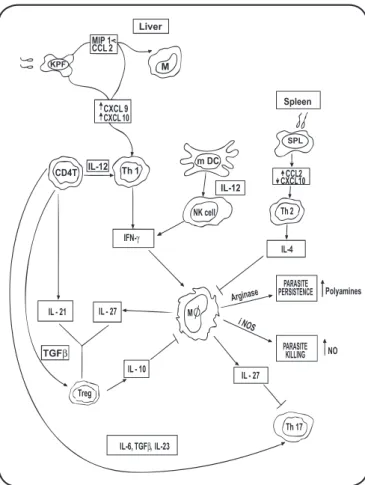
frequencies29(Figure 1).
Liver M NK cell CCL2 CXCL10 Th 2 IL-4 Polyamines i NOS NO
IL - 27 IL - 10
IL - 21 IL - 27 IFN-γ
Treg
Th 17 IL-6, TGF , IL-23β
Arginase PARASITE PERSISTENCE PARASITE KILLING Th 1 IL-12 IL-12 m DC Spleen CXCL 9 CXCL 10 SPL MIP 1 CCL 2 TGFβ M KPF CD4T SPL
FIGURE 1 - Interaction of different components of innate and adaptive immune systems and their possible role in parasite persistence/clearance.
The authors declare that there is no conlict of interest.
CONFLICT OF INTEREST
FINANCIAL SUPPORT