RESUmo
Estudo de corte transversal, conduzido em um hospital universitário, com amostra de 735 internações, cujo objeivo foi esimar a prevalência e os fatores associados à ocor-rência de incidentes relacionados à medi-cação, registrados em prontuários de pa-cientes internados em uma clínica cirúrgica no ano de 2010. Foi realizada a categoriza-ção dos ipos de incidentes com apresen-tação das frequências absoluta e relaiva, calculada a prevalência e realizada análise mulivariada. A prevalência dos incidentes relacionados à medicação foi esimada em 48,0% e ideniicaram-se como fatores re-lacionados a sua ocorrência o tempo de internação igual ou superior a quatro dias, a prescrição de três ou mais medicamentos por dia e a realização de intervenção cirúr-gica. Espera-se ter contribuído para que os proissionais e gestores da área possam ideniicar situações de risco e repensar sua atuação.
dEScRitoRES
Erros de medicação Segurança do paciente Enfermagem
Gestão em saúde
Prevalence and factors associated with
incidents related to medication in
surgical patients
O
riginal
a
rticle
AbStRAct
The aim of this study was to esimate the prevalence and factors associated with the occurrence of incidents related to medi-caion, registered in the medical records of paients admited to a Surgical Clinic, in 2010. This is a cross-secional study, conducted at a university hospital, with a sample of 735 hospitalizaions. Was per-formed the categorizaion of types of in-cidents, mulivariate analysis of regression logisic and calculated the prevalence. The prevalence of drug-related incidents was esimated at 48.0% and were ideniied, as factors related to the occurrence of these incidents: length of hospitalizaion more than four days, prescribed three or more medicaions per day and realizaion of sur-gery intervenion. It is expected to have contributed for the professionals and area managers can idenify risky situaions and rethink their acions.
dEScRiPtoRS
Medicaion errors Paient safety Nursing
Health management
RESUmEn
Estudio de corte transversal, realizado en un Hospital docente, con una muestra de 735 internaciones, cuyo objeivo fue esi-mar la prevalencia y los factores asociados a la ocurrencia de incidentes relacionados a la medicación, registrados en las historias clínicas de los pacientes hospitalizados en el Servicio de Cirugía, en el año de 2010. Se realizó la categorización de los ipos de incidentes y fueron presentados la fre-cuencia absoluta y relaiva, calculando la prevalencia y realizando el análisis muli-variante. La prevalencia de los incidentes relacionados a la medicación se esimó en 48,0% y fueron ideniicados como factores relacionados a la ocurrencia de estos inci-dentes: iempo de la hospitalización igual o superior a cuatro días, prescripción de tres o más medicamentos por día y realización de la intervención quirúrgica. Se espera haber contribuido para que los profesio-nales y administradores del área puedan ideniicar situaciones de riesgo y revisar su actuación.
dEScRiPtoRES
Errores de medicación Seguridad del paciente Enfermería
Gesión en salud
thatianny tanferri de brito Paranaguá1, Ana Lúcia Queiroz bezerra2, Andressa Luanna moreira dos Santos3, Ana Elisa bauer de camargo Silva4
PREVALÊNCIA E FATORES ASSOCIADOS AOS INCIDENTES RELACIONADOS À MEDICAÇÃO EM PACIENTES CIRÚRGICOS
PREVALENCIA Y FACTORES ASOCIADOS CON LOS INCIDENTES RELACIONADOS A LA MEDICACIÓN EN PACIENTES QUIRÚRGICOS
1 Master in Nursing, Faculty of Nursing, Federal University of Goias, Goiania, GO, Brazil. [email protected] 2 PhD. Associate Professor, Faculty of
Nursing, Federal University of Goias. 3 Undergraduate Nursing, Faculty of Nursing, Federal University of Goias. 4 PhD. Full Professor, Faculty of Nursing,
Federal University of Goias.
intRodUction
Currently, drug therapy has been widely used and more than 80% of individuals who seek health services are prescribed medicaions(1). However, improper use and
lack of safety standard during the administraion of the drug can lead to serious incidents to paients(2).
The World Health Organizaion (WHO) deines inci-dents as events or circumstances that may or may not cause harm to the paient(3). Among the incidents related
to medicaion we highlight the adverse efect and medica-ion error, being the later incident, an avoidable one(4).
It is esimated that at least 1.5 million people in the U.S. are afected every year by medicaion errors, which leads to costs higher than 3.5 billion dollars to the health care system(5). These rates are even more relevant in the
context of surgical care, as 234 million surgeries are esi-mated to occur per year. The World Health Organizaion considers the perioperaive administraion of drugs com-plex, since the 11,000 medicaion errors in the periopera-ive registered in the United States, 5% resulted in dam-age to paients including death(5).
However, it is very diicult to esimate the real extent of the damage atributable to medicaion errors in the perioperaive period, as there is a possibility of underre-poring of the consequences to the paient due to fear of punishment. Given the high rate of surgical procedures performed annually worldwide, it is believed that there is a substanial amount of paients afected by incidents related to drug intervenions. It is esimated that hospitals spend on average 15-20% of their budgets to reverse com-plicaions caused by misuse of medicines(5-6).
The risks associated with this therapy may be minimized by invesing in the quality of prescribing and dispensing of medicines and integraion of specialized knowledge and complementary experise among professionals who pre-scribe and dispense those drugs, which allows the achieve-ment of eicient and beneicial results to paients(2).
This study seeks to contribute to the knowledge of the incidents that occur during the medicaion process, raising the professionals involved relecions on their care pracices to adopt aitudes that promote a culture of safety. Further-more, this study will present factors associated with the oc-currence of incidents related to medicaion factors, currently considered a limited themaic in the scieniic community.
Thus, this research aims to esimate the prevalence and factors associated with the occurrence of incidents related to medicaion registered from medical records of paients admited to the surgical clinic of a teaching hospital.
mEtHod
Cross-secional and retrospecive study, conducted at the surgical clinic of a teaching hospital in the Seninel
Hospital Network of the Naional Health Surveillance Agency. The hospital has a Risk Management sector and supports research to diagnose incidents, in order to de-velop educaional aciviies and promote the culture of safety, a fact that moivated the development of this re-search at the insituion.
The populaion included all paients admited to the surgical clinic of the hospital during the year 2010, total-ing 2,610 hospitalizaions. The calculated sample size was 735 paients, whereas the prevalence of incidents of 10% esimated by WHO(7), the staisical power of 95%,
accu-racy of 3%, a design efect of 2.0 and an increase of 10% due to possible losses during data collecion. We used a probabilisic and systemaic sampling.
Medical records of paients with hospital admission date from January 1st to December 31st 2010 were in-cluded. We considered only the incidents recorded in the prescripion papers and clinical evoluion, laboratory or imaging tests were not consulted.
The outcome variable was the incident related to med-icaion. The independent variables were related to the pa-ient (age, gender, comorbidiies) and hospitalizaion (ad-mission type, length of hospitalizaion, surgery, amount of medicaions prescribed/per day, catheters, daily clinical assessment of paient).
Data were collected between January and May of 2011. We used a structured quesionnaire, reviewed by experts who are professors in the area of administraion, who also develop researches on the topic. Ater suggest-ed reformulaions, a pilot-test was conductsuggest-ed through a retrospecive analysis of 45 medical records, which were randomly selected in order to solve possible logisical and execuion issues. Data obtained during the pilot-test were not used in this research. The inal form used for data col-lecion consisted of objecive quesions on the hospital-izaion characterisics and a table containing a place for notes for informaion about the incident.
Data were entered into a database built using the sotware Staisical Package for the Social Sciences, ver-sion 17.0 for Windows. The categorizaion of the types of incidents was conducted, the prevalence of the incident and their conidence intervals were calculated. Descrip-ive data analysis was performed and to idenify factors associated with incident factors in univariate analysis, we used the chi-square and Fisher's exact test, when necessary, with the odds raio (OR) as a measure of as-sociaion. Mulivariate logisic regression analysis was performed with gender, age, and with p<0.10 in the uni-variate analysis. Conidence intervals of 95 % were cal-culated and associaions that had p-value <0.05 were considered staisically signiicant.
RESULtS
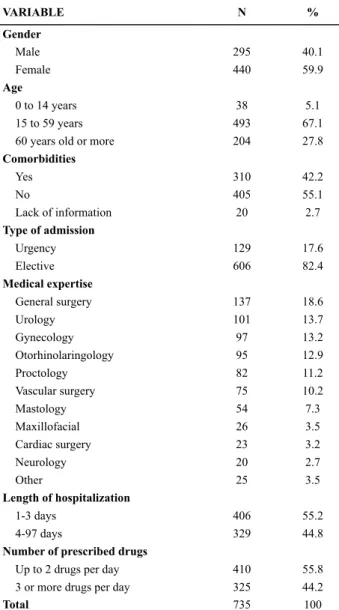
We analyzed 735 hospitalizaions, which corresponds to 28.1% of paients admited to the surgical clinic of the hospital in 2010, as shown in Table 1.
In 353 hospitalizaion, there was exposure to at least one kind of incident related to medicaion, a prevalence was esimated of 48.0% (353/735; CI: 44.4 to 51.6). The types of incidents related to medicaion from medical re-cords and hospitalized paients who were exposed to each incident are presented in Table 2.
Table 1 - Characterization of patients admitted to the surgical
clinic of a teaching hospital in 2010 - Goiania, GO, 2013
VARIABLE N %
Gender
Male 295 40.1
Female 440 59.9
Age
0 to 14 years 38 5.1
15 to 59 years 493 67.1
60 years old or more 204 27.8
Comorbidities
Yes 310 42.2
No 405 55.1
Lack of information 20 2.7
Type of admission
Urgency 129 17.6
Elective 606 82.4
Medical expertise
General surgery 137 18.6
Urology 101 13.7
Gynecology 97 13.2
Otorhinolaringology 95 12.9
Proctology 82 11.2
Vascular surgery 75 10.2
Mastology 54 7.3
Maxillofacial 26 3.5
Cardiac surgery 23 3.2
Neurology 20 2.7
Other 25 3.5
Length of hospitalization
1-3 days 406 55.2
4-97 days 329 44.8
Number of prescribed drugs
Up to 2 drugs per day 410 55.8
3 or more drugs per day 325 44.2
Total 735 100
Table 2 - Incidents related to medication that occurred during
hospitalization in the surgical clinic of a teaching hospital in 2010 - Goiania, GO, 2013
INCIDENTS HOSPITALIZATIONS N %
Omission of dose 254 34.6
Absence of checking medications 215 29.3
Lack of medicine 70 9.5
Discontinuation of drugs 57 7.8
Adverse effect to drugs 23 3.1
Incorrect prescription of medicines 15 2.0
Medication administered at the wrong time 8 1.1
Dose administration of not prescribed drug 5 0.7
Administration of different drug from
prescribed 2 0.3
Administration of medication in the wrong
patient 1 0.1
Administration of medication in the wrong
place 1 0.1
There was a predominance of female paients (59.9%), aged between 15 and 59 years old (67.1%) with a median of 47 years. In 55.1% of admissions, paients had comor-bidiies and in 2.7% this informaion was absent, indicaing problems in performing anamnesis, which can compromise the quality of care provided to paients. The most frequent type of admission (82.4%) were elecive hospitalizaion, being predominant specialies of General Surgery (18.6%), Urology (13.7%) and Gynecology (13.2%). The length of hospitalizaion in 55.2% of paients was from one to three days, with a median of three days. The number of pre-scribed drugs was two per day for 55.8% of hospitalizaions, ranging from 1 to 14, with a mean of 2.6 drugs/day.
The most frequent incident was the omission of dose, observed in 34.6% hospitalizaions. The absence of check-ing medicaions occurred in 29.3% and lack of medicine in the unit was recorded at least once in 9.5% of hospi-talizaions. Another incident ideniied in 7.8% hospitaliza-ions was the disconinuaion of drugs, which may indi-cate laws in prescribing or management the unit, related to forecasing and the provision of medicines to meet the needs of hospitalized paients.
Although in small proporions, it was also veriied the occurrence of other incidents in the medicaion process as adverse efects (3.1%), incorrect prescripion (2.0%), wrong ime (1.1%), dose administraion of not prescribed drugs (0.7%), administraion of medicaion in the wrong paient (0.1%), and administraion of medica-ion in the wrong place (0.1%), which points to systemic failures. No data on the consequences of incidents for paients were found.
As shown in Table 3, the incident related to the medi-caion has a mulifactorial characterisic.
A relaionship was observed between the occurrence of incidents involving drugs and length of hospitalizaion less than four days, the prescripion of three or more medicaions per day and performance of any surgical in-tervenions.
The length of hospitalizaion greater than four days (p=0.000) showed a risk of incident 6.12 imes greater than the length of hospitalizaion up to three days and 75.1% of hospitalizaions over four days were exposed to a drug-related incident versus 24.4% exposure among hospitalizaions with up to three days.
The prescripion of three or more medicaions per day (p=0.000) contributed to the occurrence of incidents related to medicaion, increasing the risk by 3.32 imes. Among hospitalizaions with three or more medicaion prescripions per day, 69.5% were exposed to an incident while hospitalized people with up to two medicaions pre-scripions per day, exposure was 29.2% (Table 4).
The performance of surgical intervenions (p=0.041) also indicated a risk factor for the occurrence of incidents related to medicaion, increasing chances in 1.78 imes. Al-though 70.3% of hospitalizaions for surgical intervenion have been exposed to an incident, the number of exposure among paients who did not undergo surgery was higher.
diScUSSion
The characterizaion of paients at the surgical clinic resembles other studies, especially regarding the pre-dominance of female paients, and young adults(8-9). Most
paients had no comorbidiies and elecive admissions predominated, which is a characterisic in this type of hos-pital, unlike the results of studies in which the focus was the urgent and emergency care(9).
In 55.8% of hospitalizaions two medicaions were pre-scribed per day, ranging from 1 to 14 and a mean of 2.6/ day. The need to use muliple drugs can be atributed to the treatment of comorbidiies or complicaions incurred during hospitalizaion, related to the clinical status of the paient or the surgical procedure.
Table 3 - Univariate association between exposure variables and
the occurrence of incidents related to medication in patients ad-mitted to the Surgical Clinic of the University Hospital in 2010 - Goiania, GO, 2013
EXPOSURE VARIABLES
INCIDENT
OR 95% CI p
Exposure/
Total %
Gender
Male 143/295 48.5 1.09 0.82 – 1.48 0.534
Female 203/440 46.1
Age
45 years old or
more 228/391 36.6 2.45 1.82 – 3.30 0
Up to 45 years old 125/344 58.3
Comorbidities
Yes 186/310 60 2.48 1.84 – 3.35 0
No 160/425 37.6
Type of admission
Urgency 73/129 56.6 1.59 1.08 – 2.33 0.017
Elective 273/606 45
Length of hospitalization
Four or more days 247/329 75.1 9.34 6.67 - 13.09 0
One to three days 99/406 24.4
Medicines prescribed per day
Three or more 226/325 69.5 5.52 4.01 – 7.58 0
Up to two per day 120/410 29.2
Surgical intervention
Yes 275/634 43.4 0.32 0.21 – 0.51 0
No 71/101 70.3
Catheter Use
Yes 312/673 46.3 0.71 0.42 – 1.20 0.201
No 34/62 54.8
Daily evolution of the patient's condition
Yes 247/522 47.3 0.97 0.70 – 1.33 0.836
No 99/213 46.5
Table 4 - Risk factors and their odds ratio values for the occurrence of incidents related to medication during hospitalization in the
surgical clinic of a teaching hospital in 2010 - Goiania, GO, 2013
Risk Factors Not adjusted pODDS RATIO (95% CI)Adjusted p
Male gender 1.09 (0.82 – 1.48) 0 0.92 (0.64 – 1.32) 0.661
Age > 45 years old 2.45 (1.82 – 3.30) 0 1.31 (0.90 – 1.92) 0.16
Presence of comorbities 2.48 (1.84 – 3.35) 0 0.94 (0.63 – 1.39) 0.757
Urgency admission 1.59 (1.08 – 2.33) 0.017 1.39 (0.85 – 2.27) 0.193
Hospitalization > 4 days 9.34 (6.67 – 13.09) 0 6.12 (4.23 – 8.84) 0
Medicines > 3 per day 5.51 (4.01 – 7.58) 0 3.32 (2.27 – 4.85) 0
The characterisics of paients and hospitalizaions of this study are speciic and point to the need for individual-ized care planning. It is extremely important to characterize the proile of paients, therefore, the greater the severity and complexity of care required, the greater the chance of errors that compromise the quality of care(10).
The prevalence of incidents related to medicaion was 48.0%. The medicaion error incident is the third most frequent arising from care. Retrospecive studies have shown that their occurrence varies from 14.8 to 51.5% of reported events in large teaching hospitals(11-12). The
prev-alence of these incidents in an observaional study that evaluated the process of administraion of animicrobials was approximately 30.2%(13). The diference between the
values found may be related to the possibility of underre-poring, since diferent sources of informaion and hospi-tal culture may inluence whether or not the record of the incident is documented.
Among the types of incidents, the omission of dose was more frequent. Prospecive studies indicate that 14.0 to 28.0% of the records of drug incidents are due to omission of dose(14-15). In retrospecive studies, this rate
reached 51.0%(16). Studies conducted with health
profes-sionals indicate that up to 71.0% have detected incidents due to omission of dose(17).
The absence of checking and lack of medicines sug-gest laws in the organizaion of the service and the care process. Naional and internaional, prospecive and ret-rospecive studies, ideniied those same occurrences as faults during paient care, both in surgical environments as in other hospital units(18-19).
Retrospecive analysis of adverse efects noiicaion in outpaients and hospitalized paients in a public hospital in northeastern Brazil showed that 72.0% of paients had an adverse efect and 15.0%, more than one. The occur-rence of these events in hospitalized paients accounted for 54.1% of all noiicaions and only 1.5% was reported by the surgical clinic(8).
Although in this study the incidents of administraion of medicine in the wrong ime, not prescribed dose, medi-caion not prescribed, wrong paient, and wrong place have been recorded to a lesser proporion, the literature contains several studies that describe the high rate of these incidents(14,16,20-21).
Prospecive, observaional study in a French teaching hospital found that in 27.6% of cases observed occurred at least one error in the medicaion process. The ime errors accounted for 72.6% of the incidents and admin-istraion of unauthorized medicine product, administra-ion in the wrong paient or non-prescribed drugs oc-curred in 3.7%(14).
The ime errors are the second most common inci-dent, corresponding to 22.9% of the events, and rate of 13.5%(16,21). Are also ideniied, although to a lesser extent,
errors in prescribing (4.1%), omission of dose (4.1%) and medicaion administered at the wrong paient (2.7%)(21).
The nursing staf, while not responsible for the pre-scripion, need to know the aspects involved in each step of the process because, when acing in the stages of prep-araion and administraion, enables them to intercept er-rors that went unnoiced(10,22-23). About 86% of medicaion
errors can be intercepted by nurses and pharmacists and updaing of knowledge is a strong ally in prevenion(1,24).
Prolonged hospitalizaion ime, the use of muliple medicaions and surgical intervenion consituted a risk factor for the occurrence of drug incidents. A retrospec-ive analysis showed that the probability of surviving free from incidents related to medicaion administraion dur-ing hospitalizaion process is inversely proporional to the amount of ime paient remain hospitalized. For 30, 60 and 100 days of hospitalizaion, the probability of not suf-fering incident with medicaion was 96, 93 and 73%, re-specively(10). It is noteworthy, therefore, the importance
of knowing the inluence of the factor ime in the occur-rence of diferent outcomes.
The extension of hospitalizaion may be due to a com-plicaion caused by error of the healthcare team(25).
Pro-longed hospitalizaion period may be associated with an-icipaion of hospitalizaion or postponement of discharge for assurance of hospitalizaion, cancellaion and resched-uling of surgery or need for exams. The prolongaion of hospital stay also increases the likelihood of adverse events, whereas there is the paient's exposure to risk fac-tors intrinsic to the hospital environment(10).
Concomitant administraion of various drugs in difer-ent dosages and presdifer-entaions, can cause confusion to the professional and trigger an error. Retrospecive study of paients hospitalized at the University of Pitsburgh, United States, found that paients receiving intravenous medicaions have 3% higher risk of having an adverse event and the risk increases with each drug dispensed(26).
A realização de intervenção cirúrgica também foi iden-iiThe surgical intervenion was also ideniied as fac-tor associated with the occurrence of incidents related to medicaion, depending on paient characterisics and type of surgery, and the preparaion of appropriate preopera-ive care and skill and qualiicaion of the surgeon(25). The
most common postoperaive complicaions are decreased cardiac output, renal failure, cardiac arrest, arrhythmia, pneumonia, hyperglycemia, heart failure and cerebrovas-cular accident(27). Knowing the possible postoperaively
complicaions assists the healthcare team to adopt a rapid response to reverse the worsening condiion of the paient.
Retrospecive analysis of general care in health insitu-ions in England found between the risk factors associated with drug incidents, male under 15 years or over 64 years and the number of single doses prescribed(28).
The risks associated with surgical procedures require the creaion of new intervenions for clinical stabilizaion, including addiional drug therapies, providing new risk sit-uaions, if the paient is not well monitored and properly assistance planning.
We observe, therefore, that the incidents related to medicaion administraion are common and mild to mod-erate harm are more frequent(28). However, when the
pa-ient's condiion is criical, drug incidents are 2.9 imes more likely to result in harm requiring intervenion to sup-port life, and 2.5 imes more likely to result in permanent harm or death(15).
Strategies to reduce these incidents should focus on staf training, the coninued development of profession-als, clinical leadership and improved paient’s communi-caion and security systems(24,28).
Resoluion No.36 of the Naional Health Surveillance Agency has required the installaion of the Center for Pa-ient Safety in health insituions. Noiicaion of incidents arising out of care may contribute to producion, system-aizaion and disseminaion of knowledge about the in-cidents, and fostering a culture of safety in training and pracice of health(29).
The disclosure of accurate concepts about the types of incidents and understanding that are mainly caused by inadequacies in work processes is a challenge and
at the same time, a need to direct the improvement of patient care(30).
concLUSion
The prevalence of incidents related to medicaion was 48.0%, highlighing the omission of dose, the absence of checking, lack of medicaion, disconinuaion of medica-ion, adverse efects and incorrect prescripion. As factors associated to the occurrence of incidents we highlight the length of hospitalizaion greater than or equal to four days, the prescripion of three or more medicaions per day and any surgical intervenion. The ideniicaion of these factors associated is a unique contribuion of this study and it may support the adopion of speciic strate-gies that minimize the chances of occurrence of the inci-dent related to medicaion at risk populaion.
The results can be generalized and methodology of this study can be used to invesigate these incidents in other health units in order to esimate the actual extent of drug incidents in Brazil, as well as encourage the pursuit of ap-propriate prevenive measures to the reality of our country. The lack of policy development of the health care pro-fessionals team for the noiicaion of incidents diicult their monitoring and is a present problem in the health sector with several implicaions for the quality of care.
The study has limitaions in the method of retrospec-ive analysis, since the record of the incident and espe-cially the harm to the paient depends on the aitude of health professionals, moreover, inluenced by the organi-zaional culture of the insituion where he/she works for.
REFEREncES
1. Lopes DMA, Néri EDR, Madeira LS, Souza Neto PJ, Lélis ARA, Souza TR, et al. Análise da rotulagem de medicamentos seme-lhantes: potenciais erros de medicação. Rev Assoc Med Bras. 2012;58(1):95-103.
2. Pepe VLE, Castro CGSO. A interação entre prescritores, dis-pensadores e pacientes: informação comparilhada como possível beneício terapêuico. Cad Saúde Pública [Internet]. 2000 [citado 2013 fev. 22];16(3):815-22. Disponível em: ht-tp://www.scielosp.org/pdf/csp/v16n3/2966.pdf
3. World Health Organizaion. Conceptual framework for the Internaional Classiicaion for Paient Safety. Version 1.1 [In-ternet]. Geneva; 2009 [cited 2013 Feb 22]. Available from: ht-tp://www.who.int/paientsafety/implementaion/taxonomy/ icps_technical_report_en.pdf
4. Capucho HC. Near miss: almost error or potenial event? [let-ter to the editor]. Rev Laino Am Enferm [In[let-ternet]. 2011 [ci-tado 2013 Feb 22];19(5):1272-3. Available from: htp://www. scielo.br/pdf/rlae/v19n5/27.pdf
5. World Health Organizaion. Word Alliance for Paient Safety. Guidelines for safe surgery: safe surgery saves lives [Internet]. Geneva; 2009 [cited 2013 Feb 22]. Available from: htp://whqli-bdoc.who.int/publicaions/2009/9789241598552_eng.pdf
6. World Health Organizaion. Global partnerships for health. WHO Drug Inf. 1999;13(2):61-4.
7. World Health Organizaion. Word alliance for paient safety: forward program 2006-2007 [Internet]. Geneva; 2007 [cited 2010 Jan 20]. Available from: htp://www.who.int/paientsa-fety/informaion_centre/WHO_EIP_HDS_PSP_2006.1.pdf
9. Marins M, Travassos C, Mendes W, Pavão AL. Hospital de-aths and adverse events in Brazil. BMC Health Serv Res. 2011;11:223.
10. Roque KE, Melo ECP. Tempo de internação e a ocorrência de eventos adversos a medicamentos: uma questão da en-fermagem. Esc Anna Nery Rev Enferm. 2011;15(3):595-601.
11. Lima LF, Leventhal LC, Fernandes MPP. Ideniicando os ris-cos do paciente hospitalizado. Einstein. 2008;6(4):434-8.
12. 12. Nascimento CCP, Tofoleto MC, Gonçalves LA, Freitas WG, Padilha KG. Indicators of healthcare results: analysis of adverse events during hospital stays. Rev Laino Am Enferm. 2008;16(4):746-51.
13. Marques TC, Reis AMM, Silva AEBC, Gimenes FRE, Opitz SP, Teixeira TCA, et al. Erros de administração de animicrobia-nos ideniicados em estudo mulicêntrico brasileiro. Rev Bras Ciênc Farm. 2008;44(2):305-14
14. Berdot S, Sabaier B, Gillaizeau F, Caruba T, Prognon P, Du-rieux P. Evaluaion of drug administraion errors in a tea-ching hospital. BMC Health Serv Res. 2012;12:60.
15. Laif A, Rawat N, Pustavoitau A, Pronovost PJ, Pham JC. Na-ional study on the distribuion, causes, and consequences of voluntarily reported medicaion errors between the ICU and Non-ICU seings. Crit Car Med. 2013;41(2):389-98.
16. Silva AEBC, Reis AMM, Miasso AI, Santos JO, Cassiani SH. Ad-verse drug events in a seninel hospital in the State of Goiás, Brazil. Rev Laino Am Enferm [Internet]. 2011 [cited 2013 May 15];19(2):378-86. Available from: htp://www.scielo. br/pdf/rlae/v19n2/pt_21.pdf
17. Franco JN, Ribeiro G, D’Innocenzo M, Barros BPA. Percep-ção da equipe de enfermagem sobre fatores causais de er-ros na administração de medicamentos. Rev Bras Enferm. 2010;63(6):927-32.
18. Forster AJ, Asmis TR, Clark HD, Al Saied G, Code CC, Caughey SC, et al. Otawa Hospital Paient Safety Study: incidence and iming of adverse events in paients admited to a Cana-dian teaching hospital. CMAJ. 2004;170(8):1235-40.
19. Setz VG, D’Innocenzo M. Evaluaion of the quality of nur-sing documentaion though the review of paient medical records. Acta Paul Enferm [Internet]. 2009 [cited 2013 May 15]; 22 (3): 313-7. Available from: htp://www.scielo.br/pdf/ ape/v22n3/a12v22n3.pdf
20. Gimenes FRE, Teixeira TCA, Silva AEBC, Opitz SP, Mota LMS, Cassiani SHB. Inluencia da redação da prescrição médica na administração de medicamentos em horários diferentes do prescrito. Acta Paul Enferm. 2009;22(4):380-4.
21. Teixeira TCA, Cassiani SHB. Root cause analysis: evaluaion of medicaion errors at a university hospital. Rev Esc Enferm USP [Internet]. 2010 [cited 2013 May 15];44 (1):137-44. Available from: htp://www.scielo.br/pdf/reeusp/v44n1/ en_a20v44n1.pdf
22. Oliveira RB, Melo ECP. O sistema de medicação em um Hos-pital Especializado no município do Rio de Janeiro. Esc Anna Nery Rev Enferm. 2011;15(3):480-9.
23. Miasso AI, Cassiani SHB. Erros na administração de medi-camentos: divulgação de conhecimentos e ideniicação do paciente como aspectos relevantes. Rev Esc Enferm USP. 2000;34(1):16-25.
24. Silva AEBC, Cassiani SHB, Miasso AI, Opitz SP. Problemas na comunicação: uma possível causa de erros de medicação. Acta Paul Enferm. 2007;20(3):272-6.
25. Oliveira LB, Rocha Junior PB, Guimarães NM, Didonet MT. Va-riáveis relacionadas ao tempo de internação e complicações no pós-operatório de pacientes submeidos à cirurgia do tra-to gastrointesinal. Com Ciênc Saúde. 2010;21(4):319-30.
26. Kane-Gill SL, Kirisci L, Verrico MM, Rothschild JM. Analysis of risk factors for adverse drug events in criically ill paients. Crit Care Med. 2012;40(3):823-8.
27. Carvalho MRM, Silva NAS, Oliveira GMM, Klein CH. Compli-cações e tempo de internação na revascularização miocárdi-ca em hospitais públicos no Rio de Janeiro. Rev Bras Ter In-tensiva. 2011;23(3):312-20.
28. Avery AA, Barber N, Ghaleb M, Franklin BD, Armstrong S, Crowe S, et al. Invesigaing the prevalence and causes of prescribing errors in general pracice: the PRACtICe study [Internet]. 2012 [cited 2013 Sept 15]. Available from: htp:// www.gmc-uk.org/Invesigaing_the_prevalence_and_ causes_of_prescribing_errors_in_general_pracice___The_ PRACtICe_study_Reoprt_May_2012_48605085.pdf
29. Brasil. Ministério da Saúde; Agência Nacional de Vigilância Sanitária. Resolução RDC n. 36, de 25 de julho de 2013. In-situi ações para a segurança do paciente em Serviços de Saúde e dá outras providências [Internet]. Brasília; 2013 [citado 2013 set. 15]. Disponível em: htp://bvsms.saude. gov.br/bvs/saudelegis/anvisa/2013/rdc0036_25_07_2013. html