Original Article
Artigo Original
Association between the adherence to
voice therapy and voice activity profile in
patients with behavioral dysphony
Associação entre a adesão da terapia vocal
e perfil de atividades vocais em pacientes
disfônicos comportamentais
Thales Roges Vanderlei de Góes1
Cristiane Cunha Soderini Ferracciu1
Deise Renata Oliveira da Silva1
Keywords
Voice Voice Disorders Patient Compliance Speech Therapy Quality of Life
Descritores
Voz Distúrbios da Voz Adesão do Paciente Fonoterapia Qualidade de Vida
Correspondence address:
Cristiane Cunha Soderini Ferracciu Universidade de Ciências da Saúde de Alagoas – UNICISAL
Rua Dr. Jorge de Lima, 113, Trapiche da Barra, Maceió (AL), Brazil, CEP: 57010-300.
E-mail: [email protected]
Received: September 15, 2015
Study carried out at Serviço de Fonoaudiologia, Centro Especializado em Reabilitação – CER III, Universidade Estadual de Ciências da Saúde de Alagoas – UNCISAL - Maceió (AL), Brazil.
1Universidade Estadual de Ciências da Saúde de Alagoas – UNCISAL - Maceió (AL), Brazil.
Financial support: FAPEAL – Fundação de Amparo à Pesquisa do Estado de Alagoas.
Conlict of interests: nothing to declare.
ABSTRACT
Purpose: To analyze the association between adherence to voice therapy and voice activity proile in patients
with behavioral dysphonia and possible associated factors. Methods: The study included eighteen individuals with behavioral dysphonia who were on regular treatment at the institution Hearing and Speech Therapy Service. The participants of this study responded to the Voice Activity and Participation Proile Protocol (VAPP) and URICA-VOICE scale. The associated variables (number of sessions, age, type of behavioral dysphonia, gender and previous speech therapy) were collected through interviews with patients and analysis of their medical records. The data were submitted to inferential statistical analysis. Results: Most patients were in the action stage. There was a statistically signiicant association between the aspect of the VAPP Effects on Emotion and stages of readiness for adherence to voice therapy, but other VAPP aspects were not associated with the URICA-VOICE scale. Regarding the associated variables, the number of sessions, age and type of behavioral dysphonia were associated with the adherence to voice therapy. There was a statistically signiicant difference between the type of behavioral dysphonia and VAPP scores. Conclusion: The aspect of VAPP Effects on Emotion and variables such as number of sessions, age and type of dysphonia were associated to the URICA-VOICE scale adherence stage. Individuals with organic dysphonia had greater impact of vocal disorders in their daily activities.
RESUMO
Objetivo: Analisar a associação entre a adesão da terapia vocal, peril de atividades vocais em pacientes disfônicos
INTRODUCTION
The voice has individual characteristics comparable to a ingerprint and results from the interrelation of multifactorial aspects such as: genetics, anatomy, social environment and emotions. Besides being a mechanism for verbal communication, the voice is also related to the externalization of the emotional state in an experienced situation, and may reveal some aspects of the personality(1).
When there is a change in those characteristics that compromise and disharmonize oral communication, we have as a result an altered voice production and the emergence of some symptoms, such as, fatigue and loss of voice projection, phonation effort, instability of vocal quality, pain and burning during emission, low resistance and loss of voice eficiency, among others. This change in vocal production is called dysphonia(2).
Within that perspective, dysphonia can be classiied as functional, organofunctional and organic(2). The irst two can still be categorized as behavioral, as they have as etiological factor vocal behavior, such as lack of vocal knowledge, poor vocal model and the maintenance of harmful habits to voice(3,4).
The core of vocal rehabilitation in these cases is a speech-language therapy, which aims to change the bad vocal behavior installed through healthy habits guidelines (indirect therapy) and performance of voice exercises (direct therapy), with the essential active participation of the patient throughout the period of therapeutic intervention(3-5).
In this context, compliance is an essential factor for an effective therapeutic treatment of voice, since the adherence to the recommendations involves the necessary changes in behavior and attitudes of the patient for successful therapy(3,6).
It is known that adherence, as well as voice, is inluenced by several variables, external and internal to the subject, such as environmental, psychological and cultural variables(6). Therefore it becomes necessary to understand the above variables that can interfere with the immediate change of habits and the patient’s behavioral nuances regarding treatment(6,7).
The modiications of certain behaviors in health care are studied by some theoretical models. Among them, we highlight the Transtheoretical Model (TTM) of Stages of Change, which studies the individual’s motivation, from a longitudinal perspective of stages of readiness, not in a timely manner, what enables monitoring the patient, as well as making use of strategies in order to achieve a desired result(3,7-9).
Considering that the TTM has the clinical objective of perceiving the patient’s behavioral changes, studies(9-10) suggest the monitoring of the actions of patient with dysphonia, through the transtheoretical model during treatment.
Quality of life is also a parameter that can assist in evaluating the effectiveness of adherence to treatment(11). It can be deined as the self-perception of life position and the individual’s values system that relate to his/ her goals and expectations(12). The Voice Activity and Participation Proile (VAPP) Protocol(11) proposes a self-assessment of the impact of dysphonia in the daily activities of the individual. Studies focusing on voice that use the VAPP as a marker of treatment in the patient’s quality of life showed
a signiicant improvement in their ields after speech therapy discharge, indicating the effectiveness of the treatment(4,13,14).
Accordingly, there is a need for studies to verify the association of motivational stages and self-assessment of the impact of dysphonia in the daily activities of the patient during the therapeutic process. Thus, this research aims to analyze the association between adherence of vocal therapy, proile of vocal activities in patients with behavioral dysphonia and associated factors (number of sessions, age, type of behavioral dysphonia, gender and previous speech therapy).
METHODS
This research is characterized as a transversal, descriptive and inferential, and it is elaborated based on quantitative approach, with convenience sample. It was developed at the Speech-language Therapy Rehabilitation Center- of the State University of Health Sciences of Alagoas (UNCISAL). The patients were contacted after therapy, in a private room, and the illing of the instruments was carried out at an appropriate time, without prejudice to the activities of the clinic and the patient. All participants signed a written informed consent and the research was approved by the institution’s Ethics Committee with protocol n° 1033236/2015.
The sample complied with the following inclusion criteria: to have diagnosis of behavioral dysphonia, be in regular treatment at the institution’s Speech-language Therapy Service, undergo otorhinolaryngology clinical examination with nasolaryngoscopy and/ or video laryngoscopy approach and be more than 18 years old, so that there will not be any interference of voice change period. All patients included in the mentioned criteria agreed to participate in the study, resulting in a sample of 18 individuals.
The instrument used to verify the adherence of vocal therapy was URICA-VOICE scale, based on the TTM, adapted in 2013 to the voice area(10). It consists of 32 items, divided into four stages of change: pre-contemplation (PC), contemplation (C), action (A) and maintenance (M). For each item, we have proposed possible answers of Likert ive points type, with eight questions corresponding to each stage. To ind the readiness score, we perform the average of the sum of points corresponding to each stage, then, we use the sum of the averages of contemplation, action and maintenance, with the subtraction of the average of pre-contemplation. The score with values lower than 8 indicates that the subject is in PC stage, between 8 and 11 (C), between 11 and 14 (A) and above 14 in (M)(3,10).
communication” 40 points; and the “effects in the emotion” is 70 points. The protocol also offers two extra scores: Limitation score in the activities (LSA) and Restriction score in the participation (PRP), the LSA score is obtained by the sum of the ten even questions of the aspects “work”, “daily communication” and “social communication”, while in order to ind the value of PRP, the odd questions of the same aspects are added, with maximum values of 100 points each. The greater the results in items of VAPP, the greater the negative impact of voice in daily activities.
We also collected, through interviews with the patient and analysis of their medical records, the following variables: number of sessions, age, classiication of behavioral dysphonia (functional dysphonia and organofunctional dysphonia), and previous speech therapy.
The answers were exported into EXCEL spreadsheet and then subjected to inferential statistical analysis. To investigate the association between scores of VAPP and adherence stages of vocal therapy, number of sessions and age, we used the Spearman correlation test (rs). The linear correlation coeficient (rs) is a pure number ranging from –1 to +1 and its interpretation can be assessed qualitatively: nil (0.00); low (0.00 to 0.30); regular (0.31 to 0.60); strong (0.61 to 0.90); very strong (0.91 to 0.99); Full / perfect (1.00)(15).
For the comparison of independent groups of the adherence stages of vocal therapy and ordinal data, such as age and number of sessions, we used the Mann-Whitney test, since a t-test of the sample data showed that the variables did not present normal distribution. We used the nonparametric Fisher’s Exact Test to verify the association between nominal variables and stages of URICA-VOICE. Through the t-test, Independent samples were
compared to the scores of the aspects of VAPP as regards the type of behavioral dysphonia, gender and previous speech therapy.
Statistical results were analyzed at the signiicance level of 5% (0.05). The assessment of the data was performed using the BioEstat program (version 5.3).
RESULTS
The age of patients with behavior dysphonia ranges from 23 to 64 years (mean=40.4 years, standard deviation - SD=12.5), with six males and twelve females.
Regarding motivational stages of URICA VOICE scale, it was observed that 33.3% (n=6) of the patients is in contemplation period, 66.7% (n=12) in action and 0% in the stages of pre-contemplation and maintenance.
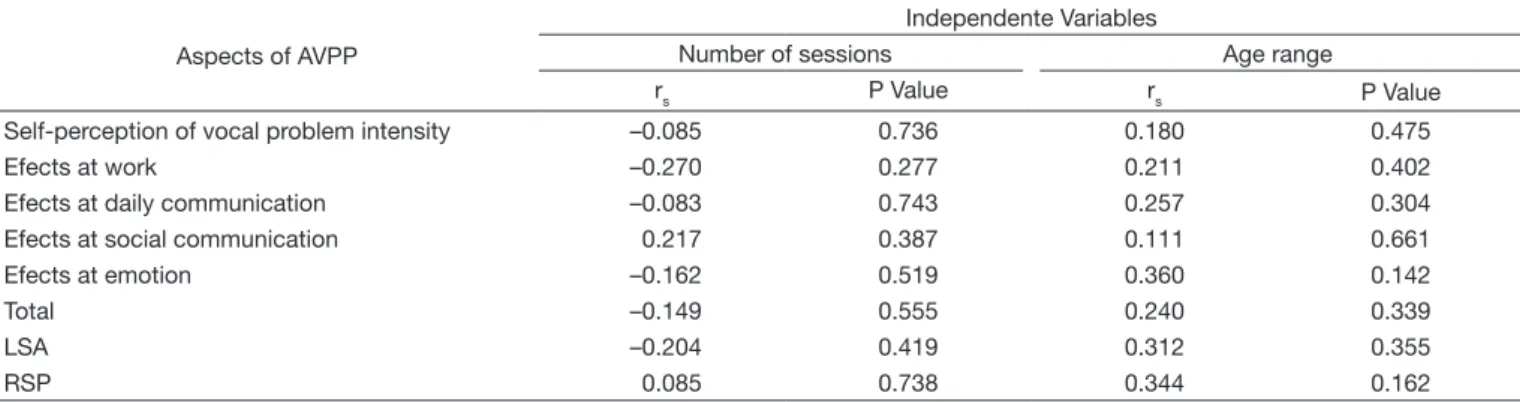
It was observed that, with the advancement of therapy adherence stage, the number of sessions and age range, also, increase progressively in the study sample, with a statistically signiicant difference (Table 1). However there was no signiicant association between the proile of participation in vocal activities and the above mentioned variables (Table 2).
Table 3 shows the comparison of the VAPP scores of all subjects by the type of behavioral dysphonia, gender and previous speech therapy. The results of the Protocol show that there is a statistically signiicant difference between the type of behavioral dysphonia and aspects of effect in work, effects in social communication, effects in emotion; the total score and the PRP score of VAPP. It was observed that the average of aspect (self-perception of the intensity of the vocal problem and effects in daily communication) and the LSA scores are not statistically different as regards the type of behavioral dysphonia.
Table 1. Comparison between the stages of adherence of vocal therapy and the variables “number of sessions” and “age”
Variables
Adherence of vocal therapyl
P Value
Contemplation Action
Mean DIQ Median DIQ
Number of sessions 5.5 11.5 7.0 10.2 0.046*
Age range 28.5 5.5 45.5 11.0 <0.0001*
*Significant values (p<0.05) – Mann Whitney’s Test
Table 2. Association between the variables “number of sessions” and “age” and “the scores of the Voice Activity and Participation Profile (VAPP) protocol”
Aspects of AVPP
Independente Variables
Number of sessions Age range
rs P Value rs P Value
Self-perception of vocal problem intensity –0.085 0.736 0.180 0.475
Efects at work –0.270 0.277 0.211 0.402
Efects at daily communication –0.083 0.743 0.257 0.304
Efects at social communication 0.217 0.387 0.111 0.661
Efects at emotion –0.162 0.519 0.360 0.142
Total –0.149 0.555 0.240 0.339
LSA –0.204 0.419 0.312 0.355
RSP 0.085 0.738 0.344 0.162
Spearman correlation test – No significant values (p<0.05)
There was no statistical difference between the variables gender and previous speech therapy with VAPP.
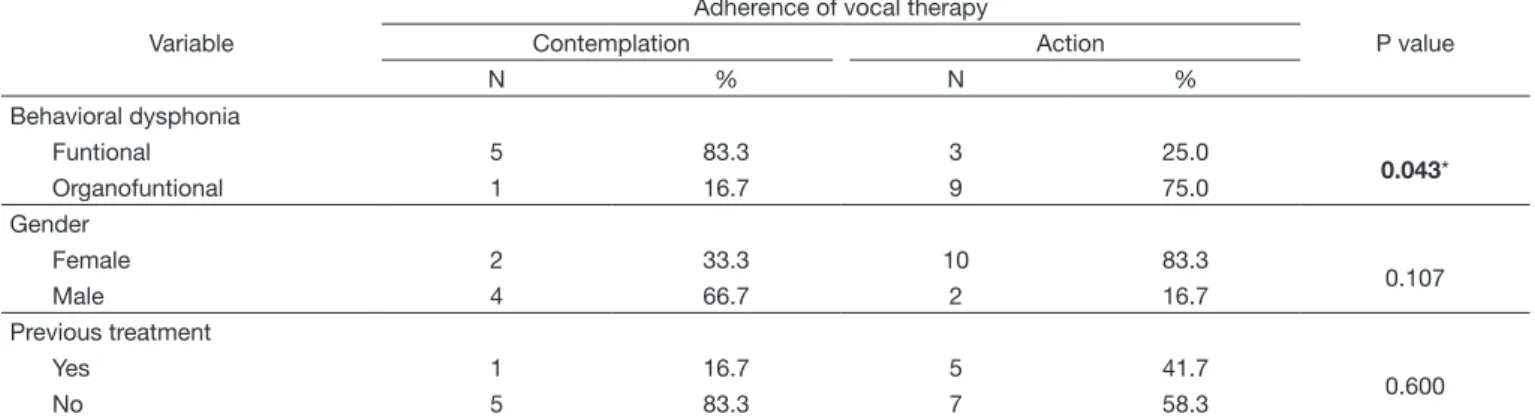
The type of behavioral dysphonia was signiicantly associated with the stages of URICA-VOICE scale. This result suggests greater adherence of vocal therapy in people with organic dysphonia. Fisher’s exact test revealed no association between the variables gender and previous speech therapy with the scale (Table 4).
According to the Spearman correlation test (Rs=0.637, p=0.004), there is an association considered strong and positive between the aspect Effects in Emotion of VAPP and the adherence stages of vocal therapy. It is observed that patients who are in the action stage show higher scores in the respective aspects. There was no signiicant difference between the other scores of VAPP and adherence scale (Table 5).
Table 3. Comparison of mean scores of Voice Activity and Participation Profile (VAPP) protocol according to the type of behavioral dysphonia, gender and previous speech therapy
Variables Aspect 1 Aspect 2 Aspect 3 Aspect 4 Aspect 5 Total LSA RSP
Behavioral dysphonia M P Value M
P Value M
P Value M
P Value M
P Value M
P Value M
P Value M
P Value Funtional 5.4
0.451 11.5 0.049* 26.2 0.142 2.2 0.019* 14.6 0.005* 59.9 0.018* 25.0 0.066 14.0 0.044* Organofuntional 6.3 25.9 42.5 10.9 35.6 121.2 46.1 34.8 Gender
Male 6.5
0.479 19.7 0.975 30.8 0.587 7.0 0.984 21.5 0.416 85.5 0.671 30.3 0.450 26.2 0.937
Female 5.9 19.4 37.4 7.1 28.7 98.2 39.9 25.2
Previous treatment
Yes 6.8
0.268 23.8 0.422 36.0 0.924 11.7 0.098 29.5 0.586 107.5 0.493 36.7 0.995 32.0 0.400
No 5.4 17.3 34.8 4.8 24.7 87.2 36.7 22.3
*Significant values (p<0.05) – T test: Independent samples
Caption: M = arithmetic mean; Aspect 1 = self-perception vocal problem intensity; Aspect 2 = effects on work; Aspect 3 = effects on daily communication; Aspect
4 = effects on social communication; Aspect 5 = effects on emotion; Total = sum of the 5 aspects; LSA = Limitation score in the activities; RSP = Restriction score in the participation
Table 4. Association between the adherence stages of vocal therapy and dysphonia variables, gender and previous speech therapy
Variable
Adherence of vocal therapy
P value
Contemplation Action
N % N %
Behavioral dysphonia
Funtional 5 83.3 3 25.0
0.043*
Organofuntional 1 16.7 9 75.0
Gender
Female 2 33.3 10 83.3
0.107
Male 4 66.7 2 16.7
Previous treatment
Yes 1 16.7 5 41.7
0.600
No 5 83.3 7 58.3
*Significant values (p<0.05) – Fisher’s exact test
Table 5. Association between the adherence stages of vocal therapy and scores of Voice Activity and Participation Profile (VAPP) Protocol
Aspects of AVPP
Adherence of vocal therapy
rs P value Contemplation Action
Median DIQ Median DIQ
Self-perception of the vocal problem intensity 5.0 3.0 5.5 2.7 0.306 0.217
Effects in work 2.5 23.5 26.0 21.5 0.217 0.388
Effects in daily communication 21.0 26.7 33.0 23.7 0.273 0.273 Effects in social communication 3.5 4.0 4.5 12.5 0.092 0.716
Effects in emotion 12.5 8.7 27.5 16.7 0.637 0.004*
Total 46.5 70.0 101.5 64.2 0.341 0.166
LSA 20.0 28.5 38.5 31.0 0.364 0.138
RSP 14.0 25.5 28.5 20.2 0.390 0.313
*Significant values (p<0.05) – Spearman correlation test
DISCUSSION
Studies(10,16) have used URICA-VOICE scale to evaluate adherence of vocal therapy and found that most patients were in the contemplation stage, followed by pre-contemplation and action. The sample of the studies was made up of patients in speech therapy with behavioral dysphonia and no behavioral dysphonia(10), as well as behavioral patients in healthcare, discharged and on waiting list(16). An intervention research with six speech therapy sessions, found most of the subjects with behavioral dysphonia in the contemplation stage and an increase in the percentage of action of the post-therapy (3). Another study evaluated the female public teachers with vocal complaints, the majority (59.4%) was in the pre-contemplation stage, but 78.3% of the sample had never sought speech therapy(17).
In this study, the results of URICA-VOICE scale demonstrate that most patients are in action stage (66.7%) and 33% in contemplation. In this action stage, the patient is able to modify his/ her routine for the beneit of the treatment. The sessions can be used to discuss relevant issues and adequately perform the technical proposals (9). This inding differs from the above cited studies, as well as the research sample that consists only of patients with behavioral dysphonia that were in speech therapy. This result can be explained by the fact that the survey was conducted in a school type clinic, in which, when getting into the healthcare service, the patient signs a consent term and is oriented about the absence which can lead to disconnect from the speech therapy. It is believed that this system of service has also contributed to a more advanced stage of readiness of patients.
Regarding the number of sessions, the analysis of the results showed that there was a meaningful comparison (p=0,046) between the number of sessions and stages of readiness, in other words, the higher the number of speech therapy sessions in the area of voice, the greater the tendency that the patient gets to a higher stage of readiness, a result that does not corroborate the study of adaptation of URICA protocol for area of voice(10). However, another study(3) found that 10% of patients went from the contemplation stage (in which the majority was) to that of action after eight sessions of speech therapy. The literature also points out that, in every vocal therapy session, the chances of the patient to complete treatment are 1.64 times higher(18).
Regarding the variable age range, older subjects reached a higher level of adherence. This data corroborate another study that linked the adherence to chronic treatment with age and demonstrated that in elderly patients adherence is higher(19). However, other studies have not corroborated this result(3,5,10). It is noteworthy that this is a controversial variable because it does not measure the maturity and the role that the voice played in life, which can make a difference as regards adherence to treatments.
As regard to the analysis of VAPP scores with the number of sessions and age, there was no statistically signiicant association. In research with individuals without vocal complaints, it was not also observed a difference between the average scores of VAPP and the different age groups(20). There were no other studies that addressed the issue of the number of sessions.
As for the variable type of behavioral dysphonia, individuals with organofunctional dysphonia presented greater vocal impact on all items evaluated using the VAPP, however there was no statistical difference in two aspects and an additional score.
The result of the irst aspect, the self-perception of the intensity of the vocal problem indicates that there is no signiicant difference regarding satisfaction about the quality of vocal production, among subjects with functional and organofunctional dysphonia. Although surveys reveal a positive correlation to that aspect with the rest of VAPP(11,21), the literature also suggests that the measurement of self-perception of voice problem should not be performed only by Visual Analog Scale, since it can present discrepancy with Speech and Language Pathology diagnosis(22).
It is noteworthy that despite the slight difference between the means of that aspect, all the others had higher average in individuals of organofunctional group. This result suggests that, although the view of the vocal quality of these individuals is similar, the voice impact on daily activities will differ. In the analysis of the groups’ comparison, the results of the LSA score and effects in daily communication did not differ signiicantly, as shown in a T test: Independent Samples. It is suggested that this should be examined in future research.
Regarding the type of dysphonia and results of URICA-VOICE, it has been found that individuals with organofunctional dysphonia have greater adherence to voice therapy. It is believed that this inding and the VAPP scores are from major vocal limitation of these subjects, since they have shown behavioral and organic commitments for voice production. This vocal limitation may contribute to a greater attitude of confrontation and adherence as regards dysphonia, because there is a stronger commitment in work, in daily communication, social communication and emotion. However, the literature shows that patients with organofunctional dysphonia are more likely to abandon the treatment, so they may require more sessions compared with functional dysphonia(5,14). Thus it is importance to use URICA-VOICE scale at the beginning and during the therapeutic process, so that possible motivational strategies are developed, according to the stage of adherence, which reverberate positively in the treatment. It was not possible to associate the VAPP scores of groups with functional and organofunctional dysphonia with the stages of readiness of URICA-VOICE scale due to small sample size. Such aspect should be investigated in future research.
According to this study, the gender variable is not related to the adherence of vocal therapy and did not inluence the results of VAPP, which corroborates the literature(3,20), although women show a higher prevalence of voice problems compared to men, as well as increased susceptibility to vocal impact due to biological differences of the larynx between genders(23), and vocal overload due to women’s multiple working hours(24).
Having undergone prior speech therapy had no association statistically signiicant with the adherence stage and average scores of VAPP. There were no similar studies with such associations for comparisons.
As regard to the association between stages of adherence of vocal therapy and scores of VAPP protocol, patients who were in the action stage have greater impact on the emotional aspect. It is understood therefore that the greater the impact of dysphonia on the emotional aspect (shame, self-esteem, boredom, worry, dissatisfaction, personality and self-image) better is the adherence to voice treatment. Perhaps, this result can be explained by the functional model of confrontation´s aptitudes. This model is a theory of health psychology that explains the adherence and the individual’s behavior in the face of a threat triggered by the condition. The functional model can be grouped into three types of strategies: Emotional Regulation referred to efforts to reduce emotional interference and promote action; Palliative aptitudes of confrontation, in which denial and distraction are used as strategies; and Instrumental aptitudes of confrontation, involving the use of negative emotional factor driving problem control efforts(25). It is believed that patients with behavioral dysphonia of the sample analyzed have the strategy of Instrumental Aptitude of Confrontation, they used the greater impact on the emotional aspect as a stimulating factor for the change of vocal behavior.
Regarding the association between adherence and other aspects of VAPP, there was no signiicant association. It was not possible to compare results of the association between the proile of participations in vocal activities and adherence of voice therapy by URICA-VOICE, because there were no studies to date.
The perception of the patient’s quality of life through Vocal Activities and Participation Proile protocol, including information of possible associated factors, can be used in conjunction with the stage readiness of adherence of the patient to make them aware of the needs of behavioral changes, as regard to the voice for the successful treatment of behavioral dysphonia.
CONCLUSION
The result of the assessment of the stage of readiness for adherence of vocal therapy showed that most of the patients were in the action stage. There was a statistically signiicant association between the aspect of effects in emotion of VAPP and the stages of readiness for adherence to vocal therapy, but other aspects of VAPP did not associate with URICA-VOICE scale. There was no association between URICA-VOICE and the variables gender and previous speech therapy, but there was association with the variable number of sessions, age range and
type of dysphonia. There was also no signiicant association between scores of VAPP and variable number of sessions and age range. The average scores of VAPP show that people with organofunctional dysphonia have greater impact of vocal disorders in their daily activities, compared with functional dysphonia. There was no statistical difference between the variables gender and previous speech therapy with VAPP.
REFERENCES
1. Zimmer V, Cielo CA, Ferreira FM. Comportamento vocal de cantores populares. Rev CEFAC. 2012;14(2):298-307. http://dx.doi.org/10.1590/ S1516-18462011005000101.
2. Behlau M, Azevedo R, Pontes P. Conceito de voz normal e classificação das disfonias. In: Behlau M. Voz: o livro do especialista. Rio de Janeiro: Revinter; 2001; p. 53-75.
3. Fahning AKCA. Terapia de grupo como facilitadora da adesão do paciente com disfonia comportamental [dissertação]. João Pessoa: Universidade Federal da Paraíba, Centro de Ciências Exatas e da Natureza; 2015. 4. Ribeiro MB, Gama ACC, Bassi IB, Teixeira LC. Parâmetros vocais,
laríngeos e de autopercepção de professoras disfônicas: análise após tratamento fonoaudiológico. Rev CEFAC. 2013;15(3):631-41. http://dx.doi. org/10.1590/S1516-18462013000300016.
5. Santos LR, Almeida L, Teixeira LC, Bassi I, Assunção AA, Gama ACC. Adesão das professoras disfônicas ao tratamento fonoterápico. CoDAS. 2013;25(2):134-9. PMid:24408242. http://dx.doi.org/10.1590/S2317-17822013000200008.
6. Leer EV, Connor NP. Patient perceptions of voice therapy adherence. J Voice. 2010;24(4):458-69. PMid:19775866. http://dx.doi.org/10.1016/j. jvoice.2008.12.009.
7. Gama ACC, Bicalho VS, Valentim AF, Bassi IB, Teixeira LC, Assunção AÁ. Adesão a orientações fonoaudiológicas após a alta do tratamento vocal em docentes: estudo prospectivo. Rev. CEFAC. 2012;14(4):714-20. http:// dx.doi.org/10.1590/S1516-18462011005000105.
8. Kuchar J. Identificação dos estágios motivacionais para a mudança em candidatos e novos usuários de aparelhos de amplificação sonora individuais [dissertação]. Bauru: Universidade de São Paulo, Faculdade de Odontologia de Bauru; 2012.
9. Leer EV, Hapner ER, Connor NP. Transtheorical model of health behavior change applied to voice therapy. J Voice. 2008;22(6):688-98. PMid:18082367. http://dx.doi.org/10.1016/j.jvoice.2007.01.011.
10. Teixeira LC, Rodrigues ALV, Silva AFG, Azevedo R, Gama ACC, Behlau M. Escala URICA-VOZ para identificação de estágios de adesão ao tratamento de voz. CoDAS. 2013;25(1):8-15. PMid:24408164. http:// dx.doi.org/10.1590/S2317-17822013000100003.
11. Ricarte A, Oliveira G, Behlau M. Validação do protocolo perfil de participação e atividades vocais no Brasil. CoDAS. 2013;25(3):242-9. PMid:24408335. http://dx.doi.org/10.1590/S2317-17822013000300009.
12. WHO: World Health Organization. World Health Organization quality: measuring quality of life. Geneva: WHO; 1997.
13. Ferreira JM, Campos NF, Bassi IB, Santos MAR, Teixeira LC, Gama ACC. Análise dos aspectos de qualidade de vida em voz em professores após alta fonoaudiológica: estudo longitudinal. CoDAS. 2013;25(5):486-9. PMid:24408555. http://dx.doi.org/10.1590/S2317-17822013000500014. 14. Almeida LD, Santos LR, Bassi IB, Teixeira LC, Gama ACC. Relationship between adherenceto speech therapy in patients with dysphonia and quality of life. J Voice. 2013;27(5):617-21. PMid:23587597. http://dx.doi. org/10.1016/j.jvoice.2013.02.003.
15. Callegari SMJ. Bioestatística princípios e aplicações. Porto Alegre: Artmed; 2003.
17. Rossi-Barbosa LA, Gama ACC, Caldeira AP. Associação entre prontidão para mudanças de comportamento e queixa de disfonia em professores. CoDAS. 2015;27(2):170-7. PMid:26107083. http://dx.doi.org/10.1590/2317-1782/20152013088.
18. Portone-Maira C, Wise JC, Johns MM 3rd, Hapner ER. Differences in temporal variables between voice therapy completers and dropouts. J Voice. 2011;25(1):62-6. PMid:20236797. http://dx.doi.org/10.1016/j. jvoice.2009.07.007.
19. Gimenes HT, Zanetti ML, Haas VJ. Fatores relacionados à adesão do paciente diabético à terapêutica medicamentosa. Rev Lat Am Enfermagem. 2009;17(1):46-51. PMid:19377806. http://dx.doi.org/10.1590/S0104-11692009000100008.
20. Dassie-Leite AP, Delazeri S, Baldissarelli B, Weber J, Lacerda Filho L. Autoavaliação vocal: relação com o tipo de instrumento utilizado, gênero, faixa etária e profissão em indivíduos sem queixas de voz. CoDAS. 2014;26(6):531-4. PMid:25590917. http://dx.doi.org/10.1590/2317-1782/20140000339.
21. Ricarte A, Bommarito S, Chiari B. Impacto vocal de professores. Rev. CEFAC. 2011;13(4):719-27. http://dx.doi.org/10.1590/S1516-18462011005000014.
22. Silva POC. Relação entre distúrbio vocal, fatores ocupacionais e aspectos biopsicossociais em professores [dissertação]. João Pessoa: Universidade Federal da Paraíba, Centro de Ciências Exatas e da Natureza; 2013. 23. Butler JE, Hammond TH, Gray SD. Gender-related differences of hialuronic
acid distribution in the human vocal fold. Laryngoscope. 2001;111(5):907-11. PMid:11359176. http://dx.doi.org/10.1097/00005537-200105000-00029. 24. Vilkman E. Ocupational safety and health aspects of voice and speech professions. Folia Phoniatr Logop. 2004;56(4):220-53. PMid:15258436. http://dx.doi.org/10.1159/000078344.
25. Almeida JPC. Impacto dos factores psicológicos associados à adesão terapêutica, ao controlo metabólico e à qualidade de vida em adolescentes com diabetes tipo 1 [dissertação]. Braga: Universidade do Minho, Departamento de Psicologia; 2003.
Author contributions