Santos EJF, Nunes MMJC, Cardoso DFB, Apóstolo JLA, Queirós PJP, Rodrigues MA
* Extracted from the dissertation “Eicácia da heparina e do soro isiológico para manter a permeabilidade dos cateteres venosos centrais em adultos,” Escola Superior de Saúde de Viseu, 2015.
1 Escola Superior de Enfermagem de Coimbra,
Unidade de Investigação em Ciências da Saúde, Coimbra, Portugal.
2 Instituto Politécnico de Viseu, Centro de
Estudos em Educação, Tecnologias e Saúde, Viseu, Portugal.
ABSTRACT
Objective: Determining which is the most efective solution (heparin lush compared to 0.9% saline lush) for reducing the risk of occlusions in central venous catheters (CVC) in adults. Method: he systematic review followed the principles proposed by the Cochrane Handbook; critical analysis, extraction and synthesis of data were performed by two independent researchers; statistical analysis was performed using the RevMan program 5.2.8. Results: Eight randomized controlled trials and one cohort study were included and the results of the meta-analysis showed no diference (RR=0.68, 95% CI=0.41-1.10;
p=0.12). Analysis by subgroups showed that there was no diference in fully deployed CVC (RR=1.09, CI 95%=0.53-2.22; p=0.82); Multi-Lumen CVC showed beneicial efects in the heparin group (RR=0.53, CI 95%=0.29-0.95; p=0.03); in Double-Lumen CVC for hemodialysis (RR=1.18, CI 95%=0.08-17.82; p=0.90) and Peripherally inserted CVC (RR=0.14, CI 95%=0.01-2.60; p=0.19) also showed no diference. Conclusion: Saline solution is suicient for maintaining patency of the central venous catheter, preventing the risks associated with heparin administration.
DESCRIPTORS
Catheterization, Central Venous; Heparin; Sodium Chloride; Central Venous Catheters; Review.
Effectiveness of heparin versus 0.9% saline solution in maintaining
the permeability of central venous catheters: a systematic review*
Eficácia da heparina e soro fisiológico para manter a permeabilidade dos cateteres venosos centrais: revisão sistemática
Efectividad de la heparina y el suero fisiológico para mantener la permeabilidad de los catéteres venosos centrales: revisión sistemática
Eduardo José Ferreira dos Santos1, Maria Madalena Jesus Cunha Nunes2, Daniela Filipa Batista Cardoso1, João Luís Alves
Apóstolo1, Paulo Joaquim Pina Queirós1, Manuel Alves Rodrigues1
Received: 03/17/2015 Approved: 08/03/2015
REVIEW ARTICLE DOI: 10.1590/S0080-623420150000600017
Corresponding author:
Effectiveness of heparin versus 0.9% saline solution in maintaining the permeability of central venous catheters: a systematic review
INTRODUCTION
Inclusion of a Central Venous Catheter (CVC) is of-ten necessary when the clinical condition of the patient requires monitoring of some hemodynamic parameters, luid therapy, administration of drugs, blood products,
par-enteral nutrition, and dialysis, among other procedures(1).
Although on the one hand its use has enabled therapeutic advances, it has also led to the origin of various associated risks, of which infection and catheter obstruction(1-4) can be highlighted; factors contributing to an increase of hospital
internalizations, morbidity and hospitalization costs(4).
For these reasons, CVC handling, maintenance and op-timization is complicit to the predominant value of care, where nurses must gather a body of knowledge and skills
to ensure proper handling of the CVC(5).
Nevertheless, despite the existence of several
interna-tional recommendations and guidelines related to this
sub-ject, doubts still persist regarding which should be used when we discuss the recommended solution to maintaining CVC patency, since there are several practices in use in the clinical setting (saline, heparin, sodium citrate, and other chemical solutions)(6).
Historically, heparin solution has been the most com-monly used method to maintain catheter patency, dating back
to the 1970s(1). However, this practice seems to have
con-cealed its negative efects(1,3), of which we can highlight the iatrogenic efects of the drug itself, such as thrombocytopenia. Heparin is an anticoagulant that acts at the level of the coagulation cascade and inhibits platelet aggregation(1), contributing to the occurrence of thrombocytopenia and bleeding, even when used in small quantities in CVC op-timization (washing/lushing)(1,7). It is administered daily in hospitals to approximately 12 million patients, for whom there are documented cases of morbidity and mortality
as-sociated with severe complications(7). hrombocytopenia
as-sociated with the administration of heparin is developed in about 1-5% of the exposed population, and it is recognized that intravenous exposure to heparin alone is a predictive
factor for developing thrombocytopenia(7-8).
From a macro perspective, indiscriminate use of hepa-rin for CVC also has negative economic and social con-sequences when compared with the use of saline solution, because the obstruction of CVC implies an interruption of therapeutic treatments and an increase in the risks associ-ated with catheterization for the patient, which becomes
more important in the aspect of quality healthcare(3).
We cannot help but relect on the diferent focuses that are necessary in this practice of nursing: thrombocytopenia is related to the frequent use of heparin; thrombocytopenia risk exists even when the exposure is minimal; heparin is found in various concentrations and formulations, increasing the risk of error in dilution preparation; and several studies have suggested that heparin is related to medication errors(1,3).
On the other hand, some studies suggest that saline
lush is cost-efective, adequate and also has the beneit of
not having the adverse efects of heparin and not having several presentations nor preparation required at diferent
concentrations(2, 9-14). In this context, some published
stud-ies have reported that most nurses use only saline solutions,
enhancing the fact that CVC lushing practices vary widely,
and are currently inconsistent(15).
his fact is even more signiicant because most existing guidelines for maintaining CVC are not based on evidence and do not identify any recommendations that promote
lushing with only saline solution(16). When considering these gaps, this issue was identiied as a research priority that could indicate signiicant beneits for the reduction of adverse events(5). In this context, it is clear that there exists the need to investigate the decision of using heparin or 0.9% sodium chloride in CVC permeability/patency; this led us
to develop the research question: What is the most efective
lush to reduce central venous catheter occlusion rates in adults?
In order to set the limits of the research, the objective was
deined as: Determining the efectiveness of heparinized lush
solutions compared to 0.9% saline lush in the permeability of central venous catheters in adults.
METHOD
To carry out this systematic literature review and to re-spond to the previously formulated research question, we
adopted the principles proposed by the Cochrane
Hand-book(17) and the research results were reported according to the Preferred Reporting Items for Systematic Reviews and
Meta-Analysis (PRISMA) statement(18-19).
It is worth mentioning that prior to the start of the em-pirical phase of the established research process, it had been approved by Ethics Committee of the Escola Superior de Saúde de Viseu (Number 35/2013). he lead author and co-authors established the protocol for this review which has not been published.
he location and selection of studies were based on a process consisting of three stages:
Santos EJF, Nunes MMJC, Cardoso DFB, Apóstolo JLA, Queirós PJP, Rodrigues MA
obtained by other means) – through Boolean combina-tion of all identiied keywords: #6 [#1 OR #2 OR #3 AND #4 AND #5] (subject); #7 [central venous cath-eter* OR cathcath-eter*AND heparin OR sodium chloride] (title and abstract).
3) Finally, the list of references of all identiied studies was analyzed to extract additional studies.
Inclusion criteria:
Participants: patients with central venous catheters (of any kind). Adults aged 18 or older in the hospital and/or clinical setting. Exclusion criteria included pa-tients with coagulation disorders, hemorrhagic disease, family history of heparin allergy, who had prolonged oral or systemic treatment with anticoagulant drugs; and patients indicated for abdominal or orthopedic surgery. Intervention: studies comparing the efectiveness of
diferent washing solutions (lush) to maintain the
per-meability of diferent types of central venous catheters; Comparisons: all heparinized solutions described in the literature vs. 0.9% saline solution;
Outcome: CVC occlusion rate (deined as inability to infuse luid through the catheter due to an obstruction);
Design: only experimental studies were included, including randomized controlled trials, non-random-ized controlled studies; and quasi-experimental studies,
including before-and-after studies and cohort studies;
studies published in English, Spanish and Portuguese; published from January 2000 to May 2015.
A critical appraisal was done prior to inclusion in the review by two reviewers with experience in the isolated method, and neither had knowledge of test results at any time during this process(17).
he tools for critical appraisal were: Grid for critical evaluation of an article describing a prospective, randomized and controlled clinical study of the Centro de Estudos de Medicina Baseada na Evidência da Faculdade de
Medic-ina de Lisboa, Portugal, which only considers high-quality
studies which met a score equal to or higher than 75%(20) to
assess RCT (Randomized Clinical Trial); and JBI Critical
Appraisal Checklist for Cohort and Case-Control Studies that according to the consensus of the authors are considered
quality studies that obtain up to two negative responses(21-22)
to assess cohort studies. In the absence of consensus among the reviewers, disagreements that emerged were resolved
through discussion with the inclusion of a third reviewer(22).
Data were extracted from the included studies in the
corpus by two isolated reviewers using the instrument he
Joanna Briggs Institute data extraction form for systematic review of experimental/observational studies, with disagree-ments being resolved by discussion or a third reviewer. he authors were contacted for information or missing data that needed clariication(22).
In the process of synthesis, quantitative data were grouped and meta-analysis was performed with the use of Cochrane Collaboration’s Review Manager software (Rev-Man 5.2.8; <http://ims.cochrane.org/Rev(Rev-Man>). All results were subjected to dual input data.
he results were expressed in relative risk (RR) with 95% conidence intervals, as referring to dichotomous data (categorical data).
he Q test and I2 were calculated to verify the existence
of heterogeneity among studies, where a I² value close to
0% indicates no heterogeneity, close to 25% indicates low heterogeneity, close to 50% indicates moderate heterogene-ity, and close to 75% indicates high heterogeneity among the studies(23). Due to the heterogeneity found, analyses were
performed with the use of the random efects model(21-23),
which implies that the efect of interest is not the same across all the studies, assuming the existence of a certain degree of clinical heterogeneity that is not liable to be controlled(23).
Levels of evidence and grades of recommendation were
established based on the classiication currently used(24).
Efectiveness comparison of heparinized lush solutions
with 0.9% saline lush on CVC permeability was performed
through three analyses (meta-analysis by subgroups): by CVC type, by design of the included studies and by their
setting (context).
RESULTS
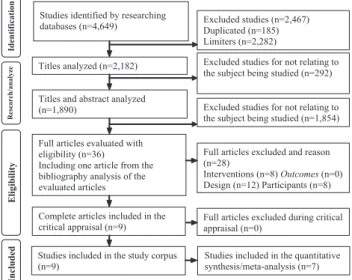
Of all the studies identiied by the method explained in the previous section, we noted that the irst selected sample comprised 4,649 studies.
Two independent researchers excluded 292 studies based on the inclusion criteria by reading the titles and 1,854 by reading the abstract.
After analyzing the full text of the articles (n=36), 28 studies were excluded, resulting in a corpus consist-ing of eight studies. Bibliography analysis of identiied reference articles also allowed the inclusion of another study, thus nine studies were considered for critical appraisal: eight RCT(2,6,9,11-14, 16) and one cohort study(10).
he entire process of study corpus selection can be
sum-marized by the following low chart (shown in Figure 1).
Excluded studies (n=2,467) Duplicated (n=185) Limiters (n=2,282) Studies identified by researching
databases (n=4,649)
Excluded studies for not relating to the subject being studied (n=1,854) Titles and abstract analyzed
(n=1,890)
Full articles excluded and reason (n=28)
Interventions (n=8) Outcomes (n=0) Design (n=12) Participants (n=8) Full articles evaluated with
eligibility (n=36) Including one article from the bibliography analysis of the evaluated articles
Full articles excluded during critical appraisal (n=0)
Complete articles included in the critical appraisal (n=9)
Studies included in the study corpus (n=9)
Titles analyzed (n=2,182) Excluded studies for not relating to the subject being studied (n=292)
Studies included in the quantitative synthesis/meta-analysis (n=7)
R
es
ear
ch
/an
al
yz
e
E
li
gi
b
il
it
y
In
cl
u
d
ed
Id
en
ti
fi
ca
ti
o
n
Figure 1 – Representative flowchart of study corpus refinement stages – Viseu, Portugal, 2015.
Effectiveness of heparin versus 0.9% saline solution in maintaining the permeability of central venous catheters: a systematic review
based on the “Cochrane Collaboration tool for Assessing risk of bias”(17).
R a n d o m se q u e n ce g e n e ra ti o n ( se le ct io n b ia s)
Beigi et al. 2014 +
Bertoglio et al. 2012 –
Bowers et al. 2008 +
Goossens et al. 2013 +
Heidari Gorji et al. 2015 +
Kaneko et al. 2004 +
Pumarola et al. 2007 +
Rabe et al. 2002 +
Schallom et al. 2012 +
Al lo ca ti o n co n ce a lm e n t (se le ct io n b ia s) + + ? + ? ? + ? + Bl in d in g o f p a rt ici p a n ts a n d p e rso n n e l (p e rf o rm a n ce b ia s) + – + ? + ? ? ? ? Bl in d in g o f o u tco m e a sse ssm e n t (d e te ct io n b ia s) ? – + ? + ? ? ? ? In co m p le te o u tco m e d a ta ( a tt ri ti o n b ia s) + + + + ? + ? + + Se le ct ive r e p o rt in g ( re p o rt in g b ia s) + + + + + + + + + O th e r b ia s + + + + + + + + + + ? –
Justification of the scores
Risk of bias unlikely to alter the results
Risk of bias raises some doubts about the results
Risk of bias seriously weakens the reliability of the results
Figure 2 – Summary of risk of bias according to the critical ap-praisal of the reviewers – Viseu, Portugal, 2015.
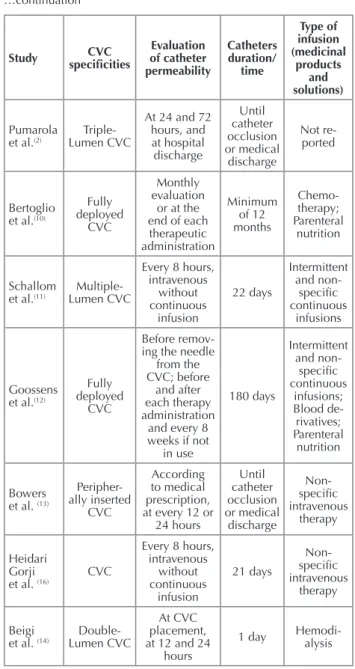
Below we present a summary of the most important aspects of the characteristics of the studies included in the study corpus, which were grouped and organized into an “evidence table” (see Chart 1).
We also present a summary of the most important as-pects of the main results from analyzing the selected studies (see Chart 2).
Summaryofquantitativedata - meta-analySiS
Analyzing the results of the meta-analysis and the re-spective forest plot (as shown in Figure 3), we can infer that there is no statistical signiicance, because the combined result of the meta-analysis overlaps the no-efect line.
Nevertheless, we can still point out that there is a ben-eicial efect in the group using the heparinized solutions as
a lush because although there is no statistical signiicance,
there is increased risk of non-permeable CVC in the saline solution group, supported by the value of meta-analytical
result (RR=0.68, CI 95%=0.41-1.10; p=0.12). From the
heterogeneity study we can infer that this is statistically
signiicant and it is classiied as low (Tau2=0.03, χ2=4.41,
df=4, p=0.35; I2=9%).
For the subgroup of fully deployed CVC, it was found that there are no statistically signiicant diferences
Chart 1 – Study corpus characteristics of the included studies – Viseu, Portugal, 2015.
Study speciicitiesCVC
Evaluation of catheter permeability Catheters duration/ time Type of infusion (medicinal products and solutions) Rabe et al.(6)
Triple-Lumen CVC Every 2 days 20 days
Not re-ported
Kaneko et al.(9)
Double-Lumen CVC with urokinase After each hemodialysis session Not reported Hemodi-alysis continued… …continuation
Study speciicitiesCVC
Evaluation of catheter permeability Catheters duration/ time Type of infusion (medicinal products and solutions) Pumarola et al.(2)
Triple-Lumen CVC
At 24 and 72 hours, and at hospital discharge Until catheter occlusion or medical discharge Not re-ported Bertoglio et al.(10)
Fully deployed
CVC
Monthly evaluation
or at the end of each
therapeutic administration Minimum of 12 months Chemo-therapy; Parenteral nutrition Schallom
et al.(11) Lumen CVC
Multiple-Every 8 hours, intravenous without continuous infusion 22 days Intermittent and non-speciic continuous infusions Goossens et al.(12)
Fully deployed
CVC
Before remov-ing the needle
from the CVC; before
and after each therapy administration
and every 8 weeks if not
in use 180 days Intermittent and non-speciic continuous infusions; Blood de-rivatives; Parenteral nutrition Bowers et al. (13)
Peripher-ally inserted CVC According to medical prescription, at every 12 or
24 hours Until catheter occlusion or medical discharge Non-speciic intravenous therapy Heidari Gorji
et al. (16) CVC
Every 8 hours, intravenous without continuous infusion 21 days Non-speciic intravenous therapy Beigi
et al. (14) Lumen CVC
Double-At CVC placement, at 12 and 24
hours
Santos EJF, Nunes MMJC, Cardoso DFB, Apóstolo JLA, Queirós PJP, Rodrigues MA
(RR=1.09, CI 95%=0.53-2.22; p=0.82). In the subgroup of
CVC with multiple lumens, there was a beneicial efect in the heparin group, which is a statistically signiicant result
(RR=0.53, CI 95%=0.29-0.95; p=0.03) and without
signii-cant heterogeneity among the studies (Tau2=0.00; χ2=0.70,
df=1, p=0.40; I2=0%). In the subgroup of double lumen CVC
for hemodialysis, a beneicial efect in the saline solution
group was veriied, although it did not reach statistical
sig-niicance (RR=1.18, CI 95%=0.08-17.82; p=0.90). Finally,
in relation to the subgroup of peripherally inserted CVC, statistical signiicance was also not observed (RR=0.14, CI
95%=0.01-2.60; p=0.19). We emphasize that the analysis of
the diferences between subgroups reveals low heterogene-ity (χ2=3.69, df=3, p=0.30; I2=18.7%).
Chart 2 – Main results of the studies included in the study corpus – Viseu, Portugal, 2015
Author/ Year/
Country Type of study/ Population
Interventions
Results/Outcomes Conclusions
Critical appraisal of quality Experimental Control
Rabe et al.(6)
(Germany)
RCT/n = 99 Participants in intensive care
5000IU of Heparin/ml Flush
0.9% saline solution Flush
200 mg/ml vitamin C
Flush
There was no difference between the use of heparin and the SS (p< 0.04, log-rank test).
Heparin-solutions are most effective when
compared to saline solution in maintaining
CVC permeability.
80%
Kaneko et al.(9)
(Japan)
RCT/n = 48 Hospitalized
participants
20 ml of saline solution Flush
20 ml of saline solution
Flush +
2 ml of 1000 IU/ml heparin
There was no difference between the use of heparin and the SS
(p =0.8599).
Saline solution is
suficient in maintaining
central catheter permeability for hemodialysis.
75%
Pumarola et al.(2)
(Spain)
RCT/n = 95 Participants in intensive care
0.9% saline solution Flush
100IU Heparin Flush
There was no difference between the use of heparin and SS
(p =0.744).
0.9% saline is also effective compared to 100 IU or 500 IU heparin
in maintaining CVC permeability.
85%
Bertoglio et al.(10)
(Italy)
Retrospective cohort study/n
= 610 Participants in the
cancer unit
500 IU/ SS 10 ml Heparin Flush
10 ml of 0.9% saline solution
Flush
There was no difference between the use of heparin and SS (HR -1.2; 95% CI: 0.6-2.5; p= 0.7).
Saline solution is as effective as heparinized
solution in maintaining patency.
7 points
Schallom et al.(11)
(USA)
RCT/n = 709 lumens/n = 341
Hospitalized participants
10IU Heparin/ml
Flush
10 ml of 0.9% saline solution
Flush
There was no difference between the use of heparin and SS (RR = 1.66, 95% CI =
0.86-3.22; p =0.136).
Saline solution may be preferable in maintaining
CVC patency, when used for a short time, compared to heparin.
85%
Goossens et al.(12)
(Belgium)
RCT/n = 802 Participants of the
cancer unit
300IU Heparin /3ml Flush
10 ml of 0.9% saline solution
Flush
There was no difference between the use of heparin and SS (RR = 0.94, 95% CI =
0.67%-1.32%).
Saline is an effective solution for fully deployed CVC lush.
85%
Bowers et al. (13)
RCT/n = 102 Hospitalized participants
100 IU/ml (3 ml) Heparin Flush
10 ml of 0.9% saline solution
Flush
There was no difference between the use of heparin and SS (6% rates of occlusion in SS group).
Saline solution is
suficient in maintaining
CVC permeability of peripheral insertions.
80%
Heidari Gorji et al. (16)
(Iran)
RCT/n = 84 Participants in intensive care
10 IU/ml (3 ml) Heparin Flush
10 ml of 0.9% saline solution
Flush
There was no difference between the use of heparin and SS
(p= 0.872).
Saline solution is recommended in maintaining CVC
permeability.
85%
Beigi et al. (14)
(Iran)
RCT/n = 96 Hospitalized
participants
1000 IU/10 ml SS Heparin Flush
10 ml of 0.9% saline solution
Flush
There was no difference between the use of heparin and SS (no CVC
occlusions)
Saline is effective in maintaining CVC
permeability for hemodialysis.
Effectiveness of heparin versus 0.9% saline solution in maintaining the permeability of central venous catheters: a systematic review
DISCUSSION
First, we must mention that to have adopted strict selec-tion criteria and rigidly followed every step of conducting a systematic review, we consider valid, reliable and transfer-able results. Yet we cannot help but notice that in some of the included studies researchers did not practice blinding, and yet there were some particular aspects of the allocation, randomization and incomplete data that were not met.
he heterogeneity found by statistical analysis is proba-bly due to the diference between the methodological qual-ity of the included RCT (methodological heterogenequal-ity), the fact that they do not possess wholly similar interven-tions such as diferent diluinterven-tions of heparin soluinterven-tions, the diferent types of CVC, and also because the populations
have diferent pathology (clinical heterogeneity). We also acknowledge that the non-permeable deinition of CVC is diferent between the included studies, which may possibly
translate some level of statistical heterogeneity(11).
Never-theless, by assuming the existence of these heterogeneities, by carrying out analyzes of subgroups and fulilling all the recommendations, we believe that this fact does not limit our conclusions.
We therefore observed that heparin CVC has been con-sidered over the years as a traditional and useful practice in maintaining the permeability of CVC, however this practice remains shrouded in some controversy. Heparin by itself is not a thrombolytic agent, it does not cause lysis or clot “fragmentation,” but prevents the progression of previously existing clots by inhibiting the factors related to the process Study or Subgroup
4.1.1 Fully deployed CVC
Goossens et al. 2013
Subtotal (95% CI)
Total events
Heterogeneity: Not applicable
Test for overall effect: Z = 0.23 (P = 0.82)
4.1.2 Multiple-Lumen CVC
Pumarola et al. 2007 Rabe et al. 2002 Schallom et al. 2012
Subtotal (95% CI)
Total events
Heterogeneity: Tau² = 0.00; Chi² = 0.70, df = 1 (P = 0.40); I² = 0% Test for overall effect: Z = 2.15 (P = 0.03)
4.1.3 Double-Lumen CVC
Beigi et al. 2014 Kaneko et al. 2004
Subtotal (95% CI)
Total events
Heterogeneity: Not applicable
Test for overall effect: Z = 0.12 (P = 0.90)
4.1.4 Peripherally inserted CVC
Bowers et al. 2008
Subtotal (95% CI)
Total events
Heterogeneity: Not applicable
Test for overall effect: Z = 1.32 (P = 0.19)
Total (95% CI)
Total events
Heterogeneity: Tau² = 0.03; Chi² = 4.41, df = 4 (P = 0.35); I² = 9% Test for overall effect: Z = 1.57 (P = 0.12)
Test for subgroup differences: Chi² = 3.69, df = 3 (P = 0.30), I² = 18.7%
Events
15
15
0 3 12
15
0 1
1
0
0
31
Total
398
398
18 33 314
365
47 22
69
52
52
884 Events
14
14
0 9 25
34
0 1
1
3
3
52
Total
404
404
25 33 395
453
49 26
75
50
50
982 Weight
37.6%
37.6%
15.0% 41.5%
56.5%
3.2%
3.2%
2.7%
2.7%
100.0%
M-H, Random, 95% CI
1.09 [0.53, 2.22]
1.09 [0.53, 2.22]
Not estimable 0.33 [0.10, 1.12] 0.60 [0.31, 1.18]
0.53 [0.29, 0.95]
Not estimable 1.18 [0.08, 17.82]
1.18 [0.08, 17.82]
0.14 [0.01, 2.60]
0.14 [0.01, 2.60]
0.68 [0.41, 1.10]
Heparin 0.9% Saline Risk Ratio Risk Ratio
M-H, Random, 95% CI
0.01 0.1 1 10 100
Favours Heparin Favours 0.9% Saline
Santos EJF, Nunes MMJC, Cardoso DFB, Apóstolo JLA, Queirós PJP, Rodrigues MA
RESUMO
Objetivo: Determinar qual é a solução (lush heparina comparado com o lush de soro isiológico 0.9%) mais eicaz na redução do risco de oclusões de cateteres venosos centrais (CVC) em adultos. Método: A revisão sistemática seguiu os princípios propostos pelo Cochrane Handbook; a análise crítica, a extração e a síntese dos dados foram realizadas por dois investigadores, isoladamente; e a análise estatística efetuada com recurso ao programa RevMan 5.2.8. Resultados: Foram incluídos oito estudos randomizados controlados e um estudo de
of clot formation, allowing lysis of the naturally occurring clot. Moreover, heparin has a very short lifespan (60 to 90 min) and no data or evidence present perfect validity of the dilution and therapeutic components of CVC to meet the therapeutic efect on one hand, and on the other and even more critically do not produce its undesirable side efects(10).
Moreover, there is no evidence in the literature that the concentration of heparin alone is related to improved permeable CVC rates, assuming a balance between
efec-tiveness and safety of the patient(10). However, the systemic
efects of the use of heparin and the development of
hepa-rin-induced thrombocytopenia may constitute a problem(6).
Despite the potential beneits of saline solution, the change in clinical practice for a normal saline solution has not been widely suggested in the literature for the whole typology of patients and CVC. A possible explanation for this may be attributed to the long period of time that CVC
remains in the patient(25-27), complications associated with
maintaining CVC(28-31), type of infusion used (medicinal,
solutions…)(32); if the purpose of the CVC is
hemodialy-sis(9-14) and institutional procedures for locking and lushing
can strengthen medical belief about heparin efectiveness(10),
thus ultimately leading to exploiting the efectiveness of other solutions(33) (i.e. citrate).
Although most of the study’s corpus suggest the use
of saline solution, one study(6) concluded that heparinized
solutions are more efective when compared to saline solu-tion for maintaining CVC patency. It is important to note
that the lush technique has not been described in detail
and it was performed only every 48 hours, which may have contributed to the diferences, for example, in comparing
this procedure to the study(11) in which the lush technique
has been described in detail and implemented every 8 hours. he same authors also point out that the strength of the results is due to adopting protocol operations and a higher nurse/patient ratio, so the standardization of practices for
conducting a lush every 8 hours, and the criteria for the
administrative lush order according to the intravenous
therapy (treatments) and interventions are shown as vital procedures.
In defense of the determined evidence, it is also note-worthy that our meta-analysis results indicate that there is no statistically signiicant diference between the eicacies
of lush solutions, which is supported by the value of
me-ta-analytic results (RR=0.68, CI 95%=0.41-1.10; p=0.12).
hese results clearly show that implementing the saline
so-lution lush in maintaining patency of CVC must be
trans-ferred to clinical practice.
In short, we should mention that the consensus among various authors and our results are consistent, allowing us to
draw the following conclusions: the saline solution is suf-icient for maintaining patency of CVC when compared to heparinized solutions(2,9-14,16); saline solution prevents exposure to complications arising from the use of heparin – these being thrombocytopenia, bleeding(11,12,14,16)… thereby adding signii-cance when associated with diferences in the dilutions used (often by the team itself ), non-uniformity of pre-established
protocols and potential errors of medication preparation(1).
CONCLUSION
Currently, CVC obstruction is assumed as an impor-tant concern for health professionals because it implies the suspension of therapies, an increase risk to the patient and associated costs. In this sense, strategies to reduce this complication are crucial, in particular the choice of solution being used to maintain CVC patency.
According to available evidence, the consensus among several authors and the results of this systematic review show no signiicant diferences between the efectiveness of heparinized solutions and saline 0.9% in maintaining CVC
patency in adults (RR=0.68, CI 95%=0.41-1.10; p=0.12).
Considering that there is evidence that using saline solution is suicient for maintaining CVC patency, thus preventing the risks associated with the administration of heparin, we suggest the realization and implementation of a new guideline; with the main purpose being better resource management, making the technique related to the issue of general research for all health professionals.
Practical imPlicationS
he interventions considered in this systematic review are efective and can be useful in practice (Level of Evi-dence 1.b); health care professionals can use these interven-tions on adults (Grade A recommendation).
reSearch imPlicationS
It is necessary to properly carry out RCT designed to compare the clinical beneits, economic evaluations, patient safety and cost-efectiveness of solutions in diferent groups of patients (comorbidities), diferent types of CVC, CVC insertion reasons (intravenous therapy, parenteral nutrition, chemotherapy …), according to the estimated time (short
or long term) and covering other outcomes for establishing
causal relationships (in addition to the number of non-permeable CVC).
RCT that validate the application of a performance protocol are necessary to maintain CVC permeability by
using 0.9% saline lush and that prove the efectiveness of
Effectiveness of heparin versus 0.9% saline solution in maintaining the permeability of central venous catheters: a systematic review
coorte e os resultados da meta-análise mostram não existir diferenças (RR=0.68, IC 95%=0.41-1.10; p=0.12). A análise por subgrupos mostra que nos CVC totalmente implantados não se veriicaram diferenças (RR=1.09, IC 95%=0.53-2.22; p=0.82); nos CVC com vários lúmens existiu um efeito benéico no grupo da heparina (RR=0.53, IC 95%=0.29-0.95; p=0.03); nos CVC de duplo lúmen para hemodiálise (RR=1.18, IC 95%=0.08-17.82; p=0.90) e nos CVC de inserção periférica (RR=0.14, IC 95%=0.01-2.60; p=0.19) também não se veriicaram diferenças. Conclusão: O soro isiológico é suiciente para manter a permeabilidade dos cateteres venosos centrais, prevenindo os riscos associados à administração da heparina.
DESCRITORES
Cateterismo Venoso Central; Heparina; Cloreto de Sódio; Cateteres Venosos Centrais; Revisão.
RESUMEN
Objetivo: Determinar cuál es la solución (lush con heparina comparado con el de suero isiológico al 0,9%) más eicaz en la reducción del riesgo de oclusiones de catéteres venosos centrales (CVC) en adultos. Método: La revisión sistemática siguió los principios propuestos por el Cochrane Handbook; el análisis crítico, la extracción y la síntesis de los datos fueron realizados por dos investigadores, aisladamente; y el análisis estadístico fue llevado a cabo con recurso al programa RevMan 5.2.8. Resultados: Se incluyeron ocho estudios randomizados controlados y un estudio de cohorte, y los resultados del metaanálisis muestran no existir diferencias (RR=0.68, IC 95%=0.41-1.10; p=0.12).El análisis por subgrupos muestra que en los CVC totalmente implantados no se veriicaron diferencias (RR=1.09, IC 95%=0.53-2.22; p=0.82); en los CVC con varios lúmenes existió un efecto benéico en el grupo de la heparina (RR=0.53, IC 95%=0.29-0.95; p=0.03); en los CVC de doble lumen para hemodiálisis (RR=1.18, IC 95%=0.08-17.82; p=0.90) y en los CVC de inserción periférica (RR=0.14, IC 95%=0.01-2.60; p=0.19) tampoco se veriicaron diferencias. Conclusión: El suero isiológico es suiciente para mantener la permeabilidad de los catéteres venosos centrales, previniendo los riesgos asociados con la administración de la heparina.
DESCRIPTORES
Cateterismo Venoso Central; Heparina; Cloruro de Sodio; Catéteres Venosos Centrales; Revisión.
REFERENCES
1. Encarnação RMC, Marques P. Permeabilidade do cateter venoso central: uma revisão sistemática da literatura. Rev Enf Ref. 2013;serIII(9):161-9.
2. Fuentes i Pumarola C, Casademont Mercader R, Colomer Plana M, Cordón Bueno C, Sabench Casellas S, Félez Vidal M, et al. Estudio comparativo del mantenimiento de la permeabilidad de los catéteres venosos centrales de tres luces. Enferm Intensiva. 2007;18(1):25-35.
3. Dal Molin A, Allara E, Montani D, Milani S, Frassati C, Cossu S, et al. Flushing the central venous catheter: is heparin necessary? J Vasc Access. 2014;15(4):241-8.
4. Khanna V, Mukhopadhayay C, Verma VKE, Dabke P. Evaluation of central venous catheter associated blood stream infections: a microbiological observational study. J Pathog. 2013;2013:936864.
5. Registered Nurses’ Association of Ontario. Care and maintenance to reduce vascular access complications: guideline supplement. Toronto: RNAO; 2008.
6. Rabe C, Gramann T, Sons X, Berna M, González-Carmona MA, Klehr HU, et al. Keeping central venous lines open: a prospective comparison of heparin, vitamin C and sodium chloride sealing solutions in medical patients. Intensive Care Med. 2002;28(8):1172-6.
7. Udeh CI, Douglas A, Udeh BL, Hata JS. Heparin-induced thrombocytopenia: a clinical and economic review. OA Anaesthetics. 2013;1(1):3.
8. Lee GM, Arepally GM. Heparin-induced thrombocytopenia. Hematology Am Soc Hematol Educ Program. 2013; 2013:668-74.
9. Kaneko Y, Iwano M, Yoshida H, Kosuge M, Ito S, Narita I, et al. Natural saline-lush is suficient to maintain patency of
immobilized-urokinase double-lumen catheter used to provide temporary blood access for hemodialysis. Blood Purif. 2004;22(5):473-9.
10. Bertoglio S, Solari N, Meszaros P, Vassallo F, Bonvento M, Pastorino S, et al. Eficacy of normal saline versus heparinized saline solution for
locking catheters of totally implantable long-term central vascular access devices in adult cancer patients. Cancer Nurs. 2012;35(4):E35-42.
11. Schallom ME, Prentice D, Sona C, Micek ST, Skrupky LP. Heparin or 0.9% sodium chloride to maintain central venous catheter patency: a randomized trial. Crit Care Med. 2012;40(6):1820-6.
12. Goossens GA, Jérôme M, Janssens C, Peetermans WE, Fieuws S, Moons P, et al. Comparing normal saline versus diluted heparin to lock non-valved totally implantable venous access devices in cancer patients: a randomised, non-inferiority, open trial. Ann Oncol. 2013;24(7):1892-9.
13. Bowers L, Speroni KG, Jones L, Atherton M. Comparison of occlusion rates by lushing solutions for peripherally inserted central catheters
with positive pressure Lueractivated devices. J Infus Nurs. 2008;31(1):22-7.
14. Beigi AA, HadiZadeh MS, Salimi F, Ghaheri H. Heparin compared with normal saline to maintain patency of permanent double lumen hemodialysis catheters: a randomized controlled trial. Adv Biomed Res. 2014;3:121.
15. Sona C, Prentice D, Schallom L. National survey of central venous catheter lushing in the intensive care unit. Crit Care Nurse.
2012;32(1):e12-9.
16. Heidari Gorji MA, Rezaei F, Jafari H, Yazdani Cherati J. Comparison of the effects of heparin and 0.9% sodium chloride solutions in maintenance of patency of central venous catheters. Anesth Pain Med. 2015;5(2):e22595.
Santos EJF, Nunes MMJC, Cardoso DFB, Apóstolo JLA, Queirós PJP, Rodrigues MA
18. Moher D, Liberati A, Tetzlaff J, Altman DG. Preferred reporting items for systematic reviews and meta-analyses: the PRISMA statement. Ann Intern Med. 2009;151(4):264-9, w64.
19. Liberati A, Altman DG, Tetzlaff J, Mulrow C, Gotzsche PC, Ioannidis JP, et al. The PRISMA statement for reporting systematic reviews and meta-analyses of studies that evaluate health care interventions: explanation and elaboration. PLoS Med. 2009;6(7):e1000100.
20. Carneiro A. Como avaliar a investigação clínica: o exemplo da avaliação crítica de um ensaio clínico. J Port Gastrenterol. 2008;15(1):30-6.
21. The Joanna Briggs Institute. User manual. Version 5.0 System for the Uniied Management, Assessment and Review of Information.
Adelaide: JBI; 2012.
22. The Joanna Briggs Institute. Reviewers’ manual: 2014 edition. Adelaide: JBI; 2014.
23. Santos E, Cunha M. interpretação crítica dos resultados estatísticos de uma meta-análise: estratégias metodológicas. Millenium. 2013;44:85-98.
24. The Joanna Briggs Institute. The JBI Approach: levels of evidence and grades of recommendation. Adelaide: JBI; 2013.
25. Ferreira MVF, Andrade D, Ferreira AM. Infection control related to central venous catheter impregnated with antiseptics: an integrative review. Rev Esc Enferm USP [Internet]. 2011 [cited 2014 Oct 12];45(4):1002-6. Available from: http://www.scielo.br/pdf/reeusp/v45n4/ en_v45n4a30.pdf
26. Gomes AV, Nascimento MA. Central venous catheterization in pediatric and neonatal intensive care units. Rev Esc Enferm USP [Internet]. 2013 [cited 2014 Oct 12];47(4):794-800. Available from: http://www.scielo.br/pdf/reeusp/v47n4/en_0080-6234-reeusp-47-4-0794.pdf
27. Smith RN, Nolan JP. Central venous catheters. BMJ. 2013;347:f6570.
28. Chopra V, Anand S, Hickner A, Buist M, Rogers MA, Saint S, et al. Risk of venous thromboembolism associated with peripherally inserted central catheter: a systematic review and meta-analysis. Lancet. 2013;382(9889):311-25.
29. Napalkov P, Felici DM, Chu LK, Jacobs JR, Begelman SM. Incidence of catheter-related complications in patients with central venous or hemodialysis catheters: a health care claims database analysis. BMC Cardiovasc Disord. 2013;13:86.
30. Hammarskjöld F, Berg S, Hanberger H, Taxbro K, Malmvall BE. Sustained low incidence of central venous catheter-related infections over six years in a Swedish hospital with an active central venous catheter team. Am J Infect Control. 2014;42(2):122-8.
31. Silva TN, Marchi D, Mendes ML, Barretti P, Ponce D. Approach to prophylactic measures for central venous catheter-related infections in hemodialysis: a critical review. Hemodial Int. 2014;18(1):15-23.
32. Moore CL, Besarab A, Ajluni M, Soi V, Peterson EL, Johnson LE, et al. Comparative effectiveness of two catheter locking solutions to reduce catheter-related bloodstream infection in hemodialysis patients. Clin J Am Soc Nephrol. 2014;9(7):1232-9.