Stress and sleep quality of nurses
working different hospital shifts
*O ESTRESSE E QUALIDADE DE SONO DO ENFERMEIRO NOS DIFERENTES TURNOS HOSPITALARES
EL ESTRÉS Y LA CALIDAD DE SUEÑO DEL ENFERMERO EN LOS DIFERENTES TURNOS HOSPITALARIOS
* Extracted from the dissertation "Stress and the sleep-wake cycle of nurses who work in different hospital departments", Nursing Department, School of Medical Sciences, State University of Campinas, 2008. 1 RN. MS in Nursing, Nursing Department, School of Medical Sciences, State University of Campinas. Campinas,
SP, Brazil. [email protected] Associate Professor at Nursing Department, School of Medical Sciences, State University of Campinas. Campinas,
O
RIGINAL
A
R
TICLE
RESUMO
Este estudo teve como objetivo analisar a re-lação entre estresse e qualidade do sono de enfermeiros que atuam em diferentes seto-res hospitalaseto-res, dos turnos diurnos e notur-nos. Foi realizado em uma instituição hospi-talar da cidade de Campinas, São Paulo. Uti-lizou-se para a coleta de dados: Escala Bianchi de Stress modificada (EBSm) e o Índice de Qualidade do Sono de Pittsburgh (PSQI). Par-ticiparam 203 enfermeiros com faixa etária predominante de 40 a 49 anos de idade. Os resultados indicaram que houve uma corre-lação significativa entre estresse e sono (cor-relação de Spearman; r= 0,21318; p= 0,0026) e entre níveis elevados de estresse e quali-dade de sono ruim para os enfermeiros do turno da manhã (p=0,030; Teste Qui-Qua-drado). Concluiu-se que o nível de estresse pode ser um fator diretamente correlacio-nado com o sono, visto que quanto maior o nível de estresse dos enfermeiros, pior é a qualidade de sono.
DESCRITORES
Estresse. Sono. Enfermagem. Trabalho em turnos.
Maria Cecília Pires da Rocha1, Milva Maria Figueiredo De Martino2
ABSTRACT
The purpose of this study was to analyze the relationship between stress and sleep qual-ity among nurses who work on different hos-pital departments during morning, after-noon and night shifts. This study was per-formed in a hospital in Campinas, Sao Paulo. Data collection was performed using the Bianchi Stress Scale modified (BSSm) and Pittsburgh Sleep Quality Index (PSQI). Study participants were 203 registered nurses, mostly aged between 40 and 49 years. Re-sults show there is a significant correlation between stress and sleep (Spearman Analy-sis; r= 0.21318; p= 0.0026). Nurses working morning shifts showed higher stress levels (p = 0.030; Chi-square Test,) and poor sleep quality. In conclusion, stress level was a fac-tor directly correlated to sleep, showing that the higher the stress score, the worse the quality of sleep.
KEY WORDS
Stress. Sleep. Nursing. Shift work.
RESUMEN
Este estudio tuvo como objetivo analizar la relación entre estrés y calidad del sueño de enfermeros que actúan en diferentes secto-res hospitalarios, de los turnos diurnos y nocturnos. Fue realizado en una institución hospitalaria de la ciudad de Campinas, São Paulo, Brasil. Para la recolección de datos se utilizaron la Escala Bianchi de Stress modifi-cado (EBSm) y el Índice de la Calidad del Sue-ño de Pittsburgh (PSQI). Participaron 203 enfermeros, pertenecientes en forma pre-dominante a la faja etaria que comprende de los 40 a los 49 años de edad. Los resulta-dos indicaron que hubo una correlación sig-nificativa entre estrés y sueño (Correlación de Spearman; r = 0,21318; p = 0,0026) y en-tre niveles elevados de estrés y mala calidad de sueño para los enfermeros del turno de la mañana (p= 0,030; Test Qui-Cuadrado). Se concluyó en que el nivel de estrés puede ser un factor correlacionado directamente con el sueño, apuntándose que cuanto mayor es el nivel de estrés de los enfermeros, peor es la calidad de su sueño.
DESCRIPTORES
INTRODUCTION
The work developed by the nurse demands attention, as he often performs activities with a high level of difficulty and responsibility, constituting psychosocial factors that condition the presence of stress at work. The accelerated rhythm, the excessive journeys and the working shift are factors that may develop occupational stress.
Occupational stress results from tensions associated to the work and the professional life. The psychic suffering related to work is determined by various factors(1). These
factors include the excessive rhythm of work and long journeys with few breaks for resting and meals.
Health institutions reduce their cost by increasing the exploitation of their workers, gradually instituting the increase of work journeys and the reduction of work force. This reduction in the number of personnel affects directly the work of those nurses who remain at the institution and who are forced to increase the overload in the execution of their activities, which generates situations of tension in the work environment and compromises the care given to the patient(2).
The work in shifts favors not only the outbreak of sleep disorders, but also the increase of daily sleepiness and the decrease of the subject’s alert states. The effects of these changes in the wake-sleep cycle may cause consequences such as a higher risk for wounds and work accidents, as well as the impairment of the life quality of these workers(3).
This study aims to analyze the stress levels
of nurses in different hospital departments, and their relation to the sleep quality.
The choice of a Public School Hospital as field study was feasible in face of the significant number of professionals linked to it, both due to its size and to the hiring policy of the Human Resources. The study departments of these institutions are considered to be highly complex and excessively involve the care and supervision activities of the nurse, representing, together with the other departments, a diversification of the work executed by this professional.
OBJECTIVES
•
Analyzing the relation between stress and sleep qual-ity in nurses who work in different departments of the hos-pital environment, during morning, afternoon and night shifts;•
Correlating the changes in sleep quality and levels of stress presented by the nurses.LITERATURE REVIEW
The knowledge about Physiology and Chronobiology were the theoretical pillars of this study, in order to under-stand the way stress could interfere in the nurse’s sleep quality. There is a narrow relation between the nervous and the endocrine systems, considering the performance of the hypothalamus as a common organ to both.
The hypothalamus and the pituitary gland together con-trol the function of several endocrine glands, especially the adrenal glands, which are responsible for the release of the cortisol hormone. Cortisol increases in the last stages of the human being’s sleep, aimed at preparing the organism to wake(4).
Stress is considered one of the main factors causing in-somnia. Both stress and wake trigger the activity of the hypothalamic-pituitary-adrenal axis (HPA), causing the awakening. During the sleep, the activities of the HPA axis are reduced, whereas the stress triggers the activities of the HPA axis as a response to stressful events(5).
Occupational activities that adopt work in shifts and at night impose serious effects to the health and impairment in the social life of the professionals. This organizational sys-tem of work changes the human rhythms, having direct consequences in the organic systems and in the wake-sleep cycle.
The association among stress and changes in sleep regarding the nurse’s work is one of the recent concerns observed in studies. In the 90’s, the first studies began to correlate stress, insomnia and overload of the nurse’s work(6-7).
There are three types of sleep disorders related to stress at work(8): difficulty to fall asleep, higher frequency of
in-terruptions during the night sleep and greater difficulty to wake up in the morning. In this study, the professionals who had overload at work presented association to the three types of sleep disorders.
The stress levels of nurses and organizational charac-teristics of the work were the object of a study(9), which
related the difficulty to fall asleep and the use of drugs to sleep to the stress related to work. Results indicated a posi-tive relation among the variables.
Authors suggest that the occupational stress is a pos-sible risk factor for insomnia and changes in the sleep pat-terns(10), by observing the existing relation between
occu-pational stress and sleep disorders with the association of high secretions of cortisol due to the activation of the hy-pothalamic-pituitary-adrenal axis and adrenal cortex.
One of the few studies relating the tension of the nurs-ing work to the sleep quality(11) observed that the
psycho-Occupational activities that adopt work in shifts and at night impose serious effects
to the health and impairment in the social life of the
logical tension of the work generates highly harmful effects to the sleep, as the result of the nurses’ bad adaptation to the work environment.
Nevertheless, the work conditions of the subjects in the work shifts of the nurse are going to be discussed more often in the next decades. Professionals in the nursing area do not always have excellent work conditions, mainly re-garding the exhausting work schedules adopted.
METHOD
The study was characterized as a quantitative, cross-sec-tional, descriptive and comparative study. It describes the condition of stress and wake-sleep cycle of nurses who work in different hospital departments, provided with primary data collected through questionnaires applied to the subjects.
The study was carried out in the period from May to July of 2007, at the Clinical Hospital of the State University of Campinas (CH-Unicamp) in the following departments: Emergency Unit (EU); Surgical Center (SC); Material and Sterilization Center (MSC); Intensive Care Unit (ICU); Emer-gency Nursing and Trauma Surgery and Psychiatry (EN-TS); Surgical Medical Nursing I; Surgical Medical Nursing II and Bone Marrow Transplant (BMT).
The nursing team of the CH-Unicamp has 242 nurses. This study had the participation (n=203) of nurses who worked in the morning, afternoon and night shifts, at the previously designed departments.
The study excluded subjects who refused to participate; those who were either on sick leave or on vacation during the period of data collection, and those who did not return the provided questionnaires up to the due date established by the researcher.
Data were collected by the researcher herself, who fol-lowed up as the questionnaires were filled out, providing instructions about how to fill them out and clarifying even-tual doubts during the working period. In order to achieve the compliance of the subjects, a period of 15 days was established for returning the questionnaires, since nurses were performing activities that could not be interrupted during data collection.
In total, 83.88% of the questionnaires were returned, 14 nurses (6.89%) did not return them in the established period and 25 nurses (12.31%) were on vacation, sick leave or refused to participate in the study.
The instruments used for data collection were: identifi-cation form, the Modified Bianchi Stress Scale – MBSS and the Pittsburgh Sleep Quality Index – PSQI.
The identification form was used to characterize the nurse’s sociodemographic data. It was elaborated by the researcher for this study and had questions regarding the identification and location of the nurse’s work.
The Bianchi Stress Scale - BSS(12) allows to identify and
classify the stress of the nurse in the hospital environment. The instrument was validated and has been used in several studies(12-13). The questionnaire was adapted to this study
considering some questions existing in the work process of nurses from different institutions.
The 63 questions of the BSS refer to the nurse’s work. Based on the total and partial scores, the stress level was classified as it follows:
•
Less than 2 = low stress level;•
From 2.0 to 2.9 = medium stress level;•
From 3.0 to 3.9 = alert for high stress level;•
Higher or equals to 4 = high stress level.The Pittsburgh Sleep Quality Index(14) (PSQI) is a
self-applied questionnaire aimed at evaluating the characteris-tics of the sleep patterns and quantifying the sleep quality of the subject. This questionnaire has ten questions and, for all questions, there is a space for the record of com-ments by the interviewee, in case it is necessary. In this instrument, the scale varies from 0 to 20 points and scores higher than 5 indicate bad sleep quality(14-15).
This type of record and evaluation of the sleep pattern was used in the literature by several authors(11,14-15).
In order to obtain the necessary consent for develop-ing the study, the first stage of data collection consisted on the personal contact to the director of the Nursing Depart-ment, who later released an internal notification to all de-partments stating nurses would be the subjects of the study, its importance and the starting date of data collection. The investigation was initiated after the project approval by the Committee of Ethics in Research with Human Beings of the School of Medical Sciences of Unicamp on March 27, 2007 (project no. 783/2006) and, therefore, it counted on the subjects who participated in this study to sign the Term of Free and Clarified Consent.
A descriptive analysis was carried out in order to evalu-ate the measures of the collected results and the sample profile according to the variables in study. Frequency tables were designed for the categorical variables (gender and work shift, for instance) with values of absolute (N) and percent (%) frequency. Descriptive statistics were used for the continuous variables, with measures of position (mean and median) and dispersion (standard deviation), (age and period of time in the function, for instance).
of p is equal or inferior to 0.05 for the statistically signifi-cant result (p<0.05).
The collected data were typed in the program Excel for Windows/98 (Microsoft Office 2003) and, later, transferred to the program SAS – System for Windows (Statistical Analy-sis System), version 9.1.3 (SAS Institute Inc, 2002-2003, Cary, NC, USA). The necessary support to the statistical treatment was offered by the professionals of the Statistics Service of the Research Committee of the School of Medical Sciences -Unicamp.
RESULTS AND DISCUSSION
In this study, the analysis of internal consistence of the instrument used to identify and classify the nurse’s stress, the MBSS, presented the value of 0.955 for the alpha coef-ficient of Cronbach. As for the analysis of internal consis-tence of the PSQI, which evaluated the characteristics of the sleep patterns and quantified the sleep quality of the nurses, the value of 0.883 was obtained for the alpha coef-ficient of Cronbach.
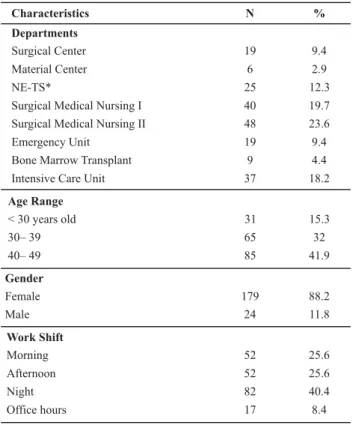
Table 1 indicates the studied categorical variables, both in numerical values of frequency and in percentage.
Table 1 - Generalcharacteristics of the studied sample - Campi-nas, SP - 2007
N %
19 9.4
6 2.9
25 12.3
40 19.7
48 23.6
19 9.4
9 4.4
37 18.2
31 15.3
65 32
85 41.9
179 88.2
24 11.8
52 25.6
52 25.6
82 40.4
Characteristics Departments
Surgical Center Material Center NE-TS*
Surgical Medical Nursing I
Surgical Medical Nursing II Emergency Unit
Bone Marrow Transplant Intensive Care Unit
Age Range
< 30 years old 30– 39 40– 49
Gender
Female Male
Work Shift
Morning Afternoon Night
Office hours 17 8.4
Note: (n= 203) * Emergency Nursing and Trauma Surgery and Psychiatry
The studied subjects were divided in the different de-partments as it follows: Surgical Center, 9.4%; Material
Center, 2.9%, Emergency Nursing and Trauma Surgery and Psychiatry, 12.3%; Surgical Medical Nursing I, 19.7%; Sur-gical Medical Nursing II, 23.6%; Emergency Unit, 9.4%; Bone Marrow Transplant, 4.4% and Intensive Care Unit, 18.2%.
Being grouped according to their age, 15.3% of the sub-jects were under 30 years old, 32% were between 30 and 39 years old, 41.9% were between 40 and 49 years old and 10.8% were over 50 years old.
Other studies(12-13) showed that the age range of the
nurses was predominantly constituted with adults from 31 to 40 years old, differently from the findings of this study, in which the average age of the nurses was between 40 and 49 years old (n=85).
Regarding the gender, the prevalence stood on the fe-male gender (88.2%). Other authors(12-13) also found the
predominance of women in the nursing profession. As for the work shift, the sample consisted of 25.6% of nurses from the morning and afternoon shifts respectively, 40.4% from the night shift, and 8.4% worked during office hours.
The total scores of stress and sleep quality of nurses who work in different departments of the hospital envi-ronment during the morning, afternoon and night periods are presented in Table 2.
Table 2 - Total score in the MBSS and global score in the PSQI -Campinas, SP - 2007
Variable
Total score of stress
Total score of sleep
N
197
203
Mean
2.6
6.8
S.D.*
0.6
3.8
Minimum
1.3
0.0
Median
2.6
6.0
Maximum
4.1
19.0
Note:(n= 203) * SD: Standard deviation of the mean
The analysis of table 2, which presents the total score of stress in the MBSS and the global score in the PSQI of the sample, indicated that the average score of stress among nurses was 2.6 (medium stress level). The values found for the average level of stress were similar to other national studies developed(12-13)
The global score in the PSQI (6.8) corresponded to bad sleep quality. It was observed that scores higher than 5.0 indicated the sleep quality could be considered bad(14-15).
Correlation between stress and sleep quality
Score of Stress
Score
of
sleep
20
16
12
8
4
0
0 1 2 3 4 5
Figure 1 - Correlation between the values for the total score of stress of the nurses and the global score in the PSQI
A poor correlation was observed between stress and sleep, however, it was considered significant by the correla-tion coefficient of Spearman (r = 0.21318; p = 0.0026) be-tween the total score of stress in the MBSS and the global score of sleep in the PSQI of the nurses, as Figure 1 shows.
Therefore, the results of this study suggest that the level of stress may be a factor that is directly proportional, posi-tive and correlated to sleep, since the higher the stress level of nurses, the higher the global score of their sleep index, indicating bad sleep quality.
The result of this study was similar to the analysis of the association between stress and life quality performed by other authors(11,16). In a study developed at seven
hospi-tals in Shanghai, in which 1,983 nurses participated, the authors observed that the stress at work was correlated to the impairment of the nurses’ sleep(16).
The data analyzed in Table 3 showed that only the com-parison to the department of SMN I (Surgical Medical Nurs-ing I) was found statistically significant, usNurs-ing the exact test of Fisher (p = 0.027) when comparing the scores of the
sub-jects referring to the low level of stress (< 2,0) with good sleep quality, as well as the scores of medium stress level (2.0 – 2.9), and alert and high stress level (> or = 3.0), when compared to bad sleep quality.
Table 3 - Comparison between the scores of stress level in the MBSS and sleep quality in the PSQI in the different departments -Campinas, SP - 2007
VARIABLE quality (%)Good sleep quality (%)Bad sleep Valueof p*
DEPARTMENT - SMN I
0.027**
< 2.0 – low stress level 100.00 0.00
2.0 – 2.9 – medium stress level >= 3.0 – alert and high stress level
59.09 26.67
40.91 73.33
Note: (n=203). *exact test of Fisher; **statistically significant (p< 0.05),
significant correlations are underlined.
whereas 73.3% of the nurses with high stress level presented bad sleep quality.
At the hospitalization unit of the Surgical Medical Nurs-ing I (SMN I) there is the aggravatNurs-ing fact that a great part of the patients receive complex nursing care, with infusions of vasoactive medications and constant monitoring of their vital signs. The correlation between work overload and stress is a subject observed in another study developed with nurses(14). Nevertheless, it is also possible to add the changes
in the sleep pattern to this overload, resulting in the sleep deficit, the excess of physical effort and the high demand of work are indicators of risks for sleep disorders(17).
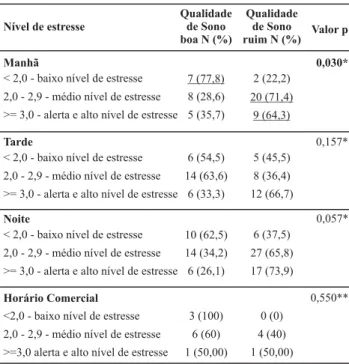
The comparison between the scores of stress levels in the MBSS and sleep quality in the PSQI in the different shifts are presented in Table 4.
Table 4 - Comparison between the scores of stress levels in the MBSS and sleep quality in the PSQI in the different shifts - Cam-pinas - SP, 2007
Nível de estresse
Qualidade de Sono boa N (%)
Qualidade de Sono
ruim N (%) Valor p
Manhã 0,030*
< 2,0 - baixo nível de estresse 7 (77,8) 2 (22,2)
2,0 - 2,9 - médio nível de estresse >= 3,0 - alerta e alto nível de estresse
8 (28,6) 5 (35,7)
20 (71,4)
9 (64,3)
Tarde 0,157*
< 2,0 - baixo nível de estresse 6 (54,5) 5 (45,5)
2,0 - 2,9 - médio nível de estresse
>= 3,0 - alerta e alto nível de estresse
Noite
14 (63,6)
6 (33,3)
8 (36,4)
12 (66,7)
0,057*
< 2,0 - baixo nível de estresse 10 (62,5) 6 (37,5)
2,0 - 2,9 - médio nível de estresse >= 3,0 - alerta e alto nível de estresse
Horário Comercial
<2,0 - baixo nível de estresse 2,0 - 2,9 - médio nível de estresse >=3,0 alerta e alto nível de estresse
14 (34,2) 6 (26,1)
3 (100) 6 (60) 1 (50,00)
27 (65,8) 17 (73,9)
0 (0) 4 (40) 1 (50,00)
0,550**
In this department, 100% of those who presented low
stress level also reported to have good sleep quality, Note: (n=203).
* Chi-Square Test; **statistically significant (p< 0.05), significant
Regarding the work shift, results were statistically sig-nificant (p=0.030) using the Chi-square test when compared to stress and sleep, as Table 4 shows.
The sleep quality of the nurses from the morning shift was related to stress and the increase in stress levels resulted in the impairment of the sleep quality for these subjects.
It was observed that 77.8% of the nurses from the morning shift with low stress level presented good sleep quality. On the other hand, 71.4% of the nurses with medium stress level pre-sented bad sleep quality, as well as 64.3% of the nurses with alert and high stress level also presented bad sleep quality.
After observing high stress levels associated to bad sleep quality during the morning shift, it is necessary to consider that hospital institutions concentrate part of their activi-ties in this period, such as hospitalizations, collection of laboratory exams, diagnostic exams, medical visits and es-timations of hospital discharge.
A meta-analysis(18) states that several studies indicate
significant effects in the personal and social life of the nurses, as well as greater risks to develop symptoms of stress caused by the night shift. A study(9) developed with nurses
found a significant correlation for high stress levels in night shifts and low stress levels and morning shifts.
Nevertheless, when this study correlated the stress lev-els and sleep quality, it obtained significant data indicating sleep impairment, daily sleepiness and high stress levels for the subjects from the morning shift, who may present early awakening and have, as consequence, sleep deficit.
Considering that work shifts may play a decisive role in the social and leisure life of the professional, separating him from the family life, it is necessary to apply measures of sleep hygiene to the subjects who present changes in their wake-sleep cycle, aimed at reducing the damages caused by the lack of sleep.
CONCLUSION
The investigation developed between the analysis of sleep and stress, in subjects from different departments,
confirmed the effect of stress over sleep, with negative re-percussion for the professional.
A relation was observed between the levels of stress and the sleep quality of nurses who work in different de-partments during morning, afternoon and night shifts.
A correlation between stress and sleep was also found. The higher the nurses’ stress level, the worst their sleep quality. The quality of the nurses’ night sleep was bad, the average global score in the PSQI was 6.8, regardless the shift or department in which they worked.
The nurses who worked in the SMN I, as well as nurses from the morning shift, presented statistically significant correlations between stress and sleep, indicating that high stress levels interfere in the sleep quality.
In order to obtain better life quality of the professional and performance of the subjects in the work environment, actions must be directed towards departments and shifts that presented higher scores of stress and bad sleep qual-ity, for instance the Surgical Medical Nursing I and the morn-ing shift, in which the presented results indicated bad sleep quality and high stress levels.
It was observed that the average values found for the sleep score were compatible with bad sleep quality. The awareness of the importance to obtain healthy sleep hab-its must be incorporated by the hospital institutions, aimed at a satisfactory life quality for their professionals. Propos-ing nurses a work that is compatible with life quality, wel-fare and personal satisfaction is a great challenge.
After the analysis of the presented results, the authors confirmed the need for changes in behavior, attitude, rest and motivation to work.
Nurses must consider the multiple repercussions of the nursing work for their biological functions, adopting hy-giene-dietetic measures, in order to keep their health ac-cording to the type of work.
These data may, at another stage, be complemented with further investigations about sleep, as well as about its correlation to the high stress levels of this population.
REFERENCES
1. Brasil. Ministério da Saúde. Organização Pan-Americana da Saú-de (OPAS). Doenças relacionadas ao trabalho: manual Saú-de proce-dimentos para os serviços de saúde. Brasília. 2001. [citado 2003 ago. 25]. Disponível em: http://dtr2004.saude.gov.br/susdeaz/ instrumento/arquivo/16_Doencas_Trabalho.pdf#search=% 22doen%C3%A7as%20relacionadas%20ao%20trabalho%22
3. De Martino MMF. Arquitetura do sono diurno e ciclo vigília-sono em enfermeiros nos turnos de trabalho. Rev Esc Enferm USP [periódico na Internet]. 2009 [citado 2009 maio 15];43(1): [cerca de 6 p.]. Disponível em: http://www.scielo.br/pdf/ reeusp/v43n1/25.pdf
4. Nunes MT. O hipotálamo endócrino. In: Aires, MM. Fisiologia. Rio de Janeiro: Guanabara Koogan; 1999. p.761-81.
5. Palma BD, Tiba PA, Machado RB, Tufik S, Suchecki D. Repercus-sões imunológicas dos distúrbios do sono: o eixo hipotálamo-pituitária-adrenal como fator modulador. Rev Bras Psiquiatr. 2007;29(1 Supl):533-8.
6. Hodgson LA. Why do we need sleep? Relating theory to nursing practice. J Adv Nurs. 1991;16(12):1503-10.
7. Weinberger R. Teaching the elderly stress reduction. J Gerontol Nurs. 1991;17(10):23-7.
8. Tachibana H, Izumi T, Honda S, Takemoto TI. The prevalence and pattern of insomnia in Japanese industrial workers: relationship between psychosocial stress and type of insomnia. Psychiatry Clin Neurosci. 1998;52(4):397-402.
9. Pikó B. Work-related stress among nurses: a challenge for health care institutions. R Soc Health J. 1999;119(3):156-62.
10. Utsugi M, Saijo Y, Yoshioka E, Horikawa N, Sato T, Gong Y, et al. Relationships of occupational stress to insomnia and short sleep in Japanese workers. Sleep. 2005;28(6):728-35.
11. Winwood PC, Lushington K. Disentangling the effects of psychological and physical work demands on sleep, recovery and maladaptive chronic stress outcomes within a large sample of Australian nurses. J Adv Nurs. 2006;56(6):679-89.
12. Bianchi ERF. Estresse em enfermagem: análise da atuação do enfermeiro de Centro Cirúrgico [tese]. São Paulo: Escola de Enfermagem, Universidade de São Paulo; 1990.
13. Guerrer FJL, Bianchi ERF. Caracterização do estresse nos en-fermeiros de unidades de terapia intensiva. Rev Esc Enferm USP [periódico na Internet]. 2008 [citado 2008 jun. 3];42(2): [cerca de 8 p.]. Disponível em: http://www.scielo.br/pdf/ reeusp/v42n2/v42n2a19.pdf
14. Buysse DJ, Reynolds CF, Monk TH, Hoch CC, Berman SR, Kupfer DJ. The Pittsburg Sleep Quality Index: a new instrument for psychiatric practice and research. Psychiatry Res. 1989; 28(2):193-213.
15. Carpenter JS, Andrykowski MA. Psychometric evaluation of the Pittsburg Sleep Quality Index. J Psychosom Res. 1998;45 (1):5-13.
16. Li J, Fu H, Hu Y. Work stress and impaired sleep in chinese nurses. In: Conference Abstracts of Work, Stress, and Health – Healthy and Safe Work Through Research, Practice and Partnerships; 2008 mar. 6-8; Washington, DC, USA. Washing-ton DC: NIOSH, SOHP, APA.
17. Åkerstedt T, Knutsson A, Westerholm P, Theorell T, Alfredsson L, Kecklund . Sleep disturbances, work stress and work hours. A cross-sectional study. J Psychosom Res. 2002; 53(3):741-48.