Abstract
Submitted: April 13, 2017 0RGL¿FDWLRQ-XQH Accepted: June 27, 2017
Pre-sintered Y-TZP sandblasting:
effect on surface roughness, phase
transformation, and Y-TZP/veneer
bond strength
Sandblasting is a common method to try to improve the Y-TZP/veneer bond strength of dental prostheses, however, it may put stress on zirconia surfaces and could accelerate the tĺm phase transformation. Y-TZP sandblasting before sintering could be an alternative to improve surface roughness and bonding strength of veneering ceramic. Objectives. The aim of this study was to analyze the effect of Y-TZP pre-sintering sandblasting on surface roughness, phase transformation, and the Y-TZP/veneer shear bond strength. Material and Methods. The Y-TZP specimen surface underwent sandblasting
(Z-POS). Z-CTR was not subjected to surface treatment. After ceramic veneer application, the specimens were subjected to shear bond testing. Surface roughness was analyzed by confocal microscopy. Y-TZP monoclinic and tetragonal phases were evaluated by micro-Raman spectroscopy. Shear bond strength and surface roughness data were analyzed by One-way ANOVA and Tukey tests (D=0.05). Differences in the wave numbers and the broadening bands of the Raman spectra were compared among groups. Results. Z-POS (9.73±5.36 MPa) and Z-PRE (7.94±2.52 MPa) showed the
groups showed bands typical of the tetragonal (T) and monoclinic (M) phases. Y-TZP sandblasting before sintering resulted in rougher surfaces but did not increase the shear bond strength compared to post-sintering and increased surface defects. Conclusions. Surface treatment with Al3O2, regardless of the moment and application, improves the results of Y-TZP/veneer bonding and
ĺm transformation.
Ke yw or ds: Zirconium. Ceramics. Surface properties. Shear strength.
Carla Müller RAMOS-TONELLO1
Bruno Freitas TREVIZO2
Raphaela Farias RODRIGUES3
Ana Paula Rodrigues MAGALHÃES3
Adilson Yoshio FURUSE3
Paulo Noronha LISBOA-FILHO4
Americo Sheitiro TABATA4
Ana Flávia Sanches BORGES3
http://dx.doi.org/10.1590/1678-7757-2017-0131
1Faculdades Metropolitanas Unidas, Faculdade de Odontologia, São Paulo, SP, Brasil. 2Universidade de São Paulo, Faculdade de Odontologia de Bauru, Bauru, SP, Brasil.
3Universidade de São Paulo, Faculdade de Odontologia de Bauru, Departamento de Dentística,
Endodontia e Materiais Dentários, Bauru, SP, Brasil.
4Univ. Estadual Paulista, Faculdade de Ciências, Departamento de Física, Bauru, SP, Brasil.
Introduction
The employment of yttria-stabilized tetragonal
zirconia (Y-TZP) by computer-aided
design/computer-aided manufacturing (CAD-CAM) systems is an accomplished approach to reduce the number of steps
in prosthetic manufacturing. Moreover, Y-TZP presents
properties such as fracture toughness6, strength12,22,
and biocompatibility33, which allow it to be employed as .
Ceramic veneers are applied to Y-TZP for esthetic
reasons, and their effective bonding is needed for the
long-term performance of all ceramic restoration18,35. A zirconia-feldspathic veneer has a 13% to 15%
rate of failure for up to 5 years26. This clinical failure
may be associated with chipping, cohesive within the
feldspathic layer, or by delamination with adhesive failure at the zirconia–veneer interface1,10.The
each ceramic12, the resultant stress of temperature
that varies at the Y-TZP/veneer interface2,13, and poor thermal diffusivity4 are factors, either isolated or in
conjunction, that may be responsible for delamination
(adhesive failures), which is the most common failure1.
Even veneer cohesive failures (chipping) occur on fragile components of the set. The origin of this type
of failure is the most tensile area of the interface
between two ceramics19. Therefore, improving the bond between the veneer and the zirconia leads to
avoidance of interface failures.
The maneuvers to increase surface roughness in an
attempt to improve the Y-TZP/veneer bond strength are not always satisfactory due to Y-TZP polycrystalline
microstructure and physical properties32. The use of
surface roughness for
mechanical retention32. Therefore, more aggressive mechanical abrasion methods are required, possibly
the material16,21.
Different surface treatments on Y-TZP were evaluated, mostly on the surface of post-sintered
zirconia, such as sandblasting, mechanical grinding,
silica coating, plasma spray treatment, liner, and
laser-etching7,9,17,18,27. Sandblasting is a useful method,
however, it may put stress on zirconia surfaces
and accelerate tetragonal-to-monoclinic (tĺm)
phase transformation20. A recent study14 shows that sandblasting before (and not after) Y-TZP sintering
improves surface roughness by over 500% and could
improve the bonding strength of veneering ceramic.
Considering that the post-sintered surface treatments weaken the structure of zirconia, increasing the risk of
fracture and zirconia damage, the use of pre-sintering
surface treatment could be an important way to
increase the strength of the zirconia-veneer interface. The aim of this study, therefore, was to analyze the
effect of Y-TZP pre-sintering sandblasting on surface
roughness, phase transformation, and Y-TZP/veneer
shear bond strength.
Material and methods
Specimen preparation
Pre-sintered zirconia blocks (IPS e.max Zircad,
Ivoclar Vivadent AG), which consisted of 95% ZrO2 and
5% HfO2+Al2O3+Y2O3+Others, were cut with a diamond
saw (Isomet 4000, Buehler) into 15 mm diameter and 2.4 mm thickness under water (n=10), and then the
surface of each disk was polished with waterproof
silicon-carbide paper until reaching 1,000#. The
specimens were randomly divided into three groups (Figure 1) according to the surface treatment. Groups
Z-PRE (sandblasted before sintering) and Z-POS
(sandblasted after sintering) were sandblasted with
50 μm aluminum oxide particles under 50 Psi pressure for 10 s from a distance of 15 mm25 by a sandblasting
instrument (Trijato, Essence Dental). All the Y-TZP
specimens were sintered in a programmable furnace
and 52 min (12ºC per min until 1500ºC; 120 min in
1500ºC; cooling at 12ºC per min; and 1 h and 27
min of holding time) according to the manufacturer’s
Specimens of each group were veneered with
Ceramic Veneer IPS e.max Ceram (Ivoclar Vivadent AG)
Group (n = ) Parameter
Z-CTR 10 Without sandblasting
Z-PRE 10 Sandblasted under 50 Psi pressure and then sintered Z-POS 10 Sintered and then sandblasted under 50 Psi pressure
for shear bond testing. According to the manufacturer’s
instructions, a thin layer (0.1 mm) of liner ceramic
(Zirliner, Ivoclar Vivadent AG) was applied on all the
for 30 min. A custom-designed metallic device23 was
employed for the standardized application of the
ceramic veneer (5 mm diameter and 5 mm thickness).
The specimens were sintered at 820°C for 30 min (Figure 2) and placed in a PVC cylinder of 10 mm in
diameter with acrylic resin (JET, Classico).
Shear Bond Test
Specimens (n=10) were subjected to a shear test
with a universal testing machine with a load cell of
50 Kgf and a mechanical testing device with stainless
steel tape that provided sliding between the two tested
surfaces30 at a speed of 1 mm/min until fracture.
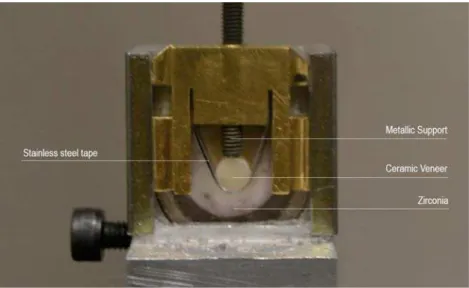
This device was developed by Ramos, et al.23 (2014)
to minimize bending stress. For that, stainless steel
tape produced smaller tensile and compression forces
on the interface, as described by Sinhoreti, et al.30
(2001) than those obtained from other tests using a
chisel and orthodontic wires. Moreover, the support
was adapted to the upper face of the stainless steel tape to minimize any possible bending stresses and
cleavage23 (Figure 3).
Failure mode analysis
The analysis of the Y-TZP/veneer interface was
performed for all specimens with optical microscopy (Discovery V8 Stereo, Carl Zeiss Microimaging GmbH)
a failure within either the zirconia or ceramic veneer
was employed to describe the combination of these
two types of failure.
Surface roughness
Surface roughness (n=3) was measured using
confocal microscopy (Leica Microsystems, Wetzlar).
For each Y-TZP specimen, surface roughness was
measured at three different locations, then these
values were averaged to obtain the average surface
roughness (Ra).
The 3D roughness of one specimen in each group
was also analyzed by scanning electron microscopy.
Phase analysis
Y-TZP specimens (n=3) were evaluated by
micro-Raman spectroscopy (Jobin Yvon micro-Raman Micro, model T64000, Groupe Horiba) to identify the typical bands
of the crystalline phase (monoclinic and tetragonal)24.
For this, argon laser scanning (SpectraPhysic, Inc.) was performed for excitation at 514.5 nm radiation
and was kept at 10 mW to avoid any thermal damage.
The spectra of each specimen were recorded with a
CCD camera (Spectra Group One-Horiba) after analysis
of the double monochromator with a focal length of
0.64 mm and diffraction grating (1800 grooves/mm)24.
Statistical analysis
Shear bond strength and surface roughness data
were analyzed by One-way ANOVA and pairwise
calculated as a percentage for each group. Differences
in the wave numbers and the broadening bands of the
Raman spectra were compared among groups.
Results
Shear Bond Test
Figure 4 shows the results of the shear bond
strength test. Z-PRE (7.94±2.52 MPa) and Z-POS (9.73±5.36 MPa) showed the highest strength,
Heating schedule Liner Ceramic Body Ceramic Venner
Standby temperature 403 (°C) 403 (°C)
Drying time 4 (16) 4 (16)
Heating rate 60 (°C/min) 50 (°C/min)
0D[LPXP¿ULQJWHPSHUDWXUH 960 (°C) 750 (°C)
Holding time 1 (16) 1 (16)
Failure mode analysis
Failure mode and distribution for each group are
presented in Figures 5 and 6. All groups showed adhesive type failures, especially Z-PRE and Z-POS,
which showed 60% adhesive failures. Few cohesive
failures were observed, and none of the specimens
were fractured within the zirconia.
Surface roughness
The comparison of surface roughness is shown
in Figure 7. A comparison of the average surface
that the Ra of Z-PRE is much greater than and
Figure 3- Custom-designed metallic device for shear bond testing with stainless steel tape and metallic support to avoid bending stress during the test
Figure 4-6KHDUERQGVWUHQJWKRIHDFKJURXS9HUWLFDOEDUVLQGLFDWHWKHVWDQGDUGGHYLDWLRQDQGVLPLODUOHWWHUVLQGLFDWHQRQVLJQL¿FDQW
GLIIHUHQFHVS!
(p<0.001). Z-CTR and Z-POS Ra values are not
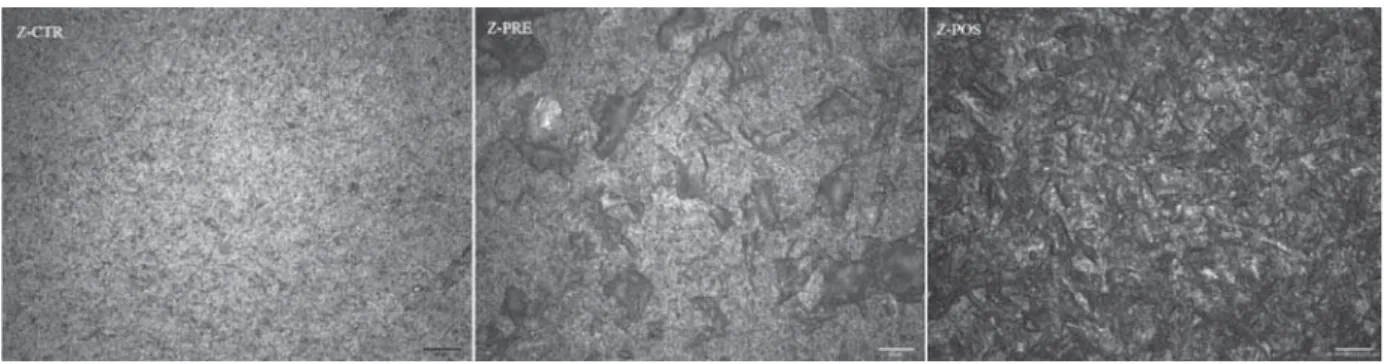
3D roughness representative of each group are shown
are shown in Figure 9. Z-PRE showed more irregular
Phase analysis
All groups showed bands typical of the tetragonal
(T) and monoclinic (M) phases. The most prominent peaks found related to monoclinic phases were
approximately ~178 and ~474cm-1, while those
related to tetragonal phases were ~142 and ~256
Figure 6- Failure types: adhesive failure (zirconia), mixed failure (zirconia and ceramic veneer), and cohesive failure (ceramic veneer)
Figure 7-6XUIDFHURXJKQHVVDIWHUVXUIDFHWUHDWPHQW9HUWLFDOEDUVLQGLFDWHVWDQGDUGGHYLDWLRQDQGVLPLODUOHWWHUVLQGLFDWHQRQVLJQL¿FDQW
GLIIHUHQFHVS!
(Figure 10).
Discussion
Surface treatments have been recommended
to improve the Y-TZP/veneer bond strength by
micromechanical interlocking7,9, even knowing that
other factors can influence bond strength, such as the sintering cycle of veneer, cooling rate, and
thermal variations18,23. The sandblasting method was
expected to increase surface roughness. Sandblasting
at different moments (pre- or post-sintering) resulted in different roughness of Y-TZP14. The roughness of
and Z-CTR. These results could be explained by the
much lower hardness of Y-TZP before being sintered, which resulted in a rougher zirconia surface through
sandblasting and thus a larger surface area available
for mechanical interlocking14.
The approach of performing pre-sintering surface
strength between Y-TZP and veneer, when compared
to an untreated surface18. In this study, sandblasting before sintering (Z-PRE) resulted in similar shear bond
greater strength than the untreated surface method
(Z-CTR). One of the limitations of the current study is that it did not consider the aging of the specimens.
Polycrystalline ceramics under wet and cyclic loading
conditions are most susceptible to subcritical crack
growth28. Nevertheless, thermocycling does not necessarily make a difference in bond strength
results23.
The higher roughness obtained by pretreatment did not result in more bond strength. Thus, the surface
roughness/shear bond strength relation may not be
linear19 and the excessive rough surface may lead
to stress concentration, which could consequently weaken the interfacial bonding15. Considering that
more adhesive failures were found for all studied
groups (Figure 4), which is expected for shear bond
tests30, the device with support adapted to the upper face23 was effective in tension distribution along the
Y-TZP/veneer interface3.
The presence of surface irregularities generated
in pretreatment (Figure 9C) indicates that the use of mechanical abrasion in pre-sintering methods
microfractures that would reduce functional strength,
and premature and catastrophic failure of material21,35. Porosity has a negative effect on the cohesive strength
of the materials by reducing the pore cross-section
area, through which a load is applied, acting as a stress
concentrator5.The untreated surface shows no visible evidence of irregularities (Figure 9A). Sandblasting
the shear bond strength, regardless of treatment time. Sandblasting is a useful tool to improve retention,
however, it may put stress on zirconia surfaces
Figure 9-6XUIDFHLPDJHDWîPDJQL¿FDWLRQ=&75±KRPRJHQRXVVXUIDFHZLWKQRHYLGHQWYLVLEOHVLJQVRIGDPDJH=326±VXUIDFH
pattern after post-sintering treatment showing irregularities along the surface. Z-PRE – areas of localized irregularities along the surface after pre-sintering treatment
and accelerate the tĺm phase transformation20,31.
Hydrothermal or mechanical stress may be responsible
for phase transformation11. Moreover, the contact
with the veneering ceramic may be the cause of the important phase transformation at the interface
amount of moisture present in the veneering porcelain
on the faceting grain of zirconia31.
The effects of tĺm phase transformation are
governed by the transformation toughening mechanism
leading to volume increase (~3 to 5%) at a localized
28. After that, tĺm
phase transformation spreads throughout the material
subsurface, resulting in grain pullout and an increase
in roughness29, jeopardizing the strength, fracture
toughness, and density of Y-TZP structures8, which is
known as low-temperature degradation8,28.
Micro-Raman spectra of Y-TZP contain important
information that can be obtained from the band positions, their intensities, and shapes34. The
micro-Raman analysis to detect crystalline phases in
polycrystalline ceramics is a very useful tool24. Even peaks are distinguished in the tetragonal phase (~142,
~256, ~320, ~466, and ~637 cm ), and the most
characteristic are a sharp band at 142 cm and a
broader band at 256 cm . For the monoclinic phase (~178, ~190, ~219, ~303, ~331, ~345, ~379, ~474,
~500, ~534, ~559, ~615, and ~638 cm ), there
is a notable doublet at 178 and 190 cm . Peaks
of tetragonal (~142; ~256) and monoclinic (~178;
groups. Pre-sintering sandblasting presented the same
Raman bands as post-sintered and untreated Y-TZP
surfaces, even with the differences in roughness.
Conclusions
Within this limited study, the experimental results
show that Y-TZP sandblasting before sintering resulted
in rougher surfaces, but did not increase the shear
bond strength compared to post-sintering treatment and increased surface defects. The surface treatment
with Al3O2, regardless of the moment and application,
improved the results of Y-TZP/veneer bonding. The
tested approaches for surface treatment did not result in different metastability of tetragonal zirconia. The
long-term consequence of the pre-sintered treatment
on the zirconia-veneer interface needs to be further
investigated.
Acknowledgments
The authors thank Bruna Carolina Costa and
Marlyni Aparecida Zens for collaborating with us. This study was supported by grants from FAPESP –
São Paulo Research Foundation (#2011/18061-0,
#2013/23464-2).
References
1- Aboushelib MN, Feilzer AJ, Kleverlaan CJ. Bridging the gap
between clinical failure and laboratory fracture strength tests using a fractographic approach. Dent Mater. 2009;25(3):383-91.
2- Aboushelib MN, Kleverlaan CJ, Feilzer AJ. Microtensile bond strength of different components of core veneered all-ceramic restorations.
Part II: Zirconia veneering ceramics. Dent Mater. 2006;22(9):857-63. 3- Anusavice KJ, Dehoff PH, Fairhurst CW. Comparative evaluation of
Res. 1980;59(3):608-13.
4- Bonfante EA, Rafferty B, Zavanelli RA, Silva NR, Rekow ED, Thompson VP, et al. Thermal/mechanical simulation and laboratory fatigue testing
of an alternative yttria tetragonal zirconia polycrystal core-veneer all-ceramic layered crown design. Eur J Oral Sci. 2010;118(2):202-9.
5- Callister WD Jr. Material science and engineering: an introduction. 8th ed. New York: John Wiley & Sons, Inc; 2012.
6- Casellas D, Cumbrera FL, Sanchez-Bajo F, Forsling W, Llanes L, Anglada M. On the transformation toughening of Y-ZrO2 ceramics
with mixed Y-TZP/PSZ microstructures. J Eur Ceram Society. 2001;21(6):765-77.
7- Chaiyabutr Y, McGowan S, Phillips KM, Kois JC, Giordano RA. The
zirconia veneering ceramic. J Prosthet Dent. 2008;100(3):194-202. 8- Chevalier J, Gremillard L, Deville S. Low-temperature degradation
of Zirconia and implications for biomedical implants. Annu Rev Mater Res. 2007;37:1-32.
9- Chintapalli RK, Mestra Rodriguez A, Garcia Marro F, Anglada M. Effect of sandblasting and residual stress on strength of zirconia for restorative
dentistry applications. J Mech Behav Biomed Mater. 2014;29:126-37. 10- Choi BK, Han JS, Yang JH, Lee JB, Kim SH. Shear bond strength
of veneering porcelain to zirconia and metal cores. J Adv Prosthodont. 2009;1(3):129-35.
11- Deville S, Gremillard L, Chevalier J, Fantozzi G. A critical comparison of methods for the determination of the aging sensitivity in biomedical
grade yttria-stabilized zirconia. J Biomed Mater Res B Appl Biomater. 2005;72(2):239-45.
12- Filser F, Kocher P, Weibel F, Luthy H, Scharer P, Gauckler LJ. Reliability and strength of all-ceramic dental restorations fabricated by
direct ceramic machining (DCM). Int J Comput Dent. 2001;4(2):89-106. 13- Fischer J, Stawarzcyk B, Trottmann A, Hammerle CH. Impact
composites. Dent Mater. 2009;25(4):419-23.
14- He M, Zhang Z, Zheng D, Ding N, Liu Y. Effect of sandblasting on surface roughness of zirconia-based ceramics and shear bond strength
of veneering porcelain. Dent Mater J. 2014;33(6):778-85.
on porcelain strength. Dent Mater. 2000;16(6):381-8.
16- Kern M, Wegner SM. Bonding to zirconia ceramic: adhesion methods
17- Kim HJ, Lim HP, Park YJ, Vang MS. Effect of zirconia surface treatments on the shear bond strength of veneering ceramic. J Prosthet Dent. 2011;105(5):315-22.
18- Kirmali O, Akin H, Ozdemir AK. Shear bond strength of veneering ceramic to zirconia core after different surface treatments. Photomed
Laser Surg. 2013;31(6):261-8.
19- Komine F, Saito A, Kobayashi K, Koizuka M, Koizumi H, Matsumura
H. Effect of cooling rate on shear bond strength of veneering porcelain to a zirconia ceramic material. J Oral Sci. 2010;52(4):647-52.
20- Kosmac T, Oblak C, Jevnikar P, Funduk N, Marion L. The effect of
of Y-TZP zirconia ceramic. Dent Mater. 1999;15(6):426-33.
21- Luthardt RG, Holzhuter M, Sandkuhl O, Herold V, Schnapp JD,
Kuhlisch E, et al. Reliability and properties of ground Y-TZP-zirconia ceramics. J Dent Res. 2002;81(7):487-91.
22- Luthy H, Filser F, Loeffel O, Schumacher M, Gauckler LJ, Hammerle CH. Strength and reliability of four-unit all-ceramic posterior bridges.
Dent Mater. 2005;21(10):930-7.
23- Ramos CM, Cesar PF, Lia Mondelli RF, Tabata AS, Santos JS, Borges
AF. Bond strength and Raman analysis of the zirconia-feldspathic porcelain interface. J Prosthet Dent. 2014;112(4):886-94.
24- Ramos CM, Tabata AS, Cesar PF, Rubo JH, Fracisconi PA, Borges AF. Application of micro-raman spectroscopy to the study of
yttria-stabilized tetragonal zirconia polycrystal (Y-TZP) Phase transformation. Appl Spectrosc. 2015;69(7):810-4.
25- Rekow D, Thompson VP. Engineering long term clinical success of advanced ceramic prostheses. J Mater Sci Mater Med.
2007;18(1):47-56.
26- Sailer I, Feher A, Filser F, Gauckler LJ, Luthy H, Hammerle CH.
partial dentures. Int J Prosthodont. 2007;20(4):383-8.
27- Saka M, Yuzugullu B. Bond strength of veneer ceramic and zirconia
Adv Prosthodont. 2013;5(4):485-93.
28- Salazar Marocho SM, Studart AR, Bottino MA, Bona AD. Mechanical
strength and subcritical crack growth under wet cyclic loading of
glass-29- Sato T, Shimada M. Transformation of yttria-doped tetragonal Zro2 polycrystals by annealing in water. J Am Ceram Soc. 1985;68(6):356-9.
30- Sinhoreti MA, Consani S, Goes MF, Correr L Sobrinho, Knowles JC.
interface bonding. J Mater Sci Mater Med. 2001;12(1):39-44. 31- Tholey MJ, Swain MV, Thiel N. SEM observations of porcelain Y-TZP
interface. Dent Mater. 2009;25(7):857-62.
32- Thompson JY, Stoner BR, Piascik JR, Smith R. Adhesion/
cementation to zirconia and other non-silicate ceramics: where are we now? Dent Mater. 2011;27(1):71-82.
33- Vagkopoulou T, Koutayas SO, Koidis P, Strub JR. Zirconia in dentistry: Part 1. Discovering the nature of an upcoming bioceramic.
Eur J Esthet Dent. 2009;4(2):130-51.
34- Wulfman C. SM, Lamy de la Chapelle M. Interest of Raman
spectroscopy for the study of dental material: the zirconia material example. IRBM. 2010;31(5-6):257-62.