Characterization of pain in women after breast cancer treatment
Caracterização da dor em mulheres após tratamento do câncer de mama
Caracterización del dolor en mujeres después del tratamiento del cáncer de mama
Vânia Tie Koga Ferreira1
Maria Antonieta Spinoso Prado1
Marislei Sanches Panobianco1
Thais de Oliveira Gozzo1
Ana Maria de Almeida1
1. Universidade de São Paulo. Ribeirão Preto - SP, Brazil.
Corresponding Author: Vânia Tie Koga Ferreira. E-mail: [email protected]
Submited on 10/29/2012. Resubmited on 05/22/2013. Accepted on 06/28/2013.
DOI: 10.5935/1414-8145.20140016
A
bstrActThe aim was to characterize and locate the pain in women who received breast cancer treatment. The study has an exploratory-descriptive character with a quantitative approach, undertaken through measures of central tendency and percentages. The research was undertaken in the Center for Teaching, Research and Assistance in the Rehabilitation of Mastectomized Women, with 30 women. Data was collected in February - August 2008, using an instrument containing variables able to characterize and locate the pain. The data was treated using means, medians, mode, standard deviation and percentages. It stood out that 56.7% of the women mentioned that the pain is daily, 46.7% of the women mention that the pain began after the breast surgery, and that for 40% the pain is constant. Knowledge, recognition and management of the symptom allow alternative therapeutic options for pain relief, minimizing physical and emotional efects which may be caused in the lives of women who receive breast cancer treatment.
Keywords: Breast neoplasms; Pain; Post-operative complications; Mastectomy.
r
esumoEste estudo pretendeu caracterizar e localizar a dor nas mulheres submetidas ao tratamento por câncer de mama. Estudo de caráter exploratório, descritivo, com abordagem quantitativa, pelas medidas de tendência central e percentual. Pesquisa desenvolvida no Núcleo de Ensino e Pesquisa e Assistência na Reabilitação de Mastectomizadas com 30 mulheres. Os dados foram coletados no período de fevereiro a agosto de 2008, por meio de instrumento contendo variáveis capazes de caracterizar e localizar a dor, e foram tratados por meio de média, mediana, moda e desvio-padrão e percentual. Destacou-se que 56,7% mulheres referiram que a dor é diária, 46,7% mulheres referiram que a dor teve início após a cirurgia da mama, e para 40% a dor é constante. Conhecimento, reconhecimento e manejo do sintoma permitem ofertas terapêuticas alternativas para o alívio da dor, minimizando efeitos físicos e emocionais que podem ser causados na vida de mulheres submetidas ao tratamento por câncer de mama.
Palavras-chave: Neoplasias mamárias; Dor; Complicações pós-operatórias; Mastectomia.
r
esumenCaracterizar y localizar el dolor en mujeres sometidas al tratamiento de cáncer de mama. Estudio exploratorio y descriptivo, con abordaje cuantitativo, con medidas de tendencia central y porcentajes. La investigación fue desarrollada con 30 mujeres en el Núcleo de Enseñanza, Investigación y Asistencia en la Rehabilitación de Mastectomizadas. Los datos fueron colectados entre febrero y agosto de 2008 y recopilados por medio de instrumento que contiene variables capaces de caracterizar el dolor. El 56,7% de las mujeres destacaron el dolor diario; el 46,7%, informaron que el dolor tuvo inicio después de la cirugía y para 40% de las enfermas, el dolor es constante. El conocimiento, el reconocimiento y la gestión de las ofertas de los síntomas permiten terapias alternativas para disminuir el dolor, reducir al mínimo los efectos físicos y emocionales que se pueden causar en las vidas de las mujeres que reciben tratamiento para el cáncer de mama.
INTRODUCTION
The Committee on Taxonomy of the International Association for the Study of Pain(IASP) conceptualizes pain as an unpleasant
sensory and emotional experience, associated with real or poten-tial tissue lesions or described in its terms1. Pain is, essentially, a
subjective, multidimensional and complex symptom, resulting from the interaction between cognitive, sensory,emotional and cultural aspects, as well as from previous experiences2.
Pain after treatment for breast cancer is common and
may have various causes. Generally, the women who deve -lop this symptom present functional reduction and important emotional changes3.
If the women are not informed about this morbidity prior to the treatment, the symptom may be interpreted as something wrong in relation to the disease and can cause social and emotional complications4.
As the symptom, when present, can be a limiting factor for
undertaking activities of daily living and leisure, it can cause changes in body image and can reduce sexual activity. The changes in women with pain, after the treatment, can result in
signiicant change in the quality of life, compared to women who
do not present this symptom3. Information on this, provided to
health professionals, can contribute by allowing a better unders-tanding of the pain and by alleviating times of distress and stress4.
The pain frequently occurs in the regions which were injured
(axilla, the medial region of the arm and/or anterior wall of the thorax of the side afected) by the local treatment of the breast
cancer. The symptoms include, burning, needle pain, feelings similar to minor electric shocks, and tightness in the axillary,
medial and upper regions of the arm and/or in the thorax. It is
also described as sudden and intense and is associated with chronic hyperesthesia, and can begin immediately after the surgery, six months or even a year following the treatment. It is a symptom which persists with rest and increases during daily activities, responding very poorly to drugs4,5.
Because the women often believe that the presence of
pain after the treatment is to be expected, they experience the symptom without often reporting it to the team. This being so, the team must inform the woman as to the occurrence of pain and when she mentions this complaint during consultations, she must be listened to and valued, this being an aspect which
is generally neglected, since - according to Andersen and Kehlet (2011)6 - there is a signiicant disagreement between
the intensity of the pain understood by the health professional and that experienced by the patient. This disagreement is often one of the causes of the inadequate control of the pain6.
Thus, this study's objective was to characterize, locate and
identify the resources used for pain relief in the women who received treatment for breast cancer.
METHODOLOGY
This is a prospective, cross-sectional study with a descrip-tive-exploratory character. The research was undertaken in the
Center for Teaching, Research and Assistance in Rehabilitation for Mastectomized Women, situated in the Ribeirão Preto School of Nursing, of the University of São Paulo (EERP/USP).
The data was collected in the period February - August 2008, following the project's approval by the EERP/USP Research Ethics Committee, under protocol nº 0802/2007, with participa
-tion upon signing of the Terms of Free and Informed Consent.
The research sample was composed of 30 women, who
met the inclusion criteria of: having received surgery to treat
breast cancer, having concluded the treatment at least one year previously, and complaining of pain related to the treatment for breast cancer.
The women were interviewed using an instrument
con-taining variables for socio-demographic categorization and variables for describing the treatment and characterizing and
locating the pain. Prior to its use, the instrument developed was
assessed by ive professionals from the area for evaluation and
adaptation. The interview was arranged ahead of time and was held at a time convenient to the woman.
So as permit a better understanding of the pain experienced by mastectomized women, variables were emphasized which
related to the start of this symptom, its frequency, duration, predominance, movements which contribute to its increasing, and forms of pain relief. The location was evaluated through a schematic representation of the human body, divided into front, dorsal, left and right, and with subdivisions numbered from 1
to 457. Each woman was advised to mark the place which cor
-responded to the manifestation of the pain.
The data was stored using the Excel® application from Microsoft Oice®, using double keying to beneit the reliability of the data-base. The statistical program used was the Statistical Package for Social Sciences (SPSS®), version 10.0, for presen -tation and organization of the data and characterization of the
sample, and data on the breast cancer and the pain. It treated the data with the measures of central tendency, arithmetic mean,
standard deviation (SD), median, and minimum and maximum values. For the tabulation of the data relating to the places whe
-re pain was identiied using the body diagram, descriptive and
percentage analysis was used.
RESULTS AND DISCUSSION
Among the 30 women who participated in the study, age varied from 32 to 79 years old, with a mean of 55.7 years old (SD = 11.46), median of 53 years old and the most frequent age
being 43 years old; 73.3% were married; 63.3% were
housewi-ves; 70% were Roman Catholic, and their education varied from 0 to 17 years, with a mean of 7.13 years of study (SD = 4.84)
and a median of six years, the most frequent length of schooling being four years.
In relation to the surgical treatment, the mean time which had passed since the surgery at the time of the study was four years
(SD = 4.31) and the median was two years, two years also being
the most frequent period of time since the surgery. In relation
in 50% of the women, and the left in 46.7%. When asked about
the adjuvant treatment, 80% had undertaken chemotherapy and 76.7% had undertaken radiotherapy. The majority of the women in this study - 76.7% had not undertaken breast reconstruction surgery, as shown in Table 1.
In relation to the region, the women researched were re-quested to mark on the body diagram the places where the pain
is most recurrent. Based on this identiication, the most-frequent places mentioned were the right and left hemi-thorax (43.3 and 40% respectively) followed by the arm and forearm (66.7 and 56.7% respectively).
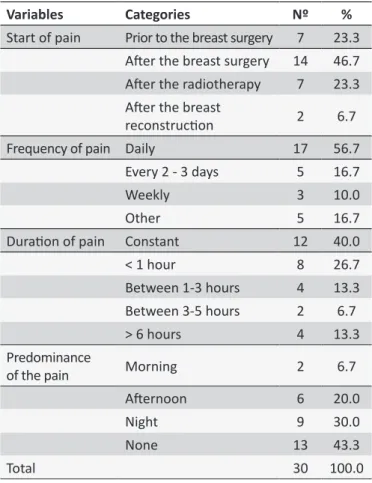
It was possible to ascertain that for 46.7% of the women, the pain began after the surgery for breast cancer, and that for 23.3% of the women, it began after the radiotherapy, it standing
out that for 56.7% the pain is daily and that for 40% it is constant.
It is observed that there is no predominance of a particular time for the occurrence of the pain, but that for those who present the
more constant pattern (40%) the pain occurs more frequently in
the afternoon and at night, as shown in Table 2.
Table 1.
Distribuion of the women interviewed, by
latera-lity and type of surgery, undertaking of axillary dissecion,
lymph node dissecion, treatment with radiotherapy
and chemotherapy, and breast reconstrucion (Ribeirão
Preto - SP, 2008)
Variables
Categories
Nº
%
Laterality of the surgery
Right
15
50.0
Let
14
46.7
Bilateral
1
3.3
Type of surgery
Total mastectomy
15
50.0
Quadrantectomy
15
50.0
Axillary dissecion
Yes
29
96.7
No
1
3.3
Seninel lymph node
dissecion
Yes
8
26.7
No
22
73.3
Radiotherapy
Yes
23
76.7
No
7
23.3
Chemotherapy
Yes
24
80.0
No
6
20.0
Breast reconstrucion
Yes
7
23.3
No
23
76.7
Total
30
100.0
This occurrence is in agreement with other studies directly
relating the appearance of pain with the treatment. Because of
the surgical technique, some structures such as the intercosto-brachial nerve and the serratus anterior muscle can be injured, and the association of the radiotherapy with the surgery can lead
to the occurrence of adhered scar tissue with ibrosis; for these
reasons, these modes of treatment have been considered to be predisposing factors for the development of the pain4,8-10.
Fabro et al. (2012) monitored 205 women over a six-month period and identiied that six months post-surgery, the incidence of chronic pain was 108.4 (52.9%) in the 205 women evaluated.
The chronic pain which appears after surgery is explained as the result of the injury to structures such as muscles and
ligaments -and as neuropathic, when it afects nerves or is a
dysfunction of the nervous system6,8.
Therefore, when one evaluates the impact that these
ope-rations can have on the patients' quality of life, it is evidenced
that the mastectomy can result in a lower score for quality of life, as the pain which can be caused by the surgery can lead to functional compromise11.
Table 2.
Distribuion of the women interviewed, by the
beginning of the pain, its frequency, duraion and
predo-minance (Ribeirão Preto - SP, 2008)
Variables
Categories
Nº
%
Start of pain
Prior to the breast surgery
7
23.3
Ater the breast surgery
14
46.7
Ater the radiotherapy
7
23.3
Ater the breast
reconstrucion
2
6.7
Frequency of pain Daily
17
56.7
Every 2 - 3 days
5
16.7
Weekly
3
10.0
Other
5
16.7
Duraion of pain
Constant
12
40.0
< 1 hour
8
26.7
Between 1-3 hours
4
13.3
Between 3-5 hours
2
6.7
> 6 hours
4
13.3
Predominance
of the pain
Morning
2
6.7
Aternoon
6
20.0
Night
9
30.0
None
13
43.3
Total
30
100.0
When Fabro et al. (2012)3 sought the characteristics of the pain, they identiied that the women who undertake treatment for
breast cancer report the pain as intermittent and constant. The
same was observed by Fecho et al (2009)9. The indings of Gart -ner et al (2012)12 are in agreement with those of the present study. In relation to the women's perception of the movement re -lated to the increase in the intensity of the pain, the movements
identiied as being the most related were those of pushing and
The movement of pulling, for 50% of them, was also related to the increase in the pain's intensity. Considering that the surgical
and adjuvant treatments can result in morbidities of the upper limbs and that these complications can lead to functional impairment, principally, of the upper limb on the same side as the tumor3,5,10, it was attempted to relate the perception of the pain to the movements made by the upper limb. The undertaking
of the movements is described by Nesvold et al. (2008) as one of the factors which can change or even worsen the women's
perception of pain after the treatment for breast cancer. These movements are described as abrupt and which stretch the upper limb10,12,14. The neuropathic pain is the factor responsible for
incre-asing the complaint of pain when undertaking these movements, as it can lead to the development of the mechanical situation of restriction of shoulder movement3,4,10,12-14.
As the women in the sample studied were periodically
undertaking exercises for rehabilitation of the range of movement of the upper limb, they were asked whether the pain increased
when undertaking these exercises and 56.7% stated that it did
not, while 23.3% reported that it sometimes increased and 20%
said that the pain always increased with physical exercise. Accor
-ding to Hwang et al. (2008)15, the practice of moderate physical
exercise under supervision can reduce the complications which occur during the treatment, including pain, when compared to a person who does not undertake exercises for rehabilitation.
As the women in this study attend a rehabilitation service
in which the practice of exercises is undertaken for one hour, three times a week, it is believed that this may be the reason why the women who made up this sample do not relate the pain to
exercise. A study undertaken in the same service demonstrated that the women identiied more beneits than barriers in relation
to the practice of physical activity. This result shows that the
beneits perceived are associated as much with the mind as the
body, as, for them, practising physical activity brings important contributions to their health and to the prevention of illnesses, as well as assisting in the return of the function of the arms and shoulders on the same side as the surgery16. Chen et al. (2011)16 and Gartner et al. (2009)12 difer from this result, presenting
important rates of relation between the pain and the practising of
physical activity/exercise. It stands out, however, that the studies
were carried out with women who did not attend rehabilitation services, which may suggest the practice of exercises at home in an inadequate way, that is, without the training of a trained professional, allowing the occurrence of the pain12,17.
In the period in which this study was undertaken, the women
used some resources for minimizing the pain, such as: massage,
relaxation, and the use of medications. It was observed that the practice of massage was the resource used by 66.7% of the
wo-men and that relaxation was used by 50%, as shown by Table 3. However, the use of resources in the attempt to seek relief from
the pain does not always give the expected result, as is the case with the use of analgesics3. Knowledge about the pain relief me
-asures is extremely important for the teams who work with these
women4,18. Appropriate pain management must be implemented,
avoiding self-treatment, since this can further compromise the symptom of pain in women with breast cancer11,13.
Table 3.
Distribuion of the women interviewed, by pain
relief with medicaion, relaxaion, massage, exercises,
deep breathing, acupuncture, stretching, and
transcu-taneous electrical nerve simulaion (TENS) (Ribeirão
Preto - SP, 2008)
Variables
Categories
Nº
%
Use of medicaions
Yes
14
46.7
No
16
53.3
Pracice of relaxaion
Yes
15
50.0
No
15
50.0
Pracice of massage
Yes
20
66.7
No
10
33.3
Pracice of exercises
Yes
11
36.7
No
19
63.3
Deep breathing technique
Yes
11
36.7
No
19
63.3
Pain relief with stretching
Yes
10
33.3
No
20
66.7
Use of the TENS
Yes
7
23.3
No
23
76.7
Total
30
100.0
CONCLUSION
Pain is a symptom which afects the women who participated
in the research, who had received treatment for breast cancer, it being the case that the pain frequently began after the surgery, but which could also have the radiotherapy as its starting point. It is located in the region on the same side as the surgery, being experienced when making movements such as pushing or reaching, happening every day and being constant, but without
a predominant period of the day to appear. As a limitation, the study had the size of its sample.
The results demonstrate the importance of the evaluation of the pain in this population, principally prior to the surgery, so
that the musculo-skeletal/articular causes and neuropathies may be discarded. One limitation of the present study was that
it was not possible to evaluate the patients prior to the surgical
intervention. One cannot assert, therefore, that these indings
result from the surgical procedure, given that the majority of the women only seek this service after the surgery and when they are referred by the medical team.
It is of great relevance that pain should be valued and
iden-tiied by the health professionals who monitor these women,
women believe that the presence of pain is normal even after
inishing their treatment.
Assessing it as early as possible and in the correct way are the health professionals' main tools for ofering the adequate management of pain and for achieving the beneits expected from the treatment. Thus, by knowing how to recognize and treat the symptom, it is possible to ofer therapeutic alternatives for its relief, minimizing the physical and emotional efects which pain
can cause in the lives of these women.
REFERENCES
1. Sociedade Brasileira para o Estudo da Dor - SBED. Hospital sem dor diretrizes para implantação da dor como 5º sinal vital [citado 2012 nov 28]. Disponível em: http://www.dor.org.br/proissionais/5_sinal_vital.asp. 2. Budó MdLD, Resta DG, Denardin JM, Ressel LB, Borges ZN. Práticas de cuidado em relação à dor -a cultura e as alternativas populares. Esc. Anna Nery. 2008 mar;12(1):90-6.
3. Fabro EAN, Bergmann A, Amaral ESB, Ribeiro ACP, Abrahao KS, Ferreira MGCL, et al. Post-mastectomy pain syndrome: incidence and risks. Breast. 2012 Jun;21(3):321-5.
4. Couceiro TC, Menezes TC, Valenca MM. Post-mastectomy pain syndrome: the magnitude of the problem. Rev. bras. anestesiol. 2009 may-jun;59(3):358-65.
5. Vilholm OJ, Cold S, Rasmussen L, Sindrup SH. The post mastectomy pain syndrome: an epidemiological study on the prevalence of chronic pain after surgery for breast cancer. British Journal of Cancer. 2008;99:604-10.
6. Andersen KG, Kehlet H. Persistent pain after breast câncer treatment: a
critical review of risk factors and strategies for prevention. J Pain. 2011
jul;12(7):725-46
7. Silva JA, Ribeiro-Filho, NP. Avaliação e mensuração da dor: pesquisa, teoria e prática. São Paulo(SP): Funpec; 2006. P. 467.
8. Delay E, Gosset J, Toussoun G, Delaporte T, Delbaere M. Post-treatment sequelae after breast cancer conservative surgery. Ann Chir Plast Esthet. 2008 apr;53(2):135-52.
9. Fecho K, Miller NR, Merritt SA, Klauber-Demore N, Hultman CS, Blau WS. Acute and persistent postoperative pain after breast surgery. Pain Med. 2009 may-jun;10(4):708-15.
10. Lauridsen MC, Overgaard M, Overgaard J, Hessov IB, Cristiansen P. Shoulder disability and late symptoms following surgery for early breast cancer. Acta Oncol. 2008;47(4):569-75.
11. Veiga DF, Campos FSM, Ribeiro LM, Ivanildo AJ, Joel VF, Yara J, Miguel SN, Lydia MF. Mastectomy versus conservative surgical treatment: the impact on the quality of life of women with breast cancer. Rev. bras. saude mater. infant. 2010 [online]. 2010 jan/mar;10(1):51-7.
12. Gartner R, Jensen MB, Nielsen J, Ewertz M, Kroman N, Kehlet H.
Prevalence of and factors associated with persistent pain following
breast cancer. Jama. 2009 nov 11;302(18):1985-92.
13. Cheville AL, Tchou J. Barriers to rehabilitation following surgery for primary breast cancer. J Surg Oncol. 2007 abr; 95(5):409-18. 14. Nesvold IL, Dahl AA, Løkkevik E, Mengshoel AM, Foss? SD. Arm and
shoulder morbidity in breast cancer patients after breast-conserving
therapy versus mastectomy. Acta Oncol. 2008;47(5):835-42. 15. Hwang JH, Chang HJ, Park YHSWH, Park W, Huh SJ, Yang JH. Efects
of Supervised Exercise Therapy in Patients Receiving Radiotherapy for Breast Cancer. Yonsei Med J. 2008 jun;49(3):443-50.
16. Chen X, Lu W, Zheng W, Gu K, Matthews CE, Chen Z, et al. Exercise after diagnosis of breast cancer in association with survival. Cancer Prev Res (Phila). 2011 sep;4(9):1409-18.
17. MACDONALD, L. et al. Long-term follow-up of breast cancer survivors with post-mastectomy pain syndrome. Br J Cancer. 2005 jan;92(2):225-30. Available in: <http://www.ncbi.nlm.nih.gov/pubmed/15655557>. 18. Nesvold IL, Reinertsen KV, Fossa SD, Dahl AA. The relation between