Adherence to antiretroviral therapy and its representations for
people living with HIV/AIDS
Adesão à terapia antirretroviral e suas representações para pessoas vivendo com HIV/AIDS Adhesión al tratamiento antirretroviral y sus representaciones por personas que viven con VIH/SIDAEduardo Pereira Paschoal1 Caren Camargo do Espírito Santo1 Antônio Marcos Tosoli Gomes1 Érick Igor dos Santos1 Denize Crisina de Oliveira1 Ana Paula Munhen de Pontes1
1. Universidade do Estado do Rio de Janeiro. Rio de Janeiro - RJ, Brazil.
Corresponding Author:
Eduardo Pereira Paschoal.
Email: [email protected]
Submited on 03/03/2013. Resubmited on 09/30/2013. Accepted on 10/02/2013.
DOI: 10.5935/1414-8145.20140005
AbstrAct
This study aimed to analyze the antiretroviral therapy adherence process and its social representation for people living with HIV/AIDS. This is a qualitative and descriptive study conducted on the Social Representation Theory. 30 people participated in an HIV/AIDS outpatient treatment in a public hospital in Rio de Janeiro. Data were collected through semi-structured interviews
and subjected to thematic content analysis. It is evident that adverse events arising from the therapy, the fear of being seropositive
revealed and the failure to realize themselves as sick result in the abandonment of therapy to the professional and family support
showing it is essential that the person continues with the therapy. It is concluded that the adherence process shows a symbolic
change process from the start of treatment until stabilization, which is expressed in attitudes and the image of the disease, virus
and medications.
Keywords: Medication Adherence; Acquired immunodeiciency syndrome; Nursing.
resumo
Neste estudo objetivou-se analisar o processo de adesão à terapia antirretroviral e suas representações sociais para pessoas que vivem com HIV/AIDS. Trata-se de um estudo de natureza qualitativa e descritiva, elaborado à luz da Teoria das Representações Sociais. Participaram 30 pessoas em tratamento ambulatorial para HIV/AIDS em um hospital público do Rio de Janeiro. Os dados foram coletados por meio de entrevistas semiestruturadas e submetidos à análise de conteúdo temática. Observa-se que os eventos adversos decorrentes da terapia, o medo de ter a soropositividade revelada e o fato de não se perceber doente implicam o abandono da terapia, e que o amparo proissional e familiar é essencial para a que a pessoa prossiga com a terapia. Conclui-se que o processo de adesão evidencia um processo de mudanças simbólicas, do início do tratamento até sua estabilização, expresso em atitudes e imagens da doença, do vírus e dos medicamentos.
Palavras-chave: Adesão à medicação; Síndrome da Imunodeiciência Adquirida; Enfermagem.
resumen
Este estudio objetivó analizar el proceso de adhesión a la terapia antirretroviral y sus representaciones sociales para personas que viven con VIH/SIDA. Es un estudio descriptivo, cualitativo, elaborado a la luz de las Representaciones Sociales. Participaron 30 personas en tratamiento ambulatorial para VIH/SIDA en un hospital público de Rio de Janeiro. Los datos fueron recolectados a través de entrevistas semiestructuradas y sometidos al análisis de contenido temático. Es evidente que los eventos adversos
derivados de la terapia, el miedo de tener la seropositividad revelada y no darse cuenta de que es enfermo, resultan en abandono
de la terapia, ya que el soporte profesional y familiar son esenciales para que la persona continúe el tratamiento. Se concluye que el proceso de adhesión muestra un proceso de cambios simbólicos, desde el inicio del tratamiento hasta su estabilización, expreso en actitudes e imágenes de la enfermedad, del virus y de los medicamentos.
INTRODUCTION
To analyze the process of adherence to antiretroviral
therapy considering the psychosocial construction of the epidemic through the social representations of patients with
HIV / AIDS a brief historical review is necessary. Despite the reports observed in 1975, the irst case of acute immune depression was described only in 1981 by CDC (Centers for Disease Control) in the United States, identiied in 1982 its etiologic agent, the human immunodeiciency virus (HIV)1. At
irst called WOG, acronym for "Wrath of God"or fury of God in Portuguese, the acquired immunodeiciency syndrome was the target of stigmatization and prejudice because of the fact that the irst cases have been identiied in groups
male homosexuals, which had its sexual behavior judged and considered promiscuous by society1.
In Brazil, studies show that in the period 1980 to June 2011 were registered 608,230 cases of AIDS. From 1980
to 2010, there were 241,469 deaths, having as root cause
AIDS2.Over these three decades there were numerous changes regarding the perception of the syndrome, mainly from 1996 with the introduction of combined antiretroviral
(ARV) therapy. Therapy has led to a signiicant reduction in morbidity and mortality related to AIDS, going to be characterized as evolutionary and chronic, surpassing
the vision of the beginning of the epidemic that was
characterized as a disease that brought death as a certainty,
in a short time3.
I this aspect it is worth noting that Brazil was one of the irst countries to implement the universal distribution of
medicines3. The results proved to be successful from the
adoption of the concept of HAART (HighlyActive Antiretroviral Therapy), which is the combination of protease inhibitors and reverse transcriptase, tobe extremely efective in reducing plasma viral load of RNA-HIV-1 to undetectable levels4.
There is absolutely no doubt about the fact that
HAART, although not a cure, making a slower course for
the disease, the step that extends and promotes a better
quality of life for the patient. However, studies have shown
that the non-compliance occurs in some degree, in both
rich and poor countries, and the average rate is 50%4. The non-adherence or inadequate adherence are the most frequent causes for the treatment failure, because the use of medicinal products in inappropriate doses or of irregular shape accelerates the process of selection of resistant viral strains, threatening the effectiveness of treatment at the individual level and leading to the spread of the virus resistance, at the collective level5.
The non-adherence is pointed out by the literature as an event determined by several factors, which can be grouped into factors related to the person under treatment, the
disease, the treatment, health services and social support6. Therefore, adherence to treatment with antiretroviral therapy shows itself as a complex process, highlighting the need to understand the subjective factors intrinsic to the person and their social group involved in the adherence process, in order to allow the formation of a real therapeutic alliance between client and caregiver.
By being little understood, the adherence shows itself
at times as a tough process, generating wear both for the healthcare professional, as well as the person being cared for that many times choose to abandon the treatment by
considers it an easy and less painful path. By studying the
adherence process from the social representations of people
living with HIV/AIDS, it becomes possible to identify how to
manage their daily lives and thus identify possible factors
inluencing the vulnerability associated with this process. Considering the biopsychosocial impact of the syndrome, as well as antiretroviral therapy, it has as objective to analyze
the process of adherence to antiretroviral therapy and its
social representations for people living with HIV/AIDS. This study becomes relevant by allowing the relection on
the psychosocial aspects involved in this process, making possible a better understanding of the events that lead to the rupture of this process.
THEORETIC REFERENTIAL
AIDS can be understood, as a social phenomenon possesses an immense stigmatizing load, in which the patient or virus carrier doubly experiences their sufering. On the one hand, we realized the physical sufering from a
disease, which, even with the advances of science, still has
no cure, while on the other; we see social sufering caused
by the excludent look, intolerance, fear and prejudice towards people living with the virus7. Thus, AIDS is perceived as a disease that brings in addition to the prejudice, a series of uncertainties with respect to the future.
In this context, it is noted the inclusion of antiretroviral therapy, as of 1996, which brought with it a hope of prolonging life, giving the disease a chronic evolutive, potentially
controlled character. However, adherence to treatment stands
out among the greatest challenges of attention to people
living with HIV/AIDS, a time that requires behavioral changes,
dietary, the use of various medications for their whole life, besides the need, on the part of health care services, new
arrangements and provision of speciic activities designed
to promote and ensure their adherence7.
Adherence to treatment is a collaborative process
Consists in a process of negotiation in which it seeks the
adequacy to the habits, individual needs,and which aims to strengthen the autonomy to self-care, transcending, thus, the simple ingestion of drugs9.
With regard to social representations theory, this has been
widely used to explain the psychosocial problems of AIDS,
a time which allows us to understand the meaning attributed to a phenomenon such as the sickening, directing the ducts of the subjects from the representations that they have built on the disease that they have. This happens because these social representations are inscribed in a human experience that has a series of meanings10. Inother words, through the study of representations it becomes possible to understand
the vision of the world that the HIV positive person constructs
from their insertion into social groups. In addition to better, understand the position taken and the behaviors adopted ahead to the adherence process, which allows the formation of a consistent link between the professional and the user.
This link, when established among the professionals involved in health care and the people who live with
HIV/AIDS is of utmost importance to the adherence process. Since the consolidation of partnership between
the professional and the patient in listening, feeling and thinking together allows the creation of solutions for improving the adhesion and the overcoming of numerous barriers that arise in everyday life8.
METHODOLOGY
This is a descriptive qualitative study conducted in the light
of the social representations theory in the Social Psychology
perspective, using the procedural approach, in which were explored the contents and processes of the formation of representations to the antiretroviral therapy adherence process.
The social representations themselves constitute as a way to understand and give meaning to what is strange or new. They are complex phenomena that are always active and active in social life. In its phenomenal wealth indicates various elements in its constitution, which are sometimes studied
in isolation: pieces of information, cognitive, ideological,
normative beliefs, values, attitudes, opinions, pictures etc.
One can observe the social representations in daily life as
they circulate in statements, they arecharged by the words,
images and messages conveyed in the media, crystallized in
conduits and intermediation, material or spatial11.
For the realization of this study,30 people were interviewed who live with HIV/AIDS, in the period from April to May 2009.
The inclusion of the participants was given through preset
criteria: being a studied specialized assistance service (SAE)
user, older than 18 years, of both genders, in therapy with antiretroviral drugs, and who has received diagnosis less than 6 months prior, due to the time factor set as a determinant
in the development of social representations. The ield of study was a municipal public hospital in the city of Rio de Janeiro, specialized and referenced for treatment of people with HIV/AIDS, being considered by the Ministry of Health as an SAE.
For the collection of data a semi-structured interview was
used guided by a script topic, because they stimulate the research participants to talk more freely, allowing them to be the protagonists in this scenario and can reveal their ways of thinking, values, feelings, as well as the objective and subjective
factors that motivate or hinder their adherence to therapy. For
such, were raised questions concerning how was the start of therapy, and who helped most during this process and what
actions were taken with the diiculties imposed by therapy. The research was approved by the Research Ethics Committee of the Municipal Secretary of Health (CEP SMS-RJ) being its approval protocol 200/08. The interviews
were recorded with the consent of the interviewees and signed the free and informed consent term according to resolution
196/96. It is worth noting that the research relied on volunteers
who agreed to participate after being informed about the
objectives of the survey and assured about the conidential
nature of their discourse.
After collections, transcripts were made of the interviews,
in order to allow a thorough analysis of each statement and their transversal elements, seeking to identify common aspects with patients that interfere in the adherence process.
For this purpose, the thematic-categorical content analysis
was used12,13. The content analysis technique allows access of various explicit content or not present in a text, but to do
this requires some steps, such as: pre-analysis, exploration
of the material or encoding, treatment of results, inference and interpretation12. For the realization of this technique a
systematization13 was employed in which, in principle, carried out a thorough initial reading of the text in order to allowing to be impressed by the elements present in the text, but without
attachment to speciic elements in the reading. After reading, the objectives of the analysis were deined as well as some
hypotheses on the examined object. It was started, then the
pre-analysis which were identiied reporting units (RU) as deined clippings meanings expressed in the text by partial or complete sentences and / or paragraphs, as well as characters
and events that are important facts for the object under study.
The testimonies of the participants were identiied in the
text according to the number given to the subject during the
interview (subject 01, subject 02, etc.).
PRESENTATION AND DISCUSSION OF RESULTS
Of the 30 respondents, 76.7% are concentrated in theage group of 30 to 49 years and in their majority are married,
greater part lives with family (76.7%) and has schooling up to complete high school education (36.7%), earn up to 4 minimum wages (n = 23 or 76.6%). Predominated in the study people living with HIV for less than 11 years (69.6%), heterosexual (63.3%), predominantly catholic (44%) followed by Evangelical (36%).
Regarding the analysis of the discursive data results, we obtained 380 RU and 36 units of meaning. These units
were distributed into three categories that represent 100%
of the analyzed corpus. The three categories were named as
Factors that hinder the process of adherence to antiretroviral therapy; Elements that facilitate the process of adherence to the antiretroviral therapy; Change and appreciation of life in the adaptation process to antiretroviral drugs. For
this text, these categories were addressed separately,
analyzing each one of them and stressing their quantitative
representation.
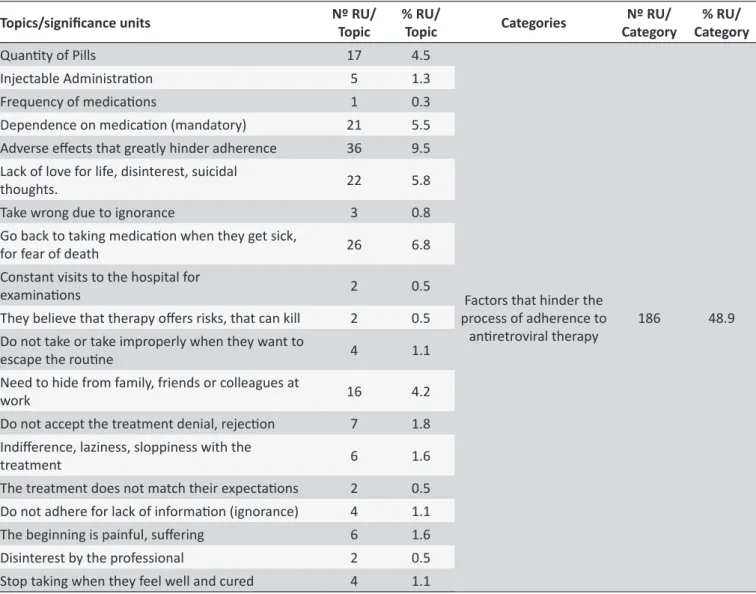
Category 1 - Factors that hinder the adherence process to antiretroviral therapy
This category, the largest of the analysis, involves 186
RU and 19 meaning units, which is equivalent to 48.9% of the
corpus of analysis. It identiied the reasons that lead patients
to abandon the treatment or not adhering properly. The main
topics/units of meaning that have been part of this analysis were: adverse efects very diicult to adherence, returning
to take medication when they fall ill by fear of death, need to hide from family, friends and work colleagues and stop to take when they feel well, think they are cured.
Within this category, we found a negative attitude present in the social representation of antiretroviral therapy
expressing the diiculty imposed by the adverse efects of
antiretroviral drugs. This makes the treatment itself aversive, causing its abandonment seem an easier alternative and
relieving as the following RU:
Figure 1.
Table summary of the construcion of categories in content analysis, Rio de Janeiro, 2012
Topics/signiicance units Nº RU/
Topic
% RU/
Topic Categories
Nº RU/ Category
% RU/ Category
Quanity of Pills 17 4.5
Factors that hinder the process of adherence to
aniretroviral therapy
186 48.9
Injectable Administraion 5 1.3
Frequency of medicaions 1 0.3
Dependence on medicaion (mandatory) 21 5.5
Adverse efects that greatly hinder adherence 36 9.5 Lack of love for life, disinterest, suicidal
thoughts. 22 5.8
Take wrong due to ignorance 3 0.8
Go back to taking medicaion when they get sick,
for fear of death 26 6.8
Constant visits to the hospital for
examinaions 2 0.5
They believe that therapy ofers risks, that can kill 2 0.5
Do not take or take improperly when they want to
escape the rouine 4 1.1
Need to hide from family, friends or colleagues at
work 16 4.2
Do not accept the treatment denial, rejecion 7 1.8 Indiference, laziness, sloppiness with the
treatment 6 1.6
The treatment does not match their expectaions 2 0.5
Do not adhere for lack of informaion (ignorance) 4 1.1
The beginning is painful, sufering 6 1.6
Disinterest by the professional 2 0.5
Sometimes, the people, in the case of many who sufer with the efects, then, sometimes, do so badly, so badly, that they prefer not to take, sometimes the person says: ah, I'm already bad even, I'm bad (subject 21). Through the reactions. Of vomiting, diarrhea, dizziness, one thing, which if you don't persevere, you quit. That is tough... (Subject 07).
In addition to the vomiting, diarrhea, headache and sleepiness, there are body changes, such as lipodystrophy, as hinderers to the adherence process and that interfere
mainly in self-esteem of people who live with HIV/AIDS. Some
changes are assigned by subject the amount of medicines that must be ingested, this being another complicating factor,
also, as RU below:
I don't take the medication because I'm diabetic, because of lipodystrophy, I'll stick with the ugly face, the ugly face and the side efects. Some side efects are bizarre, really... (Subject 21). Every time I go get the drugs I throw all the labels in the trash, just take
the medications, the box and everything I throw away because if you read and becomes aware you will read and understand something because the same medicine that makes you well it will do away with your kidneys. It is not out of malice, it is the amount of drugs... (Subject 01).
The lipodystrophy, which expresses a dimension of imagery representation of antiretroviral therapy, brings a new stigma in relation to disease, because it fosters the discovery of the condition of seropositivity by third parties and impact
on self-image and sexuality, which may inluence the quality
of the adherence and lead to the abandonment of treatment8. It is also observed that taking the medication involves
perceiving it or feel sick, which leads to two problems: the irst is the fact that the patient only seek help when they
are ill, and the second is that after you feel good or "cured",
abandons the treatment again. Another complicating factor
is the dependence of the lifetime maintenance to the drug, leading the client and feel compelled to take the drug, since
them not taking; it equates to die according to the RU below:
Topics/signiicance units Nº RU/
Topic
% RU/
Topic Categories
Nº RU/ Category
% RU/ Category
Seek take at the right imes 19 5.0
Elements that facilitate the adherence process to aniretroviral therapy
123 32.3
Free Distribuion 4 1.1
Care with the diet 18 4.7
Spiritual Support 8 2.1
Support from family 13 3.4
Support, guidance and professional interest 37 9.7 Recognize lectures and posters as strategies 9 2.4
Aware of NGOs and support groups, but did not
atend due to lack of ime 3 0.8
Seek afecion, love 2 0.5
Looking for taking the medicaion correctly to avoid
complicaions 10 2.6
Don't hide 7 1.8
Change and appreciaion of life in the adaptaion process to aniretroviral drugs.
71 18.6
Adaptaion to the medicaion in daily rouine 10 2.6 They had No diiculies or problems during the
adaptaion 25 6.6
Ater the adaptaion everything improves 11 2.9
Change of habits 5 1.3
Desire to prolong life 5 1.3
Cling to life, want to live longer 8 2.1
Total 380 100 380 100
When the disease attacks... when it manifests itself and I begin to feel something, here comes a call to the doctor... When you're okay, you disappear again... (Subject 15). Only when undetected, what will happen? I stayed without taking medication, which, incidentally, stimulates it. Then we have to do our part (subject 16).You have to take it; you are obliged to take it. You have to take, if not you die (subject 01).
The introduction of antiretroviral therapy gave people with
HIV/AIDS a new perspective, by modifying the course ofthe disease and bringing a signiicant improvement in quality of life, especially after the introduction of the concept of HAART, which consists in the combination of diferent antiviral drugs. However, therapy is associated with fear and loneliness
by objectifying the situation of seropositivity, since in many
cases, the drugs are the only evidence that the person is HIV
positive. The removal of the labels or the disposal of bottles ends up being a resource used by clients as a way to avoid the discovery of seropositivity by third parties8.
In this sense, the participants of this study also reveal this fear of discovery of diagnosis and social isolation, which encompass the conditions of transport and storage of
medicines which require to be stored in refrigerators:
When I get home I am obliged to take the label of the medication, everything that refers to AIDS I remove, because they will read and will ask. My children, so they don't ind out I remove the labels (subject 5). The fear of you be discovered, if it is a person who does not account for the family, as it is that you will save the medicines in the refrigerator, if in your home nobody knows? How are you going to take the drug to work, if no one at work knows? On the other hand, will you lie to a girlfriend or a boyfriend, if you have never told them? The fear of loneliness is to be... it is to be alone. I think that the person does not adhere to treatment, because they'll expose them self, one day a pill may drop on the loor, or just make a mistakeand leave them out, or say something (subject 29).
An important component of the analyzed discursive
structure as to the reasons for non-adherence to medication is the lack of will to live and the meaning of life, as well as lack of self-esteem and fear of not surviving. These representational elements derived mainly from imagery of death present in the
social representation of AIDS:
Not if you like it, because if you're sick and have to take the medication, that medication will prolong your life, and you do not want to take it is because you do not like
yourself. You want to kill yourself (subject 28). I think that it is because these people are afraid, because they do not believe that he will survive, thinks that the life of them ended, and then prefers to end it faster.
This is corroborated by another study, which shows that the representation of death implies a negative attitude toward
the disease, to the extent that people with HIV/AIDS consider death as something inevitable and leave to ind a meaning
for drug adherence14.
It becomes evident in this category that the patient cannot and should not be the sole agent of the adherence process, since there is a social network, such as family, friends and
professionals who have an inluence on the decision to take the medication or not. It emphasizes, therefore, the need for acceptance of the person with HIV/AIDS by part of the
healthcare team, as well as the development of a joint action between the professional team and the person carefully,
paying special attention to the adverse efects and looking
for devising strategies to improve adherence.
Category 2 - Elements that facilitate the adherence process to antiretroviral therapy
This category is comprised of 123 RUs and 8 meaning units, equivalent to 32.3%of the analyzed data. It addresses
the elements and agents that contribute positively to the antiretroviral treatment adaptation process. These agents involve the family, health professional and the subject them
self. As the main meaning units, it has the: looking at the
right times, take care with food, support from family, support, guidance and interest of professionals.
In this category, therefore, identiies the positive attitude
of the social representation of antiretroviral therapy and care with time as the main form of adjustment of routine treatment, a concern taken by the subject. Theunderstanding of the
importance of schedules in efectiveness of treatment is also clear:
You have to be aware at the time. Before you leave for the day, you have to schedule it because you can't forget the medication (subject 3). The interval doesn't make a lot diference because in time the viruses will resist the medicine. (Subject 3). I take it at the right times, avoiding going of schedule to not have future problems. (Subject 12). I cannot be too late;I cannot stop taking the medicine... (Subject 10).
The family is conigured as a support network of extreme
importance to carry forward the adherence to medication treatment. It is observed that importance of family nucleus as a strong reason, mainly in cases of abandonment, for the
Oh, it is love from the family. [...] What really counts are your relatives. The love of them, encouraging them, the love that a person has for life, and the desire to live (subject 18).I returned to treatment because of my children, it was not because of me. I think so... I already have lived up to now, for me both makes being here or not being here, I returned more because of my children (subject 4).
People who can mobilize resources both individual and social experience to new situations posed by ARVs
adapt better to their new condition. In this context, the family constitutes itself as an agent that supports the adherence to antiretroviral therapy and, therefore, the caregivers must take into account the family core of the person in treatment, seeking
identiies them and insert them in this process15.
Another social actor referred involved in the adherence
process to drug therapy is the health professional, especially doctors and nurses, who are seen as enhancers, already seeking follow the routine of the person cared for, as testimony
to the following:
Who encourages me? At the time now, it's a doctor [...], because when the baby is born who will move on to consult me is the doctor [...],my doctor, she encourages me too (Subject 16). Before you get to the doctors, the nurses themselves advise... Give advice, looking to see schedules, look for the everyday life of the person, the person's routine (subject 3).
In this sense, health services are of paramount importance to the adherence, as by healthcare professionals enable dialog, communication, allowing a relationship where the negotiation, places them as possible. These services have trace strategies such as case studies, interdisciplinary workshops and groups of adherence, which has as objective to improve adherence to treatment by receiving the patient and making them the main subject of this change process16.
The incentives on the part of the family and the professionals show up as essential factors for treatment adherence. When the patient perceives the conviction that health professionals have on a given therapeutic agent, they
tend to internalize this conviction, which contributes greatly
to their adherence8.
Category 3 - Change and appreciation of life in the adaptation process to antiretroviral drugs
The initiation of ARV therapy, although troubled, is also
marked by hope deposited in the treatment. This hope, along with the social support and the strategies developed by the health team, allows the seropositive person to overcome the
With 58 RUs and 15.3% of the analysis corpus,this category is dedicated to describe the daily life of people
with HIV/AIDS after adaptation to antiretroviral drugs. In this category were addressed four meaning units: not hiding,
adaptation of medication daily routine, after adaptation and everything improves, change of habits, clinging to life and want to live longer.
After the adaptation, notes to consolidation of a routine in which the person who lives with HIV/AIDS can tailor the
antiretroviral therapy to their life. This adjustment summed
the reduction or absence of side efects resulting from the
adaptation of the body to the drug leads to a change in perception about the therapy. This will no longer have a representation negative, going to be seen as a source of
well-being or as something normal in everyday life:
The times noon and midnight are the times that I adjusted my work routine, my personal routine, that are practical and when I'm on the street I have a plastic box... that for years I bring my medications (subject 29). Today, is two years that I have taken it every day, I'm ine, however, after I started to take the medicine, I even feel better (subject 05).In the beginning, it was diicult... it was very diicult. The irst week until I adapted to the medication, my body adapted I sufered greatly. Because I was very nauseous, many headaches, pain in my body... However, after a week it all disappeared, vanished and I returned to having a normal life (subject 17). [...] I was learning to live with the reactions that the medicine gave me, I was that way once a month and a month and a half and then not anymore, I remained normal (subject 30).
In this respect, the construction of the habit of taking the medication, along with the possibility of changes in the
combination of medicines, assists the acceptance of ARV therapy. Confidence in treatment is reinforced when the
asymptomatic period is prolonged, because for people with
HIV/AIDS, the long periods without symptoms demonstrate the efectiveness of the antiretroviral drugs17.
The adherence process, by its turn, ends up being seen as a form of learning in which it is necessary to acquire self-knowledge, passing to respect the limitations imposed by the disease and to live in a more healthy way. Thus, the social representations of antiretroviral therapy assume a practical character, which implies a change of old habits, according
to the statements:
away from alcohol, remembering the medication times, showing how it is that if you take them all, saying the type of medicines (subject 19).
The membership can be seen as a collaborative process and not in care unidirectional, implying the correspondence of the professional and client. Initially, the care practice must start from the person with the virus being that this is the main change agent. Notes in this respect that the assisted person understands the need for self-knowledge, as well as the
self-care, as in the RUs below:
Either live having, being HIV positive, you have to take seriously, have to respect your body, you have to know your body. Many people live seeing the body, but ignore their own body, then this is very much reinforced, not being scared, don't believe in everything you hear, do not follow these rumors and fashions, and always protect yourself (subject 29).
In this respect, people who believe in their ability to cope or deal with the circumstances that might prevent them from achieving health behavior, both in terms of preventive treatment, show with a better adherence to treatment regimens, unlike people who perceive themselves incapable or without skills to handle the adversity from the treatment18.
As a way to get a sense for whether live front to the
disease, emerges from the search for what is sacred in life. It was observed that the faith and waiting in the divine as a way of dealing with the fact of not being able to modify their own reality, depositing as well, the hope of a change of reality
on a greater being:
Or people begin to advise, to tell them it is not so, or sometimes a person goes to church and talks: now God will help me. Therefore, you have to have some point of support for their return... (Subject 14) what helps me a lot is the faith that I know is very great (subject 13) This feeds our spirit, this faith as well, I am already healed... I am healed... (Subject 13).
Thus, religion presents itself as an important motivational
factor, given that the search for spirituality is conigured as
"support base for which the people live their lives and even to change their ways to lead their life"15:735.
Despite the introduction of antiretroviral therapy, AIDS is
still very marked by the representation of death. Therefore, attachment to life is an important motivational factor for
medication adherence:
So In Fact, they will return, and what will be their encouragement? They will want to live, and they want to live she has to identify a target and have to start taking the drugs (subject 12). For those who have the goal of living a little more, or live everything that they need to live, I think it is important (subject 09). It is always interesting living a little more... (Subject 09).
One can perceive in this category that the adherence
process is as a process of learning in which the person experiences the experience of seropositivity and from this win
forces for mobilization of changes, taking a position in relation
to the disease and life15. We see that to mobilize resources for coping with the situation, such as the adequacy of treatment the daily routine and the perseverance to continue even in the face
of adverse efects, it becomes possible to give continuity to the
treatment, the attitude before the antiretroviral therapy is positive.
CONCLUSION
Upon the results obtained, it was concluded that the adherence process is a multifactorial event and extremely
inluenced by an interconnected network of several issues
that pervades the living conditions, such as the work and interpersonal relationships. This process can be overwhelmed
by factors related to the person with HIV, the disease, the
treatment, and to the environment surrounding the client.
This study shows that the early use of ARV is marked by
a representation strictly negative, expressed in the image of socialisolation, fear of experiencing the prejudice hindering the adherence process. The family nucleus shows itself as agent motivator of this process, especially when this nucleus involves dependents of the person in treatment, such as the children.
However, it was observed that when there is no possibility of
revelation of the state of seropositivity to the family, this process
becomes more diicult, because the person with HIV/AIDS tends to use the for fear of being recognized as HIV positive
It is evident that the fear of being recognized is related to factors such as the discovery of ARVs by third parties,
mainly family and the perception by others regarding side
efects expressed mainly in image of lipodystrophy. This fear
determines actions of concealment of the medication as a form of denial of the disease, such as the disposal of lables, boxes and, in some cases, even of their own medicines.
In spite of the person with HIV/AIDS be seen as
protagonist in the adherence process, it was observed that the customer cannot act alone during this process, highlighting the professional host as a strong motivating factor, to the
extent that develops in "adherent" conidence in treatment.
which the professional should welcome the conversations of
the person with HIV, without expressing judgment of value
to what is being said, thereby allowing a person to develop
conidence in professional and express their doubts, anxieties,
fears and expectations. The need for practitioners is highlight to observe and identify the presence of possible factors
that may be hindering or afecting medication adherence self-conidence of the clients
The representations of the adherence process demons-trate the development of a process of change symbolic
since the start of the treatment until its stabilization, which is
expressed in not only attitudes, but also the representative images of the disease, the virus and medicines. This process is evidenced when the seropositive person can overcome
the diiculties imposed by the initial treatment, comes to
understand this process as a period of learning and face the antiretroviral therapy as a new motivation for life, assuming a positive attitude towards it.
It is noted that the study had a limited number of subjects
and was conducted in a single ield that accompanies people
who are in use of antiretroviral therapy, it is not possible to reach people who did not adhere to therapy and reveal the
process of adaptation to antiretroviral therapy. It Highlights the need for new more comprehensive studies, which speciically
address this process, being that this is still a great challenge and that they committed to continuity of therapy.
REFERENCES
1. Campos MS, Coelho MTAD. A AIDS e o discurso homofóbico da indústria cinematográica hollywoodiana. Anais eletrônicos do Seminário Internacional Fazendo Gênero 9: Diásporas, Diversidades, Desloca
-mentos; 2010 ago 23-26. Florianópolis (SC), Brasil. Florianópolis(SC): UFSC; 2010. p. 1-7. Disponível em: http://www.fazendogenero.ufsc.br/9/ resources/anais/1278272053_ARQUIVO_AAids.pdf
2. Ministério da Saúde (BR). Boletim Epidemiológico: AIDS/DST. Brasília(DF): MS; 2011.
3. Cardoso GP, Arruda A. As representações sociais da soropositividade e sua relação com a observância terapêutica. Cienc. saude colet. 2004;10(1):151-62.
4. Colombrini MRC, Coleta MFD, Lopes MHBM. Fatores de risco para a não adesão ao tratamento com terapia antiretroviral altamente eicaz. Rev Esc Enferm USP. 2008;42(3):490-5.
5. Ministério da Saúde (BR). Guia de tratamento: recomendações para terapia antiretroviral em adultos e adolescentes infectados pelo HIV. Brasília(DF): MS; 2006.
6. Brawley LR, Culos-Reed SN. Studying Adherence to Therapeutic Regi
-mens: Overview, Theories, Recommendations. Control Clin Trials. 2000 Oct;21(5 Suppl):156-63.
7. Barbará A, Sachetti VAR, Crepaldi MA. Contribuições das representa
-ções sociais ao estudo da AIDS. Interação. 2005 jul/dez;9(2):331-9. 8. Ministério da Saúde (BR). Manual de adesão ao tratamento para pes
-soas vivendo com HIV e AIDS. Brasília(DF): MS; 2008.
9. Ministério da Saúde (BR). Diretrizes para o fortalecimento das ações de adesão ao tratamento para pessoas que vivem com HIV/AIDS. Brasília(DF): MS; 2007.
10. Herzlich C. A problemática da representação e sua utilidade no campo da doença. Physis [online]. 2005;15(suppl):57-70 Disponível em: http:// www.scielo.br/pdf/physis/v15s0/v15s0a04.pdf.
11. Jodelet D. Représentations sociales: un domaine en expansion. In: Jodelet D, organizadora. Les représentations sociales. Paris (FRA): PUF; 1989. p. 31-61.
12. Bardin L. Análise de conteúdo. Lisboa(POR): edições 70; 2010. 13. Oliveira DC. Análise de conteúdo temático-categorial: uma proposta de
sistematização. Rev. enferm. UERJ. 2008;16(4):569-76.
14. Gomes AMT, Oliveira DC, Santos EI, Santo CCE, Valois BRG, Pontes APM. As facetas do convívio com o HIV: formas de relações sociais e representações sociais da AIDS para pessoas soropositivas hospitali
-zadas. Esc. Anna Nery. 2012 jan/mar;16(1):111-20.
15. Teixeira MG, Silva GA. A representação do portador do vírus da imu
-nodeiciência humana sobre o tratamento com os anti-retrovirais. Rev Esc Enferm USP [online]. 2008;42(4):729-36. Disponível em: http://www. scielo.br/pdf/reeusp/v42n4/v42n4a15.pdf.
16. Narciso MAS, Paulilo MAS. Adesão e AIDS: alguns fatores intervenien
-tes. Serv. soc. rev. 2001 jul/dez;4(1):27-43.
17. Torres TL, Camargo BV. Representações sociais da Aids e da Terapia Anti-retroviral para pessoas vivendo com HIV. Psicologia: teoria e pratica. 2008;10(1):64-78.