Health education with adolescents: analysis of knowledge
acquisition on health topics
Educação em saúde com adolescentes: análise da aquisição de conhecimentos sobre temas de saúde
Educación en salud para adolescentes: análisis de la adquisición de conocimientos sobre temas de salud
Vanise dos Santos Ferreira Viero1
Joni Marcio de Farias1
Fabiane Ferraz1
Priscyla Waleska Simões1
Jéssica Abai Marins1
Luciane Bisognin Cereta1
1. Universidade do Extremo Sul Catarinense. Criciúma - SC, Brazil.
Corresponding author: Vanise dos Santos Ferreira Viero. E-mail: [email protected]
Submited on 08/25/2014. Accepted on 06/01/2015.
DOI: 10.5935/1414-8145.20150064
A
bstrActObjective: The study aimed to analyze the acquisition of knowledge on three themes: Oral Health, Drug use Prevention and
Sexuality. The research subjects were adolescents enrolled in public schools, in the south of Santa Catarina state. Methods: It is
a ield research, temporal, prospective, analytical, carried out in two public schools on the mentioned state. The sample size of adolescents, of both sexes, aged 11-17 years, varied according the theme: 108 (oral health), 105 (drugs prevention), 99 (sexuality). For every action, it was developed and implemented a questionnaire (pre/post-action) with speciic topics. The research was approved by the Ethics Committee of Research. Results: The actions, although punctual, showed positive results in increasing the
knowledge of adolescents on drug prevention and sexuality, which did not happen on the theme of oral health. Conclusion: The
results are related to factors that aroused the interest of adolescents, for example, methods which promote dialogue, exchange of experiences, relect on their own practices and relationships with groups of friends/family.
Keywords: Adolescent; Health Education; Life style; Public Health.
r
esumoObjetivo: O estudo tem por objetivo analisar a aquisição de conhecimentos sobre os temas: Saúde Bucal, Prevenção ao uso de
Drogas e Sexualidade, junto a adolescentes matriculados na rede pública de ensino do Sul de Santa Catarina. Métodos: Pesquisa
de campo, temporal, prospectiva, analítica, realizada em duas escolas públicas do sul catarinense. Amostra de adolescentes de ambos os sexos, idades entre 11 e 17 anos, variou conforme tema: 108 (saúde bucal), 105 (prevenção-drogas), 99 (sexualidade). Para cada ação foi construído e aplicado questionário (pré/pós-ação) com temas especíicos. Pesquisa aprovada Comitê Ética nº 278.224/2013. Resultados: As ações, mesmo que pontuais, apresentaram resultados positivos quanto ao aumento de
conhecimento dos adolescentes nas temáticas sobre prevenção de drogas e sexualidade, fato que não se conigurou na temática saúde bucal. Conclusão: Os resultados estão relacionados a fatores que despertaram o interesse dos adolescentes como:
métodos empregados que favoreceram o diálogo, troca de experiências e relexão sobre as próprias práticas, relacionamentos com grupos de amigos/famílias.
Palavras-chave: Adolescente; Educação em Saúde; Estilo de Vida; Saúde Coletiva.
r
esumenObjetivo: Analizar la adquisición de conocimientos sobre los temas Salud Bucal, Prevención al Uso de Drogas y Sexualidad,
tratados con adolescentes matriculados en escuelas públicas de Santa Catarina. Métodos: Investigación de campo, temporal,
prospectiva, analítica, realizada en dos escuelas públicas. Participaron adolescentes de ambos sexos, entre 11 y 17 años: 108 (salud oral); 105 (prevención contra las drogas); 99 (sexualidad). Para cada acción, se aplicó un cuestionario (pre/post acción) con temas especíicos. Investigación aprobada en el Comité de Ética nº 278.224/2013. Resultados: Las acciones, aunque
puntuales, mostraron resultados positivos cuanto al aumento de los conocimientos de los adolescentes sobre prevención de drogas y sexualidad, lo que no se ha constatado en la temática de salud bucal. Conclusión: Resultados relacionados con
factores que despertaron el interés de los adolescentes como: métodos empleados que favorecieron el diálogo, intercambio de experiencias y relexión sobre sus propias prácticas, las relaciones con los grupos de amigos/familiares.
INTRODUCTION
The adolescence is a gradual transition between childhood and adulthood, characterized by changes: physical, psycho -logical, social and comportamentales1. Represents an important moment of the life cycle and according to the World Health Organization (WHO) corresponds to a period between 10 and 19 years. It is characterized by the need for social integration, the pursuit and personality development, the deinition of sexual identity and the discovery of limitations. Yet, some characteristics stand out, among others: the emotional and intellectual growth, the interpersonal relationships and the experience of emotion and sexuality1,2.
Alongside these changes, it is growing the autonomy and independence from the family and also the experimentation with new behaviors and experiences that may represent signii -cant risk factors for the health, such as unprotected sex, poor diet, physical inactivity, use of licit and/or illicit drugs (including alcohol and tobacco). These factors predispose the emergence of infections caused by sexually transmitted diseases, unwanted pregnancies, accidents and violence, as well as vulnerability to chronic non-communicable diseases, such as obesity and dyslipidemia1-4.
By addressing issues such as drug use and sexuality, it is important to understand that the information, delivered to adoles -cents, has to assume the role of prevention and health promotion, and it must be given with prudence so as not to arouse curiosity for consuming or starting an early use5. In order to consider the information as a factor of protection and health promotion, it has to be shared correctly and completely, informing the negative efects - use of drugs and unprotected sex - but also explaining that there are momentary pleasures, which may cause in the future anguish and sufering. Thus, it is believed that adolescents may act more consciously when facing external pressures1,5.
In addition to the mentioned problems, another aspect that was clearly demonstrated in adolescents refers to neglecting oral health care. As a consequence, there is a signiicant incidence, in that population, of oral diseases such as dental caries, gingivitis, periodontal disease and also bad breath6-8.
There is the understanding that adolescence is the period where several habits and behaviors are established and incor -porated, and possibly they are transferred to adulthood, making them more diicult to be changed2,3. Therefore, it is important to motivate the adolescent to become an active subject of his own care, using for this, health education strategies that aim at promoting health, prevent damage and practice of self-care2.
The participation of parents, family members, professionals of health and education, in the lives of adolescents, are essential in this process because they can provide moments of dialogue, counseling and health education activities, thus enabling the construction of critical awareness about the importance of ac -quiring healthy habits2,4.
With this notion, the school occupies an important place in the development of orientation activities, freedom of expres -sion and health education. The health education promoted
in this space must be based on references that innovate in education and in professionals who understand the complex -ity of the health phenomenon, from a broad and multidimen -sional concept, which considers the social determinants of the health-disease process9,10. These aspects contribute to promote positive health actions on school students, which could be broadened to his family.
Thus, health education developed in this study is based on health promotion assumptions which sought, in the last three decades, renew and transform educational practices in the health care ield. These changes occurred when health educa -tion was understood as a factor for promoting and protecting the health, which mobilizes the construction and incorporation of practices aimed at changing unhealthy behaviors through the empowerment of individuals; these changes took place when participatory intervention models, that consider the knowledge of all participants, were included in the education activities9,10. Therefore, from that educational and dialogic model, that aims to promote the transformation of reality based on criticism and relection, people are encouraged to make decisions about their own lives, through the notion of autonomy11.
It is speculated that the earlier attitudes of health promotion are introduced (explicative and active in pursuing knowledge about health conditions) the sooner these actions can change the current scenario of adolescents' health, and thus forming healthier adults.
However, it is essential that these actions occur continu -ously with content and diversiied methodologies that respect local and regional characteristics; in addition, it should be pos -sible to evaluate the efectiveness of those actions, checking the change in behavior and/or self-knowledge, through the acquisition of knowledge, encouraging young people to adopt a healthy lifestyle.
Given these concerns and since the time period in which the study was designed, it was not possible to evaluate the change in behavior; the current research aims to analyze the acquisition of knowledge on following topics: Oral Health, Prevention of Drug Use and Sexuality, among adolescents enrolled in public schools in the south of Santa Catarina state.
METHODS
This is a ield study, temporal, prospective and analytical, it was held in two state schools that belong to the public school system, situated in the south of the Santa Catarina state; they were divided into two categories: Elementary School II (E1) and High School (E2); the research analyzed: a) the initial knowledge and b) the knowledge after the implementation of the health education actions.
of institutions was carried out taking into account the geographi -cal location (downtown area) and the research approval by the schools and participants of the study.
The research was approved by the Institutional Research Ethics Committee (HREC). To be able to participate in the study the adolescents should: a) be enrolled regularly and with a minimum attendance of 75%; b) complete and return the ques -tionnaires in the two periods - before and after the educational activities; and c) sign the informed consent. To participate in the research, the underage students must have the parental or guardian consent.
Were excluded from the study, students who did not properly complete the questionnaires and/or did not return the question -naires, in one of the two moments of data collection (before and/or after the educational activities); as a result, the sample size was diferent for the three research themes. In the oral health theme, the sample consisted of 108 students; in the theme about drugs was of 105 students, and in the theme of sexuality, the sample was formed by 99 participants.
The study contained the following actions: 1) apply the ques -tionnaire "pre" (educational activities aiming to analyze the prior knowledge of adolescents on the themes); on each theme it was applied a speciic questionnaire related to the theme content; 2) develop health education actions on oral health, drug prevention and sexuality, through audiovisual exposition and dialogue; 3) apply the same questionnaire (related to each educational activ -ity) after an interval of 30 days of having completed the activity. The questionnaires used contained only closed questions, prepared by each professional who participated in the research as a mediator of the teaching-learning process; each questionnaire contained eight multiple-choice questions, in accordance with the themes. To analyze the acquisition of knowledge, about the topics covered in the educational actions evaluated with scores, were given questionnaires, in the two moments; they were divided into three categories: Low (0 a 3.00); Average (3.01a 6.00) and High (6.01a 8.00).
The activities on health education were carried out monthly, between the months of May and July 2013, totaling three ac -tivities in the adolescence on the following themes: oral health, prevention of drug use and sexuality; the actions were performed by professionals acting in the areas of Odontology, Psychology and Nursing, in the health multiprofessional residency programs at the Universidade do Extremo Sul Catarinense.
The questionnaires were made using content developed by each professional on themes related to educational actions, which were built speciically for this study and validated by the examining board of research projects. The variables considered in the data collection were: score (pre- and post-educational ac -tion), sex (Male and Female), age interval (11-12 years, 13-14 years, 15-16 years and 17 years or more) and educational level (Elementary School II and High School).
After collecting the data, it was created a database into the Excel Microsoft spreadsheet software 20.0; then, these data were exported to the software Statistical Package for Social Sciences
(SPSS) version 20.0. The data were expressed in absolute and relative frequency, mean and standard deviation. The data nor -mality was veriied by the Kolmogorov-Smirnov test.
To compare the average score pre- and post-actions of health (sex, age interval and educational level) it was used the T test for paired samples. To assess the percentage variation among the groups participating in the research, on the two moments of assessment (pre- and post-action) it was used the percent delta (Δ%), calculated by the proportional diference of pre and post correct answers. To assess pre and post scores among age groups, it was used the analysis of variance (ANOVA). In the case of statistical signiicance (p < 0.05), it was used the Tukey post hoc test. The α level of signiicance established for the statistical tests was 0.05 and the conidence interval was set at 95%.
RESULTS
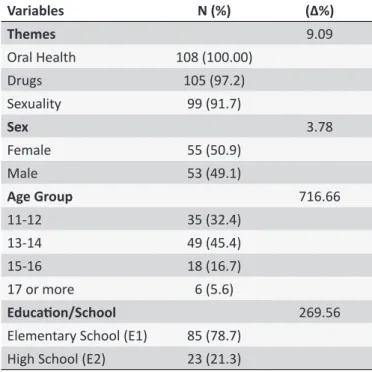
Table 1 shows the following characteristics, of students participating in the research: absolute frequency and relative, and percent delta, of subjects related to sex, age interval and education level
With regard to educational activities, Table 2 shows the over -all average score of the three themes involved in the research.
Table 3 presents the results stratiied by sex, education and age interval, comparing the efectiveness of measures (pre and post) intra-group evaluating only the diference in the knowledge. To better understand the results shown above, Table 4 shows the relationship of the knowledge acquired and the students interest by the topics covered.
Table 1.
Characterizaion of adolescents who paricipated
in aciviies of health educaion
Variables
N (%)
(Δ%)
Themes
9.09
Oral Health
108 (100.00)
Drugs
105 (97.2)
Sexuality
99 (91.7)
Sex
3.78
Female
55 (50.9)
Male
53 (49.1)
Age Group
716.66
11-12
35 (32.4)
13-14
49 (45.4)
15-16
18 (16.7)
17 or more
6 (5.6)
Educaion/School
269.56
Elementary School (E1)
85 (78.7)
High School (E2)
23 (21.3)
Table 2.
Results of health educaion acions pre- and
post-intervenion
Variables N Mean SD p
Pre Score Post Score
Oral Health 108 4.84 ± 1.25 4.84 ± 1.46 1.000
Drug prevenion 105 2.09 ± 0.96 2.42 ± 1.25* 0.030
Sexuality 99 4.12 ± 1.23 5.02 ± 1.56* < 0.001
Source: Research Data. * Signiicant diferences at p level < 0.05.
Table 3.
Results of health educaion acions pre- and post-intervenion, divided by sex, educaion level and age group
Oral Health Drug prevenion Sexuality
Mean SD Mean SD Mean SD
N Score Pre Score Post p N Score Pre Score Post p N Score Pre Score Post p
Sex Female 55 4.93 ± 1.20 5.02 ± 1.39 0.696 53 2.09 ± 1.01 2.26 ± 1.33 0.460 52 4.33 ± 1.31 5.17 ± 1.59* 0.006 Male 53 4.75 ± 1.31 4.66 ± 1.52 0.743 52 2.08 ± 0.93 2.58 ± 1.14* 0.015 47 3.89 ± 1.11 4.85 ± 1.52* < 0.001
Educaion E1 85 4.88 ± 1.27 4.98 ± 1.41 0.654 80 1.94 ± 0.92 2.49 ± 1.24* 0.001 81 4.06 ± 1.12 5.01 ± 1.58* < 0.001
E2 23 4.70 ± 1.22 4.35 ± 1.56 0.357 25 2.56 ± 0.96 2.20 ± 1.26 0.295 18 4.39 ± 1.65 5.06 ± 1.51 0.175
Age Group
11-12 years 35 4.29 ± 1.10 4.74 ± 1.38 0.189 32 1.75 ± 0.98 2.88 ± 1.34* < 0.001 35 3.97 ± 1.20 4.60 ± 1.63 0.076
13-14 years 49 5.29 ± 1.22 5.16 ± 1.43 0.644 47 2.11 ± 0.81 2.19 ± 1.10 0.628 42 4.17 ± 1.08 5.33 ± 1.51* < 0.001
15-16 years 18 5.06 ± 1.11 4.61 ± 1.33 0.249 22 2.45 ± 1.06 2.32 ± 1.36 0.753 18 4.33 ± 1.64 4.94 ± 1.47 0.172 17 or more 6 3.83 ± 1.17 3.50 ± 1.87 0.750 4 2.50 ± 1.29 2.00 ± 0.82 0.182 4 4.00 ± 1.15 5.75 ± 1.26 0.213 Source: Research Data. * Signiicant diferences at p level < 0.05 intra-groups.
DISCUSSION
Examining the data in Table 1, the diference found in the "n" sample, related to each of the topics (oral health, preventing drug use and sexuality), it is justiied by the diference found in attending the inclusion criteria of participants, in each theme. Because the incorrect illing or the failure to return the question -naires, there was a loss of 3 participants on the theme preventing drug use and sexuality, and 9 on the oral health theme. It should be noted that this fact did not present a signiicant diference when evaluated by the percent delta.
With respect to sex, Table 1 showed relatively equal values also. The largest diferences were found in the distribution of students by the age interval, however, within the normal range for the evaluated school groups the larger incidence was among students aged 13-14 years, this occurred because the 9th grade classes of elementary school II had more students. The difer -ence found on "n", referred to Elementary School II and High School, it was justiied due to the sample being a representation of the total number of students.
When examining the acquisition of knowledge, about the themes covered in health education activities, utilizing the aver -age of scores awarded in the questionnaires pre- and post-test (Table 2), it can be veriied signiicant results in the themes: prevention of drug use (p = 0.030) and sex (p < 0.001). A study on health education activities regarding the use of drugs and violent behavior, conducted with 23 adolescents aged 14 to 20 years, in a public school in the city of Fortaleza (CE), also found
an increased knowledge among adolescents on the theme12, which corroborates the indings of our study, since it is believed that health education actions on drugs contribute signiicantly to ponder, since it is believed that health education actions on drugs contribute signiicantly to ponder about the themes and better understand the dangers associated with the use of drugs in the adolescence.
Regarding sexuality, the fact that health education actions have enlarged the knowledge acquired by adolescents, it has also been demonstrated in studies performed in workshops about sex education, sexually transmitted diseases and AIDS, arguing for the importance of providing spaces to adolescents for receiving guidance and discussion on these themes, in order to develop in them the concern about practices of self-care, as well as promotion of decision making on safer-sex practices1,13-15. The increase of knowledge was evidenced only on the topics of prevention of drug use and sexuality, this can be justiied by the fact that the adolescence is marked by a phase of conlicts, doubts, curiosity, the search of new experiences and the sexual initiation12,15, these factors may have contributed to arouse on the students a greater interest by those two themes. It is important highlight that behavior change is not linked only to knowledge about certain subject; in fact, it involves a variety of variables, nonetheless, the knowledge is essential to arouse the interest of people for seeking a change5.
As seen in Table 2, the action oral health education, after its completion, did not show changes related to the acquisition of knowledge by adolescents. These indings difer from those found in a study16, that evaluated the habits and knowledge of 386 adolescents from 9 to 14 years, who participated in a preven -tive educational program developed by the Federal University of Alfenas (MG); in this study was demonstrated an increase of knowledge on the theme of oral health in adolescents, who participated in the educational program developed in the school environment. With regard to behavioral changes of adolescents after receiving educational actions on oral health, another study6
Table 4.
Frequency of correct answers of health educaion acions pre- and post-intervenion, about Oral Health,
Prevenion of Drugs and Sexuality
Themes/Quesions
Pre N (%)
Post N (%)
(Δ%)
Oral Health (n = 108)
Tooth brushing
95.4 (103)
103 (95.4)
7.97
Causes of halitosis
54 (50)
39 (36.1)
-27.78
Dental care searching
78 (72.2)
92 (85.2)
17.95
Toothbrush replacement
42 (38.9)
46 (42.6)
9.52
Neglect of lossing the teeth
57 (52.8)
50 (46.3)
-12.28
Treatment to prevent caviies
41 (38)
27 (25)
-34.15
Use of dental loss
91 (84.3)
78 (72.2)
-14.29
Best kind of toothbrush
57 (52.8)
88 (81.5)
54.39
Drug prevenion (n = 105)
Drugs
5 (4.8)
9 (8.6)
80.00
Illicit drugs
16 (15.2)
18 (17.1)
12.50
Marijuana reacions
16 (15.2)
22 (21.0)
37.50
Drugs that causes immediate dependence
3 (2.9)
5 (4.8)
66.67
Psychological dependence
58 (55.2)
66 (62.9)
13.79
Anxiolyic
32 (30.5)
33 (31.4)
3.13
Hallucinogen
76 (72.4)
79 (75.2)
3.95
Objecive of primary prevenion
13 (12.4)
22 (21.0)
69.23
Sexuality (n = 99)
Sexuality
59 (59.6)
94 (94.9)
59.32
Sexual iniiaion
19 (19.2)
50 (50.5)
163.16
When an adolescent is able to get pregnant
79 (79.8)
83 (83.8)
5.06
Sexually transmited diseases
78 (78.8)
69 (69.7)
-11.54
The pill and the intrauterine device will protect against
sexu-ally transmited diseases
56 (56.6)
49 (49.5)
-12.50
Double protecion
42 (42.4)
50 (50.5)
19.05
Human immunodeiciency virus/HIV
57 (57.6)
57 (57.6)
0.00
Symptoms of Human Papillomavirus/HPV
18 (18.2)
45 (45.5)
150.00
Source: Research Data. (Δ%) Delta Percent.
in the intervention at the school. It is worth pointing out that the studies6,16 mentioned had a longer time of intervention, that may be the reason for the success in the changes of knowledge and attitudes towards oral health of participants in the research.
When analyzing the average values of scores presented in Table 2, it can be veriied that the theme of prevention of drugs showed the lowest scores in the two moments of evaluation; this information is worrisome when considering the consequences of the lack of knowledge on the subject. These results corroborate the indings in study that veriied low knowledge about drugs in 35 adolescents, aged 10 to 19 years, residents in a community of Rio de Janeiro (RJ); the analysis of that study suggested that the low knowledge about legal and illegal drugs it is one of the main
factors of risk for initiating experimentation and consumption of these substances among teenagers5.
As exhibited in Table 3, it is observed that in the case of knowledge about themes covered in educational activities, female adolescents showed better results when compared with males. The characteristics that distinguishing the sexes can arouse diferent interests in adolescents15, thus, the diference in gain of knowledge between the sexes it could be explained by the greater interest shown by males on the themes of drugs and sexuality while females showed improvement in all themes. Using education (Table 3) as benchmark assessment, it was veriied the best results among adolescents of elementary school II, they showed a signiicant increase in knowledge in themes about prevention of drug use and sexuality (p < 0.001). Those results can be explained by diferent projects that this school develops; the contents were treated frequently and in a simple way, starting with the knowledge that students bring from their experiences, aspect that was acknowledged during the students participation in the educational activities.
Regarding the age groups (Table 3), it was observed sig -niicant increase in knowledge, in the age interval (11-12) years, in the activity prevention of drug use (p < 0.001) and, in the age interval (13-14) years, in the theme about sexuality (p < 0.001). The fact that younger age intervals presented the best results it can be explained by the greater attention, the interest and participation of those students in the health education activities. The signiicant acquisition of knowledge related to the health education themes in younger age intervals, demonstrate that the sooner the health promotion and disease prevention are initiated, it is possible to obtain better results in the health status in adulthood2,10,13.
Since the knowledge was analyzed by means of self-administered questionnaires pre- and post-actions on health education, it was assessed the frequency of responses, as a mean of pointing out themes, addressed in the activities, that were of interest to adolescentes.
With regard to oral health, when crossing information from Tables 3 and 4, it was observed that the frequency of correct answers was higher among females; the themes that had higher averages were: best kind of toothbrush, dental care searching and time to replace the toothbrush. These results are consistent with a study on 1,170 students, with a mean age of 14 years that showed, among the female participants, a proactive behavioral diference regarding the oral health attitude; the authors thought that this diference between the sexes was due to cultural hab -its, in which adolescent women care more about their physical appearance, "aspect that contributes to take better care of their bodies, also relected in the habits and behaviors about oral health"7:662.
On the theme of prevention of drug use, Table 4 shows an increase in the frequency of right answers on all issues after performing the educational action, nevertheless, the questions that showed more signiicant increases were: a) what are drugs, b) which drug causes immediate dependence and c) what is
the objective of primary prevention. The better understanding of these issues can be an important factor to prevent or delay experimentation with drugs during adolescence5.
About the theme sexuality, in Table 4, the frequency of correct answers was more signiicant in the following issues: a) what is sexuality, b) timing of sexual initiation and c) what are the symptoms of Human Papillomavirus/HPV. The activity promoted the understanding that the term sexuality is comprehensive and is not a synonymous of sexual intercourse, because the irst manifestation of sexuality occurs inside the uterus; it was also be emphasized the importance of using condoms to prevent Human Papilloma Virus/HPV and other sexually transmissible diseases. Understanding these issues allows students to face naturally their sexuality which will help them to experience sexuality in a healthy and responsible manner, in all phases of life14,15.
It is important to highlight that conducting Health Education activities in appropriate spaces it is fundamental for the success of actions with the adolescent audiences. Therefore, taking into account its inluence in the formation of habits and attitudes of adolescents and also its capability of reaching a high number of students, the school is a privileged space for development of health-promoting strategies10,13,14.
Another fundamental aspect to be considered, is to un -derstand that in the teaching-learning process, the relationship between the educator (health professionals) and students (stu -dents belonging to schools that participate in the study) should aggregate the knowledge; it is known that one learns from the other, by means of dialogue and relections, to solve problems of everyday life10,11,13. The educator must respect the limitations and the previous knowledge of students and share the experi -ences of these subjects, only in this way educational practices will obtain the expected results11.
CONCLUSION
We conclude, therefore, that the application of instruments to analyze the acquisition of shared-knowledge in health edu -cation activities it is extremely important. With this procedure it was possible to identify: - themes of lesser knowledge, - actions that provided an increase in knowledge, - themes that aroused greater interest in adolescents. Moreover, it enabled to identify contents that should be addressed in other health education activities by the institutions that participated in this research.
The study limitations were established in the fact that the actions in health education were punctual and also it was not performed a longitudinal accompaniment to verify the efective contribution of the actions in changing adolescent behavior, suggesting further studies.
factors that arouse the interest of adolescents, among which we can mention: methods employed that favored dialogue; exchange of experiences and relection on their own practices, from previ -ous experiences; relationships with groups of friends and family; and others.
As a strong point of the work it stands out the actions per -formed in an interdisciplinary way, which predispose progress related to health education. It was veriied that the school environ -ment was an important scenario of practices, being that through this research, administrators increased their interest in keeping those types of activities.
We believe that the acquisition of knowledge, by itself, sen -sitized participants on related topics or that may contribute to self-care and behavior change, therefore, improving the quality of life for the school.
REFERENCES
1. Soares SM, Amaral MA, Silva LB, Silva PAB. Workshops on sexuality in adolescence: revealing voices, unveiling views student's of the medium teaching glances. Esc. Anna Nery [on line]. 2008 July/Sept;[cited 2015 abril 20];12(3):[aprox.7 telas]. Available from: http://www.scielo.br/scielo. php?pid=S1414-81452008000300014&script=sci_arttext
2. Sousa ZAA, Silva JG, Ferreira MA. Knowledge and practices of teenagers about health: implications for the lifestyle and self care. Esc. Anna Nery [on line]. 2014 July/Sept;[cited 2015 abril 20];18(3):[aprox. 6 telas]. Available from: http://www.scielo.br/pdf/ean/v18n3/en_1414-8145-ean-18-03-0400.pdf
3. Farias Júnior JC, Nahas MV, Barros MVG, Loch MR, Oliveira ESA, De Bem MFL et al. Comportamentos de risco à saúde em adolescentes no Sul do Brasil: prevalência e fatores associados. Rev. Panam. Salud Pública. 2009;25(4):344-52.
4. Malta DC, Sardinha LMV, Mendes I, Barreto, SM, Giatti L, Castro IRR et al. Prevalência de fatores de risco e proteção de doenças crônicas não transmissíveis em adolescentes: resultados da Pesquisa Nacional de Saúde do Escolar (PeNSE), Brasil, 2009. Cienc. saude colet. [on line].2010 out;[citado 2015 abril 20];15(Supl. 2):[aprox.. 10 telas]. Disponível: http://www.scielo.br/scielo.php?script=sci_ arttext&pid=S1413-81232010000800002&lng=en.
5. Zeitoune RCG, Ferreira VS, Silveira HS, Domingos AM, Maia AC. Knowledge of teenagers about licit and ilicit drugs: a contribuition to community nursing. Esc. Anna Nery [on line]. 2012 Jan./Mar.;[cited 2015 abril 20];16(1):[aprox. 6 telas]. Available from: http://www.scielo. br/scielo.php?script=sci_arttext&pid=S1414-81452012000100008
6. Turrioni APS, Salomão FGD, Monti JFC, Vazquez FL, Cortellazzi KL, Pereira AC. Avaliação das ações de educação na saúde bucal de adolescentes dentro da Estratégia de Saúde da Família. Cienc. saude colet. [on line]. 2012 jul;[citado 2015 abril 20]; 17(7):[aprox. 7 telas]. Disponível: http://www.scielo.br/scielo.php?script=sci_ arttext&pid=S1413 81232012000700023&lng=en.
7. Davoglio RS, Aerts DRGC, Abegg C, Freddo SL, Monteiro L. Fatores associados a hábitos de saúde bucal e utilização de serviços odontológi -cos entre adolescentes. Cad. Saude Pubica [on line]. 2009 mar;[citado 2015 abril 20];25(3):655-67. Disponível: http://www.scielosp.org/scielo. php?script=sci_arttext&pid=S0102-311X2009000300020&lng=en. 8. Carvalho RWF, Santos CNA, Oliveira CCC, Gonçalves, SRJ, Novais
SMA, Pereira MAS. Aspectos psicossociais dos adolescentes de Aracaju (SE) relacionados à percepção de saúde bucal. 2011; Cienc. saude colet. 16(supl.1):1621-28.
9. Oliveira DLLC. A “nova” saúde pública e a promoção da saúde via educação: entre a tradição e a inovação. Rev. Latino-Am. Enfermagem [on line]. 2005 jun;[citado 2015 abril 20];13(3):[aprox. 8 telas]. Disponível em: http://www.scielo.br/scielo.php?script=sci_arttext&pid=S0104-11692005000300018&lng=en.
10. Besen CB, Netto MS, Da Ros MA, Silva FW, Silva CG, Pires MF. A estratégia saúde da família como objeto de educação em saúde. Saude Soc. [on line]. 2007 abr; [citado 2015 abril 20];16(1):[aprox. 11 telas]. Disponível em:http://www.scielo.br/scielo.php?script=sci_ arttext&pid=S0104-12902007000100006&lng=en.
11. Freire P. Pedagogia da autonomia: saberes necessários à prática educativa. 43ª ed. São Paulo: Paz e Terra; 2011.
12. Silva KL, Dias FLA, Vieira NFC, Pinheiro PNC. Relections concerning the drug abuse and the violence in the adolescence. Esc. Anna Nery [on line]. 2010 July/Sep.;[cited 2015 abr 20];14(3):[aprox. 5 telas]. Available from: http://www.scielo.br/scielo.php?pid=S1414-81452010000300024&script=sci_arttext
13. Oliveira, HM, Gonçalves MJF. Educação em Saúde: Uma Experiência transformadora. Rev. Bras. Enferm. [on line].2004 dez;[citado 2015 abril 20]; 57(6):[aprox. 2 telas]. Disponível em: http://www.scielo.br/scielo. php?script=sci_arttext&pid=S0034-71672004000600028&lng=en. 14. Rodrigues MGS, Cosentino SF, Rossetto M, Maia KM, Pautz M, Silva
VC. Oicinas educativas em sexualidade do adolescente: a escola como cenário. Enferm Glob. [internet]. 2010 out;[citado 2015 abril 20];20(2):1-8. Disponível em: http://scielo.isciii.es/scielo.php?script=sci_ arttext&pid=S1695-61412010000300009&lng=es.
15. Camargo EAI, Ferrari RAP. Adolescentes: conhecimentos sobre sexualidade antes e após a participação em oicinas de prevenção. Cienc. saude colet. [on line]. 2009 jun; [citado 2015 abril 20];14(3):[aprox. 9 telas]. Disponível em: http://www.scielo.br/scielo.php?script=sci_ arttext&pid=S1413-81232009000300030&lng=en.