Scoring system for the diagnosis of tuberculosis in
indigenous children and adolescents under 15 years
of age in the state of Mato Grosso do Sul, Brazil*
Diagnóstico da tuberculose em indígenas menores de quinze anos pormeio de um sistema de pontuação em Mato Grosso do Sul
Sandra Christo dos Santos, Ana Maria Campos Marques, Roselene Lopes de Oliveira, Rivaldo Venâncio da Cunha
Abstract
Objective: To evaluate the process of diagnosing pulmonary tuberculosis in smear-negative indigenous children and adolescents under 15 years of age with the modified Brazilian National Ministry of Health Scoring System (mBNMH-SS). Methods: This was a retrospective descriptive study involving 49 indigenous patients under 15 years of age with tuberculosis, treated between 2007 and 2010 in the state of Mato Grosso do Sul, Brazil. Results: Of the 49 patients, 27 (56%) were under 5 years of age, 33 (67%) had symptoms suggestive of tuberculosis, 24 (49%) were underweight, and 36 (73.5%) had been BCG vaccinated. The tuberculin skin test was positive in 28 patients (57%), 18 (64%) of whom had an induration ≥ 10 mm. Chest X-rays were performed in 37 (76%) of the patients, 31 (84%) of whom had only one chest X-ray taken. Among those 37 patients, the radiological findings were suggestive of tuberculosis in 16 (43%), infiltration/condensation in 10 (27%), and normal in 4 (11%). The Indigenous Health Care Teams made the diagnosis in 31 (63%) of the cases, using the original BNMH-SS in only 14 (45%). We calculated the mBNMH-SS scores for 30 (61%) of the 49 patients. Among the 30 cases scored, a diagnosis of tuberculosis was found to be highly likely, possible, and unlikely in 16 (53%), 11 (37%), and 3 (10%), respectively. Conclusions: The proportion of highly likely and possible diagnoses was consistent with the standard proportion of cases diagnosed by the teams (90%), demonstrating the epidemiological applicability of the mBNMH-SS for the diagnosis of pulmonary tuberculosis in the indigenous population, within the scenario of the health care provided.
Keywords: Tuberculosis, pulmonary/diagnosis; Health services, indigenous/standards; Health services, indigenous/organization & administration.
Resumo
Objetivo: Avaliar o processo diagnóstico da tuberculose pulmonar em indígenas menores de 15 anos, por meio do Sistema de Pontuação do Ministério da Saúde Modificado (SP-MSm), em crianças e adolescentes com resultados negativos na baciloscopia. Métodos: Estudo descritivo retrospectivo de 49 casos de tuberculose em indígenas menores de 15 anos no estado do Mato Grosso do Sul entre 2007 e 2010. Resultados: Dos 49 pacientes, 27 (56%) eram menores de 5 anos, 33 (67%) apresentavam sintomas sugestivos de tuberculose, 24 (49%) tinham baixo peso, e 36 (73,5%) haviam sido vacinados com BCG. O teste tuberculínico foi reator em 28 pacientes (57%). Dentre esses, 18 (64%) apresentaram enduração ≥ 10 mm. Foram realizadas radiografias de tórax em 37 pacientes (76%), sendo que 31 (84%) fizeram apenas um exame. Desses 37 pacientes, os achados radiológicos eram sugestivos de tuberculose em 16 (43%), de infiltrado/condensação em 10 (27%) e normais em 4 (11%). As Equipes de Saúde Indígena foram responsáveis pelo diagnóstico em 31 (63%) dos casos, mas o SP-MS original só foi utilizado em 14 (45%). Os escores do SP-MSm foram determinados em 30 pacientes (61%). Dos 30 casos pontuados, os resultados dos escores indicaram diagnóstico de tuberculose muito provável, possível e pouco provável em 16 (53%), 11 (37%) e 3 (10%), respectivamente. Conclusões: A proporção de diagnóstico muito provável e possível foi concordante com o diagnóstico padrão do serviço (90%), evidenciando a aplicabilidade epidemiológica do SP-MSm para o diagnóstico da tuberculose pulmonar em indígenas, de forma compatível com a realidade do serviço de saúde prestado.
Descritores: Tuberculose pulmonar/diagnóstico; Serviços de saúde do indígena/normas; Serviços de saúde do indígena/organização & administração.
* Study carried out as part of the PhD thesis of the lead author in the Graduate Program in Health and Development in Central-Western Brazil, Federal University of Mato Grosso do Sul, Campo Grande, Brazil.
Correspondence to: Sandra Christo dos Santos. Rua das Garças, 2757, Casa 102, CEP 79021-110, Campo Grande, MS, Brasil. Tel. 55 67 3326-7382 or 55 67 9981-7150. E-mail: [email protected]
Financial support: None.
of diagnosing pulmonary tuberculosis in smear-negative indigenous children and adolescents under 15 years of age with the Brazilian NMH Scoring System. Considering the limitations of its applicability in this population, because of operational aspects inherent to the health care system, the authors adjusted the numerical values assigned to some of the scoring system variables and applied the modified Brazilian NMH Scoring System for the diagnosis of pulmonary tuberculosis as a new proposal for use in the assessment of indigenous children and adolescents.
Methods
This was a retrospective descriptive study of the diagnostic process in 49 indigenous patients under 15 years of age with tuberculosis who were treated between 2007 and 2010 and who resided in indigenous villages in the state of Mato Grosso do Sul. The cases were reported and treated by the Equipes de Saúde Indígena (ESI, Indigenous Health Care Teams) of the Distrito Sanitário Especial Indígena de Mato Grosso do Sul (DSEI-MS, Special Indigenous Health District of Mato Grosso do Sul), which is affiliated with the Special Department of Indigenous Health, in accordance with guidelines of the Programa Nacional de Controle da Tuberculose do MS (PNCT/MS, Brazilian National Tuberculosis Control Program of the Brazilian NMH).(14) We chose non-probability, convenience sampling, which is recommended because this was a homogeneous population and because of its operational ease. (15) The population was selected on the criterion of cases reported in the DSEI-MS base clinics with the highest incidence of tuberculosis, all of which were located in the south of the state. The records (medical charts and case registries) made available by the ESI of the DSEI-MS were analyzed for epidemiological, clinical, and radiological characteristics, as well as data regarding nutritional status, BCG vaccination, and TST results, all of which are used by the Brazilian NMH Scoring System (Chart 1).(13) We retrospectively applied the Brazilian NMH Scoring System to the cases studied. However, changes were made to the numerical values assigned to the variable chest X-ray findings. The Brazilian NMH Scoring System(13) presupposes that a second chest X-ray will be taken to assess progression of imaging findings and therefore determine the score for this variable. Since this procedure is operationally
Introduction
by the Conselho Nacional de Ética em Pesquisa (CONEP, Brazilian National Ethics Committee; no. 25000.140518/2010-96).
Results
During the study period, 76 indigenous patients under 15 years of age were reported to have tuberculosis. Initially, we selected 69 cases reported in the base clinics with the highest incidence of tuberculosis, all of which were located in the south of the state. Among those cases, there was a change in diagnosis in 3, the records were not found in 8, the available records were incomplete in 6; and it was impossible to go to the base clinic of origin in 3. Therefore, we selected 49 cases reported and treated by the ESI. Of those 49 patients, 29 (59%) and 20 (41%) were male and female, respectively. In relation to age group, 27 patients (56%) were under 5 years of age, 13 (27%) were between 5 and 9 years of age, and 8 (17%) were between 10 and 14 years of age. Among the 49 patients, there were symptoms unfeasible for this population, the authors made
changes to the numerical values assigned to this variable so that normal chest X-ray findings were
assigned −5 points, whereas abnormal chest X-ray
findings, as defined by the standards described in this system, were assigned +5 points. The system with the previously mentioned changes was then designated modified Brazilian NMH Scoring System for the diagnosis of pulmonary tuberculosis in smear-negative indigenous children and adolescents (Chart 2). The modified Brazilian NMH Scoring System was retrospectively applied to all cases that had recorded data regarding at least four of the five attributable variables (Chart 2). Cases of tuberculosis were defined as reported cases in which the diagnosis was made by the ESI, with or without positive bacteriological testing, and whose outcome was not a change in diagnosis. Microsoft Office Excel 2003 was used to build the database. The present study was approved by the Human Research Ethics Committee of the Anhanguera University and
Chart 1 - Brazilian National Ministry of Health Scoring System for the diagnosis of pulmonary tuberculosis in smear-negative children and adolescents, Brazil, 2011.
Clinical manifestations Points
Fever or symptoms such as cough, adynamia, expectoration, weight loss, and sweating for more than 2 weeks
+15
No symptoms or symptoms for less than 2 weeks 0
Respiratory infection that improved with antibiotics for common pathogens or without antibiotics −10 Chest X-ray findings
Hilar lymphadenopathy or miliary pattern +15
Condensation or infiltration (with or without cavitation) for more than 2 weeks, remaining unchanged
+15
Condensation or infiltration (with or without cavitation) for more than 2 weeks, worsening or not improving with antibiotics for common pathogens
+15
Condensation or infiltration of any type for less than 2 weeks +5
Normal −5
History of contact with adult tuberculosis
Close contact in the last 2 years +10
Occasional or no contact 0
Tuberculin skin test results
Induration ≥ 5 mm in patients who have not been BCG vaccinated, or who were BCG vaccinated 2 or more years earlier, or who are immunocompromised
+15
Induration ≥ 10 mm in patients who were BCG vaccinated 2 or more years earlier +15
Induration from 0 to 4 mm 0
Nutritional status
Severe malnutrition +5
Normal nutritional status or no severe malnutrition 0
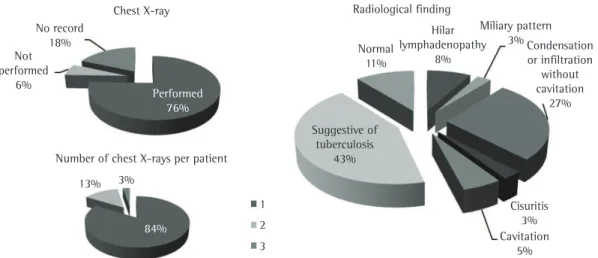
recorded data regarding it. There was a positive history of contact with adult active tuberculosis in 63% of the cases, and there was no information regarding history of contact in 37%. The results for the variable chest X-ray findings (Figure 1) revealed that 37 patients (76%) underwent chest X-ray, 3 (6%) did not, and 9 (18%) had no recorded data regarding it. Among those 37 patients, the radiological findings were described as suggestive or suspicious of tuberculosis in 16 (43%), as specific in 17 (46%)—in 10 (27%), there was infiltration and/or condensation—and as normal in 4 (11%; Figure 1). One, two, and three chest X-rays were performed, respectively, in 31 (84%), 5 (13%), and 1 (3%; Figure 1). As shown in Table 1, the diagnosis of tuberculosis was made by the ESI and by other professionals during hospitalization, respectively, in 63% and 37% of the cases. In the diagnoses made by the ESI, the Brazilian NMH Scoring System was used in 45% of the cases, it was not used in 45% of the cases, and it was not applicable in 7% of the cases (because those were cases of suggestive of tuberculosis, such as fever, cough,
adynamia, expectoration, and weight loss, in 33 (67%), and the clinical course lasted 2 or more weeks in 31 (63%). Of the remaining patients, 11 (23%) had no recorded data regarding clinical profile, 4 (8%) were asymptomatic, and 1 (2%) had other symptoms. In relation to nutritional status,(16) 24 patients (49%) had severe malnutrition or had weight below the 10th percentile, 8 (16%) had weight at or above the 10th percentile, and 17 (35%) had no recorded data regarding it. We found that 36 cases (73.5%) had been BCG vaccinated. The TST was positive in 28 patients (57%), whereas 13 (27%) did not undergo the TST and 8 (16%) had no recorded data regarding it. Among those 28 patients, 18 (64%) had a TST induration ≥ 10 mm, 3 (11%) had a TST induration from 5 to 9 mm, and 7 (25%) had a TST induration from 0 to 4 mm. Among the 18 patients with a TST induration ≥ 10 mm, 10 (56%) had been BCG vaccinated 2 or more years earlier, 6 (33%) had been BCG vaccinated less than 2 years earlier, and 2 (11%) had no
Chart 2 - Modified Brazilian National Ministry of Health Scoring System for the diagnosis of pulmonary tuberculosis in smear-negative indigenous children and adolescents, Brazil, 2011.
Clinical manifestations Points
Fever or symptoms such as cough, adynamia, expectoration, weight loss, and sweating for more than 2 weeks
+15
No symptoms or symptoms for less than 2 weeks 0
Respiratory infection that improved with antibiotics for common pathogens or without antibiotics −10 Chest X-ray findings
Hilar lymphadenopathy or miliary pattern +5
Condensation or infiltration (with or without cavitation) for more than 2 weeks, remaining unchanged
+5
Condensation or infiltration (with or without cavitation) for more than 2 weeks, worsening or not improving with antibiotics for common pathogens
+5
Condensation or infiltration of any type for less than 2 weeks +5
Normal −5
History of contact with adult tuberculosis
Close contact in the last 2 years +10
Occasional or no contact 0
Tuberculin skin test results
Induration ≥ 5 mm in patients who have not been BCG vaccinated, or who were BCG vaccinated 2 or more years earlier, or who are immunocompromised
+15
Induration ≥ 10 mm in patients who were BCG vaccinated 2 or more years earlier +15
Induration from 0 to 4 mm 0
Nutritional status
Severe malnutrition +5
Normal nutritional status or no severe malnutrition 0
diagnosis of pulmonary tuberculosis in smear-negative indigenous children and adolescents. By using this system, it was possible to assign a score to 30 patients (61%), whereas it was impossible to assign a score to 14 patients (29%) extrapulmonary tuberculosis). In addition, there
were no records of the diagnostic criteria used in 3% of the cases. Table 2 shows the result of the retrospective application of the modified Brazilian NHM Health Scoring System for the
Figure 1 - Performance of chest X-ray, number of chest X-rays per patient, and radiological findings in indigenous patients under 15 years of age with tuberculosis, Special Indigenous Health District of Mato Grosso do Sul, 2007-2010.
Table 1 - Application of the Brazilian National Ministry of Health Scoring System for the diagnosis of tuberculosis to smear-negative indigenous children and adolescents under 15 years of age who were diagnosed with tuberculosis, by health care professional responsible for the diagnosis, Special Indigenous Health District of Mato Grosso do Sul, 2007-2010.
Health care professional responsible
for the diagnosis
Application of the Scoring System
Yes No Not
applicable
Unknown Total
n % n % n % n % n %
Indigenous Health Care Teams 14 45.16 14 45.16 2 6.45 1 3.23 31 63.27 Regional hospital professionals 2 11.11 1 5.56 2 11.11 13 72.22 18 36.73
Total 16 32.65 15 30.61 4 8.16 14 28.57 49 100.00
Table 2 - Score obtained by the retrospective application of the modified Brazilian National Ministry of Health Scoring System for the diagnosis of pulmonary tuberculosis to smear-negative indigenous children and adolescents under 15 years of age who were diagnosed with tuberculosis and number of cases in which one of the variables of the system was missing, Special Indigenous Health District of Mato Grosso do Sul, 2007-2010.
Score, n Cases Cases in which one variable was missing Score for the missing variable
5 10 15
n % n n n
≥ 40 16 53.3 1 0 0
30-35 11 36.7 1 1 1
≤ 25 3 10.0 1 1 0
basis of BCG vaccination status; nutritional status; and history of contact with adult active tuberculosis. According to this system, a score ≥ 40 indicates that the diagnosis of tuberculosis is highly likely, a score between 30 and 35 points indicates that the diagnosis is possible, and a score ≤ 25 indicates that the diagnosis is unlikely. The results of the present study reveal that, for the five variables included in the scoring system, the proportion of missing records was high (mean, 27%), denoting that the elements used to make the diagnosis in this age group are not valued. The ESI are the ones primarily responsible for the diagnosis of tuberculosis in this population. However, more than 30% of cases are diagnosed late, at tertiary care level, the disease being advanced and strongly associated with severe malnutrition. Despite continuing training, recording of use of the scoring system by the ESI for diagnosing the cases was lower than 50%, which is in agreement with the high rate of missing records regarding the previously mentioned variables. Retrospective application of the scoring system has been used by researchers to demonstrate the sensitivity (88.9%) and specificity (86.5%) of this diagnostic method(6) in different populations, on the basis of diagnostic agreement, by using the protocol of the referral health care facility as the gold standard,(22,23) even in the absence of positive bacteriology. In the present study, the standard diagnosis was cure without a change in diagnosis, in accordance with the PNCT/MS. The analysis of the variable chest X-ray findings showed the difficulties faced by the ESI in terms of imaging tests. Although chest X-ray service has been offered by municipal governments through a partnership between the DSEI and Municipal Health Departments, the delivery of the service is limited and time consuming because of the distances between the indigenous villages and the cities and because of the reduced availability of tests. The interpretation of radiological images is left to the physicians of the ESI, given that, as a rule, there are no radiologists to issue reports or to participate in the clinical discussion of the cases. This context explains why one single X-ray was performed in more than 80% of the investigated cases and why the radiological findings were considered suggestive or suspicious of tuberculosis, a classification used by the PNCT/MS,(14) without any description of the radiographic abnormalities. because of missing information regarding two or
more variables. In addition, the system was not applicable in 5 patients (10%) because those were cases of extrapulmonary tuberculosis. Among the 30 cases scored, a diagnosis of tuberculosis was found to be highly likely, possible, and unlikely in 16 (53%), 11 (37%), and 3 (10%), respectively.
Discussion
the recommendations of the Brazilian NMH, the Brazilian NMH Scoring System being infrequently used. Despite the continuing training activities promoted by the regional technical teams responsible for the PNCT/MS, there are operational difficulties in obtaining information regarding the variables included in the Brazilian NMH Scoring System, especially regarding chest X-ray findings. In this context, the results of the experimental proposal of the modified Brazilian NMH Scoring System for the diagnosis of pulmonary tuberculosis in smear-negative indigenous children and adolescents demonstrate the epidemiological applicability of this scoring system, which is consistent with the characteristics of the health care provided to this population. Another important contribution of the present study is to show the possibilities of overcoming the technical difficulties by means of further studies involving adjustments in the variables and/or in their respective numerical values. Such studies should be based on the health care scenario as well as on the epidemiological peculiarities of the indigenous population (high incidence of tuberculosis, high transmissibility, prevalence in the age group at greatest risk for severe forms, and death), a population in which early diagnosis is required.
Acknowledgments
We would like to thank all of the professionals working in the DSEI-MS and, especially, the members of the ESI for their work and their commitment to the arduous and constant task of overcoming difficulties, gently sharing information, being aware of the fact that the research group and the teams should be partners.
References
1. Escobar AL, Coimbra CE Jr, Camacho LA, Portela MC. Tuberculosis among indigenous populations in Rondonia, Amazonia, Brazil [Article in Portuguese]. Cad Saude Publica. 2001;17(2):285-98. PMid:11283760. http:// dx.doi.org/10.1590/S0102-311X2001000200004 2. Marques AM, da Cunha RV. Assisted treatment and
tuberculosis cure and treatment dropout rates in the Guaraní-Kaiwá Indian nation in the municipality of Dourados, Mato Grosso do Sul, Brazil [Article in Portuguese]. Cad Saude Publica. 2003;19(5):1405-11. PMid:14666222. http://dx.doi.org/10.1590/ S0102-311X2003000500019
3. Marques AM, Pompilio MA, Santos SC, Garnês SJ, Cunha RV. Tuberculosis among Brazilian indigenous individuals aged less than 15 years-old in State of Mato Grosso do
This scenario shows the severe operational restrictions on the application of the Brazilian NMH Scoring System (Chart 1). It is of note that, except when chest X-ray findings are normal or specific (miliary pattern or hilar adenopathy), the Brazilian NMH Scoring System presupposes that a second chest X-ray will be taken in suspected cases in order to assess progression of imaging findings and only then determine the score for this variable. The response of researchers to this impasse was the experimental proposal of the modified Brazilian NMH Scoring System for the diagnosis of pulmonary tuberculosis in smear-negative indigenous children and adolescents. The change proposed applies to only two
situations: normal chest X-ray findings, −5 points;
14. Comitê Técnico-Científico de Assessoramento à Tuberculose e Comitê Técnico-Científico de Assessoramento à Tuberculose. Comitê Assessor para co-infecção HIV-Tuberculose e Colaboradores. Tuberculose – guia de vigilância epidemiológica. – Brasília: Ministério da Saúde, Fundação Nacional de Saúde; 2002.
15. Bloch KV, Luiz RR, Werneck GL. Amostragem. In: Medronho RA, Bloch KV, Werneck GL, editors. Epidemiologia. São Paulo: Atheneu; 2009. p. 412-6.
16. Hamill PV. NCHS growth curves for children. Hyattsville: U.S. Dept. of Health, Education, and Welfare, Public Health Service, National Center for Health Statistics, 1977. PMCid:432063.
17. Kabra SK, Lodha R, Seth V. Some current concepts on childhood tuberculosis. Indian J Med Res. 2004;120(4):387-97. Pmid:15520488.
18. Maciel EL, Dietze R, Silva RE, Hadad DJ, Struchiner CJ. Evaluation of a scoring system recommended by the Brazilian Ministry of Health for the diagnosis of childhood tuberculosis [Article in Portuguese]. Cad Saude Publica. 2008;24(2):402-8. PMid:18278287. http://dx.doi.org/10.1590/S0102-311X2008000200019 19. Carreira MN, Sant’Anna CC. Estudo comparativo de critérios
para o diagnóstico de tuberculose em crianças atendidas em centro de saúde. J Pneumol. 2000;26(5): 219-26. http://dx.doi.org/10.1590/S0102-35862000000500001 20. Fourie PB, Becker PJ, Festenstein F, Migliori GB, Alcaide
J, Antunes M, et al. Procedures for developing a simple scoring method based on unsophisticated criteria for screening children for tuberculosis. Int J Tuberc Lung Dis. 1998;2(2):116-23. PMid:9562121.
21. Basta PC, Rios DP, Alves LC, Sant’ Anna CC, Coimbra Junior CE. Clinical and radiological study of Suruí indigenous children and adolescents, Amazon Region, Brazil [Article in Portuguese]. Rev Soc Bras Med Trop. 2010;43(6):719-22. PMid:21181031. http://dx.doi. org/10.1590/S0037-86822010000600024
22. Sant’Anna CC, Santos MA, Franco R. Diagnosis of pulmonary tuberculosis by score system in children and adolescents: a trial in a reference center in Bahia, Brazil. Braz J Infect Dis. 2004;8(4):305-10. PMid:15565261. http://dx.doi.org/10.1590/S1413-86702004000400006 23. Coelho Filho JC, Caribé MA, Caldas SC, Martins Netto
E. Is tuberculosis difficult to diagnose in childhood and adolescence? J Bras Pneumol. 2011;37(3):288-93. PMid:21755182. http://dx.doi.org/10.1590/ S1806-37132011000300003
Sul, Brazil [Article in Portuguese]. Rev Soc Bras Med Trop. 2010;43(6):700-4. PMid:21181027. http://dx.doi. org/10.1590/S0037-86822010000600020
4. Brasil. Ministério da Saúde. Secretaria de Vigilância em Saúde. Departamento de Vigilância Epidemiológica. Guia de vigilância epidemiológica. Brasília: Ministério da Saúde; 2009.
5. Graham SM, Marais BJ, Gie RP. Clinical features and index of suspicion of TB in children. In: Schaaf HS, Zumla AI, editors. Tuberculosis: a comprehensive clinical reference. London: Saunders Elsevier; 2009. p. 154-63. PMid:18996460.
6. Sant’Anna CC, Orfaliais CT, March Mde F. A retrospective evaluation of a score system adopted by the Ministry of Health, Brazil in the diagnosis of pulmonary tuberculosis in childhood: a case control study. Rev Inst Med Trop Sao Paulo. 2003;45(2):103-5. PMid:12754577. http:// dx.doi.org/10.1590/S0036-46652003000200010 7. Maciel EL, Brotto LD, Sales CM, Zandonade E, Sant’anna
CC. Gastric lavage in the diagnosis of pulmonary tuberculosis in children: a systematic review. Rev Saude Publica. 2010;44(4):735-42. PMid:20585739. http:// dx.doi.org/10.1590/S0034-89102010005000019 8. Stegen G, Jones K, Kaplan P. Criteria for guidance in the
diagnosis of tuberculosis. Pediatrics. 1969;43(2):260-3. PMid:5304285.
9. Nair PH, Philip E. A scoring system for the diagnosis of tuberculosis in children. Indian Pediatr. 1981;18(5):299-303. PMid:6974697.
10. Graham SM. The use of diagnostic systems for tuberculosis in children. Indian J Pediatr. 2011;78(3):334-9. PMid:21165720. http://dx.doi.org/10.1007/ s12098-010-0307-7
11. Swaminathan S, Rekha B. Pediatric tuberculosis: global overview and challenges. Clin Infect Dis. 2010;50 Suppl 3:S184-94. PMid:20397947. http://dx.doi. org/10.1086/651490
12. Fundação Oswaldo Cruz. Escola Nacional de Saúde Pública Sergio Arouca. Educação a Distância. Controle da tuberculose: uma proposta de integração ensino-serviço. Rio de Janeiro: EAD/ENSP; 2008.
13. Brasil. Ministério da Saúde. Secretaria de Vigilância em Saúde. Departamento de Vigilância Epidemiológica. Manual de recomendações para o controle da tuberculose no Brasil. Brasília: Ministério da Saúde; 2011.
About the authors
Sandra Christo dos Santos
Professor. Anhanguera-Uniderp University, Campo Grande, Brazil.
Ana Maria Campos Marques
Professor. Anhanguera-Uniderp University, Campo Grande, Brazil.
Roselene Lopes de Oliveira
Nurse. Special Indigenous Health District of Mato Grosso do Sul, Secretaria Especial de Saúde Indígena – SESAI, Special Department of Indigenous Health – Campo Grande, Brazil.
Rivaldo Venâncio da Cunha