ORIGINAL
RES
EAR
CH
Correspondence to: Silvio Assis de Oliveira Júnior – Curso de Fisioterapia, UFMS, s/n – Bairro Universitário – Cidade Universitária – CEP: 79070-900 – Campo Grande (MS), Brasil – E-mail: [email protected]
Presentation: Feb. 2014 – Accepted for publication: Oct. 2014 – Financial source: none – Conflict of interests: nothing to delcare – Approval at the Ethics Committee No. 230.163 (CAAE 11683813.0.0000.0021).
ABSTRACT | Specific overloads of ballet practice may
represent risk factors for injuries. The objective of this study was to analyze the epidemiology of typical inju-ries of ballet, including factors associated with history of injury in ballet practitioners. Studied subjects integrated 124 dancers, of both genders, from nine ballet schools from Campo Grande, Mato Grosso do Sul State, Brazil. To obtain information about injuries, we used a morbid-ity survey. Participants were divided into two groups: G1 (with injuries) and G2 (without injuries). In relation to prevalence of injuries, 89 cases were registered, and 61 dancers (49%) reported damages incidence, with record of 1.48 cases per practitioner. Moreover, the G2 presented higher body weight (G1: 51±8 versus G2: 55±10 kg) and training time (G1: 4.0±2.0 versus G2: 5.0±4.1 years). With respect to injury type, joints (32%) and muscle affections (25%) were the main occurrences in the lower limbs (85%) due to specific exercises (30%). Weekly exposure time was the most important mechanism to injury installa-tion. The more important causal circumstance to injury occurrence was constituted by specific training (49%) and choreographic performance (41%). In conclusion, evidences have showed that joint injuries in lower limbs are the main classical ballet injuries in ballet practitioners, and weekly exposure time is the most important factor associated with injuries in classical ballet.
Keywords | Dancing/injuries; Exposure Time; Descriptive Epidemiology.
Epidemiology of athletic injuries in classic ballet
practitioners
Epidemiologia de lesões musculoesqueléticas em praticantes de ballet clássico
Epidemiologia de lesiones musculoesqueleticas en practicantes de balé clásico
Laynna de Carvalho Schweich1, Aline Margareth Gimelli1, Mariane Braulio Elosta1, Wania dos Santos
Weingartner Matos1, Paula Felippe Martinez1,2, Silvio Assis de Oliveira Júnior1,2
Study conducted out ate the Unidade XII, Physical Therapy Course, Center of Biological and Health Sciences (UFMS) – Campo Grande (MS), Brazil.
1Physical Therapy Course, Center of Biological and Health Sciences/UFMS – Campo Grande (MS), Brazil. 2Graduate Program in Health and Development in the Midwest Region, UFMS – Campo Grande (MS), Brazil.
RESUMO | Demandas específicas da prática de ballet
podem representar fatores de risco para lesões muscu-loesqueléticas. Este estudo teve por objetivo analisar a epidemiologia das lesões típicas do ballet, com fatores associados ao histórico de lesão em bailarinos. A casuís-tica integrou 124 participantes de ambos os sexos, pro-cedentes de nove escolas e companhias de ballet de Campo Grande, no Mato Grosso do Sul. Para registro de lesões, utilizou-se um inquérito de morbidade refe-rida. Os participantes foram distribuídos em dois gru-pos: G1, sem lesão, e G2, com lesão. Em relação à pre-sença de lesão, foram registrados 89 casos, sendo que 61 bailarinos (49%) relataram terem se lesionado, com registro de 1,48 casos por praticante. O G2 apresentou maior massa corporal (G1: 51±8 versus G2: 55±10 kg) e tempo de treinamento (G1: 4,0±2,0 versus G2: 5,0±4,1 anos). Houve predomínio de lesões articulares (32%) e muscu-lares (25%) nos membros inferiores (85%), decorrentes de exercícios específicos (30%). O maior tempo sema-nal de prática configurou o principal fator de risco para lesão. A circunstância que mais provocou lesões foi o treino específico (49%), seguido pelo ensaio de coreo-grafia (41%). Conclui-se que as lesões articulares em membros inferiores são as principais lesões do ballet
clássico, e o tempo semanal de exposição constitui o principal fator associado a lesões no ballet clássico.
INTRODUCTION
Dancing has always been present in the history of man-kind and it has been used as a cultural element, instrument of seduction or even of power. It was an integral part of sacred rituals, civic and seasonal celebrations1. he classical
ballet was born with the Renaissance in the sixteenth
cen-tury, in the court of the Medici, in Paris, France, initially relecting gestures, movements and cultural patterns of the time2. Its practice was restricted to the nobility and it was strongly incorporated into the curriculum of the formal education of adolescents and young adults2,3.
In the physical aspect, practicing dancing requires con-tinuity, speciicity, individuality, precision, psychomotor coordination, lexibility, laterality, spatial concept, physical itness condition and body language4,5. In this sense, the classical ballet is an activity which implies important dif-ferent physical and motor applications, integrating move-ment and position requiremove-ments which are considered as being anti-anatomic and relecting, most often, in articu-lar and postural overload2,3,5. In general, ballet demands result from warm-up, stretching and lexibility exercises, from the falls, the jumps, the balance, the extreme range of movement, the dynamic forces, the aerobic and anaer-obic resistance, among others, in the search for the best timing and an accurate technical performance4,6.
In the sports aspect, these specific demands from dancing may represent extrinsic factors related to the onset of injuries in dancers. Other extrinsic factors include the kind of floor, the room temperature and the shape of the ballet shoes. It is noteworthy that the continuous use of pointe ballet shoes is a poten-tial risk factor in the development of injuries and losses in performance7. The intrinsic ones, on the other hand, consist of anatomical and biomechanical
abnormalities, such as muscle shortening, hypermobil-ity and muscles weakness, anthropometric character-istics, flexibility and history of injuries8-10. The onset of injuries is common to any sports modality and, the higher the number of risk factors, whether intrin-sic or extrinintrin-sic, the more likely is the occurrence of orthopaedic and traumatic injuries11,12.
In the epidemiological context, the main medical con-ditions of classical ballet dancers include dermal abrasions and blisters, articular disorders, fractures and lumbar dis-orders13. Nonetheless, the evidences on the epidemiol-ogy of injuries among ballet dancers are not yet suicient, considering possible factors associated to their history, in diferent performance categories. herefore, the present work aims at analyzing the epidemiology of typical clas-sical ballet injuries, related to potential factors associated to the history of injuries among ballet dancers. It is con-sidered, as an initial hypothesis, that the kind of shoes is related to the onset of injuries among ballet dancers.
METHODOLOGY
Participants
A analytical observational descriptive research, cross-sec-tional, including 124 practitioners of classical ballet, from nine schools and ballet companies from Campo Grande, in Mato Grosso do Sul. he volunteers were of both gen-ders and were 17.6±5.2 years old; 53.1±9.2 kg of body mass; 162.5±7.9 cm of height and 8.5±4.9 years of his-tory as a ballet practitioner. As an inclusion criteria, it was established a minimal frequency of two classes per week, each lasting one and a half hour or more. he participants
RESUMEN | Demandas específicas de la práctica de balé
pue-den representar factores de riesgo para lesiones musculoes-queleticas. Eso estudio tuvo como objetivo analizar la epide-miologia de lesiones típicas del balé, con factores asociados a la historia de lesión en bailarines. Hubo la integración de 124 participantes de los dos géneros, procedentes de nueve escue-las de balé de Campo Grande, Mato Grosso do Sul, Brasil. Se
utilizó una averiguación de morbidad referida para registrar las lesiones. Los participantes fueron distribuidos en dos grupos: G1, sin lesión, y G2, con lesión. Con relación a la presencia de lesión, se registraron 89 casos, y 61 bailarines (un 49%) repor-taron lesiones con registro de 1,48 casos por practicante. El G2 presentó mayor masa corporal (G1: 51±8 versus G2: 55±10 kg) y
tiempo de entrenamiento (G1: 4,0±2,0 versus G2: 5,0±4,1 años). Hubo predominancia de lesiones articulares (32%) y muscula-res (25%) en las extremidades inferiomuscula-res (85%) originarias de ejercicios específicos (30%). El mayor tiempo semanal de prác-tica se configuró como el principal factor de riesgo para lesión. La circunstancia que más causó lesiones fue el entrenamiento específico (49%), seguido por el ensayo de coreografía (41%). Se concluso que las lesiones articulares en extremidades inferiores son las principales lesiones del balé clásico, y el tiempo sema-nal de exposición se constituye el principal factor asociado a las lesiones en el balé clásico.
and/or their guardians were informed on the objectives of the research, as well as on the volunteer nature of their participation and signed an Informed Consent Form. his research was approved by the Research and Ethics Committee of the Federal University do Mato Grosso do Sul
(UFMS), approval No. 230.163/2013.
The volunteers were distributed into two groups, deined according to the occurrence of injuries. Group 1 (G1) consisted of practitioners without previous injuries at the moment of the interview, while Group 2 (G2) con-sisted of participants who reported, at least, one injury within the 24 preceding months.
Collection of anthropometric and nosographic
information
he height was measured with the use of a metric tape attached to the wall, and the body mass was obtained with the use of a digital scale. For the collection of information on injuries occurred within the last two years, we used the Morbidity Survey (MS)14. he changes performed in order to adequate the MS to the reality of the modality at matter involved the speciic motor gestures of ballet15. hus, the mechanisms were classiied into: jump, spin/ spin, stretching, strength, use of the pointe, repetitive movement, fall/shock/collision or inadequate posture. Besides that, the period when the injury occurred was separated into three classes: bar training, speciic gesture training or choreography rehearsal. he requirement for medical-therapeutical treatment was considered in case the injury would be diagnosed and/or treated by a health professional. he symptoms of the athlete’s return to the activity were registered after each reported injury was approached.
For study purposes, the injury was deined as any symp-tomatic manifestation of pain or physical dysfunction, due to training practice or dance competitions resulting in training alterations, whether in form, duration, inten-sity or frequency16. he whole process for the acquisition of information was performed by two trained researchers and began with the approach to the participant and/or guardian, with explanations on the objectives and devel-opment of the study, instructions to ill-out the Informed Consent and notes on the survey itself.
Statistical Analysis
he demographic and anthropometric results, as well as the training history, are presented in descriptive measures and were analyzed by the use of a Student’s t-test for the
independent samples. he epidemiological quantitative concluded data were expressed by absolute and relative distribution (%) and analyzed with the Goodman test17. All conclusions were discussed for 5% of statistical sig-niicance. Having met this, the relative risk (Odds Ratio) was calculated, through the association analysis between the variables of the study.
RESULTS
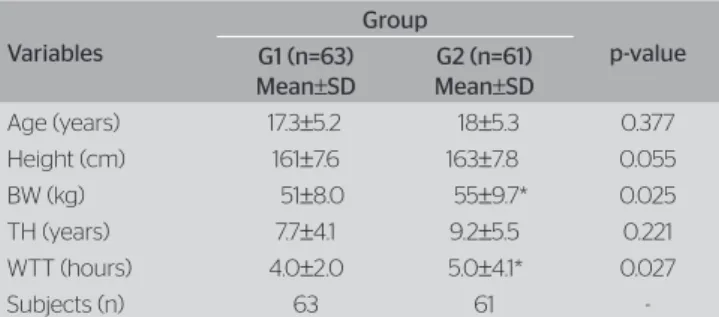
In Table 1, the demographic measures, the practice his-tory and the incidence of injuries are presented. he G2 presented higher body mass and weekly exposure time; among the 124 assessed dancers, 61 (49%) of them reported having gotten injured, totaling 1.48 cases per practitioner (Table 1). Besides, 16 participants (26%) reported injury recurrence.
No statistically signiicant association was observed between age or the use of the pointe and the occurrence of injuries, though the number of pointe users was higher in both groups. In relation to the weekly training time, the G2 had most participants who trained for four or more hours a week; in the G1, where there was a bal-ance between practitioner of up to four hours or more (Table 2). In particular, equal or more than four hours of exposition time was associated to a 2.1 higher chance of injury incidence (OR=2.09; 95%CI 1.00–4.36; p=0.049).
Furthermore, it was observed a predominance of articular (44%) and muscle (34%) disorders of the lower limbs. here were no injuries in the head and neck seg-ments found in the dancers (Table 3).
Regarding injury distribution, according to the nature and mechanism of the manifestation, it was observed that the predominance of muscle (65%) and tendon (22%) impairments are due to stretching. Approximately half
Table 1. Demographic and anthropometric practice profiles, according to the occurrence of athletic injuries
Variables
Group
p-value G1 (n=63)
Mean±SD
G2 (n=61)
Mean±SD
Age (years) 17.3±5.2 18±5.3 0.377
Height (cm) 161±7.6 163±7.8 0.055
BW (kg) 51±8.0 55±9.7* 0.025
TH (years) 7.7±4.1 9.2±5.5 0.221
WTT (hours) 4.0±2.0 5.0±4.1* 0.027
Subjects (n) 63 61
of the articular injuries (53%) occurred from jump and spin circumstances. he practice of using pointe resulted in about 6% of the cataloged registers (Table 4).
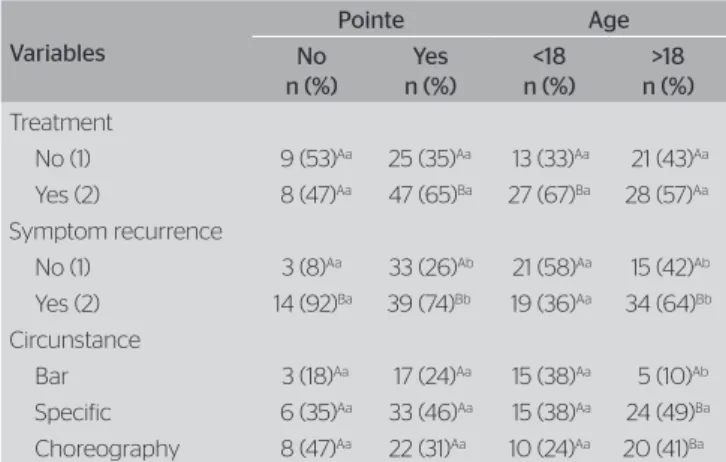
As for the afection circumstances, the main exercises which led to injuries among adults were during speciic rehearsal (49%) and choreographies (41%). Considering the request for treatment, there was predominance of the search for medical-therapeutical assistance among und-eraged dancers (67%) and pointe users (65%). he pres-ence of recurrent symptoms was higher with the use of pointe and among adults (Table 5).
About the time away from the activity, it was ver-iied that the onset of afections resulted in similar recuperative intervals among non-users of pointe ballet
shoes (41±88 days versus 13±26 days away from the activity; p=0.06).
DISCUSSION
This study aimed at analyzing the epidemiology of
ballet injuries, relating some common factors to the
his-tory of injuries among practitioners. Under the light of the theme of Science and Sports, it is recognized that the comparison between dancers and elite athletes is diicult, due to evident diferences as for the format and periodic-ity of the training practices18. herefore, it is essential to clarify that the evidences are relevant to a speciic kind of public, consisted of classical ballet practitioners, from diferent categories and age ranges.
he presence of injuries is associated to higher body mass. In general, the practice of ballet implies continuous improvement of body image, which includes the need for adequate nutritional habits10 and low rates of body fat4. Despite the weight diferences, the main factor associ-ated to the occurrence of injuries was the weekly time of exposure to ballet practice. he manifestation of extrinsic
Table 3. Absolute and relative distribution (%) of the cases of injury, according to the nature and anatomic locations of the onset
Location
Nature of the injury Muscle
n (%)
Tendon n (%)
Articulation n (%)
Bone n (%)
Others n (%)
Total n (%)
Lombar region 4 (13)Aa 0 (0)Aa 2 (6)Aa 0 (0)Aa 2 (40)ABa 8 (9)
UL 0 (0)Aa 1 (6)Aa 0 (0)Aa 0 (0)Aa 0 (0)Aa 1 (1)
LL 25 (83)Bb 16 (94)Bb 32 (89)Bb 0 (0)Aa 3 (60)Bab 76 (85)
Others 1 (3)Aa 0 (0)Aa 2 (6)Aa 1 (100)Bb 0 (0)Aa 4 (5)
Total 30 (34) 17 (19) 36 (44) 1 (1) 5 (6) 89 (100)
UL: upper limbs; LL: lower limbs; A and Bp<0.05 for vertical comparisons; a and bp<0.05 for horizontal comparisons; Goodman test for the contrast between and within multinomial populations
Table 4. Absolute and relative distribution (%) of the cases of injury, according to the nature and mechanism of the onset
Mechanism
Nature of the injury Muscle
n (%)
Tendon n (%)
Articulation n (%)
Bone n (%)
Others n (%)
Total n (%)
Jump 4 (19)ABab 4 (19)Aab 12 (57)ABb 1 (5)Aa 0 (0)Aa 21 (24)
Spin 2 (22)ABa 0 (0)Aa 7 (78)Bb 0 (0)Aa 0 (0)Aa 9 (10)
Stretching 15 (65)Bb 5 (22)Aab 3 (13)Aa 0 (0)Aa 0 (0)Aa 23 (26)
Strength 0 (0)Aa 1 (25)Aa 2 (50)Aa 0 (0)Aa 1 (25)Aa 4 (4)
Pointe 0 (0)Aa 4 (57)Ab 3 (43)Aab 0 (0)Aa 0 (0)Aa 7 (8)
Gesture 7 (53)Bb 3 (23)Aab 3 (23)Aab 0 (0)Aa 0 (0)Aa 13 (16)
Posture 1 (25)Ba 2 (50)Aa 1 (25)Aa 0 (0)Aa 0 (0)Aa 4 (4)
Others 1 (22)ABa 1 (11)Aa 4 (44)Aa 0 (0)Aa 2 (22)Aa 8 (9)
Total 30 (34) 20 (22) 35 (39) 1 (1) 3 (3) 89 (100)
A and Bp<0.05 for vertical comparisons; a and bp<0.05 for horizontal comparisons; Goodman test for the contrast between and within multinomial populations Table 2. Absolute and relative distributions (%) of dancers, according
to age, the use of pointe ballet shoes, weekly time of exposure and occurrence of athletic injury
Variables
Group
G1 (n=63) n (%)
G2 (n=61) n (%)
Age (years)
<18 37 (58.7) 34 (55.7)
>18 26 (41.3) 27 (44.3)
Pointe ballet shoe
No 18 (28.6) 12 (19.7)
Yes 45 (71.4)# 49 (80.3)#
WTE (hours)
<4 hours 31 (49) 19 (31)*
>4 hours 32 (51) 42 (69)#*
factors is associated to the speciic movements with high impact, wide range of articular movement and complex movements15. he speciic ballet exercises are usually per-formed with intensity, duration and a lot of repetition, favoring the onset of injuries19.
In order to support such, the mechanisms of higher physical injury incidence integrated stretching and jump-ing activities, common requirements in ballet4,15. Repetitive movements, the use of pointe ballet shoes, the kind of loor and prolonged rehearsals interact in the pathophys-iology of injuries by repetitive efort20,21. In an similar investigation with athletes, it was found that most part of injuries are caused by excessive repetition, alerting to the interference of auxiliary factors related to excessive use, such as physical and mental fatigue which may com-promise strength and coordination22.
he high prevalence of tendinopathies and artic-ular injuries of the lower limbs corresponded to the speciic ballet requirements. Numerous authors20,21,23-25 say lumbar and lower limbs injuries are due to the classical position in dancing, in which hips perform extreme external rotation, with knees in hyperexten-sion, supported by the extremities of the ingers, using the pointe and overloading ankles. Most injury cases resulted in the search for medical-therapeutical sup-port among dancers who use the pointe and, specially, among underaged participants. In general, adult danc-ers ignore adaptive efects of the continuous overload, neglecting prevention and treatment of smaller inju-ries26. It is very common that adults do not interrupt rehearsal and presentations, even if in pain27, which may justify the high rate of symptomatic recurrence
among adult dancers and pointe users. he precocious performing of excessive exercises after an injury may aggravate even more the conditions28. Only from the 1970’s on is that the dancers started looking for spe-ciic treatments in the medical area27. In developed nations, there is an increasing concern with dancing injuries, considering the activities on health educa-tion to dancers have commonly been implemented27. At last, one should not out rule that the cross-sectional nature of this investigation and the physiological heterogeneity of the studied group may constitute possible methodological biases. Considering the movement speciicity of ballet, longitudinal studies may provide greater precision on the mechanisms as well as on the circumstances injuries occur. In analogy, the categorization according to the level of physical and motor performance may additionally contribute to the characterization of injuries among dancers.
CONCLUSION
he articular injuries of the lower limbs are the main afec-tions resulting from classical ballet. Diferently from the initial hypothesis, the weekly time of exposure is associ-ated to the onset of injuries among dancers.
REFERENCES
1. Ossona P. A educação pela dança. 2 ed. São Paulo: Summus; 1988.
2. Bambirra W. Dançar e sonhar. Belo Horizonte: Del Rey; 1993.
3. Garcia A, Haas AN. Ritmo e dança. Canoas: ULBRA; 2003.
4. Fração V, Vaz MA, Ragasson CA, Müller JP. Efeito do treinamento na aptidão física da bailarina clássica. Rev Mov. 1999;5(11):13-5.
5. Simas JP, Melo SI. Padrão postural de bailarinas clássicas. Rev Ed Fis UEM. 2000;11:51-7.
6. Lima L. Dança como atividade física. Rev Bras Med Esporte. 1995;3(1):94-6.
7. Picon AP. Estudo biomecânico do ballet clássico: Influência da sapatilha e do andamento musical no sauté em primeira posição. [Dissertação]. Escola de Educação Física e Esporte, Universidade de São Paulo, São Paulo; 2004.
8. Lianza S. Medicina de reabilitação. 3 ed. Rio de Janeiro: Guanabara Koogan; 2001.
9. Delisa J, Gans BM. Tratado de medicina de reabilitação: princípios e práticas. São Paulo: Manole; 2002. v. 2.
10. Deliberato PC. Fisioterapia preventiva: fundamentos e aplicações. São Paulo: Manole; 2002.
Table 5. Absolute and relative distribution (%) of the cases of injury, according to request for treatment, symptoms reccurrence and onset circunstances, age and use of pointe ballet shoes
Variables
Pointe Age
No n (%)
Yes n (%)
<18 n (%)
>18 n (%)
Treatment
No (1) 9 (53)Aa 25 (35)Aa 13 (33)Aa 21 (43)Aa
Yes (2) 8 (47)Aa 47 (65)Ba 27 (67)Ba 28 (57)Aa
Symptom recurrence
No (1) 3 (8)Aa 33 (26)Ab 21 (58)Aa 15 (42)Ab
Yes (2) 14 (92)Ba 39 (74)Bb 19 (36)Aa 34 (64)Bb
Circunstance
Bar 3 (18)Aa 17 (24)Aa 15 (38)Aa 5 (10)Ab
Specific 6 (35)Aa 33 (46)Aa 15 (38)Aa 24 (49)Ba
Choreography 8 (47)Aa 22 (31)Aa 10 (24)Aa 20 (41)Ba
11. Gantus MC, Assumpção JD. Epidemiologia das lesões do sistema locomotor em atletas de basquetebol. Acta Fisiatr. 2002;9(2):77-84.
12. Bahr R, Holme I. Risk factors for sports injuries – a methodological approach. Brit J Sports Med. 2003;37:384-92.
13. Monteiro H, Grego L. As lesões na dança: conceitos, sintomas, causa situacional e tratamento. Motriz. 2003;9(2):63-71.
14. Pastre CM, Carvalho FG, Monteiro HL, Netto JJ, Padovani CR. Lesões desportivas no atletismo: comparação entre informações obtidas em prontuários e inquéritos de morbidade Referida. Rev Bras Med Esporte. 2004;10:1-8.
15. Costa MS, Ferreira AS, Felicio LR. Equilíbrio estático e dinâmico em bailarinos: revisão da literatura. Fisiot Pesq. 2013;20(3):292-8.
16. Bennell KL, Crossley K. Musculoskeletal injuries in track and field: incidence, distribuition and risk factors. Aust J Sci Med Sport. 1996;28:69-75.
17. Goodman LA. On simultaneous confidence intervals for multinomial proportions technometrics. 1965;7:247-54.
18. Kiefer AW, Riley MA, Shockley K, Sitton CA, Hewett TE, Cummins-Sebree S, et al.Multi-segmental postural coordination in professional ballet dancers. Gait Post. 2011;34:76-80.
19. Boas JA, Ghirotto FM. Aspectos epidemiológicos das lesões em bailarinas clássicas. Rev Bras Cienc Saúde. 2006;2(7):447-88.
20. Coplan JA. Ballet dancer’s tournout and its relationship to self-reported injury. J Orthop Sports Phys Thr. 2002;32(11):579-84.
21. Hillier JC, Peace K, Hulme A, Healy JC. Pictorial review: MRI features of foot and ankle injuries in balet dancers. Braz J Radiol. 2004;77(918):532-7.
22. Pastre CM, Filho GC, Monteiro HL, Júnio JN, Padovani CR. Lesões desportivas na elite do atletismo brasileiro: estudo a partir de morbidade referida. Rev Bras Med Esporte. 2005;11(1):43-7.
23. Hamilton GW, Hamilton LH, Marshall P, Molnar MA. A profile of the musculoskeletal characteristies of professional ballet dancers. Am J Sports Med. 1992;20(3):267-73.
24. Khan K, Brown J, Way S, Vass N, Crichton K, Alexander R, et al.Overuse injuries in classical ballet. Sports Med. 1995;19(5):341-57.
25. Kadel NJ, Tietz CC, Kronmal RA. Stress fractures in ballet dancers. Am J Sports Med. 1992;20(4):445-9.
26. Amhein D. Dance injuries: their prevention and care. 3 ed. Pennington: Dance Horizons/Princeton Book Company; 1991.
27. Grego LG, Monteiro HL, Padovani CR, Gonçalves A. Lesões na dança: estudo transversal híbrido em academias da cidade de Bauru-SP. Rev Bras Med Esporte. 1999;5:47-54.