107
Rev Bras Med Esporte – Vol. 17, No 2 – Mar/Abr, 2011
LOCOMOTOR APPARATUS IN EXERCISE AND SPORTS
ORIGINAL ARTICLE
Lesions in Shotokan Karate and Jiu-Jitsu – Direct
Trauma Versus Indirect
José Mario Couto de Souza1,2,3 Flavio Tomazelli Faim1,2,3 Inês Yoshie Nakashima1 Carla Regina Altruda1 Wladimir Musetti Medeiros1,3,4 Leandro Reis da Silva1,2
1. Santo Amaro University – UNISA.
2. Multidisciplinary Center of Sports Rehabilitation – Cemare. 3. Study Group in Rehabilitation and Exercise Physiology – GERFE. 4. Federal University of São Paulo – Unifesp.
Mailing Address:
Wladimir Musetti Medeiros Rua Prof. Enéas de Siqueira Neto, 340 – Vila São José – 04829-300 – São Paulo, SP E-mail: [email protected]
ABSTRACT
Introduction: Karate and Jiu-Jitsu are martial arts sharing a common origin but showing distinct movement biomechanics. The main features of Shotokan Karate are the impact blows, whereas Jiu-Jitsu utilizes projections, strangulations, torsions and immobilizations. These differences can provoke different sites of lesion. Objective: To verify the frequency of lesions in Karate and Jiu-Jitsu and confront their respective lesions between the two studied groups. Methods: Ninety-four athletes from three different competitive levels (international, national and state) were transversally evaluated through an open-closed-question questionnaire. Data regarding starting age and period of training were also assessed. The T-Student test and Chi-Square test were applied for the group comparison. Statistically significant differences were considered when p<0,05. Results: 148 lesions were reported from a sample of 53 karate players, and 160 lesions from 41 Jiu-Jitsu athletes. The most frequency site of lesion in karate was the hands and fingers (15.5%) and, in Jiu- Jitsu, the knees (16.3%). The places which presented significant differences between the two groups were: legs (p=0.042), mouth and teeth (p=0,028), neck (p=0,038), shoulder (p=0,000), elbow (p=0,001), and ear (p=0,000). Conclusion: Karate and Jiu-Jitsu show differences as regards frequency and incidence of lesion sites. These findings contribute to the elaboration of specific preventive and therapeutic measures for each sport.
Keywords: lesion, martial arts, sport, rehabilitation.
INTRODUCTION
Different kinds of martial arts had their origin from the tech-nique named Shaolin-su-kempo, developed by the Indian Bud-dhist monk Bodhidharma who initially spread the technique in China and it was subsequently taken to Japan, where it has gone through countless transformations which resulted in dif-ferent techniques, out of which we highlight Shotokan Karate and Jiu-Jitsu(1).
Shotokan Karate is the mostly well-known martial art in the world, having as main characteristic impact strikes, with no use of any weapon, since the word Karate means ‘empty hands’. The dy-namics of a Shotokan Karate competition is composed of blocks and a myriad of strikes, through punches and kicks, performed with upper and lower limbs, which reach the opponent’s trunk and head regions(1,2).
Jiu-Jitsu, as Shotokan Karate, has its origin in Japan; however, it is different from Karate in movement technique and mechanics. The word Jiu-Jitsu means suave art. In Jiu-Jitsu, the intention is to defeat the opponent through projections, strangulations, torsions and immobilizations resulted from tensional force on the joints(3).
Despite the similar origin of the two martial arts, it is clear that the movement dynamics of the two modalities is opposite (4). These
specific characteristics can determine important differences in the type and frequency of injuries, which are crucial information to prevention and treatment.
The numerous competitions, as well as the expressive num-ber of practitioners in the two modalities, justify the performance of this study.
OBJECTIVE
To verify the frequency of injuries of Shotokan Karate practi-tioners comparing them with Jiu-Jitsu practipracti-tioners.
CAUSES AND METHODS
This work is a transversal research investigation carried out through an open and closed questionnaire. 94 questionnaires were assessed, where 41 were answered by Jiu-Jitsu fighters and 53 by Shotokan Karate practitioners. Athletes from three competi-tion levels were asked, following this distribucompeti-tion: internacompeti-tional level, national level and state level.
The questionnaire was composed of the following items: name, date of birth, weight age at the beginning of sports prac-tice, time of practice with no interval, current belt, dominant side, if he is a competitor, level of competition, number of weekly trainings, number of hours per training and site of injury during sports practice (skull, neck, shoulder, arm, elbow, forearm, wrist, hand/fingers, hip, thigh knee, leg, ankle, foot/toes, spine, chest/ back, mouth/teeth, nose, ear).
The data are presented in percentage, means and standard deviations and presented in charts and tables.
108 Rev Bras Med Esporte – Vol. 17, No 2 – Mar/Abr, 2011 Figure 2. Frequency of injuries per body segment in Jiu-Jitsu.
Note: Three main sites of injury in Jiu-Jitsu (Frequency and percentage).
Figure 1. Frequency of injuries per body segment in Shotokan Karate. Note: Three main sites of injury in Shotokan Karate (Frequency and percentage).
RESULTS
This study was approved by the Ethics and Research Committee of the University of Santo Amaro.
The studied sample was composed of 94 individuals (table 1), all from the male sex, divided in 53 karate fighters (56.3%) and 41 Jiu-Jitsu practitioners (43.7%). Age mean among Karate practitioners was of 22.4 years and in Jiu-Jitsu it was of 22.1 years. Concerning weight, a significant difference was observed (p = 0.002) between groups, since the weight mean in Karate was 68.6kg and in Jiu-Jitsu, 76.6kg. In the age at the beginning variable, a significant difference was found (p = 0.006) between groups, in which the karate fight-ers began their training with mean age of 14.4 years and Jiu-Jitsu practitioners with 17.7years. The time of practice was also different (p = 0.001); karate fighters present longer time of practice of 6.3 years, against 3.7 years of the Jiu-Jitsu practitioners. The number of weekly trainings and of hours per training, both specific to the sport and complementary, also presented difference (p = 0.008) and (p = 0.002), where in Shotokan Karate, 3.7 days per week and 111 minutes per day and in Jiu-Jitsu, 4.6 days per week and 144 minutes per day. 308 injuries were reported; 160 in the Jiu-Jitsu practitioners and 148 in the Karate fighters.
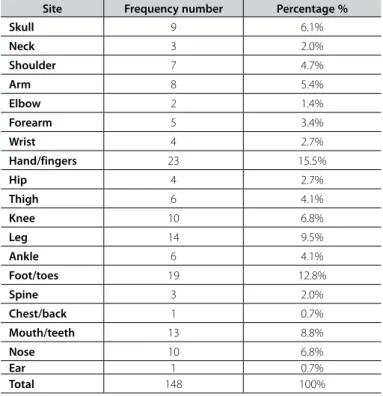
Regarding the Shotokan Karate practitioners (table 2), it was observed that 88.6% presented any kind of sport injury. The sites which presented the highest incidence were (figure 1): hand/fin-gers in 23 practitioners (15.5%), followed by foot/toes with 19 practitioners (12.8%) and leg with 14 practitioners (9.5%). While in the Jiu-Jitsu practitioners (table 3), an impressive prevalence of 97.5% of sport injuries was observed, with most of them having been reported in (figure 2): knee in 26 practitioners (16.3%), shoul-der in 23 practitioners (14.4%) and ear in 21 practitioners (13.3%).
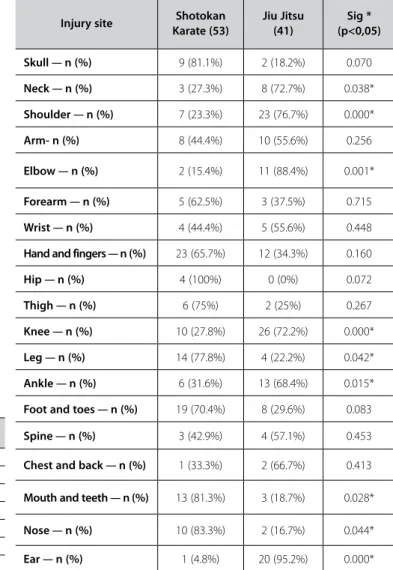
Comparing the sites of injury between Jiu-Jitsu practitioners versus Karate fighters (table 4) it was observed that hand/fingers and foot/toes were the most frequent injuries in Shotokan Ka-rate; however, they did not present significant differences when compared with the Jiu-Jitsu practitioners. The leg was the third most frequent site of injury in Shotokan Karate and presented significantly higher incidence (p = 0.042) when compared with the Jiu-Jitsu practitioners; that is to say, from the total of injuries on the le, 77.8% were in Shotokan Karate versus 22.2% in Jiu-Jitsu. Comparing the site of injury in the Jiu-Jitsu practitioners, signifi-cantly higher incidence was observed on the knee, shoulder and ear, presenting p = 0.000 for the three sites. Out of the total of knee injuries, 72.2% occurred in Jiu-Jitsu and 27.8% in Shotokan Karate; while on the shoulder, the prevalence was of 76.7% in Jiu-Jitsu and 23.3% in Shotokan Karate; and on the ear, the difference was shocking, being 95.2% in Jiu-Jitsu and 4.8% in Shotokan Karate.
Table 1. Sample characterization.
Variables Shotokan Karate Jiu Jitsu Sig * (p<0,05)
N 53 41
Age (years) 22.4 ± 8.4 22.1 ± 3.9 0.878
Weight (kg) 68.6 ± 11.9 76.7 ± 12.1 0.002*
Age beginning (years) 14.4 ± 7 17.7 ± 4.7 0.006*
Time (years) 6.3 ± 4.3 3.7 ± 3.1 0.001*
Training/week (day) 3.7 ± 1.5 4.6 ± 1.7 0.008*
Time/training (min) 111± 45.7 144 ± 57.4 0.002* Note: Variables represented by Mean ± Standard deviation. Result of the statistical analysis through the Student’s t tes
Table 2. Frequency of injuries per body segment in Shotokan Karate.
Site Frequency number Percentage %
Skull 9 6.1%
Neck 3 2.0%
Shoulder 7 4.7%
Arm 8 5.4%
Elbow 2 1.4%
Forearm 5 3.4%
Wrist 4 2.7%
Hand/fingers 23 15.5%
Hip 4 2.7%
Thigh 6 4.1%
Knee 10 6.8%
Leg 14 9.5%
Ankle 6 4.1%
Foot/toes 19 12.8%
Spine 3 2.0%
Chest/back 1 0.7%
Mouth/teeth 13 8.8%
Nose 10 6.8%
Ear 1 0.7%
Total 148 100%
Nota: Frequência e percentual.
23 (15.5%)
23 (14.4%)
26 (16.3%)
21 (13.3%) 14 (9.5%)
109
Rev Bras Med Esporte – Vol. 17, No 2 – Mar/Abr, 2011
DISCUSSION
The present study assessed only male individuals so that influence of the anatomic differences on the injury incidence could be avoided.
The understanding on the importance as well as sites where injuries occur in specific sports modalities and the movement biomechanics is crucial to identify the trauma mechanisms and hence perform a more efficient prevention and rehabilitation work.
This research shows that Shotokan Karate and Jiu-Jitsu ath-letes start their activities when still young; however, this starting time is even earlier in Shotokan Karate, being it an aggravation Table 3. Frequency of injuries per body segment Jiu-Jitsu.
Site Frequency number Percentage %
Skull 2 1,3%
Neck 8 5.0%
Shoulder 23 14.4%
Arm 10 6.3%
Elbow 11 6.9%
Forearm 3 1.9%
Wrist 5 3.1%
Hand/fingers 13 8.1%
Hip 0 0%
Thigh 2 1.3%
Knee 26 16.3%
Leg 4 2.5%
Ankle 14 8.8%
Foor/toes 7 4.4%
Spine 4 2.5%
Chest/back 2 1.3%
Mouth/teeth 3 1.9%
Nose 2 1.3%
Ear 21 13.3%
Total 160 100%
Note: Frequency and percentage.
Table 4. Frequency of injuries per body segment comparing Shotokan Karate versus
Jiu-Jitsu.
Injury site Shotokan Karate (53)
Jiu Jitsu (41)
Sig * (p<0,05)
Skull — n (%) 9 (81.1%) 2 (18.2%) 0.070
Neck — n (%) 3 (27.3%) 8 (72.7%) 0.038*
Shoulder — n (%) 7 (23.3%) 23 (76.7%) 0.000*
Arm- n (%) 8 (44.4%) 10 (55.6%) 0.256
Elbow — n (%) 2 (15.4%) 11 (88.4%) 0.001*
Forearm — n (%) 5 (62.5%) 3 (37.5%) 0.715
Wrist — n (%) 4 (44.4%) 5 (55.6%) 0.448
Hand and fingers — n (%) 23 (65.7%) 12 (34.3%) 0.160
Hip — n (%) 4 (100%) 0 (0%) 0.072
Thigh — n (%) 6 (75%) 2 (25%) 0.267
Knee — n (%) 10 (27.8%) 26 (72.2%) 0.000*
Leg — n (%) 14 (77.8%) 4 (22.2%) 0.042*
Ankle — n (%) 6 (31.6%) 13 (68.4%) 0.015*
Foot and toes — n (%) 19 (70.4%) 8 (29.6%) 0.083
Spine — n (%) 3 (42.9%) 4 (57.1%) 0.453
Chest and back — n (%) 1 (33.3%) 2 (66.7%) 0.413
Mouth and teeth — n (%) 13 (81.3%) 3 (18.7%) 0.028*
Nose — n (%) 10 (83.3%) 2 (16.7%) 0.044*
Ear — n (%) 1 (4.8%) 20 (95.2%) 0.000*
Note: Frequency and percentage of injuries in the studied groups. Result of the statistical analysis through the Chi-square test.
issue, since the bone resistance below 16 years of age is not similar to in an adult(5). Additionally, the interaction between age
and years of experience significantly contributes to the reduction of injury risk(6).
The most interesting aspect of this study is the comparison between two martial arts with different styles. In Shotokan Karate there is partial contact with strikes and blocks, while in Jiu-Jitsu physical contact is total. However, contrary to Shotokan Karate, it does not present punches and blocks, but projections to the ground and joint torsions (1,3).
The incidence of injuries observed in Shotokan Karate in the present study is similar to what is observed in the literature. A study which assessed 186 karate fighters found that the main sites for injuries were feet, hands and head, with 35%, 28.9% and 26.5%, respectively(7). Safety was also evaluated in 114 athletes
in which the authors concluded that training load lower than or equal to three hours per week presented low injury incidence, corroborating that training can be harmful when excessively performed(8).
The injuries on the hands and fingers were the main in Sho-tokan Karate. A study reports that these injuries are frequent in many sports. The authors mention that the joint amplitude of different sports activities and overuse are the main factors for Table 4. Frequency of injuries per body segment comparing Shotokan Karate versus
Jiu-Jitsu.
Injury site Shotokan Karate (53) Jiu Jitsu (41) Sig * (p<0,05)
Skull — n (%) 9 (81.1%) 2 (18.2%) 0.070 Neck — n (%) 3 (27.3%) 8 (72.7%) 0.038* Shoulder — n (%) 7 (23.3%) 23 (76.7%) 0.000* Arm- n (%) 8 (44.4%) 10 (55.6%) 0.256 Elbow — n (%) 2 (15.4%) 11 (88.4%) 0.001* Forearm — n (%) 5 (62.5%) 3 (37.5%) 0.715 Wrist — n (%) 4 (44.4%) 5 (55.6%) 0.448 Hand and fingers — n (%) 23 (65.7%) 12 (34.3%) 0.160 Hip — n (%) 4 (100%) 0 (0%) 0.072 Thigh — n (%) 6 (75%) 2 (25%) 0.267 Knee — n (%) 10 (27.8%) 26 (72.2%) 0.000* Leg — n (%) 14 (77.8%) 4 (22.2%) 0.042* Ankle — n (%) 6 (31.6%) 13 (68.4%) 0.015* Foot and toes — n (%) 19 (70.4%) 8 (29.6%) 0.083 Spine — n (%) 3 (42.9%) 4 (57.1%) 0.453 Chest and back — n (%) 1 (33.3%) 2 (66.7%) 0.413 Mouth and teeth — n (%) 13 (81.3%) 3 (18.7%) 0.028* Nose — n (%) 10 (83.3%) 2 (16.7%) 0.044* Ear — n (%) 1 (4.8%) 20 (95.2%) 0.000*
110 Rev Bras Med Esporte – Vol. 17, No 2 – Mar/Abr, 2011 these injuries(9). However, in Shotokan Karate there is not demand
for wide joint amplitudes on the wrists, hands and fingers. Thus, these injuries could be justified by direct trauma, since it was observed in a study significant reduction of these injuries with introduction of hand and foot guards. It is important to high-light that the guards did not limit the joint amplitude, however, they protected against direct trauma(10). One study assessed the
impact force of boxers during a direct strike with the wrists and found for the 4.7m/s velocity an impact force of 2.45kg, which is an impact sufficient to cause serious injuries (11). These physical
characteristics are even more striking, since a wrist strike and a kick reach velocities of 9.8m/s and 14.4m/s, respectively, in Shotokan Karate athletes(12).
The joint torsion techniques present in Jiu-Jitsu explain the high incidence of knee and shoulder injuries. A study which com-pared Aikido – a martial art characterized by projections and tor-sions as well – with other martial arts, observed high incidence of injuries on the upper and lower limbs(13).
Despite the low incidence of injuries in the neck region in both martial arts, these were significantly higher (p = 0.038) in the Jiu-Jitsu practitioners. Injuries in the neck region are always of great concern due to the common motor incapacity and death associated with these regions. The kinematic evaluation of four different strikes of different martial arts concluded that the pos-sibility of cervical injury through these strikes was significant (14).
A factor which should be considered is the possibility that some athletes have omitted or underestimated their injuries due to the fear of being excluded from some competition or training.
This behavior was verified in a previous study which also assessed the frequency of injuries(15).
Jiu-Jitsu is a martial art with a large number of practitioners around the world, especially in countries such as Brazil, Japan and United States; however, the research related to injuries is limited. Until the present date, only two articles related to injury were found in the PubMed database, which were published in 1955 and 1957, extremely outdated(16,17).
In one article it was observed that the main injuries in Judo occurred on the upper limbs, resulting from projections to the ground. This study is similar to ours, since the second main site of injury observed were the shoulders. Concomitantly, the authors did not observe high incidence of knee injuries as in the present study. Such fact is probably due to the freedom of strikes appli-cation on the lower limbs present in Jiu-Jitsu but not in Judo(18).
Interestingly, among the few injuries reported on the lower limbs in Judo, the most common was the knee injury, as observed in 9,936 individuals/year(19), which agrees with the present study.
CONCLUSION
Based on the data obtained with the studied sample it was concluded that the main sites of injury observed in Shotokan Karate were hand and fingers and in Jiu-Jitsu, the knee. Such behavior is probably due to the biomechanical differences be-tween the two martial arts.
All authors have declared there is not any potential conflict of interests concerning this article.
REFERENCES
1. Stricevic MV, Patel MR, Okazaki T, et al. Karate Shotokan: historical perspective and injuries sustained in national and international tournament competitions. Am J Sports Med. 1983;11:320-4. 2. Critchley GR, Mannion S, Meredith C. Injury rates in Shotokan Karate Shotokan. Br J Sports Med.
1999;33;174-7.
3. Gurgel F. Brazilian Jiu Jitsu Manual Pessoal do Jiu Jitsu. Editora Axel Books. 1° Edição São Paulo Brasil 2007.
4. Pieter W. Martial arts injuries. Med Sport Sci. 2005;48:59-73.
5. Rivara FP, Bergman AB, LoGerfo JP, Weiss NS. Epidemiology of childhood injuries. II. Sex differences in injury rates. Am J Dis Child. 1982;136:502-5.
6. Zetaruk MN, Violán MA, Zurakowski D, Micheli LJ. Injuries in martial arts: a comparison of five styles. Br J Sports Med. 2005;39;29-33.
7. Destombe C, Lejeune L, Guillodo Y, Roudaut A, Jousse S, Devauchelle V, Saraux A. Incidence and nature of Karate Shotokan injuries. Joint Bone Spine.2006;73:182-8.
8. Zetaruk MN, Violan MA, Zurakowski D, Micheli LJ. Karate injuries in children and adolescents. Accid Anal Prev. 2000;32:421-5.
9. Rettig AC. Athletic injuries of the wrist and hand. Part I: traumatic injuries of the wrist. Am J Sports Med. 2003;31:1.038-48.
10. McLatchie G, Jennett B.ABC of sports medicine. Head injury in sport. BMJ. 1994;18;308(6944):1.620-4. 11. Khalili-Borna D, Honsik K. Wrestling and sports medicine. Curr Sports Med Rep. 2005;4:144-9. 12. Feld MS, McNair RE, Wilk SR. The physics of Karate Shotokan. Sci Am. 1979;240:150-8.
13. Zetaruk MN, Zurakowski D, Violan MA, Micheli LJ.Safety recommendations in Shotokan Karate Shotokan. Clin J Sport Med.2000;10:117-22.
14. Kochhar T, Back DL, Mann B, Skinner J. Risk of cervical injuries in mixed martial arts. Br J Sports Med. 2005;39:444-7.
15. Birrer RB, Birrer CD. Unreported injuries in the Martial Arts. Br J Sports Med. 1983;17:131-3. 16. Padilla Antoni H. Lipothymia and jiu-jitsu. Dia Med. 1955;9;27:1.150.
17. Cozzolino A, Rienzo C. Traumatic lesions in jiu-jitsu. Arch Ortop. 1957;70:136-40.
18. Green CM, Petrou MJ, Fogarty-Hover ML, Rolf CG. Injuries among judokas during competition. Scand J Med Sci Sports. 2007;17:205-10.