PARTIAL CHARACTERIZATION OF COLD ACTIVE AMYLASES AND PROTEASES OF STREPTOMYCES SP. FROM ANTARCTICA
Mihaela Cotârle1, Teodor Gh. Negoi 1, Gabriela E. Bahrim2, Peter Stougaard3
1
Romanian Polar Research Institute, Bucharest, Romania; 2University “Dun rea de Jos”, Faculty of Food Science and Engineering, Bioengineering Department, Gala i, Romania; 3University of Copenhagen, Faculty of Life Sciences, Department of
Agriculture and Ecology, Denmark.
Submitted: July 11, 2010; Returned to authors for corrections: September 02, 2010; Approved: March 14, 2011.
ABSTRACT
The aim of this study was to isolate novel enzyme-producing bacteria from vegetation samples from East
Antarctica and also to characterize them genetically and biochemically in order to establish their phylogeny.
The ability to grow at low temperature and to produce amylases and proteases cold-active was also tested.
The results of the 16S rRNA gene sequence analysis showed that the 4 Alga rRNA was 100% identical to
the sequences of Streptomyces sp. rRNA from Norway and from the Solomon Islands. The Streptomyces
grew well in submerged system at 20ºC, cells multiplication up to stationary phase being drastically
increased after 120 h of submerged cultivation. The beta-amylase production reached a maximum peak after
seven days, while alpha-amylase and proteases were performing biosynthesis after nine days of submerged
cultivation at 20ºC. Newly Streptomyces were able to produce amylase and proteases in a cold environment.
The ability to adapt to low temperature of these enzymes could make them valuable ingredients for
detergents, the food industry and bioremediation processes which require low temperatures.
Key words:Streptomyces sp., East Antarctica, cold-adapted strain, cold active proteases and amylase
INTRODUCTION
Extremozymes have great economic potential in many
industrial processes - detergents, textiles, baking, brewing,
starch, animal food, leather and the pulp industries, including
agricultural, chemical, and pharmaceutical applications (15, 5).
Among extremozymes, cold-active enzymes have important
biotechnological applications in the food industry, as well as in
biomass conversion and bioremediation. Running processes at
low temperatures reduces risk of contamination by mesophiles
and also saves energy (33, 16, 13, 28, 27).
Therefore, researchers are now trying to exploit
extremophiles as valuable source of novel enzymes (6).
Particular enzymes who display highly specific activity and
catalytic efficiency at low temperatures have the capability to
adapt to cold habitats. (31). Among the extremophiles,
adapted organisms such as psychrophiles and psychrotrophs
inhabit both terrestrial and aquatic environments in polar and
alpine regions, in the bulk of the ocean, in shallow
subterranean regions, in the upper atmosphere, in refrigerated
environments, and on plants and animals living in cold regions.
Psychrotolerant organisms grow well at temperatures close to
the freezing point of water, but have the fastest growth rates
above 20ºC, whereas psychrophilic organisms grow faster at a
temperature of 15ºC or lower, but are unable to grow above
20ºC (26, 25, 31).
Amylases (endo-1,4- -D-glucanohydrolases EC 3.2.1.1)
represent 25% of the sales in enzyme market. These enzymes
play a vital role in many industrial manufacturing processes
such as textile, paper, food industries and detergents (6, 18, 35,
38). Proteases are industrially important enzymes also having
wide applications in the manufacture of pharmaceuticals,
leather, silk, detergents, food, the waste processing industries,
diagnostics and for the recovery of silver used in X-ray films
(33, 20).
The possibility of using actinomycetes, especially
Streptomyces for enzyme production has recently been
investigated. Streptomyces genus exhibits remarkable capacity
for the synthesis of many valuable enzymes with attractive
properties (39, 6, 38). Streptomyces species have served as an
important source of numerous secondary metabolites, enzymes
(9) and antibiotics (1) mainly due to their shorter generation
time, and the ease of genetic and environmental manipulation.
Literature offers valuable information on streptomycetes
species able to produce proteases. In particular S. clavuligerus,
S. griseus, S. moderatus, S. rimosus, S. thermoviolaceus, S.
thermovulgaris, S. avermectinus, and S. pactum DSM 40530
(36, 1, 23), S. gulbargensis (10) are able to produce proteases,
while S. fradie, S. griseus, S. lividans, S. peptidofaciens, and S.
rimosus are known as aminopeptidase producers.
Alpha-amylases have been also produced with S. aureofaciens, S.
rimosus, S. gulbargensis, S. hygroscopicus, S. preacox (12, 34,
40). The study of transglutaminase production by Streptomyces
higroscopus, Streptomyces mobaraensis, S. libani,
Streptoverticillium mobaraense is more recent (11, 37, 24, 30,
8).
Due to the insufficiency of information regarding useful
cold-active enzymes and the industrial application of the
psychrophilic and psychrotrophic taxa it is imperative to isolate
new adapted bacteria and to identify production of
cold-adapted amylase and proteases.
Herein we characterize genetically and biochemically a
polar streptomycete 4 Alga, we examine its growth behaviour
and also the production of amylases and proteases at low
temperature.
MATERIALS AND METHODS
Microorganism and growth properties
The selected bacterial coded 4 Alga was isolated from
Antarctic vegetation samples from Progress Lake 2, Larsemann
Hills, East Antarctica (Negoita T. Gh.) (7). The stock cultures
were maintained on Gause-agar medium with the following
composition (g/l): starch 20, K2HPO4 0.5, MgSO4·7H2O 0.5,
KNO3 1.0, NaCl 0.5, FeSO4·7H2O 0.01, agar 25.0, pH 7.2–7.4
(6).
Growth kinetic and enzyme biosynthesis were performed
in a submerged system. A liquid medium with following
composition (g/l): soluble starch 20.0, corn steep liquor 10.0,
(NH4)2SO4 6.0, CaCO3 8.0, NaCl 5.0 and soybean oil 0.2 ml,
pH 7.0 (7) was inoculated with 2% spore suspension and
incubated during 15 days, at 20°C and 7.276x g. Growth
kinetic was acquired by measuring the cell density at a
wavelength of 610 nm with spectrophotometer UV-VIS,
JENWAY.
Morphological and biochemical characterization
The morphology of the 4 Alga strain was assessed by the
colonies formed on Gause agar medium and by contrast phase
biochemical properties were characterised by using the Biolog
microtiter plate in accordance with the manufacturer’s
instructions. The results were interpreted as positive reaction
(+) or negative reaction (-) after 24 h incubation at 20°C.
16S rRNA gene amplifications and sequencing
Genomic DNA was isolated from the 4 Alga strain using
the Power Soil® DNA Isolation Kit (Mo Bio Laboratories, Inc.). Isolation of the 16S rRNA gene was carried out by means
of PCR with the primer pair 27F/1492R (22). PCR was
performed in a 25 µl reaction mixture containing 2.5 l 10X
buffer (without MgCl2), 1.25 l MgCl2 (25 mM), 0.25 l dNTP
(25 mM), 0.25 l Taq polymerase (5 units/ l) (Ampliqon), 1.0
l of each of the primers 27 F and 1492R. Amplification was
performed with an initial denaturising step (5 min at 94ºC),
followed by 30 cycles of 94ºC for 30 sec., 55ºC for 1 min and
72ºC for 1 min and a final extension at 72ºC for 5 min. The
amplified fragments were purified from agarose gels using
QIAquick gel extraction kit (QIAGEN) and inserted into the
cloning vector pCR®2.1 TOPO according to the manufacturer's instructions. Inserts in pCR®2.1 TOPO were sequenced at GATC Biotech AG, Germany, and the DNA sequences were
submitted to GenBank/EMBL/DDBJ with the accession
numbers EF571003, EF571002, EU263063 and GQ924533.
Phylogenetic analysis
Related sequences were retrieved from public databases
using BLAST at the NCBI server
(http://www.ncbi.nlm.nih.gov/blast/). The closest related 16S
rRNA gene sequences were aligned with the sequences of the
Antarctic isolate using the alignment algorithm in the CLC
Main Workbench 5.1 (CLC bio, Denmark).
Amylase and proteases assays
The crude extracts were obtained after cultivation in
submerged conditions and biomass separation at 4952x g, for
15 minutes. Proteolytic assay was performed via modified
Anson method using 2% casein as substrate (2) and proteases
activity was expressed as Anson units. One Anson unit is the
amount of enzyme which, under the analytical specified
conditions (2% casein as substrate, pH 7.0; for 15 min, at
20°C) hydrolyzed the casein to release, in one minute, the
hydrolysis products soluble in the trichloroacetic acid; this
provides coloration equivalent, measured as absorbance at 670
nm, to 1 mol of tyrosine, in the presence of the
Folin-Ciocalteau reagent by using a tyrosine standard curve over the
range of 0.02-0.24 mol/ml (14).
Alpha-amylase assay was performed by using an adapted
method based on a selective distinction of the hydrolysis
products in 0.1 N Lugol solution. One α-amylase unit
represents the equivalent of the amount of enzyme which
generates a 0.05 decrease in the optical density, for 1 min,
measured at 610 nm, of the colour iodine-starch complex, into
a 1% starch solution, at pH 7.0 and 20ºC (4).
The Shaffer-Somogyi method was used to measure the
released maltose with few modifications (32). One β-amylase
unit represents the amount of maltose (in mg) produced by one
ml crude extract by using 1% starch as substrate, at 20ºC and
pH 7.0 for 1 min.
RESULTS
Phylogenetic analysis
By cultivation on Gause agar medium the outer surface of
colonies was perfectly round initially, but after the fourth day
of incubation started to develop white aerial mycelium that
appeared powdery and also formed spores. Distinctive
substrate mycelium colours were not produced and diffusible
extracellular pigment was not formed. Microscopic
examination revealed that aerial mycelia were morphologically
branched with compact spirals of sporophore.
After genomic DNA separation and purification, the
sequence of the 16S rRNA gene was determined in order to
GenBank/EMBL/DDBJ database and subsequent alignment of
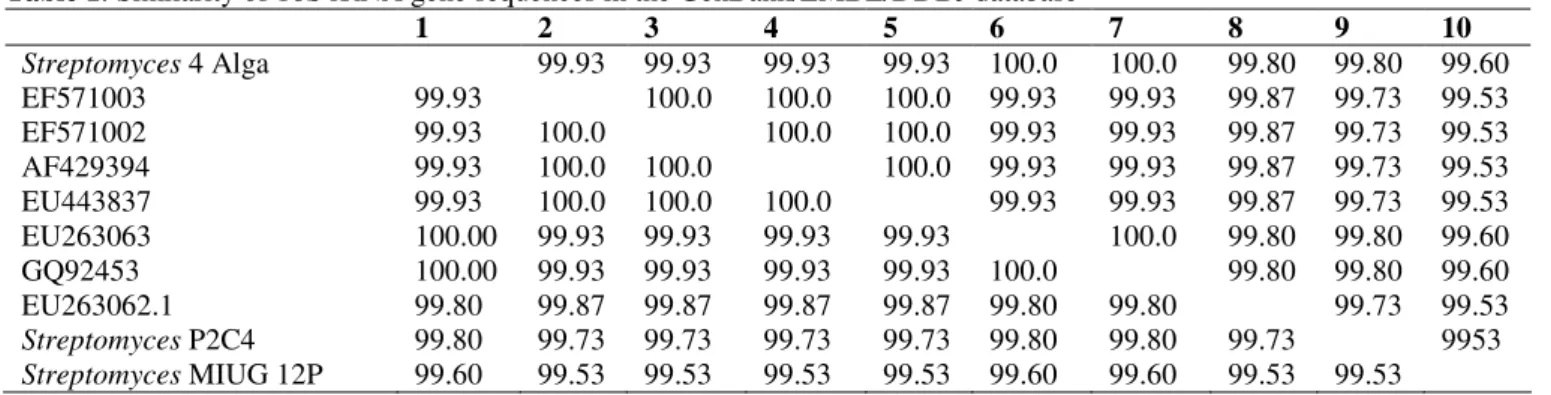
the retrieved sequences indicated that the DNA sequence
showed high similarity (99-100%) to the known 16S rRNA
gene sequences from Streptomyces. The 16S rRNA gene
sequence of 4 Alga strain was shown to be 100% identical to
sequences of Streptomyces sp. isolates from Norway (accession
no. EU263063) and from Solomon Islands (accession no.
GQ924533) and to other Streptomyces (code P2C4 and MIUG
12P members of The Collection of Industrial Microbiology
Laboratory of University of Gal ti Romania) (Fig. 1 and Table
1).
Figure 1. Phylogenetic tree of the 16S rDNA sequence of 4 Alga. The tree was rooted via a neighbor-joining method, and numbers within the dendogram indicate the occurrence (%) of the branching order in 100 bootstrapped trees.
Table 1. Similarity of 16S rRNA gene sequences in the GenBank/EMBL/DDBJ database
1 2 3 4 5 6 7 8 9 10
Streptomyces 4 Alga 99.93 99.93 99.93 99.93 100.0 100.0 99.80 99.80 99.60
EF571003 99.93 100.0 100.0 100.0 99.93 99.93 99.87 99.73 99.53
EF571002 99.93 100.0 100.0 100.0 99.93 99.93 99.87 99.73 99.53
AF429394 99.93 100.0 100.0 100.0 99.93 99.93 99.87 99.73 99.53
EU443837 99.93 100.0 100.0 100.0 99.93 99.93 99.87 99.73 99.53
EU263063 100.00 99.93 99.93 99.93 99.93 100.0 99.80 99.80 99.60
GQ92453 100.00 99.93 99.93 99.93 99.93 100.0 99.80 99.80 99.60
EU263062.1 99.80 99.87 99.87 99.87 99.87 99.80 99.80 99.73 99.53
Streptomyces P2C4 99.80 99.73 99.73 99.73 99.73 99.80 99.80 99.73 9953 Streptomyces MIUG 12P 99.60 99.53 99.53 99.53 99.53 99.60 99.60 99.53 99.53
Biochemical characterization of the Streptomyces sp. 4 Alga isolate
The biochemical properties of Streptomyces 4 Alga were
assesed based on their ability to oxidize various carbon sources
of the Biolog microtiter plate assay (Table 2). Arabinose,
xylose, mannitol, L-phenylalanine were metabolised by the 4
Alga strain. There are many reports regarding utilization of
carbon sources by the streptomycetes and in this sense
Vonothini et al., (2008) research concerning actinomycete
strain, PS-18A isolated from an estuarine shrimp pond sustain
our results. Fructose, maltose, dextrin, glycogen, Tween 40,
citric acid, itaconic acid, D-mannitol, histidine, D-serine,
L-threonine were well utilized; sucrose, inositol, trehalose, formic
acid, malonic acid, L-alanine, inosine, hydroxy-L-proline were
not utilized. These results are also in accordance with Kim et
al., (1998) for Streptomyces thermocarboxydovorans sp. nov.
and Streptomyces thermocarboxydus sp. nov., two moderately
thermophilic carboxydotrophic species from soils.
Table 2. Biochemical properties of the Streptomyces 4 Alga after 24 h of incubation at 20°C
Principal component Reaction Principal component Reaction
-cyclodextrin + L-Rhamnose -
Dextrin + D-Sorbitol -
Glycogen + Sucrose -
Tween 40 + D-trehalose -
Tween 80 + Turanose -
N-acetyl-D-galactosamine + Xylitol +
N-acetyl-D-glucosamine + Pyruvic acid methyl ester +
Adonitol + Succinic Acid Mono-Methyl-Ester +
L-Arabinose + Acetic Acid +
D-Arabitol + Cis-Aconitic Acid +
D-Cellobiose + Citric Acid +
i-Erythritol + Formic Acid -
D-Fructose + D-Galactonic Acid Lactone -
L-Fucose + D-Galacturonic Acid -
D-Galactose + D-Gluconic Acid -
Gentiobiose - D-Glucosaminic Acid -
-D-Glucose - D-Glucuronic Acid +
m-Inositol - -hydroxybutyric Acid +
-D-Lactose - -hydroxybutyric Acid +
Lactulose + -hydroxybutyric Acid +
Maltose + p-hydroxy Phenylacetic Acid +
D-Mannitol + Itaconic Acid +
D-Mannose + -Keto Butyric Acid +
D-Melibiose + Hydroxy-L-Proline -
-Methyl D-glucoside + L-Leucine +
D-Psicose + L-Orithine +
D-Raffinose - L-Phenylalanine +
-Keto Glutaric Acid - L-Proline +
-Keto Valeric Acid - L-Pyroglutamic Acid +
D,L-Lactic Acid - D-serine +
Malonic Acid - L-Serine +
Propionic Acid - L-Threonine +
Quinic Acid + D,L-Carnitine +
D-Saccharic Acid + -Amino Butyric Acid +
Sebacic Acid + Urocanic Acid +
Succinic Acid + Inosine -
Bromosuccinic Acid + Uridine +
Succinamic Acid + Thymidine +
Glucuronamide + Phenyethyl-amine +
L-Alaninamide - Putrescine +
D-Alanine - 2-Aminoethanol +
L-Alanine - 2,3-Butanediol +
L-Alanyl-glycine - Glycerol +
L-Asparagine - D,L- -Glycerol Phosphate +
L-Aspartic Acid + -D-Glucose 1-Phosphate +
L-Glutamic Acid + D-Glucose 6-Phosphate +
Glycyl-L-Aspartic Acid + L-Histidine +
Growth kinetic and time course production of amylases and protease in cold conditions
The Streptomyces 4 Alga is a psychrotolerant strain (data not
shown). The data presented in Fig. 2 showed that the Streptomyces
4 Alga was capable to adapt easily to submerged cultivation and
that cells multiplication drastically increased in the exponentially
growth phase and reached the stationary phase after the five days
of submerged cultivation at 20°C. Previous research (Thumar and
Singh, 2007) showed that Streptomyces clavuligerus strain mit-1
reached the stationary phase after 100 h. It can be seen that the
optical density is high compared to literature results for
Streptomyces sp. D1 from marine sediment samples, which
reached the stationary phase after almost six days of submerged
cultivation at 45°C and 5.502x g (Chakraborty et al., 2008).
Figure 2. Growth kinetic of Streptomyces 4 Alga in submerged culture, by shaking at 7.276x g. Initial pH 7.0; inoculum 2% spore
suspension; incubation period: 15 days; incubation temperature 20°C. Data are the average of two parallel replicates.
The production of amylases and proteases was achieved
during 15 days of submerged culture at 20°C. Alpha-amylase
was synthesised during the early exponential phase, however
the highest yield (14.10 UA) was registered after 216 h of
cultivation, in the middle of the stationary phase. After that the
amylase biosynthesis potential remains constant and after 12
days of cultivation amylase biosynthesis slowly decreases (Fig.
3).
These results are in accordance with Chakraborty et al.
(2008) who reported that amylase from Streptomyces sp. D1,
from marine sediments sampled from coastal region India,
reached the optimum production after 11 days of submerged
cultivation at 45°C and 5.502x g. Syed et al., (2009), referred
that amylase from S. gulbargensis DAS 131 reached the
maximum of enzyme activity after 48 h of incubation at 28°C.
Beta-amylase synthesis started in the middle of the
stationary phase. The highest production of beta-amylase,
173.47 UA, was achieved after 168 h of submerged cultivation,
while alpha-amylase biosynthesis was noticed after 216 h of
submerged cultivation (Fig. 4).
The maximum proteases biosynthesis was recorded after
nine days of cultivation during the stationary phase (Fig. 5).
This result is in agreement with Bascaran et al. (1990) and
proteases from Streptomyces clavuligerus starts in the early
stationary phase of growth. Filamentous bacteria like
Streptomyces rimosus and Streptomyces clavuligerus mit-1
recorded the optimum proteases production at 166 h (40) and
144 h (36) respectively. These results certify the ability of
newly Streptomyces 4 Alga to grow well at low temperature
(20°C) and to produce cold-active amylase (alpha and beta
amylase) and proteases.
Figure 3. Alpha-amylase production at Streptomyces 4 Alga in submerged culture, by shaking at 7.276x g. Initial pH 7.0; inoculum 2% spore suspension; incubation period: 15 days; incubation temperature 20°C. Data are the average of two parallel
replicates.
Figure 5. Proteases production at Streptomyces 4 Alga in submerged culture, by shaking at 7.276x g. Initial pH 7.0; inoculum 2% spore suspension; incubation period: 15 days; incubation temperature 20°C. Data are the average of two parallel replicates.
DISCUSSION
The main objective of this study was to isolate novel
enzyme-producing filamentous bacteria from vegetation
samples from East Antarctica, to characterize them genetically
and biochemically, in order to establish their phylogeny and
their ability to grow at low temperature, and to generate
cold-adapted amylase and proteases.
The 16S rRNA gene sequence of the new strain 4 Alga
was shown to be 100% identical to the sequences of
Streptomyces sp. from Norway and from the Solomon Islands.
The morphological and biochemical studies also confirmed the
classification of this strain in Streptomyces genus. Therefore, in
accordance with the GenBank, the strains closely related with
the 4 Alga are psychrophiles isolated from cold Arctic and
Antarctic regions. Streptomyces sp. MP47-06 (EU263062.1)
showed a 99% similarity with the 4 Alga strain and it was
isolated from a Norway fjord (19).
While most of the studies are concerned about the
molecular phylogeny of streptomycetes, similar attention has
not been paid to their enzymology. Their ability to produce a
variety of enzymes may be an attractive phenomenon in these
prokaryotes (36).
A fast and accurate method has been widely used to
identify newly strain using 16S r DNA gene sequence analysis.
This technique is important to identify organisms which are
slow-growing, fastidious and where identification by
conventional methods is time consuming along with subjective
interpretation such as identifying streptomycetes. Castillo et al.
(2003) had Streptomyces sp. NRRL 30566, which produced
novel antibiotic Kakadumycins using this method (17).
The Streptomyces 4 Alga strain grew properly at low
temperatures. The data showed that the Streptomyces 4 Alga
was capable to easily adapt to submerged cultivation and
reached the stationary phase after the five days of submerged
Alpha-amylase production was recorded after 216 h of
cultivation, in the middle of the stationary phase. After that the
amylase biosynthesis potential remains constant and after 12
days of cultivation amylase biosynthesis slowly decreased.
Beta-amylase synthesis started in the middle of the stationary
phase and it was achieved after 168 h of submerged cultivation.
The maximum proteases biosynthesis was revealed after nine
days of submerged cultivation. These results are in accordance
with previously reported literature results (Yang and Wang,
2000) which also confirm that the biosynthesis of proteases
was detected before amylase production, at Streptomyces
rimosus.
Streptomyces 4 Alga was highly competent to grow in
cold conditions and to biosynthesize amylase and proteases
cold-adaptive at low temperature (20ºC).
The amylases and proteases generated by this
cold-adapted streptomycete strain could be valuable candidates in
competitive bioremediation of polluted soils and waste waters
when the metabolic ability of the endogenous microflora is
reduced due to low temperatures. These enzymes might also
have tremendous applications in other industrial processes,
which require low temperatures.
ACKNOWLEDGEMENTS
The Bioaliment Platform of Dunarea de Jos University,
Galati Romania and the Department of Agriculture and
Ecology, Faculty of Life Sciences, University of Copenhagen,
Denmark have been provided high scientific conditions of
researches. The research was financed by the Romanian Polar
Research Institute with support of UEFISCSU, contract no.1
Europolar/29.03.2010 funded by the Executive Unit for
Funding of High Level Education and of Universities Scientific
Research, Romania (U.E.F.I.S.C.S.U.) in the frame of the
contract no.1 Europolar 2009-2010.
REFERENCES
S.A. (2008). Optimization, Immobilization of Extracellular Alkaline Protease and Characterization of its Enzymatic Properties. Res. J. Agricul. Biol. Sci. 4, 434-446.
2. Anson, M.L. (1938). The estimation of pepsin, trypsin, papain and cathepsin with hemoglobin. J. Gen. Physiol. 22, 79-89.
3. Bascaran, V.; Hardisson, C.; Brana, A.F. (1990). Regulation of extracellular protease production in Streptomyces clavuligerus. Appl. Microbiol. Biotechnol. 34, 208-213.
4. Bahrim G.; Scintee (Cotarlet) M.; Negoita T. (2007). Biotechnological conditions of amylase and protease complex production and utilisation involving filamentous bacteria. The Annals of the University Dunarea de Jos Galati, Fascicle IV-Food Technology, New Series, Year I (XXX),
76-82.
5. Burg, B. (2003). Extremophiles as a source for novel enzymes. Curr Opin Microbiol. 6, 213–218.
6. Chakraborty, S.; Khopade, A.; Kokare, C.; Mahadik, K.; Chopade, B. (2008). Isolation and characterization of novel -amylase from marine Streptomyces sp.D1. J. Molecul Cat B: Enzym. 58,17-23.
7. Cotarlet, M.; Bahrim, G.; Negoita, T.; Stougaard, P. (2008). Screening of polar streptomycetes able to produce cold-active hydrolytic enzymes using common and chromogenic substrates. Rom Biotechnol Lett. 13, 69-80.
8. Cui, L.; Du, G.; Zhang, D.; Chen, J. (2008). Thermal stability and conformational changes of transglutaminase from a newly isolated Streptomyces hygroscopicus. Biores. Technol. 99, 3794–3800.
9. De Azeredo, L.A.I.; Castilho, L.R.; Leite, S.G.F.; Coelho, R.R.R.; Freire, D.M.G. (2003). Protease Production by Streptomyces sp. Isolated from Brazilian Cerrado Soil. Optimization of Culture Medium Employing Statistical Experimental Design. Appl Biochem Biotech.105–108, 749-755.
10. Dastager, S.G.; Lee, J.C.; Ju, Y.J.; Park, D.J.; Kim, C.J. (2008). Nocardioides halotolerans sp. nov., isolated from soil on Bigeum Island,
Korea. Syst Appl Microbiol. 31, 24-29.
11. Dube, M.; Schäfer, C.; Neidhart, S.; Carle, R. (2006). Texturisation and modification of vegetable proteins for food applications using microbial transglutaminase. Springer-Verlag, http://www.aseanfood.info/Articles /11019737.pdf.
12. Fairbairn, D.A.; Priest, F.G.; Stark J.R. (1986). Extracellular amylase sinthesis by Streptomyces limosus. Enzyme Microb Tech. 8, 89-92. 13. Feller, G.; Gerday, C. (2003). Psychrophilic enzymes: hot topics in cold
adaptation. Nat rev/Microbiol. 1, 200-208.
14. Folin, O. and Ciocalteau, V. (1929). On tyrosine and tryptophane determinations in proteins. J. Biol. Chem. 73, 627.
15. Fujiwara S. 2002. Extremophiles: Developments of their special function and potential resources. J. Biosci Bioeng. 94, 518-525.
TIBTECH. 18, 103-107.
17. Ghadin, N.; Zin, N.M.; Sabaratnam, V.; Badya, N. (2008). Izolation and characteriztion of a novel endophytic Streptomyces SUK 06 with antimicrobial activity from malaysian plant. Asian J Plant Sci. 7, 189-194.
18. Hogue, M.M.; Khaman, M.; Shiekh, M.A. (2006). Characterization and optimization of -amylase activity of Streptomyces clavifer. Pak. J. Biol. Sci. 9, 1328-1332.
19. Jorgensen, H.; Fjaervik, E.; Hakvag, S.; Bruheim, P.; Bredholt, H.; Klinkenberg, G.; Ellingsen,T.E.; Zotchev, S.B. (2009). Candicidin biosynthesis gene cluster is widely distributed among Streptomyces spp. isolated from the sediments and the neuston layer of the Trondheim fjord, Norway. Appl Environ Microbiol.75, 3296-3303. 20. Kamoun, A.S.; Haddar, A.; Ali, N.E.H; Frikha, B.G; Kanoun, S.; Nasri,
M. (2008). Stability of thermostable alkaline protease from Bacillus licheniformis RP1 in commercial solid laundry detergent formulations.
Microbiol. Res.163, 299-306.
21. Kim, S.B; Falconer, C.; Williams, E.; Goodfellow, M. (1998). Streptomyces thermocarboxydovorans sp. nov. and Streptomyces thermocarboxydus sp. nov., two moderately thermophilic carboxydotrophic species from soil. Int. J. Syst. Bacteriol. 48, 59-68. 22. Lane, D.J. (1991). 16S/23S rRNA sequencing. In: Stackebrandt E,
Goodfellow M (eds) Nucleic acid techniques in bacterial systematics. Wiley, New York, pp 115-175.
23. Lazim, H.; Mankai, H.; Slama, N.; Barkallah, I.; Limam, F. (2009). Production and optimization of thermophilic alkaline protease in solid-state fermentation by Streptomyces sp. CN902. J Ind Microbiol Biotechnol. 36, 531–537.
24. Macedo, J.A. (2007). Optimization of medium composition for transglutaminase production by a Brazilian soil Streptomyces sp.. Electronic J Biotechnol.10:618-626.
25. Madigan, M.; Martinko, O, J. (2005). Brock Biology of Microorganisms, 11 Editions, Publisher Benjamin Cummings.
26. Margesin, R.; Shinner, F. (1999). Biotechnological Applications of Cold-Adapted Organisms, Heidelberg: Springer-Verlag Berlin.
27. Marx, J.C.; Collins, T.; D’Amico, S.; Feller, G.; Gerday, C. (2006). Cold-adapted enzymes from marine Antarctic Microorganisms. Marin. Biotechnol., 293-304.
28. Metha, V.J.; Trumar, J.T.; Singh, S.P. (2006). Production of alkaline protease from an alkalophilic actinomycete. Biores. Technol. 97, 1650-1654.
29. Moreira, K.A.; Cavalcanti, M.T.; Duarte, H.S.; Tambourgi, E.B.; Silva, V.L.; Porto, A.L.; Filho, J.L. (2001). Partial characterization of proteases from streptomyces clavuligerus using an inexpensive medium. Braz. J. Microbiol. 32, 23-28.
30. Ozer, B.; Kirmaci, H.A.; Oztekin, S.; Hayaloglu, A.; Atamer, M. (2007). Incorporation of microbial transglutaminase into non-fat yogurt production. Int Dairy J. 17, 199–207.
31. Park, J.W.; Oh, Y.S.; Lim J.Y; Roh, D.H. (2006). Isolation and Characterization of Cold-adapted strains producing -galactosidase. J. Microbiol. 4, 396-402.
32. Ranganan, S. (1977). Handbook of analysis and quality control for fruit and vegetable products. Second edition. Tata McGram-Hill Publishing Company Limitated, pp 17-18.
33. Rob, A.H. (1992). A perspective on the biotechnological potential of extremophiles. Trends. Biotechnol. 10, 395-402.
34. 23. Syed, D.G.; Agasar, D.; Pandey, A. (2009). Production and partial purification of -amylase from a novel isolate Streptomyces gulbargensis. J. Ind. Microbiol. Biotechnol. 36, 189–194.
35. Sivaramakrishnan, S.; Gangadharan, D.; Nampoothiri, M. K.; Soccol, C.R.; Pandey, A. (2006). -amylases from microbial sources – an overview on recent developments. Food Technol. Biotechnol. 44, 173-184.
36. Thumar, J.T.; Singh, S.P. (2007). Secretion of an alkaline protease from a salt- tolerant and alkaliphilic, Streptomyces clavuligerus strain mit-1. Braz. J. Microbiol. 38, 766-772.
37. Umezawa, Y.; Ohtsuka, T.; Yokoyama, K.; Nio, N. 2002. Comparison of Enzymatic Properties of Microbial Transglutaminase from Streptomyces sp. Food Sci Technol Res. 8, 113–118.
38. Vonothini, G.; Murugan, M.; Sivakumar, K.; Sudha, S. (2008). Optimization of protease production by an actinomycete strain, PS-18A isolated from an estuarine shrimp pond. African J. Biotechnol. 18, 3225-3230.
39. www.biolog.com. Accessed 26 October 2009.
40. Yang, S.S.; Wang, J.Y. (2000). Protease and amylase production of Streptomyces rimosus in submerged and solid state cultivations. Bot. Bull. Acad. Sin. 40, 259-265.
41. Zhang, Y.; Menga, K.; Wang, Y.; Luoa, H.; Yang, P.; Shi, P.; Wu, N.; Fan, Y.; Li, J.; Yao, B. (2008). A novel proteolysis-resistant lipase from keratinolytic Streptomyces fradiae var. k11. Enzyme Microb. Tech. 42, 46–352.