Expression of stress-related genes in zebrawood (
Astronium fraxinifolium
,
Anacardiaceae) seedlings following germination in microgravity
Peter W. Inglis
1, Ana Y. Ciampi
1, Antonieta N. Salomão
2, Tânia da S.A. Costa
3and Vânia C.R. Azevedo
11
Laboratorio de Genética Vegetal, Embrapa Recursos Genéticos e Biotecnologia,
Parque Estação Biológica, Brasília, DF, Brazil.
2
Laboratorio de Sementes, Embrapa Recursos Genéticos e Biotecnologia,
Parque Estação Biológica, Brasília, DF, Brazil.
3Laboratório de Química de Produtos Naturais, Embrapa Recursos Genéticos e Biotecnologia,
Parque Estação Biológica, Brasília, DF, Brazil.
Abstract
Seeds of a tropical tree species from Brazil,Astronium fraxinifolium, or zebrawood, were germinated, for the first time in microgravity, aboard the International Space Station for nine days. Following three days of subsequent growth un-der normal terrestrial gravitational conditions, greater root length and numbers of secondary roots was observed in the microgravity-treated seedlings compared to terrestrially germinated controls. Suppression subtractive hybridiza-tion of cDNA and EST analysis were used to detect differential gene expression in the microgravity-treated seedlings in comparison to those initially grown in normal gravity (forward subtraction). Despite their return to, and growth in normal gravity, the subtracted library derived from microgravity-treated seedlings was enriched in known micro-gravity stress-related ESTs, corresponding to large and small heat shock proteins, 14-3-3-like protein, polyubiquitin, and proteins involved in glutathione metabolism. In contrast, the reverse-subtracted library contained a compara-tively greater variety of general metabolism-related ESTs, but was also enriched for peroxidase, possibly indicating the suppression of this protein in the microgravity-treated seedlings. Following continued growth for 30 days, higher concentrations of total chlorophyll were detected in the microgravity-exposed seedlings.
Key words:microgravity, stress response, germination, suppression subtractive hybridization, zebrawood.
Received: July 13, 2013; Accepted: December 2, 2013.
Introduction
Plants have evolved under constant gravitational con-ditions and even transient exposure to microgravity is un-natural. Gravisensing is one of the most important factors in the regulation of plant growth and development, where plant shoots grow upward (negative gravitropism) and roots grow downward (positive gravitropism) (Morita and Tasaka, 2004). However, seed-to-seed growth experiments performed with plants such asBrassica rapa, Arabidopsis thalianaand peas have shown that microgravity may not be an impediment to development and completion of the life cycle (Musgraveet al. 2000; Laurinavicius et al., 2001; Sychevet al., 2007). Microgravity, experienced by plants during spaceflight, as distinct from simulated microgravity in clinostat or random positioning machine experiments, may cause physiological and ultrastructural changes that can provoke acceleration of growth and differentiation of
cells and their aging as a result (Kordyum, 1994). Recent evidence from transcriptome profiling of seedlings and cul-tured cells confirms the fundamental hypothesis that survival in the spaceflight environment requires adaptive changes that are both governed and displayed by alterations in gene expression, primarily of heat shock-related and stress-related genes (Paulet al., 2012).
Zebrawood (Astronium fraxinifolium Schott,
Anacardiaceae) is a tropical tree species native to the Ama-zon Rainforest, Atlantic Forest, Caatinga, and Cerrado Bio-mes in Brazil (Santin PA, 1989, Masters Thesis - Instituto de Biologia, Universidade Estadual de Campinas, Cam-pinas, Brazil). In conservation terms, the species is classi-fied as being vulnerable by The Instituto Brasileiro do Meio Ambiente e dos Recursos Naturais Renováveis (Ibama) (http://www.arvoresbrasil.com.br), due to its exploitation for use as timber, as an ornamental tree in landscaping, for its medicinal uses, and due to the disappearance of its natu-ral habitats. In a spacial autocorrelation study of two road-side populations ofA. fraxinifolium, no genetic structure was detected between 1 and 78 km, where the
morphologi-www.sbg.org.br
Send correspondence to Vânia C.R. Azevedo. Laboratorio de Ge-nética Vegetal, Embrapa Recursos Genéticos e Biotecnologia, Parque Estação Biológica, Caixa Postal 02372, 70770-900 Bra-sília, DF, Brazil. E-mail: [email protected].
cal traits analyzed appeared to be highly variable (Aguiaret al., 2004). The adaptability of the species has attracted in-terest for its use in the reforestation of degraded soils in Brazil (Mirandaet al., 2011). The seeds are tolerant of os-motic (-10 Bars), and anoxic (1% O2) stress, with germina-tion that is both rapid and homogenous (A.N. Salomão, unpublished data). These characteristics made the germina-tion of zebrawood seeds an attractive choice for one of eight experiments to be carried out by the first Brazilian as-tronaut, Lt. Col. Marcos Cesar Pontes, on the International Space Station (ISS), where the timeframe available to ob-tain seed germination results was strictly limited by the pro-posed six-day orbital flight.
On their return to Earth, the zebrawood seedlings were grown on for a further six days, along with parallel control batches of seedlings grown solely under terrestrial conditions. The germination process was both faster and more homogeneous in microgravity conditions, both for seeds maintained in the presence of light, and for those kept in the dark. A differential gene expression analysis was then conducted after the total 12-day growth period. To our knowledge, these are the first experiments of their kind to be carried out on a tropical tree species.
Materials and Methods
Germination
Experiment GSM formed part of the scientific re-search program performed by the Brazilian Astronaut, Marcos C. Pontes on the Russian Segment of the ISS in the framework of the CENTENARIO Brazilian Soyuz Mission Project. The zebrawood germination experiment was de-signed by researchers at Embrapa Genetic Resources and Biotechnology, who germinated identical seeds on the ground using the same materials as those used aboard the ISS. Four replicates of 10A. fraxinifoliumseeds were fixed to a blotting paper substrate by Kapton tape in sealed plastic bags. Two plastic bags were exposed to light and the other two were put into an aluminium foil coated bag. Activation of the germination process was performed by seed wetting using a water-filled syringe, incorporated in the germina-tion kit, which was injected by the astronaut when on the ISS. To monitor the germination rate and phenotype, pho-tography by an onboard digital camera was used, where the germination kits kept in the dark were periodically re-moved from their foil-coated bags to facilitate this. Follow-ing the nine day spaceflight, the germinated seeds were returned to earth. On arrival in the laboratory three days later, development was again monitored (12 days post-wetting) and samples of the microgravity-treated seedlings and terrestrial controls reserved, where roots and any emer-gent shoot tissue were dissected and frozen in liquid nitro-gen for later RNA extraction.
The remaining seedlings germinated in both environ-ments were also removed from their packs and transferred
to a germinator, maintained at a temperature of 25 °C, with a photoperiod of 74.98mMm-2.s-1/12 h for about 30 days, for the development of leaflets. Chlorophylls and caroten-oids were then extracted, separated, identified and quanti-fied by scanning spectrophotometer at 180-600 nm,
adapt-ing methods of Gomeset al.(2003) and Rodriguez-Amaya
(1999).
RNA methods and construction of subtractive cDNA libraries
Because of the extremely limited amounts of biologi-cal material available from the spaceflight samples, we opted to produce and sequence two cDNA libraries of ex-pressed sequence tags (ESTs) from a subtractive hybridiza-tion experiment, to detect differential gene expression under microgravity and normal gravity, mixing light- and dark-grown seedlings together.
The roots and shoots from five dark-germinated, and five light-germinated seedlings from either microgravity or terrestrial samples were ground to a fine powder in liquid nitrogen with a mortar and pestle. Total RNA was then ex-tracted using a mini-column purification kit (Invisorb spin plant RNA mini kit; STRATEC Molecular GmbH, Berlin, Germany). Messenger RNAs were purified using Oligo (dT)25magnetic beads (Dynabeads; Dynal - Life Technol-ogies Corp., Carlsbad, USA) and quantified spectrophoto-metrically using a Nanodrop instrument (Thermo Scien-tific, Wilmington, USA).
EST analysis
EST analysis was carried out using the Blast2GO gene annotation and ontology assignment pipeline (Conesa and Götz, 2008). BLAST searches of the NCBI nucleotide database (nr) used the BlastX algorithm, with an ExpectValue of 1.0E-3 and HSP length cutoff of 33. The 20 most significant BlastX hits per sequence were saved, and the top hits then annotated with their gene ontology (GO)-terms, using the default annotation configuration and
evidence code weights. Annotation augmentation
(ANNEX) was applied, and the results of an InterProScan and GO-EnzymeCode mapping steps added. The gene ontologies were also simplified using the GO-Slim Plant ontology for comparative purposes. Overlap in GO-terms between the libraries was calculated and visualised using the BioVenn web application (Hulsenet al., 2008).
Results
Germination
Radicle protrusion and growth of rootlets appeared both faster and more uniform in seeds sent to the ISS. Seven days after the start of the experiment, 60% of the seeds in the presence of light and 30% of those kept in darkness had germinated on the ISS. For seeds kept in the laboratory, germination values were 5% and 10% in the presence and absence of light, respectively, though these values did not reach statistical significance, due to the large variances ob-tained (Figure 1). On the day the experiment returned to Earth (nine days after the start of the experiment), the per-centages of seeds germinated in microgravity were 65% (light) and 85% (dark) and the seeds germinated in the labo-ratory were 80% (light) and 60% (dark). At 12 days after the start of the experiment, the germination of the material from the ISS was 100% in both the presence and absence of light, with rootlets having an average length of 1.5 cm and
starting to show positive geotropic curvature. The germina-tion rate of the terrestrial control was also 100% by the 12th day, but the average length of the radicle was 0.5 cm. Dur-ing later seedlDur-ing development for 30 days in the ger-minator, no difference between the growth of the shoots derived from seeds exposed to microgravity and the control seedlings was observed (not shown). However, the micro-gravity-treated seedlings of seeds had greater root length and number of secondary roots.
Pigments content
The ratio of Chlorophyll a to b was 2.5 in leaflets of seedlings that started germination both in microgravity and in the laboratory (Figure 2). However, leaflets of plantlets that germinated in microgravity showed a significantly (p < 0.001) higher concentration of total chlorophyll (581.47 mg/100 g fresh weight) than those germinated in the laboratory (381.84 mg/100 g fresh weight), following 30 days of terrestrial growth. The concentration ofa -caro-tene in leaflets of plantlets that initiated germination in microgravity was not significantly different (p > 0.05) from those germinated terrestrially, while the concentrations of bothb-carotene (p < 0.05) and xanthophils (p < 0.01) were both significantly higher in the microgravity-treated sam-ples (Figure 3).
Suppression subtractive hybridization library EST analysis
Of the microgravity SSH ESTs, 704 of 741 high qual-ity sequence reads were assembled into 56 contigs, leaving 36 singletons. Filtering of ribosomal RNAs usingAesculus paviarRNA 26S, 18S and 5.8S sequences found a massive 405 ESTs assembling to the 26S rRNA gene and a further 17 ESTs assembling to the 18S rRNA gene. Of the terres-trial SSH ESTs, 588 of 681 high quality reads were
assem-Figure 1- Germination rates of seeds ofAstronium fraxinifolium in microgravity (ISS) and terrestrially (Lab). There was no significant differ-ence (p > 0.05) between the percentage germination in microgravity and terrestrial conditions, and in both light and dark, according to ANOVA with Bonferroni test). Error bars = SD.
bled into 101 contigs, leaving 93 singletons. Ribosomal RNA filtering found 136 ESTs matching 26S rRNA and 1 EST matching 18S rRNA. Cross-assembly between the two libraries, with the exception of the rRNA hits, found only three mixed-library contigs, demonstrating that the PCR suppression subtractive hybridization protocol had other-wise been highly effective.
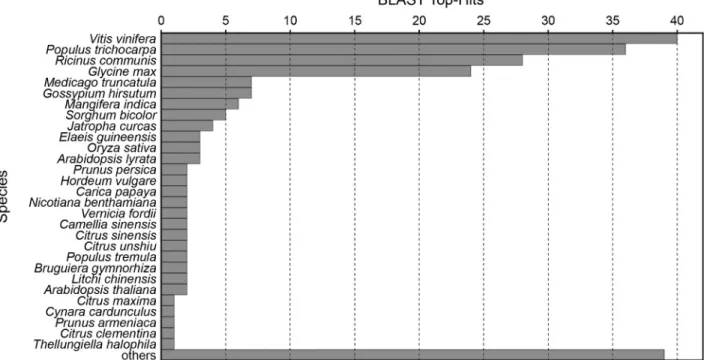
The species distribution of the top BLAST hits for the rRNA filtered ESTs was similar for both microgravity and terrestrial SSH libraries, and the combined results are
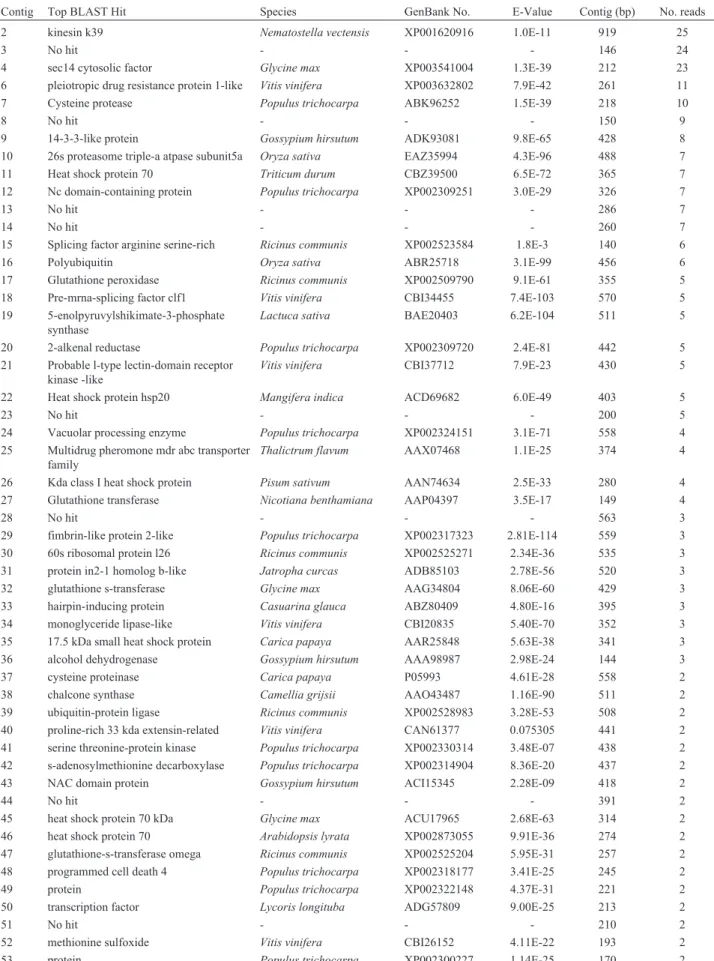
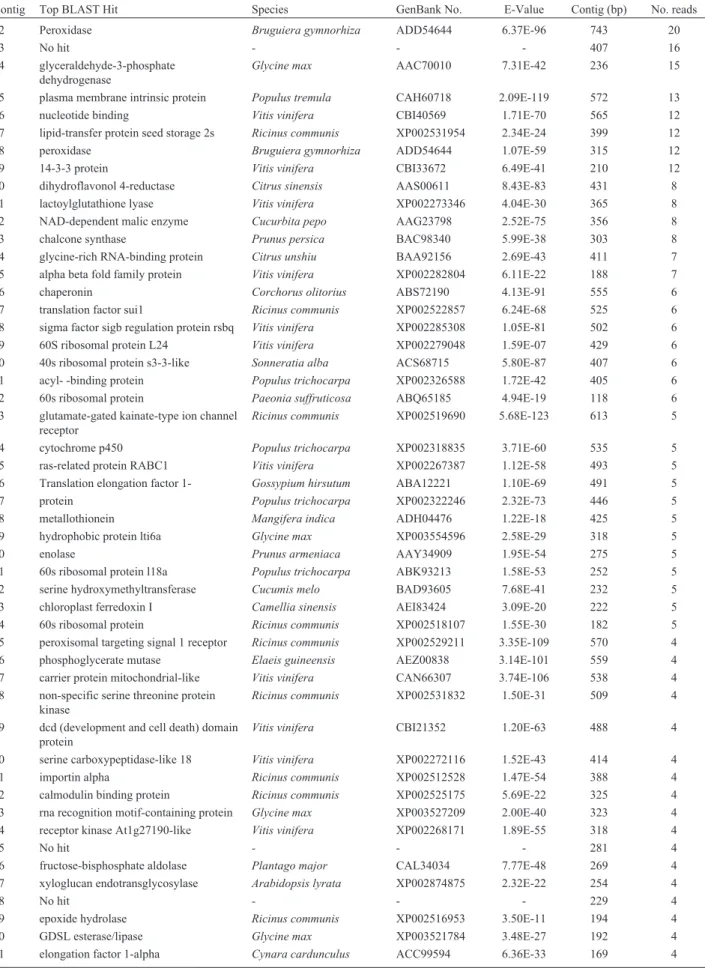
shown in Figure 4. The great majority of hits were with genes from other dicotyledonous plants, as might be ex-pected. The top hits for both microgravity and terrestrial li-brary contigs (excluding singletons) are given in Table 1 and Table 2 respectively.
The microgravity SSH library was notably rich in ESTs of stress-related genes, where seven hits with several different classes of heat shock proteins were noted (Ta-ble 1), as well as an additional six hits among the singleton reads (not shown). In contrast, there was just one hit for heat shock protein 70 in the terrestrial library (Table 2). Also related to a stress-response, there were three separate hits for glutathione transferase among the contigs in theA. fraxinifolium microgravity SSH library (Table 1) and an additional hit among the singleton reads (not shown), whereas no hit for this protein was found in the terrestrial li-brary. Similar stress-related hits included polyubiquitin and 14-3-3-like protein. Notably enriched in the terrestrial SSH library was peroxidase (Table 2).
Despite the low frequency of common EST reads in the two libraries, there was a large overlap in all GO terms extracted from the microgravity and terrestrial SSH library top Blast hits (Figure 5). This was emphasised in the analy-sis of the GOSlims, where the great majority of GOs were common to both libraries. Unique plant GOSlims in the microgravity library were: GO:0009856 (fimbrin-like pro-tein 2-like (Pollination)), from contig 29; GO:0030528 (btb and taz domain protein 4 (transcriptional regulator activ-ity)), singleton; GO:0007049 (cell division cycle protein 48 homolog (cell-division cycle)), singleton; GO:0030234 (cystatin (enzyme modulator)), singleton. Because of the Figure 3- Synthesis of carotenoids in 30-day plantlets derived from seeds
germinated in microgravity (ISS) and terrestrially (Laboratory). The caro-tenoid content was measured relative to leaflet fresh weight, and pairs of measurements between the ISS and the terrestrial laboratory are signifi-cant at p < 0.05 forbcarotene and p < 0.01 for xanthophylls, but were not significant at p > 0.05 foracarotene according to ANOVA with Bonfer-roni test. Error bars = SD.
Table 1- Top BLAST hits of microgravity SSH library assembled contigs containing 2 or more reads.
Contig Top BLAST Hit Species GenBank No. E-Value Contig (bp) No. reads
2 kinesin k39 Nematostella vectensis XP001620916 1.0E-11 919 25
3 No hit - - - 146 24
4 sec14 cytosolic factor Glycine max XP003541004 1.3E-39 212 23
6 pleiotropic drug resistance protein 1-like Vitis vinifera XP003632802 7.9E-42 261 11
7 Cysteine protease Populus trichocarpa ABK96252 1.5E-39 218 10
8 No hit - - - 150 9
9 14-3-3-like protein Gossypium hirsutum ADK93081 9.8E-65 428 8
10 26s proteasome triple-a atpase subunit5a Oryza sativa EAZ35994 4.3E-96 488 7
11 Heat shock protein 70 Triticum durum CBZ39500 6.5E-72 365 7
12 Nc domain-containing protein Populus trichocarpa XP002309251 3.0E-29 326 7
13 No hit - - - 286 7
14 No hit - - - 260 7
15 Splicing factor arginine serine-rich Ricinus communis XP002523584 1.8E-3 140 6
16 Polyubiquitin Oryza sativa ABR25718 3.1E-99 456 6
17 Glutathione peroxidase Ricinus communis XP002509790 9.1E-61 355 5
18 Pre-mrna-splicing factor clf1 Vitis vinifera CBI34455 7.4E-103 570 5
19 5-enolpyruvylshikimate-3-phosphate synthase
Lactuca sativa BAE20403 6.2E-104 511 5
20 2-alkenal reductase Populus trichocarpa XP002309720 2.4E-81 442 5
21 Probable l-type lectin-domain receptor kinase -like
Vitis vinifera CBI37712 7.9E-23 430 5
22 Heat shock protein hsp20 Mangifera indica ACD69682 6.0E-49 403 5
23 No hit - - - 200 5
24 Vacuolar processing enzyme Populus trichocarpa XP002324151 3.1E-71 558 4
25 Multidrug pheromone mdr abc transporter family
Thalictrum flavum AAX07468 1.1E-25 374 4
26 Kda class I heat shock protein Pisum sativum AAN74634 2.5E-33 280 4
27 Glutathione transferase Nicotiana benthamiana AAP04397 3.5E-17 149 4
28 No hit - - - 563 3
29 fimbrin-like protein 2-like Populus trichocarpa XP002317323 2.81E-114 559 3
30 60s ribosomal protein l26 Ricinus communis XP002525271 2.34E-36 535 3
31 protein in2-1 homolog b-like Jatropha curcas ADB85103 2.78E-56 520 3
32 glutathione s-transferase Glycine max AAG34804 8.06E-60 429 3
33 hairpin-inducing protein Casuarina glauca ABZ80409 4.80E-16 395 3
34 monoglyceride lipase-like Vitis vinifera CBI20835 5.40E-70 352 3
35 17.5 kDa small heat shock protein Carica papaya AAR25848 5.63E-38 341 3
36 alcohol dehydrogenase Gossypium hirsutum AAA98987 2.98E-24 144 3
37 cysteine proteinase Carica papaya P05993 4.61E-28 558 2
38 chalcone synthase Camellia grijsii AAO43487 1.16E-90 511 2
39 ubiquitin-protein ligase Ricinus communis XP002528983 3.28E-53 508 2
40 proline-rich 33 kda extensin-related Vitis vinifera CAN61377 0.075305 441 2
41 serine threonine-protein kinase Populus trichocarpa XP002330314 3.48E-07 438 2
42 s-adenosylmethionine decarboxylase Populus trichocarpa XP002314904 8.36E-20 437 2
43 NAC domain protein Gossypium hirsutum ACI15345 2.28E-09 418 2
44 No hit - - - 391 2
45 heat shock protein 70 kDa Glycine max ACU17965 2.68E-63 314 2
46 heat shock protein 70 Arabidopsis lyrata XP002873055 9.91E-36 274 2
47 glutathione-s-transferase omega Ricinus communis XP002525204 5.95E-31 257 2
48 programmed cell death 4 Populus trichocarpa XP002318177 3.41E-25 245 2
49 protein Populus trichocarpa XP002322148 4.37E-31 221 2
50 transcription factor Lycoris longituba ADG57809 9.00E-25 213 2
51 No hit - - - 210 2
52 methionine sulfoxide Vitis vinifera CBI26152 4.11E-22 193 2
Table 2- Top BLAST hits of terrestrial SSH library assembled contigs containing 2 or more reads.
Contig Top BLAST Hit Species GenBank No. E-Value Contig (bp) No. reads
02 Peroxidase Bruguiera gymnorhiza ADD54644 6.37E-96 743 20
03 No hit - - - 407 16
04 glyceraldehyde-3-phosphate dehydrogenase
Glycine max AAC70010 7.31E-42 236 15
05 plasma membrane intrinsic protein Populus tremula CAH60718 2.09E-119 572 13
06 nucleotide binding Vitis vinifera CBI40569 1.71E-70 565 12
07 lipid-transfer protein seed storage 2s Ricinus communis XP002531954 2.34E-24 399 12
08 peroxidase Bruguiera gymnorhiza ADD54644 1.07E-59 315 12
09 14-3-3 protein Vitis vinifera CBI33672 6.49E-41 210 12
10 dihydroflavonol 4-reductase Citrus sinensis AAS00611 8.43E-83 431 8
11 lactoylglutathione lyase Vitis vinifera XP002273346 4.04E-30 365 8
12 NAD-dependent malic enzyme Cucurbita pepo AAG23798 2.52E-75 356 8
13 chalcone synthase Prunus persica BAC98340 5.99E-38 303 8
14 glycine-rich RNA-binding protein Citrus unshiu BAA92156 2.69E-43 411 7
15 alpha beta fold family protein Vitis vinifera XP002282804 6.11E-22 188 7
16 chaperonin Corchorus olitorius ABS72190 4.13E-91 555 6
17 translation factor sui1 Ricinus communis XP002522857 6.24E-68 525 6
18 sigma factor sigb regulation protein rsbq Vitis vinifera XP002285308 1.05E-81 502 6
19 60S ribosomal protein L24 Vitis vinifera XP002279048 1.59E-07 429 6
20 40s ribosomal protein s3-3-like Sonneratia alba ACS68715 5.80E-87 407 6
21 acyl- -binding protein Populus trichocarpa XP002326588 1.72E-42 405 6
22 60s ribosomal protein Paeonia suffruticosa ABQ65185 4.94E-19 118 6
23 glutamate-gated kainate-type ion channel receptor
Ricinus communis XP002519690 5.68E-123 613 5
24 cytochrome p450 Populus trichocarpa XP002318835 3.71E-60 535 5
25 ras-related protein RABC1 Vitis vinifera XP002267387 1.12E-58 493 5
26 Translation elongation factor 1- Gossypium hirsutum ABA12221 1.10E-69 491 5
27 protein Populus trichocarpa XP002322246 2.32E-73 446 5
28 metallothionein Mangifera indica ADH04476 1.22E-18 425 5
29 hydrophobic protein lti6a Glycine max XP003554596 2.58E-29 318 5
30 enolase Prunus armeniaca AAY34909 1.95E-54 275 5
31 60s ribosomal protein l18a Populus trichocarpa ABK93213 1.58E-53 252 5
32 serine hydroxymethyltransferase Cucumis melo BAD93605 7.68E-41 232 5
33 chloroplast ferredoxin I Camellia sinensis AEI83424 3.09E-20 222 5
34 60s ribosomal protein Ricinus communis XP002518107 1.55E-30 182 5
35 peroxisomal targeting signal 1 receptor Ricinus communis XP002529211 3.35E-109 570 4
36 phosphoglycerate mutase Elaeis guineensis AEZ00838 3.14E-101 559 4
37 carrier protein mitochondrial-like Vitis vinifera CAN66307 3.74E-106 538 4
38 non-specific serine threonine protein kinase
Ricinus communis XP002531832 1.50E-31 509 4
39 dcd (development and cell death) domain protein
Vitis vinifera CBI21352 1.20E-63 488 4
40 serine carboxypeptidase-like 18 Vitis vinifera XP002272116 1.52E-43 414 4
41 importin alpha Ricinus communis XP002512528 1.47E-54 388 4
42 calmodulin binding protein Ricinus communis XP002525175 5.69E-22 325 4
43 rna recognition motif-containing protein Glycine max XP003527209 2.00E-40 323 4
44 receptor kinase At1g27190-like Vitis vinifera XP002268171 1.89E-55 318 4
45 No hit - - - 281 4
46 fructose-bisphosphate aldolase Plantago major CAL34034 7.77E-48 269 4
47 xyloglucan endotransglycosylase Arabidopsis lyrata XP002874875 2.32E-22 254 4
48 No hit - - - 229 4
49 epoxide hydrolase Ricinus communis XP002516953 3.50E-11 194 4
50 GDSL esterase/lipase Glycine max XP003521784 3.48E-27 192 4
Contig Top BLAST Hit Species GenBank No. E-Value Contig (bp) No. reads
52 No hit - - - 146 4
53 nucleoside-triphosphatase-like Vitis vinifera XP002269993 3.14E-68 575 3
54 Cu/Zn superoxide dismutase Tetradium ruticarpum AFF57842 3.43E-83 574 3
55 erd4 protein Davidia involucrata AAL47004 1.30E-53 533 3
56 atp binding Sorghum bicolor XP002441590 5.74E-21 505 3
57 sucrose synthase 1 Citrus unshiu BAA89049 1.65E-81 405 3
58 transcription factor tcp14-like Gossypium barbadense ABL86669 6.18E-21 404 3
59 protein Glycine max NP001240231 3.33E-11 396 3
60 60s ribosomal protein l31 Vernicia fordii ACJ02351 2.07E-46 391 3
61 polyketide synthase Acer maximowiczianum AEK80412 8.39E-74 372 3
62 p-type h+-atpase Phaseolus acutifolius AAQ19040 5.11E-74 365 3
63 alpha tubulin Arabidopsis thaliana BAD94893 2.66E-58 353 3
64 heat shock protein 70 kda Hordeum vulgare CAA10980 5.13E-61 291 3
65 leucine zipper and W2 domain-containing Medicago truncatula XP003624182 1.40E-33 268 3
66 dna-damage-repair toleration protein drt100
Populus trichocarpa ABK94260 1.13E-26 257 3
67 p-loop containing nucleoside triphosphate hydrolase-like protein
Glycine max XP003538031 3.48E-13 216 3
68 adenosylhomocysteinase
s-adenosyl-l-homocysteine hydrolase
Caragana jubata ABI22054 3.16E-38 214 3
69 No hit - - - 182 3
70 No hit - - - 161 3
71 at3g52930-like protein Glycine max ACU16628 3.01E-20 139 3
72 No hit 93 3
73 No hit 84 3
75 fasciclin-like arabinogalactan protein Vitis vinifera XP002270426 1.80E-49 544 2
76 FRIGIDA-like Vitis vinifera XP002282465 3.13E-83 527 2
77 Glycogen synthase kinase-3 Medicago truncatula XP003592909 6.53E-121 518 2
78 translation factor sui1 Ricinus communis XP002522857 1.42E-67 508 2
79 protein toc75 Vitis vinifera CBI16091 9.31E-100 501 2
80 calnexin-like protein Populus trichocarpa XP002321768 3.49E-77 500 2
81 protein Glycine max ACU21243 1.26E-35 493 2
82 acyl-CoA thioesterase Ricinus communis XP002511811 3.95E-23 469 2
83 high mobility group b2 protein Gossypium hirsutum ADO34795 1.08E-24 468 2
84 pectinacetylesterase family protein Glycine max XP003536006 7.37E-55 458 2
85 gtp-binding protein Sorghum bicolor XP002445189 5.12E-64 438 2
86 mitochondrial respiratory chain complexes assembly protein
Ricinus communis XP002530989 9.70E-78 429 2
87 proteasome subunit alpha type 3 Oryza sativa ABR25575 1.80E-45 427 2
88 photolyase blue-light receptor 2 Medicago truncatula ACJ85635 1.75E-62 405 2
89 beta-tubulin Populus tremula AEK64520 4.45E-90 397 2
90 catalase Jatropha curcas ADU56189 2.06E-45 359 2
91 protein notum homolog Litchi chinensis ACF05806 2.51E-37 340 2
92 NADPH cytochrome p450 reductase Citrus maxima ACP43317 9.76E-63 337 2
93 60s ribosomal protein L8-3 Glycine max XP003537629 2.71E-49 332 2
94 hormone-sensitive lipase Ricinus communis XP002517206 3.50E-42 328 2
95 protein Populus trichocarpa XP002298558 8.31E-17 316 2
96 No hit - - - 269 2
97 esterase lipase domain-containing protein Glycine max ACU23514 5.90E-39 261 2
98 seven transmembrane domain protein Populus trichocarpa XP002302451 2.49E-46 245 2
99 60s ribosomal protein L13A Vernicia fordii ACJ02350 2.26E-38 243 2
100 rna-binding csx1-like Vitis vinifera CBI26626 9.51E-18 212 2
101 beta-tubulin Vitis vinifera AAF25842 1.15E-28 157 2
low differential resolution offered by the GOSlim terms, further comparative analysis was conducted on the full set of GO terms.
The elevated expression of stress-related genes in the spaceflight exposed seedlings was evident in the analysis of the GO terms for the top hits for all contigs and singleton reads. Figure 6 shows the result of a Fisher’s Exact Test comparison (Bluthgenet al., 2005) of the enrichment of all GO terms (full set) in the microgravity and terrestrial librar-ies, where 33% of the microgravity sequences (contigs and
singletons) yielded the GO term “response to stress”, com-pared to 13% of the terrestrial sequences. Similarly, the terms “glutathione metabolic process”, “glutathione conju-gation reaction” and “glutathione transferase activity” were exclusive to the microgravity library. Similar microgra-vity-exclusive, stress-related terms were “defence response to bacterium” and “response to fungus”. Additionally, the term “response to stimulus” was almost doubled in repre-sentation in the microgravity library in comparison with the terrestrial sample, and the term “response to oxidative stress” was increased almost four-fold. Conversely, the ter-restrial subtracted library was much richer in generalist growth-related terms such as “biological process”, “struc-tural molecule activity”, and “cellular component bio-genesis”, among other structural GO terms, and, as stated earlier, possessed nearly double the number of distinct BLAST hits for contigs and an almost three-fold increase in diversity of singleton read hits.
Discussion
The high germination rate and rapid root growth seen in the A. fraxinifolium seeds exposed to spaceflight has
been observed in other species, such as Linum
Figure 6- Fisher’s Exact Test (conducted in Blast2GO) comparison of the enrichment of GO terms in the microgravity and terrestrial libraries, with cor-rection for multiple testing.
usitatissimum(Levineet al., 2003),Glycine max(Levineet al., 2000) andArabidopsis(Millaret al., 2011). The limited time available on the spaceflight precluded reliable obser-vation of any difference in shoot length in the microgravity and terrestrially germinated seedlings, but early shoot growth stimulation has been observed in other, faster devel-oping plants, such as rice seedlings subjected to simulated microgravity, such as clinorotation (Jagtapet al., 2011), where chlorophyll content was also increased. After pro-longed further development under normal gravity, shoot growth appeared not to be affected by microgravity treat-ment inA. fraxinifolium. However, an interesting persistent effect on chlorophyll content was observed, even after 30 days of subsequent terrestrial growth.
The abundance of reads representing rRNA genes in the cDNA libraries is surprising, since these molecules are thought not to be normally polyadenylated, and the library preparation method included both a mRNA purification step and oligo(dT)-primed first strand cDNA synthesis, to avoid spurious rRNA cloning. Possible explanations for the abundance of rRNA genes in our libraries include anneal-ing of the oligo(dT) first strand cDNA synthesis primer to poly-A tracts in theA. fraxinifoliumrRNA or self-priming by hairpin formation (Gonzalez and Sylvester, 1997). Al-though inspection of the unclipped rRNA sequences from our libraries showed no convincing evidence of poly-adenylated tails, polyadenylation of rRNA has been period-ically reported in the literature, where in plants, rRNA
polyadenylation was first observed inNicotiana tabacum
stressed by exposed to cadmium (Lewandowska et al.,
2007).
The presence of multiple heat-shock protein reads in the microgravity-exposedA. fraxinifoliumseedlings agrees with previous experimental findings in plants exposed to gravity perturbations. In this context, Kozeko and Kor-dyum (2006) showed that HSP70 and HSP90 levels were both significantly increased in pea seedlings grown under horizontal or vertical clinorotation, simulating micro-gravity. Similarly, levels of HSPs have been found to in-crease under hypergravity, where the HSPs could be involved in protein stabilization and quality control as well as signal transduction pathways under altered gravity (Ko-zeko and Kordyum, 2009). Using an agravitropic mutant of
Arabidopsis thaliana grown under clinorotation or
in-creased gravity (7 g), it was shown that HSP70 and
glutathione s-transferase 6, among other proteins, are part of a generalized stress response to gravitational changes (Tanet al., 2011). The glutathione antioxidant pathway has
also been shown to be induced inXenopus laevisembryos
during simulated microgravity, and was suggested to play a protective role (Rizzo et al., 2009). A further type of stress-related gene present among the microgravity ETSs was polyubiquitin (Table 1, 6 ESTs), where in budding yeast, the stress-inducible polyubiquitin gene, UBI4, has been shown to be upregulated in response to oxidative
stress, and has been suggested to play an important role in increasing cellular ubiquitin levels to allow cells to survive under toxic stress conditions (Chenget al., 1994). Further-more, polyubiquitin has been shown to be upregulated in rat muscle during spaceflight, and was associated with the stimulation of expression of ubiquitin-proteasome pathway genes and resultant muscle atrophy (Ikemotoet al., 2001). Recent evidence suggests that protein ubiquitination also plays a critical role in regulating responses to abiotic stresses in plants (Lyzenga and Stone, 2012).
It has been shown that peroxidase activity can be de-pressed under weightlessness in pine seedlings (Cowleset al., 1984), inBrassica napusprotoplasts (Skagen and Iver-sen, 2000), and in germinating spores of the aquatic fern,
Ceratopteris richardii, where three different genes likely to encode peroxidases were down regulated 1.5 to 2.5 fold during spaceflight (Salmi and Roux, 2008). Peroxidase re-pression inA. fraxinifoliumduring spaceflight may, there-fore, have been indicated by its corresponding overrepre-sentation in the terrestrial SSH library, where peroxidase was the most abundant non-rRNA EST (Table 2; Contigs 02 and 08). InArabidopsis, however, peroxidase expres-sion was shown to be insensitive to six minutes exposure to
microgravity on a sounding rocket (Martzivanou et al.,
2006).
phosphorylated chloroplast precursors towards their desti-nations (May and Soll, 2000).
It would appear that a major consequence for germi-nation during spaceflight for theA. fraxinifoliumseeds was an at least temporary switch to a “stress” mode of growth and a quantitative reduction in general metabolism, when compared to terrestrially germinated seeds. This was de-spite the phenotypic effects observed, where the micro-gravity sample germinated more rapidly and more homogenously. The latter observation may, in part, explain the increased variety of ESTs in the terrestrial sample, which, being less synchronized than the spaceflight-sample, may have possessed a greater variety of tempo-rally-expressed mRNAs, quantitatively affecting the subtractive hybridization results.
The gene expression responses to microgravity-indu-ced stresses are likely to be variable over time and difficult to standardize between different model- and experimental systems. An example of this was found in rat cells, where the activity of the intracellular antioxidant enzymes, super-oxide dismutase, glutathione peroxidase, and catalase, was all significantly increased at 12 h after the microgravity on-set, yet decreased at 96 h (Wanget al., 2009). Preparation procedures for spaceflight and the non-ideal environmental conditions on board the ISS subject organisms to additional environmental stresses that demonstrably affect gene ex-pression. The vibrational stresses incurred during space ve-hicle launch and re-entry and transient hypergravity during acceleration are likely to have a physiological impact on bi-ological systems. The stress gene responses induced by vi-bration, however, may differ from purely microgravity-related responses, where, for example, mechanical stresses and vibration did not cause the up-regulation of mRNA for hsp70 and hsp27 in human lymphocytes (Cubano and Lewis, 2001). Importantly, the response of whole plants or seedlings may differ to that of cultured cells. InArabidopsis thalianaseedlings,up-regulation ofTCH(touch) gene ex-pression and an increase in hypocotyl elongation was dem-onstrated in response to vibration at 50 Hz for 72 h, though the response was weaker than in touch-stimulated plants (Johnsonet al., 1998).
Logistical problems are a major complication for gene expression analysis in true spaceflight scenarios, where in the current study, three days of terrestrial develop-ment during transit to our laboratory in Brazil was added to the nine day spaceflight time, before samples could be sta-bilized. Despite this, however, the effects of microgravity on A. fraxinifolium seedlings appear to be persistent, at least for three days following their return to normal gravity, and longer when the increased chlorophyll content in the 30 day plantlets is considered. An example of the long-term ef-fects of stress on plants is priming of defence in response to pathogen attack, which is a strategy employed by stressed plants to enhance resistance against future stress episodes with minimal associated costs on growth. Worrall et al.
(2012) showed that tomato seeds treated with the signalling molecules, jasmonic acid or b-aminobutryric acid, dis-played increased resistance for up to eight weeks to a range of pests and diseases. A growing body of evidence indicates that stress can induce persistent and substantial changes at the chromatin level in plants, with concomitant changes in gene expression. The long-term duration and heritability of these changes, however, is controversial (Pecinka and Scheid, 2012). Simulated microgravity experiments per-formed on the ground, under ideal conditions, using a ran-dom position machine or clinostat, may show much more subtle effects on gene expression (Herranzet al., 2010).
Although localized hypoxia, caused by the design of the germination kits utilized in our experiment, may be a source of stress for the germinating seedlings, this aspect of the experiment could have been eliminated by the use of identical kits for the terrestrial controls. Differing convec-tion currents and variaconvec-tions in heat and gas exchange during spaceflight and their effects on plants have been investi-gated (Kitayaet al., 2006), but these effects are, however, difficult to reproduce accurately on the ground in the con-trol kits. Also difficult to concon-trol and separate from the di-rect microgravity-induced effects is the increased exposure of living tissue to cosmic radiation as well as variation in magnetic flux during spaceflight. Despite the fact that re-ported gene expression effects are frequently similar in real and simulated microgravity experiments, the synergistic ef-fects of the spaceflight environment on microgravity re-sponses cannot be discounted (Beckingham, 2010; Herranz
et al., 2010).
Our results largely agree with many other experi-ments using more widely studied model plants, where a general theme of the induction of multiple stress genes in response to microgravity is usually seen. Since this is the first gene expression analysis of the germination during spaceflight of a tropical tree species, this study represents only the first glimpse of the response of these plants to this environment. Terrestrial clinostat experiments with
accom-panying EST analyses, involving A. fraxinifolium
Acknowledgments
The authors thank the Brazilian astronaut, Lt. Col. Marcos Cesar Pontes, for his implementation of the GSM experiment aboard the International Space Station (ISS). Financial support was kindly provided by Empresa Bra-sileira de Pesquisa Agropecuária - Embrapa (Brazil) and Fundação Arthur Bernardes - Funarbe (Brazil).
References
Aguiar AV, Coelho ASG, Moura MF, Morais K, Pinheiro JB, Moraes MLT, Zucchi MI, Moura NF and Vencovsky R (2004) Autocorrelação espacial de caracteres morfológicos em populações naturais de gonçalo-alves (Astronium fraxinifoliumSchott.) Biosci J (Uberlândia) 20:151-160. Beckingham KM (2010) Synergy between stresses: An
interac-tion between spaceflight-associated condiinterac-tions and the microgravity response. Mol Ecol 19:4105-4107.
Blüthgen N, Brand K, Cajavec B, Swat M, Herzel H and Beule D (2005) Biological profling of gene groups utilizing gene on-tology. Genome Inform 16:106-115.
Cheng L, Watt R and Piper PW (1994) Polyubiquitin gene expres-sion contributes to oxidative stress resistance in respiratory yeast (Saccharomyces cerevisiae). Mol Gen Genet 243:358-362.
Conesa A and Götz S (2008) Blast2GO: A comprehensive suite for functional analysis in plant genomics. Int J Plant Geno-mics 2008:619832.
Cowles JR, Scheld HW, Lemay R and Peterson C (1984) Growth and lignification in seedlings exposed to eight days of microgravity. Ann Bot 54(suppl 3):33-48.
Cubano LA and Lewis ML (2001) Effect of vibrational stress and spaceflight on regulation of heat shock proteins hsp70 and hsp27 in human lymphocytes (Jurkat). J Leucoc Biol 69:755-761.
Diatchenko L, Lau YFC, Campbell AP, Chenchik A, Moqadam F, Huang B, Lukyanov S, Lukyanov K, Gurskaya N, Sverdlov ED,et al.(1996) Suppression subtractive hybridization: A method for generating differentially regulated or tissue-specific cDNA probes and libraries. Proc Natl Acad Sci USA 93:6025-6030.
Gomes MSO, Sinnecker P, Tanaka RT and Lanfer-Marquez UM (2003) Effect of harvesting and drying conditions on chloro-phyll levels of soybean (Glycine maxL. Merr). J Agric Food Chem 51:1634-1639.
Gonzalez IL and Sylvester JE (1997) Incognito rRNA and rDNA in databases and libraries. Genome Res 7:65-70.
Gurskaya NG, Diatchenko L, Chenchik A, Siebert PD, Khas-pekov GL, Lukyanov KA, Vagner LL, Ermolaeva OD, Lukyanov SA and Sverdlov ED (1996) Equalizing cDNA subtraction based on selective suppression of polymerase chain reaction: Cloning of Jurkat cell transcripts induced by phytohemaglutinin and phorbol 12-myristate 13-acetate. Anal Biochem 240:90-97.
Herranz R, Benguría A, Laván DA, López-Vidriero I, Gasset G, Javier Medina F, van Loon JJ and Marco R (2010) Space-flight-related suboptimal conditions can accentuate the al-tered gravity response of Drosophilatranscriptome. Mol Ecol 19:4255-4264.
Hulsen T, de Vlieg J and Alkema W (2008) BioVenn - A web ap-plication for the comparison and visualization of biological lists using area-proportional Venn diagrams. BMC Geno-mics 9:e488.
Ikemoto M, Nikawa T, Takeda S, Watanabe C, Kitano T, Baldwin KM, Izumi R, Nonaka I, Towatari T, Teshima S, et al. (2001) Space shuttle flight (STS-90) enhances degradation of rat myosin heavy chain in association with activation of ubiquitin-proteasome pathway. FASEB J 15:1279-1281. Jagtap SS, Awhad RB, Santosh B and Vidyasagar PB (2011)
Ef-fects of clinorotation on growth and chlorophyll contents of rice seeds. Microgravity Sci Technol 23:41-48.
Johnson JA, Sistrunk ML, Polisensky DH and Braam J (1998) Arabidopsis thaliana responses to mechanical stimulation do not require ETR1 or EIN2. Plant Physiol 116:643-649. Kitaya Y, Kawai M, Takahashi H Tani A, Goto E, Saito T,
Shibuya T and Kiyota M (2006) Heat and gas exchanges be-tween plants and atmosphere under microgravity conditions. Ann N Y Acad Sci 1077:244-255.
Kordyum EL (1994) Effects of altered gravity on plant cell pro-cesses: Results of recent space and clinostatic experiments. Adv Space Res 14:77-85.
Kozeko L and Kordyum E (2006) The stress protein level under clinorotation in context of the seedling developmental pro-gram and the stress response. Microgravity Sci Tech 18:254-256.
Kozeko L and Kordyum E (2009) Effect of hypergravity on the level of heat shock proteins 70 and 90 in pea seedlings. Microgravity Sci Tech 21:175-178.
Laurinavicius R, Svegzdiene D, Rakleviciene D and Kensta-viciene P (2001) Ontogeny of plants under various gravity conditions. Adv Space Res 28:601-606.
Levine HG, Sharek JA, Johnson KM, Stryjewski EC, Prima VI, Martynenko OI and Piastuch WC (2000) Growth protocols for etiolated soybeans germinated within BRIC-60 canisters under spaceflight conditions. Adv Space Res 26:311-314. Levine HG, Anderson K, Boody A, Cox D, Kuznetsov OA and
Hasenstein KH (2003) Germination and elongation of flax in microgravity. Adv Space Res 31:2261-2268.
Lewandowska M, Borcz B, Kaminska J, Wawrzynski A and Sirko A (2007) Polyadenylation and decay of 26S rRNA as part of Nicotiana tabacumresponse to cadmium. Acta Biochim Pol 54:747-755.
Lyzenga WJ and Stone SL (2012) Abiotic stress tolerance medi-ated by protein ubiquitination. J Exp Bot 63:599-616. Martzivanou M, Babbick M, Cogoli-Greuter M and Hampp R
(2006) Microgravity-related changes in gene expression af-ter short-af-term exposure of Arabidopsis thalianacell cul-tures. Protoplasma 229:155-162.
May T and Soll J (2000) 14-3-3 Proteins form a guidance complex with chloroplast precursor proteins in plants. Plant Cell 12:53-63.
Mayfield JD, Paul AL and Ferl RJ (2012) The 14-3-3 proteins of Arabidopsisregulate root growth and chloroplast develop-ment as components of the photosensory system. J Exp Bot 63:3061-3070.
Millar KDL, Johnson CM, Edelman RE and Kiss JZ (2011) An endogenous growth pattern of roots is revealed in seedlings grown in microgravity. Astrobiology 11:787-797.
fraxini-folium Schott em área degredada utilizando-se adubos verdes e lodo de esgoto. Pesq Agropec Trop 41:475-480. Morita MT and Tasaka M (2004) Gravity sensing and signaling.
Curr Opin Plant Biol 7:712-718.
Musgrave ME, Kuang A, Xiao Y, Stout SC, Bingham GE, Briarty LG, Levenskikh MA, Sychev VN and Podolski IG (2000) Gravity independence of seed-to-seed cycling inBrassica rapa. Planta 210:400-406.
Paul AL, Zupanska AK, Ostrow DT, Zhang Y, Sun Y, Li JL, Shanker S, Farmerie WG, Amalfitano CE and Ferl RJ (2012) Spaceflight transcriptomes: Unique responses to a novel environment. Astrobiology 12:40-56.
Pecinka A and Scheid OM (2012) Stress-induced chromatin chan-ges: A critical view on their heritability. Plant Cell Physiol 53:801-808.
Rizzo AM, Montorfano G, Negroni M, Corsetto P, Berselli P, Marciani P, Zava S and Berra B (2009) Simulated micro-gravity induce glutathione antioxidant pathway inXenopus laevisembryos. Cell Biol Int 33:893-898.
Roberts MR, Salinas J and Collinge DB (2002) 14-3-3 Proteins and the response to abiotic and biotic stress. Plant Mol Biol 50:1031-1039.
Rodriguez-Amaya DB (1999) A Guide to Carotenoid Analysis in Food. ILSI Press, Washington, 65 pp.
Salmi ML and Roux SJ (2008) Gene expression changes induced by space flight in single-cells of the fern Ceratopteris richardii.Planta 229:151-159.
Skagen EB and Iversen TH (2000) Effect of simulated and real weightlessness on early regeneration stages of Brassica napusprotoplasts. In Vitro Cell Dev Biol Plant 36:312-318. Sychev VN, Levenskikh MA, Gostimsky SA, Bingham GE and
Podolsky IG (2007) Spaceflight effects on consecutive gen-erations of peas grown onboard the Russian segment of the International Space Station. Acta Astronaut 60:426-432. Tan C, Wang H, Zhang Y, Qi B, Xu G and Zheng H (2011) A
proteomic approach to analyzing responses ofArabidopsis thalianaroot cells to different gravitational conditions using an agravitropic mutant, pin2 and its wild type. Proteome Sci 9:72.
Wang J, Zhang J, Bai S, Wang G, Mu L, Sun B, Wang D, Kong Q, Liu Y, Yao X, et al.(2009) Simulated microgravity pro-motes cellular senescence via oxidant stress in rat PC12 cells. Neurochem Int 55:710-716.
Worrall D, Holroy GH, Moore JP, Glowacz M, Croft P, Taylor JE, Paul ND and Roberts MR (2012) Treating seeds with activa-tors of plant defense generates long-lasting priming of resis-tance to pests and pathogens. New Phytol 193:770-778. Yano M, Nakamuta S, Wu X, Okumura Y and Kido H (2006) A
novel function of 14-3-3 protein: 14-3-3zis a heat-shock-related molecular chaperone that dissolves thermal-aggregated proteins. Mol Biol Cell 17:4769-4779.
Associate Editor: Adriana S. Hemerly