www.ccarevista.ufc.br ISSN 1806-6690
Artificial light and growth regulators on the
in vitro
etiolation of
Cattleya labiata
1Luz artificial e reguladores de crescimento no estiolamento
in vitro
de
Cattleya
labiata
Antonio Anderson de Jesus Rodrigues2, Eder de Oliveira Santos3, Roberto Jun Takane2and Ana Cristina
Portugal Pinto de Carvalho4*
ABSTRACT -The technique of etiolation is widely used in the micropropagation of various plant species. The aim of this study was to evaluate growth and development in shoots ofCattleya labiata grownin vitro, as a function of growth regulators and the presence and absence of light. Stem segments, approximately ± 1.0 cm in height, were inoculated in test tubes containing 15.0 mL of MS culture medium supplemented with different concentrations of BAP (0.0, 2.0 and 4.0 mg L-1) and NAA (0.0, 1.0
and 2.0 mg L-1), and in different growth environments (growth room, darkness and a photoperiod of 16 hours) in a completely
randomised design. At 150 days, the following were evaluated: a) number of etiolated shoots; b) number of nodes per etiolated shoot; c) length of stem segment (cm); d) number of roots; and e) total seedling dry weight (g). The highest mean values were achieved with the use of 4.0 mg L-1 BAP and 1.0 mg L-1 NAA for the number of etiolated shoots, and 2.0 mg L-1 NAA for the
number of nodes per etiolated shoot in the absence of light. The length of stem segment was greater in the absence of light; in contrast, the number of roots and the total seedling dry weight were greater in a bright environment, irrespective of the growth regulator added to the culture medium. The etiolation of stem segments is a viable technique, as it provides features that are advantageous in thein vitro multiplication stage of the species.
Key words: Orchidaceae. Tissue culture. Photoperiod. 6-benzylaminupurine. Naphthaleneacetic acid.
RESUMO - A técnica do estiolamento é muito utilizada na micropropagação de várias espécies de plantas. Este trabalho teve como objetivo avaliar o crescimento e desenvolvimento de brotos deCattleya labiata in vitro em função de reguladores
de crescimento e da presença e ausência de luz. Segmentos caulinares, com aproximadamente + 1,0 cm de altura, foram inoculados em tubos de ensaio contendo 15,0 mL de meio de cultura MS, acrescido de diferentes concentrações de BAP (0,0; 2,0 e 4,0 mg L-1), ANA (0,0; 1,0 e 2,0 mg L-1) e ambientes de cultivo (sala de crescimento no escuro e com fotoperíodo
16 horas) em delineamento inteiramente casualizado. Aos 150 dias, avaliou-se: a) número de brotos estiolados; b) número de nós por broto estiolado; c) comprimento do segmento caulinar (cm); d) número de raízes; e, e) massa seca total da plântula (g). As maiores médias foram obtidas com a utilização de 4,0 mg L-1 de BAP e 1,0 mg L-1 de ANA para número de
brotos estiolados e de 2,0 mg L-1 de ANA para número de nós por broto estiolado, em ausência de luz. O comprimento do
segmento caulinar foi superior em ambiente sob ausência de luz; em contraste, o número de raízes e a massa seca total da plântula foram superiores em ambiente luminoso, independente do regulador de crescimento adicionado ao meio de cultivo. O estiolamento de segmentos caulinares é uma técnica viável, visto que proporcionou características vantajosas para a fase de multiplicaçãoin vitro da referida espécie.
Palavras-chave: Orchidaceae. Cultura de tecidos. Fotoperíodo. 6-benzilaminupurina. Ácido naftaleno acético.
DOI: 10.5935/1806-6690.20170034 * Autor para correspondência
Recebido para publicação em 04/11/2015; aprovado em 26/05/2016
1Extraído da Dissertação do primeiro autor, pesquisa desenvolvida no Laboratório de Cultura de Tecidos Vegetais/CNPAT/Embrapa
2Programa de Pós-Graduação em Fitotecnia/CCA/UFC, Av. Mister Hull, 2977, Bloco 805, Campus do Pici, Fortaleza-CE, Brasil, 60.356-000,
[email protected], [email protected]
3Programa de Pós-Graduação em Solos e Nutrição de Plantas/CCA/UFC, Av. Mister Hull, 2977, Bloco 807, Campus do Pici, Fortaleza-CE, Brasil,
60.356-000, [email protected]
4Laboratório de Cultura de Tecidos Vegetais/CNPAT/Embrapa, Rua Doutora Sara Mesquita, 2270, Bairro Pici, Fortaleza-CE, Brasil, 60.511-110,
INTRODUCTION
The family Orchidaceae has plants with greatly diversified flowers; there are about 800 genera containing 35,000 described species, valued for the beauty and durability of their flowers, which exhibit a wide variety of size, shape, colouration and fragrance (ROBERTS; DIXON, 2008).
The genus Cattleya includes epiphytic orchids,
with more than 113 species found from Central America to the south of South America. They are considered the “Queens of the Orchids” because of their large, colourful and showy flowers (BERKA; VENTURIERI; TEIXEIRA, 2014; CABRERA; CÚDOM, 2013).
Noteworthy among these species is Cattleya labiata,
native to the northeast of Brazil. However, due to anthropic action, represented by predatory harvesting and the destruction of its habitat, it has been included by the Ministry of the Environment in the list of endangered species of Brazilian flora, along with 33 other orchids (BRASIL, 2008).
In nature, the propagation of orchids occurs from shoots or by the natural dissemination of the seeds contained in capsules. Under natural conditions, the greatest obstacle is the limited or lack of seed germination in the absence of mycorrhizae, which are essential for germination (RAMOS; CARNEIRO, 2007; SOARES
et al., 2010). Considering the difficulty of seminiferous
multiplication in orchids due to delay and the necessity
of the presence of mycorrhizal fungi,in vitrogermination
and cultivation are necessary.
In this context, the technique of micropropagation is seen as an alternative for obtaining seedlings of high genetic and phytosanitary quality on a commercial scale
(SILVAet al., 2007).
Tissue culture has provided for the preservation of species of orchids, such as those of the genera
Cattleya and Brassavola, with the advantages of
handling a large quantity of seedlings in a reduced space and under aseptic conditions (VILLA; PASQUAL; SILVA, 2014).
The plants present different and opposite phenotypic characteristics when developed in an environment with or without light. Seedlings that are submitted to the absence of luminosity undergo a special type of development known as skotomorphogenesis. Such seedlings develop stems that are elongated and whitish, short leaves, and distant internodes, and are unable to accumulate chlorophyll. Due to these characteristics, such seedlings are said to be etiolated (SUZUKI; KERBAUY; ZAFFARI, 2004; TAIZ; ZEIGER, 2013).
Etiolation has been used successfully in the micropropagation of other cultivated ornamental species.
In the pineapple (Ananas comosus var. ananassoides),
Dias et al. (2011b) obtained satisfactory results in the
number of shoots using MS medium plus 0.5 mg L-1 BAP
(6-benzylaminopurine), with the largest etiolated shoots being produced in the absence of growth regulators. After
60 days ofin vitrogrowth in the absence of light, Pinheiro
et al. (2009) obtained good results for the number of shoots
in anthurium (Anthurium andraeanum) var. IAC Eidibel
in MS medium. Those researchers further found that there is no need for the addition of auxins to the culture medium
to inducein vitro etiolation in this variety of anthurium.
In view of the need to obtain alternative methods for the propagation of native species threatened with extinction, and the lack of studies using growth regulators within vitro etiolation, the aim was to evaluate thein vitro
growth and development of shoots of Cattleya labiata
as a function of growth regulators and the presence and absence of light.
MATERIAL AND METHODS
The experiment was carried out at the Laboratory for Plant Tissue Culture of Embrapa Agroindústria Tropical (CNPAT) in Fortaleza, in the State of Ceará, Brazil.
Seedlings germinated in vitro were used, originating from
seeds from the self-fertilisation of orchids of the species
Cattleya labiata Lindl. from an orchid house located in
Guaramiranga, Ceará. The seeds were inoculated and germinated in MS culture medium (MURASHIGE;
SKOOG, 1962), supplemented with 30 g L-1 sucrose, and
gelled with 5.5 g L-1 agar. The pH of the culture medium
was adjusted to 5.8 before adding the agar, and the medium then autoclaved at 121 °C and 1 atm for 20 minutes.
During germination, the cultures were kept in a growth chamber under artificial light provided by cool-white fluorescent lamps, at a light intensity of 30 mol
m-2s-1, a photoperiod of 16 hours and a temperature of
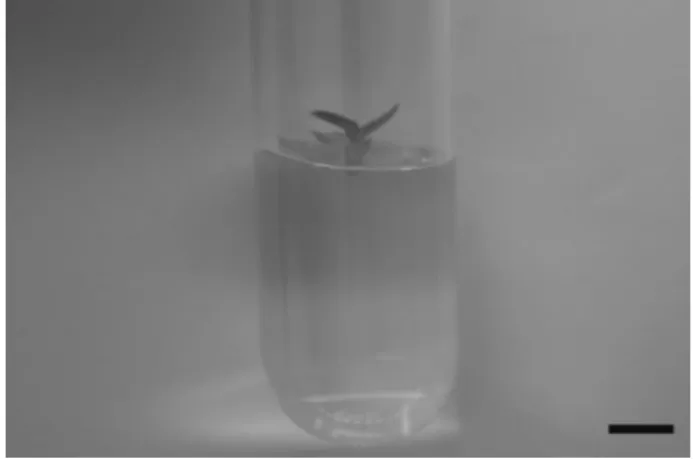
24 ± 2 °C in MS medium, remaining for three months, until the experiment was set up. For the plant material to be uniform, the most developed seedlings were selected, having a vigorous appearance and dark green colouration, and containing 3 to 4 leaves. In a laminar flow chamber, their size was standardised by cutting at the apical region (1.0 + 0.2 cm) and their roots removed; they were inoculated in test tubes (size 150 mm x 25 mm) containing 15 mL of MS culture medium under the same conditions
as in thein vitro germination phase (Figure 1).
The growth environment was a growth room under
Figure 1 - Explant used in the study: stem segment of
Cattleya labiata Lindl. in a test tube containing MS medium. Bars = 1.0 cm
induce etiolation, part of the explants were kept in the growth room in the absence of light, maintaining the same temperature.
The experimental design was completely randomised, in a 2 x 3 x 3 factorial scheme (two environments x three doses of BAP x three doses of NAA), with four replications per treatment. Each replication consisted of five tubes containing one explant per tube for analysis, totalling 72 lots and 18 treatments. The experimental unit used was one test tube with one explant. The treatments comprised MS medium plus three levels of BAP (with no BAP: 0.0, medium: 2.0 and
high: 4.0 mg L-1), three levels of NAA (with no NAA:
0.0, medium: 1.0 and high: 2.0 mg L-1) and two growth
environments (presence and absence of light).
The evaluations were carried out after 150 days of in vitro growth, when the following were assessed:
number of etiolated shoots per explant, length of stem segment (cm), number of nodes per shoot, number of roots and total seedling dry weight (g).
The data were submitted to analysis of variance using the Sisvar® statistical software (FERREIRA, 2014), and the means compared by F-test at 5% significance.
RESULTS AND DISCUSSION
The analysis of variance relative to the data shows, that for all the variables analysed, there was a significant effect at 1% from the environment (ENV) and its interaction with 6-benzylaminopurine (BAP) and naphthaleneacetic acid (NAA). Only for length of stem segment (LSS) was there a significant effect from the levels of BAP; there was a significant effect from the levels of NAA for all variables, except for the number of nodes per shoot (NN/S). There was no significant difference for the interaction between BAP and NAA, nor in the triple interaction including the factor environment, for any of the variables under analysis (Table 1).
At 150 days ofin vitro growth, it was found that
most of the explants maintained in the absence of light had the typical characteristics of etiolated and achlorophyllous
DF = Degrees of freedom; CV = Coefficient of variation; MS = Mean square; * and ** Significant at 0.05 and 0.01 probability respectively;ns - not
significant by F-test
Source of variation DF MS
NS/E NN/S LSS NR TSDW
Environment (ENV) 1 9.58** 1296.81** 16.86** 742.00** 0.0487**
BAP (BAP) 2 0.03ns 0.26ns 0.86* 0.03ns 0.0000ns
NAA (NAA) 2 7.95** 0.30ns 1.04** 4.27** 0.0046**
ENV x BAP 2 9.49** 1.25** 2.17** 1.61** 0.0018**
ENV x NAA 2 7.84** 1.26** 5.11** 4.24** 0.0028**
BAP x NAA 4 0.06ns 0.27ns 0.20ns 0.12ns 0.0000ns
ENV x BAP x NAA 4 0.05ns 0.32ns 0.33ns 0.08ns 0.0000ns
Residual 54 0.48 0.36 0.18 0.30 0.0000
CV (%) 29.04 25.00 16.96 30.62 14.36
Table 1 - Summary of analysis of variance and coefficients of variation (CV) for number of etiolated shoots per explant (NS/E), number
of nodes per etiolated shoot (NN/S), length of stem segment (LSS) in cm, number of roots (NR) and total seedling dry weight in g (TSDW), in etiolated nodal segments ofCattleya labiata grown at different levels of BAP and NAA in the presence and absence of
plants, such as whitish and translucent stems, small leaves whose blades had not expanded, and a greater internodal distance (Figure 2A). These explants produced shoots at the base or from the nodes, with these shoots also presenting the phenotype of etiolated plants common to the process of skotomorphogenesis. Taiz and Zeiger (2013) report that the occurrence of these characteristics in plants grown in the dark over long periods is due to inhibition of the development of proplastids which, without the bright stimulus, instead of becoming chloroplasts, develop into etioplasts, which do not synthesise the photosynthetic enzymes and pigments necessary to the photosynthetic machinery.
The cultures kept in an environment of artificial light showed normal photosynthetic development, as seen by the greenish colouration, when compared to the etiolated cultures (Figure 2B). However, there was a smaller distance between nodes, which did not allow their separation nor their being counted.
The number of etiolated shoots was greater for most levels of growth regulator in the dark (Table 2A). Analysing the growth environment in the presence of light, there was no difference for levels of NAA; however, a significance was seen for BAP, and the
mean level of 2.0 mg L-1 proved to be beneficial, (2.11
shoots explant-1). In relation to the growth environment
in the absence of light, the use of high levels of BAP
(4.0 mg L-1) gave the highest number of shoots (2.36),
although it did not differ from the other doses of BAP;
Figure 2 - Seedlings ofCattleya labiata Lindl. grown in the absence of light (A) and in the presence of light (B), at 150 days ofin vitrogrowth. Bars = 1.0 cm
with no BAP (0.0 mg L-1), there was an average of 2.21
etiolated shoots, showing it to be more economical. For the factor NAA, the best responses were obtained in the
presence of an average level of 1.0 mg L-1 (2.51 shoots
explant-1) (Table 2A).
In the absence of light, the increase in BAP concentration in the culture medium did not result in
a greater number of shoots in Cattleya labiata. Ramos
and Carneiro (2007) and Soares et al. (2010), studying
Cattleya x mesquitae and Laelia crispata respectively,
obtained an increase in shoots in the absence of BAP and
Mean values followed by the same letter, lowercase on a line and uppercase in a column, within each variable differ by Tukey’s test at 5% probability
(A) Number of etiolated shoots per explant
Environment BAP (mg L-1) NAA (mg L-1)
0 2 4 0 1 2
Light 1.64 bB 2.11 aA 1.38 bB 1.74 aB 1.77 aB 1.68 aB
Dark 2.21 aA 1.97 aB 2.36 aA 1.97 bA 2.51 aA 2.28 aA
(B) Number of nodes per etiolated shoot
Environment BAP (mg L-1) NAA (mg L-1)
0 2 4 0 1 2
Light 0.00 aB 0.00 aB 0.00 aB 0.00 aB 0.00 aB 0.00 aB
Dark 3.98 aA 3.79 bA 3.93 aA 3.82 bA 3.74 bA 3.97 aA
(C) Length of stem segment (cm)
Environment BAP (mg L
-1) ANA (mg L-1)
0 2 4 0 1 2
Light 1.90 aB 1.97 aB 1.86 aB 1.87 aA 1.84 abB 1.68 bB
Dark 2.65 aA 2.16 bA 2.22 bA 1.96 bA 2.09 bA 2.6 4aA
Table 2 - Number of shoots per explant, number of nodes per shoot, and length of stem segment, inCattleya labiata in different growth
in the dark. Suzuki, Kerbauy and Zaffari (2004) found that the endogenous level of cytokinins in an environment with
no light is greater than in the presence of light inCattleya
fimbriatum. This phenomenon may also have occurred
with the explants fromCattleya labiata grown in a dark
environment, i.e. the endogenous level of cytokinins, and the addition of BAP to the culture medium, may have resulted in interference to the formation of new shoots. In the dark, the addition of NAA to the culture medium proved suitable for the formation of shoots on the explants, as this is possibly due the ratio of auxin to cytokinin that directed the plant metabolism towards a greater production of shoots. The addition of BAP also resulted in an increase in the number of etiolated shoots when used at the medium
concentration of 2.0 mg L-1 in the presence of light.
The addition of the high level of NAA (2.0 mg L-1)
to the culture medium in the absence of light resulted in a significant increase in the number of nodes per etiolated
shoot (Table 2B). In the micropropagation of Cattleya
x mesquita, Ramos and Carneiro (2007) obtained
an average of 3.72 nodes per shoot under the same
conditions, 2.0 mg L-1 NAA, and in the dark. In the
present study, a production of 2.28 nodes per shoot was seen under the same conditions. This is because some of the nodes produced by the explants had no buds at the time of evaluation.
In this study, the greatest production of nodes with the use of BAP was obtained both at the high level
of 4.0 mg L-1 and with no BAP (0.0 mg L-1), producing
3.93 and 3.98 nodes per shoot respectively. These results
partially agree with those obtained by Soares et al.
(2010) where, in the absence of the cytokinin BAP, they observed the highest average production of nodes per
shoot (7.31) inLaelia crispata. For the characteristic in
question, not adding growth regulators when obtaining seedlings by micropropagation is advantageous to a reduction in production costs. Also in relation to the number of nodes per etiolated shoot, it was found that with light the etiolated shoots presented no perceptible nodes for counting, even with the addition of BAP and NAA to the culture medium. This is due to the growth and the organised and repetitive development in the formation of the organ in the plant, which presents a short distance between formed nodes, making a direct count impossible macroscopically.
The length of the stem segments varied between environments for each of the growth regulators. Values were higher in the absence of light (Table 2C). It can be seen that the BAP has a reducing effect compared to the medium with no addition of this cytokinin in the dark; this was represented by a drop in mean values for length as the concentration of the growth regulator increased. For the factor NAA, a positive effect was seen with the increase
in concentration of this auxin in the culture medium in a dark environment, obtaining an average length of 2.64 cm
at the high dose of 2.0 mg L-1.
The observed behaviour for the length of the stem segment can be attributed to the ability of cytokinins to modify apical dominance and promote growth of the lateral buds (TAIZ; ZEIGER, 2013). Mok, Martin and Mok (2000) mention that supplementing the culture medium with BAP causes breaking of apical dominance, favouring the emission of new shoots.
Studies carried out by Diaset al. (2011a) showed
that an increase in BAP in the culture medium caused a
reduction in the length of the shoots inAnanas comosus
var. ananassoides. The same was found in this study,
where it was seen that the addition of BAP resulted in a decrease in the length of the stem segments in the absence of light. However, the addition of NAA had the opposite effect, noted by a longer length for the stem segments as the dose of NAA increased in the absence of light.
On the other hand, no differences were seen when using the various concentrations of BAP in the culture medium in a bright environment; increases in the doses of NAA did not benefit growth in the presence
of light, producing smaller nodes. Moreiraet al. (2003)
state that the length of the stem segment is an important variable, since it is directly related to the number of nodes that will be formed in the new shoots when placed in a bright environment.
In thein vitro cultivation ofCatasetum fimbriatum,
Suzuki, Kerbauy and Zaffari (2004) obtained larger seedlings when these were kept in the absence of light, irespective of the growth regulators and doses used.
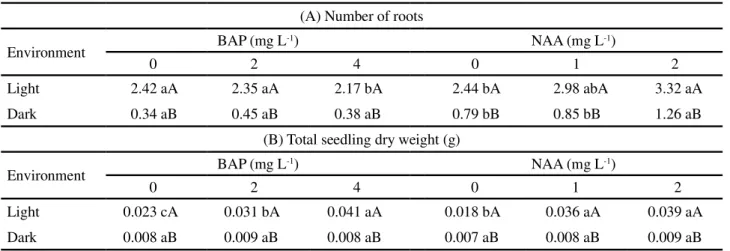
For the number of roots, the interaction between NAA levels and the environment was significant by F-test (Table 3). The greatest number of roots was obtained in the interaction between the high level of
NAA (2.0 mg L-1) and the bright environment, with
an average production of 3.32 roots, whereas in the dark environment and with the same dose of auxin, the average production was 1.26 roots.
In the micropropagation ofAnanas comosus, Piza,
Lima and Brasil (2001) found that the culture medium
supplemented with 2.0 mg L-1 NAA favoured rooting in
the species.
The usual concentration of NAA used with different
plant species is less than 0.5 mg L-1; however, there may
be variations in the results of these studies due to genetic differences (GRATTAPAGLIA; MACHADO, 1998). This is because plant species respond differently to the application of growth regulators as a function of the endogenous auxin/
Table 3 - Number of roots and total seedling dry weight, inCattleya labiata in different growth environments (presence and absence of light and different levels of BAP and NAA), at 150 days ofin vitro growth
(A) Number of roots
Environment BAP (mg L-1) NAA (mg L-1)
0 2 4 0 1 2
Light 2.42 aA 2.35 aA 2.17 bA 2.44 bA 2.98 abA 3.32 aA
Dark 0.34 aB 0.45 aB 0.38 aB 0.79 bB 0.85 bB 1.26 aB
(B) Total seedling dry weight (g)
Environment BAP (mg L-1) NAA (mg L-1)
0 2 4 0 1 2
Light 0.023 cA 0.031 bA 0.041 aA 0.018 bA 0.036 aA 0.039 aA
Dark 0.008 aB 0.009 aB 0.008 aB 0.007 aB 0.008 aB 0.009 aB
Mean values followed by the same letter, lowercase on a line and uppercase in a column, within each variable differ by Tukey’s test at 5% probability
Both controls demonstrated that light favours in
vitro rooting inCattleya labiata. In the presence of light,
the highest level of BAP tested had a negative effect on the number of formed roots. Whereas under the same conditions, the addition of NAA to the culture medium favoured root development.
Auxins and cytokinins have opposite effects on
the root development ofin vitro cultures in environments
with the presence of light. While a higher concentration of auxins favours root formation, a higher concentration of cytokinins inhibits it (LEMOS, 2010).
There were significant differences between the interactions BAP x Environment and NAA x Environment for total seedling dry weight. The greatest accumulations of seedling dry weight were seen in the culture medium with high levels of growth regulator in the bright environment.
The high levels of BAP (4.0 mg L-1) and NAA (2.0 mg L-1)
promoted an increase in biomass of 0.041 g and 0.039 g respectively (Table 3B).
In studies into the increase in total dry weight in
seedlings of Oncidium leuchochilum in an MS nutrient
medium containing 1.0 mg L-1 BAP and 0.25 mg L-1
NAA in the presence of light, Scheidt et al. (2009)
obtained seedlings with an average of 0.45 g of total
dry weight. Souto et al. (2010), studying the effects
of naphthaleneacetic acid on thein vitro development
ofCattleya bicolor, recorded approximate mean values
of 0.025 g dry weight in seedlings of the same species,
with the use of 2.0 mg L-1 of NAA.
Both the species and the varieties present varied and different responses to the use of growth regulators (MITRA; BOSE, 1991).
Seedlings grown in the presence of light had higher mean values for total dry weight at all levels, irrespective of the growth regulator, when compared to those grown in the dark.
There was no increase in seedling weight in the presence of BAP or NAA when the cultures were grown in the absence of light. However, the opposite was seen in cultures kept under light, with increases in seedling dry weight.
These observations emphasize the essential role of the photosynthetic process in obtaining energy, and in the formation of the carbon skeletons necessary for plant growth and development (TAIZ; ZEIGER, 2013), whereas etiolation is an evolutionary mechanism in which the energy contained in the plant tissues is used for elongation as an adaptive strategy in the search for light (KERBAUY; CHAER, 2011). In the first process, plant growth occurs in an organised way in the width and length of all the organs, while with etiolation, growth in the length of the stem is given priority to the detriment of width; the leaves are small and little developed, resulting in a lesser amount of dry weight, compared to seedlings grown in a bright environment.
The production ofin vitro shoots from orchids of
the speciesCattleya labiata by means of the etiolation
of nodal seedling segments is therefore a viable technique, since it affords advantageous characteristics
during the phase of in vitro multiplication of the
CONCLUSIONS
1. The number of etiolated shoots in seedlings ofCattleya
labiata is greater in the absence of light, both using a
high level of BAP (4.0 mg L-1) and in the absence of
NAA (0.0 mg L-1); the same is seen in the presence of
medium (1.0 mg L-1) and high (2.0 mg L-1) levels of
NAA;
2. The presence of NAA induces a greater number of nodes, longer main shoots and an increase in the number
of roots, while encouraging the in vitro etiolation of
nodal segments in the orchid (Cattleya labiata);
3. The addition of high levels of BAP (4.0 mg L-1) and
NAA (2.0 mg L-1) increases seedling dry weight in the
in vitro cultivation of the orchid (Cattleya labiata) in the
presence of light.
ACKNOWLEDGMENTS
The authors wish to thank Embrapa Agroindústria Tropical and the Universidade Federal do Ceará (UFC) for their assistance in this research. Thanks also go to FUNCAP for the scholarships grants.
REFERENCES
BERKA, M. G.; VENTURIERI, G. A.; TEIXEIRA, T. N. Development of Cattleya amethystoglossa x nobilior in
simplified culture media.Acta Scientiarum. Agronomy, v. 36, n. 4, p. 425-428, 2014.
BRASIL. Ministério do Meio Ambiente.Instrução normativa de setembro de 2008. Disponível em: <http://www.estadao.com.br/
ext/especiais/2008/09/extint.pdf>. Acesso em: 25 maio 2016. CABRERA, M. G.; CÚDOM, M. A. Ocurrencia deLasiodiplodia theobromae enCattleyaspp. en Corrientes, Argentina.Summa Phytopathologica, v. 39, n. 2, p. 143-143, 2013.
DIAS, M. M. et al. Concentrações de reguladores vegetais no
estiolamentoin vitro de ananás do campo.Semina: Ciências Agrárias, v. 32, n. 2, p. 513-520, 2011b.
DIAS, M. M.et al. Reguladores de crescimento na propagação in vitro de abacaxizeiro ornamental. Revista Brasileira de Ciências Agrárias, v. 6, n. 3, p. 383-390, 2011a.
FERREIRA, D. F. Sisvar: a guide for its bootstrap procedures in multiple comparisons.Ciência e Agrotecnologia, v. 38, n. 2, p. 109-112, 2014.
GRATTAPAGLIA, D.; MACHADO, M. A. Micropropagação. In: TORRES, A. C.; CALDAS, L. S. (Ed.). Técnicas e aplicações da cultura de tecidos de plantas. Brasília, DF:
ABCTP. EMBRAPA-CNPH, 1998. p. 99-169.
KERBAUY, G. B.; CHAER, L. Micropropagação comercial de orquídeas conquistas, desafios e perspectivas. In: GERALD,
L. T. S. (Org.).Biofábrica de plantas: produção industrial de plantasin vitro. 1. ed. São Paulo: Antiqua, 2011. p. 177-205.
LEMOS, E. E. P. Organogênese. In: BARRUETO CID, L. P. (Ed.).Cultivoin vitro de plantas. 1 ed. Brasília: EMBRAPA,
2010. v. 1, p. 103-127.
MITRA, S. K.; BOSE, T. K. Metabolic changes during adventitious root formation in ethrel and IBA treated cutting of litchi. The Indian Journal of Horticulture, v. 48, n. 2, p. 105-107, 1991. MOK, M. C.; MARTIN, R. C.; MOK, D. W. S. Cytokinins: biosynthesis, metabolism and perception. In vitro Cellular & Developmental Biology Plant, v. 36, n. 1, p. 102-107, 2000. MOREIRA, M. A.et al. Estiolamento na micropropagação do
abacaxizeiro cv. Pérola. Ciência e Agrotecnologia, v. 27, n. 5, p.1002-1006, 2003.
MURASHIGE, T.; SKOOG, F. A revised medium for rapid growth and biossays with tobbaco tissue cultures.Physiologia Plantarum, v. 15, n. 1, p. 473-497, 1962.
PINHEIRO, M. V. M.et al. Micropropagação de antúrio ‘IAC
Eidibel’ por meio da indução ao estiolamento e regeneração de plantas.Revista Brasileira de Horticultura Ornamental,
v. 15, n. 2, p. 133-142, 2009.
PIZA, I. M. T.; LIMA, G. P. P.; BRASIL, O. G. Reguladores vegetais na micropropagação do abacaxizeiro.Revista Ceres,
v. 48, n. 280, p. 681-690, 2001.
RAMOS, T. V.; CARNEIRO, I. F. Multiplicação “in vitro” deCattleya x mesquitae pelo método de estiolamento de segmentos caulinares.
Pesquisa Agropecuária Tropical, v. 37, n. 1, p. 10-15, 2007. ROBERTS, D. L.; DIXON, K. W. Orchids.Current Biology,
v. 18, n. 8, p. 325-329, 2008.
SCHEIDT, G. N. et al. Multiplicação in vitro de Oncidium leucochilum (Orchidaceae) em diferentes sistemas de cultivo.
Biociências, v. 17, n. 1, p. 82-85, 2009.
SILVA, J. V. et al. Aclimatização “ex vitro” de mudas
de antúrio em diferentes substratos. Revista Ciência Agronômica, v. 38, n. 2, p. 188-191, 2007.
SOARES, J. D. R.et al. Estiolamento e luz artificial no cultivo
in vitro de orquídeas nativa e híbrida.Ciencia Rural, v. 40, n. 9, p. 1941-1947, 2010.
SOUTO, J. S. et al. Efeitos do ácido naftalenoacético
no desenvolvimento in vitro de Cattleya bicolor Lindl.
(Orchidaceae).Revista Brasileira de Biociências, v.8, n. 2,
p. 179-185, 2010.
SUZUKI, R. M.; KERBAUY, G. B.; ZAFFARI, G. R. Endogenous hormonal levels and growth of dark-incubated shoots ofCatasetum fimbriatum.Journal of Plant Physiology, v. 161, p. 929-935, 2004.
TAIZ, L.; ZEIGER, E.Fisiologia Vegetal. 5. ed. Artmed: Porto
Alegre, 2013, 918 p.