Orexinergic Neurotransmission in Temperature
Responses to Methamphetamine and Stress:
Mathematical Modeling as a Data
Assimilation Approach
Abolhassan Behrouzvaziri1, Daniel Fu2, Patrick Tan3, Yeonjoo Yoo1, Maria V. Zaretskaia4, Daniel E. Rusyniak4, Yaroslav I. Molkov1‡, Dmitry V. Zaretsky4‡*
1Department of Mathematical Sciences, Indiana University—Purdue University Indianapolis, Indianapolis, IN 46202, United States of America,2Park Tudor School, Indianapolis, IN 46240, United States of America, 3Carmel High School, Carmel, IN 46032, United States of America,4Department of Emergency Medicine, Indiana University School of Medicine, Indianapolis, IN 46202, United States of America
‡These authors are shared senior authors on this work. *[email protected]
Abstract
Experimental Data
Orexinergic neurotransmission is involved in mediating temperature responses to metham-phetamine (Meth). In experiments in rats, SB-334867 (SB), an antagonist of orexin recep-tors (OX1R), at a dose of 10 mg/kg decreases late temperature responses (t>60 min) to an intermediate dose of Meth (5 mg/kg). A higher dose of SB (30 mg/kg) attenuates tempera-ture responses to low dose (1 mg/kg) of Meth and to stress. In contrast, it significantly exag-gerates early responses (t<60 min) to intermediate and high doses (5 and 10 mg/kg) of Meth. As pretreatment with SB also inhibits temperature response to the stress of injection, traditional statistical analysis of temperature responses is difficult.
Mathematical Modeling
We have developed a mathematical model that explains the complexity of temperature re-sponses to Meth as the interplay between excitatory and inhibitory nodes. We have extended the developed model to include the stress of manipulations and the effects of SB. Stress is synergistic with Meth on the action on excitatory node. Orexin receptors mediate an activation of on both excitatory and inhibitory nodes by low doses of Meth, but not on the node activated by high doses (HD). Exaggeration of early responses to high doses of Meth involves disinhibi-tion: low dose of SB decreases tonic inhibition ofHDand lowers the activation threshold, while the higher dose suppresses the inhibitory component. Using a modeling approach to data assimilation appears efficient in separating individual components of complex response with statistical analysis unachievable by traditional data processing methods.
OPEN ACCESS
Citation:Behrouzvaziri A, Fu D, Tan P, Yoo Y, Zaretskaia MV, Rusyniak DE, et al. (2015) Orexinergic Neurotransmission in Temperature Responses to Methamphetamine and Stress: Mathematical Modeling as a Data Assimilation Approach. PLoS ONE 10(5): e0126719. doi:10.1371/ journal.pone.0126719
Academic Editor:Vladimir E. Bondarenko, Georgia State University, UNITED STATES
Received:January 7, 2015
Accepted:April 7, 2015
Published:May 20, 2015
Copyright:© 2015 Behrouzvaziri et al. This is an open access article distributed under the terms of the Creative Commons Attribution License, which permits unrestricted use, distribution, and reproduction in any medium, provided the original author and source are credited.
Data Availability Statement:All relevant data are within the paper and its Supporting Information files.
Introduction
Amphetamine and its derivatives are among the most prevalent abused drugs in the world [1]. Amphetamines can cause various medical complications including myocardial infarctions, is-chemic and hemorrhagic strokes, rhabdomyolysis, renal failure, and fatal hyperthermia [2–8]. Despite this, there is little understanding of neural mechanisms underlying hyperthermia pro-duced by amphetamines. For instance a similar dose of amphetamine may cause a mild effect in some patients but be fatal to others; this can occur even though the blood levels of the drug appear low [9,10].
In rats, amphetamines cause the central release of monoamines and the subsequent activa-tion of the sympathetic nervous system causing in heat generaactiva-tion by brown adipose tissue (BAT) [11,12] and skeletal muscle [13]. In addition, amphetamines decrease heat dissipation through cutaneous vasoconstriction [14,15]. The brain areas mediating these effects are not known but we have previously shown that sympathetic and behavioral responses mediated, by the substituted amphetamine MDMA, can be prevented by suppressing neuronal activity in the dorsomedial hypothalamus [16], the area which is now well-established to participate in the control of heat production in the BAT and heat dissipation through the skin [17]. This is one of the few brain regions containing neurons that project trans-synaptically to both the ad-renal gland and skeletal muscle [18] and these dual-projecting neurons contain the peptide orexin [19]. It has also been further shown that Meth and d-amphetamine activate orexin-con-taining neurons [20,21].
Central activation of orexin receptors increases body temperature, BAT sympathetic nerve activity and thermogenesis, plasma epinephrine, and heart rate [22–26]. The systemic adminis-tration of SB-334867 (SB), an OX1R antagonist, hereinafter referred as SB, prevents increases
in heart rate and mean arterial pressure in models of stress and panic [27,28], and suppresses hyperthermia caused by stress of injection [29]. Pretreatment with SB has also been shown to significantly attenuate hyperthermia evoked by a moderate but not a low or high dose of Meth [29]. Unfortunately, in the cited study temperature fluctuations resulting from the stress of two intraperitoneal injections (SB and Meth) made it impossible to quantify the effect of SB on low doses of Meth using a traditional data analysis.
The differential effects of SB on the temperature responses to different doses of Meth do not allow for a straight-forward interpretation. Recently, we developed a mathematical model [30] that reproduced dose-dependent temperature responses to methamphetamine. The model de-scribed interactions of putative brain nuclei that participate in thermoregulation. We use this model to provide mechanistic explanation of how the orexin antagonist SB-334867 affects complex Meth-induced dynamics of the body temperature.
Materials and Methods
Animal experiments
Animals. Male Sprague-Dawley rats (280–350 g) were individually housed with a 12 h light cycle at a room temperature of 23–25°C with free access to food and water. All animals for which data are reported remained in good health throughout the course of surgical proce-dures and experimental protocols as assessed by appearance, behavior, and maintenance of body weight. All procedures described here were approved by the Indiana University School of Medicine Institutional Animal Care and Use Committee and followed NIH guidelines.
Surgical Procedures. For measurements of core temperature, rats were implanted with telemetric transmitters (C50-PXT, Data Sciences Int., St.Paul, MN) under isoflurane anesthesia as previously described [31]. The body of the transmitter was placed into the abdominal cavity
no role in study design, data collection and analysis, decision to publish, or preparation of the manuscript.
and sutured to the abdominal wall. After at least seven days of recovery, rats, still in their home cages, were brought to experimental room. Cages were placed on telemetric receivers (RPC-1), and animals were given at least two hours to adapt to the new environment.
Drugs. The orexin-1 receptor antagonist SB-334867 (Tocris Bioscience, Ellisville, MO) was dissolved immediately before injection, and administered in the volume of 1 ml/kg. For in-jections of 10 mg/kg, 10 mg of SB was dissolved in 40μl DMSO, followed by addition of 60μl of 1 M HCl, and 900μl of 10% 2-hydroxypropyl-β-cyclodextrin (Sigma-Aldrich, St. Louis, MO) in saline. For injections of 30 mg/kg, 50 mg of SB was dissolved in 300μl DMSO, followed by addition of 160μl of 1 M HCl, and 1200μl of 10% 2-hydroxypropyl-β-cyclodextrin in saline. These procedures provided clear yellow solutions without evidence of flocculation. The vehi-cles were prepared in the same way without the drug.
Methamphetamine hydrochloride (Sigma-Aldrich, St. Louis, MO) was dissolved in sterile saline at the time of injections and injected at a volume of 1 ml/kg.
Experimental protocol: The effect of SB-334867 on methamphetamine-evoked re-sponses. Two separate experimental series were performed. In the first series SB was adminis-tered in the dose of 10 mg/kg. In second series, SB was adminisadminis-tered in the dose 30 mg/kg. In each study we have used the corresponding vehicles (see above).
In each series rats were randomly assigned to one of eight groups (n = 6–8 per group): one of two pretreatments (SB vs vehicle), followed by one of four treatments (saline or one of three doses of Meth). Each rat received only one treatment. Experiments were performed in a tem-perature controlled room at T = 25°C and relative humidity 30–70%. Air temtem-perature and hu-midity were monitored by independent sensors. For all experiments deviations of the
temperature from 25°C did not exceed 0.8°C. After baseline physiological parameters were re-corded for at least 30 min, animals received an intraperitoneal injection of either vehicle or SB-334867. Thirty min later, rats received an intraperitoneal injection of either saline or one of three doses of methamphetamine (1 mg/kg, 5 mg/kg, or 10 mg/kg). Although there is a wide range of methamphetamine doses that humans abuse, the doses we chose include ones that are commonly used recreationally (1 mg/kg) as well as larger doses that may be reached by binge users (5 and 10 mg/kg) [32]. For convenience we refer to these doses as“low”,“moderate”, and “high”respectively. Each rat was used for only one injection of Meth or saline.
Statistical analysis. The results are presented as the mean ± SEM. Results were compared using a one way ANOVA with repeated measures followed by a Fisher’s LSD post hoc test, where appropriate. A value of P<0.05 was considered to indicate a significant difference in all comparisons. Baseline levels of locomotor activity, temperature, HR and MBP did not differ between groups across the series of experiments, so changes from baseline were analyzed.
Mathematical Modeling
name. Complex dose-dependence of temperature responses to Meth is formed by the competi-tion of two excitatory inputs and one inhibitory input, all of which have different sensitivities to Meth.
Low doses of Meth (1 mg/kg i.p. and below) activate the Excitatory node almost exclusively, and administration of those doses evokes a monophasic mild hyperthermia. Higher doses (3–5 mg/kg i.p.) are able to activate the inhibitory node, which completely masks the activity of the Excitatory node. As a result, immediately after injection of Meth there is no temperature re-sponse, but after partial elimination of the drug, the excitatory drive is disinhibited, and tem-perature increases display a delayed monophasic response. Finally, high doses (10 mg/kg i.p.) activate theHDnode, and cause immediate powerful hyperthermia followed by a secondary temperature increase due to transient activation of the Excitatory node.
To analyze the orexin data we first modified the existing model to accommodate stress. Since inhibition of the dorsomedial hypothalamus, a putative excitatory node, suppresses sym-pathetic activation from both stress [33] and amphetamines [16], we hypothesized that stress and Meth both provide direct inputs to the Excitatory node. Each stress stimulus was modeled as a spike of activity of short duration.
Next, we assumed that SB affects Meth and stress inputs at the relevant nodes. Excitatory node exhibits some tonic activity without Meth [30]. If the projections from Excitatory and/or Inhibitory node to Medullary node are orexinergic, the antagonist would cause dramatic (up to 3°C) hypothermia by itself. However, as it will be shown in the Results, the administration of the antagonist alone did not result in any hypothermia whatsoever. Therefore, we were restrict-ed to placing orexin receptors on the Meth-sensitive populations to mrestrict-ediate effects of Meth, but not to cause any perturbations by the receptor blockade alone.
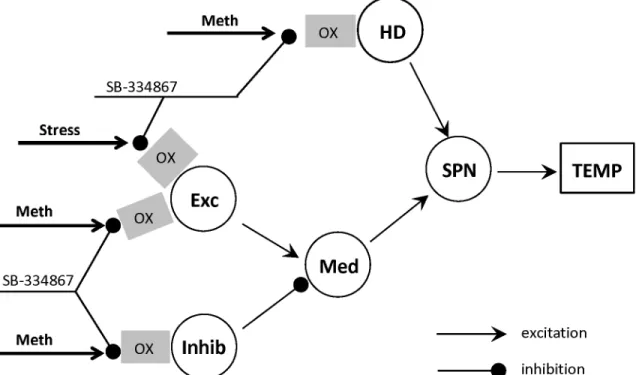
Fig 1. Schematic of the model neuronal circuitry involved in responses to methamphetamine.Stress input and the orexin receptors (shown by gray rectangles labeled“OX”) are added to extend the circuitry used in [30]. Effect of Stress and/or Meth can be affected by the orexin receptor antagonist SB-334867. Each circle represents a neural population. Abbreviations:Exc—excitatory node,Inhib—inhibitory node,HD—high-dose activated node,Med— medullary node,SPN—sympathetic preganglionic node,TEMP—temperature. See text for a detailed description.
By fitting the temperature responses to Meth after different doses of SB we calculated values of the model parameters.
Implementation of the model. The model consisted of three components: pharmacoki-netics describing concentration of Meth in the blood after injection; a neural network whose activity was dependent on Meth and SB; and a temperature control system driven by a signal from the neural network.
We assumed that after the injection the drug is being absorbed in the blood from the perito-neum and is also being eliminated from the blood. Accordingly, drug concentrations are de-scribed by the following equations:
d½Mp
dt ¼
½Mp
tu ð1Þ
d½M
dt ¼
½Mp
tu
½M
td
wheretis time in minutes,Mpis the intra-peritoneal drug concentration, andMis the blood drug concentration (both in mg/kg). [Mp]/τurepresents drug absorption with time constantτu, and [M]/τ
drepresents drug elimination with time constantτd. Initial conditions are [Mp](0) =
D, [M](0) = 0 for injections made at time0whereDis the initial dose of the drug being mod-eled. System (1) can be solved explicitly as:
½MðtÞ ¼D tu
td
1
1
ðe t=tu e t=tdÞ ð2Þ
fort>0, and [M](t) = 0 ift<0. Stress input from the injection made att=t0was modeled as
a single exponential function
Sðt;t0Þ ¼ (
e ðt t0Þ=ts;ift>t 0
0;iftt
0
ð3Þ
In our study, the neural circuitry is modeled as a feed-forward artificial neural network. The excitatory nodeExcreceives two stress inputs att=−30 min andt= 0 min from injections of
SB (or vehicle) and Meth (or saline) respectively. The outputs of Meth-sensitive neural popula-tions are calculated as follows:
PExcðtÞ ¼sðwSSðt; 30Þ þwSSðt;0Þ þwExc½MðtÞ þgExcÞ
PInhðtÞ ¼sðwInh½MðtÞ þgInhÞ
PHDðtÞ ¼sðwHD½MðtÞ þgHDÞ
ð4Þ
whereσ(x) = (1 + tanhx)/2 is a sigmoid activation function,w
i(t) is the sensitivity ofPi(t) to Meth, andγiis the basal excitability ofPi,i∊{Exc,Inh,HD}. To account for the effect of the SB,
we used different values of (wS,wExc,wInh,wHD) for different doses of SB. The activity of medullary populationMedis described as follows:
PMedðtÞ ¼wExc!MedPExcðtÞ wInh!MedPInhðtÞ ð5Þ
wherewExc!MedandwInh!Medare the weights of the excitatory and inhibitory projections fromExctoMedandInhibtoMed, respectively. Inframedullary populationSPNtransmits the activity ofMedbut is additionally excited by the Meth-sensitiveHDpopulation as follows:
wherewHD!SPNis the weight of the excitatory projection fromHDtoSPN, andγSPNis the basal excitability ofSPN.
The temperature response is modeled by a first-order linear ODE driven by theSPNsignal as follows:
tTdT
dt ¼PSPNðtÞ ðT T0Þ ð7Þ
whereTis the body temperature in degrees Celsius,τTis the time constant of the temperature response, andT0is the baseline body temperature.
Statistical Analysis. We used the Bayesian approach for inferring the model parameters. Then, statistical analysis is used to estimate statistical significance of changes in (wS,wExc,wInh,
wHD) individually when 30, 10, and 0 mg/kg of SB are injected, respectively. To do this, we con-structed a corresponding posterior probability density function (PDF) of the parameter vector = (wS,wExc,wInh,wHD) considering other parameters fixed at values shown in theTable 1. Ac-cording to Bayes' rule, this probability distribution is proportional to the probability that an ob-served temperature time series {Ti} is produced by our model with the givenW, usually referred to as a likelihood. Assuming that the residuals are normally distributed, the posterior PDFp(W| {Ti}) is given by the following formula:
pðWj fT
igÞ ¼exp
X180 i¼ 50
½Ti TðW;iÞ2
2s2
i
ð8Þ
whereT(W,i) is the temperature calculated by our model at timeiwith the givenW.T
iandσi are respectively a mean and a standard deviation of the body temperature over a corresponding group of animals at timeiby increments of 2 minutes.
We used the Markov Chain Monte Carlo (MCMC) approach, in particular the modified Metropolis-Hastings algorithm [34–37], to create an ensemble of points distributed according to the PDF (8). Once we had the ensembles, we calculated mean values of the parameters and their standard errors for each group: vehicle, SB10, and SB30, and used two-sample z-test to es-timate statistical significance of the differences in parameter values between the groups. We as-sumed that p-value<0.05 means that SB has a statistically-significant effect on the
corresponding parameter of the model.
Results
SB-334867 suppresses stress-induced hyperthermia
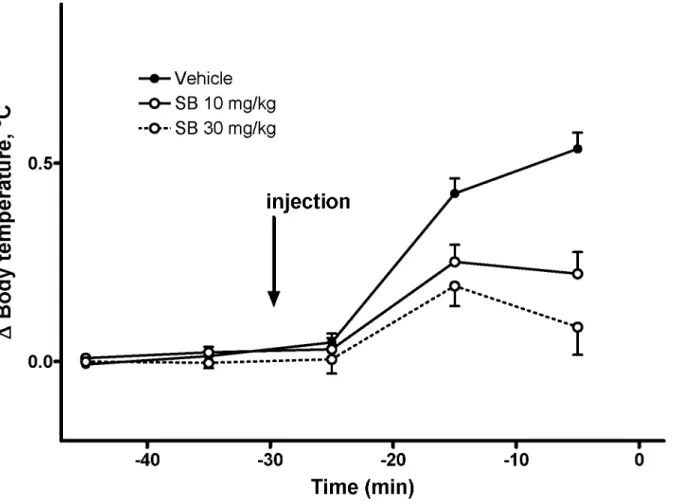
The first intraperitoneal injections evoked increases in the body temperature, which tended to return to baseline before the second injection in some groups. We have pooled the responses to the first injection in all groups before administration of Meth according to pretreatment to
Table 1. Values of parameters of the model, which were considered not affected by SB (adapted from [30]).
Parameter Value Parameter Value
τu(Meth), min 8.25 τT, min 89.2
τd(Meth), min 57.5 T0,°C 37
τ(Stress), min 10 γExc,mg/kg −0.357
wExc!Mdl, °C 9.89 γInh,mg/kg −1.335
wInh!Mdl, °C 6.38 γHD,mg/kg −3.69
wHD!SPN, °C 5.66 γSPN, °C −3.35
make four groups (two doses of SB and two vehicles for each dose of SB). However, there was no difference between responses to different vehicles, so data for both vehicles were pooled to-gether as a single group. This reduced the number of groups to three. The increase of body tem-perature in response to the first injection was statistically significantly attenuated by both doses of SB (Fig 2), whereas there was no statistically significant difference between the two doses of SB (p>0.05).
Effects of SB-334867 on temperature responses to Meth
The effects of Meth on body temperature were not different between the two vehicles used for the different doses of SB. These effects had complex dose-dependence, which has previously been described [29,30,38,39]. In short, low (1 mg/kg) and high doses of Meth (10 mg/kg) evoked virtually immediate response while response to intermediate dose (5 mg/kg) was de-layed. Peak hyperthermia after low and intermediate doses was similar (38.2 ± 0.1°C vs 38.2± 0.1°C) but occurred at different moments (76±11 min vs 226±15 min after injection). The highest dose of Meth evoked a robust hyperthermia with temperatures reaching 39.5±0.2°C within 90 min of administration with the temperature subsequently declining from 90 to 150 min, followed by a plateau until the end of the recording period (up to 200 min). Injections of saline evoked slight increases of body temperature, which were short-lived: temperature re-turned to baseline within 60 min.
Fig 2. Effect of SB-334867 on stress-induced body temperature increase associated with i.p. injections (n = 24–26 per group).Black circles, solid line—pooled vehicle data; open circles, solid line—SB 10 mg/kg; open circles, dashed line—SB 30 mg/kg. Injection was performed att=–30 min.
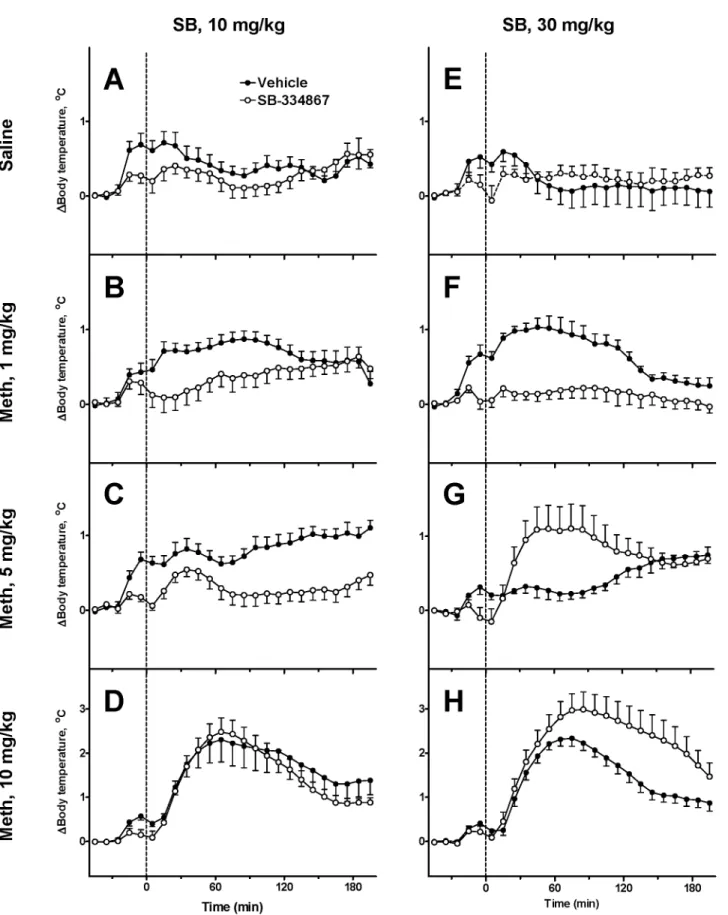
The responses to the same doses of Meth after SB are shown inFig 3. After the low dose of Meth (1 mg/kg), rats treated with SB had lower body temperature than rats treated with vehicle during 3 h after administration of Meth (Fig 3B and 3F). However, this difference did not at any time reach statistical significance in the experiment with the lower dose of SB (10 mg/kg,
Fig 3B). However, the suppression of the response to the low dose of Meth became statistically significant after the injection of higher dose of the antagonist (30 mg/kg,Fig 3F).
Next, after an intermediate dose of Meth (5 mg/kg) temperature transiently increased but remained lower than temperatures in the vehicle group. Furthermore, this dose of SB signifi-cantly attenuated thermogenic response after 70–90 min. In contrast, after the higher dose of SB (30 mg/kg) intermediate dose of Meth evoked a rapid hyperthermic response (Fig 3G) such that core temperature rose statistically significantly above the vehicle group. Qualitatively this response resembles a temperature response to a high dose of Meth in the vehicle group (Fig 3D).
Finally, the response to a high dose of Meth (10 mg/kg) was not modified by the lower dose of SB (Fig 3D) whereas the higher dose of SB significantly increased and prolonged the re-sponse to the high dose of Meth with the difference progressively increasing for over 120 min after the administration of Meth.
Effects of SB on estimates of the model parameters
In this study we used the Metropolis algorithm to implement a Markov Chain Monte Carlo ap-proach to estimate the posterior distribution of model parameters. Specifically, this algorithm generates a multidimensional cloud of points in the parameter space distributed according to the PDF (formula 8 in Methods) for a given experimental series {Ti}. Four parameters (wS,
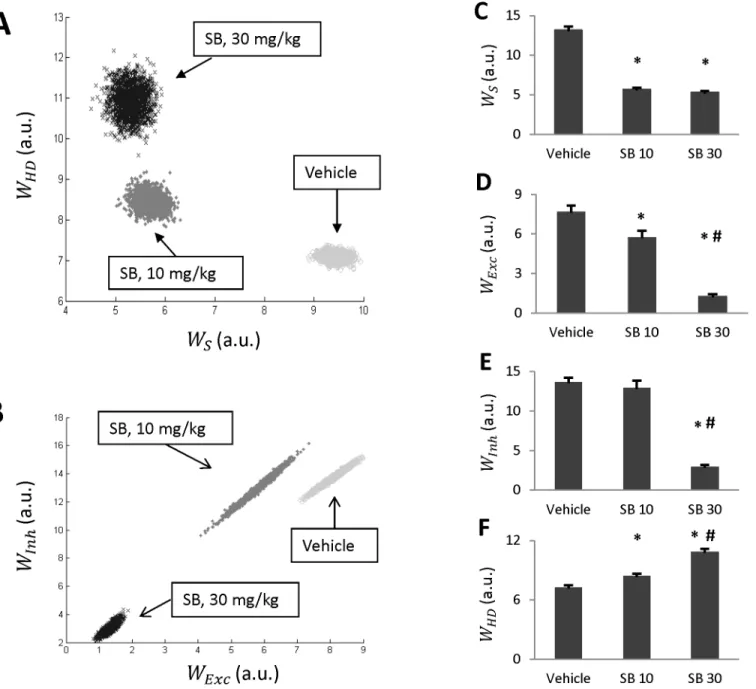
wExc,wInh,wHD) have been sampled for three different doses of SB. We demonstrate the corre-sponding clouds in projections onto (wExc,wInh) and onto (wS,wHD)-planes shown inFig 4A and 4Brespectively. Each panel contains three clouds labeled“Vehicle”,“SB, 10 mg/kg”and “SB, 30 mg/kg”. These clouds are well separated implying that the differences in parameter val-ues are statistically significant.
Statistical analysis confirms that antagonism of orexin receptors leads to statistically signifi-cant changes in estimates of the model parameters. Particularly, the stress amplitudewSis re-duced by administration of the orexin antagonist (Fig 4C), although, there was no significant difference inwSestimates between 10 and 30 mg/kg of the antagonist. Also, parameters of sen-sitivity to Meth of both excitatory and inhibitory drives,wExc,wInh, were decreased by adminis-tration of SB (Fig 4D and 4E). The suppression was dose-dependent. The lower dose of the antagonist significantly decreasedwExc, but the effect was virtually absent forwInh. However, the higher dose of SB was much more efficient in suppressing the Meth sensitivity of both the inhibitory and excitatory drives. Finally, the Meth sensitivity of HD node was progressively in-creased with increasing dose of SB (Fig 4F) implying an ability of this population to be activat-ed by progressively lower doses of Meth.
Effects of SB on the network components
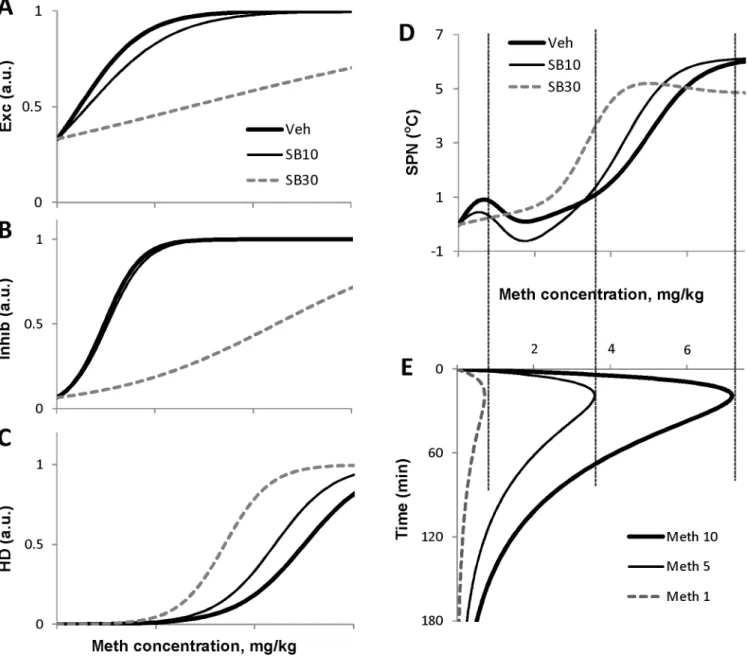
sensitivity to Meth when SB is present as its dose-dependence curve shifts to the left. Therefore, lower concentrations of Meth are able to activate this neuronal population.
Superposition of inputs from these populations results in complex modification ofSPN ac-tivity which ultimately controls the thermal response. The dose-dependence ofSPNactivity is shown in theFig 5D, which is aligned with simulated pharmacokinetic profile of Meth after various doses of Meth used in this study (Fig 5E). The low dose of Meth (1 mg/kg, Meth-1 in. 5E) does not evoke any significant response when either of SB doses is present.
Fig 4. Parameter estimates generated by Monte-Carlo simulations.A-B: Statistical ensembles of parameters (amplitude of stress, and Meth-sensitivities of three Meth-dependent populations) projected onto (wS,wHD)-plane (A) and (wExc,wInh)-plane (B) for each of the three doses of SB (vehicle, 10 and 30 mg/
kg). C-F: Individual parameters for each dose of SB.*denotes statistically significant difference from vehicle (SB 0, p<0.05); #—between SB 10 and SB 30 (p<0.05).
The intermediate Meth dose (5 mg/kg, Meth-5 inFig 5E) is sufficient to elicit strong ther-mogenesis after the higher dose of SB (30 mg/kg, SB30 inFig 5D) but not after the lower dose of the antagonist (10 mg/kg, SB10 inFig 5D). 10 mg/kg of SB desensitizesExc, barely affects
Inhib, and sensitizesHD. Together these changes leave the activity ofSPNat the peak Meth concentration caused by the injection of 5 mg/kg of Meth almost unaltered (Fig 5D and 5E). In contrast, 30 mg/kg of SB sensitize HD a little more (Fig 5C), but more importantly this dose substantially desensitizes theInhibpopulation (Fig 5B) leading to disinhibition ofSPNactivity (compare SB10 and SB30 inFig 5D).
As mentioned SB induces sensitization ofHDpopulation to Meth (Figs4Fand5C) which results in longer activation of theHDcomponent by the same Meth concentration profile Fig 5. Activation curves of nodes of the model compared with pharmacokinetics of Meth.A-D: Activity of the network nodes as functions of Meth concentration in the blood after three doses of SB-334867: 0 (Veh), 10 and 30 mg/kg using best fit parameters. E: Time courses of the Meth concentration after different doses of Meth (1, 5 and 10 mg/kg) as generated by the model.
(Meth-10 inFig 5E) due to progressively lowerHDactivation threshold (compare Veh, SB10 and SB30 inFig 5D).
Effects of SB on the temperature responses to Meth explained
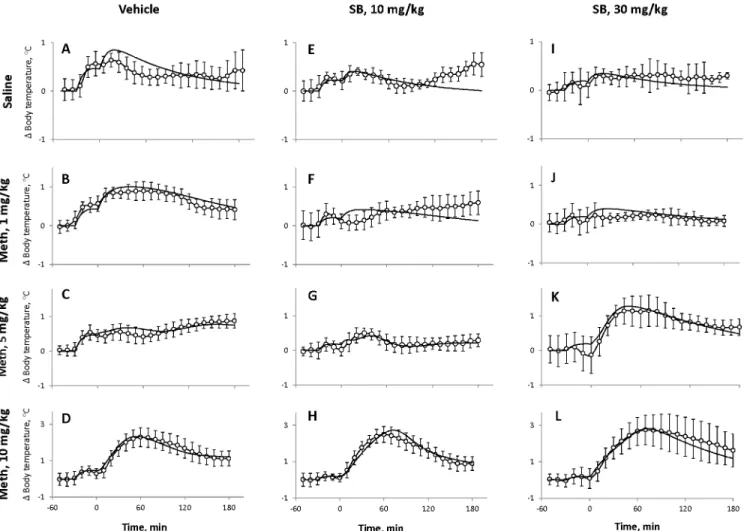
Control responses to Meth. Without SB and Meth, injections of the vehicle and saline cause stress which activatesExc(seeFig 1). This activation results in two early“peaks”of tem-perature in the beginning due to two injections separated by 30 min, followed by a decline to baseline (Fig 6A).
For 1 mg/kg of Meth, stress and Meth together activateExcfar greater thanInhibresulting in higher and longer maximum temperature after 1 mg/kg than after saline, however, the grad-ual decline afterwards was similar (Fig 6B).
Following the vehicle, the intermediate dose of Meth (5 mg/kg) activates bothExcandInhib
to their full extent effectively cancelling each other, and the second“stress bump”almost completely disappears. Accordingly, the body temperature does not react until after 60 min when the Meth concentration falls below the activation threshold ofInhib. This explains the plateau and gradual increase in temperature in the late phase (Fig 6C).
Finally, after 10 mg/kg of Meth at the early stage the activation levels ofExcandInhibare saturated and negating each other.HDcomponent is activated which results in an immediate robust temperature increase (Fig 6D). After approximately 70 min the Meth concentration falls belowHD’s activation threshold, and the temperature starts declining. Later on, in about 120 min, Meth decreases enough to deactivateInhiband, thus, to disinhibitExcwhich temporarily slows the temperature drop or even initiates a secondary peak (not seen inFig 6D).
For more details about temperature responses to Meth alone see [30].
Responses to Meth after SB. Administration of SB itself results in a spike in temperature due to stress caused by the injection which is partially suppressed by the drug (seeFig 2). The second bump on the temperature curve inFig 6Ecorresponds to the injection of saline. The suppression of the responses to stress does not increase significantly with increasing dose of the orexin antagonist (compareFig 6E and 6I).
After administration of SB the temperature response to the low dose of Meth does not ex-ceed that of animals injected with saline (compareFig 6F and 6JwithFig 6E and 6I) suggesting that the temperature responses to the low dose of Meth are eliminated (seeFig 5D).
At the intermediate dose of Meth (5 mg/kg) the temperature responses are noticeably and differentially altered by 10 and 30 mg/kg of SB (Fig 6C, 6G and 6K). After 10 mg/kg of SB the temperature curve loses the late ascending phase present inFig 5C. This modification is con-cerned with SB-evoked desensitization ofExcto Meth (see Figs4D,5A and 5D). After the higher dose of SB (30 mg/kg) there appears strong immediate hyperthermia (Fig 6K) explained by sensitization ofHDand desensitization ofInhib(Fig 5B, 5C and 5D).
Finally, after 10 mg/kg of Meth, bothExcandInhibare activated to some extent by over-coming the blockade, but activation ofHDovershadows the activity of the two, producing pro-gressively larger temperature increase with increasing dose of SB (Fig 6D, 6H and 6L). This augmented hyperthermia as well as its longer duration are also mediated by SB-induced sensiti-zation of theHDnode and desensitization ofInhibto Meth (seeFig 5).
Mechanism of HD sensitization. Orexin is an excitatory neurotransmitter [40]. Accord-ingly, a blockade of orexin receptors is expected to reduce the activity of the postsynaptic neu-rons in presence of orexinergic synaptic inputs. From this perspective, the desensitization of
Meth-activated neurons, and, hence, these inputs are suppressed by the orexin receptor antagonism (seeFig 2).
In the model presented inFig 1we assumed that SB affects the parameters of sensitivity of Meth-dependent populationswExc,wInh. This worked out very well to reproduce the data and is consistent with orexin excitatory action. In contrast, theHDpopulation gets sensitized by the antagonist, which contradicts to the excitatory influence of orexin. Therefore, we assume that Meth-activated excitatory input, which this node receives, is not mediated by orexin. In-stead,HDnode may receive strong inhibition from another neural population whose activity is controlled by orexin receptors. In the presence of the orexin antagonist the activity of this in-hibitory population gets reduced which in turn disinhibitsHD(Fig 7A).Therefore, progressive sensitization ofHD(Fig 4F), which was described above by an increase inwHD, is more likely a result ofHDdisinhibition as illustrated inFig 7A.
The orexinergic drive inFig 7Acan be Meth-dependent or Meth-independent. In the for-mer case the net Meth-dependent input to HD will be defined by the difference of Meth-in-duced excitation and inhibition. In presence of SB, the inhibition is reMeth-in-duced which results in the increased HD sensitivity to Meth characterized by the parameterwHD. In the latter case, the Fig 6. Comparison of experimental data and model responses.Experimental data shown by open circles (average temperature); error bars represent standard deviations over a group of rats. Model responses using best fit parameters are shown as a thick lines. SB vehicles for both doses were pooled into a single group. Columns of graphs correspond to different doses of the antagonist (A-D: Vehicle, E-H: 10 mg/kg and I-K: 30 mg/kg as marked at the top), rows of graphs correspond to different doses of Meth (Saline, 1, 5 and 10 mg/kg, as marked at the left).
orexin antagonist does not affect the Meth-dependent input directly. It rather alters the basal excitability of the HD population defined by the orexin-dependent tonic inhibition it receives. Accordingly, a more biologically correct way to describe this is to alterγHDfor different doses of SB, rather thanwHD.
γHDestimates obtained by Monte Carlo simulations using (wS,wExc,wInh,γHD) as a set of
SB-affected parameters are shown inFig 7B. As expected, this parameter progressively declines with increasing SB dose which leads to changes inHDactivation curve almost indistinguish-able from shown inFig 5C. Obviously, the likelihood for these two models is almost the same, and hence they are equally probable from Bayesian standpoint.
To summarize, the sensitization ofHDcomponent of the network is concerned with its dis-inhibition. Our experimental data does not allow for a conclusion if this inhibition is Meth-ac-tivated or not.
Effect of inhibition failure
The inhibitory control ofHDpopulation described above may originate from theInhibnode of the circuitry (seeFig 1). In this case we can synthesize the network architecture by combining the schematics from Figs1Aand7Aas shown inFig 8A. We implemented a corresponding Fig 7. Interpretation of HD sensitization as a change of inhibitory tone to the HD.A: The mechanism of HD sensitization by the orexin receptor antagonist. SB suppresses activation of the inhibitory population InhHDby orexinergic input which disinhibits HD and thus lowers its activation threshold. B: Effect of SB on the
basal inhibitory tone to HD populationγHDwhen it is used as an SB-affected parameter instead ofwHD.*—
the estimate is statistically significantly different from the one for Vehicle (SB-0, p<0.05); #—the estimates are
statistically significantly different between SB 10 and SB 30 (p<0.05). SeeResultsfor more details.
Fig 8. Reduced model and effect of inhibitory failure on the response.A. The extended model schematic in which the inhibitory tone to HD originates from Inhib population (see explanations in theResults). B: Effect of inhibitory failure in the modified model on the response to 3 mg/kg of Meth (see details in theResults).
mathematical model and found that it fitted our experimental data with comparable precision (not shown) and hence had similar likelihood.
This model has a very important implication for the role of inhibition in this system. Indeed, both excitatory components,ExcandHD, appear to be controlled by the inhibitory drive whose failure may have dramatic consequences. Our simulations demonstrate the conse-quences of such failure.Fig 8Bdemonstrates how temperature responses to Meth change if the maximal activity ofInhibpopulation is bounded. In our simulations we used a relatively low dose (3 mg/kg) which does not produce major response under baseline conditions (see unmod-ified 100% inhibition inFig 8B). If the maximal activity of theInhibpopulation was decreased by two times (50% inhibition), the body temperature rose by almost 2 degrees. WhenInhibwas completely silenced, the body temperature reached life-threatening levels at almost 40°C (0% inhibition inFig 8B).
Discussion
This study builds upon previously published mathematical models [30], which were based on the premise that body temperature response to Meth is dependent upon the interaction tween two neural components: excitatory and inhibitory drives. The difference in strength be-tween these two signals ultimately determines the dynamics of body temperature.
The injections of SB (0 mg/kg, 10 mg/kg, and 30 mg/kg) differentially modify temperature responses to low, intermediate and high doses of Meth (0 mg/kg, 1 mg/kg, 5 mg/kg, and 10 mg/kg). Previously it was reported that 10 mg/kg of SB suppressed the temperature response to stress of injection and also late hyperthermia induced by the intermediate (5 mg/kg) dose of Meth [29]. The limited conclusiveness of that study was concerned with the fact that SB-related effects on the temperature response in the early phase (t<60 min) were impossible to separate from stress-induced temperature fluctuations resulting from two intraperitoneal injections.
In this study using mathematical modeling we were able to reliably decompose the effect of SB into stress- and Meth-related components, and thus provide a straight-forward mechanistic explanation for the intricate alterations of the temperature responses to different doses of Meth induced by orexin receptor antagonism.
Two excitatory components in temperature responses to Meth
In our previous publication [30], where we suggested the circuitry shown inFig 1to explain the complexity of the temperature responses to Meth, we also considered an alternative model where the excitatory populations,ExcandHD, were combined into a single excitatory node. The data used in that study failed to emphasize the plausibility of either architecture.
In the present study we have shown that two distinct excitatory populations are necessary to explain differential effects of the orexin receptor antagonist on the responses to low and high doses of Meth. Specifically, activation of the first excitatory population (ExcinFig 8A) by low doses of Meth is mediated by orexinergic neurotransmission, while the direct Meth-dependent input to the second population (HD) does not rely on orexin receptor activation.
thus lowersHDactivation threshold which underlies SB-induced exaggeration of responses to high doses of Meth.
Biological implications
The results of this work have several important implications to consider.
Amphetamines are known to activate orexin-containing neurons in the perifornical area and dorsomedial hypothalamus [20,21]. From the phenomena observed in our experiments we conclude that this activation of orexinergic cells is required for temperature responses to Meth. Due to absence of hypothermia after administration of SB, we conclude that existing orexinergic projection to raphe pallidus [41] does not mediate temperature responses to Meth based on assumed locations of Excitatory and Medullary nodes [30]. In turn, the entire hypo-thalamus including dorsomedial hypohypo-thalamus contains orexin-containing fibers [41], which can mediate the above effects of Meth. However, this transmission can be not mono-, but poly-synaptic (for example, perifornical area—ventral tegmental area—hypothalamus, or have even more connections).
TheInhibpopulation in the network plays an extremely important role in counteracting hy-perthermia. Previously, we have demonstrated that an imbalance of excitatory and inhibitory components can result in significant amplification of the response to relatively low doses of Meth [30]. The details of the circuitry proposed in this study emphasize the importance of the inhibitory component(s) even more. Simulations shown inFig 8Bdemonstrate that a relatively low dose (3 mg/kg), which does not induce virtually any response in intact animals (see 100% inhibition inFig 8B), can evoke profound hyperthermia typical for much higher doses (com-pare 0% inhibition inFig 8BwithFig 6D). The impairment of the inhibitory control can not only allow excitation to pass throughMed, but also lower theHDactivation threshold so that this population gets activated by relatively low Meth doses.
Another implication of our results is that using orexin receptor blockade as a treatment for other ailments could cause life-threatening side effects. In particular, orexin antagonists were proposed to prevent or treat addictions to various drugs [42,43]. An increase in excitability of theHDpopulation in presence of SB highlights a potential danger of its use to treat drug abuse if the person uses the drug during treatment. Indeed, suppression of acute effects of amphet-amines by the orexin antagonist may force an abuser to increase the dose which may cause life-threatening hyperthermia due to a dysfunction of the inhibitory population(s). Similarly, our model predicts that narcoleptic patients, whose condition is putatively caused by a lack of orexin [44], may be at higher risk of life-threatening overdose of amphetamine-like stimulants, which are usually prescribed to treat such patients [45].
Tupone, Madden (26) reported that administration of orexin into raphe pallidus evoked ac-tivation of thermogenesis in the BAT and increased body temperature in anesthetized rats. Sur-prisingly, local microinjection of SB into the same area also induced thermogenesis and hyperthermia [26]. Our analysis provides possible interpretation of this data as the network has both excitatory and inhibitory populations activated by orexin. Namely, activation of the excitatory drive by orexin can evoke thermogenic response, whereas a blockade of orexin re-ceptors in the inhibitory population will remove the inhibitory tone which may result in a similar effect.
Conclusions
thermogenic effects of Meth when activity of orexin receptors is modified. The model has sev-eral essential features regarding the mechanisms of Meth-evoked hyperthermia and stress response.
• Both low dose of Meth and stress activate the excitatory component which is mediated by orexin receptors and hence can be suppressed by SB.
• The inhibitory component of the response to Meth is also mediated by orexin.
• Orexin antagonism disinhibits, and thus increases the sensitivity of the component normally activated by the high dose of Meth.
• Insufficient inhibitory drive can cause fatal hyperthermia after relatively low doses of Meth. This insufficiency can be provoked by a decreased orexinergic tone either due to deficiency of orexinergic transmission (narcolepsy) or after administration of orexin receptor antago-nists (e.g. used for drug abuse treatments).
Supporting Information
S1 Dataset. Body temperature changes induced by methamphetamine in rats pretreated with different doses of SB-334867.
(XLSX)
Acknowledgments
Pamela Durant is gratefully acknowledged for editorial assistance.
Author Contributions
Conceived and designed the experiments: DVZ YIM DER MVZ. Performed the experiments: DVZ MVZ. Analyzed the data: AB DF PT YY MVZ DER YIM DVZ. Contributed reagents/ma-terials/analysis tools: AB DF PT YY YIM. Wrote the paper: AB DF PT DER YIM DVZ.
References
1. UNODC. Annual Report 2008 2008. Available:www.unodc.org/documents/about-unodc/AR08_WEB. pdf.
2. Jordan SC, Hampson F. Amphetamine poisoning associated with hyperpyrexia. British Medical Jour-nal. 1960; 2(5202):844. Epub 1960/09/17. PMID:14407884; PubMed Central PMCID: PMC2097773. 3. Kojima T, Une I, Yashiki M, Noda J, Sakai K, Yamamoto K. A fatal methamphetamine poisoning
associ-ated with hyperpyrexia. Forensic Science International. 1984; 24(1):87–93. Epub 1984/01/01. doi: 0379-0738(84)90156-7 [pii]. PMID:6698457.
4. Kalant H, Kalant OJ. Death in amphetamine users: causes and rates. Canadian Medical Association Journal. 1975; 112(3):299–304. Epub 1975/02/08. PMID:1089034; PubMed Central PMCID: PMC1956334.
5. Ginsberg MD, Hertzman M, Schmidt-Nowara WW. Amphetamine intoxication with coagulopathy, hy-perthermia, and reversible renal failure. A syndrome resembling heatstroke. Annals of Internal Medi-cine. 1970; 73(1):81–5. PMID:5433281
6. Westover AN, Nakonezny PA, Haley RW. Acute myocardial infarction in young adults who abuse am-phetamines. Drug and Alcohol Dependence. 2008; 96(1–2):49–56. Epub 2008/03/21. doi: S0376-8716 (08)00064-1 [pii] doi:10.1016/j.drugalcdep.2008.01.027PMID:18353567; PubMed Central PMCID: PMC2533107.
8. Kendrick WC, Hull AR, Knochel JP. Rhabdomyolysis and shock after intravenous amphetamine admin-istration. Ann Intern Med. 1977; 86(4):381–7. PMID:848798.
9. Verschraagen M, Maes A, Ruiter B, Bosman IJ, Smink BE, Lusthof KJ. Post-mortem cases involving amphetamine-based drugs in The Netherlands. Comparison with driving under the influence cases. Fo-rensic Sci Int. 2007; 170(2–3):163–70. doi:10.1016/j.forsciint.2007.03.030PMID:17658708.
10. De Letter EA, Piette MH, Lambert WE, Cordonnier JA. Amphetamines as potential inducers of fatalities: a review in the district of Ghent from 1976–2004. Medicine, science, and the law. 2006; 46(1):37–65. Epub 2006/02/04. PMID:16454462.
11. Wellman PJ. Influence of amphetamine on brown adipose thermogenesis. Research Communications in Chemical Pathology and Pharmacology. 1983; 41(1):173–6. Epub 1983/07/01. PMID:6622830. 12. Blessing WW, Zilm A, Ootsuka Y. Clozapine reverses increased brown adipose tissue thermogenesis
induced by 3,4-methylenedioxymethamphetamine and by cold exposure in conscious rats. Neurosci-ence. 2006; 141(4):2067–73. PMID:16814930.
13. Sprague JE, Mallett NM, Rusyniak DE, Mills E. UCP3 and thyroid hormone involvement in metham-phetamine-induced hyperthermia. Biochemical Pharmacology. 2004; 68(7):1339–43. Epub 2004/09/ 04. doi:10.1016/j.bcp.2004.03.049PMID:15345323.
14. Pedersen NP, Blessing WW. Cutaneous vasoconstriction contributes to hyperthermia induced by 3,4-methylenedioxymethamphetamine (ecstasy) in conscious rabbits. The Journal of neuroscience: the of-ficial journal of the Society for Neuroscience. 2001; 21(21):8648–54. Epub 2001/10/19. PMID: 11606652.
15. Blessing WW, Seaman B, Pedersen NP, Ootsuka Y. Clozapine reverses hyperthermia and sympatheti-cally mediated cutaneous vasoconstriction induced by 3,4-methylenedioxymethamphetamine (ecsta-sy) in rabbits and rats. The Journal of neuroscience: the official journal of the Society for Neuroscience. 2003; 23(15):6385–91. PMID:12867524.
16. Rusyniak DE, Zaretskaia MV, Zaretsky DV, DiMicco JA. Microinjection of muscimol into the dorsome-dial hypothalamus suppresses MDMA-evoked sympathetic and behavioral responses. Brain Res. 2008; 1226:116–23. Epub 2008/07/01. doi:10.1016/j.brainres.2008.06.011PMID:18586013; PubMed Central PMCID: PMCPmc2600867.
17. Dimicco JA, Zaretsky DV. The dorsomedial hypothalamus: a new player in thermoregulation. American journal of physiology Regulatory, integrative and comparative physiology. 2007; 292(1):R47–63. Epub 2006/09/09. doi:10.1152/ajpregu.00498.2006PMID:16959861.
18. Kerman IA, Akil H, Watson SJ. Rostral elements of sympatho-motor circuitry: a virally mediated transsy-naptic tracing study. The Journal of neuroscience: the official journal of the Society for Neuroscience. 2006; 26(13):3423–33. Epub 2006/03/31. doi: 26/13/3423 [pii] doi:10.1523/JNEUROSCI.5283-05. 2006PMID:16571749.
19. Kerman IA, Bernard R, Rosenthal D, Beals J, Akil H, Watson SJ. Distinct populations of presympa-thetic-premotor neurons express orexin or melanin-concentrating hormone in the rat lateral hypothala-mus. Journal of Comparative Neurology. 2007; 505(5):586–601. Epub 2007/10/11. doi:10.1002/cne. 21511PMID:17924541.
20. Estabrooke IV, McCarthy MT, Ko E, Chou TC, Chemelli RM, Yanagisawa M, et al. Fos Expression in Orexin Neurons Varies with Behavioral State. Journal of Neuroscience. 2001; 21(5):1656–62. PMID: 11222656
21. Fadel J, Bubser M, Deutch AY. Differential Activation of Orexin Neurons by Antipsychotic Drugs Associ-ated with Weight Gain. Journal of Neuroscience. 2002; 22(15):6742–6. doi: 20026632. PMID:
12151553
22. Samson WK, Gosnell B, Chang JK, Resch ZT, Murphy TC. Cardiovascular regulatory actions of the hypocretins in brain. Brain Res. 1999; 831(1–2):248–53. Epub 1999/07/21. doi: S0006-8993(99) 01457-2 [pii]. PMID:10412003.
23. Shirasaka T, Kunitake T, Takasaki M, Kannan H. Neuronal effects of orexins: relevant to sympathetic and cardiovascular functions. Regulatory Peptides. 2002; 104(1–3):91–5. Epub 2002/02/07. doi: S0167011501003524 [pii]. PMID:11830282.
24. Monda M, Viggiano A, Viggiano A, Viggiano E, Messina G, Tafuri D, et al. Sympathetic and hyperther-mic reactions by orexin A: Role of cerebral catecholaminergic neurons. Regulatory Peptides. 2007; 139 (1–3):39–44. PMID:17207869
25. Yoshimichi G, Yoshimatsu H, Masaki T, Sakata T. Orexin-A regulates body temperature in coordination with arousal status. Experimental Biology and Medicine. 2001; 226(5):468–76. PMID:11393177 26. Tupone D, Madden CJ, Cano G, Morrison SF. An orexinergic projection from perifornical hypothalamus
27. Johnson PL, Truitt W, Fitz SD, Minick PE, Dietrich A, Sanghani S, et al. A key role for orexin in panic anxiety. Nature Medicine. 16(1):111–5. Epub 2009/12/29. doi: nm.2075 [pii] doi:10.1038/nm.2075 PMID:20037593.
28. Samson WK, Bagley SL, Ferguson AV, White MM. Hypocretin/orexin type 1 receptor in brain: role in cardiovascular control and the neuroendocrine response to immobilization stress. American Journal of Physiology. 2007; 292(1):R382–R7. doi:10.1152/ajpregu.00496.2006PMID:16902182
29. Rusyniak DE, Zaretsky DV, Zaretskaia MV, Durant PJ, Dimicco JA. The orexin-1 receptor antagonist SB-334867 decreases sympathetic responses to a moderate dose of methamphetamine and stress. Physiology & behavior. 2012. doi:10.1016/j.physbeh.2012.02.010PMID:22361264; PubMed Central PMCID: PMC3371311.
30. Molkov YI, Zaretskaia MV, Zaretsky DV. Meth math: modeling temperature responses to methamphet-amine. American journal of physiology Regulatory, integrative and comparative physiology. 2014; 306 (8):R552–66. doi:10.1152/ajpregu.00365.2013PMID:24500434.
31. Zaretsky DV, Zaretskaia MV, DiMicco JA. Stimulation and blockade of GABA(A) receptors in the raphe pallidus: effects on body temperature, heart rate, and blood pressure in conscious rats. American jour-nal of physiology Regulatory, integrative and comparative physiology. 2003; 285(1):R110–6. Epub 2003/03/01. doi:10.1152/ajpregu.00016.2003PMID:12609814.
32. Cruickshank CC, Dyer KR. A review of the clinical pharmacology of methamphetamine. Addiction. 2009; 104(7):1085–99. doi:10.1111/j.1360-0443.2009.02564.xPMID:19426289
33. DiMicco JA, Sarkar S, Zaretskaia MV, Zaretsky DV. Stress-induced cardiac stimulation and fever: com-mon hypothalamic origins and brainstem mechanisms. Autonomic neuroscience: basic & clinical. 2006; 126–127:106–19. Epub 2006/04/04. doi:10.1016/j.autneu.2006.02.010PMID:16580890. 34. Loskutov EM, Molkov YI, Mukhin DN, Feigin AM. Markov chain Monte Carlo method in Bayesian
recon-struction of dynamical systems from noisy chaotic time series. Phys Rev E Stat Nonlin Soft Matter Phys. 2008; 77(6 Pt 2):066214. PMID:18643357.
35. Mukhin DN, Feigin AM, Loskutov EM, Molkov YI. Modified Bayesian approach for the reconstruction of dynamical systems from time series. Phys Rev E Stat Nonlin Soft Matter Phys. 2006; 73(3 Pt 2):036211. PMID:16605635.
36. Molkov YI, Mukhin DN, Loskutov EM, Timushev RI, Feigin AM. Prognosis of qualitative system behav-ior by noisy, nonstationary, chaotic time series. Phys Rev E Stat Nonlin Soft Matter Phys. 2011; 84(3 Pt 2):036215. PMID:22060483.
37. Feigin A, Molkov YI, Mukhin D, Loskutov E. Prognosis of qualitative behavior of a dynamic system by the observed chaotic time series. Radiophysics and quantum electronics. 2001; 44(5–6):348–67. 38. Myles BJ, Jarrett LA, Broom SL, Speaker HA, Sabol KE. The effects of methamphetamine on core
body temperature in the rat—part 1: chronic treatment and ambient temperature. Psychopharmacology. 2008; 198(3):301–11. doi:10.1007/s00213-007-1061-zPMID:18438646.
39. Molkov YI, Zaretsky DV. Balanced excitation and inhibition in temperature responses to meth. Temper-ature. 2014:00-. doi:10.4161/2167549X.2014.968483
40. Kukkonen JP, Leonard CS. Orexin/hypocretin receptor signalling cascades. Br J Pharmacol. 2014; 171 (2):314–31. doi:10.1111/bph.12324PMID:23902572; PubMed Central PMCID: PMCPMC3904254. 41. Peyron C, Tighe DK, van den Pol AN, de Lecea L, Heller HC, Sutcliffe JG, et al. Neurons containing
hypocretin (orexin) project to multiple neuronal systems. The Journal of neuroscience: the official jour-nal of the Society for Neuroscience. 1998; 18(23):9996–10015. Epub 1998/11/21. PMID:9822755. 42. Khoo SY, Brown RM. Orexin/hypocretin based pharmacotherapies for the treatment of addiction:
DORA or SORA? CNS Drugs. 2014; 28(8):713–30. doi:10.1007/s40263-014-0179-xPMID:24942635. 43. Baimel C, Bartlett SE, Chiou LC, Lawrence AJ, Muschamp JW, Patkar O, et al. Orexin/hypocretin role
in reward: implications for opioid and other addictions. Br J Pharmacol. 2014. doi:10.1111/bph.12639 PMID:24641197.
44. Sakurai T. Orexin deficiency and narcolepsy. Curr Opin Neurobiol. 2013; 23(5):760–6. doi:10.1016/j. conb.2013.04.007PMID:23663890.
![Table 1. Values of parameters of the model, which were considered not affected by SB (adapted from [30]).](https://thumb-eu.123doks.com/thumbv2/123dok_br/18202157.333619/6.918.302.865.910.1048/table-values-parameters-model-considered-affected-sb-adapted.webp)