Abstract— This study investigated and compared the mechanical properties of boron suboxide (B6O) with and without chromium bromide (CrB2) additive, hot pressed at 1900oC and 1850oC and for 20 minutes, with applied pressures of 50 and 80 MPa respectively. The theoretical density attained for these materials was More than 96%. The phase relationship, microstructures and mechanical properties of these materials were examined and good combination of mechanical properties was obtained with the B6O-CrB2 material (HV 32.1 GPa, KIC 4.5 MPa.m
0.5 ) compared to pure B6O material. Mixing with a small amount (1.7 wt.%, equivalent of 0.4 vol.%) of CrB2 additive resulted in a pronounced improvement in both the hardness and fracture toughness values. The improvement in the fracture toughness was attributed to the introduction of the second phase and the toughening mechanism is presumed to be by crack bridging and deflection due to bimetallic stress.
Keywords — Boron suboxide, chromium boride, fracture toughness, hardness, hot isostatic pressing.
I. INTRODUCTION
ONSIDERABLE fundamental and technological interests have been a great challenge in recent times to the synthesis of new materials with hardness comparable to or even harder than that of diamond [1].
Diamond and cubic boron nitride (cBN) combine excellent mechanical, chemical, and physical properties. Diamond cannot be however used as a cutting tool for steel, due to its chemical interaction with that metal at high temperatures. cBN attributes of great hardness and abrasion resistance, coupled with a higher chemical stability than diamond when in contact with ferrous alloys, can be used to machine both steel and cast iron. However, increase in temperature weakens cBN due to diffusion wear and
Manuscript received June 24, 2014; accepted July 18, 2014.
EN Ogunmuyiwa* and AS Afolabi are both with the Department of Civil and Chemical Engineering, University of South Africa, Florida Campus, Johannesburg, South Africa. (*Corresponding author: phone: +27-79-838-1218; e-mail: [email protected], [email protected]).
OT Johnson is with the Department of Mining and Metallurgical Engineering, University of Namibia, Ongwediva Campus, Namibia. (e-mail: [email protected], [email protected]).
I Sigalas is with the School of Chemical and Metallurgical Engineering, University of the Witwatersrand, Johannesburg, South Africa. (e-mail: [email protected]).
M. Herrmann is with the Fraunhofer Institute of Ceramic Technologies and Systems, Winterbergstrasse 28, D-01277, Dresden, Germany. (e-mail: [email protected]).
transformation to its hexagonal structure (hBN) [1].
In addition, both materials also require high pressures and temperatures for their synthesis, which make their production expensive and limit the sizes and geometric forms possible. For this reason and because of the need to replace expensive diamond in many applications, new hard materials with comparable or even superior properties are required.
Boron suboxide (nominally B6O) is the third hardest material with the hardness values between 31 to 38 GPa, after diamond (HV: 70–100 GPa) and cBN (HV: 60 GPa) [2–9]. Its single crystal can have a hardness of 45 GPa and with abrading properties compared to those of diamond. In addition to this hardness, its fracture toughness has been reported to be 4.5 MPa.m0.5 [10, 12], approaching that of single crystal of diamond at 5 MPa.m0.5 and significantly better than that of a single crystal of cBN at 2.8 MPa.m0.5 [11]. B6O has a better thermal stability compared to that of diamond [10, 12] and can be produced at lower pressure [13–16]. All these properties suggest that B6O may be a good candidate for cutting tool and other wear part applications where abrasive wear resistance is important.
The development of thermodynamic data for B6O at elevated temperatures has allowed the prediction of the stability and crystalline phases in B6O composites [17]. This suggests that a careful selection of additives with controlled sintering conditions can result in a production of B6O materials with unique combination of mechanical properties for industrial applications. In order to achieve a complete densification, high pressures between 1–5 GPa are usually required, but the resulting fracture toughness does not exceed 2 MPam0.5 [18–19]. Several attempts have been made to improve on the fracture toughness of B6O through the addition of different materials.
B6O-composite made via high-pressure technique with the addition of materials such as diamond, boron carbide and cBN yielded a fracture toughness of 1.8 MPa.m0.5 [3–4, 7]. The addition of Al2O3 has been reported to increase the fracture toughness to a value of 3.1 MPa.m0.5 but with a slight reduction in hardness in comparison to pure B6O material [13–14, 17]. The addition of different cobalt containing additives resulted in a fracture toughness of between 3.2 – 3.9 MPa.m0.5 [15], and recently, B6O materials with different amount of rare-earth oxide additives reported a fracture toughness between 3.9 – 5.6 MPa.m0.5 [16].
Although B6O can be cost effectively synthesized at ambient pressure with enhanced properties [13–17], its commercial use is actually prevented by its poor sinterability (due to low diffusion coefficients and a high vapour pressure) and low fracture toughness of polycrystalline materials. A good understanding of the role of sintering additives on the sintering behaviour and the
Mechanical Properties of Hot-pressed Boron
Suboxide with Chromium Boride Additive
Enoch N. Ogunmuyiwa*, Oluwagbenga T. Johnson,
Member, IAENG,
Iakovos Sigalas, Mathias
Hermann and
Ayo S. Afolabi,Member, IAENG
resulting microstructures is essential for specific tailoring and optimization of the physical properties of B6O materials. Therefore, in this study, B6O materials containing chromium boride additive was prepared by hot isostatic pressing (HIP) and the densification, the phase and microstructural transformation correlated with the resulting mechanical properties and compared with that of pure B6O material.
II. METHODOLOGY
The B6O powder used in this study was produced from the reaction of boric acid and amorphous boron powder described elsewhere [6, 20–21]. An excess amount (3 mol. %) of boric acid was added to compensate for the evaporation of B2O3 that occurred during synthesis. The mixture was heated in a furnace under argon at 1380oC for 5 hours. The powder, (3 µm particle size) produced and supplied by IKTS – Dresden, Germany produced was crushed and then milled for 20 hours in an attrition mill at 400 rpm using steel balls (2.5 mm diameter), with propan-2-ol as a grinding media to reduce ball wear. The charge to ball ratio was kept at 3:1. The weight of the balls was measured before and after milling to determine weight loss during milling.
The mean particle size of the milled powder was 0.5 m measured using a Mastersizer 2000 (Malvern Instruments, Germany). Washing of the milled B6O powders was done in 1 M HCl for 3 days followed by washing in ethanol and warm methanol to remove any B2O3 remaining resulting from milling operation. Chemical analysis by an inductively coupled plasma optical emission spectrometry (ICP-OES SPECTRO CIRUS CCD), revealed that minor impurities of Fe (0.06 wt.%) and Cr (0.04 wt.%) were introduced through the milling operation. The washed B6O powder was thereafter mixed with 1.7 wt.% chromium boride (CrB2) in methanol for 2 hours using the planetary ball mill (Fritsch Pulversette 6). The mixing speed was kept at 200 rpm, while using 2.5 mm steel ball as the media. After the mixing, the slurry was dried using a rotavap, and then characterized using X-Ray diffraction (XRD), to identify the phases present and SEM to examine the homogeneity of the admixed powder.
Sintering and densification of the materials was done by hot-isostatic pressing (HIP) using a uniaxial hot press HP20 Thermal Technology, (Thermal Technology Industries, USA) in a hexagonal boron nitride (hBN) crucible. For pure B6O, the furnace was heated to 1700oC at 15oC/min and held at this temperature for 20 minutes, the applied pressure was increased gradually to 30 MPa at this temperature, after which the temperature was increased at a rate of 10oC/min to 1900oC. The holding time at 1900oC was 20 minutes during which time the applied pressure was kept constant at 50 MPa. The furnace was then cooled to room temperature at 20oC/min.
For the B6O-CrB2 material, the furnace was heated to 1400oC at 20oC/min and held at this temperature for 5 minutes, to apply a load of 80 MPa (this load was maintained throughout the hot pressing). The furnace was further heated to 1850oC (sintering temperature) at 20oC/min and held at this temperature for 20 minutes. The furnace was then cooled to room temperature at 20oC/min. The sintered samples were 18 mm in diameter and between 3 – 4 mm thick.
After sintering, the samples produced were surface grounded to remove hBN and also any decomposed layer. The density of the densified samples was determined by the Archimedes method and compared with theoretical densities, which were estimated on the basis of the rule of mixture using 2.55 g/cm3 for B6O and 4.24 g/cm3 for CrB2. The cross-sections of all materials were prepared by polishing with diamond suspensions and characterized for phase analysis using X-ray diffraction (XRD) a Philips PW 1713 fitted with a monochromatic Cu Kα radiation set at 40 kV and 20 mA in the 2Θ range of 10 – 90o, and the phase identification was performed with X’Pert HighScore, while the microstructural changes were investigated using an environmental scanning electron microscope (Philips ESEM XL30) equipped with energy dispersive X-ray spectrometer (EDX) for various elemental compositions present in the materials.
For all the materials prepared, the hardness (HV) was measured by the indentation technique using a LECO V-100-A2 Vickers Hardness Tester machine, with a load of 1 kg for pure B6O, and 5 kg for B6O-CrB2 sintered sample. The fracture toughness (K1C) of the hot pressed samples was determined using the direct crack measurement using the Antis’ equation [22], with the calibration constant
=0.016 and elastic constant E = 470 GPa [23]. The average hardness, fracture toughness and the standard deviation were calculated on the basis of measuring five indentations.III. RESULTS
The B6O powder hot pressed at temperature of 1900oC and pressure of 50 MPa for 20 minutes resulted to a nearly dense sample having 96.5% of the theoretical density, while the B6O-CrB2 sample hot pressed at 1850oC and pressure of 80 MPa showed 98.4% density of the calculated theoretical values. Some quantifiable amounts of the remaining porosity present in both sintered samples is between 1 and 1.4 %, respectively. In comparison to the sintering behavior of pure B6O sample, the small amounts of CrB2 sintering additive significantly promoted the densification. Whereas the densification of pure B6O started at about 1700oC, the onset of pronounced sintering was reduced to about 1400oC for the B6O-CrB2 sample. Hence, the addition of CrB2 additive improved the densification rate and lowered the sintering temperature required for good densification from 1900oC for pure B6O to about 1400oC.
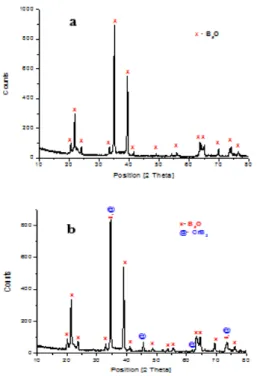
Figure 1(a & b) shows the XRD pattern of the hot pressed B6O samples with and without CrB2. XRD pattern for the hot pressed pure B6O sample showed a reduction in the width of the peaks and increased crystallinity during hot pressing (Figure 1a). For the B6O-CrB2 sample, the XRD patterns revealed that CrB2 crystalline grain boundary phase was retained beside B6O in the material (Figure 1b). There is no evidence in the variation of lattice constants for both B6O and CrB2 in the hot pressed sample, which suggests neither formation of solid solution nor new compound under the sintering conditions employed.
the sintered sample has two phases (B6O and CrB2) (Figure 2d). These analyses agrees with the results obtained from the XRD patterns. There are no differences in the distribution of the additives between the center and the near surface area of the sintered materials. Although the microstructural investigations of cross-sections by electron microscope showed a good densification for both samples (Figure 2(a & c)), however, some amount of porosity were observed at higher magnifications. The pores retained in the samples can be attributed to the decomposition at the sintering temperature and/or pull-out of the softer secondary phase during grinding of the material.
Figure 1 XRD pattern of hot pressed (a) B6O, and (b) B6O-CrB2
material.
The Vickers hardness value obtained for the pure B6O sample in this study (Table 1), shows good agreement with those of other researchers using ultra-high pressure [2–4, 7]. At a load of 1 kg, the pure B6O sample fractured. Hence, the fracture toughness could not be determined and so the material was considered brittle. The Vickers hardness value of the B6O-CrB2 (32.1 GPa) material shows a slight increase compared to that of the pure B6O (30.5 GPa), which could have been as a result of the change in the load applied. The CrB2 clusters were seen to form around the B6O grains, therefore the hardness values obtained in this area was low while the fracture toughness was high. At higher magnification no grain growth was observed in the hot pressed material. The addition of CrB2 to B6O powder resulted in a significant improvement in the fracture toughness considering the brittleness of the pure B6O material.
IV. DISCUSSION
B6O powders hot pressed either under vacuum or argon conditions at temperatures in the range of 1600–1900oC, have produced B6O samples with densities in the range of 85-97% of the theoretical density [5, 23–25]. Table 1 shows
the summary of the resulting properties of the sintered materials.
Figure 2 SEM images of hot pressed (a) B6O, (b) EDX of (a), (c) SEM
image of B6O-CrB2 and (d) EDX of (c).
This study produced a density of 2.45 g/cm3 for pure B6O sample, which was 96.1% of the theoretical density. The amount of porosity measured in the hot pressed B6O samples in this work is very low compared to the others. The SEM image of the hot pressed B6O sample Figure 2(a) at higher magnifications, reveals some small holes representing pores. This could have resulted from the small amount of B2O3, which may have volatilized at high temperatures (partly acting as the source of small pores) and/or could have been caused by the removal of the remaining B2O3 during polishing or due to bad polishing.
a
b
d
The theoretical density of B2O3 is 2.46 g/cm3, which is less than that of B6O (2.55 g/cm3); therefore a small amount of B2O3 in the material will lower the overall theoretical density of a hot pressed B6O and hence, the density could not attain a 100% theoretical.
Table 1 Properties of hot pressed samples
Sinter ed mater
ial
Addit ive weigh
t (%) Dens
ity (g/c m3)
Open porosit y (%)
HV (GPa )
KIC (MPa.
m0.5)
Pure
B6O - 2.45 0.9
30.5 ±
2.1a Brittle
B6
O-CrB2
1.7 2.51 1.4
32.1 ± 1.6b
4.5 ± 0.4
a– hardness measured at 1 kg; b– hardness measured at 5 kg.
The addition of 1.7 wt% of CrB2 additive improved the densification of the B6O powders in comparison to the pure B6O powder. Figure 3 shows a typical phase diagram of the Cr-B system [26]. The type of CrB2 formed was identified with the XRD pattern shown in Figure 1(b), which gives an indication of the composition under consideration (arrow in Figure 3). From the phase diagram, at 1850oC there will not be any liquid present in the material at sintering temperature. Nevertheless, there is some level of solubility of B6O in the system resulting in the formation of transient liquid or it could be that the composition is not pure CrB2 and therefore a liquid is formed which lowers the melting point in this system, creating enough liquid for densification to occur via liquid phase sintering.
A good combination of hardness (32.1 GPa) and fracture toughness (4.5 MPam0.5) was obtained when 1.7 wt.% CrB2 was hot pressed with B6O. CrB2 clusters was formed at the grain boundaries and it is believed that the grain boundary composition increased the toughness of this material. The difference between the thermal expansion coefficients of the B6O matrix and the CrB2 secondary phase induces a tangential compressive stress near the particle/matrix interface and diverts the crack around the particle, thus making the material tough. Figure 4 shows the examples of the crack paths in B6O-CrB2 hot pressed material.
Figure 3 Phase diagram of Cr-B system (ACerS-NIST phase equilibrium diagram, figure 08865a). The arrow represents the composite under
consideration [26].
The effect of residual stresses on fracture toughness that resulted from the mismatch between the thermal expansion coefficients of the two components in ceramic materials has been reported in the literatures [27–28, 30–32]. The residual stress between B6O and CrB2 is estimated, using equations 1 from [28, 30], to be between 571–751 MPa, assuming the change in temperature is about 1000oC.
]
/
)
2
1
(
2
/
)
1
[(
)
.
(
s s m
m
E
E
T
(1)Where:
= Difference in thermal expansion coefficient between B6O (B6O = 5.5
10-6 / oC-1 [5, 24] and the secondary phase, CrB2 (B6O = 7.8
10-6 / oC-1 [29]).T
= Change in temperature at which sufficient softening occurs to alleviate the stresses (~1000oC)s m,
= Poison ratios [B6O = 0.197; CrB2 = 0.2–0.3]s m
E
, = Elastic moduli [B6O = 540 GPa; CrB2 = 211.04 GPa].This differences also induces stresses in the final material thus preventing crack propagation. The fracture toughness enhancement via this mechanism is very common in ceramic materials. The reason for the increase in fracture toughness could also be due to many reasons such as crack bridging and crack deflection due to bimetallic stresses, or due to crack arrest in the secondary phase, or due to the solidification of the grain boundaries between B6O particles being present as films or by many other mechanisms. Both of these crack-path modification mechanisms would give rise to an increase in fracture toughness. The CrB2 additives used had the potential of removing the B2O3 present at the surfaces of B6O particles by forming other phases that cause bimetallic strain toughening at the grain boundaries.
Figure 4 Indentation crack paths on the hot pressed B6O-CrB2 material.
V. CONCLUSIONS
In conclusion, the materials developed in this study are promising candidates for a new class of liquid phase sintered materials produced without ultrahigh pressure. B6O with and without CrB2 additive was successfully hot pressed at 1900oC and 1850oC for 20 minutes, with an applied pressure
Crack deflection
of 50 and 80 MPa respectively. More than 96% of the theoretical density was attained for these materials. The phase relationship, microstructures and mechanical properties were examined and good combination of mechanical properties was obtained. Mixing with even a small amount of CrB2 additive resulted in a pronounced improvement in both the hardness and fracture toughness values. The improvement in the fracture toughness was attributed to the introduction of the second phase and the toughening mechanism is presumed to be by crack bridging and deflection due to bimetallic stress.
ACKNOWLEDGEMENT
The authors acknowledge Element Six and National Research Foundation Centre of Excellence in Strong Materials, for financial support.
REFERENCES
[1.] A Zerr and R Riedel. Introduction: Novel ultrahard materials, In: Handbook of ceramic hard materials, [ed.] R. Riedel,
Wiley-VCH GmbH, Germany. Vol. 1, 45 – 73.
[2.] H Itoh, I Maekawa, and H Iwahara. High pressure sintering of B6O powder properties of the sintered compact. Journal of
Society of Materials Science, 47 (1998); 1000 – 1005.
[3.] H Itoh, I Maekawa, and H Iwahara. Microstructure and
mechanical properties of B6O-B4C sintered composites prepared
under high pressure. Journal of Materials Science, 35 (2000); 693 – 698.
[4.] H Itoh, R Yamamoto, and H Iwahara. B6O-cBN composite
prepared by high pressure sintering. Journal of American
Ceramic Society, 83 (2000); 501 – 506.
[5.] IO Kayhan and OT Inal. Synthesis of aluminium infiltrated
boron suboxide drag cutters and drill bits. Journal of Materials
Science, 34 (1999); 4105 – 4120.
[6.] M Olofsson and T Lundström. Synthesis and structure of
non-stoichiometric B6O. Journal of Alloys and Compounds, 257
(1997); 91 – 95.
[7.] R Sasai, H Fukatsu, T Kojima, and H Itoh. High pressure
consolidation of B6O-diamond mixtures. Journal of Materials
Science, 36 (2001); 5339 – 5343.
[8.] S Veprek. Nanostructured superhard materials, In: handbook of
ceramic hard materials, [ed.] R. Riedel, Wiley-VCH GmbH,
Germany. Vol. 1, 104 – 134.
[9.] W Zhongwu and Z Yusheng. In situ pressure Raman
spectroscopy and mechanical stability of superhard boron suboxide. Applied Physics Letters, 86 (2005); 1 – 3.
[10.]D He, Y Zhao, L Daemen, J Qian, and TD Shen. Boron
suboxide: As hard as cubic boron nitride. Applied Physics Latters, 81 (2002); (4) 643 – 645.
[11.]CA Brookes. Mechanical properties of cubic boron nitride – a perspective. Institute of Physics, Conference Series, 75 (1986); 207 – 220.
[12.]D He, M Akaishi, BI Scott and Y Zhao. Growth of boron
suboxide crystals in the B-B2O3 system at high pressure and high temperature. Journal of Materials Research, 17 (2002); 284 – 290.
[13.]TC Shabalala, DS McLachlan, I Sigalas, and M Herrmann. Hard
and tough boron suboxide based composite. Ceramics International, 34 (2008); 1713 – 1717.
[14.]A Andrews, M Herrmann, TC Shabalala, and I Sigalas. Liquid phase assisted hot pressing of boron suboxide materials. Journal
of European Ceramics Society, 28 (2008); 1613 – 1621.
[15.]OT Johnson, I Sigalas, EN Ogunmuyiwa, HJ Kleebe, MM
Muller, and M Herrmann. Boron suboxide materials with Co sintering additives, Ceramics International, 36, (2010); 1767 – 1771.
[16.]OT Johnson, EN Ogunmuyiwa, I Sigalas, and M Herrmann.
Boron suboxide materials with rare-earth metal oxide additives, In: Proceedings of International Conference on Manufacturing
Engineering and Engineering Management Chemical
Engineering and Technology, ICMEEM, World Congress of
Engineering (WCE) 2013, London, United Kingdom, 3 – 5 July,
2013.
[17.]HJ Kleebe, S Lauterbach, TC Shabalala, M Herrmann, and I
Sigalas. B6O: A correlation between mechanical properties and
microstructure evolution upon Al2O3 addition during
hot-pressing. Journal of American Ceramics Society, 91 (2008); (2) 569 – 575.
[18.]H Hubert, LAJ Garvie, B Devouard, PR Buseck, WT Petuskey,
and PF McMillan. High pressure high temperature synthesis and
characterization of boron suboxide (B6O). Chemistry of
Materials, 10 (1998); 1530 – 1537.
[19.]H Hubert, LAJ Garvie, B Devouard, PR Buseck, WT Petuskey,
and PF McMillan. High pressure high temperature synthesis of superhard alpha-rhombohedral boron-rich solids in B-C-N-O. Materials Research Society, symposium proceeding, 499 (1998); 315.
[20.]BF Goosey. Method of fabricating boron suboxide articles.
United State Patent – US 3816586A, 1974.
[21.]DR Petrak, R Robert, and GR Atkins. Mechanical properties of
hot-pressed boron suboxide and boron. Ceramic Society Bulletin, 53 (1974); 569 – 573.
[22.]G Antis, P Chantikul, B Lawn, and D Marshall. A critical
evaluation indentation techniques for measuring fracture toughness: I, direct crack measurements. Journal of Ceramic Society, 64 (1981); 533 – 538.
[23.]TC Shabalala. The preparation and characterization of boron
suboxide (B6O) based composites. PhD thesis, University of the
Witwaterstand, 2007.
[24.]IA Bairamashvili, GI Kalandadze, AM Eristavi, JS Jobava, VV
Chotulidi, and YL Saloev. An investigation of the
physicomechanical properties of B6O and SiB4. Journal of Less
Common Metals, 67 (1979); 455 – 561.
[25.]C Brodhag and F Thévenot. Hot pressing of boron suboxide
B12O2. Journal of Less Common Metals, 117 (1986); 1 – 6.
[26.]EN Ogunmuyiwa. Study of sintering and structure-property
relationships in boron suboxide (B6O) – alkaline earth metal oxide, cobalt and nickel compound. University of the Witwatersrand, Johannesburg. MSc(Eng) dissertation, 2009.
[27.]L Bingqiang, H Chuanzhen, L Xinyu, G Meilin, and L Hanlian.
In situ growth of TiC whiskers in Al2O3 matrix for ceramic
machine tools. Ceramics International, 33 (2007); 1475 – 1480.
[28.]D Jianxin. Effect of thermal residual stress on the high
temperature toughening behaviour of TiB2/SiC composites.
Journal of Materials Processing Technology, 98 (2000); 292 – 298.
[29.]OT Johnson. Improvement on the mechanical properties of
boron suboxide (B6O) based composites using other compounds
as second phase. University of the Witwatersrand,
Johannesburg. MSc dissertation 2008.
[30.]JH Liversage. An enhancement of the mechanical properties in functionally graded liquid-phase SiC-TiC ceramic composites. University of the Witwaterrsand, Johannesburg. PhD thesis, 2005.
[31.]YB Pan, JH Qiu, M Morita, SH Tan, and D Jiang. The
mechanical properties and microstructure of SiC-AlN particulate
composite. Journal of Materials Science, 33 (1998); 1233 –
1237.
[32.]RP Wahi and B Ilschner. Fracture behaviour of composite based