S CIE
NT OR
U
M
ACTA
Acta Sci. Pol., Technol. Aliment. 9(2) 2010, 171-188
ISSN 1644-0730 (print) ISSN 1889-9594 (online)
© Copyright by Wydawnictwo Uniwersytetu Przyrodniczego w Poznaniu
Corresponding author – Adres do korespondencji: Dr in . Anna Gramza-Michałowska,
Depart-THE ANTIOXIDANT POTENTIAL OF CAROTENOID
EXTRACT FROM
PHAFFIA RHODOZYMA
*Anna Gramza-Micha
ł
owska, Barbara Stachowiak
Poznań University of Life Sciences
Background. Carotenoids are components playing an important role in biological
sys-tems, starting with light protection, immunoenhancement, protection against carcinogens and finishing with antioxidant activity. Food additives market is based mainly on syn-thetic additives; however, higher consumer awareness has resulted in an increased use of natural substances. One of the potentially antioxidant compounds could be a lipid soluble carotenoid – astaxanthin (xanthophyll), found in the microbial world. The aim of this study was to evaluate the antioxidant potential of carotenoid extract from Phaffia rhodozyma extract.
Material and methods. Carotenoids extracted from Phaffia rhodozyma and the
astaxan-thin standard was selected for the investigations. Antioxidant potential was evaluated by radical scavenging activity (DPPH• and ABTS•+ radicals) and in lipid oxidative stability measurements (Rancimat, Oxidograph and Schaal oven tests).
Results. It was found that the examined extracts presented a significantly higher ability to
scavenge the DPPH• radical in comparison to the ABTS•+ radical. Evaluations of linoleic acid emulsion oxidative stability showed a higher antioxidant effect of the Phaffia rhodozyma extract than that of astaxanthin during 19 h of incubation. That potential how-ever, was not detected in linoleic acid emulsion incubated for 96 h, where both additives accelerated oxidation process. In bulk sunflower oil a protective effect of Phaffia rhodozyma extract was observed. In both Rancimat and Oxidograph tests antioxidant ac-tivity measured using the induction period was evaluated. However, results of the Schaal oven test indicated that a 144 h incubation of sunflower oil offered a significantly better protection of the lipid against oxidation when the Phaffia rhodozyma extract was added.
Conclusions. On the basis of recorded results it was found that the Phaffia rhodozyma
ca-rotenoid extract showed moderate antioxidant properties, depending on the environmental conditions of methods used.
Key words:Phaffia rhodozyma, carotenoids, astaxanthin, lipids oxidation, radical
scav-enging activity
*
INTRODUCTION
Carotenoids are components that play an important role in biological systems, start-ing with light protection, immunoenhancement, protection against carcinogens and finishing with antioxidant activity [Kurihara et al. 2002, Dufosse et al. 2005, Sikora et al. 2009]. There are many carotenoids widely applied in feed, pharmaceutical, food and cosmetics industry [Fraser and Bramley 2004]. The world market of food additives is based mainly on synthetic additives; however, higher consumer awareness has re-sulted in an increased use of natural substances [Pokorny 2007]. One of the new poten-tially antioxidant compounds could be a lipid soluble carotenoid – astaxanthin (xantho-phyll) [Jackson et al. 2008]. Astaxanthin (3,3’-dihydroxy-,-carotene-4,4’-dione), a reddish pink-colored carotenoid, is an indispensable component of feeds that are used in commercial salmon, rainbow trout and shrimp cultures [Gil-Hwan and Eui-Sung 2003, Guerin et al. 2003].
Almost 95% of astaxanthin preparations available on the market contain a synthetic pigment [Lorenz and Cysewski 2000], which is much more expensive and less stable than the natural one. One of the methods to reduce costs is the application of microor-ganisms in natural astaxanthin synthesis. A primary commercial source of astaxanthin could be Phaffia rhodozyma (syn. Xanthophyllomyces dendrorhous) yeast, since astax-anthin makes up as much as 83-87% of total carotenoids produced [Guerin et al. 2003, Calo et al. 1995, Flen et al. 1999]. Another advantage of Phaffia rhodozyma use is its capacity to assimilate various carbon sources, cheapness and easy culture [Palagyi et al. 2001]. A major disadvantage is the low level of synthesized pigment (0.2-0.4 g/kg dry matter of yeast) [Guerin et al. 2003, Lorenz and Cysewski 2000, Visser et al. 2003], but the following procedures could minimize that problem: manipulations with media pH, temperature, culture media composition, etc. [Palagyi et al. 2001, Flores-Cotera et al. 2001, Ramirez et al. 2001, Wang et al. 2006, Stachowiak and Czarnecki 2006].
To date antioxidant potential of carotenoid extracts is a new and insufficiently inves-tigated chapter of potential wider use in food industry. There is scarce information in the available literature on the role of the antioxidant potential of Phaffia rhodozyma in lipid systems. The possible utilization of astaxanthin and carotenoid compounds in food in-dustry could improve quality and safety of food products. One of the applications of carotenoid compounds could be stabilization of lipids and lipid-containing products.
Lipids undergo oxidation, both during production stages and storage, causing a se-quence of unfavourable changes, deterioration of product sensory attributes (rancidity, changes of texture and colour) and reduced nutritive value [Gray 1978, Frankel et al. 1998, Klensporf-Pawlik and Jeleń 2009]. Enrichment of lipids with alternative natural substances could have an advantageous effect on its oxidative stability. Nowadays sec-ond very important aspect is their additional introduction to human body, which would positively influence human health and reduce morbidity caused by degenerative dis-eases. From both the technological and nutritional point of view it is highly desirable to control the oxidation process by an addition of antioxidants.
car-cinogenicity of the latter [Barlow 1990, Prior and Cao 2000]. The modern world needs to look for new sources of substances, which could influence lipids and food stability, be harmless for consumers and exhibit high antioxidant activity when added to food.
Present investigations aimed at finding a new source of antioxidant compounds to be used in stabilization of lipids. In view of remarkable carotenoids activity in different biological systems [Hussein et al. 2006], the present study examined the antioxidant potential of carotenoid extract from Phaffia rhodozyma and the astaxanthin standard.
MATERIAL AND METHODS
Chemicals. All chemicals used were of analytical grade: ethanol, methanol, ddH2O,
chloroform, hexane, acetic acid, HCl, KJ, hydrolysable starch, Na2S2O3, isooctane,
KOH, K2S2O8, glucose, the hexane fraction, acetonitrile, ethanolamine, ethyl acetate
(POCH, Poland), K2HPO4, KH2PO4, Na2HPO4 · 12 H2O, FeSO4 · 7 H2O, NH4SCN,
Fe(NH4)(SO4)2 · 12 H2O [Merck], p-anisidine, tiobarbituric acid, Tween 20 (Sigma),
trichloroacetic acid (Ubichem), linoleic acid (NuChek Prep), 2,2'-azino-bis(3-ethyl-benzthiazoline-6-sulphonic acid), Trolox, 2,2-diphenyl-1-picrylhydrazyl, astaxanthin (Sigma-Aldrich), yeast malt (YM), malt extract, agar, NaCl (BTL Poland), bactopeptone (Dickinson and Co.), DMSO (Riedel-de Haen).
Yeast and culture conditions. Phaffia rhodozyma CBS 5626 (now
Xanthophylomy-ces dendrorhous) from the DSMZ collection was used in the study. This strain was
cultured on slants of yeast malt (YM) at 4°C and transferred monthly. The components of the proliferation medium (YM) were 10 g glucose, 5 g bactopeptone, 3 g yeast ex-tract, 3 g malt extract and 20 g agar (for slants) in 1 L distilled water [Calo et al. 1995]. Cultivation: The yeast culture was rinsed from slants with ten mL of medium. Four mL of this suspension were transferred into 250 mL Erlenmayer flasks containing 76 mL of autoclaved medium. Proliferation experiments were carried out for 4 days at 22°C in orbital shakers (agitation speed, 200 rpm) at a constant illumination of 600 lx.
Carotenoid extraction from yeast cells of Phaffia rhodozyma. Yeast culture was centrifuged and harvested cells were washed with distilled water and dissolved in DMSO [Sedmak et al. 1990]. Hexane fraction pure and 20% NaCl solution were serially added with vortexing between additions. After extraction the upper hexane layer con-taining carotenoids was collected for quantitative and qualitative pigment analyses and antioxidant determination. Extracts were stored in air-tight and light protected vials at (–40°C) until further use. Carotenoid extract dry matter was analysed with the use of two-stage dryer method. A known yeast extract volume was repeatedly dried in a weigh-ing bottle (2 h at 55°C, and then at 105°C until constant mass was received). Results are expressed as g/mL of the extract and g/kg of dry weight of culture.
Total carotenoid contents and profile determination. Biomass was measured by DCW (dry cell weight). The total carotenoid yield was quantified by an HPLC (Waters)
model Alliance 2695 with PAD detection. Operating conditions: a X-Terra C18RP
col-umn, Waters (3.9 × 150 mm, particle size 5 µm); oven temperature 30°C; gradient
elu-tion (flow rate = 0.5 mL·min-1; mobile phase: 95% solvent A (acetonitrile with 0.05%
at = 480 nm, by manual integration using astaxanthin as an external standard. Astax-anthin was identified by their retention times and by comparing VIS-UV spectra with those of pure compounds.
Antiradical activity. Carotenoid extract was first concentrated (Buchi, Rotavapor) and the solvent from the hexane-kerosene fraction was replaced with methanol. In the obtained extracts the yields of dry matter and total carotenoids were also controlled.
Radical scavenging activity of carotenoid extracts from Phaffia rhodozyma was
meas-ured with the use of DPPH• and ABTS+• methods, based on a decrease in absorbance of examined solutions, which is a result of radical scavenging activity of the additive.
DPPH• radical scavenging method. The effect of Phaffia rhodozyma extracts was estimated according to the procedure described by Sanchez-Moreno et al. [1998]. An aliquot of methanol (0.1 ml), a solution containing the extracts, was added to 3.9 ml of DPPH• 0.025 g·l-1 in methanol prepared daily. A decrease in absorbance of samples was measured at = 515 nm (Jena Optik). The faster the decrease in absorption, the stronger the antioxidant, possessing a higher ability of hydrogen donation. The range of extract concentrations and measurement frequencies was established experimentally. The antiradical value represents the percentage of radical scavenging ability according to the following formula:
% scavenging effect = [(Abk – Abb ) / Abk] · 100
where:
Abb – sample absorbance,
Abk – control sample absorbance.
ABTS+• radical scavenging method. Radical scavenging activity of extracts was measured according to Re et al. [1999]. The ABTS+• solutions with a stable absorbance at = 734 nm were used for the determination. Antiradical activity of examined samples was presented as the percentage of radical scavenging and calculated using the same equation as in the DPPH• method.
Antioxidant activity. Antioxidant activity of carotenoid extracts was measured in emulsified and bulk lipid systems: linoleic acid emulsion and bulk sunflower oil.
Linoleic acid emulsion. The linoleic acid emulsion (NuChek Prep. USA) was used
to evaluate the antioxidant potential of Phaffia rhodozyma carotenoid extract.
The other method consisted in assessment of linoleic acid emulsion oxidation stage with periodical measurements of peroxides [Kawashima et al. 1981], thiobarbituric acid reactive substances (TBARS) [Buege and Aust 1978] and conjugated linoleic acid (CLA) diene contents [Lingnert et al. 1979]. Lipid emulsions with additives were incu-bated at 37°C for 96 h, until the completion of the induction period. For the purpose of the study it was decided to apply extract concentration of 0.1% counted in relation to linoleic acid content.
Sunflower oil. The oxidative stability of bulk oil – sunflower oil, with an addition of carotenoids was determined by three methods: Rancimat, Oxidograph and Schaal oven tests. Based on earlier results additive concentrations of 0.02, 0.05 and 0.1% in relation to lipid content were used (Rancimat and Oxidograph test), for further analysis using the Shaal oven test additive concentrations were limited to 0.1%.
The first method was the Rancimat test (Metrohm, Switzerland) [Laubli and Bruttel 1986]. The amount of 2.5 g lipid was weighed into a reaction vessel, placed in a heating block kept at 110°C, with airflow of 20 L/h. During the oxidation process volatile
com-pounds are released and collected in the receiving flask filled with ddH2O, and then
their conductivity is measured and recorded. Results of the experiments are automati-cally evaluated by the Rancimat software. The completion of the induction period (Ip) is indicated with a sudden conductivity increase caused by the dissociation of volatile carboxylic acids. On the basis of obtained Ip readings, antioxidant efficiency of addi-tives was established. The protection factor (PF) was determined as the ratio of the induction period of a sample with antioxidants to the induction period of the control.
Protection factor (Pf) = Induction period of sample / Induction period of control
The second test used was the Oxidograph test (Microlab Aarhus, Denmark) [Larsen 1989, Gramza et al. 2007]. The amount of 5 g of lipid was weighed into a reaction ves-sel, placed in a heating block kept at 110°C. The method is based on the measurement of pressure reduction in a reaction vessel with a heated (110°C) lipid sample. The induc-tion period was evaluated graphically. The protecinduc-tion factor was evaluated similarly as in the Rancimat test.
The third test used was the Schaal oven test, where lipid samples with additives were incubated at 60°C in darkness for six days. The incubation period was limited by perox-ide content (lipid samples were incubated until the level of 50 meq O2/kg was recorded)
[Pardun and Kroll 1970]. The rate of lipid oxidative stability was recorded periodically, every 24 h of samples incubation. The chemical analysis of bulk sunflower oil oxidation included the determination of peroxide (PV) [PN ISO 3960: 2005], anisidine (AV) and total oxidation values (TOTOX) [PN EN ISO 6885: 2001]. Similarly to Rancimat and Oxidograph tests, the protection factor (PF) of additives was determined.
RESULTS AND DISCUSSION
Total carotenoid content
The two-step drying method made it possible to determine dry matter of Phaffia
rhodozyma yeast CBS 5626 at 5.1 g/L. The analysis of total carotenoid content in the
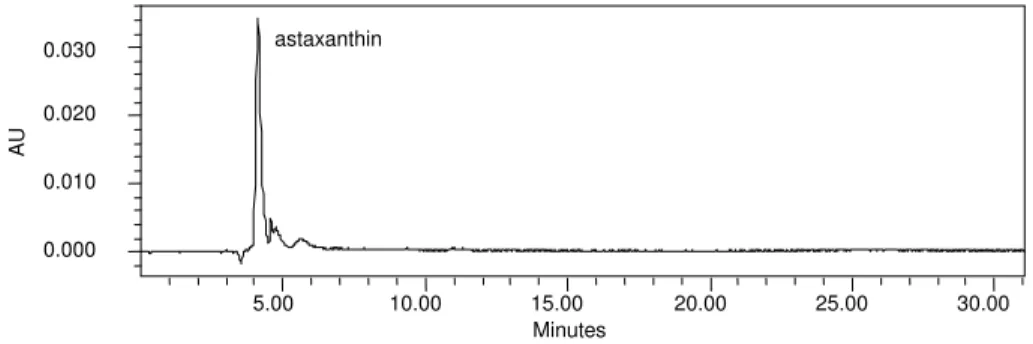
produced extract showed 1.32 mg in terms of a culture unit (1 L) and 0.26 g in terms of yeast dry matter (1 kg). Astaxanthin was the main carotenoid produced by the studied yeast and accounted for almost 80% total carotenoids (Fig. 1). Obtained pigment yields were typical of Phaffia rhodozyma wild strains [Flen et al. 1999, Palagyi et al. 2001, An et al. 1989, Echavarri-Erasun and Johnson 2004, Stachowiak and Czarnecki 2007]. The primary carotenoid concentration was too low for antioxidant activity
measure-ments, so Phaffia rhodozyma carotenoid extracts were concentrated up to 21.67 µg/mL
and further used.
Fig. 1. HPLC chromatogram of carotenoid extract from Phaffia rhodozyma CBS 5626
Antiradical activity
Investigations of radical scavenging activity of Phaffia rhodozyma yeast extract
were conducted for two different radicals: DPPH• and ABTS+•. To determine antiradical activity the original yeast extracts solvent – hexane was replaced with methanol. Total carotenoid content was evaluated to be 5.08 g/mL.
The DPPH• radical scavenging activity was presented as the percentage of radical
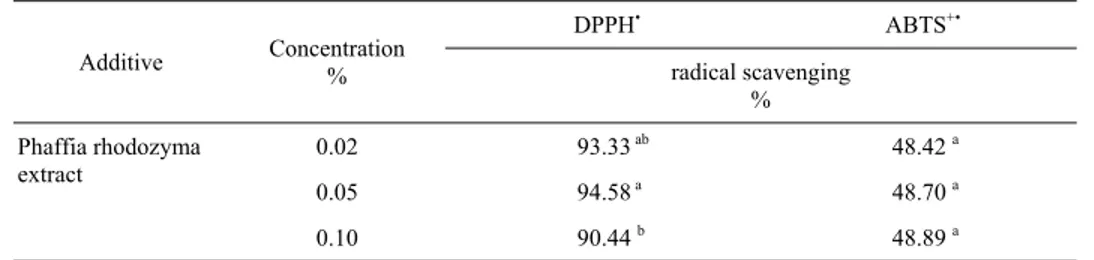
scavenging (%). Results showed that there were no differences in percentage of radicals scavenged in examined extract concentrations (Table 1). The highest percentage of scavenged radicals was recorded for an addition of 0.05% carotenoid extract (94.58%), while the other extracts at different concentrations were slightly weaker scavengers.
The ABTS+• radical scavenging activity was presented similarly as in the DPPH•
method, as the radical scavenging activity (%). Results showed that all tested concentra-tions of the Phaffia rhodozyma extract scavenged the ABTS+• radical at a similar per-centage of 48% (Table 1).
Results of antiradical activity measurements showed a high potential of the Phaffia
rhodozyma extract. A comparison of two methods results showed a higher radical
scav-enging activity of examined additives in the presence of the DPPH• radical than in case
of ABTS+•. Because antiradical activity measurement methods depending on the manner
AU
0.000 0.010 0.020 0.030
Minutes
5.00 10.00 15.00 20.00 25.00 30.00
Table 1. Antiradical potential of Phaffia rhodozyma carotenoids extract
Additive Concentration %
DPPH• ABTS+•
radical scavenging % Phaffia rhodozyma
extract
0.02 93.33 ab 48.42 a
0.05 94.58 a 48.70 a
0.10 90.44 b 48.89 a
a, b – mean values with different letters differ statistically in the column (p < 0.05).
of radical generation and its type, it suggests that the carotenoid extract could have a higher affinity to the lipophilic fraction rather than hydrophilic [Gramza-Michałowska 2007]. Also the antiradical potential measurements, suitable for simple non-complex products, could possibly fail in the presence of complex substances that are composed of a number of intensifying or masking substances [Huang et al. 2005]. No correlation between carotenoid content and antiradical activity was observed.
Miller et al. [1996] examined antiradical activity of carotenoids in the presence of ABTS•+ and found that the highest activity was exhibited by lycopene than -carotene, while astaxanthin showed a much weaker activity. Results suggested that relative abili-ties of carotenoids to scavenge the ABTS•+ radical cation are influenced by the func-tional groups with increasing polarities and the number of conjugated double bonds. Liu and Osawa [2007] examined the antiradical activity of astaxanthin and its isomers in the DPPH radical system. It was found that astaxanthin, generally known as all-trans astax-anthin, was a less potent antioxidant than its isomers, especially 9-cis astaxanthin, which activity was 4-fold higher than that of all-trans astaxanthin. Similar tendencies were shown in the lipid peroxidation system and ROS generation in human neuroblas-toma cells. Different results were presented by Kobayashi and Sakamoto [1999], who examined singlet oxygen quenching activities of carotenoids, free astaxanthin and its esters. Results showed that astaxanthin esters function as powerful antioxidant agents under both hydrophobic and hydrophilic conditions. Naguib [2000] examined the anti-oxidant activity of astaxanthin and related carotenoids in fluorometric assay involving peroxyl radical generation. It was found that astaxanthin exhibited a relatively higher antioxidant activity as compared to selected carotenoids tested. According to studies by Di Mascio et al. [1990] and Baron et al. [2005], astaxanthin and canthaxanthin were
the best singlet oxygen quenchers, followed by Trolox and -tocopherol. Mortensen
et al. [1997] examined antiradical activity of astaxanthin and -carotene by pulse radio-lysis. It was observed that the rate and mechanism of scavenging are much more de-pendent on the nature of the oxidizing radical species than the carotenoid structure. In another review it was stated that there is still limited evidence on carotenoid antioxi-dant activity to support its high effect in vivo through their antioxidant potential [1997].
Antioxidant activity
Emulsified lipid system – linoleic acid emulsion
The antioxidant activity of carotenoid extracts was evaluated with the use of the li-noleic acid emulsion system. Firstly the Lingnert method [1979] was used to find addi-tives with the highest activity concentration. Conjugated diene content was measured in the beginning of the experiment and after 19 hours of storage at 37°C. On the basis of recorded results the antioxidant efficiency (AE) was determined.
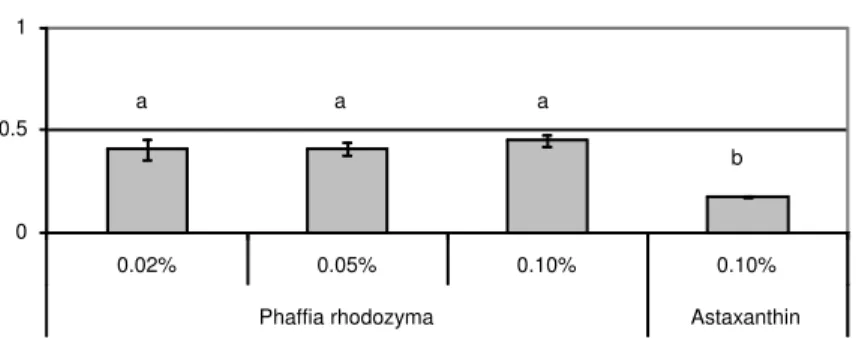
Fig. 2. Antioxidant efficiency (AE) of linoleic acid emulsion with carotenoid extract and astaxanthin incubated for 19 h: a, b – mean values with different letters differ statistically in the row (p < 0.05)
It was found that all additives inhibited the oxidation process in the linoleic acid emulsion (Fig. 2). The highest AE value, amounting to 0.45, was found in the carote-noid extract at a 0.1% concentration. The value for other concentrations was slightly lower, but no statistically significant differences were found. A significantly weaker protection was observed in case of the linoleic acid emulsion with an addition of astax-anthin. It was stated that antioxidant efficiency (AE) for the linoleic acid emulsion with the carotenoid extract from Phaffia rhodozyma was almost three times higher than that of astaxanthin at the examined concentration.
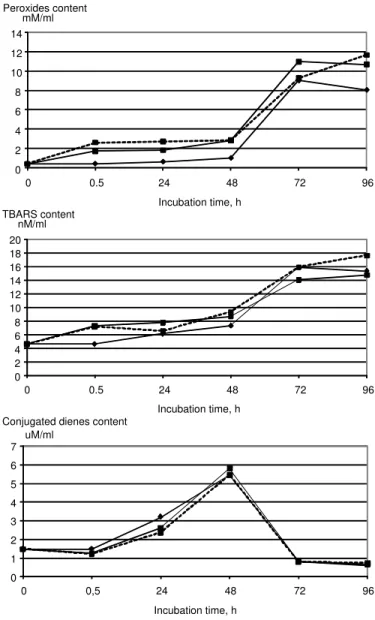
The next step included linoleic acid emulsion storage for 96 hours and the evaluation of primary and secondary oxidation products (Fig. 3). During the 96-hour incubation of linoleic acid emulsion with carotenoid extract three autoxidation process stages were distinguished: initiation, propagation and the termination period. Evaluation of peroxide content in the examined emulsion samples showed higher levels than in the control sample during the 96-hour incubation. The highest peroxide content was recorded for
astaxanthin (0.1%) and it was lower in the Phaffia rhodozyma extract (0.1%) emulsion
samples. Peroxide content was consistently increasing until the 48th hour of incubation to increase rapidly at the 72nd hour, to decrease slightly again at the 96th hour. The ex-periment was planned to last until the induction period is observed. When analysing peroxide content it was suggested that an addition of the carotenoid extract and astaxan-thin enhanced the oxidation process. The level of TBARS was consistently increasing until the 48th hour of incubation to increase rapidly at the 72nd hour. Results showed that until the second day of incubation all additives had a negative effect on the oxidative stability of the emulsion, which was reversed starting from the third day. The lowest
0 0.5
1
0.02% 0.05% 0.10% 0.10%
Phaffia rhodozyma Astaxanthin
Ae
a a
Fig. 3. Oxidative stability of linoleic acid emulsion incubated for 96 h with an addition of Phaffia rhodozyma extract and astaxanthin
increase in the level of secondary oxidation products was recorded in the emulsion with an addition of the Phaffia rhodozyma extract and astaxanthin. Linoleic acid conjugated diene content increased rapidly until the 48th incubation hour, to decrease suddenly at the 72nd hour and stability. Longer storage resulted in the conjugated diene content of linoleic acid comparable to that of the control sample.
0 1 2 3 4 5 6 7
0 0,5 24 48 72 96
Conjugated dienes content uM/ml
Incubation time, h
Control Astaxanthin 0.1% Phaffia rhodozyma 0.1% 0
2 4 6 8 10 12 14 16 18 20
0 0.5 24 48 72 96
TBARS content nM/ml
Incubation time, h 0
2 4 6 8 10 12 14
0 0.5 24 48 72 96
Peroxides content mM/ml
It was observed that in all experiments Phaffia rhodozyma extracts exhibited better antioxidant potential in emulsified linoleic acid. No significant antioxidant effect of
Phaffia rhodozyma carotenoid extracts and the astaxanthin standard on primary products
of oxidation process was observed in the experiment. Hydroperoxides produced during the lipid oxidation process are very unstable and undergo different transformations. One of its disintegration products is malondialdehyde. Analyses of secondary oxidation product contents showed their higher content in all samples containing additives as compared to the control. Other samples showed no antioxidant effect under analysed conditions. A further increase in malondialdehyde content in linoleic acid emulsion is evidence of a continuing oxidation process.
There is scarce information in the literature on the role of the antioxidant potential of
Phaffia rhodozyma astaxanthin in lipid systems. Results reported in a study by Terao
[1989] showed that astaxanthin was more effective than -carotene in retarding hydrop-eroxide formation on azo-initiated lipid peroxidation in homogeneous methyl li-noleate/AMVN systems. It was found that astaxanthin, which contains oxo groups at the 4 and 4’ positions in the beta-ionone ring, retarded hydroperoxide formation more
effi-ciently than -carotene, which possesses no oxo groups. The authors suggested that
astaxanthin could be a more effective antioxidant than -carotene because of stabilizing the trapped radicals. Matsushita et al. [2000] demonstrated that the antioxidant activity of polar carotenoids, i.e. zeaxanthin, astaxanthin and astaxanthin--glucoside, in free radical-mediated oxidation of phosphatidyl choline liposomes depends not only on their ability to trap free radicals, but also on their location and orientation in a structured liposome system. In contrast, oxidation of ethyl linoleate in a chloroform solution measured based on hydroperoxide formation was strongly protected by tocopherol,
while carotenoids were less effective. A similar tendency was observed in the DPPH•
scavenging effect, in which tocopherol was a stronger scavenger than carotenoids. Lim et al. [1992] reported also a stronger antioxidant activity of astaxanthin and zeaxanthin than that of -carotene in egg yolk liposomes. It was demonstrated that polar astaxan-thin and zeaxanastaxan-thin could be oriented parallel to the hydrocarbon chains of phosphatidyl choline in liposomes and this orientation is favourable for these carotenoids to trap the free radical attack at the liposome bilayer surface. Low antioxidant activity of astaxan-thin could be explained by its possible oxidative deterioration. Results reported by Chen and Djuric [2001] showed a substantial depletion of carotenoids after incubation with free radicals generated by Fe2+ or AAPH, although no protection against lipid peroxida-tion in unilamellar liposomes was found. Nishigaki and coworkers [1994] observed that astaxanthin, as the naturally occurring derivatives of vitamin A, suppressed lipid per-oxidation in the rat liver microsomal system. The following effect was more potent than that of -tocopherol.
Bulk lipid system – sunflower oil
Antioxidant stability in bulk lipid was evaluated with the use of three different methods: Rancimat, Oxidograph and Schaal oven tests.
Table 2. Antioxidant activity of Phaffia rhodozyma extract and astaxanthin in sunflower oil under Rancimat and Oxidograph test conditions
Sample Concentration %
Rancimat Oxidograph induction period
h
protection factor
induction period h
protection factor Phaffia rhodozyma
extract
0.1 20.98 c 3.70 5.20 a 1.41
0.05 6.07 d 1.07 4.80 ab 1.30
0.02 5.57 d 0.98 4.65 b 1.26
Astaxanthin 0.1 25.80 a 4.55 4.00 c 1.08
Control 0 5.67 d 1.00 3.68 c 1.00
a, b, c, d – mean values with different letters differ statistically in the column (p < 0.05).
astaxanthin showed high activity. The longest induction period of a lipid sample was found for astaxanthin in case of a 0.1% sample (25.80 h) and the Phaffia rhodozyma ex-tract at 0.1% (20.98 h). Almost a four time lower activity was observed in other samples. Such induction periods resulted in the recording of equal protection factors, which simi-larly to induction periods were highest in samples with a 0.1% addition of astaxanthin (4.55). A protection factor above 1.00 indicates antioxidant effect of a given additive on examined lipids. Results of analyses showed that all additives except for the Phaffia
rho-dozyma extract at 0.02% (Pf = 0.98) protected sunflower oil from deterioration.
Oxidograph test. Antioxidant activity of the carotenoid extract and astaxanthin showed a protective effect of additives on sunflower oil under Oxidograph test
condi-tions. Among additives used the Phaffia rhodozyma extract exhibited a significantly
higher activity than astaxanthin did (Table 2). It was found that its activity depended on the concentration used (p < 0.05), and it decreased with a decrease in concentration.
The induction period of a lipid sample with a 0.1% addition of the Phaffia rhodozyma
extract was found at 5.20 h. Protection factor values confirmed results concerning the induction period of lipid samples. Results showed a weaker protection of additives in the Oxidograph test than in Rancimat. Such a difference resulted from specific evalua-tions that are basic for the tests used. Rancimat makes it possible to measure carboxylic acids as an increase in the level of oxidation products, while in the Oxidograph test measures the oxygen consumption by lipid samples.
Behaviour of lipids and antioxidants in accelerated oxidation tests such as Rancimat or Oxidograph does not always correspond with their behaviour under normal condi-tions. Sometimes different tests could lead to different a result that is why more experi-ments are needed to confirm antioxidant activity of examined constituents in bulk lipids.
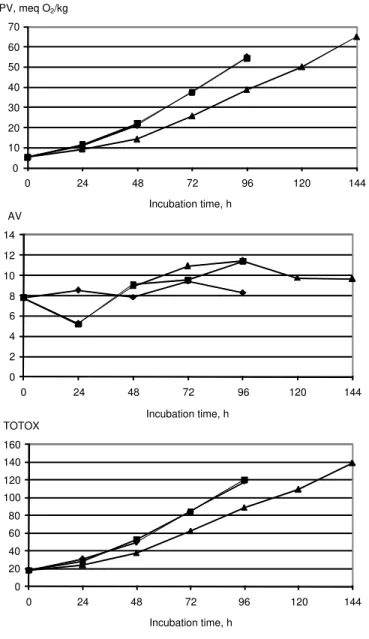
To show a wider potential of the Phaffia rhodozyma extract antioxidant activity was
analysed using the Schaal oven test. The above mentioned test shows the kinetics of oxidation in sunflower oil by presenting changes in primary and secondary oxidation products. Antioxidant activity of tested additives was presented as the Totox value, which is a total content of primary and secondary lipid oxidation products.
were recorded in samples with an addition of the Phaffia rhodozyma extract (0.1%); however, the astaxanthin standard exhibited a significantly lower activity. For the lipid sample with an addition of the carotenoid extract the peroxide value was 50 meq O2/kg
in a longer time (> 120 h) than in case of astaxanthin (96 h), which was not different from with the figures for the unprotected sunflower oil sample.
Fig. 4. Oxidative stability of sunflower oil incubated for 144 h with addition of Phaffia rhodozyma extract and astax-anthin
0 20 40 60 80 100 120 140 160
0 24 48 72 96 120 144
TOTOX
Incubation time, h
Control Astaxanthin 0.1% Phaffia rhodozyma 0.1% 0
2 4 6 8 10 12 14
0 24 48 72 96 120 144
AV
Incubation time, h 0
10 20 30 40 50 60 70
0 24 48 72 96 120 144
PV, meq O2/kg
Anisidine value (AV) is an indicator of contents of secondary oxidation products in a lipid sample. Results showed that in all examined samples the accumulation of sedary oxidation products varied (Fig. 4). During the first 24 hours of incubation the con-tent of secondary oxidation products decreased in all samples except for the control sample, whereas further incubation resulted in a sudden increase of their content. It showed that the protective action of additives was noticeable at the beginning of the incubation period, further incubation showed no lipid protection whatsoever.
Totox value (TOTOX) shows an overall oxidation degree, characterizing both pri-mary and secondary lipid oxidation products. Results of Totox value confirm results concerning trends for peroxide and anisidine values (Fig. 4). The longest accumulation time of oxidation products was evaluated in a sample with an addition of the carotenoid
extract from the Phaffia rhodozyma. The Totox value for the astaxanthin standard was
similar to that of the control sample with no carotenoids added, proving an non- -significant effect of lipid protection. No prooxidative activity of additives was found under examined conditions. Results of protection factor (Pf) evaluations showed that
a 0.1% addition of the Phaffia rhodozyma extract protected sunflower oil 1.5 times
longer than it was in case of the sample with a 0.1% addition of the astaxanthin stan-dard.
Becker et al. [2007] examined the synergistic effect of antioxidants in bulk oil under Rancimat test conditions. It was found that quercetin and astaxanthin showed an addi-tive effect at low concentrations and an antagonistic effect at high concentrations. The induction period for purified sunflower oil was close to zero at all examined astax-anthin concentrations (0.25-2 M/g oil). In the same publication the authors observed astaxanthin in emulsified methyl linoleate. Astaxanthin was expected to orientate close to the interface of the liposome lipid bilayer and protect lipids, but no protection was observed. It was suggested that astaxanthin antioxidant activity in bulk oil was corre-lated with the polarity of the antioxidants, with a higher effectiveness of hydrophilic antioxidants in bulk lipid systems. However, in emulsions more lipophilic antioxidants protected the lipid phase more effectively, indicating proper localization of the antioxi-dant at the oil-water interface, where oxidation takes place. The limited efficacy of astaxanthin in bulk oil was explained by its hydrophobicity, due to its localization in the oil and not in the air-oil interface where lipid oxidation is initiated. It was also expected that in multiphase systems, astaxanthin due to the diketo-group would be close to the interface and thus to peroxy radicals. That activity was observed by the protection of methyl linoleate in emulsions, but not in liposomes [Becker et al. 2007, Frankel et al. 1994]. Concluding the differences in the antioxidant activity of compounds in the organ-ised (liposomes or emulsion) or the homogeneous (bulk oil) systems may be explained by the antioxidants partitioning into different phases. Unfortunately, the relationship between partition of antioxidants and their effectiveness in multiphase systems is not very clear [Becker et al. 2007, Frankel et al. 1994].
astaxan-thin and tocopherol isomers, were remarkably stable throughout the experiment and this might have also contributed to the oxidative stability of frozen farmed Coho salmon lipids.
In another study Jensen et al. [1998] examined antioxidant stability of female
rain-bow trout (Oncorhynchus mykiss) fed with astaxanthin. Frozen storage of raw fish for
18 months significantly reduced astaxanthin and α-tocopherol levels, while lipid oxida-tion, measured as TBARS, was limited. Astaxanthin did not affect lipid oxidation in the chill-stored smoked product, in contrast to the frozen, raw fish. Astaxanthin seems to protect against the very early stages of lipid oxidation, while α-tocopherol is more im-portant as an antioxidant at more advanced stages of lipid oxidation. Results of the above analysis suggest a complexity of the antioxidative mechanism involved in yeasts extracts antioxidative potential evaluations.
SUMMARY
Phaffia rhodozyma yeast could be a potential source of compounds that might be
ac-tive in lipid systems. Research showed a potential antioxidant effect of Phaffia
rhodo-zyma carotenoid extracts and the astaxanthin standard under examined conditions of
emulsified linoleic acid and bulk sunflower oil systems. Results presented a signifi-cantly higher ability to scavenge the DPPH• radical in comparison to the ABTS•+ radi-cal. Evaluations of lipid oxidative stability with an addition of carotenoids again showed a higher antioxidant effect of the Phaffia rhodozyma extract than that of astaxanthin, which did not differ significantly in emulsified linoleic acid incubated for 96 hours. In bulk sunflower oil the protective effect of additives was observed. In both Rancimat and Oxidograph tests antioxidant activity measured using the induction period was high in samples with both additives, depending on their concentration. However, results of the Schaal oven test indicated that a 144-hour incubation of sunflower oil significantly
better protected the lipid against oxidation when the Phaffia rhodozyma extract was
added.
Research on the Phaffia rhodozyma antioxidant potential indicated its potential,
which is why further precise analyses of culturing and carotenoid extraction procedures are needed. The present study is an element in a wider set of experiments on the anti-oxidant potential of microbial antianti-oxidants. As far as complex interactions in different lipid systems are concerned, further research aiming at the evaluation of astaxanthin and
Phaffia rhodozyma carotenoid extracts needs to be conducted.
CONCLUSIONS
On the basis of received results the following statements were formed:
– Phaffia rhodozyma yeast could be a source of compounds potentially active in
lipid systems;
– according to antiradical activity better properties of Phaffia rhodozyma extract were found in presence of DPPH• than ABTS•+ radical;
astaxan-thin in bulk sunflower oil, no statistically significant different results were evalu-ated in emulsified linoleic acid;
– research on the Phaffia rhodozyma antioxidant activity indicated its moderate po-tential, which is why further precise analyses are needed.
REFERENCES
An G.H., Schuman D.B., Jonson E.A., 1989. Phaffia rhodozyma mutatis with increased astaxan-thin content. Appl. Environ. Microbiol. 55, 116-124.
Aubourg S.P., Vinagre J., Rodríguez A., Losada V., Larraín M.A., Quitral V., Gómez J., Maier L., Wittig E., 2005. Rancidity development during the chilled storage of farmed Coho salmon (Oncorhynchus kisutch). Eur. J. Lipid Sci. Technol. 107, 411-417.
Barlow S.M., 1990. Toxicological aspects of antioxidants used as food additives. In: Food anti-oxidants. Ed. B.J.F. Hudson. Elsevier New York, 253-307.
Baron C.P., Berner L., Skibsted L.H., Refsgaard H.H.F., 2005. Evaluation of activity of selected antioxidants on proteins in solution and in emulsions. Free Rad. Res. 39 (7), 777-785. Becker E.M., Ntouma G., Skibsted L.H., 2007. Synergism and antagonism between quercetin and
other chain-breaking antioxidants in lipid systems of increasing structural organization. Food Chem. 103, 1288-1296.
Buege J.A., Aust S.D., 1978. Microsomal lipid peroxidation. Methods Enzym. 35, 302-310. Calo P., Velazquez J.B., Sieiro C., Blanco P., Longo E., Villa T.G., 1995. Analysis of astaxanthin
and other carotenoids from several Phaffia rhodozyma mutants. J. Agric. Food Chem. 43, 1396-1399.
Chen G., Djuric Z., 2001. Carotenoids are degraded by free radicals but do not affect lipid peroxida-tion in unilamellar liposomes under different oxygen tensions. FEBS Lett. 505 (1), 151-154. Di Mascio P., Devasagayam T.P., Kaiser S., Sies H., 1990. Carotenoids, tocopherols and thiols as
biological singlet molecular oxygen quenchers. Biochem. Soc. Trans. 18, 1054-1056. Dufosse L., Galaup P., Yaron A., Arad S.M., Blanc P., Murthy K.N.C., Ravishankar G.A., 2005.
Microorganisms and microalgae as sources of pigments for food use: a scientific oddity or an industrial reality? Trends Food Sci. Tech. 16, 389-406.
Echavarri-Erasun C., Johnson E.A., 2004. Stimulation of astaxanthin formation in the yeast Xan-thophyllomyces dendrorhous by the fungus Epicoccum nigrum. FEMS Yeast Res. 4, 511-519. Flen S.B., Christensen I., Larsen R., Johansen S.R., Johnson E.A., 1999. Astaxanthin – producing
yeast cells, methods for their preparation and their use. U.S. Patent No 5, 712, 110.
Flores-Cotera L.B., Martin R., Sanchez S., 2001. Citrate, a possible precursor of astaxanthin in Phaffia rhodozyma: influence of varying levels of ammonium, phosphate and citrate in chemically defined medium. Appl. Microbiol. Biotechnol. 55, 341-347.
Frankel E.N., 1998. Foods. Biological systems. In: Lipid oxidation. The Oily Press Scotland, 187- -292.
Frankel E.N., Huang S.W., Kanner J., German J.B., 1994. Interfacial phenomena in the evaluation of antioxidants – bulk oils vs emulsions. J. Agric. Food Chem. 42 (5), 1054-1059.
Fraser P.D., Bramley P.M., 2004. The biosynthesis and nutritional uses of carotenoids. Progr. Lipid Res. 43, 228-265.
Gil-Hwan A., Eui-Sung Ch., 2003. Preparation of the red yeast Xanthophyllomyces dendrorhous, as feed additive with increased availability of astaxanthin. Biotechnol. Lett. 25, 767-771. Gramza A., Korczak J., 2005. Tea constituents (Camellia sinensis l.) as antioxidants in lipid
systems. Trends Food Sci. Technol. 16, 351-358.
Gramza-Michałowska A., 2007. Antiradical methods in evaluating antioxidant potential of prepa-rations of plant origin. Med. Arom. Plant Sci. Biotech. 1 (2), 227-233.
Gray J., 1978. Measurement of lipid oxidation: a review. J. Am. Oil Chem. Soc. 55, 539-546. Guerin M., Huntley M.E., Olaizola M., 2003. Haematococcus astaxanthin: applications for human
health and nutrition. Trends Biotech. 21 (5), 210-216.
Huang D., Ou B., Prior R., 2005. The chemistry behind the antioxidant capacity assays. J. Agric. Food Chem. 53, 1841-1856.
Hussein G., Sankawa U., Goto H., Matsumoto K., Watanabe H., 2006. Astaxanthin, a carotenoid with potentialin human health and nutrition. J. Nat. Prod. 69, 443-449.
Jackson H., Braun C.L., Hansgeorg E., 2008. The chemistry of novel xanthophyll carotenoids. Am. J. Card. 101 (10A), 50D-57D.
Jensen C., Birk E., Jokumsen A., Skibsted L.H., Bertelsen G., 1998. Effect of dietary levels of fat, a-tocopherol and astaxanthin on colour and lipid oxidation during storage of frozen rainbow trout (Oncorhynchus mykiss) and during chill storage of smoked trout. Z. Lebensm. Unters. Forch. A, 207, 189-196.
Kawashima K., Itoh H., Chibata I., 1981. Antioxidant effect of peptide in combination with sugar on autoxidation of edible oils. Agric. Biol. Chem. 45, 987-992.
Klensporf-Pawlik D., Jeleń H.H., 2009. Nitrogen atmosphere and natural antioxidants effect on muesli oxidation during long-time storage. Acta Sci. Pol, Technol. Aliment. 8 (1), 5-15. Kobayashi M., Sakamoto Y., 1999. Singlet oxygen quenching ability of astaxanthin esters from
the green alga Haematococcus pluvialis. Biotech. Lett. 21, 265-269.
Kurihara H., Koda H., Asami S., Kiso Y., Tanaka T., 2002. Contribution of the antioxidative property of astaxanthin to its protective effect on the promotion of cancer metastasis in mice treated with resistant stress. Life Sci. 70, 2509-2520.
Larsen K.E., 1989. Methods for measuring autoxidation resistance. In Proceedings of the 15th Scandinavian symposium on lipids. Lipidforum. Rebild Bakker Denmark.
Laubli M.W., Bruttel P.A., 1986. Determination of the oxidative stability of fats and oils: com-parision between the Active Oxygen Method (AOCS Col 12-57) and the Rancimat method. J. Am. Oil Chem. Soc. 63, 792-794.
Lim B.P., Nagao A., Terao J., Tanaka K., Suzuki T., Takama K., 1992. Antioxidant activity of xanthophylls on peroxy radical-mediated phospholipid peroxidation. Biochim. Biophys. Acta 1126, 178-184.
Lingnert H., Vallentin K., Eriksson C.E., 1979. Measurement of antioxidative effect in model system. J. Food Proc. Preserv. 3, 87-103.
Liu X., Osawa T., 2007. Cis astaxanthin and especially 9-cis astaxanthin exhibits a higher anti-oxidant activity in vitro compared to the all-trans isomer. Biochem. Biophys. Res. Comm. 357, 187-193.
Lorenz R.T., Cysewski G.R., 2000. Commercial potential of Haematococcus miroalgae as a natural source of astaxanthin. Tibtech. 18, 160-167.
Matsushita Y., Suzuki R., Nara E., Yokoyama A., Miyashita K., 2000. Antioxidant activity of polar carotenoids including astaxanthin-b-glucoside from marine bacterium on PC liposomes. Fisheries Sci. 66, 980-985.
Miller N.J., Sampson J., Candeias L.P., Bramley P.M., Rice-Evans C.A., 1996. Antioxidant ac-tivities of carotenes and xanthophylls. FEBS Lett. 384, 240-242.
Mortensen A., Skibsted L.H., Sampson J., Rice-Evans C., Everett S.A., 1997. Comparative mechanisms and rates of free radical scavenging by carotenoid antioxidants. FEBS Lett. 418, 91-97.
Naguib Y.M.A., 2000. Antioxidant activities of astaxanthin and related carotenoids. J. Agric. Chem. 48, 1150-1154.
Nishigaki I., Dimitrovskii A.A., Miki W., Yagi K., 1994. Suppressive effect of astaxanthin on lipid peroxidation induced in rats. J. Clin. Biochem. Nutr. 16 (3), 161-166.
Pardun H., Kroll E., 1970. Der Schaal-test, eine einfache mittel zur bestimung der oxydationsta-bilitaet von oelen und fetten. Dtsch. Lebensm. Rdsch. 66, 413-417.
PN-EN-ISO 6885: 2001. Animal and vegetable fats and oils. Determination of anisidine value. PN-ISO 3960: 2005. Animal and vegetable fats and oils. Determination of peroxide value. Pokorny J., 2007. Are natural antioxidants better – and safer – than synthetic antioxidants? Eur. J.
Lipid Sci. Technol. 109, 629-642.
Prior R.L., Cao G., 2000. Antioxidant photochemical in fruits and vegetables: diet and health implications. Horticulture Sci. 35, 588-592.
Ramirez J., Gutierrez H., Gschaedler A., 2001. Optimization of astaxanthin production by Phaffia rhodozyma through factorial design and response surface methodology. J. Biotech. 88, 259-268. Re R., Pellegrini N., Proteggente A., Pannala A., Yang M., Rice-Evans C., 1999. Antioxidant
activity applying an improved ABTS radical cation decolorization assay. Free Rad. Biol. Med. 26, 1231-1237.
Rice-Evans C.A., Sampson J., Bramley P.M, Holloway D.E., 1997. Why do we expect carote-noids to be antioxidants in vivo? Free Rad. Res. 26, 381-389.
Rodrıguez A., Losada V., Larrain M.A., Quitral V., Vinagre J., Aubourg S.P., 2007. Development of lipid changes related to quality loss during the frozen storage of farmed Coho Salmon ( On-corhynchus kisutch). J. Am. Oil Chem. Soc. 84, 727-734.
Sanchez-Moreno C., Larrauri J.A., Saura-Calixto F., 1998. A procedure to measure the antiradical efficiency of polyphenols. J. Sci. Food Agric. 76, 270-276.
Sedmak J.J., Weerasinghe D.K., Jolly S.O., 1990. Extraction and quantification of astaxanthin from Phaffia rhodozyma. Biotechnol. Tech. 4, 107-112.
Sikora E., Cie lik E., Topolska K., 2009. The sources of natural antioxidants. Acta Sci. Pol., Technol. Aliment. 7 (1), 5-17.
Stachowiak B., Czarnecki Z., 2006. Dro d e Phaffia rhodozyma jako potencjalne ródło natural-nej astaksantyny [Yeast of Phaffia rhodozyma as potential source of natural astaxanthin]. Food Sci. Tech. Quality 47 (2), 17-28 [in Polish].
Stachowiak B., Czarnecki Z., 2007. Effect of light on carotenoid yield in fed cultures of Phaffia rhodozyma CBS 5626. Pol. J. Food Nutr. Sci. 57 (3A), 129-131.
Terao J., 1989. Antioxidant activity of β-carotene-related carotenoids in solution. Lipids 24, 659-661.
Visser H., Ooyen A.J.J., Verdoes J.C., 2003. Metabolic engineering of the astaxanthin- -biosynthetic pathway of Xanthophyllomyces dendrorhous. FEMS Yeast Res. 4, 221-231. Wang W., Yu L., Zhou P., 2006. Effects of different fungal elicitors on growth total carotenoids
and astaxanthin formation by Xanthophyllomyces dendrorhous. Biores. Technol. 97, 26-31.
POTENCJAŁ PRZECIWUTLENIAJ CY EKSTRAKTU KAROTENOIDÓW
Z DRO D Y PHAFFIA RHODOZYMA
Wst p. Karotenoidy są związkami pełniącymi wa ną rolę w układach biologicznych:
Materiał i metody. Do badań wykorzystano karotenoidy ekstrahowane z Phaffia rhodo-zyma oraz standard astaksantyny. Zdolno ć zmiatania wolnych rodników oznaczono me-todami z wykorzystaniem DPPH• i ABTS•+. Potencjał przeciwutleniający w układach li-pidowych analizowano za pomocą testów Rancimat, Oxidograph oraz termostatowego Schaala.
Wyniki. Rezultatywskazują na większą zdolnoć zmiatania rodnika DPPH• w
porówna-niu z rodnikiem ABTS•+ przez badane ekstrakty. Efekt ochronny zanotowano tak e w układach zawierających zemulgowany kwas linolowy (19 h inkubacji) i olej sł oneczni-kowy. W te cie Rancimat i te cie Oxidograph okres indukcyjny prób z dodatkiem karote-noidów był dłu szy ni w próbie kontrolnej i zale ał od ich stę enia w układzie. Wyniki analiz stabilno ci oksydacyjnej tłuszczu na podstawie testu Schaala wskazują na większą stabilnoć prób z dodatkiem ekstraktu z dro d y Phaffia rhodozyma w porównaniu ze standardem astaksantyny.
Wnioski. Na podstawie uzyskanych wyników badań stwierdzono, e ekstrakt
karoteno-idów z dro d y Phaffia rhodozyma wykazuje potencjalne wła ciwo ci przeciwutleniające, zale ne od stęenia oraz warunków prowadzonych analiz.
Słowa kluczowe: Phaffia rhodozyma, karotenoidy, astaksantyna, utlenianie tłuszczów,
zdolnoć wygaszania rodników
Accepted for print – Zaakceptowano do druku: 6.04.2010