Antennal Transcriptome Analysis of Odorant
Reception Genes in the Red Turpentine
Beetle (RTB),
Dendroctonus valens
Xiao-Cui Gu1☯, Ya-Nan Zhang3☯, Ke Kang1☯, Shuang-Lin Dong2
*, Long-Wa Zhang1*
1Anhui Provincial Key Laboratory of Microbial Control, School of Forestry & Landscape Architecture, Anhui Agricultural University, Hefei, China,2Education Ministry, Key Laboratory of Integrated Management of Crop Diseases and Pests, College of Plant Protection, Nanjing Agricultural University, Nanjing, China,
3College of Life Sciences, Huaibei Normal University, Huaibei, China
☯These authors contributed equally to this work.
*[email protected](LWZ); [email protected](SLD)
Abstract
Background
The red turpentine beetle (RTB),Dendroctonus valensLeConte (Coleoptera: Curculioni-dae, Scolytinae), is a destructive invasive pest of conifers which has become the second most important forest pest nationwide in China.Dendroctonus valensis known to use host odors and aggregation pheromones, as well as non-host volatiles, in host location and mass-attack modulation, and thus antennal olfaction is of the utmost importance for the bee-tles’survival and fitness. However, information on the genes underlying olfaction has been lacking inD.valens. Here, we report the antennal transcriptome ofD.valensfrom next-gen-eration sequencing, with the goal of identifying the olfaction gene repertoire that is involved inD.valensodor-processing.
Results
We obtained 51 million reads that were assembled into 61,889 genes, including 39,831 con-tigs and 22,058 unigenes. In total, we identified 68 novel putative odorant reception genes, including 21 transcripts encoding for putative odorant binding proteins (OBP), six chemo-sensory proteins (CSP), four chemo-sensory neuron membrane proteins (SNMP), 22 odorant re-ceptors (OR), four gustatory rere-ceptors (GR), three ionotropic rere-ceptors (IR), and eight ionotropic glutamate receptors. We also identified 155 odorant/xenobiotic degradation en-zymes from the antennal transcriptome, putatively identified to be involved in olfaction pro-cesses including cytochrome P450s, glutathione-S-transferases, and aldehyde
dehydrogenase. Predicted protein sequences were compared with counterparts in Tribo-lium castaneum,Megacyllene caryae,Ips typographus,Dendroctonus ponderosae, and
Agrilus planipennis.
OPEN ACCESS
Citation:Gu X-C, Zhang Y-N, Kang K, Dong S-L, Zhang L-W (2015) Antennal Transcriptome Analysis of Odorant Reception Genes in the Red Turpentine Beetle (RTB),Dendroctonus valens. PLoS ONE 10 (5): e0125159. doi:10.1371/journal.pone.0125159
Academic Editor:Joseph Clifton Dickens, United States Department of Agriculture, Beltsville Agricultural Research Center, UNITED STATES
Received:November 25, 2014
Accepted:March 20, 2015
Published:May 4, 2015
Copyright:© 2015 Gu et al. This is an open access article distributed under the terms of theCreative Commons Attribution License, which permits unrestricted use, distribution, and reproduction in any medium, provided the original author and source are credited.
Data Availability Statement:Relevant data are within the paper and supporting information files. The sequences of 60 odorant reception genes (21 OBPs, six CSPs, four SNMPs, four GRs, three IRs and 22 ORs) of D. valens antenna were submitted to the GenBank database (accession number GenBank KP736107-KP736166).
Conclusion
The antennal transcriptome described here represents the first study of the repertoire of odor processing genes inD.valens. The genes reported here provide a significant addition to the pool of identified olfactory genes in Coleoptera, which might represent novel targets for insect management. The results from our study also will assist with evolutionary analy-ses of coleopteran olfaction.
Introduction
A sophisticated olfactory system is crucial to insects for survival and reproduction [1,2]. Anten-nae are the primary olfactory sensors of insects, where odorant messages (such as host volatiles, pheromones, or non-host volatiles) are perceived and subsequently translated into physiologi-cal signals that ultimately influence the insect’s behavior [3]. Antennae are accordingly well-equipped with a wide variety of sensilla. These sensilla are small sensory hair structures in which olfactory receptor neurons (ORNs) extend dendrites into the antennal lymph, where pe-ripheral olfactory signal transduction events occur [4]. The ORNs act as biological transducers that convert ecologically relevant volatile signals into a sensory input [3]. The entire olfactory system is heavily dependent on the types of receptors expressed on peripheral ORNs [2]. The ability of the insect’s peripheral system to selectively detect and rapidly inactivate minute amounts of odorants once they have conveyed information is the cornerstone of a sophisticated olfactory system [2]. Diverse peripheral olfactory proteins have been reported to have roles in olfaction. These include the odorant binding proteins (OBPs), chemosensory proteins (CSPs), gustatory receptors (GRs), olfactory receptor proteins (ORs), sensory neuron membrane pro-teins (SNMPs), and ionotropic receptors (IRs), all of which are involved in different steps in the insect olfactory signal transduction pathway [4].
OBPs are small, hydrophilic proteins that are secreted by the accessory cells and accumulate in the sensillar lymph [2,3]. The soluble OBPs facilitate the transport of odorant molecules through the sensillar lymph and are the liaison between the external environment and Ors [2,4]. CSPs, like OBPs, are another class of small soluble proteins that are expressed at high lev-els in the sensillar lymph [3,5]. The exact role of CSPs in olfactory transduction remains largely unknown. However, the binding affinity of some CSPs for pheromone molecules supports their putative role in insect olfaction [6–9].
ORs have seven transmembrane domains with inverted membrane topology [10,11] and are embedded in the dendrites of ORNs. ORs are the key players in chemosensory signal transduc-tion processes [4]. Two ORs are required in order to transduce odor-evoked signals, an olfacto-ry receptor coreceptor (Orco) [12,13] and a specific OR, which varies according to ORN type [14]. Orco is both highly conserved across insect orders and widely expressed in the majority of ORNs, acting as an ion channel [15,16]. The individual ORs are associated with odorant-binding specificity [17]. ORs respond to a variety of volatile chemicals, including pheromones, and plant- and microbe-derived compounds [16,18,19].
IRs are relatives of ionotropic glutamate receptors (IGluRs) with atypical binding domains that are conserved across proteosome lineages; IRs are far more ancient than ORs [20]. IRs were recently discovered as another class of insect-specific gene products that are involved in odorant recognition inDrosophila[3]. The IR family contains a conserved subgroup, the an-tennal IRs, and a species-specific subgroup, the divergent IRs [20]. The antennal IRs are a novel group of chemosensory receptors and are expressed in sensory dendrites [4].
collection and analysis, decision to publish, or preparation of the manuscript.
SNMPs were first found in the dendritic membrane of sex pheromone-sensing olfactory neurons (ORNs) of the wild silk moth,Antheraea polyphemus(Saturniidae), [21] and are pro-posed to play an important role in pheromone reception in insects [22–25]. SNMPs are homol-ogous to the mammalian CD36 protein and have been shown to be required for detecting an aggregation pheromone inDrosophila[22]. SNMP1 and SNMP2 genes has been found in sev-eral different coleopteran insects [5,26]. Insects express SNMP1 and SNMP2 in pheromone-sensitive hairs, but in different locations: SNMP1 is specifically expressed in the dendritic membrane of a neuron of an olfactory sensillum, whereas SNMP2 is only found in supporting cells or the sensillar lymph of the antenna [27–29].
The red turpentine beetle (RTB),Dendroctonus valensLeConte (Coleoptera: Curculionidae: Scolytinae), is a secondary pest of pines in its native range in North and Central America. Den-droctonus valenswas introduced into China in the early 1980s, where it aggressively kills pine species native to China [30–32]. The behavior ofD.valensin its native range is clearly different from that in China [31]. Since the outbreaks ofD.valensin 1999, it has infected over 5,000,000 ha of pine forest, and more than 10 millionPinus tabuliformisCarr. as well as other pine spe-cies such asPinus bungeanaZucc [31,33–35] and has resulted in unprecedented economic losses. At present,D.valensis the second most important forest pest nationwide in China [31] and its spread continues. As with most insect species, antennal olfaction is of the utmost im-portance inD.valensfitness because the beetle uses aggregation pheromones, as well as host and non-host volatiles in intra- and inter-specific communication [36–50]. However, there is little information on the molecular mechanisms underlying olfaction inD.valens. Investigating the repertoire of odor processing genes involved inD.valensolfaction could provide valuable insights into the molecular mechanisms of insect olfaction, and also identify possible molecular targets that could be manipulated forD.valenscontrol.
Although the genome ofTribolium castaneumhas been sequenced, our knowledge of the molecular basis of odorant reception in Coleoptera, the largest insect order, remains relatively limited. Recently, the advent of RNA-Seq approaches (next generation sequencing techniques) triggered an exponential growth in our knowledge of insect olfaction. Genes involved in odor processing in Coleoptera have been identified from insects whose genomes have not been se-quenced, such asIps typographus,Dendroctonus ponderosae[5], andAgrilus planipennis[26]. Additional beetle species need to be investigated to reach a better understanding of the molecu-lar biology of coleopteran and insect olfaction.
Here, we employed a transcriptome approach based on next-generation sequencing of an-tennae ofD.valensto identify the olfactory gene repertoire involved inD.valens’ odor-process-ing. In this study, we conducted a transcriptome analysis of antennae of adult beetles, and identified 68 putative chemosensory transcripts comprising 21 OBPs, six CSPs, four SNMPs, 22 ORs, four GRs, three IRs, and eight ionotropic glutamate receptors. We also obtained 155 odorant/xenobiotic degradation enzymes from the antennal transcriptome, putatively identi-fied to be involved in olfaction processes including cytochrome P450s, glutathione-S-transfer-ases, and aldehyde dehydrogenase.
Results
Transcriptome Sequencing and Assembly
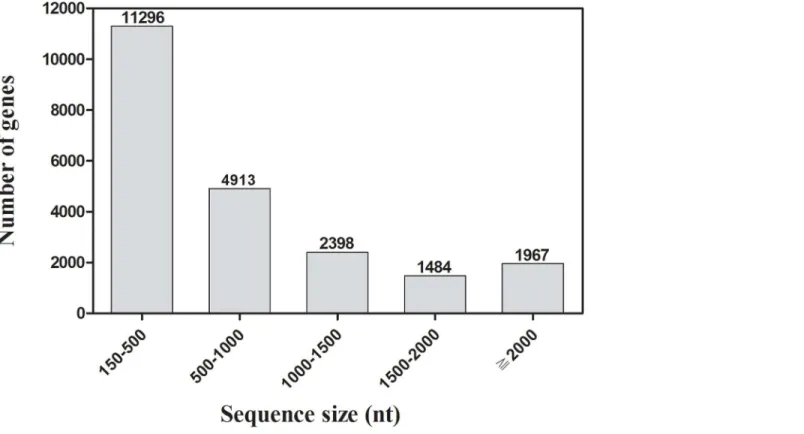
with a sequence length of more than 500 bp accounted for 48.79% of the transcriptome assem-bly (Fig 1). All the unigenes are referred to as transcripts hereafter and given a unique unigene ID.
Homology Analysis and Gene Ontology (GO) Annotation
Among 22,058 transcripts, 15,531 (70.40%) were matched by the BlastX homology search to entries in the NCBI non-redundant (nr) protein database with a cut-off E-value of 10−5. The species distribution of the best match result for each sequence is shown inFig 2. Overall, there is a strong match preference withT.castaneumgenes, comprising 69.10%. Interestingly, there was only an 18.29% similarity ofD.valensantennal transcripts to those of the congenerD. pon-derosae. However, this result does not mean that the identified transcripts inD.valensshare more similarity withT.castaneumtranscripts thanD.ponderosaetranscripts. Instead, it is like-ly due to the availability of moreT.castaneumthanD.ponderosaesequences in the NCBI pro-tein database used in the homology analysis. The propro-tein number ofT.castaneumin the NCBI database is 36,478, 1.2 times higher than that ofD.ponderosae(29,316). With more protein se-quences annotated fromD.ponderosae, we believe that more sequences inD.valenswill align to those ofD.ponderosae.
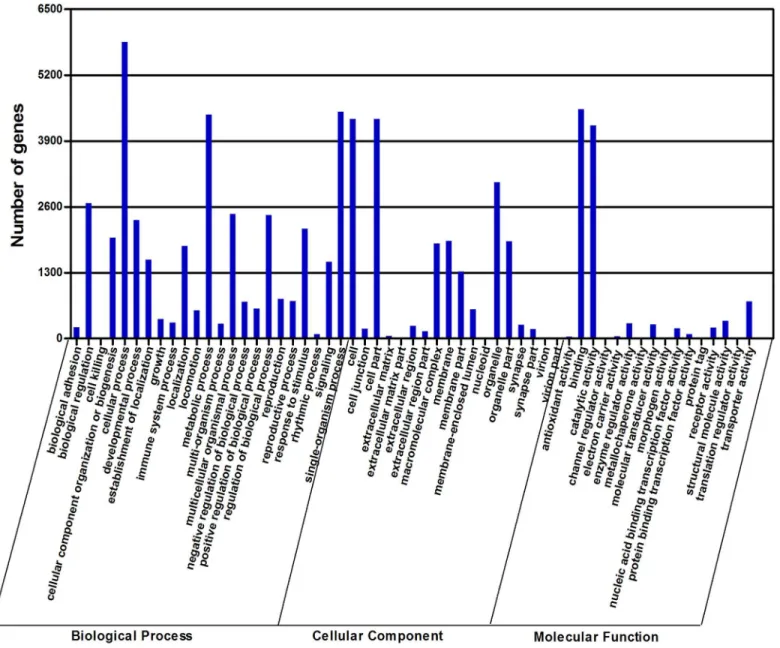
The gene functional annotation was first performed by GO annotation using Blast2GO. Of 22,058 transcripts, 8,743 (39.64%) could be annotated based on sequence homology. Because one transcript could align to more than one biological process, the 8,743 transcripts were as-signed to the biological process category (38,416 alignments), cellular component category (20,508 alignments), and molecular function category (11,016 alignments). The major GO terms associated with molecular function were binding (41.09%) and catalytic activity
Fig 1. Distribution of unigene size in theD.valenstranscriptome assembly.
(38.19%), which potentially reflects the metabolic processes of the antennal tissue (Fig 3). Cel-lular processes (15.23%), single-organism processes (11.66%), and metabolic processes
(11.50%) were the main subcategories of biological processes, indicative of the important meta-bolic activities withinD.valensantennae (Fig 3andS1 Table). Under the category of cellular components, cell (21.11%) and cell parts (21.11%) were among the most highly represented subcategories (Fig 3andS1 Table).
Identification of Putative Olfactory Genes
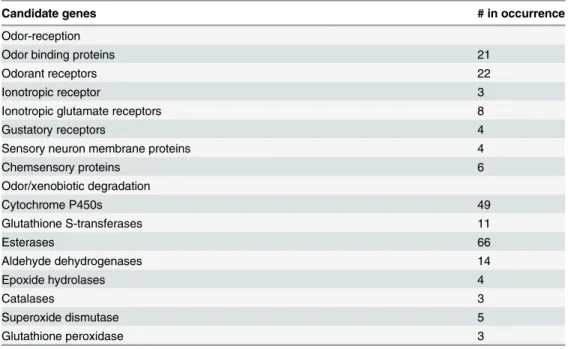
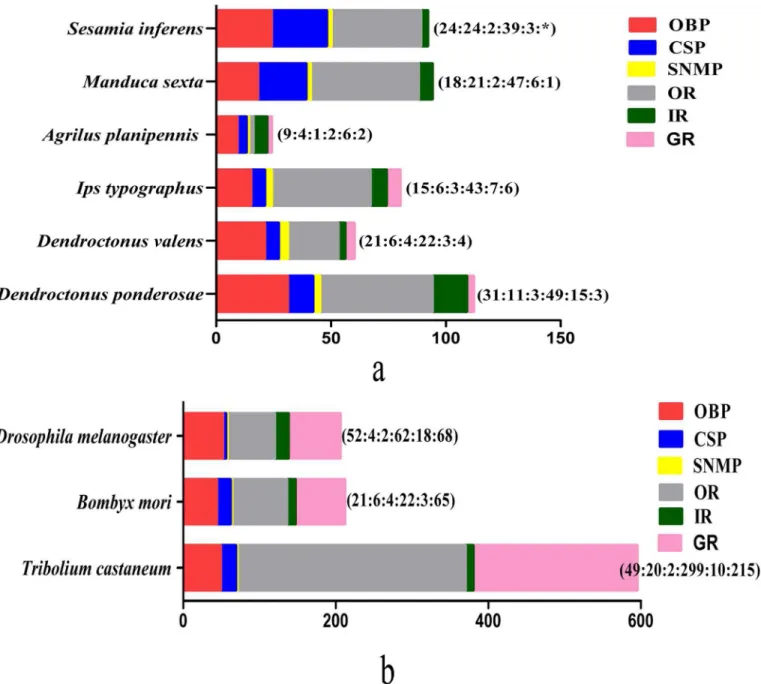
Further analysis on the transcriptome ofD.valensfocused on gene families associated with ol-factory processing. By homology analysis, we identified 68 putative odor-reception genes, in-cluding 21 OBPs, six CSPs, four SNMPs, 22 ORs, four GRs, three IRs, and eight IGluRs. As well, 155 putative odorant/xenobiotic degradation enzymes were found (Table 1). The number of major olfactory genes obtained in the current study was larger than that ofA.planipennis
[26], but less than that ofD.ponderosaeandI.typographus(Fig 4A and 4B).
Identification of Putative Odorant-binding Proteins
We identified 21 transcripts encoding putative OBPs in theD.valensantennal transcriptome. The number of putative OBP-coding genes inD.valensis less than that ofD.ponderosae(31), but more thanI.typographus(15). Sequence analysis identified 18 unigenes with a full length ORF (Open Reading Frame) with predicted signal peptide sequences (Table 2). Twenty of the 21 putative OBPs had high similarity to known coleopteran OBPs, (Table 2). DvalOBP3, 4, 7, 10, 14, 16, 18, and 21 had very high similarity with DponOBP6, 5, 4, 30, 8, 12, 19, and 18, re-spectively, with at least 95% identity (Table 2). A phylogenetic tree based on the neighbor-join-ing method is shown inFig 5. Among the 21 putative OBPs, 19 sequences were clustered with at least one coleopteran orthologous gene (Fig 5). Not surprisingly, the identified DvalOBPs se-quences were mostly clustered together with DponOBPs, and fourteen OBP orthologous pairs shared high amino acid identity (>85%) between the two species (Fig 5andTable 2). The
amino acid sequences of all OBPs are listed inS1 Fig.
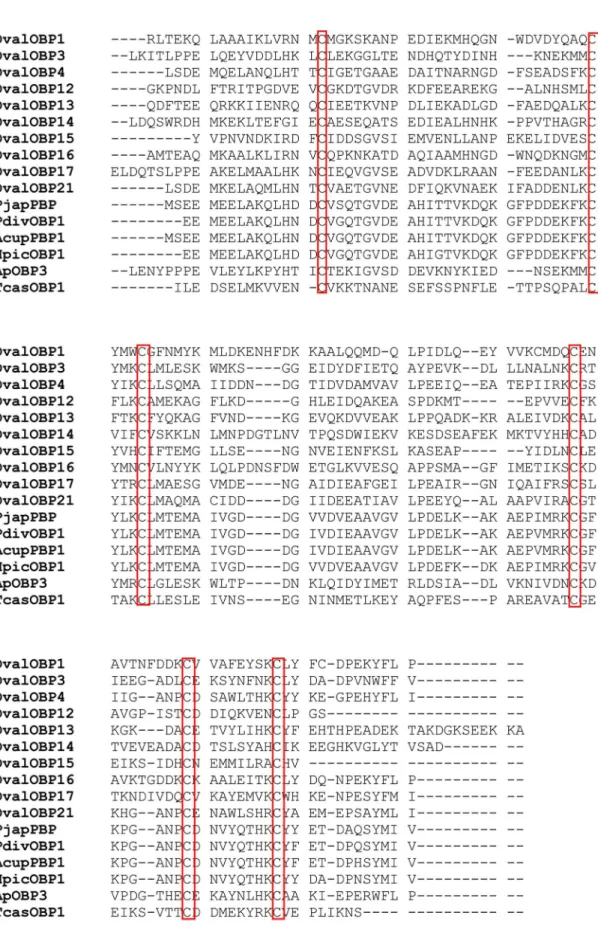
In general, OBPs are divided into different subclasses. The classic OBPs are characterized by a pattern of six conserved cysteines. Multiple amino acid sequence alignment revealed the
Fig 2. Percentage of homologous hits of theD.valenstranscripts to other insect species.TheD. valenstranscripts were searched by BlastX against the non-redundancy protein database with a cutoff E-value of 10−5. Species which have more than 0.5% matching hits to theD.valenstranscripts are shown.
conserved and defined spacing of six cysteine residues (C1-X15-39-C2-X3-C3-X21-44-C4-X7-12-C5-X8-C6;Fig 6), which are considered to form disulfide bonds that stabilize the three-di-mensional structure of the OBP [51].
The amino acid sequences used for multiple sequence alignment are listed inS2 Fig. The Plus-C class has more than 6 cysteines, whereas the Minus-C class has lost cysteine residues, generally C2 and C5. In our study, the members of the Minus-C class were DvalOBP2, 5, 6, 9, 10, 18, 19, and 20 and all of these are missing C2 and C5 cysteine residues, whereas only Dva-lOBP8 was classified as Plus-C.
Identification of Candidate Chemosensory Proteins
Bioinformatic analysis led to the identification of six different sequences encoding candidate CSPs inD.valens(Table 2), among which four sequences were predicted to be full length and
Fig 3. Gene ontology (GO) classification of theD.valenstranscripts with Blast2GO program.
all of them had a signal peptide. We compared all predicted CSPs ofD.valenswith 42 coleop-teran CSPs and two dipcoleop-teran CSPs in order to reveal the diversity of CSPs within the insect order (Fig 7). The CSPs were dispersed in different branches of the phylogenetic tree (Fig 7). Among the six candidate CSPs, five sequences were clustered together with bark beetles CSPs (Fig 7). The information of all the six CSPs is listed inTable 2. DvalCSP1, 5, and 6 had at least 94% similarity with the corresponding CSPs ofD.ponderosae(DponCSP5, 8, and 11;Table 2). The amino acid sequences of all six CSPs are listed inS3 Fig.
Identification of Putative OR/GR Superfamily Members
Within theD.valensantennal transcriptome, 22 OR candidates were identified. Among these ORs, only three identified DvalOR sequences (Dval 7, 8 and 11) had a full length ORF (Table 3). As expected, 17 of the 22 putative DvalORs shared high amino acid identity with known coleopteran ORs, and six ORs inD.valens(DvalORs1, 3, 14, 15, 16, and 17) had at least 87% similarity with corresponding ORs ofD.ponderosae(Table 3).
A phylogenetic tree of ORs based on the neighbor-joining method was constructed using protein sequences of ORs fromD.valens, two other bark beetles (I.typographus,D. pondero-sae),T.castaneum,Megacyllene caryae, andAgrilus planipennis. Eleven DvalORs were exclud-ed from analysis due to insufficiently long amino acid sequences.
ORs are divided into several subgroups of various size and content in the phylogenetic tree (Fig 8). Almost all ORs ofD.valenswere clustered with at least one bark beetle orthologous gene in the phylogenetic tree except for two ORs (DvalOR2 and DvalOR17). Among them, five ORs fromD.valenswere clustered with oneD.ponderosaeorthologous gene.
The numbering of coleopteran OR subfamilies has been standardized in previous studies [5,51], and numbered from 1 to 7. Groups 1 and 2 included OR representatives from all six spe-cies. Receptor group 3 contained ORs only fromT.castaneumandM.caryae. Receptor groups 4–6 contained ORs only fromT.castaneum. Group 7 contained 11 ORs fromM.caryae, but no ORs fromT.castaneumorA.planipennis. The results showed eight of 11 ORs fromD.valens
Table 1. Summary of candidate genes from the antennal transcriptome ofDendroctonus valens.
Candidate genes # in occurrence
Odor-reception
Odor binding proteins 21
Odorant receptors 22
Ionotropic receptor 3
Ionotropic glutamate receptors 8
Gustatory receptors 4
Sensory neuron membrane proteins 4
Chemsensory proteins 6
Odor/xenobiotic degradation
Cytochrome P450s 49
Glutathione S-transferases 11
Esterases 66
Aldehyde dehydrogenases 14
Epoxide hydrolases 4
Catalases 3
Superoxide dismutase 5
Glutathione peroxidase 3
were present within group 7. These eight DvalORs were further divided into two subgroups: group 7a and 7b. Subgroup 7b was exclusive to bark beetle species, including ORs fromD. va-lens,I.typographus, andD.ponderosae. In three groups (1, 2, and 7), we found most of the can-didate genes were grouped together with orthologs inD.ponderosaeandI.typographus. The amino acid sequences of all the 11 ORs are listed inS4 Fig.
In the OR phylogenetic tree, DvalOR2 was clustered with MacrOR1 and AplaOR83b, which are Orco homologs. In addition, a similarity search for the DvalOR1 against the non-redundant
Fig 4. The number of chemosensory genes in different insect species, obtained from antenna transcriptome (4a) or genome (4b).The digits by the histogram bars represent number of chemosensory genes in different subfamilies (OBP:CSP:SNMP:OR:IR). The data were obtained from the current study forD.valensand from references [7,20,24,91] forDrosophila melanogaster, [92] forSesamia inferens,[20,24,62,93–95] forBomby mori, [7,20,24,91] for Tribolium castaneum,[5] forI.typographusandD.ponderosae, [1] forManduca sexta, [26] forAgrilus planipennis.
Table 2. The Blastx match ofD.valensputative OBPs,CSPs and SNMPs genes.
Gene Gene ORF Complete Signal Best Blastx Match
Name ID Length
(bp)
ORF Peptide Name Acc.number Species E value Identity
(%)
Odorant Binding Protein(OBP)
OBP1 455 438 Yes 1–23 odorant-binding protein 10 AFI45063.1 [Dendroctonus ponderosae]
6.00E-95
91
OBP2 840 726 Yes 1–19 odorant-binding protein 21 AGI05159.1 [Dendroctonus ponderosae]
1.00E-120
87
OBP3 849 417 Yes 1–20 odorant-binding protein 6 AGI05177.1 [Dendroctonus ponderosae]
1.00E-75
95
OBP4 10282 408 Yes 1–19 odorant-binding protein 5 AFI45059.1 [Dendroctonus ponderosae]
2.00E-72
95
OBP5 10284 405 Yes 1–23 odorant-binding protein 22 AGI05180.1 [Dendroctonus ponderosae]
5.00E-79
93
OBP6 1456 426 Yes 1–20 odorant-binding protein 3 AGI05174.1 [Dendroctonus ponderosae]
7.00E-85
82
OBP7 14597 222 No 0 odorant-binding protein 4 AGI05167.1 [Dendroctonus ponderosae]
3.00E-52
99
OBP8 5689 522 No 0 odorant-binding protein 2 AGI05158.1 [Dendroctonus
ponderosae]
2.00E-109
94
OBP9 5818 395 Yes 1–17 odorant-binding protein 28 AGI05178.1 [Dendroctonus ponderosae]
3.00E-10
32
OBP10 7393 402 Yes 1–18 odorant-binding protein 30 AGI05176.1 [Dendroctonus ponderosae]
4.00E-77
98
OBP11 7769 507 No 0 odorant-binding protein 28 AGI05178.1 [Dendroctonus ponderosae]
9.00E-63
93
OBP12 8450 387 Yes 1–24 odorant-binding protein 31 AGI05165.1 [Dendroctonus ponderosae]
3.00E-67
93
OBP13 8460 447 Yes 1–19 odorant binding protein ADY17884.1 [Spodoptera exigua] 1.00E-16
46
OBP14 9456 475 Yes 1–27 odorant-binding protein 8 AGI05175.1 [Dendroctonus ponderosae]
1.00E-120
96
OBP15 9499 354 Yes 1–17 odorant-binding protein 16 AGI05186.1 [Dendroctonus ponderosae]
7.00E-72
91
OBP16 9616 426 Yes 1–18 odorant-binding protein 12 AFI45058.1 [Dendroctonus ponderosae]
1.00E-93
95
OBP17 9643 435 Yes 1–21 odorant-binding protein 13 AFI45057.1 [Dendroctonus ponderosae]
9.00E-83
88
OBP18 9644 426 Yes 1–18 odorant-binding protein 19 AGI05183.1 [Dendroctonus ponderosae]
1.00E-65
95
OBP19 9906 411 Yes 1–19 odorant-binding protein 29 AGI05182.1 [Dendroctonus ponderosae]
3.00E-61
94
OBP20 9965 423 Yes 1–20 odorant-binding protein 9 AGI05185.1 [Dendroctonus ponderosae]
2.00E-80
90
OBP21 9974 408 Yes 1–19 odorant-binding protein 18 AFI45062.1 [Dendroctonus ponderosae]
2.00E-71
95
Chemosensory Protein(CSP)
CSP1 10610 432 Yes 1–26 chemosensory protein5 AFI45003.1 [Dendroctonus ponderosae]
2.00E-81
94
CSP2 8762 375 Yes 1–16 chemosensory protein 1 AGI05161.1 [Dendroctonus ponderosae]
3.00E-54
90
CSP3 3805 102 No 0 chemosensory protein 2 AGI05172.1 [Dendroctonus
ponderosae]
5.00E-33
89
nucleotide (nr) database at NCBI using BlastX revealed 97% identity with the Orco homolog of
D.ponderosae(AEE62122.1,0; DponOR1;Table 3) at the nucleotide level.
Four GR candidates (GR1-4) were identified inD.valens, which is in agreement with several other recent antennal transcriptomic studies [3,5,26]. Only one of these likely represented a full-length gene (GR3). Because GRs and ORs belong to the same superfamily, both were in-cluded in the same dendrogram analysis, in which GRs formed a distinct clade (Fig 8). The in-formation of all four GRs is listed inTable 3. The amino acid sequences of all four GRs are listed inS4 Fig.
Identification of Candidate Sensory Neuron Membrane Proteins
We also found four SNMPs (Table 2) in the antennal transcriptome ofD.valens, none of which represented full-length genes. Among them, SNMP1 and SNMP1a are orthologs of SNMP1. DvalSNMP1 and DvalSNMP1a were very similar to the DponSNMP1 and
DponSNMP1a published in GenBank, with 94% and 95% identity, respectively (Table 2). The genes grouped together with orthologs inT.castaneum,I.typographus,D.ponderosae, andA.
planipennis. We found 1:1 orthologous candidate (SNMP1, SNMP1a, and SNMP2) relation-ships among the SNMPs (Fig 9). DvalSNMP was scattered in a monophyletic clade in the outer part of the tree, indicating an ancestral relationship to the rest of the tree. DvalSNMP was searched against the non-redundant nucleotide (nr) database at NCBI using BlastX (BLAST 2.2.23+, E-value<e-5), and showed 85% identity with a sensory neuron membrane protein of
D.ponderosae(GenBank accession number: AFI45067.1). The information for all four SNMPs is listed inTable 2with the amino acid sequences listed inS5 Fig.
Identification of Candidate Ionotropic Receptors
We discovered three antennal IRs from antennal transcriptome assembly inD.valens. IR1 and IR3 have high sequence similarity to the ionotropic receptor 8a ofD.ponderosae(GenBank ac-cession number: AGI05169.1) with amino acid identities of 87%, and 97%, respectively (Table 3), suggesting that IR1 and IR3 are homologs. We also identified eight ionotropic
Table 2. (Continued)
Gene Gene ORF Complete Signal Best Blastx Match
Name ID Length
(bp)
ORF Peptide Name Acc.number Species E value Identity
(%)
CSP4 168 822 Yes 1–18 chemosensory protein 6 precursor
NP_001039288.1 [Tribolium castaneum]
1.00E-49
67
CSP5 8684 423 No 0 chemosensory protein 8 AGI05164.1 [Dendroctonus
ponderosae]
2.00E-82
96
CSP6 11692 309 Yes 1–23 chemosensory protein 11 AGI05163.1 [Dendroctonus ponderosae]
3.00E-55
94
Sensory Neuron Membrane Protein(SNMP)
SNMP1 561 954 No No sensory neuron membrane
protein1
AFI45066.1 [Dendroctonus ponderosae]
0 94
SNMP1a 10985 1674 No No sensory neuron membrane protein 1a
AGI05171.1 [Dendroctonus ponderosae]
0 95
SNMP2 7572 1338 No No sensory neuron membrane
protein 2, isoform B
NP_001036593.1 [Drosophila melanogaster]
2.00E-83
35
SNMP 11087 225 No No sensory neuron membrane
protein
AFI45067.1 [Dendroctonus ponderosae]
4.00E-39
85
glutamate receptor genes (IGluR) (Table 3), likely as cell surface proteins which allow neurons to communicate with cells in the insect [20].
Identification of Candidate Odor/Xenobiotic Degradation Enzymes
A large number of odor/xenobiotic degradation genes were found within theD.valensantennal transcriptome (155). These genes are likely involved in olfaction processes. Among the odor/ xenobiotics degradation genes, the number of esterase genes (66) was the highest, followed by cytochrome P450 genes (49). Cytochrome P450s are thought to participate in detoxification, odor processing, and neuro/development functions in insects [52–55]. Esterases are thought to function in metabolic resistance and odor degradation in several insect species [56–60]. The re-maining genes identified inD.valensantennae are involved in odor/xenobiotic degradation, in-cluding glutathione S-transferases (GSTs, 11), aldehyde dehydrogenase (14), epoxide
hydrolases (four), and several antioxidants (Table 1).
Fig 5. Phylogenetic tree of putative OBPs fromDendroctonus valens(Dval),Ips typographus (Ityp),Dendroctonus ponderosae(Dpon),Tribolium castaneum(Tcas) andAgrilus planipennis(Ap).TheD.valenstranslated unigenes are shown in blue. Amino acid sequences are given inS1 Fig. The tree was constructed with MEGA5.0, using the neighbor-joining method. Values indicated at the nodes are bootstrap values based on 1000 replicates, and the bootstrap values below 50% are not shown.
Fig 6. Multiple sequences alignment of OBPs ofDendroctonus valens(Dval) with other insects OBPs.Analyses included OBPs and pheromone binding proteins (PBPs). Amino acid sequences are given inS2 Fig.
Fig 7. Phylogenetic tree of putative CSPs fromDendroctonus valens(Dval),Ips typographus(Ityp),Dendroctonus ponderosae(Dpon),Tribolium castaneum(Tcas) andDrosophila melanogaster(Dmel).TheD.valenstranslated unigenes are shown in blue. Amino acid sequences are given inS3 Fig. The tree was constructed with MEGA5.0, using the neighbor-joining method. Values indicated at the nodes are bootstrap values based on 1000 replicates, and the bootstrap values below 50% are not shown.
Table 3. The BlastX match ofD.valensputative GRs, IRs and ORs genes.
Gene Gene ORF Complete Signal Best BlastX Match
Name ID Length
(bp)
ORF Peptide Name Acc.number Species E value Identity
(%)
Gustatory Receptor(GR)
GR1 14175 396 No 0 gustatory receptor 2 NP_001161916.1 [Tribolium castaneum] 2.00E-62
73
GR2 16566 207 No 0 Gustatory receptor 21a,
putative
XP_001655150.1 [Aedes aegypti] 3.00E-26
74
GR3 2217 375 Yes 1–22 putative gustatory receptor candidate 59
EHJ69979.1 [Danaus plexippus] 2.00E-04
74
GR4 6503 576 No 0 gustatory receptor 101 EFA02934.1 [Tribolium castaneum] 5.00E-14
30
Ionotropic Receptor(IR)
IR1 11453 171 No 0 ionotropic receptor 8a AGI05169.1 [Dendroctonus
ponderosae]
3.00E-31
87
IR2 12733 264 No 0 putative ionotropic receptor IR75, partial
AFC91756.1 [Cydia pomonella] 1.00E-10
36
IR3 67 2367 No 0 ionotropic receptor 8a AGI05169.1 [Dendroctonus
ponderosae]
0 97
Odorant Receptor(OR)
OR1 11271 780 No 0 olfactory receptor AEE62122.1 [Dendroctonus
ponderosae]
0 97
OR2 40 795 No 0 odorant receptor 20 AEE63423.1 [Dendroctonus
ponderosae]
7.00E-173
77
OR3 2158 705 No 0 odorant receptor 18 AEE62488.1 [Dendroctonus
ponderosae]
1.00E-155
97
OR4 5354 789 No 0 odorant receptor XP_001651754.1 [Aedes aegypti]
2.00E-13
29
OR5 8369 528 No 0 olfactory receptor XP_001864544.1 [Culex
quinquefasciatus]
2.00E-17
32
OR6 5 723 No 0 odorant receptor 2 ACH69148.1 [Anopheles stephensi]
6.00E-06
27
OR7 13471 279 Yes 1–20 odorant receptor 10 ACH69151.1 [Anopheles stephensi] 9.00E-10
41
OR8 2313 300 Yes 1–17 odorant receptor 14 EFA09245.1 [Tribolium castaneum] 4.00E-05
42
OR9 12394 273 No 0 odorant receptor 23 AGI05173.1 [Dendroctonus
ponderosae]
8.00E-10
37
OR10 2425 171 No 0 odorant receptor 23 AGI05173.1 [Dendroctonus
ponderosae]
7.00E-10
44
OR11 2712 241 Yes 1–19 odorant receptor 23 AGI05173.1 [Dendroctonus ponderosae]
5.00E-10
39
OR12 4846 390 No 0 odorant receptor 23 AGI05173.1 [Dendroctonus
ponderosae]
8.00E-22
40
OR13 5024 179 No 0 odorant receptor 23 AGI05173.1 [Dendroctonus
ponderosae]
1.00E-12
43
OR14 2032 197 No 0 odorant receptor 10 AEE61404.1 [Dendroctonus
ponderosae]
1.00E-45
99
OR15 9058 1215 No 0 odorant receptor 38 AEE63155.1 [Dendroctonus
ponderosae]
0.00E +00
92
OR16 9393 378 No 0 odorant receptor 23 AGI05173.1 [Dendroctonus
ponderosae]
3.00E-61
87
OR17 7310 792 No 0 odorant receptor 24 AGI05166.1 [Dendroctonus
ponderosae]
4.00E-148
88
Discussion
The antennal transcriptome described here represents the first study on the repertoire of odor processing genes of the destructive and invasive red turpentine beetle,Dendroctonus valens. In this study, 21 OBPs, six CSPs, four SNMPs, 22 ORs, four GRs, three IRs, eight ionotropic gluta-mate receptors and 155 odorant/xenobiotic degradation enzymes were identified as putative ol-factory system genes. These genes are not only involved in signal detection and transduction, but also in metabolic activity. It is well known thatD.valensexploits host kairomones (such as (+)-3-carene), as well as non-host volatiles (e.g., 1-octen-3-ol, (Z)-3-hexen-1-ol, and (E )-2-hexen-1-ol) during host location, and uses aggregation pheromones and congeneric kairo-mones (trans-verbenol, myrtenol, myrtenal, and frontalin) in intra- and interspecific commu-nication [36–50]. The odor reception and odor degradation genes identified here likely play important physiological roles in these aspects ofD.valens’s biology and provide a foundation to further unravel the molecular mechanisms underlying olfaction inD.valens. Functional studies will be required to ascertain the specific role of these genes inD.valensolfaction. Fur-thermore, critical molecular targets of important semiochemicals such as (+)-3-carene,trans -verbenol, and frontalin could be identified via computational and molecular methods, such as homology modeling, molecular docking, and RNA interference (RNAi). By collating chemical and ecological knowledge with the putatively identified genes in this study, we can begin to elu-cidate the olfactory mechanisms ofD.valens.
Prior to this study, coleopteran species’odorant reception genes had been characterized from the genome ofT.castaneum[51], the antennal transcriptomes ofI.typographusandD.
ponderosae[5], and the antennal transcriptome ofA.plannipennis[26]. However coleopteran odorant degrading enzymes have received minimal study, except for the DponCYP345E2, an antenna-specific cytochrome P450 inD.ponderosae[61], and several odorant degrading en-zymes in the antennal trasncriptome ofA.plannipennis[26]. Odorant degrading enzymes are needed to quickly deactivate the odorants once the signal has been transduced so that the olfac-tory system can respond to continuing plumes of odor [2,62]. In the context of pest insect man-agement, some of these genes or their products could be targets for development of specific inhibitors that interfere with the insect’s ability to respond appropriately to olfactory cues from mates or host plants[4,5,26]. The odorant degrading genes reported here provide a significant addition to the pool of identified olfactory genes in Coleoptera, and will advance our under-standing of coleopteran olfactory molecular mechanisms.
Table 3. (Continued)
Gene Gene ORF Complete Signal Best BlastX Match
Name ID Length
(bp)
ORF Peptide Name Acc.number Species E value Identity
(%)
OR18 2992 267 No 0 odorant receptor 73 EFA05710.1 [Tribolium castaneum] 6.00E-06
35
OR19 1231 195 No 0 odorant receptor 46 EFA02901.1 [Tribolium castaneum] 6.00E-11
46
OR20 13762 705 No 0 odorant receptor 59 EEZ99171.1 [Tribolium castaneum] 2.00E-10
48
OR21 7442 357 No 0 olfactory receptor 60 NP_001155301.1 [Bombyx mori]
9.00E-13
32
OR22 313 798 No 0 odorant receptor 64 EFA10800.1 [Tribolium castaneum] 3.00E-112
59
In theD.valenstranscriptome analyzed here, 70.41% of 22,058 transcripts had homologous matches in GenBank with the cutoff value of 10−5. Among these transcripts, 39.6% of the genes were annotated on one or more GO terms by GO analyses. More than 60% of the transcripts had no GO terms, similar to what was found withManduca sexta[1],I.typographusandD.
ponderosae[5], andA.planipennis[26] This result indicates high levels of unknown processes in antennal tissue and a large number ofD.valenstranscripts that may potentially represent novel genes.
OBPs play an important role in odor processing by insects, facilitating the transport of odor-ant molecules through the sensillar lymph and serving as the liaison between the external envi-ronment and ORs [2,4]. In this study, we identified 21 transcripts encoding putative OBPs in theD.valensantennal transcriptome. Even though the number of putative OBP-coding genes inD.valensis much lower than that ofD.ponderosa(31), the majority of putative OBPs showed a high similarity to those ofD.ponderosa, and most of the OBPs ofD.valensclustered
Fig 8. Phylogenetic tree of putative ORs and GRs fromDendroctonus valens(Dval),Ips typographus(Ityp),Dendroctonus ponderosae(Dpon)and
Tribolium castaneum(Tcas).TheD.valenstranslated unigenes are shown in blue. The branch containing GRs was used as outgroup to root the tree. The different subgroups (numbered 1–7 according to [35,53], and 7a-7b) are discussed in the main text. Originally, DponOR15Fix was found within group 2 [29], as indicated here by the numbers in brackets. Amino acid sequences are given inS4 Fig. The tree was constructed with MEGA5.0, using the neighbor-joining method. Values indicated at the nodes are bootstrap values based on 1000 replicates, and the bootstrap values below 50% are not shown.
together with DponOBPs. CSPs are another more conserved class of small binding proteins which can bind pheromone compounds [6–9]. Here we identified six transcripts encoding pu-tative CSPs in theD.valensantennal transcriptome. Among the six candidate CSPs, four se-quences were clustered together with DponCSPs.Dendroctonus valensandD.ponderosaeare sympatric in North America, and the sequence similarity of olfactory-related orthologous genes is very high between the two species, suggesting that the OBPs and CSPs ofD.valens
may have similar forms of expression and function as those ofD.ponderosae. It was interesting that nearly one third of the transcripts which encoded putative OBPs and CSPs inD. pondero-saewere identified only in non-sensory tissues rather than the antennal tissues [2,4], suggesting that these proteins might have physiological functions independent of olfaction.
SNMPs are membrane proteins observed to associate with chemosensory neurons in insects [24]. There are two representatives of insect SNMPs (SNMP1 and SNMP2). To date, the gener-al mechanism of SNMP function is still poorly understood. Benton et gener-al.[22] demonstrated that SNMP1 was essential for the detection of the pheromone (Z)-11-octadecenyl acetate (a volatile male-specific fatty-acid-derived pheromone) inDrosophila melanogasterand (Z )-11-hexadecenal (a lipid-derived pheromone) inHeliothis virescens, and suggested that SNMP acts in concert with odorant receptors to capture pheromone molecules on the surface of olfac-tory dendrites, particularly pheromones with hydrophobic tails [5]. In the current antennal
Fig 9. Phylogenetic tree of putative SNMPs fromDendroctonus valens(Dval),Ips typographus(Ityp),Dendroctonus ponderosae(Dpon),Tribolium castaneum(Tcas) andDrosophila melanogaster(Dmel).TheD.valenstranslated unigenes are shown in blue. Accession numbers are given inS5 Fig. The tree was constructed with MEGA5.0, using the neighbor-joining method. Values indicated at the nodes are bootstrap values based on 1,000 replicates, and the bootstrap values below 50% are not shown.
transcriptome ofD.valens, four SNMPs were identified. Because bark beetle pheromones lack the hydrophobic tails ofD.melanogasterandHeliothis virescenspheromones, we assume that SNMPs may have an alternate functional role. The expression of antennal SNMPs inD.valens, similar toI.typographusandD.ponderosae, suggests that SNMPs may be involved in phero-mone detection by bark beetles.
The IR family contains two major groups, the conserved antennal IRs involved in olfaction and species-specific divergent IRs that are expressed in other tissues including gustatory organs [63]. We identified three IRs from antennal transcriptome assembly inD.valens. The number of IR genes inD.valensis much lower than that ofD.ponderosae(15). We could not exclude the possibility that some of transcripts were missed in our antennal transcriptome, because of the lower sequencing depth ofD.valensthan that ofD.ponderosae. Sequence alignments showed that the putativeD.valensIRs have high similarity with the known ionotropic receptor ofD.ponderosae, DponIR8a. DponIR8a belongs to the group of IR8a, which is a broadly ex-pressed co-receptor and necessary for odor responses[5]. Originally, IR8a was identified in the fruitflyD.melanogasterand it may form heteromers with another variant ionotropic receptor [64].
ORs belong to a large multigene family encoding seven transmembrane domain proteins [10,11], and are the key players in insect olfactory reception [4]. Twenty-two OR candidates were identified from theD.valensantennal transcriptome. This number is much lower than for two other bark beetles (I.typographus, 43, andD.ponderosae, 49). The lower number of re-ceptors inD.valensmay be due to technical reasons. Despite the number difference in the pu-tative OR-coding genes, the majority of DvalORs grouped together with orthologs inD.
ponderosaeandI.typographus. In agreement with previous results, we found distinct expan-sions of OR lineages in bark beetles, and the subgroup 7b was exclusive to three bark beetle spe-cies in the OR phylogenetic tree [2,5]. In addition, DvalOR1 and DvalOR2 were identified as co-receptors in theD.valensantennal transcriptome. Further function studies on DvalOR1 and DvalOR2 may help in deciphering their role inD.valensolfaction.
GRs are mostly expressed in gustatory receptor neurons in taste organs and are involved in detection of sugars, bitter compounds, and contact pheromones [2,5]. In the antennal tran-scriptome ofD.valens, four GR candidates (GR1-4) were identified. In the phylogenetic tree, Gr1, Gr 2, and Gr4 inD.valensgrouped together with ItypGR3 and DponGR3, which may function as carbon dioxide receptors, and DvalGr3 was clustered with ItypGR6, tentatively as-signed as a trehalose receptor [2,5]. So far, insect GRs have been identified as sugar receptors—
BmorGR8 ofB.mori[65] and HarmGR9 ofHelicoverpa armigera[66]—heat sensors—
DmelGR28B(D) ofD.melanogaster[67]—and carbon dioxide and bitter receptors [68]. It is therefore likely that theD.valensGRs play important roles in the detection of carbon dioxide, sugars, or bitter compounds. Future studies on GR expression patterns ofD.valensin chemo-sensory and non-chemochemo-sensory tissues (e.g. the head and maxillary palps of both sexes) will be helpful in understanding the actual roles of GRs inD.valens.
glutathione-S-transferases, and cytochrome P450s [2,57,61,69–78]. Given the diverse expres-sion and functions of these odorant degrading enzymes, identification and characterization of the enzymes specializing in odorant degradation is challenging [62]. At present, in contrast to odorant reception genes, there have been relatively few studies of odor degradation genes in in-sects. The first odorant degrading enzyme identified was an antennal-specific esterase fromA.
polyphemus(ApolSE), which could effectively degrade the acetate component of the phero-mone blend [59,60]. A glutathione-S-transferase inM.sexta(GST-msolf1) has been shown to play a key role in sex pheromone detection by inactivating the aldehyde component of the sex pheromone blend [79]. Cytochrome P450 is one of the most studied groups of detoxification enzymes linked to odorant degradation [62]. DponCYP345E2, an antenna-specific cytochrome P450 found inD.ponderosae, degrades several pine host monoterpenes [61]. This was the first P450 to be functionally characterized in insect olfaction in bark beetles. In another study, sever-al antennsever-al-specific cytochrome P450’s were found inD.valens, suggesting that these P450 genes may be involved in detoxification or odor degradation of these monoterpenes [80]. Here, we found 49 novel P450 genes in theD.valensantennal transcriptome, but their functional roles remain to be determined. Understanding the molecular mechanism(s) of signal inactiva-tion is important in fundamental biology and may lead to novel molecular targets for insect pest control [2].
Conclusions
This study reports the first antennal transcriptome analysis inDendroctonus valens. The genes reported here provide valuable insight into the molecular mechanisms of insect olfaction, and also represent possible novel targets forD.valenscontrol or management. In addition, the re-sults from our study provide the basis for a deeper understanding of coleopteran olfaction in the context of complex behavior, and information for comparative and functional genomic analyses of related species.
Recent studies have shown that the numbers of functional chemosensory receptor genes vary enormously among the genomes of different animal species [3–5]. Despite the number of chemosensory transcripts being highly variable within the Scolytinae, the putative olfactory genes inD.valensdemonstrated close similarity in sequence alignments to those of two other two bark beetles. The phylogenetic trees showed that the majority of the odor processing genes ofD.valenscluster with the analogous genes inD.ponderosae. In addition, we also found a dis-tinct species-specific expansion of OR lineages in our results.Dendroctonus valensandD. pon-derosaeare sympatric in their host range in North America, and the two species live in similar coniferous habitats and share a number of biologically relevant compounds, including host compounds, pheromone compounds and non-host volatiles (S2 Table). The low degree of spe-cies-specific diversification in chemosensory genes can be explained by the shared semiochem-ical space of the three bark beetles. Ecologsemiochem-ical adaptation and life history parameters might play important roles in shaping the olfactory gene repertoire [81]. The patterns seen in the cur-rent study likely reflect the evolutionary and ecological relatedness of these species. Further functional evidence is required to support this hypothesis.
patterns in the context of different tissues and life stages inD.valenscould provide important information on the functions of the chemosensory genes. Following that, functional studies on the chemosensory genes will help to depict the molecular mechanisms underlyingD.valens ol-factory detection from an evolutionary viewpoint.
Materials and Methods
Insect and RNA Extraction
Adults ofDendroctonus valenswere collected by Lindgren funnel traps baited with a kairo-mone lure (3-carene) inP.tabuliformisplantations at the Tunlanchuan Forest Farm (N 37° 480, E 111° 570, average elevation 1,400 m), Gujiao, Shanxi Province, China. Forest Pest Control
Station of Shanxi Province issued the permit for the field
collections (by the director, Zhenwang, Miao). About one thousand newly emerged adults (650 females and 350 males) were collected. AllD.valenswere identified using the morphologi-cal characteristics of front and elytral declivity [82] and sexed based on distinguishing charac-ters on the seventh abdominal tergite [83]. In total, 2,000 antennae from both sexes were used for RNA extraction. The antennae were cut off and immediately frozen in liquid nitrogen, and stored at—70°C until RNA extraction. The samples were homogenized using a Tissue-tearor, and total RNA was extracted using TRIzol reagent (Invitrogen) according to the
manufacturer’s instructions.
cDNA Library Construction
cDNA library construction and Illumina sequencing of the samples were performed at Beijing Genomics Institute Shenzhen, China [84]. Briefly, the mRNA was purified from 20 mg of total RNA (a mixture of RNAs from the antennae) using oligo (dT) magnetic beads and fragmented into short sequences in the presence of divalent cations at 94°C for 5 min. Then, the first-strand cDNA was generated using random hexamer-primed reverse transcription, followed by syn-thesis of the second-strand cDNA using RNaseHand DNA polymerase I. After end-repair and ligation of adaptors, the products were amplified by PCR and purified using the QIAquick PCR Purification Kit to create a cDNA library.
Transcriptome Sequencing and Assembly
The cDNA library constructed from the antennae ofDendroctonus valenswere sequenced on the Illumina HiSeq 2000 platform. Transcriptomede novoassembly was carried out using the short reads assembling program Trinity-2014 [85]. Trinity-2014 first combines reads with a certain length of overlap to form longer fragments without N (N represents unknown se-quence) to produce contigs. The reads are then mapped back to contigs, by using paired-end reads that enable identification of contigs from the same transcript and the distances between these contigs. Next, Trinity-2014 connects the contigs based on the paired-end reads for gap filling between each pair of contigs to build scaffold sequences with the least Ns. Such se-quences are defined as unigenes.
Homology Analysis and Gene Ontology (GO) Annotation
functional annotations. Then, we used the Blast2GO program [86] to get GO annotation of the unigenes, and got GO functional classification by using WEGO software [87]. The ORFs of the unigenes were predicted by using ORF finder (http://www.ncbi.nlm.nih.gov/gorf/gorf.html). The signal peptides of the protein sequences were predicted using SignalP 4.0 [88].
Sequence Alignment and Phylogenetic Analyses
The amino acid sequence alignment of the candidate OBPs, CSPs, ORs, GRs and SNMPs from
D.valensand other insect species (S1–S5Figs) were performed using ClustalX 2.0 [89]. The OBP data set contained 21 sequences fromD.valens, 11 fromIps typographus, 31 fromD. pon-derosae, 45 fromT.castaneumand nine fromA.plannenis. The CSP data set contained six se-quences fromD.valens, four fromI.typographus, seven fromD.ponderosae, 20 fromT.
castaneum, four fromA.planipennis, and two fromD.melanogaster. The SNMP data set con-tained four sequences fromD.valens, three fromI.typographus, two fromD.ponderosae, five fromT.castaneum, one fromA.planipennis, and two fromD.melanogaster. The OR data set contained 11 sequences fromD.valens, 18 fromI.typographus, 13 fromD.ponderosae, two se-quences fromA.planipennis, 36 sequences fromM.caryae, and 28 fromT.castaneum. The GR data set contained three sequences fromD.valens, three fromI.typographus, and two fromD.
ponderosae. The unrooted phylogenetic trees were constructed by MEGA5.0 [90] using the Neighbor-joining method with Poisson correction of distances. Node support was assessed using a bootstrap procedure base on 1,000 replicates.
Data Deposition
The sequences of 60 odorant reception genes (21 OBPs, six CSPs, four SNMPs, four GRs, three IRs and 22 ORs) ofD.valensantennae were submitted to the GenBank database (accession number GenBank KP736107-KP736166).
Supporting Information
S1 Fig. Amino acid sequences of OBPs used in phylogenetic analyses.
(DOCX)
S2 Fig. Amino acid sequences of OBPs used for Multiple sequence alignment.
(DOCX)
S3 Fig. Amino acid sequences of CSPs used in phylogenetic analyses.
(DOCX)
S4 Fig. Amino acid sequences of ORs and GRs used in phylogenetic analyses.
(DOCX)
S5 Fig. Amino acid sequences of SNMPs used in phylogenetic analyses.
(DOCX)
S1 Table. Gene ontology ofD.valensantennal transcriptome.
(DOCX)
S2 Table. Semiochemicals overlap within three bark beetle species.
Acknowledgments
We thank Professor Miao ZhenWang (Forest Pest Control Station of Shanxi Province) for help in collectingD.valens. The Tunlanchuan Forest Farm, Gujiao, Shanxi Province, provided logistical support in collecting insects. We thank Dr. Jocelyn Millar and R. Maxwell Collignon (University of California, Riverside), who kindly provided critical comments on early drafts. We also acknowledge two anonymous reviewers for useful comments on the submitted manuscript.
Author Contributions
Conceived and designed the experiments: XCG Y-NZ S-LD L-WZ. Performed the experiments: X-CG Y-NZ KK. Analyzed the data: X-CG Y-NZ KK S-LD L-WZ. Contributed reagents/mate-rials/analysis tools: S-LD L-WZ. Wrote the paper: X-CG Y-NZ KK S-LD L-WZ.
References
1. Grosse-Wilde E, Kuebler LS, Bucks S, Vogel H, Wicher D, Hansson BS (2011) Antennal transcriptome ofManduca sexta. Proc Natl Acad Sci U S A 108: 7449–7454. doi:10.1073/pnas.1017963108PMID:
21498690
2. Leal WS (2013) Odorant reception in insects: roles of receptors, binding proteins, and degrading en-zymes. Annu Rev Entomol 58: 373–391. doi:10.1146/annurev-ento-120811-153635PMID:23020622 3. Nishimura O, Brillada C, Yazawa S, Maffei ME, Arimura G (2012) Transcriptome pyrosequencing of the
parasitoid waspCotesia vestalis: genes involved in the antennal odorant-sensory system. PLoS One 7: e50664. doi:10.1371/journal.pone.0050664PMID:23226348
4. Liu Y, Gu S, Zhang Y, Guo Y, Wang G (2012) Candidate olfaction genes identified within the Helicov-erpa armigeraAntennal Transcriptome. PLoS One 7: e48260. doi:10.1371/journal.pone.0048260
PMID:23110222
5. Andersson MN, Grosse-Wilde E, Keeling CI, Bengtsson JM, Yuen MM, Li M, et al. (2013) Antennal tran-scriptome analysis of the chemosensory gene families in the tree killing bark beetles,Ips typographus andDendroctonus ponderosae(Coleoptera: Curculionidae: Scolytinae). BMC Genomics 14: 198. doi:
10.1186/1471-2164-14-198PMID:23517120
6. Pelosi P, Zhou JJ, Ban LP, Calvello M (2006) Soluble proteins in insect chemical communication. Cell Mol Life Sci 63: 1658–1676. PMID:16786224
7. Sanchez-Gracia A, Vieira FG, Rozas J (2009) Molecular evolution of the major chemosensory gene families in insects. Heredity (Edinb) 103: 208–216. doi:10.1038/hdy.2009.55PMID:19436326 8. Liu R, He X, Lehane S, Lehane M, Hertz-Fowler C, Berriman M, et al. (2012) Expression of
chemosen-sory proteins in the tsetse flyGlossina morsitansis related to female host-seeking behaviour. Insect Mol Biol 21: 41–48. doi:10.1111/j.1365-2583.2011.01114.xPMID:22074189
9. Briand L, Swasdipan N, Nespoulous C, Bezirard V, Blon F, Huet JC, et al. (2002) Characterization of a chemosensory protein (ASP3c) from honeybee (Apis melliferaL.) as a brood pheromone carrier. Euro-pean Journal of Biochemistry 269: 4586–4596. PMID:12230571
10. Clyne PJ, Warr CG, Freeman MR, Lessing D, Kim J, Carlson JR (1999) A novel family of divergent seven-transmembrane proteins: candidate odorant receptors inDrosophila. Neuron 22: 327–338. PMID:10069338
11. Vosshall LB, Amrein H, Morozov PS, Rzhetsky A, Axel R (1999) A spatial map of olfactory receptor ex-pression in theDrosophilaantenna. Cell 96: 725–736. PMID:10089887
12. Bengtsson JM, Trona F, Montagne N, Anfora G, Ignell R, Witzgall P, et al. (2012) Putative chemosen-sory receptors of the codling moth,Cydia pomonella, identified by antennal transcriptome analysis. PLoS One 7: e31620. doi:10.1371/journal.pone.0031620PMID:22363688
13. Wicher D, Schafer R, Bauernfeind R, Stensmyr MC, Heller R, Heinemann SH, et al. (2008) Drosophila odorant receptors are both ligand-gated and cyclic-nucleotide-activated cation channels. Nature 452: 1007–1011. doi:10.1038/nature06861PMID:18408711
14. Hallem EA, Ho MG, Carlson JR (2004) The molecular basis of odor coding in theDrosophilaantenna. Cell 117: 965–979. PMID:15210116
16. Carey AF, Wang G, Su CY, Zwiebel LJ, Carlson JR (2010) Odorant reception in the malaria mosquito Anopheles gambiae. Nature 464: 66–71. doi:10.1038/nature08834PMID:20130575
17. Hallem EA, Carlson JR (2006) Coding of odors by a receptor repertoire. Cell 125: 143–160. PMID:
16615896
18. Sakurai T, Nakagawa T, Mitsuno H, Mori H, Endo Y, Tanoue S, et al. (2004) Identification and functional characterization of a sex pheromone receptor in the silkmothBombyx mori. Proc Natl Acad Sci U S A 101: 16653–16658. PMID:15545611
19. Stensmyr MC, Dweck HK, Farhan A, Ibba I, Strutz A, Mukunda L, et al. (2012) A conserved dedicated olfactory circuit for detecting harmful microbes inDrosophila. Cell 151: 1345–1357. doi:10.1016/j.cell. 2012.09.046PMID:23217715
20. Zhang S, Zhang Z, Wang H, Kong X (2014) Antennal transcriptome analysis and comparison of olfacto-ry genes in two sympatric defoliators,Dendrolimus houiandDendrolimus kikuchii(Lepidoptera: Lasio-campidae). Insect Biochem Mol Biol 52: 69–81. doi:10.1016/j.ibmb.2014.06.006PMID:24998398 21. Rogers ME, Sun M, Lerner MR, Vogt RG (1997) Snmp-1, a novel membrane protein of olfactory
neu-rons of the silk mothAntheraea polyphemuswith homology to the CD36 family of membrane proteins. J Biol Chem 272: 14792–14799. PMID:9169446
22. Benton R, Vannice KS, Vosshall LB (2007) An essential role for a CD36-related receptor in pheromone detection inDrosophila. Nature 450: 289–293. PMID:17943085
23. Rogers ME, Krieger J, Vogt RG (2001) Antennal SNMPs (sensory neuron membrane proteins) of Lepi-doptera define a unique family of invertebrate CD36-like proteins. J Neurobiol 49: 47–61. PMID:
11536197
24. Vogt RG, Miller NE, Litvack R, Fandino RA, Sparks J, Staples J, et al. (2009) The insect SNMP gene family. Insect Biochem Mol Biol 39: 448–456. doi:10.1016/j.ibmb.2009.03.007PMID:19364529 25. Jin X, Ha TS, Smith DP (2008) SNMP is a signaling component required for pheromone sensitivity in
Drosophila. Proc Natl Acad Sci U S A 105: 10996–11001. doi:10.1073/pnas.0803309105PMID:
18653762
26. Mamidala P, Wijeratne AJ, Wijeratne S, Poland T, Qazi SS, Doucet D, et al. (2013) Identification of odor-processing genes in the emerald ash borer,Agrilus planipennis. PLoS One 8: e56555. doi:10. 1371/journal.pone.0056555PMID:23424668
27. Forstner M, Gohl T, Gondesen I, Raming K, Breer H, Krieger J (2008) Differential expression of SNMP-1 and SNMP-2 proteins in pheromone-sensitive hairs of moths. Chem Senses 33: 29SNMP-1–299. doi:10. 1093/chemse/bjm087PMID:18209018
28. Gu SH, Yang RN, Guo MB, Wang GR, Wu KM, Guo YY, et al. (2013) Molecular identification and differ-ential expression of sensory neuron membrane proteins in the antennae of the black cutworm moth Agrotis ipsilon. J Insect Physiol 59: 430–443. doi:10.1016/j.jinsphys.2013.02.003PMID:23454276 29. Liu C, Zhang J, Liu Y, Wang G, Dong S (2014) Expression of SNMP1 and SNMP2 genes in antennal
sensilla ofSpodoptera exigua(Hubner). Arch Insect Biochem Physiol 85: 114–126. doi:10.1002/arch. 21150PMID:24436214
30. Taerum SJ, Duong TA, de Beer ZW, Gillette N, Sun JH, Owen DR, et al. (2013) Large shift in symbiont assemblage in the invasive red turpentine beetle. PLoS One 8: e78126. doi:10.1371/journal.pone. 0078126PMID:24205124
31. Sun JH, Lu M, Gillette NE, Wingfield MJ (2013) Red turpentine beetle: innocuous native becomes inva-sive tree killer in China. Annu Rev Entomol 58: 293–311. doi:10.1146/annurev-ento-120811-153624
PMID:22994548
32. Yan ZL, Sun JH, Don O, Zhang ZN (2005) The red turpentine beetle,Dendroctonus valensLeConte (Scolytidae): an exotic invasive pest of pine in China. Biodivers Conserv 14: 1735–1760.
33. Li J, CG, Song Y, Wang Y, Chang B (2001) Control project on red turpentine beetle (Dendroctonus va-lens). For Pest Dis 4: 41–44.
34. Legeai F, Malpel S, Montagne N, Monsempes C, Cousserans F, Merlin C, et al. (2011) An Expressed Sequence Tag collection from the male antennae of the Noctuid mothSpodoptera littoralis: a resource for olfactory and pheromone detection research. BMC Genomics 12: 86. doi: 10.1186/1471-2164-12-86PMID:21276261
35. Allen JE, Wanner KW (2011) Asian corn borer pheromone binding protein 3, a candidate for evolving specificity to the 12-tetradecenyl acetate sex pheromone. Insect Biochem Mol Biol 41: 141–149. doi:
10.1016/j.ibmb.2010.10.005PMID:21056664
37. Rappaport NG, Owen DR, Stein JD (2001) Interruption of semiochemical-mediated attraction of Den-droctonus valens(Coleoptera: Scolytidae) and selected nontarget insects by verbenone. Environ Ento-mol 30: 837–841.
38. Sun JH, Gillette NE, Miao ZW, Kang L, Zhang ZN, Owen DR, et al. (2003) Verbenone interrupts attrac-tion to host volatiles and reduces attack onPinus tabuliformis(Pinaceae) byDendroctonus valens (Co-leoptera: Scolytidae) in the People's Republic of China. Can Entomol 135: 721–732.
39. Fettig CJ, Borys RR, Cluck DR, Smith SL (2004) Field response ofDendroctonus valens(Coleoptera: scolytidae) and a major predator,Temnochila chlorodia(Coleoptera: Trogositidae), to host kairomones and aDendroctonusspp. pheromone component. J Entomol Sci 39: 490–499.
40. Miao Z-W Zhang Z-N, Wang P-X, Guo Y-Y, Sun J-H (2004) Response of the red turpentine beetle, Den-droctonus valensLeConte (Coleoptera: Scolytidae) to host semiochemicals and its implication in man-agement. Acta Entomologica Sinica 47 47: 360–364.
41. Sun JH, Miao ZW, Zhang Z, Zhang ZN, Gillette NE (2004) Red turpentine beetle,Dendroctonus valens LeConte (Coleoptera: Scolytidae), response to host semiochemicals in China. Environ Entomol 33: 206–212.
42. Fettig CJ, Borys RR, Dabney CP, McKelvey SR, Cluck DR, Smith SL (2005) Disruption of red turpen-tine beetle attraction to baited traps by the addition of California fivespined ips pheromone components. Can Entomol 137: 748–752.
43. Zhang LW, Sun JH, Clarke SR (2006) Effects of verbenone dose and enantiomer on the interruption of response of the red turpentine beetle, Dendroctonus valens LeConte (Coleoptera: Scolytidae), to its kariomones. Environ Entomol 35: 655–660.
44. Zhang LW, Sun JH (2006) Electrophysiological and behavioral responses ofDendroctonus valens (Co-leoptera: Curculionidae: Scolytinae) to candidate pheromone components identified in hindgut extracts. Environ Entomol 35: 1232–1237.
45. Erbilgin N, Mori SR, Sun JH, Stein JD, Owen DR, Merrill LD, et al. (2007) Response to host volatiles by native and introduced populations ofDendroctonus valens(Coleoptera: Curculionidae, Scolytinae) in North America and China. J Chem Ecol 33: 131–146. PMID:17160720
46. Fettig CJ, McKelvey SR, Dabney CP, Borys RR (2007) The response ofDendroctonus valensand Temnochila chlorodiatoIps paraconfususpheromone components and verbenone. Can Entomol 139: 141–145.
47. Zhang LW, Gillette NE, Sun JH (2007) Electrophysiological and behavioral responses ofDendroctonus valensto non-host volatiles. Annals of Forest Science 64: 267–273.
48. Zhang LW, Ming L, Liu ZD, Sung JH (2007) Progress on invasion biology and chemical ecology of red turpentine beetle,Dendroctonus valens. Chinese Bulletin of Entomology 44 44: 171–178.
49. Koch SI, Groh K, Vogel H, Hansson BS, Kleineidam CJ, Grosse-Wilde E (2013) Caste-specific expres-sion patterns of immune response and chemosensory related genes in the leaf-cutting ant,Atta vollen-weideri. PLoS One 8: e81518. doi:10.1371/journal.pone.0081518PMID:24260580
50. Liu Z, Xu B, Miao Z, Sun J (2013) The pheromone frontalin and its dual function in the invasive bark beetleDendroctonus valens. Chem Senses 38: 485–495. doi:10.1093/chemse/bjt019PMID:
23629623
51. Engsontia P, Sanderson AP, Cobb M, Walden KK, Robertson HM, Brown S (2008) The red flour bee-tle's large nose: an expanded odorant receptor gene family inTribolium castaneum. Insect Biochem Mol Biol 38: 387–397. doi:10.1016/j.ibmb.2007.10.005PMID:18342245
52. Wojtasek H, Leal WS (1999) Degradation of an alkaloid pheromone from the pale-brown chafer, Phyllo-pertha diversa(Coleoptera: Scarabaeidae), by an insect olfactory cytochrome P450. FEBS Lett 458: 333–336. PMID:10570935
53. Niwa R, Matsuda T, Yoshiyama T, Namiki T, Mita K, et al. (2004) CYP306A1, a cytochrome P450 en-zyme, is essential for ecdysteroid biosynthesis in the prothoracic glands ofBombyxandDrosophila. J Biol Chem 279: 35942–35949. PMID:15197185
54. Warren JT, Petryk A, Marques G, Parvy JP, Shinoda T, Fujimoto Y, et al. (2004) Phantom encodes the 25-hydroxylase ofDrosophila melanogasterandBombyx mori: a P450 enzyme critical in ecdysone bio-synthesis. Insect Biochem Mol Biol 34: 991–1010. PMID:15350618
55. Petryk A, Warren JT, Marques G, Jarcho MP, Gilbert LI, Kahler J, et al. (2003) Shade is the Drosophila P450 enzyme that mediates the hydroxylation of ecdysone to the steroid insect molting hormone 20-hydroxyecdysone. Proc Natl Acad Sci U S A 100: 13773–13778. PMID:14610274
57. Ishida Y, Leal WS (2002) Cloning of putative odorant-degrading enzyme and integumental esterase cDNAs from the wild silkmoth,Antheraea polyphemus. Insect Biochem Mol Biol 32: 1775–1780. PMID:
12429129
58. Ishida Y, Leal WS (2008) Chiral discrimination of the Japanese beetle sex pheromone and a behavioral antagonist by a pheromone-degrading enzyme. Proc Natl Acad Sci U S A 105: 9076–9080. doi:10. 1073/pnas.0802610105PMID:18579770
59. Vogt RG, Riddiford LM, Prestwich GD (1985) Kinetic properties of a sex pheromone-degrading en-zyme: the sensillar esterase ofAntheraea polyphemus. Proc Natl Acad Sci U S A 82: 8827–8831. PMID:3001718
60. Vogt RG, Riddiford LM (1981) Pheromone binding and inactivation by moth antennae. Nature 293: 161–163. PMID:18074618
61. Keeling CI, Henderson H, Li M, Dullat HK, Ohnishi T, Bohlmann J. (2013) CYP345E2, an antenna-spe-cific cytochrome P450 from the mountain pine beetle,Dendroctonus ponderosaeHopkins, catalyses the oxidation of pine host monoterpene volatiles. Insect Biochem Mol Biol 43: 1142–1151. doi:10. 1016/j.ibmb.2013.10.001PMID:24139909
62. Younus F, Chertemps T, Pearce SL, Pandey G, Bozzolan F, Coppin CW, et al. (2014) Identification of candidate odorant degrading gene/enzyme systems in the antennal transcriptome ofDrosophila mela-nogaster. Insect Biochem Mol Biol 53: 30–43. doi:10.1016/j.ibmb.2014.07.003PMID:25038463 63. Croset V, Rytz R, Cummins SF, Budd A, Brawand D, Kaessmann H, et al. (2010) Ancient protostome
origin of chemosensory ionotropic glutamate receptors and the evolution of insect taste and olfaction. PLoS Genet 6: e1001064. doi:10.1371/journal.pgen.1001064PMID:20808886
64. Abuin L, Bargeton B, Ulbrich MH, Isacoff EY, Kellenberger S, Benton R (2011) Functional architecture of olfactory ionotropic glutamate receptors. Neuron 69: 44–60. doi:10.1016/j.neuron.2010.11.042
PMID:21220098
65. Zhang HJ, Anderson AR, Trowell SC, Luo AR, Xiang ZH, Xia QY (2011) Topological and functional characterization of an insect gustatory receptor. PLoS One 6: e24111. doi:10.1371/journal.pone. 0024111PMID:21912618
66. Xu W, Zhang HJ, Anderson A (2012) A sugar gustatory receptor identified from the foregut of cotton bollwormHelicoverpa armigera. J Chem Ecol 38: 1513–1520. doi:10.1007/s10886-012-0221-8PMID:
23224441
67. Ni L, Bronk P, Chang EC, Lowell AM, Flam JO, Panzano VC, et al. (2013) A gustatory receptor paralo-gue controls rapid warmth avoidance inDrosophila. Nature 500: 580–584. doi:10.1038/nature12390
PMID:23925112
68. Briscoe AD, Macias-Munoz A, Kozak KM, Walters JR, Yuan F, Jamie GA, et al. (2013) Female behav-iour drives expression and evolution of gustatory receptors in butterflies. PLoS Genet 9: e1003620. doi:10.1371/journal.pgen.1003620PMID:23950722
69. He P, Zhang YN, Li ZQ, Yang K, Zhu JY, Liu SJ, et al. (2014) An antennae-enriched carboxylesterase fromSpodoptera exiguadisplays degradation activity in both plant volatiles and female sex phero-mones. Insect Mol Biol 23: 475–486. doi:10.1111/imb.12095PMID:24628907
70. He P, Zhang J, Li ZQ, Zhang YN, Yang K, Dong SL, et al. (2014) Functional characterization of an an-tennal esterase from the noctuid moth,Spodoptera exigua. Arch Insect Biochem Physiol 86: 85–99. doi:10.1002/arch.21164PMID:24753123
71. He P, Li ZQ, Liu CC, Liu SJ, Dong SL (2014) Two esterases from the genusSpodopteradegrade sex pheromones and plant volatiles. Genome 57: 201–208. doi:10.1139/gen-2014-0041PMID:24955877 72. Choo YM, Pelletier J, Atungulu E, Leal WS (2013) Identification and characterization of an
antennae-specific aldehyde oxidase from the navel orangeworm. PLoS One 8: e67794. doi:10.1371/journal. pone.0067794PMID:23826341
73. Pottier MA, Bozzolan F, Chertemps T, Jacquin-Joly E, Lalouette L, Siaussat D, et al. (2012) Cyto-chrome P450s and cytoCyto-chrome P450 reductase in the olfactory organ of the cotton leafworm Spodop-tera littoralis. Insect Mol Biol 21: 568–580. doi:10.1111/j.1365-2583.2012.01160.xPMID:22984814 74. Chertemps T, Francois A, Durand N, Rosell G, Dekker T, Lucas P, et al. (2012) A carboxylesterase,
Es-terase-6, modulates sensory physiological and behavioral response dynamics to pheromone in Dro-sophila. BMC Biol 10: 56. doi:10.1186/1741-7007-10-56PMID:22715942
75. Durand N, Carot-Sans G, Bozzolan F, Rosell G, Siaussat D, Debernard S, et al. (2011) Degradation of pheromone and plant volatile components by a same odorant-degrading enzyme in the cotton leaf-worm,Spodoptera littoralis. PLoS One 6: e29147. doi:10.1371/journal.pone.0029147PMID:
76. Merlin C, Rosell G, Carot-Sans G, Francois MC, Bozzolan F, Pelletier J, et al. (2007) Antennal esterase cDNAs from two pest moths,Spodoptera littoralisandSesamia nonagrioides, potentially involved in odourant degradation. Insect Mol Biol 16: 73–81. PMID:17257210
77. Merlin C, Francois MC, Bozzolan F, Pelletier J, Jacquin-Joly E, Maibeche-Coisne M, et al. (2005) A new aldehyde oxidase selectively expressed in chemosensory organs of insects. Biochem Biophys Res Commun 332: 4–10. PMID:15896291
78. Maida R, Ziegelberger G, Kaissling KE (1995) Esterase activity in the olfactory sensilla of the silkmoth Antheraea polyphemus. Neuroreport 6: 822–824. PMID:7605955
79. Rogers ME, Jani MK, Vogt RG (1999) An olfactory-specific glutathione-S-transferase in the sphinx mothManduca sexta. J Exp Biol 202: 1625–1637. PMID:10333508
80. Lopez MF, Cano-Ramirez C, Cesar-Ayala AK, Ruiz EA, Zuniga G (2013) Diversity and expression of P450 genes fromDendroctonus valensLeConte (Curculionidae: Scolytinae) in response to different kairomones. Insect Biochem Mol Biol 43: 417–432. doi:10.1016/j.ibmb.2013.02.004PMID:23454142 81. Nei M, Niimura Y, Nozawa M (2008) The evolution of animal chemosensory receptor gene repertoires:
roles of chance and necessity. Nat Rev Genet 9: 951–963. doi:10.1038/nrg2480PMID:19002141 82. Yin HF (2000) The synopsis on morphological and biological characters ofDendroctonus valens
Le-Conte. Aata Zootaxonomica Sinica 25: 120.
83. Lyon RL (1958) A Useful Secondary Sex Character inDendroctonusBark Beetles. Can Entomol 90: 582–584.
84. Zhang G, Guo G, Hu X, Zhang Y, Li Q, Li R, et al. (2010) Deep RNA sequencing at single base-pair res-olution reveals high complexity of the rice transcriptome. Genome Res 20: 646–654. doi:10.1101/gr. 100677.109PMID:20305017
85. Li R, Zhu H, Ruan J, Qian W, Fang X, Shi Z, et al. (2010) De novo assembly of human genomes with massively parallel short read sequencing. Genome Res 20: 265–272. doi:10.1101/gr.097261.109
PMID:20019144
86. Gress JC, Robertson HM, Weaver DK, Dlakic M, Wanner KW (2013) Odorant receptors of a primitive hymenopteran pest, the wheat stem sawfly. Insect Mol Biol 22: 659–667. doi:10.1111/imb.12053
PMID:23964849
87. Wheeler DL, Barrett T, Benson DA, Bryant SH, Canese K, Chetvernin V, et al. (2007) Database re-sources of the National Center for Biotechnology Information. Nucleic Acids Res 35: D5–12. PMID:
17170002
88. Petersen TN, Brunak S, von Heijne G, Nielsen H (2011) SignalP 4.0: discriminating signal peptides from transmembrane regions. Nat Methods 8: 785–786. doi:10.1038/nmeth.1701PMID:21959131 89. Larkin MA, Blackshields G, Brown NP, Chenna R, McGettigan PA, McWilliam H, et al. (2007) Clustal W
and Clustal X version 2.0. Bioinformatics 23: 2947–2948. PMID:17846036
90. Tamura K, Peterson D, Peterson N, Stecher G, Nei M, Kumar S. (2011) MEGA5: molecular evolution-ary genetics analysis using maximum likelihood, evolutionevolution-ary distance, and maximum parsimony meth-ods. Mol Biol Evol 28: 2731–2739. doi:10.1093/molbev/msr121PMID:21546353
91. Chen H, Lin L, Xie M, Zhang G, Su W (2014) De novo sequencing, assembly and characterization of antennal transcriptome ofAnomala corpulentaMotschulsky (Coleoptera: Rutelidae). PLoS One 9: e114238. doi:10.1371/journal.pone.0114238PMID:25461610
92. Zhang YN, Jin JY, Jin R, Xia YH, Zhou JJ, Deng JY, et al. (2013) Differential expression patterns in che-mosensory and non-cheche-mosensory tissues of putative cheche-mosensory genes identified by transcrip-tome analysis of insect pest the purple stem borerSesamia inferens(Walker). PLoS One 8: e69715. doi:10.1371/journal.pone.0069715PMID:23894529
93. Menuz K, Larter NK, Park J, Carlson JR (2014) An RNA-seq screen of theDrosophilaantenna identifies a transporter necessary for ammonia detection. PLoS Genet 10: e1004810. doi:10.1371/journal.pgen. 1004810PMID:25412082
94. Chandler JC, Aizen J, Elizur A, Hollander-Cohen L, Battaglene S, Ventura T (2014) Discovery of a novel insulin-like peptide and insulin binding proteins in the Eastern rock lobsterSagmariasus verreauxi. Gen Comp Endocrinol.