Copyright: Wyższa Szkoła Logistyki, Poznań, Polska
> Scientific Journal of Logistics <
http://www.logforum.net p-ISSN 1895-2038 e-ISSN 1734-459X
LOGISTICS
POTENTIALS
IN
BUSINESS
COMPETITIVE
ADVANTAGE CREATION
Rafał Matwiejczuk
Opole University, Opole, Poland
ABSTRACT. Background: Companies constantly search for ways to achieve and sustain long-term competitive advantage. Among the factors influencing the competitive advantage creation there are so called logistics potentials, which constitute a component part of a business strategic potentials. Logistics resources, logistics capabilities and logistics competences are the main components of the logistics potentials structure and hierarchy.
Methods: In order to recognize the logistics potentials which determine the competitive advantage creation one may use the assumptions and elements of contemporary management concepts, including strategic management. In particular the article deals with Resource-Based View (RBV), Dynamic Capabilities Concept (DCC) and - first of all - Competence-Based Management (CBM).
Results and conclusions: Several significant research projects have presented a wide scope and a large number of possibilities of logistics potentials (and logistics competences in particular) influence on business competitive advantage creation. The article briefly presents the research results conducted by: (1) Michigan State University (USA), (2) European Logistics Association (ELA) in cooperation with A.T. Kearney, (3) Computer Sciences Corporation and (4) Capgemini. The research results have pointed out to differentiated but at the same distinctive symptoms of logistics competences influence on competitive advantage creation. The article also refers to the results of the research carried out by the Chair of Logistics & Marketing at Opole University (Poland) in companies operating in Poland. The research has been mainly dealing with the significance of logistics competences in competitive advantage creation.
Key words: logistics, competitive advantage, potentials, resources, capabilities, competences.
INTRODUCTION
Firms constantly aim at gaining and maintaining competitive advantage. Such advantage seems to be the central "point of interest" within contemporary strategic management. In competitive advantage creation the key role is assigned to so called "business success potentials", also referred to as "strategic potentials of business success". In general, the potentials may be understood as factors influencing business success [Blaik, Matwiejczuk 2011]. The most important symptom of the success is when the firm reaches the expected market outcomes (for example: market share, customer satisfaction,
customer loyalty) and economic outcomes (for example: profit, profitability, ROA, ROE, ROI, EVA). The outcomes are related to competitive advantage.
STRATEGIC MANAGEMENT AS A
BASIS OF BUSINESS SUCCESS
POTENTIALS DEVELOPMENT
Among different fields and disciplines of management sciences, a key role is assigned to strategic management due to its practical aspects and matters [Kaleta 2008]. Many practical aspects of strategic management are related to managers' expectations formulation, connected with proposals and solutions leading to a firm's expected market and economic outcomes achievement and business competitive advantage creation.
The majority of authors distinguish two basic approaches to a firm strategy - resource oriented approach, based on business success potentials (resources, capabilities, and competences) and positioning approach, based on competitive position of a firm within the market. P. Huovinen [2008] enumerates a more detailed proposition of contemporary approaches within strategic management field:
− Porterian value chain concept,
− Resource-based approach,
− Competence-based management,
− Knowledge-based management,
− Organization-based management,
− Process-based management,
− Dynamism-based management,
− Evolutionary approach.
Business success potentials which influence competitive advantage creation are widely presented especially within three superior strategic management concepts: Resource Based View (RBV), Dynamic Capabilities Concept (DCC) and Competence Based Management (CBM).
HIERARCHY OF BUSINESS
SUCCESS POTENTIALS AS
FACTORS INFLUENCING
COMPETITIVE ADVANTAGE
CREATION (BASED ON RBV, DCC
AND CBM CONCEPTS)
According to RBV concept, sustained competitive advantage achievement depends particularly on resources and capabilities of
their exploitation in relation to assumed goals [Barney, Clark 2007]. Resources, generally understood as tangible and intangible assets, occupy the lowest (first) level in the hierarchy of business success potentials. Such assets ensure business tasks performance and result in assumed goals achievement related to competitive advantage creation [Sanchez, Heene 2004]. Resources which are particularly important in achieving competitive advantage are referred to as key resources. J. Barney [1991] suggests that key resources have to be valuable, rare, difficult to imitate and non-substitutable.
DCC concept emphasises the key importance of dynamic business capabilities in competitive advantage creation. The capabilities, which occupy the medium (second) level in the hierarchy of business success potentials, make it possible to acquire, integrate and reconfigure the resources and to adjust a firm to market changes. Dynamic capabilities involve strategically important processes, activities and mechanisms, which enable a firm to create new resources configurations within new markets emergence, their differentiation, development and decline [Eisenhardt, Martin 2000]. Dynamic capabilities determine the creation, integration and reconfiguration of operational capabilities connected with securing current tasks performance [Teece, Pisano, Shuen 1997] and create premises and possibilities of business success. It may be said that within DCC concept, the most important sources of competitive advantage are assigned not just to business (firm) resources, but to firm capabilities of their use and effective exploitation (business dynamic capabilities).
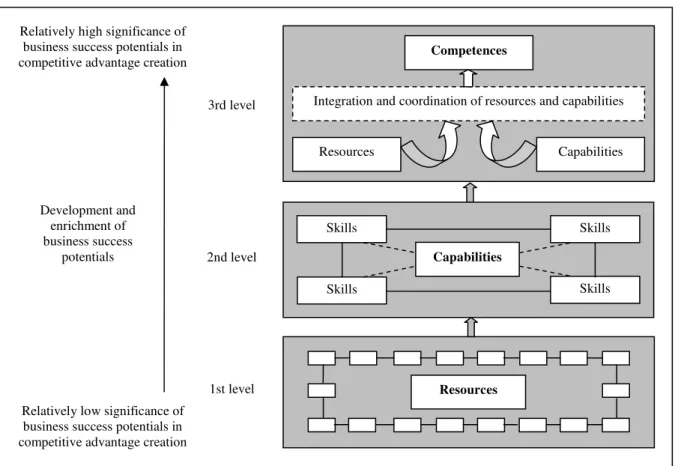
Competences integrate firm resources with capabilities of their exploitation, accounting for the highest (third) level in the hierarchy of business success potentials which influence
competitive advantage creation (figure 1) [Matwiejczuk 2011d].
Source: Own concept based on: Day, Wensley 1988; Javidan 1998; Prockl 2007.
Fig. 1. Hierarchy levels of business success potentials in the context of competitive advantage creation
Rys. 1. Poziomy hierarchii potencjałów sukcesu przedsiębiorstwa w kontekście tworzenia przewagi konkurencyjnej
As presented at figure 1, the hierarchy of business success potentials comprises the following components situated at three levels: resources (level 1), capabilities (level 2), and competences (level 3). Such components may be referred to as "strategic profile of business success potentials". The profile involves many detailed factors (types of resources, capabilities, and competences) influencing competitive advantage creation. Apart from "normative" factors concerning general business management, one may distinguish several "functional" types of factors determining competitive advantage. One of such areas is contemporary logistics.
LOGISTICS POTENTIALS AS
COMPONENTS OF STRATEGIC
PROFILE OF BUSINESS SUCCESS
POTENTIALS
A. Sennheiser and M. Schnetzler [2008], who use the term "logistics potentials of outcomes", define the potentials as specific resources and capabilities in the logistics or even supply chain management area. A firm can exploit and / or develop these potentials in the long run in order to achieve sustained and significant outcomes within logistics / supply chain management area.
According to P. J. Daugherty et al. [2009], logistics resources may be perceived as
Resources Competences
Resources Capabilities
Integration and coordination of resources and capabilities
Skills Skills
Skills Skills
Capabilities Development and
enrichment of business success
potentials
1st level 3rd level
2nd level
business strengths, exploited in competitive strategy development leading to sustained competitive advantage. Key logistics resources are important parts of logistics system. They are of higher value compared to other resources. This value depends on the level of inputs which are necessary to acquire and develop the resources. Such value is also related to the level of logistics service. In this sense logistics resources may be a significant source of sustained, long-term competitive advantage.
As to logistics capabilities, likewise "general" business capabilities, one may say about dynamic capabilities within logistics area [Matwiejczuk 2011c]. Dynamic logistics capabilities tend to exploit not only the existing business potentials, but also their long-term formation and development. Such capabilities may be then perceived as "drivers" of changes related to both business management system as well as market system. Dynamic logistics capabilities make it possible to efficiently and effectively exploit firm resources and firm operational capabilities, by means of "creating" their new and innovative
configurations, ensuring better changes adjustment. Integration and coordination of logistics resources and logistics capabilities enable, finally, formation and development of logistics competences which may have significant influence on competitive advantage creation.
LOGISTICS COMPETENCES AS
BUSINESS SUCCESS POTENTIALS
INFLUENCING COMPETITIVE
ADVANTAGE CREATION IN THE
LIGHT OF RESEARCH STUDIES
Logistics competences and their influence on competitive advantage creation have been the subject of several interesting research studies. Among them there is the research carried out by: (1) Michigan State University (MSU) /in two editions: 1995 and 1999/, (2) European Logistics Association in cooperation with A.T. Kearney (ELA/A.T. Kearney), (3) Computer Sciences Corporation (CSC) and (4) Capgemini (table 1).
Table 1. Logistics competences in world-wide research studies Tabela 1. Kompetencje logistyki w badaniach światowych
Logistics competences MSU 1995 MSU 1999 ELA / A.T.
Kearney CSC Capgemini 1. Logistics positioning and integration within
business management 2. Integration with suppliers
3. Integration with distribution companies
4. Integration with customers
5. Internal integration
6. Agility (adaptability and flexibility)
7. Flow leaness and transparency
8. Logistics processes
9. Order management
10. Information systems and technologies
Logistics competences presented in relatively wide scope within world-wide research studies
Logistics competences presented in relatively narrow scope within world-wide research studies
The above research studies have confirmed relatively differentiated, but - in general - positive impact of complex logistics competences on business success and competitive advantage creation [Matwiejczuk 2011a, Matwiejczuk 2011b]. The world-wide research results have been a basis of research on logistics competences as factors influencing business competitive advantage carried out at Chair of Logistics and Marketing at Opole University, Poland. (The research has been carried out by author during 2012 using CAWI (Computer Assisted Web Interview), CATI (Computer Assisted Telephone Interview), and CAPI (Computer Assisted Personal Interview)
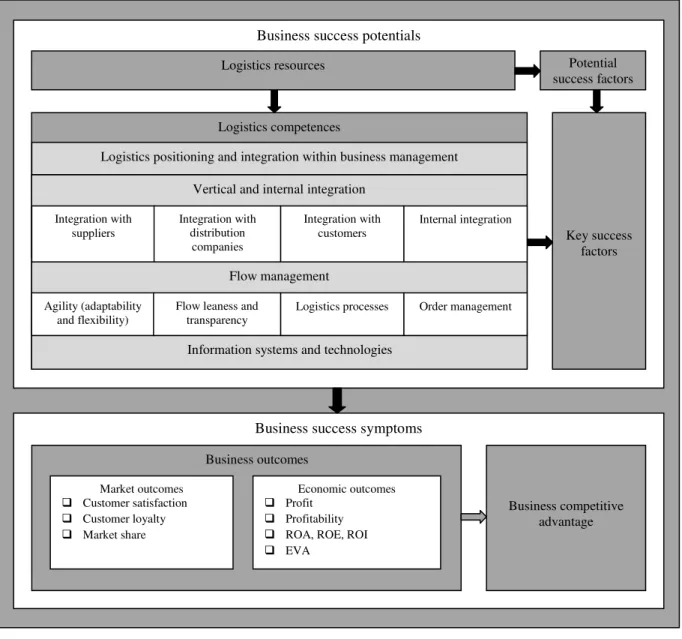
methods. The sample comprised 62 firms representing the following lines of business (sectors): mining and extraction mining (1 firm), industrial processing (19), media production and delivery - energy, gas, etc. (2), building engineering (3), commerce (21), transport and warehousing (7), accommodation and catering (2), information and communication (7)). The most significant result of the research has been the original model of business success potentials and symptoms with highlighted role of logistics competences influencing competitive advantage creation (figure 2).
Fig. 2. Logistics competences within the model of business success potentials and symptoms Rys. 2. Kompetencje logistyki w modelu potencjałów i wyznaczników sukcesu przedsiębiorstwa
Business success potentials
Business success symptoms
Potential success factors
Key success factors Logistics resources
Logistics competences
Logistics positioning and integration within business management Vertical and internal integration
Flow management
Information systems and technologies
Integration with suppliers
Integration with distribution companies
Integration with customers
Internal integration
Agility (adaptability and flexibility)
Flow leaness and transparency
Logistics processes Order management
Business outcomes
Business competitive advantage
Market outcomes Customer satisfaction Customer loyalty Market share
Economic outcomes Profit
Firstly, four key (superior) logistics competences have been distinguished. They may vary significantly contribute to business competitive advantage creation. These competences are as follows:
1. Logistics positioning and integration within business management,
2. Vertical and internal integration, 3. Flow management,
4. Information systems and technologies.
Within logistics competences concerning vertical and internal integration there are: 1. Integration with suppliers,
2. Integration with distribution companies, 3. Integration with customers,
4. Internal integration (integration within the firm).
As to logistics competences within flow management, the following competences have been specified:
1. Agility, comprising adaptability and flexibility,
2. Flow leanness and transparency, 3. Logistics processes,
4. Order management.
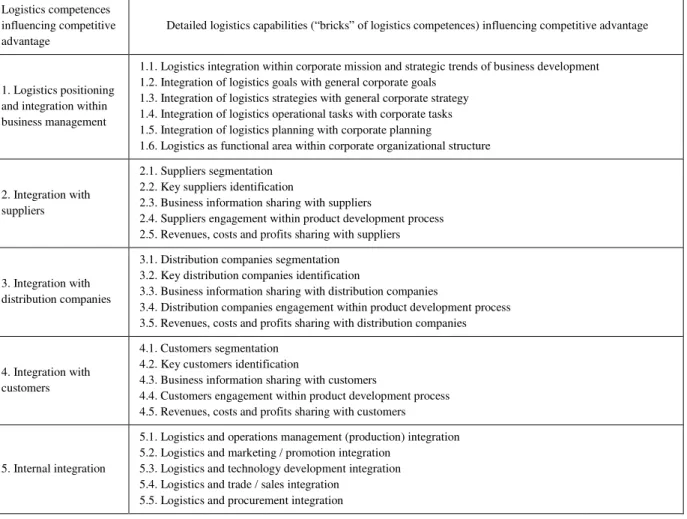
In the next step, the mentioned (ten) groups of logistics competences have been detailed into itemized logistics capabilities influencing business competitive advantage creation (table 2).
Table 2. Structure of logistics competences (detailed logistics capabilities) influencing business competitive advantage creation Tabela 2. Strukturyzacja kompetencji logistyki (szczegółowe zdolności logistyczne) wpływających na tworzenie przewagi
konkurencyjnej przedsiębiorstwa
Logistics competences influencing competitive advantage
Detailed logistics capabilities (“bricks” of logistics competences) influencing competitive advantage
1. Logistics positioning and integration within business management
1.1. Logistics integration within corporate mission and strategic trends of business development 1.2. Integration of logistics goals with general corporate goals
1.3. Integration of logistics strategies with general corporate strategy 1.4. Integration of logistics operational tasks with corporate tasks 1.5. Integration of logistics planning with corporate planning
1.6. Logistics as functional area within corporate organizational structure
2. Integration with suppliers
2.1. Suppliers segmentation 2.2. Key suppliers identification
2.3. Business information sharing with suppliers
2.4. Suppliers engagement within product development process 2.5. Revenues, costs and profits sharing with suppliers
3. Integration with distribution companies
3.1. Distribution companies segmentation 3.2. Key distribution companies identification
3.3. Business information sharing with distribution companies
3.4. Distribution companies engagement within product development process 3.5. Revenues, costs and profits sharing with distribution companies
4. Integration with customers
4.1. Customers segmentation 4.2. Key customers identification
4.3. Business information sharing with customers
4.4. Customers engagement within product development process 4.5. Revenues, costs and profits sharing with customers
5. Internal integration
5.1. Logistics and operations management (production) integration 5.2. Logistics and marketing / promotion integration
5.3. Logistics and technology development integration 5.4. Logistics and trade / sales integration
Logistics competences influencing competitive advantage
Detailed logistics capabilities (“bricks” of logistics competences) influencing competitive advantage
6. Agility (adaptability and flexibility)
6.1. Monitoring / identification of suppliers’ needs and expectations
6.2. Monitoring / identification of distribution companies needs and expectations 6.3. Monitoring / identification of customers’ needs and expectations
6.4. Suppliers service care
6.5. Distribution companies service care 6.6. Customers service care
6.7. Suppliers’ unique order execution
6.8. Distribution companies unique order execution 6.9. Customers’ unique order execution
7. Flow leaness and transparency
7.1. Value creation streams flowgistics 7.2. Value creation processes / tasks focusing 7.3. Non-value creation processes / tasks outsourcing 7.4. Raw materials and materials stock monitoring 7.5. Products (finished goods) stock monitoring
8. Logistics processes
8.1. Transportation management (TMS) 8.2. Warehousing management (WMS)
8.3. Handling, packaging and labeling management 8.4. Inventory management
8.5. Raw materials and materials supply management 8.6. Distribution management
8.7. Reverse flow management
9. Order management
9.1. Reliability of supply (delivery) 9.2. On-time supply (delivery) 9.3. Completeness of supply (delivery) 9.4. Accuracy of supply (delivery) 9.5. Flowgistics of supply (delivery) 9.6. Speed of supply (delivery) 9.7. Flexibility of supply (delivery)
10. Information systems and technologies
10.1. Material Requirements Planning (MRP) 10.2. Manufacturing Resource Planning (MRP II) 10.3. Distribution Resource Planning (DRP) 10.4. Enterprise Resource Planning (ERP) 10.5. Electronic Data Interchange (EDI)
10.6. Radio-Frequency Identification (RFID) technology and systems
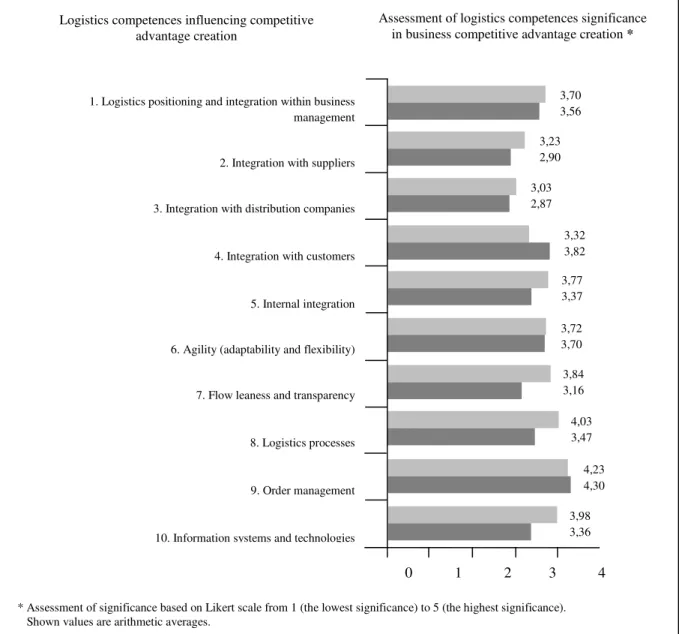
The aim of the research conducted by the author within the Chair of Logistics and Marketing research studies has been an attempt to evaluate logistics competences significance in business competitive advantage creation. Every time the evaluation has been related to two basic dimensions of competitive advantage: (1) competitive advantage achieved through focusing on costs (cost leadership) and (2) competitive advantage achieved through focusing on customer service (creation and delivering of unique value for customers) (figure 3).
The research results have mostly confirmed the significant importance of logistics competences as potentials of a business
competitive advantage creation. According to firms (managers) which (who) took part in the research, logistics competences concerning customers' orders management are the most important factors influencing competitive advantage creation. These competences contribute to both: competitive advantage based on cost leadership, as well as competitive advantage based on customer service.
Source: Own concept based on conducted empirical research
Fig. 3. The significance of logistics competences in business competitive advantage creation in the light of research conducted in firms operating in Poland
Rys. 3. Znaczenie kompetencji logistyki w tworzeniu przewagi konkurencyjnej przedsiębiorstwa w świetle badań w przedsiębiorstwach w Polsce
FURTHER RESEARCH
The purpose of further research will be a more detailed identification of premises and possibilities concerning logistics potentials influence on competitive advantage creation. Logistics resources as potential business
success factors and logistics capabilities as well as logistics competences as key (superior) business success factors require deeper and more comprehensive assessment. Such assessment could lead to better embedding of logistics potentials (i.e. resources, capabilities and competences) within strategic management area, and especially within competitive advantage creation problems.
1. Logistics positioning and integration within business management
2. Integration with suppliers
3. Integration with distribution companies
4. Integration with customers
5. Internal integration
6. Agility (adaptability and flexibility)
7. Flow leaness and transparency
8. Logistics processes
9. Order management
10. Information systems and technologies
3,70 3,56
Assessment of logistics competences significance in business competitive advantage creation * Logistics competences influencing competitive
advantage creation
Competitive advantage based on costs
Competitive advantage based on customer service
3,23 2,90
3,03 2,87
3,72 3,70 3,32 3,82
3,77 3,37
3,84 3,16
4,03 3,47
4,23 4,30
3,98 3,36
* Assessment of significance based on Likert scale from 1 (the lowest significance) to 5 (the highest significance). Shown values are arithmetic averages.
REFERENCES
Barney J.B., 1991, Firm Resources and Sustained Competitive Advantage, Journal of Management, 17, 1, 99-120.
Barney J.B., Clark D.N., 2007, Resource-Based Theory. Creating and Sustaining Competitive Advantage, Oxford University Press Inc., New York.
Blaik P., Bruska A., Kauf S., Matwiejczuk R., 2013, Logistyka w systemie zarządzania przedsiębiorstwem. Relacje i kierunki zmian [Logistics within Business Management System. Relationships and Trends of Changes], PWE, Warszawa.
Blaik P., Matwiejczuk R., 2011, Kompetencje logistyki jako potencjały sukcesu rynkowego przedsiębiorstwa [Logistics Competences as Potentials of Business Market Success], [in:] Wybory strategiczne w przedsiębiorstwach. Strategie funkcjonalne [Strategic Choices in Firms. Functional Strategies], (edited by) E. Urbanowska-Sojkin, Zeszyty Naukowe Uniwersytetu Ekonomicznego w Poznaniu, No.172, Wydawnictwo Uniwersytetu Eko-nomicznego w Poznaniu, Poznań, 21-30.
Daugherty P.J., Chen H., Mattioda D.D., Grawe S. J., 2009, Marketing/Logistics Relationships: Influence on Capabilities and Performance, Journal of Business Logistics, 30, 1, 1-18.
Day G.S., Wensley R., 1988, Assessing Advantage: A Framework of Diagnosing Competitive Superiority, Journal of Marketing, 52, 2, 1-20.
Eisenhardt K.M., Martin J.A., 2000, Dynamic Capabilities: What Are They?, Strategic Management Journal, 21, 10/11, 1105-1121.
Huovinen P., 2008, Platform for Advancing Research in Competence-Based Business Management: A Population of 84 Concepts Published Between the Years 1990-2002, [in:] A Focused Issue on Fundamental Issues in Competence Theory Development, (edited by) R. Sanchez, Research in Competence-Based Management, 4, Emerald Group Publishing Ltd., Bingley, 175-218.
Javidan M., 1998, Core Competence: What Does it Mean in Practice?, Long Range Planning, 31, 1, 60-71.
Kaleta A., 2008, Wstęp [Introduction], [in:] Zarządzanie strategiczne w badaniach teoretycznych i w praktyce [Strategic Management in Theoretical Research and Practice], (edited by) A. Kaleta, K. Moszkowicz, Prace Naukowe Uniwersytetu Ekonomicznego we Wrocławiu, 20, Wrocław, 11-12.
Matwiejczuk R., 2011a, Kompetencje logistyki i łańcucha dostaw w świetle badań (cz. I) [Logistics and Supply Chain Competences in the Light of Research Studies (part I)], Gospodarka Materiałowa i Logistyka, 3, 18-23.
Matwiejczuk R., 2011b, Kompetencje logistyki i łańcucha dostaw w świetle badań (cz. II) [Logistics and Supply Chain Competences in the Light of Research Studies (part II)], Gospodarka Materiałowa i Logistyka, 4, 19-26.
Matwiejczuk R., 2011c, The Meaning of Logistics Capabilities in Achieving the Market Success by A Company, LogForum, 7, 4, 4.
Matwiejczuk R., 2011d, Zasoby oraz zdolności i kompetencje przedsiębiorstwa w two-rzeniu przewagi konkurencyjnej [Firm Resources and Capabilities & Competences in Competitive Advantage Creation], Przegląd Organizacji, 4, 32-35.
Matwiejczuk R., 2012a, The Influence of Logistics Potentials on Business Management, LogForum, 8, 3, 3.
Matwiejczuk R., 2012b, Wpływ kompetencji łańcucha dostaw na tworzenie przewagi konkurencyjnej w świetle badań Computer Sciences Corporation [Supply Chain Competences Impact on Competitive Advantage Creation in the Light of the Research Conducted by Computer Sciences Corporation], Gospodarka Materiałowa i Logistyka, 11, 7-14.
and Practical Action], Deutscher Universitäts Verlag/GWV Fachverlage, Wiesbaden.
Sanchez R., Heene A., 2004, The New Strategic Management. Organization, Competition, and Competence, John Wiley & Sons, Inc., New York.
Sennheiser A., Schnetzler M., 2008, Wertorientiertes Supply Chain Management
[Value-Based Supply Chain Management], Springer Verlag, Berlin - Heidelberg - New York.
Teece D. J., Pisano G., Shuen A., 1997, Dynamic Capabilities and Strategic Management, Strategic Management Journal, 18, 7, 509-533.
POTENCJAŁY
LOGISTYKI
W
TWORZENIU
PRZEWAGI
KONKURENCYJNEJ PRZEDSI
Ę
BIORSTWA
STRESZCZENIE. Wstęp: Przedsiębiorstwa stale poszukują sposobów osiągania i utrzymywania przewagi konkurencyjnej na rynku. Wśród czynników determinujących tworzenie tej przewagi można wy-mienić m.in. tzw. potencjały logistyki, stanowiące część składową potencjału strategicznego przedsiębiorstwa. Strukturę i - jednocześnie - hierarchię potencjałów logistyki tworzą w kolejności: (1) zasoby logistyczne, (2) zdolności logistyczne oraz (3) kompetencje logistyki.
Metody: W celu rozpoznania potencjałów logistyki determinujących tworzenie przewagi konkurencyjnej warto wykorzystać założenia i elementy współczesnych koncepcji zarządzania, w tym zwłaszcza zarządzania strategicznego. Szczególną rolę w świetle problematyki niniejszego artykułu można przypisać koncepcji zasobowej, koncepcji dynamicznych zdolności oraz - przede wszystkim - koncepcji zarządzania opierającego się na kompetencjach.
Wyniki i wnioski: Zakres oraz możliwości oddziaływania potencjałów - w tym zwłaszcza kompetencji - logistyki na tworzenie przewagi konkurencyjnej przedsiębiorstwa przedstawiono jak dotąd m.in. w kilku znaczących projektach badawczych. Zaprezentowane syntetycznie w niniejszym artykule wyniki badań przeprowadzonych przez Michigan State University, European Logistics Association we współpracy z A.T. Kearney, Computer Sciences Corporation oraz Capgemini, wskazały na zróżnicowane, ale jednocześnie wyraźne przejawy oddziaływania kompetencji logistyki na tworzenie przewagi konkurencyjnej przedsiębiorstwa. W artykule odniesiono się również do rezultatów badań Katedry Logistyki i Marketingu Uniwersytetu Opolskiego przeprowadzonych w przedsiębiorstwach w Polsce, dotyczących znaczenia kompetencji logistyki w tworzeniu przewagi konkurencyjnej..
Słowa kluczowe:logistyka, przewaga konkurencyjna, potencjały, zasoby, zdolności, kompetencje.
LOGISTIKPOTENTIALE
IN
DER
BILDUNG
DES
KONKURRENZVORSPRUNGS DES UNTERNEHMENS
ZUSAMMENFASSUNG. Einleitung: Die Unternehmen suchen ständig nach Art und Weise, den Konkurrenzvorsprung auf dem Markt zu erreichen und zu erhalten. Unter den diesen Vorsprung determinierenden Faktoren kann man u.a. die s.g. Logistikpotentiale nennen, die den Bestandteil des strategischen Unternehmenspotentials bilden. Die Struktur und - gleichzeitig - die Hierarchie von Logistikpotentialen bilden in folgender Reihe: (1) Logistikbestände, (2) Logistikfähigkeiten sowie (3) Logistikkompetenzen.
Methoden: Um die die Bildung des Konkurrenzvorsprungs determinierenden Logistikpotentiale zu erkennen, lohnt es sich, die Voraussetzungen und Elemente der Gegenwartsmanagementskonzepte anzuwenden, darin besonders die des strategischen Managements. Im Lichte der Problematik des vorliegenden Artikels kann man der Bestandskonzeption, der Konzeption der dynamischen Fähigkeiten und - vor allem - der Konzeption des sich auf die Kompetenzen stützenden Managements eine besondere Rolle zuschreiben.
haben auf differenzierte, aber zugleich deutliche Einwirkungszeichen der Logistikkompetenz auf die Bildung des Konkurrenzvorsprungs des Unternehmens hingewiesen. Im Artikel hat man sich auch auf die Ergebnisse der Forschungen des Lehrstuhls für Logistik und Marketing der Universität Opole bezogen, die in den Unternehmen in Polen durchgeführt worden sind und die Bedeutung der Logistikkompetenz in der Bildung des Konkurrenzvorsprungs betroffen haben.
Codewörter: Logistik, Konkurrenzvorsprung, Potentiale, Bestände, Fähigkeiten, Kompetenzen
dr inż. Rafał Matwiejczuk Opole University
Faculty of Economics
Chair of Logistics & Marketing 46a Ozimska St.
45-058 Opole, Poland