Review article
Exercise in bipolar patients: A systematic review
Matias Carvalho Aguiar Melo
a,n, Elizabeth De Francesco Daher
a,
Saulo Giovanni Castor Albuquerque
b, Veralice Meireles Sales de Bruin
aaDepartment of Medical Sciences, Universidade Federal do Ceará, Brazil bHospital de Saúde Mental Professor Frota Pinto, Brazil
a r t i c l e
i n f o
Article history:
Received 12 December 2015 Received in revised form 27 February 2016 Accepted 5 March 2016 Available online 15 March 2016
Keywords: Physical activity Sedentary lifestyle Exercise Bipolar disorder Mania
a b s t r a c t
Background:Sedentary lifestyle is frequent in psychiatric disorders, however the directions of this as-sociation and benefits of physical activity are unclear. This is a systematic review about exercise in pa-tients with bipolar disorder.
Methods:We performed a systematic literature search of studies published in English (1995 Jan to 2016 Jan) in PubMed, and Cochrane Library combining the medical terms‘physical activity’or‘sedentary’or ‘physical exercise’with‘bipolar disorder’or‘mania’or‘bipolar depression’.
Results:Thirty-one studies were selected and included 15,587 patients with bipolar disorder. Sedentary lifestyle varied from 40% to 64.9%. Physical activity was associated with less depressive symptoms, better quality of life and increased functioning. Some evidence indicates a relationship between vigorous ex-ercises and mania. Three prospective cohorts were reported; and no prospective randomized controlled trial was identified. Three studies focused on biomarkers in bipolar patients; and one reported the re-lationship between exercise and sleep in this group. Two assessed physical exercise in adolescents. Limitations: (1) Differences between studies preventing a unified analysis; (2) most studies were cross-sectional; (3) motivation for exercising is a selection bias in most studies; (4) no intervention study assessing only physical exercise; (5) lack of studies comparing exercise across mood states.
Conclusion:Generally, exercise was associated with improved health measures including depressive symptoms, functioning and quality of life. Evidence was insufficient to establish a cause-effect re-lationship between mood and physical exercise. Future research including randomized trials is needed to clarify the role of physical activity in bipolar patients.
&2016 Elsevier B.V. All rights reserved.
Contents
1. Background . . . 33
2. Methods . . . 33
2.1. Search strategies . . . 33
2.2. Data analysis . . . 33
3. Results . . . 33
3.1. Study selection. . . 33
3.2. Physical activity levels in bipolar patients . . . 33
3.3. Exercise and biomarkers . . . 34
3.4. Comorbidities. . . 34
3.5. Beneficial effects of exercise . . . 34
3.6. Complications of exercise . . . 36
4. Discussion . . . 36
Role of the funding source . . . 37 Contents lists available atScienceDirect
journal homepage:www.elsevier.com/locate/jad
Journal of Affective Disorders
http://dx.doi.org/10.1016/j.jad.2016.03.004 0165-0327/&2016 Elsevier B.V. All rights reserved.
n
Correspondence to: Department of Medical Sciences, Universidade Federal do Ceará, Av. Sargento Hermínio, 880 Quadra A. Bloco 5. Ap 201, Bairro: Monte Castelo, Fortaleza, CE CEP 60326-348, Brazil.
E-mail address:[email protected](M.C.A. Melo).
Declaration of interest . . . 37 Contributors . . . 37 References . . . 37
1. Background
Bipolar disorder is a chronic psychiatric condition associated with severe disability, high mortality rates and increased demand for health services (Anderson et al., 2012;Price and Marzani-Nis-sen, 2012) whose therapy generally is based on pharmacological and non-pharmacological interventions (Geddes and Miklowitz, 2013;Kendall et al., 2014;McCormick et al., 2015).
Physical activity is frequently indicated for the prevention and treatment of various mental disorders (Moylan et al., 2013; Ten Have et al., 2011). The anti-inflammatory properties of exercise and the high comorbidity with obesity, diabetes, hypertension and cardiovascular disease (increased by psychotropic action) support this recommendation (Morriss and Mohammed, 2005; Petersen and Pedersen, 2005).
Exercise is a good non-pharmacological option to treat depressive disorders (Josefsson et al., 2014;Stanton and Reaburn, 2014;Stubbs et al., in press; Wegner et al., 2014). It is also associated with better cardiorespiratory performance, physicalfitness, metabolic syndrome in depressive patients (Kerling et al., 2015;Stubbs et al., 2016b). Stu-dies show that exercise training reduces depressive symptoms in people with cardiovascular and neurological conditions (Adamson et al., 2015;Ensari et al., 2014;Tu et al., 2014). Furthermore, it has been suggested that physical activity increased hippocampal brain-derived neurotrophic factor (BDNF) levels and stimulates neurogenesis, simi-larly to anti-depressant medications. It can be a neurophysiologic mechanism that can explain the antidepressant properties of exercise (Carek et al., 2011;Lopresti et al., 2013).
Nevertheless, the effect of physical activity on bipolar disorder is unclear. Whereas bipolar disorder may be understood as an in-flammatory disease (Drago et al., 2015;Leboyer et al., 2012), it is in-teresting to consider whether the anti-inflammatory properties of exercise are particularly important for bipolar disorder and could be a specific pathway to improve all its mood states (Kucyi et al., 2010). Conversely, physical activity increases body energy and has be asso-ciated with manic episodes (Sylvia et al., 2013a;Wright et al., 2012).
Prior reviews on this subject have only included a limited number of studies, and not research published in the last few years (Thomson et al., 2015;Vancampfort et al., 2013;Wright et al., 2009). Some re-views did not focus specifically on physical activity, but discuss ex-ercise in context of other lifestyle interventions (Bauer et al., 2015; Kemp, 2014;Lopresti and Jacka, 2015;Nierenberg et al., 2015;Ward et al., 2015). Other reviews reported on the effects of exercise in mental illness as an umbrella diagnosis and did not analyze separately and thoroughly bipolar patients (Barbour et al., 2007; Kucyi et al., 2010;Stanton and Happell, 2014).
Considering the current evidence, the relationship between exercise and mood symptoms in bipolar patients needs to be further clarified. The objective of this study is to perform a sys-tematic review in order to investigate the practice of physical exercise in bipolar patients and its influences in bipolar disorder.
2. Methods
2.1. Search strategies
Two researchers performed an electronic search of PubMed and Cochrane Library. The following keywords were used:
‘physical activity’or‘sedentary’or‘physical exercise’and‘bipolar disorder’or‘mania’or‘bipolar depression’. Manual searches were also conducted, using reference lists from identified articles.
We included all articles published since 1995 Jan until 2016 Jan evaluating the relationship between bipolar disorder and physical exercise. Reviews, case reports, conference abstracts, and expert opinions were excluded. Articles that were duplicated or un-available in English language were eliminated. Studies of patients with mental disorders without analysis according to diagnosis were removed.
2.2. Data analysis
The data was classified according to study design and partici-pants. All articles were displayed on a table with the following data: names of authors, publication year, study design, physical activity assessment, main results and limitations, when available.
3. Results
3.1. Study selection
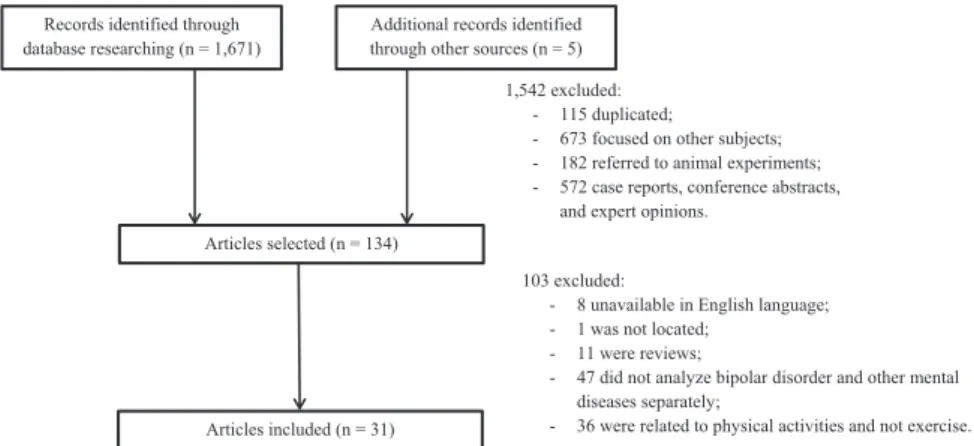
The initial electronic database search yielded 1671 hits. Five records were found from the reference list of identified studies. Initially, 1676 articles were included. After careful examination, 1542 were excluded: 115 were duplicated; 673 focused on other conditions; 182 referred to animal experiments and 572 were case reports, conference abstracts, and expert's opinions. Thereafter, 94 articles were removed: 8 were unavailable in English language; 1 was not located; 11 were reviews; 47 analyzed bipolar disorder and other mental diseases in the same group and 36 were eval-uated physical health and not physical activity or exercise. Thirty-one studies were finally selected and included 15,587 patients with bipolar disorder in total (Fig. 1).
The results were organized considering the relevant topics: (1) physical activity levels in bipolar patients–15 studies; (2) ex-ercise and biomarkers–3 studies; (3) comorbidities–3 studies; (4) beneficial effects of exercise–7 studies; (5) complications of exercise–4 studies (Table 1).
3.2. Physical activity levels in bipolar patients
Most studies showed that bipolar patients commonly had se-dentary lifestyle, defined as absent or irregular practice of physical activity (Table 1). The majority of investigated psychiatric dis-orders (including bipolar disorder) were associated with lack of exercise (Chwastiak et al., 2011). The percentage of sedentary lifestyle in bipolar disorder varied from 40% to 64.9% in self-re-ported questionnaires (Cairney et al., 2009;Chwastiak et al., 2011; Gomes et al., 2013;Sylvia et al., 2013a).
Only one study assessed physical activity through objective measures. Motor activity levels of 60 bipolar patients were as-sessed using an actigraph. Most of them were classified as se-dentary (around 78%). Moreover, 21% practiced light physical ac-tivity; and 1%, moderate/vigorous (Janney et al., 2014).
et al. (2016) compared adolescents with bipolar disorder and controls. In thefirst study, bipolar adolescents tended to practice less physical activities in general (p¼0.10) and they reported less vigorous physical activity than controls (p¼0.005) (Jewell et al.,
2015). The second study showed that bipolar adolescents and controls experience a bout of exercise largely similar. Nevertheless, healthy adolescents reported a significantly greater tolerance for high intensity exercise than bipolar ones (po0.05) (
Sub-ramaniapillai et al., 2016).
Few studies evaluated motor and functional details of physical performance. Bipolar disorder was associated with poorer func-tional exercise capacity. They walked a shorter distance (po0.001), were less physically active (p¼0.005) and reported more musculoskeletal pain (p¼0.03) than controls (Vancampfort
et al., 2015b). Patients had reduced speed of limb movement (po0.001), explosive leg strength (p¼0.003) and abdominal muscular endurance (po0.001) (Vancampfort et al., 2015a). It was also observed that men had higher explosive muscle (p¼0.001) and handgrip strength (po0.001) than women (Vancampfort
et al., 2015a).
Most studies revealed that exercise duration and intensity were reduced in bipolar disorder when compared with controls (Elmslie et al., 2001;Hausdorff et al., 2004;Shah et al., 2007). Only one study found no difference in the total energy expenditure between the groups (Cairney et al., 2009).
Comparisons between bipolar disorder and major depressive disorder showed conflicting evidence. Cairney et al. (2009) de-monstrated higher total energy expenditure in bipolar disorder than major depressive disorder (p¼0.02); however there were no differences compared to control group (p¼0.39) (Cairney et al., 2009).Hausdorff et al. (2004) showed no differences in walking speed, swing time and stride time between depressive and bipolar patients (Hausdorff et al., 2004). However, compared to the control group, swing time variability was significantly larger in bipolar subjects (po0.0001) and in subjects with major depression (po0.0004).Chuang et al. (2008) concluded that the frequency of vigorous exercise did not differ between depression, bipolar and schizophrenia groups (p¼0.16). There were also no differences in the frequency of getting as much exercise as is needed in three groups (p¼0.32) (Chuang et al., 2008).
Two studies compared the physical activity in schizophrenia and bipolar patients.Bly et al. (2014)reported more physical ac-tivity in bipolar group (p¼0.004) (Bly et al., 2014). On the other hand,Chuang et al. (2008) found no difference in frequency of vigorous exercise between these groups (p¼0.16) (Chuang et al.,
2008).
3.3. Exercise and biomarkers
Alterations of biomarkers associated with physical exercise in bipolar patients were rarely investigated (Table 1). El-Mallakh et al. (2010) described an aberrant regulation of ouabain-like fac-tor (OLF), an endogenous cardenolide, in bipolar subjects during exercises. In contrast, salivary cortisol levels were not different in two groups. Patients showed low rates of OLF before (p¼0.019), during (p¼0.029) and after exercise (p¼0.020). Higher levels of OLF and an evident peak activity was found in controls. The phy-siologic actions of the endogenous cardenolides and the implica-tions of thisfinding are still unknown (El-Mallakh et al., 2010).
Schuch et al. (2015) demonstrated higher brain-derived neu-rotrophic factor (BDNF) in bipolar patients before and after ex-ercise testing. Only bipolar women had increased serum BDNF from pre- to post-test (p¼0.004). No significant changes were observed in bipolar men or healthy people (men and women). These results indicate a gender related difference of exercise on BDNF levels in bipolar patients (Schuch et al., 2015).
Hays et al. (2008) assessed the effect of aerobic exercise on DHEAS levels (a precursor of the adrenal steroid dehydroepian-drosterone) and perceptions of well-being in bipolar patients. It was observed an improvement in perception of global well-being after exercise (po0.05). However, there was no correlation be-tween DHEAS levels and perceptions of well-being (p¼0.38) (Hays
et al., 2008).
3.4. Comorbidities
Studies have suggested an association between sedentary life-style and comorbidities in bipolar patients.Strohle et al. (2007) reported decreased prevalence of co-morbid mental disorder in patients who practices physical activity (po0.05) (Strohle et al.,
2007). Sedentary lifestyle was associated with sleep disturbance in bipolar patients (po0.01), but not in controls (McGlinchey et al.,
2014). The direction of the association is uncertain because these studies are cross-sectional.
Goodrich et al. (2010) assessed determinants of access to weight counseling in bipolar disorder. Atypical antipsychotics and increased BMI were associated with exercise counseling (po0.05). Therefore, the study highlights the importance of advice on weight loss for bipolar patients, especially for those with increased car-diovascular risk (Goodrich et al., 2010).
3.5. Beneficial effects of exercise
Studies indicate that physical activity is associated with less depressive symptoms, better quality of life and increased func-tioning (Table 1).Sylvia et al. (2013a,2013b)showed that less self-Records identified through
database researching (n = 1,671)
Additional records identified through other sources (n = 5)
Articles selected (n = 134)
1,542 excluded: - 115 duplicated;
- 673 focused on other subjects; - 182 referred to animal experiments; - 572 case reports, conference abstracts,
and expert opinions.
103 excluded:
- 8 unavailable in English language; - 1 was not located;
- 11 were reviews;
- 47 did not analyze bipolar disorder and other mental diseases separately;
- 36 were related to physical activities and not exercise. Articles included (n = 31)
Fig. 1.Flowchart for study selection.
Summary of selected studies.
Author Study design Participants Physical activity assessments or interventions Results
Elmslie et al., 2001 Case-control 89 euthymic BD and 445 controls Life in New Zealand Questionnaire Patients had fewer episodes of low- to moderate-intensity and high-intensity physical activity
Hausdorff et al., 2004 Case-control 23 BD, 19 MDD and 9 control Stride time and swing time during walking Patient groups tended to walk slowly, decreased swing time and increased stride time
Kilbourne et al., 2007 Case-control 2032 BD, 1895 Sz and 3065 control Self-report BD patients report poorer exercise habits–infrequent walking or strength exercises Ng et al., 2007 Retrospective cohort (24
months)
49 BD: 14 in a walking group and 35 without physical activity
Walking program No differences in clinical global impression (CGI), but participants had lower scores for depression anxiety stress scales (DASS)
Shah et al., 2007 Case-control 14 BD and 10 controls Time of exercise in treadmill with increase of speed
BD patients had reduced exercise duration. No difference in respiratory and echocardiographic variables.
Strohle et al., 2007 Community cohort (4 years)
2548 people (39 BD) Self-report Increased physical activity was associated with high incidence of BD. Co-morbid mental disorder associated with less exercise
Chuang et al., 2008 Cross-sectional 60 BD, 61 Sz, and 61 MDD or anxiety disorders
Leisure-time physical activity questionnaire 24.2% reported daily physical activity. Frequency of vigorous exercise did not differ between groups.
Hays et al., 2008 Intervention 26 BD Walking on a treadmill for 20 min Improvement in perception of global well-being after exercise. No association be-tween Dehydroepiandrosterone Sulfate (DHEAS) levels and global well-being
Salvi et al., 2008 Cross-sectional 108 BD Self-report No relationship between exercise and metabolic syndrome
Cairney et al., 2009 Cross-sectional 831 BD vs 4713 MDD vs 31,834 control
Total energy expenditure (EE) EE did not differ between BD and control. EE was higher among BD than in MDD
El-Mallakh et al., 2010 Case-control 14 euthymic BD and 10 controls Walking on a treadmill with progressively in-creased speed
Downregulation of a endogenous cardenolide before, during and after exercise in BD patients
Goodrich et al., 2010 Cohort study (2 years) 298 BD Self-report Atypical antipsychotics and increased BMI were associated with exercise counseling.
Guan et al., 2010 Cohort study (6 months) 148 BD and 65 control Self-report No relationship between exercise and metabolic syndrome
Chwastiak et al., 2011 Cross-sectional 501,161 md (9522 BD) Self-report All psychiatric disorders (including BD) had lack of exercise as compared to control
Salvi et al., 2011 Cross-sectional 200 BD Self-report BD patients with metabolic syndrome had lower exercise levels
Sylvia et al., 2011 Intervention 10 BD Therapy with 3 modules: Nutrition, Exercise, and Wellness
BD patients improved quality of life, depressive symptoms and weight
Dakwar et al., 2012 National cross-sectional 23,505 md (851 BD) International Physical Activity Questionnaire Vigorous exercise was associated with BD II and alcohol dependence
Proudfoot et al., 2012 Cross-sectional 198 BD Self-report Decreased physical exercise was associated with depressive episodes
Wright et al., 2012 Qualitative study 25 BD Self-report Almost 50% used exercise to regulate symptoms. Exercise had different effects on mood according to intensity
Gomes et al., 2013 Cross-sectional 159 BD Self-report High rates of physical inactivity (64.9%)
Sylvia et al., 2013a Cross-sectional 482 BD Self-report Less exercise was associated with higher BMI, depressive symptoms, lower quality of life and functioning. In contrast, more exercise was associated with mania Sylvia et al., 2013b Intervention 5 BD Therapy with 3 modules: Nutrition, Exercise, and
Wellness
Less physical activity was associated with more depressive symptoms, lower quality of life and functioning.
Bly et al., 2014 Cross-sectional 116 BD and 143 Sz Total Activity Measure 2 (TAM2) BD patients reported more physical activity than Sz.
Janney et al., 2014 Cross-sectional 60 BD Actigraphy BD patients were more inactive (78%). 21% practiced light physical activity; and 1.4% moderate/vigorous
McGlinchey et al., 2014 Case-control 32 euthymic BD and 36 controls Self-report and actigraphy BD patients tended to have reduced physical activity. It was a predictor of sleep disorder in BD, but not in controls
Jewell et al., 2015 Case-control 86 BD adolescents and 50 controls 17-item Quick Weight, Activity & Excess Screener (WAVE)
Physical activity tends to be lower in BD. Patients with low physical activity were less likely to have a family history of substance use (p¼0.03)
Schuch et al., 2015 Case-control 18 BD and 18 controls Measurement of BDNF before and after exercise BD patients had higher BDNF levels, both at pre-and post-test Vancampfort et al., 2015a Cross-sectional 46 BD EUROFIT test battery Men had higher explosive muscle and handgrip strength than women. Vancampfort et al., 2015a Case-control 30 BD and 30 controls EUROFIT test and International Physical Activity
Questionnaire
BD patients had reduced speed of limb movement, explosive leg strength and ab-dominal muscular endurance
Vancampfort et al., 2015b Case-control 30 BD and 30 controls International Physical Activity Questionnaire and 6 min walk test
BD patients had poorer functional exercise capacity
Subramaniapillai et al., 2016 Case-control 32 BD adolescents and 31 controls Exercise-Induced Feeling Inventory (EFI) There were no differences between groups on any subscales. Controls reported greater tolerance for high intensity exercise than BD.
BD: Bipolar disorder md: mental disorders MDD: Major depressive disorder Sz: Schizophrenia
EE: energy expenditure
M.C.A
.
Melo
et
al.
/
Journal
of
Af
fectiv
e
Disorders
198
(20
1
6)
32
–
38
reported exercise was associated with higher depressive symp-toms (po0.001), and lower quality of life (p¼0.032) and func-tioning (po0.001) (Sylvia et al., 2013a). Proudfoot et al. (2012) also identified a relationship between decreased physical exercise and depressive episodes (po0.001) (Proudfoot et al., 2012).
In a qualitative study, 25 bipolar patients answered a semi-structured interview about their views on the relationship be-tween exercise and bipolar disorder. Almost 50% used exercise to regulate symptoms (Wright et al., 2009).
Some intervention studies support effects of exercise on mood. Ng et al. (2007) invited bipolar inpatients to participate voluntarily in a walking group during admissions. The walking group had lower scores in Depression Anxiety Stress Scales – DASS (p¼0.005) and all its subscales (Depression p¼0.048, Anxiety p¼0.002, Stress p¼0.01). Nevertheless, there was no difference in Clinical Global Impression (CGI) between two groups (p40.05) (Ng et al., 2007).Sylvia et al. (2011,2013b)assessed the effects of nutrition/weight loss, exercise, and wellness treatment. These studies involved a combined of three treatment modules, ad-ministered in twelve 60-min group sessions over 14 weeks. The treatment tends to improve quality of life, depressive symptoms, functioning and weight (Sylvia et al., 2011,2013b).
Most studies revealed a high prevalence of metabolic syndrome in bipolar patients. Nonetheless, the relationship between meta-bolic syndrome and physical activity in this population is un-certain.Guan et al. (2010) and Salvi et al. (2008) showed higher rates of hyperglycemia, dyslipidemia, hypertension and metabolic syndrome in bipolar patients. However, a relationship between metabolic syndrome and physical activity was not found (Guan et al., 2010p¼0.986;Salvi et al., 2008p¼0.232).Salvi et al. (2011), in a larger sample, demonstrated that bipolar with the metabolic syndrome practiced less exercise (p¼0.030) (Salvi et al., 2011).
3.6. Complications of exercise
Two studies estimates higher incidence of bipolar disorder in people that practices more physical activities.Strohle et al. (2007) followed 2548 people over four years in a community, including 959 with mental disorders and 39 with bipolar. At baseline, any mental disorder was associated with irregular physical activity (OR 0.69; CI 0.56–0.84, po0.05), but not in bipolar patients (OR 1.23, CI 0.58–2.60, p40.05). Over 4 years, the incidence of mental disorders in general was higher in people with irregular exercise or no exercise (OR 0.71, CI 0.53–0.95, p40.05). In contrast, those who practices regularly physical activity were associated with bi-polar disorder (OR 10.29, CI 1.36–78.08, po0.05) (Strohle et al.,
2007). In a national survey with 23,505 people with mental dis-orders (851 with bipolar disorder), vigorous exercise was asso-ciated with a vulnerability to some mental illness, especially al-cohol dependence (OR 1.43, CI 1.12–1.84, po0.05) and bipolar II disorder (OR 2.29, CI 1.31–4.02, po0.05) (Dakwar et al., 2012).
Interestingly, some studies associated physical activity with manic episodes.Sylvia et al., 2013ashowed that less exercise was associated with depressive symptoms (po0.001), and frequent exercise with mania (p¼0.012) (Sylvia et al., 2013a). However, this study is cross-sectional, which limits its conclusions. Thefindings possibly can be explained because individuals who are manic tend to exercise more. In a qualitative study,Wright et al. (2009) sug-gested that physical activity has different effects on bipolar pa-tients, depending upon the severity of the exerciser’s mood state (Wright et al., 2009). It could relieve symptoms of hypomania and prevent severe mood swings. However, vigorous exercise may worsen mania or hypomania.
4. Discussion
This review shows that evidence about the effects of physical activity on bipolar disorder is scarce. The majority of studies are cross-sectional evaluations of patients compared, or not, to con-trols. Only three prospective cohorts were reported in this review. However, neither of them evaluated the effects of physical activity on symptoms, quality of life and functioning. Two intervention studies evaluated the effects of a combined therapy including nutrition, physical activity and lifestyle. They showed benefit in quality of life, depressive symptoms and functioning. However, none assessed the exercise as a single intervention strategy. No prospective randomized controlled trial was identified.
Current evidence shows that bipolar patients lead a sedentary life, which has been associated with more comorbidities, poorer quality of life, worse functioning and more depressive symptoms in bipolar disorder. Thesefindings are in accordance with studies in populations with mental disorders (Carneiro et al., 2016; Ho et al., 2016), indicating worse evolution of sedentary patients. However, studies in children and adolescents are scarce and needy. The pathways by which exercise acts in bipolar disorder are unclear. The effects of exercise on BDNF levels in bipolar were poorly studied, despite its strong influence on brain functions. Aerobic exercise raises BDNF levels, associated with the chronic stress suppression, frequently found in bipolar patients (Heijnen et al., 2016; De Sá Filho et al., 2015). Some animal experiments showed that exercise independently attenuate mania-like beha-vior (Kirshenbaum et al., 2014). Besides, exercise contributes to reduce oxidative stress and inflammatory activity (Muneer, 2016; Sallam and Laher, 2016). Available evidence supports the im-portant role of inflammation on bipolar disorder (Goldstein et al., 2009). Studies with BDNF and inflammatory cytokines in bipolar patients are much needed.
The impact of physical activity on sleep has been little studied in bipolar patients. There is a complex and bilateral interaction between exercise and sleep (Chennaoui et al., 2015). Poor sleep quality has been associated with residual mood symptoms, mood episode recurrence in bipolar patients and poor work performance (Boland et al., 2015;Cretu et al., 2016). It is necessary to study the influence of physical activity on sleep in bipolar patients.
Studies about the effects of physical activity on the metabolic syndrome in bipolar patients showed uncertain results. Similarly to other physical and mental conditions (Kahl et al., 2015;Liu et al., 2015; Park and Larson, 2014), physical activity should improve anthropometric measures and impact positively on metabolic syndrome. Possibly, an explanation for the few available studies may be the difficulty in recruiting and the adherence to physical exercise in bipolar population with frequent severe behavioral symptoms. In summary, the relationship between physical ex-ercise and metabolic syndrome also needs further clarification.
Despite the highlighted beneficial effects of exercise, some studies suggest that frequent exercise is associated with mania in bipolar patients. It is unknown if the exacerbation of manic symptoms is cause or consequence of increased physical activity. It is also unclear if the manic state is associated with only vigorous exercise or with any kind of physical activity. Therefore, cohorts are needed to clarify this important subject.
Although there are previous reviews about the topic (Thomson et al., 2015; Vancampfort et al., 2013; Wright et al., 2009), this systematic review includes a larger number of articles. Eight re-cent publications (including 390 patients) are new to this review compared three prior ones. Furthermore, many gaps remain and it implies that the subject should be studied constantly.
Several limitations should be acknowledged. The small number of studies about same topic, the diversity in physical activity measures, the different types of study design and the M.C.A. Melo et al. / Journal of Affective Disorders 198 (2016) 32–38
heterogeneous samples prevented us from performing meta-ana-lysis. Most studies were cross-sectional, which limits establishing a cause and effect relationship. Furthermore, the motivation for exercising can be a selection bias in majority of cases. Some in-tervention simultaneously promoted nutrition, lifestyle changes and physical activity, hampering to infer conclusions about the only physical exercise. Other limitation was the lack of studies comparing exercise across mood states and assessing effects of medications on exercise.
In conclusion, sedentary lifestyle is common in bipolar patients. Physical exercise was associated with better functioning, quality of life and depressive symptoms. Some studies report the relation-ship between vigorous exercise and mania. However, evidence was insufficient to infer a cause-effect relationship and randomized trials are suggested. Other issues to be considered are the infl u-ence of exercise on sleep and its neurochemical changes on bipolar disorder.
Role of the funding source
The authors do not have afinancial relation with a commercial entity that has an interest in the content of this paper.
Declaration of interest
The authors report no conflicts of interest. The authors are responsible for the content and writing of the paper.
Contributors
MCAM conceived and designed the study, collected data and analyzed data. EDFD, SGCA and VMSB contributed to the concep-tion and design of the study. All authors contributed to the drafting, and revisions of the manuscript. All authors read and approved thefinal manuscript.
References
Adamson, B.C., Ensari, I., Motl, R.W., 2015. Effect of exercise on depressive symp-toms in adults with neurologic disorders: a systematic review and meta-ana-lysis. Arch. Phys. Med. Rehabil. 96, 1329–1338.
Anderson, I.M., Haddad, P.M., Scott, J., 2012. Bipolar disorder. BMJ 345, e8508. Bauer, I.E., Gálvez, J.F., Hamilton, J.E., Balanzá-Martínez, V., Zunta-Soares, G.B., Soares, J.C., Meyer, T.D., 2015. Lifestyle interventions targeting dietary habits and exercise in bipolar disorder: a systematic review. J. Psychiatr. Res. 74, 1–7. Bly, M.J., Taylor, S.F., Dalack, G., Pop-Busui, R., Burghardt, K.J., Evans, S.J., McInnis, M. I., Grove, T.B., Brook, R.D., Zollner, S.K., Ellingrod, V.L., 2014. Metabolic syndrome in bipolar disorder and schizophrenia: dietary and lifestyle factors compared to the general population. Bipolar Disord. 16, 277–288.
Barbour, K.A., Edenfield, T.M., Blumenthal, J.A., 2007. Exercise as a treatment for depression and other psychiatric disorders: a review. J. Cardiopulm. Rehabil. Prev. 27, 359–367.
Boland, E.M., Stange, J.P., Molz Adams, A., LaBelle, D.R., Ong, M.L., Hamilton, J.L., Connolly, S.L., Black, C.L., Cedeño, A.B., Alloy, L.B., 2015. Associations between sleep disturbance, cognitive functioning and work disability in bipolar disorder. Psychiatry Res. 230, 567–574.
Cairney, J., Veldhuizen, S., Faulkner, G., Schaffer, A., Rodriguez, M.C., 2009. Bipolar disorder and leisure-time physical activity: results from a national survey of Canadians. Ment. Health Phys. Act. 2, 65–70.
Carek, P.J., Laibstain, S.E., Carek, S.M., 2011. Exercise for the treatment of depression and anxiety. Int. J. Psychiatry Med. 41, 15–28.
Carneiro, L.S., Fonseca, A.M., Serrão, P., Mota, M.P., Vasconcelos-Raposo, J., Vieira-Coelho, M.A., 2016. Impact of physical exercise on catechol-O-methyltransfer-ase activity in depressive patients: a preliminary communication. J. Affect. Disord. 193, 117–122.
Chennaoui, M., Arnal, P.J., Sauvet, F., Leger, D., 2015. Sleep and exercise: a reciprocal issue? Sleep. Med. Rev. 20, 59–72.
Chuang, H.T., Mansell, C., Patten, S.B., 2008. Lifestyle characteristics of psychiatric outpatients. Can. J. Psychiatry 53, 260–266.
Chwastiak, L.A., Rosenheck, R.A., Kazis, L.E., 2011. Association of psychiatric illness and obesity, physical inactivity, and smoking among a national sample of ve-terans. Psychosomatics 52, 230–236.
Cretu, J.B., Culver, J.L., Goffin, K.C., Shah, S., Ketter, T.A., 2016. Sleep, residual mood symptoms, and time to relapse in recovered patients with bipolar disorder. J. Affect. Disord. 190, 162–166.
Dakwar, E., Blanco, C., Lin, K.H., Liu, S.M., Warden, D., Trivedi, M., Nunes, E.V., 2012. Exercise and mental illness: results from the National Epidemiologic Survey on Alcohol and Related Conditions (NESARC). J. Clin. Psychiatry 73, 960–966. De Sa Filho, A.S., Moura, A.M.S., Lamego, M.K., Rocha, N.B.F., Paes, F., Oliveira, A.C.,
Lattari, E., Rimes, R., Manochio, J., Budde, H., Wegner, M., Mura, G., Arias-Car-rión, O., Cheniaux, E., Yuan, T.F., Nardi, A.E., Machado, S., 2015. Potential ther-apeutic effects of physical exercise for bipolar disorder. CNS Neurol. Disord. Drug. Targets 14, 1255–1259.
Drago, A., Crisafulli, C., Calabrò, M., Serretti, A., 2015. Enrichment pathway analysis. the inflammatory genetic background in bipolar disorder. J. Affect. Disord. 179, 88–94.
El-Mallakh, R.S., Stoddard, M., Jortani, S.A., El-Masri, M.A., Sephton, S., Valdes Jr., R., 2010. Aberrant regulation of endogenous ouabain-like factor in bipolar sub-jects. Psychiatry Res. 178, 116–120.
Elmslie, J.L., Mann, J.I., Silverstone, J.T., Williams, S.M., Romans, S.E., 2001. De-terminants of overweight and obesity in patients with bipolar disorder. J. Clin. Psychiatry 62, 486–491, Quiz 492-483.
Ensari, I., Motl, R.W., Pilutti, L.A., 2014. Exercise training improves depressive symptoms in people with multiple sclerosis: results of a meta-analysis. J. Psy-chosom. Res. 76, 465–471.
Geddes, J.R., Miklowitz, D.J., 2013. Treatment of bipolar disorder. Lancet 381, 1672–1682.
Gomes, F.A., Almeida, K.M., Magalhaes, P.V., Caetano, S.C., Kauer-Sant'Anna, M., Lafer, B., Kapczinski, F., 2013. Cardiovascular risk factors in outpatients with bipolar disorder: a report from the Brazilian Research Network in Bipolar Disorder. Rev. Bras. Psiquiatr. 35, 126–130.
Goodrich, D.E., Lai, Z., Lasky, E., Burghardt, A.R., Kilbourne, A.M., 2010. Access to weight loss counseling services among patients with bipolar disorder. J. Affect. Disord. 126, 75–79.
Guan, N., Liu, H., Diao, F., Zhang, J., Zhang, M., Wu, T., 2010. Prevalence of metabolic syndrome in bipolar patients initiating acute-phase treatment: a 6-month follow up. Psychiatry Clin. Neurosci. 64, 625–633.
Hausdorff, J.M., Peng, C.K., Goldberger, A.L., Stoll, A.L., 2004. Gait unsteadiness and fall risk in two affective disorders: a preliminary study. BMC. Psychiatry 4, 39. Hays, A.E., Goss, F., Aaron, D., Abt, K., Friedman, E., Gallagher, M., Nagle, E., 2008.
Hormonal and perceptual changes in bipolar subjects after acute aerobic ex-ercise. Med. Sci. Sports Exerc. 40, S17.
Heijnen, S., Hommel, B., Kibele, A., Colzato, L.S., 2016. Neuromodulation of aerobic exercise–a review. Front. Psychol. 6, 1890.
Ho, R.T., Fong, T.C., Wan, A.H., Au-Yeung, F.S., Wong, C.P., Ng, W.Y., Cheung, I.K., Lo, P. H., Ng, S.M., Chan, C.L., Chen, E.Y., 2016. A randomized controlled trial on the psychophysiological effects of physical exercise and Tai-chi in patients with chronic schizophrenia. Schizophr. Res. 171, 42–49.
Janney, C.A., Fagiolini, A., Swartz, H.A., Jakicic, J.M., Holleman, R.G., Richardson, C.R., 2014. Are adults with bipolar disorder active? Objectively measured physical activity and sedentary behavior using accelerometry. J. Affect. Disord. 152-154, 498–504.
Josefsson, T., Lindwall, M., Archer, T., 2014. Physical exercise intervention in de-pressive disorders: meta-analysis and systematic review. Scand. J. Med. Sci. Sports 24, 259–272.
Jewell, L., Abtan, R., Scavone, A., Timmins, V., Swampillai, B., Goldstein, B.I., 2015. Preliminary evidence of disparities in physical activity among adolescents with bipolar disorder. Ment. Health Phys. Act. 8, 62–67.
Kahl, K.G., Schweiger, U., Correll, C., Muller, C., Busch, M.L., Bauer, M., Schwarz, P., 2015. Depression, anxiety disorders, and metabolic syndrome in a population at risk for type 2. Diabetes Mellit. Brain Behav. 5, e00306.
Kemp, D.E., 2014. Managing the side effects associated with commonly used treatments for bipolar depression. J. Affect. Disord. 169 (Suppl. 1), S34–S44. Kendall, T., Morriss, R., Mayo-Wilson, E., Marcus, E., Guideline Development Group
of the National Institute for, H., Care, E., 2014. Assessment and management of bipolar disorder: summary of updated NICE guidance. BMJ 349, g5673. Kerling, A., Tegtbur, U., Gützlaff, E., Kück, M., Borchert, L., Ates, Z., von Bohlen, A.,
Frieling, H., Hüper, K., Hartung, D., Schweiger, U., Kahl, K.G., 2015. Effects of adjunctive exercise on physiological and psychological parameters in depres-sion: a randomized pilot trial. J. Affect. Disord. 177, 1–6.
Kilbourne, A.M., Rofey, D.L., McCarthy, J.F., Post, E.P., Welsh, D., Blow, F.C., 2007. Nutrition and exercise behavior among patients with bipolar disorder. Bipolar disorders 9, 443–452.
Kirshenbaum, G.S., Burgess, C.R., Dery, N., Fahnestock, M., Peever, J.H., Roder, J.C., 2014. Attenuation of mania-like behavior in Na(þ),K(þ)-ATPase alpha3 mutant mice by prospective therapies for bipolar disorder: melatonin and exercise. Neuroscience 260, 195–204.
Kucyi, A., Alsuwaidan, M.T., Liauw, S.S., McIntyre, R.S., 2010. Aerobic physical ex-ercise as a possible treatment for neurocognitive dysfunction in bipolar dis-order. Postgrad. Med. J. 122, 107–116.
Leboyer, M., Soreca, I., Scott, J., Frye, M., Henry, C., Tamouza, R., Kupfer, D.J., 2012. Can bipolar disorder be viewed as a multi-system inflammatory disease? J. Affect. Disord. 141, 1–10.
osteoarthritis. Arthritis Care Res. 67, 1371–1378.
Lopresti, A.L., Jacka, F.N., 2015. Diet and bipolar disorder: a review of its relationship and potential therapeutic mechanisms of action. J. Altern. Complement. Med. 21, 733–739.
Lopresti, A.L., Hood, S.D., Drummond, P.D., 2013. A review of lifestyle factors that contribute to important pathways associated with major depression: diet, sleep and exercise. J. Affect. Disord. 148, 12–27.
McCormick, U., Murray, B., McNew, B., 2015. Diagnosis and treatment of patients with bipolar disorder: a review for advanced practice nurses. J. Am. Assoc. Nurse Pract. 27, 530–542.
McGlinchey, E.L., Gershon, A., Eidelman, P., Kaplan, K.A., Harvey, A.G., 2014. Physical activity and sleep: day-to-day associations among individuals with and without bipolar disorder. Ment. Health Phys. Act. 7, 183–190.
Morriss, R., Mohammed, F.A., 2005. Metabolism, lifestyle and bipolar affective disorder. J. Psychopharmacol. 19, 94–101.
Moylan, S., Eyre, H.A., Maes, M., Baune, B.T., Jacka, F.N., Berk, M., 2013. Exercising the worry away: how inflammation, oxidative and nitrogen stress mediates the beneficial effect of physical activity on anxiety disorder symptoms and beha-viours. Neurosci. Biobehav. Rev. 37, 573–584.
Muneer, A., 2016. Bipolar disorder: role of inflammation and the development of disease biomarkers. Psychiatry Invest. 13, 18–33.
Nierenberg, A.A., Hearing, C.M., Sande Mathias, I., Young, L.T., Sylvia, L.G., 2015. Getting to wellness: the potential of the athletic model of marginal gains for the treatment of bipolar disorder. Aust. N. Z. J. Psychiatry 49, 1207–1214. Ng, F., Dodd, S., Berk, M., 2007. The effects of physical activity in the acute
treat-ment of bipolar disorder: a pilot study. J. Affect. Disord. 101, 259–262. Park, S.K., Larson, J.L., 2014. The relationship between physical activity and
meta-bolic syndrome in people with chronic obstructive pulmonary disease. J. Car-diovasc. Nurs. 29, 499–507.
Petersen, A.M., Pedersen, B.K., 2005. The anti-inflammatory effect of exercise. J. Appl. Physiol. 98, 1154–1162.
Price, A.L., Marzani-Nissen, G.R., 2012. Bipolar disorders: a review. Am. Fam. Phys. 85, 483–493.
Proudfoot, J., Whitton, A., Parker, G., Doran, J., Manicavasagar, V., Delmas, K., 2012. Triggers of mania and depression in young adults with bipolar disorder. J. Af-fect. Disord. 143, 196–202.
Sallam, N., Laher, I., 2016. Exercise modulates oxidative stress and inflammation in aging and cardiovascular diseases. Oxid. Med. Cell. Longev.〈http://www.hinda wi.com/journals/omcl/2016/7239639/〉(accessed 31.1.16
Salvi, V., Albert, U., Chiarle, A., Soreca, I., Bogetto, F., Maina, G., 2008. Metabolic syndrome in Italian patients with bipolar disorder. Gen. Hosp. Psychiatry 30, 318–323.
Salvi, V., D'Ambrosio, V., Rosso, G., Bogetto, F., Maina, G., 2011. Age-specific pre-valence of metabolic syndrome in Italian patients with bipolar disorder. Psy-chiatry Clin. Neurosci. 65, 47–54.
Schuch, F.B., da Silveira, L.E., de Zeni, T.C., da Silva, D.P., Wollenhaupt-Aguiar, B., Ferrari, P., Reischak-Oliveira, A., Kapczinski, F., 2015. Effects of a single bout of maximal aerobic exercise on BDNF in bipolar disorder: a gender-based re-sponse. Psychiatry Res. 229, 57–62.
Shah, A., Alshaher, M., Dawn, B., Siddiqui, T., Longaker, R.A., Stoddard, M.F., El-Mallakh, R., 2007. Exercise tolerance is reduced in bipolar illness. J. Affect. Disord. 104, 191–195.
Stanton, R., Happell, B., 2014. Exercise for mental illness: a systematic review of inpatient studies. Int. J. Ment. Health Nurs. 23, 232–242.
Stanton, R., Reaburn, P., 2014. Exercise and the treatment of depression: a review of the exercise program variables. J. Sci. Med. Sport. 17, 177–182.
Strohle, A., Hofler, M., Pfister, H., Muller, A.G., Hoyer, J., Wittchen, H.U., Lieb, R., 2007. Physical activity and prevalence and incidence of mental disorders in adolescents and young adults. Psychol. Med. 37, 1657–1666.
Subramaniapillai, M., Goldstein, B.I., MacIntosh, B.J., Korczak, D.J., Ou, X., Scavone,
A., Arbour-Nicitopoulos, K., Faulkner, G., 2016. Characterizing exercise-induced feelings after one bout of exercise among adolescents with and without bipolar disorder. J. Affect. Disord. 190, 467–473.
Sylvia, L.G., Friedman, E.S., Kocsis, J.H., Bernstein, E.E., Brody, B.D., Kinrys, G., Kemp, D.E., Shelton, R.C., McElroy, S.L., Bobo, W.V., Kamali, M., McInnis, M.G., Tohen, M., Bowden, C.L., Ketter, T.A., Deckersbach, T., Calabrese, J.R., Thase, M.E., Reilly-Harrington, N.A., Singh, V., Rabideau, D.J., Nierenberg, A.A., 2013a. Association of exercise with quality of life and mood symptoms in a comparative effec-tiveness study of bipolar disorder. J. Affect. Disord. 151, 722–727. Sylvia, L.G., Nierenberg, A.A., Stange, J.P., Peckham, A.D., Deckersbach, T., 2011.
Development of an integrated psychosocial treatment to address the medical burden associated with bipolar disorder. J. Psychiatr. Pract. 17, 224–232. Sylvia, L.G., Salcedo, S., Bernstein, E.E., Baek, J.H., Nierenberg, A.A., Deckersbach, T.,
2013b. Nutrition, exercise, and wellness treatment in bipolar disorder: proof of concept for a consolidated intervention. Int. J. Bipolar Disord. 1, 24. Stubbs, B., Vancampfort, D., Rosenbaum, S., Ward, P.B., Richards, J., Ussher, M.,
Schuch, F.B., 2016a. Challenges establishing the efficacy of exercise as an anti-depressant treatment: a systematic review and meta-analysis of control group responses in exercise randomised controlled trials. Sports Med., In press Stubbs, B., Rosenbaum, S., Vancampfort, D., Ward, P.B., Schuch, F.B., 2016b. Exercise
improves cardiorespiratoryfitness in people with depression: a meta-analysis of randomized control trials. J. Affect. Disord. 190, 249–253.
Ten Have, M., de Graaf, R., Monshouwer, K., 2011. Physical exercise in adults and mental health statusfindings from the Netherlands mental health survey and incidence study (NEMESIS). J. Psychosom. Res. 71, 342–348.
Thomson, D., Turner, A., Lauder, S., Gigler, M.E., Berk, L., Singh, A.B., Pasco, J.A., Berk, M., Sylvia, L., 2015. A brief review of exercise, bipolar disorder, and mechanistic pathways. Front Psychol. 6, 147.
Tu, R.H., Zeng, Z.Y., Zhong, G.Q., Wu, W.F., Lu, Y.J., Bo, Z.D., He, Y., Huang, W.Q., Yao, L. M., 2014. Effects of exercise training on depression in patients with heart fail-ure: a systematic review and meta-analysis of randomized controlled trials. Eur. J. Heart Fail. 16, 749–757.
Vancampfort, D., Correll, C.U., Probst, M., Sienaert, P., Wyckaert, S., De Herdt, A., Knapen, J., De Wachter, D., De Hert, M., 2013. A review of physical activity correlates in patients with bipolar disorder. J. Affect. Disord. 145, 285–291. Vancampfort, D., Sienaert, P., Wyckaert, S., De Hert, M., Stubbs, B., Rosenbaum, S.,
Buys, R., Probst, M., 2015a. Test-retest reliability, feasibility and clinical corre-lates of the Eurofit test battery in people with bipolar disorder. Psychiatry Res. 228, 620–625.
Vancampfort, D., Sienaert, P., Wyckaert, S., De Hert, M., Stubbs, B., Soundy, A., De Smet, J., Probst, M., 2015a. Health-related physicalfitness in patients with bi-polar disorder vs. healthy controls: an exploratory study. J. Affect. Disord. 177, 22–27.
Vancampfort, D., Wyckaert, S., Sienaert, P., De Hert, M., Stubbs, B., Buys, R., Schueremans, A., Probst, M., 2015b. The functional exercise capacity in patients with bipolar disorder versus healthy controls: a pilot study. Psychiatry Res. 229, 194–199.
Ward, M.C., White, D.T., Druss, B.G., 2015. A meta-review of lifestyle interventions for cardiovascular risk factors in the general medical population: lessons for individuals with serious mental illness. J. Clin. Psychiatry 76, 477–486. Wegner, M., Helmich, I., Machado, S., Nardi, A.E., Arias-Carrion, O., Budde, H., 2014.
Effects of exercise on anxiety and depression disorders: review of meta-ana-lyses and neurobiological mechanisms. CNS Neurol. Disord. Drug. Targets 13, 1002–1014.
Wright, K., Armstrong, T., Taylor, A., Dean, S., 2012. 'It’s a double edged sword’: a qualitative analysis of the experiences of exercise amongst people with bipolar disorder. J. Affect. Disord. 136, 634–642.
Wright, K.A., Everson-Hock, E.S., Taylor, A.H., 2009. The effects of physical activity on physical and mental health among individuals with bipolar disorder: a systematic review. Ment. Health Phys. Act. 2, 86–94.