ORIGINAL ARTICLE
Religious coping and its influence on psychological
distress, medication adherence, and quality of life in
inflammatory bowel disease
Thiago H. Freitas,
1Thomas N. Hyphantis,
2Elias Andreoulakis,
3Joa˜o Quevedo,
4,5Hesley L. Miranda,
1Gilberto S. Alves,
1Marcellus H. Souza,
6,7Lu´cia L. Braga,
6Kenneth I. Pargament,
8Joanna K. Soczynska,
9Roger S. McIntyre,
9,10Andre´ F. Carvalho
11Translational Psychiatry Research Group, Department of Clinical Medicine, Universidade Federal do Ceara´ (UFC), Fortaleza, CE, Brazil.
2Department of Psychiatry, University of Ioannina, Medical School, Ioannina, Greece.33rd Department of Psychiatry, Aristotle University of
Thessaloniki, Thessaloniki, Greece.4Center for Experimental Models in Psychiatry, Department of Psychiatry and Behavioral Sciences, The University of Texas Medical School at Houston, Houston, TX, USA.5Laboratory of Neurosciences, Graduate Program in Health Sciences, Health Sciences Unit, Universidade do Extremo Sul Catarinense (UNESC), Criciu´ma, SC, Brazil.6Institute of Biomedicine of Brazilian Semi-Arid (INCT-IBISAD), Department of Clinical Medicine, Faculty of Medicine, UFC, Fortaleza, CE, Brazil.7Department of Physiology and Pharmacology, Faculty of Medicine, UFC, Fortaleza, CE, Brazil.8Department of Psychology, Bowling Green State University, Bowling Green, OH, USA.9Mood Disorders Psychopharmacology Unit (MDPU), University of Toronto, Toronto, ON, Canada.10Departments of Pharmacology and Psychiatry, University of Toronto, Toronto, ON, Canada.
Objective: Inflammatory bowel disease (IBD) is associated with elevated levels of anxiety and depression and a reduction in health-related quality of life (HRQoL). Nonadherence to treatment is also frequent in IBD and compromises outcomes. Religious coping plays a role in the adaptation to several chronic diseases. However, the influence of religious coping on IBD-related psychological distress, HRQoL, and treatment adherence remains unknown.
Method:This cross-sectional study recruited 147 consecutive patients with either Crohn’s disease or ulcerative colitis. Sociodemographic data, disease-related variables, psychological distress (Hospital Anxiety and Depression Scale), religious coping (Brief RCOPE Scale), HRQoL (WHOQOL-Bref), and adherence (8-item Morisky Medication Adherence Scale) were assessed. Hierarchical multiple regression models were used to evaluate the effects of religious coping on IBD-related psychological distress, treatment adherence, and HRQoL.
Results:Positive RCOPE was negatively associated with anxiety (b = -0.256; p = 0.007) as well as with overall, physical, and mental health HRQoL. Religious struggle was significantly associated with depression (b = 0.307; po0.001) and self-reported adherence (b = -0.258; p = 0.009). Finally, anxiety
symptoms fully mediated the effect of positive religious coping on overall HRQoL.
Conclusion: Religious coping is significantly associated with psychological distress, HRQoL, and adherence in IBD.
Keywords: Inflammatory bowel disease; psychological distress; adherence; religious coping; quality of life
Introduction
Inflammatory bowel disease (IBD) includes a group of chronic inflammatory diseases of the gastrointestinal tract. Crohn’s disease (CD) and ulcerative colitis (UC) are among the most prevalent and impairing of these conditions. These illnesses become chronic at an early stage and are characterized by periods of remission and exacerbations.1In addition to their burdensome intestinal manifestations, both CD and UC present with a wide range of systemic manifestations, including constitutional symptoms, arthritis, weight loss, fever, and uveitis.
Depression and anxiety are often associated with IBD, and the prevalence of depression in IBD populations ranges from 15 to 30%2,3compared to a 14.6% lifetime prevalence of major depressive disorder in the general population worldwide.4 Both clinical and experimental studies have confirmed that adverse life events, chronic stress, and depression may increase the likelihood of relapse in IBD patients.5,6
Nonadherence to treatment regimens has been reported to affect 7-72% of IBD patients.7 Nonadher-ence is associated with an increased number of flares and additional elevation of healthcare utilization costs.7 Psychosocial factors, including but not limited to depression, anxiety, the patients’ beliefs about medica-tion, and discordant doctor-patient relationships, are among the most consistently identified contributors to treatment nonadherence in this population.7-9In keeping with this view, identification of additional modifiable Correspondence: Andre F. Carvalho, Rua Prof. Costa Mendes,
1608, 4˚ andar, CEP 60430-040, Fortaleza, CE, Brazil. E-mail: [email protected]
Submitted Jul 06 2014, accepted Nov 21 2014.
Associac¸a˜o Brasileira de Psiquiatria
factors that may improve treatment adherence is a research priority.
Health-related quality of life (HRQoL) is also significantly impaired in people with IBD.10,11Among individuals with IBD, HRQoL is influenced by the longitudinal profile of disease activity,11 female gender, lower education,12 clinical symp-toms, and illness representations,13 as well as by psycho-logical distress, somatization, social support, and personality factors, including coping capacities.10,14,15
Frequently, when facing the burden, stress, and limita-tions imposed by a chronic illness, patients find relief and control in a process referred to as religious coping.16 Religious coping is linked to five key objectives: search for meaning, control, spiritual comfort, closeness to God and other society members, and change in life.17 Religious coping strategies are classified as either positive or negative (i.e., religious struggle). Positive religious coping includes strategies that lead to beneficial effects: seeking God’s love or protection, stronger connection with a transcendent power, seeking help in religious literature, seeking forgiveness, praying for others, or reappraisal of the stressor as a benefit.18However, some individuals face a coping process referred to as a ‘‘spiritual struggle’’, involving questions, doubt, and strain around sacred matters with the divine, within oneself, and with others. Specific manifestations of spiritual struggles include ques-tioning God’s existence, doubts concerning God’s love or acts, or redefining the stressor as God’s punishment or the act of an evil power.
The seminal work of Koenig et al.19with 577 medically ill hospitalized older adults showed that negative religious coping was related to poorer physical health, worse quality of life, and more depressive symptoms, whereas positive religious coping was associated with better mental health. Religious struggle was associated with greater psychological distress and impaired HRQoL in patients with end-stage renal disease.20Finally, religious struggle independently predicted death in a sample of elderly inpatients.21
These findings highlight the importance of including religious coping parameters in the study of factors associated with a number of outcomes in the medically ill. To the best of our knowledge, no studies have investigated the influence of religious coping in adaptation to IBD. Thus, in the present study, we aimed to test the possible independent associations of religious coping with clinically significant levels of anxiety and depression, medication adherence, and HRQoL in a sample of adults diagnosed with IBD.
Method
Participants
The sample comprised 147 consecutively enrolled patients with a confirmed diagnosis of IBD. Patients were receiving regular outpatient care at the gastroenterology service of Hospital Universita´rio Walter Cantı´dio (HUWC), Fortaleza, Brazil. The diagnosis of either CD or UC was confirmed by clinical (gastroenterologist assessment),
endoscopic (upper and lower gastrointestinal endoscopy), radiological, and pathological evidence (biopsy speci-mens reviewed by experienced pathologists), in accor-dance with widely accepted diagnostic criteria.22,23 Exclusion criteria were: unconfirmed diagnosis of IBD, current hospitalization, dementia and cognitive impair-ment (as assessed by the Brazilian Portuguese version of the Mini-Mental Status Examination; the cutoff score was 24, except for illiterate subjects, where the cutoff score was 20),24 inability to understand the instruments or to provide informed consent, and comorbid psychotic or substance use disorders. All participants underwent a structured diagnostic interview (through the Brazilian Portuguese version of the Mini International Neuropsy-chiatric Interview)25with a research psychiatrist (THF).
The estimated sample size required for the intended multivariate analyses for a maximum of 15 predictors, a desired significance level of 0.05 (alpha), a medium anticipated effect size (F2= 0.15), and a desired statistical power of 0.8 was approximately 140. Of 155 patients invited, 150 were eligible and 147 agreed to participate (response rate, 98%). Participants and non-participants did not statistically differ regarding major sociodemo-graphic variables (data available upon request). All participants provided written informed consent. This study was approved by the HUWC ethics committee.
Measures
Clinical data were obtained from patients’ records using a standardized data collection form. Disease-related vari-ables included time since diagnosis, relapse rate, history of hospitalizations and surgical interventions for IBD, as well as disease activity/severity measures. The relapse rate was based on the number of relapses within the last 2 years and was classified as follows: low (two relapses or fewer during the last 2 years, reflecting a mean annual relapse rate of one or fewer), moderate (three to five relapses, reflecting a mean annual relapse rate of one to three), or high (six or more relapses during the last 2 years, reflecting a mean annual relapse rate of three or more). Disease activity/severity was estimated based on the assessment of relevant clinical variables by the treating gastroenterologist. For patients with CD, disease activity was assessed by means of the Crohn Disease Activity Index (CDAI)26; scores above 150 are indicative of active disease. For patients with UC, disease severity was assessed according to the six criteria proposed by Truelove & Witts.27 A score of 6 on the Truelove-Witts Ulcerative Colitis Severity Index (TWT) is indicative of mild disease severity, whereas scores above 6 are indicative of moderate or severe disease. A common measure of disease activity/severity applicable to both diseases (i.e., CD and UC) was generated, and a categorical variable labeled disease in remission was coded as follows: yes (i.e., mild disease activity/severity; CDAI scoreo150 or TWT scorep6, accordingly) or no (i.e., moderate or severe disease activity/severity; CDAI scoreX150 or TWT score47, accordingly).
Pargament et al.29 The Brief RCOPE Scale evaluates positive and negative religious coping on a four-point Likert scale. The items for the Brief RCOPE Scale were directly obtained from the validated Brazilian Portuguese version of the complete RCOPE instrument30(as advised by author KIP). We also assessed its factor structure and internal consistency in the present sample.
Psychological distress symptoms, namely anxiety and depression, were assessed with the validated Brazilian Portuguese version of the Hospital Anxiety and Depres-sion Scale (HADS).31The HADS is comprised of 14 items equally distributed between anxiety (HADS-A) and depression (HADS-D) subscales. Each item of the HADS is rated on a four-point Likert scale. A scoreX8 indicates
clinically significant symptoms of anxiety or depression, accordingly.31 Cronbach’s alpha coefficients for the present sample were 0.81 for HADS-A, 0.67 for HADS-D, and 0.83 for the entire scale.
HRQoL was evaluated with the validated Brazilian Portuguese version32 of the World Health Organization Quality of Life instrument-Abbreviated version (WHO-QOL-Bref). The WHOQOL-Bref is a generic instrument composed of 26 items assessing overall HRQoL and satisfaction with health as well as physical health, psychological health, social relationships, and environ-ment.19Each item is rated on a five-point Likert scale and the scores are transformed on a scale from 0 to 100. A higher score indicates better HRQoL. Cronbach’s alpha coefficients for the present sample ranged from 0.64 to 0.75 for the subscales and 0.86 for the whole instrument. Self-reported medication adherence was assessed with the validated Brazilian Portuguese version33of the eight-item Morisky Medication Adherence Scale (MMAS-8). The MMAS-8 consists of one item addressing adherent behavior and six items addressing non-adherent beha-viors, rated as 0 (yes) or 1 (no), as well as an additional item also addressing non-adherent behavior, rated on a four-point Likert scale. Higher total scores indicate higher self-reported adherence. Previous studies suggest that the MMAS-8 may be a valid instrument for assessing medica-tion adherence in IBD.8,34
Statistical analysis
The Brief RCOPE Scale was not validated for use in IBD samples. Therefore, we assessed its factor structure and internal consistency in the present sample. An exploratory principal component factor analysis was performed with varimax rotation. Subscales were identified whenever items loaded sufficiently on a component with an eigenvalue above 1.5 and factor loadings for the contributory items above 0.40. Internal consistency (i.e., Cronbach’s alphas) was also determined.
Descriptive summary statistics for all variables were calculated (Table 1). Normality was tested by the Kolmo-gorov-Smirnov test. Non-normally distributed (i.e., contin-uous) variables underwent either logarithm or square root transformation. Following such procedures, all variables had normal distribution. Comparisons between CD and UC were performed by means of two-tailed t tests and chi-square tests as appropriate. Univariable analyses were next carried
out to assess the associations of all variables with psychological distress, HRQoL, and treatment adherence.
To assess independent associations of religious coping with psychological distress symptoms, medication adher-ence, and HRQoL, a series of hierarchical multiple regression models were built. The independent (a priori-selected) variables were positive and negative religious coping measures, adjusted for background and disease-related variables. Background variables (age, sex, race, religion, marital status, education, and gross monthly income) were entered in step one and disease-related variables (time since diagnosis, relapse rate, previous hospitalization due to IBD, previous surgical procedure for IBD, and whether or not the disease was in remission) in step two, followed by RCOPE scores in step three. Considering that psychological distress may influence HRQoL, an additional step (i.e., step four), including psychological distress symptoms (i.e., anxiety and depression), was added in analyses that evaluated independent associations of RCOPE and HRQoL. Thus, we were able to test whether psychological distress symptoms mediate the relationship of RCOPE with HRQoL. All tolerance values in the hierarchical regression analyses were40.2 and all variance inflation factorso2, thereby indicating that multicollinearity was not a source of bias in the regression models.
Hierarchical analyses involving the HRQoL compo-nents as criterion variables showed that psychological distress symptoms may mediate the relationship of RCOPE with HRQoL. Thus, formal mediation analyses and Sobel tests were next performed using the ‘‘process’’ procedure developed by Hayes35to confirm whether the effect of religious coping on HRQoL is mediated by psychological distress symptoms. All analyses were carried out in SPSS version 20.0. The statistical sig-nificance level was set at po0.05.
Results
Sample characteristics
The characteristics of the sample are summarized in Table 1. Importantly, 73.5% of participants were Roman Catholic, while 18.3% (n=27) were Protestants. More than one-quarter of participants (25.2%) presented clinically significant levels of anxiety, while 24.5% had significant depressive symptoms. Patients with CD had a higher relapse rate during the last 2 years (p = 0.023), and significantly more CD patients had undergone previous surgery (p o 0.001). Moreover, significantly fewer CD patients were in remission (3.1% vs. 66.3%, p o0.001). Finally, CD patients’ overall (p = 0.008) and mental (p = 0.030) HRQoL were more impaired compared to those of UC patients.
Psychometric properties of the Brief RCOPE Scale
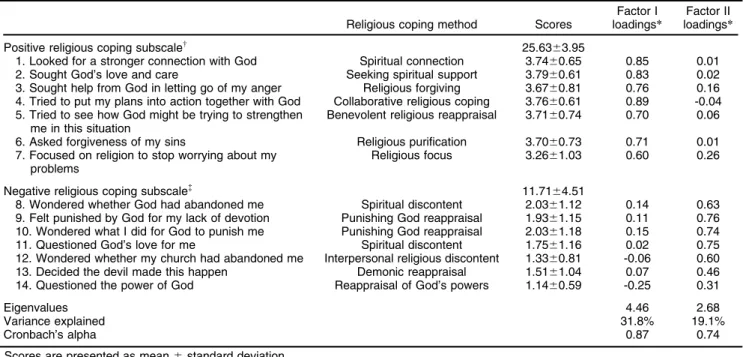
a Kaiser-Mayer-Olkin (KMO) statistics of 0.83 and a significant Bartlett’s test for sphericity (w2(91) = 819.40; po0.001), supporting the factorability of the correlation matrix. Inspection of the scree plot revealed two large components, indicating a factor structure. A two-component extraction with varimax rotation revealed that the first factor, positive religious coping, explained 31.8% of variance, whereas the second factor, religious struggle, explained an additional 19.1% of the variance. All items loaded significantly on the expected factors (Table 2). Cronbach’s alphas were 0.87 for factor I and 0.74 for factor II (Table 2).
Associations of religious coping with psychological distress and medication adherence
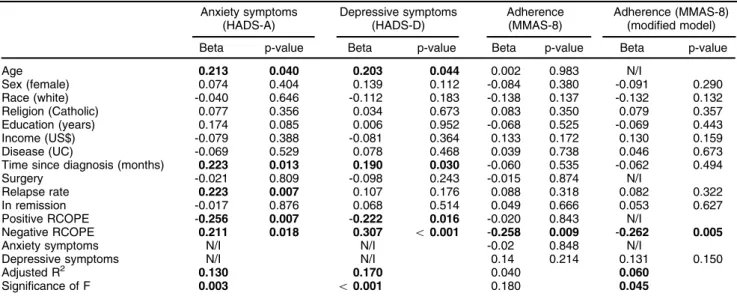
Both positive and negative religious coping were signifi-cantly associated with anxiety symptoms; these associa-tions remained significant throughout the hierarchical steps
applied (Table 3). As shown in Table 3, in the final model, being older (p = 0.040), having longer disease duration (p = 0.013), a higher relapse rate (p = 0.007), lower positive religious coping (p = 0.007), and higher negative religious coping (p = 0.018) were significantly and independently associated with the severity of anxiety symptoms. A similar analysis revealed significant associations of depressive symptoms with older age (p = 0.044), longer disease duration (p = 0.030), lower positive religious coping (p = 0.007), and higher negative religious coping (p = 0.018) (Table 3).
Negative religious coping (p = 0.009) was the only variable significantly and independently associated with self-reported medication adherence in the final model (Table 3). However, the final model was not significant overall (p = 0.180), due to redundant predictors. Therefore, variables that made small contributions to the model, namely age, surgery, positive religious coping, and anxiety, were dropped. In this modified final model, negative Table 1 Sociodemographic profile, disease-related variables, religious coping, psychological distress symptoms, HRQoL, and self-reported adherence scores in patients with inflammatory bowel disease
Overall sample (n=147) CD (n=64) UC (n=83) p-value
Age 45.1614.08 43.86614.29 46.06613.93 0.350 Sex (female) 84 (57.1) 37 (57.8) 47 (56.6) 0.885 Race (white plus Brazilian mulatto) 96 (65.3) 44 (68.8) 52 (62.7) 0.441 Religion (Catholic) 108 (73.5) 46 (71.9) 62 (74.7) 0.701*
Marital status (spouse/partner) 98 (66.7) 46 (71.9) 52 (62.7) 0.239*
Education (years) 8.3764.89 8.1464.59 8.5465.13 0.627w
Gross monthly income (US$) 482.936560.03 487.586665.19 479.346467.37 0.930w
Time since diagnosis (months) 80.47671.83 79.73673.97 81.04670.57 0.914w
Relapse rate 0.023*
1 = low (one or two in last 2 years) 53 (36.3) 23 (36.5) 30 (36.1) 2 = moderate (three to five in last 2 years) 61 (41.8) 20 (31.7) 41 (49.4) 3 = high (six or more in last 2 years) 32 (21.9) 20 (31.7) 12 (14.5)
Hospitalized for IBD 79 (53.7) 39 (60.9) 40 (48.2) 0.124*
Surgery for IBD 26 (17.7) 20 (31.3) 6 (7.2) o0.001*
Disease in remission=
o0.001*
No (medium/high activity/severity) 57 (38.8) 2 (3.1) 55 (66.3) Yes (low activity/severity) 90 (61.2) 62 (96.9) 28 (33.7)
Religious coping
Positive religious coping score 25.6363.95 24.9764.64 26.1363.26 0.091w
Negative religious coping score 11.7164.51 11.5364.18 11.8664.76 0.667w
HRQoL
Overall HRQoL 3.8860.81 3.9460.75 3.8460.85 0.485w
Satisfaction with health 3.5960.96 3.3461.10 3.7860.80 0.008w
Physical HRQoL 3.4860.64 3.4260.60 3.5460.67 0.272w
Psychological HRQoL 3.8260.67 3.6860.61 3.9260.71 0.030w
Social HRQoL 3.9060.74 3.9860.74 3.8360.74 0.234w
Environmental HRQoL 3.3860.53 3.4160.54 3.3660.53 0.554w
Psychological distress
Anxious (HADS-AX8) 37 (25.2) 21 (32.8) 16 (19.3) 0.061* Anxiety score (HADS-A) 5.5864.30 6.0064.06 5.2664.47 0.302w
Depressive (HADS-DX8) 36 (24.5) 15 (23.4) 21 (25.3) 0.794* Depression score (HADS-D) 5.2763.78 5.0063.83 5.4863.74 0.445w
Morisky scale adherence score 5.5761.75 5.5661.85 5.5861.69 0.946w
Data presented as n (%) or mean6standard deviation.
CD = Crohn’s disease; HADS-A = Hospital Anxiety and Depression Scale – Anxiety Subscale; HADS-D = Hospital Anxiety and Depression Scale – Depression Subscale; HRQoL = health-related quality of life; IBD = inflammatory bowel disease; SD = standard deviation; UC = ulcerative colitis.
*Chi-square test;w
two-tailed t-test. Statistically significant results are in bold. =
religious coping remained the only significant correlate of self-reported adherence (p = 0.005), with the model being statistically significant (p = 0.045) (Table 3).
Associations of religious coping and psychological distress with HRQoL
In the final model, anxiety was the only significant variable independently associated with overall HRQoL (Table 4).
A similar set of analyses for satisfaction with health (Table 4) showed that demographic (model 1) and disease (model 2) variables explained 16.4% of the variance (p = 0.044); UC patients manifested better satisfaction with health (p o 0.01). Addition of religious coping (model 3) increased the variance by 2%, with positive religious coping significantly associated with satisfaction with health. The addition of anxiety and depressive symptoms (model 4) rendered the previous significant association non-significant, adding a further 17% to the variance explained. In the final model, having UC and less symptoms of anxiety were the variables significantly and independently associated with better satisfaction with health.
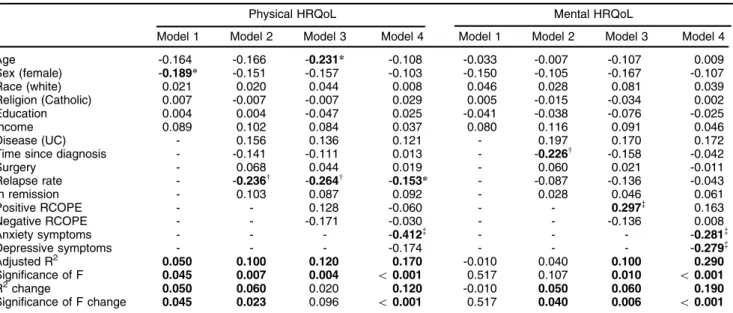
Table 5 shows that, in the final model for physical HRQoL, a higher relapse rate and more severe anxiety symptoms were variables independently associated with poor physical HRQoL.
A similar analysis with mental HRQoL as dependent variable (Table 5) showed that demographic (model 1) and disease (model 2) variables explained 10.7% of the
variance (p = 0.044); in this analysis, longer disease duration was associated with impaired mental HRQoL (p o 0.01). Addition of religious coping (model 3) increased the variance by 6% (p = 0.006), with positive religious coping significantly associated with mental HRQoL (po0.001). However, anxiety and depressive symptoms (model 4) rendered the previous association non-significant.
Similar patterns of associations were observed for HRQoL in the social relationships and environment domains. Better HRQoL in the social relationships domain was independently associated with younger age (b = -0.225, p = 0.015), higher positive religious coping (b = 0.196, p = 0.022), and higher anxiety (b = -0.361, p o 0.001) and depressive (b = -0.200, p = 0.029) symptoms. Finally, lower income (b = -0.216, p = 0.016) and higher anxiety (b = -0.204, p = 0.038) and depressive (b = -0.235, p = 0.020) symptoms were independently associated with HRQoL in the environment domain (Table 5).
Mediation analysis
All assumptions suggested by Baron & Kenny for a mediation effect were met,37 as all pairwise partial correlations between the predictor (positive religious coping), the potential mediators (anxiety and depressive symptoms), and the outcome variables (certain aspects of HRQoL) were significant, after controlling for demo-graphics and disease-related variables (results available upon request).
Table 2 Scores and factor loadings of Brief RCOPE Scale items among patients with inflammatory bowel disease (n=147)
Religious coping method Scores
Factor I loadings*
Factor II loadings*
Positive religious coping subscalew 25.63
63.95
1. Looked for a stronger connection with God Spiritual connection 3.7460.65 0.85 0.01 2. Sought God’s love and care Seeking spiritual support 3.7960.61 0.83 0.02 3. Sought help from God in letting go of my anger Religious forgiving 3.6760.81 0.76 0.16 4. Tried to put my plans into action together with God Collaborative religious coping 3.7660.61 0.89 -0.04 5. Tried to see how God might be trying to strengthen
me in this situation
Benevolent religious reappraisal 3.7160.74 0.70 0.06
6. Asked forgiveness of my sins Religious purification 3.7060.73 0.71 0.01 7. Focused on religion to stop worrying about my
problems
Religious focus 3.2661.03 0.60 0.26
Negative religious coping subscale=
11.7164.51
8. Wondered whether God had abandoned me Spiritual discontent 2.0361.12 0.14 0.63 9. Felt punished by God for my lack of devotion Punishing God reappraisal 1.9361.15 0.11 0.76 10. Wondered what I did for God to punish me Punishing God reappraisal 2.0361.18 0.15 0.74 11. Questioned God’s love for me Spiritual discontent 1.7561.16 0.02 0.75 12. Wondered whether my church had abandoned me Interpersonal religious discontent 1.3360.81 -0.06 0.60 13. Decided the devil made this happen Demonic reappraisal 1.5161.04 0.07 0.46 14. Questioned the power of God Reappraisal of God’s powers 1.1460.59 -0.25 0.31
Eigenvalues 4.46 2.68
Variance explained 31.8% 19.1%
Cronbach’s alpha 0.87 0.74
Scores are presented as mean6standard deviation.
Labels for religious coping methods were obtained from Devlen et al.36
Principal component factor analysis of the Brief RCOPE Scale revealed two factors: factor I (positive religious/spiritual coping factor) and factor II (negative religious/spiritual coping factor).
*Factor loadings obtained after varimax rotation.
w
Positive coping subscale score is the sum of the scores of the seven items that loaded in factor I, i.e., positive coping strategies. =
As shown in Table 6, anxiety symptoms fully mediated the effect of positive religious coping on overall HRQoL, satisfaction with health, and psychological HRQoL, and partially mediated the effect of positive religious coping on social relationships HRQoL. Depressive symptoms did not demonstrate any mediation effect on the association between positive religious coping and all aforementioned aspects of HRQoL.
Discussion
Individuals with IBD face significant limitations and burden imposed by their illness. A recent qualitative investigation proposed a framework model for informing the impact of IBD from a patient’s perspective.38 Acc-ording to this study, individuals with IBD deal with several unique sources of distress, including the need to take Table 3 Final models of the hierarchical linear multiple regression analyses performed with dependent variables anxiety and depressive symptom severity (HADS) and self-reported adherence (MMAS-8) (n=147)
Anxiety symptoms (HADS-A)
Depressive symptoms (HADS-D)
Adherence (MMAS-8)
Adherence (MMAS-8) (modified model)
Beta p-value Beta p-value Beta p-value Beta p-value
Age 0.213 0.040 0.203 0.044 0.002 0.983 N/I
Sex (female) 0.074 0.404 0.139 0.112 -0.084 0.380 -0.091 0.290 Race (white) -0.040 0.646 -0.112 0.183 -0.138 0.137 -0.132 0.132 Religion (Catholic) 0.077 0.356 0.034 0.673 0.083 0.350 0.079 0.357 Education (years) 0.174 0.085 0.006 0.952 -0.068 0.525 -0.069 0.443 Income (US$) -0.079 0.388 -0.081 0.364 0.133 0.172 0.130 0.159 Disease (UC) -0.069 0.529 0.078 0.468 0.039 0.738 0.046 0.673 Time since diagnosis (months) 0.223 0.013 0.190 0.030 -0.060 0.535 -0.062 0.494 Surgery -0.021 0.809 -0.098 0.243 -0.015 0.874 N/I
Relapse rate 0.223 0.007 0.107 0.176 0.088 0.318 0.082 0.322 In remission -0.017 0.876 0.068 0.514 0.049 0.666 0.053 0.627 Positive RCOPE -0.256 0.007 -0.222 0.016 -0.020 0.843 N/I
Negative RCOPE 0.211 0.018 0.307 o0.001 -0.258 0.009 -0.262 0.005
Anxiety symptoms N/I N/I -0.02 0.848 N/I
Depressive symptoms N/I N/I 0.14 0.214 0.131 0.150
Adjusted R2 0.130 0.170 0.040 0.060
Significance of F 0.003 o0.001 0.180 0.045
Beta = standardized beta regression coefficients; HADS-A = Hospital Anxiety and Depression Scale – Anxiety Subscale; HADS-D = Hospital Anxiety and Depression Scale – Depression Subscale; MMAS-8 = Morisky Medication Adherence Scale; N/I = not included in the model; RCOPE = Brief RCOPE Scale; UC = ulcerative colitis.
Statistically significant results are in bold.
Table 4 Hierarchical multiple regression analysis assessing variables independently associated with overall HRQoL and satisfaction with health (n=147)
Overall HRQoL Satisfaction with health
Model 1 Model 2 Model 3 Model 4 Model 1 Model 2 Model 3 Model 4
Age -0.114 -0.105 -0.188 -0.104 0.158 0.154 0.108 0.215*
Sex (female) -0.115 -0.112 -0.136 -0.106 -0.099 -0.078 -0.145 -0.100 Race (white) 0.120 0.119 0.154 0.138 0.073 0.090 0.126 0.098 Religion (Catholic) -0.054 -0.058 -0.064 -0.034 -0.027 -0.045 -0.067 -0.032 Education 0.097 0.117 0.065 0.132 0.099 0.081 0.093 0.163 Income 0.020 0.010 -0.012 -0.043 -0.118 -0.110 -0.118 -0.159 Disease (UC) -0.067 -0.091 -0.117 0.335w 0.325w 0.307w
Time since diagnosis -0.068 -0.023 0.064 -0.106 -0.057 0.052
Surgery 0.116 0.085 0.076 0.128 0.108 0.089
Relapse rate -0.081 -0.118 -0.031 -0.045 -0.073 0.027 In remission -0.066 -0.073 -0.079 0.117 0.159 0.160
Positive RCOPE 0.092 0.213w
0.086
Negative RCOPE -0.092 0.030 0.148
Anxiety symptoms -0.387=
-0.399=
Depressive symptoms -0.009 -0.111
Adjusted R2 0.030 0.020 0.050 0.170 -0.020 0.030 0.060 0.230 Significance of F 0.135 0.263 0.098 0.001 0.699 0.164 0.076 0.001 R2change 0.030 -0.010 0.030 0.120 -0.020 0.050 0.020 0.170 Significance of F change 0.135 0.575 0.044 o0.001 0.699 0.044 0.070 o0.001
Data presented as standardized beta regression coefficients.
HRQoL = health-related quality of life; RCOPE = Brief RCOPE Scale; UC = ulcerative colitis.
medications, dietary restrictions, the need to maintain close proximity to a toilet (which is associated with stigma and embarrassment), the potential need to cancel commitments due to bowel symptoms, and impact on relationships (e.g., avoidance of dating).38The investiga-tion of processes through which IBD patients deal with these stressors becomes important for improving out-comes. Its relevance for the adaptive process to chronic diseases notwithstanding, religious coping had not been previously studied in IBD samples. This study suggests that IBD patients utilize religious coping resources to adapt to the unique stressors they face.
In the present sample, IBD patients often drew on positive religious coping methods to deal with their illness. Negative religious coping (i.e., religious struggle) was less commonplace, yet both forms of coping held significant implications for outcomes. The results of the present study reveal that religious struggle is related to more psychological distress symptoms and lower treatment adherence. Conversely, positive religious
coping was associated with lower levels of psychological distress and greater satisfaction with health, as well as with mental and overall HRQoL. These findings are consistent with those generated in studies of patients dealing with several other chronic disease states.20,21 A recent longitudinal survey indicated that religiousness and spirituality, but not church attendance, are asso-ciated with thicker cortices in regions related to mood regulation, arguably conferring resilience in individuals at risk of developing depression.39Thus, neurobiological factors could also partly explain the association of positive religious coping and lower levels of psychological distress observed in this study. These results extend this research to the experiences of IBD patients and, more generally, underscore the salience of religious coping to our understanding of illness and its conse-quences.
Lower levels of anxiety mediated the beneficial effects of positive religious coping on quality of life. These findings indicate that, although religious coping may Table 5 Hierarchical multiple regression analyses assessing the variables independently associated with physical and mental HRQoL (n=147)
Physical HRQoL Mental HRQoL
Model 1 Model 2 Model 3 Model 4 Model 1 Model 2 Model 3 Model 4
Age -0.164 -0.166 -0.231* -0.108 -0.033 -0.007 -0.107 0.009 Sex (female) -0.189* -0.151 -0.157 -0.103 -0.150 -0.105 -0.167 -0.107 Race (white) 0.021 0.020 0.044 0.008 0.046 0.028 0.081 0.039 Religion (Catholic) 0.007 -0.007 -0.007 0.029 0.005 -0.015 -0.034 0.002 Education 0.004 0.004 -0.047 0.025 -0.041 -0.038 -0.076 -0.025 Income 0.089 0.102 0.084 0.037 0.080 0.116 0.091 0.046 Disease (UC) - 0.156 0.136 0.121 - 0.197 0.170 0.172 Time since diagnosis - -0.141 -0.111 0.013 - -0.226w -0.158 -0.042
Surgery - 0.068 0.044 0.019 - 0.060 0.021 -0.011 Relapse rate - -0.236w -0.264w -0.153
* - -0.087 -0.136 -0.043 In remission - 0.103 0.087 0.092 - 0.028 0.046 0.061 Positive RCOPE - - 0.128 -0.060 - - 0.297= 0.163 Negative RCOPE - - -0.171 -0.030 - - -0.136 0.008 Anxiety symptoms - - - -0.412=
- - - -0.281=
Depressive symptoms - - - -0.174 - - - -0.279=
Adjusted R2 0.050 0.100 0.120 0.170 -0.010 0.040 0.100 0.290 Significance of F 0.045 0.007 0.004 o0.001 0.517 0.107 0.010 o0.001 R2change 0.050 0.060 0.020 0.120 -0.010 0.050 0.060 0.190 Significance of F change 0.045 0.023 0.096 o0.001 0.517 0.040 0.006 o0.001
Data presented as standardized beta regression coefficients.
HRQoL = health-related quality of life; RCOPE = Brief RCOPE Scale; UC = ulcerative colitis.
*po0.05;w
po0.01,=
po0.001. Statistically significant results are in bold.
Table 6 Mediation analyses (Sobel test); effect of positive RCOPE on aspects of HRQoL, mediated by anxiety and/or depressive symptoms
Indirect effect; z (p)
Outcome variable Direct effect (p) Through anxiety symptoms Through depressive symptoms
Overall HRQoL 0.021 (0.326) 0.020; 2.205 (0.028) 0; 0.085 (0.932) Satisfaction with health 0.019 (0.340) 0.025; 2.256 (0.024) 0.006; 0.975 (0.330) Psychological HRQoL 0.029 (0.063) 0.012; 1.995 (0.046) 0.011; 1.834 (0.067) Social HRQoL 0.037 (0.022) 0.018; 2.234 (0.026) 0.008; 1.567 (0.117)
HRQoL = health-related quality of life; RCOPE = Brief RCOPE Scale.
contribute to psychological distress among IBD patients, anxiety symptoms per se have a direct detrimental effect on HRQoL. Accordingly, IBD patients suffer from significant worry and fear of potentially embarrassing bowel symptoms and exacerbations in the social context.36 Therefore, anxious cognitions may persist even in remitted IBD. We found that anxiety was a consistent independent predictor of worse HRQoL in several investigated domains (overall, satisfaction with health, physical HRQoL, and mental HRQoL). Depressive symptoms were also associated with poorer mental HRQoL. In fact, depression and anxiety are interrelated conditions in IBD.40Previous evidence indicates that psychological distress symptoms are independent correlates of impaired HRQoL across studies.10,11,41Given the importance of psychological distress symptoms such as anxiety to HRQoL, greater recognition of the ties between positive religious coping and lower levels of anxiety may be of practical value in fostering less distress and, in turn, greater HRQoL.
Psychological distress symptoms were not indepen-dent correlates of lower treatment adherence in our sample. This finding is consistent with a recent large cross-sectional study.42Other psychosocial factors may in fact be more closely related to nonadherence in IBD. These factors include, for example, belief of necessity for medication and lower concerns towards medication.42 In the present study, we found that religious struggle was an independent correlate of poorer adherence. Religious struggle may in theory contribute to treatment nonadher-ence through several cognitions, such as the beliefs that ‘‘God has abandoned me. No matter what I do, God had already turned His back on me.’’ In fact, fatalistic cognitions related to religion may promote nonadherence in other chronic medical conditions.43,44Religious fatalism may develop as a non-adaptive response to chronic medical illnesses.43
This study has some limitations that should be recognized. First, the sample was largely composed of Roman Catholic Christian participants. Therefore, these results are not generalizable to other religious denomina-tions. Second, the cross-sectional design of this investi-gation could not establish a causal relationship between religious coping and the outcomes assessed. Third, other intervening variables not measured in the present study might contribute to some of the observed effects. For example, social support may mediate some of the effects of positive coping on psychological distress.45Fourth, this was a single-center study. Finally, we used an indirect measure of treatment adherence (MMAS-8).
Despite these limitations, the present study opens important avenues for research and practice. This work suggests that gastroenterologists and consultation-liaison psychiatrists should consider religious coping strategies in IBD patients, as this construct may independently influence important illness-related outcomes – namely, psychological distress symptoms and treatment adherence. This study also paves the way for future research directions. For example, prospective studies could be conducted to confirm the causality of the observed associations. Furthermore, psycho-spiritual interventions designed to support positive religious coping and to prevent or treat
religious struggle may directly alleviate psychological distress and improve treatment adherence in IBD, while being of indirect benefit for improving IBD-related HRQoL.
Acknowledgements
AFC and LLB are recipients of research fellowships from Conselho Nacional de Desenvolvimento Cientifico e Tecnolo´gico (CNPq; level II), Brazil. JQ and MHS have also been supported by research fellowship awards from CNPq (levels IA and ID, respectively).
Disclosure
RSM has received grant support or honoraria from or has served in scientific advisory boards for AstraZeneca, Bristol-Myers Squibb, France Foundation, GlaxoSmithK-line, Janssen-Ortho, Eli Lilly, Organon, Lundbeck, Merck, Pfizer, CME Outfitters, Optum Health, I3CME, and Physicians’ Postgraduate Press. AFC has received speaker honoraria from Abbott, GlaxoSmithKline, Lund-beck, Pfizer, and Ache. The other authors report no conflicts of interest.
References
1 Mulder DJ, Noble AJ, Justinich CJ, Duffin JM. A tale of two diseases: the history of inflammatory bowel disease. J Crohns Colitis. 2014;8:341-8. 2 Fuller-Thomson E, Sulman J. Depression and inflammatory bowel
disease: findings from two nationally representative Canadian sur-veys. Inflamm Bowel Dis. 2006;12:697-707.
3 Hauser W, Moser G, Klose P, Mikocka-Walus A. Psychosocial issues in evidence-based guidelines on inflammatory bowel diseases: a review. World J Gastroenterol. 2014;20:3663-71.
4 Bromet E, Andrade LH, Hwang I, Sampson NA, Alonso J, de Girolamo G, et al. Cross-national epidemiology of DSM-IV major depressive episode. BMC Med. 2011;9:90-90.
5 Sajadinejad MS, Asgari K, Molavi H, Kalantari M, Adibi P. Psychological issues in inflammatory bowel disease: an overview. Gastroenterol Res Pract. 2012;2012:106502.
6 Mawdsley JE, Rampton DS. Psychological stress in IBD: new insights into pathogenic and therapeutic implications. Gut. 2005;54: 1481-91.
7 Selinger CP, Robinson A, Leong RW. Clinical impact and drivers of non-adherence to maintenance medication for inflammatory bowel disease. Expert Opin Drug Saf. 2011;10:863-70.
8 Goodhand JR, Kamperidis N, Sirwan B, Macken L, Tshuma N, Koodun Y, et al. Factors associated with thiopurine non-adherence in patients with inflammatory bowel disease. Aliment Pharmacol Ther. 2013;38:1097-108.
9 Lakatos PL. Prevalence, predictors, and clinical consequences of medical adherence in IBD: how to improve it? World J Gastroenterol. 2009;15:4234-9.
10 Iglesias-Rey M, Barreiro-de Acosta M, Caamano-Isorna F, Rodriguez IV, Ferreiro R, Lindkvist B, et al. Psychological factors are associated with changes in the health-related quality of life in inflammatory bowel disease. Inflamm Bowel Dis. 2014;20:92-102.
11 Lix LM, Graff LA, Walker JR, Clara I, Rawsthorne P, Rogala L, et al. Longitudinal study of quality of life and psychological functioning for active, fluctuating, and inactive disease patterns in inflammatory bowel disease. Inflamm Bowel Dis. 2008;14:1575-84.
12 Casellas F, Lopez-Vivancos J, Casado A, Malagelada JR. Factors affecting health related quality of life of patients with inflammatory bowel disease. Qual Life Res. 2002;11:775-81.
14 Boye B, Jahnsen J, Mokleby K, Leganger S, Jantschek G, Jantschek I, et al. The INSPIRE study: are different personality traits related to disease-specific quality of life (IBDQ) in distressed patients with ulcera-tive colitis and Crohn’s disease? Inflamm Bowel Dis. 2008;14:680-6. 15 Hyphantis TN, Tomenson B, Bai M, Tsianos E, Mavreas V, Creed F.
Psychological distress, somatization, and defense mechanisms associated with quality of life in inflammatory bowel disease patients. Dig Dis Sci. 2010;55:724-32.
16 Ehman JW, Ott BB, Short TH, Ciampa RC, Hansen-Flaschen J. Do patients want physicians to inquire about their spiritual or religious beliefs if they become gravely ill? Arch Intern Med. 1999;159:1803-6. 17 Pargament KI. The psychology of religion and coping: theory,
research, practice. New York: Guilford Press; 1997.
18 Panzini RG, Bandeira DR. Coping (enfrentamento) religioso/ espiritual. Rev Psiq Clin. 2007;34:126-35.
19 Koenig HG, Pargament KI, Nielsen J. Religious coping and health status in medically ill hospitalized older adults. J Nerv Men Dis. 1998;186:513-21.
20 Ramirez SP, Macedo DS, Sales PM, Figueiredo SM, Daher EF, Araujo SM, et al. The relationship between religious coping, psychological distress and quality of life in hemodialysis patients. J Psychosom Res. 2012;72:129-35.
21 Pargament KI, Koenig HG, Tarakeshwar N, Hahn J. Religious strug-gle as a predictor of mortality among medically ill elderly patients: a 2-year longitudinal study. Arch Intern Med. 2001;161:1881-5. 22 Dignass A, Eliakim R, Magro F, Maaser C, Chowers Y, Geboes K,
et al. Second European evidence-based consensus on the diagnosis and management of ulcerative colitis part 1: definitions and diagnosis. J Crohns Colitis. 2012;6:965-90.
23 Van Assche G, Dignass A, Panes J, Beaugerie L, Karagiannis J, Allez M, et al. The second European evidence-based Consensus on the diagnosis and management of Crohn’s disease: definitions and diagnosis. J Crohns Colitis. 2010;4:7-27.
24 Bertolucci PH, Brucki SM, Campacci SR, Juliano Y. [The Mini-Mental State Examination in a general population: impact of educational status]. Arq Neuropsiquiatr. 1994;52:1-7.
25 de Azevedo Marques JM, Zuardi AW. Validity and applicability of the Mini International Neuropsychiatric Interview administered by family medicine residents in primary health care in Brazil. Gen Hosp Psychiatry. 2008;30:303-10.
26 Best WR, Becktel JM, Singleton JW, Kern F Jr. Development of a Crohn’s disease activity index. National Cooperative Crohn’s Disease Study. Gastroenterology. 1976;70:439-44.
27 Truelove SC, Witts LJ. Cortisone in ulcerative colitis; final report on a therapeutic trial. Br Med J. 1955;2:1041-8.
28 Pargament K, Feuille M, Burdzy D. The Brief RCOPE: Current Psy-chometric Status of a Short Measure of Religious Coping. Religions. 2011;2:51-76.
29 Pargament KI, Koenig HG, Perez LM. The many methods of religious coping: development and initial validation of the RCOPE. J Cin Psychol. 2000;56:519-43.
30 Panzini RG, Bandeira DR. Escala de coping religioso-espiritual (Escala CRE1): elaborac¸a˜o e validac¸a˜o de construto. Psicol Estud.
2005;10:507-16.
31 Botega NJ, Bio MR, Zomignani MA, Garcia C, Pereira WA. [Mood disorders among medical in-patients: A validation study of the Hos-pital Anxiety and Depression Scale (HAD)]. Rev Saude Publica. 1995;29:355-63.
32 Fleck MP, Louzada S, Xavier M, Chachamovich E, Vieira G, Santos L, et al. [Application of the Portuguese version of the abbreviated instrument of quality life WHOQOL-bref]. Rev Saude Publica. 2000;34:178-83.
33 Oliveira-Filho AD, Barreto-Filho JA, Neves SJ, Lyra Junior DP. Association between the 8-item Morisky Medication Adherence Scale (MMAS-8) and blood pressure control. Arq Bras Cardiol. 2012;99:649-58.
34 Trindade AJ, Ehrlich A, Kornbluth A, Ullman TA. Are your patients taking their medicine? Validation of a new adherence scale in patients with inflammatory bowel disease and comparison with physician perception of adherence. Inflamm Bowel Dis. 2011;17:599-604.
35 Hayes AF. Introduction to mediation, moderation, and conditional process analysis: a regression-based approach. New York: Guilford Publications; 2013.
36 Devlen J, Beusterien K, Yen L, Ahmed A, Cheifetz AS, Moss AC. The burden of inflammatory bowel disease: a patient-reported qualitative analysis and development of a conceptual model. Inflamm Bowel Dis. 2014;20:545-52.
37 Baron RM, Kenny DA. The moderator-mediator variable distinction in social psychological research: conceptual, strategic, and statistical considerations. J Pers Soc Psychol. 1986;51:1173-82.
38 Kiebles JL, Doerfler B, Keefer L. Preliminary evidence supporting a framework of psychological adjustment to inflammatory bowel dis-ease. Inflamm Bowel Dis. 2010;16:1685-95.
39 Miller L, Bansal R, Wickramaratne P, Hao X, Tenke CE, Weissman MM, et al. Neuroanatomical correlates of religiosity and spirituality: a study in adults at high and low familial risk for depression. JAMA Psychiatry. 2014;71:128-35.
40 Graff LA, Walker JR, Bernstein CN. Depression and anxiety in inflammatory bowel disease: a review of comorbidity and manage-ment. Inflamm Bowel Dis. 2009;15:1105-18.
41 Vidal A, Gomez-Gil E, Sans M, Portella MJ, Salamero M, Pique JM, et al. Health-related quality of life in inflammatory bowel disease patients: the role of psychopathology and personality. Inflamm Bowel Dis. 2008;14:977-83.
42 Selinger CP, Eaden J, Jones DB, Katelaris P, Chapman G, McDonald C, et al. Modifiable factors associated with nonadherence to main-tenance medication for inflammatory bowel disease. Inflamm Bowel Dis. 2013;19:2199-206.
43 Franklin MD, Schlundt DG, McClellan LH, Kinebrew T, Sheats J, Belue R, et al. Religious fatalism and its association with health behaviors and outcomes. Am J Health Behav. 2007;31:563-72. 44 Azaiza F, Cohen M, Awad M, Daoud F. Factors associated with low
screening for breast cancer in the Palestinian Authority: relations of availability, environmental barriers, and cancer-related fatalism. Cancer. 2010;116:4646-55.