Correlation of Menopausal Symptoms and
Quality of Life with Physical Performance in
Middle-Aged Women
Relação entre sintomas climatéricos e qualidade de vida
no desempenho físico em mulheres de meia-idade
Rívea Trindade da Silva
1Saionara Maria Aires da Câmara
2Mayle Andrade Moreira
1Rafaela Andrade do Nascimento
1Mariana Carmem Apolinário Vieira
1Maria Socorro Medeiros de Morais
3Álvaro Campos Cavalcanti Maciel
11Department of Physiotherapy, Universidade Federal do Rio Grande do Norte, Natal, RN, Brazil
2Faculty of Health Sciences of Trairi, Universidade Federal do Rio Grande do Norte, Natal, RN, Brazil
3Health Sciences Center, Universidade Federal do Rio Grande do Norte, Natal, RN, Brazil
Rev Bras Ginecol Obstet 2016;38:266–272.
Address for correspondenceMayle Andrade Moreira, Master Degree, PhD applicant, Department of Physiotherapy, Universidade Federal do Rio Grande do Norte, Avenida Senador Salgado Filho, S/N Caixa Postal 1524 - Campus Universitário - Lagoa Nova, 59072-970, Natal, RN, Brazil (e-mail: [email protected]).
Keywords
►
menopause
►
quality of life
►
muscle strength
Abstract
Introduction
Some studies have investigated the in
fl
uence of hormonal de
fi
cits and
menopausal status in muscle disorders of women. However, it has not been
investi-gated the relationship of both climacteric symptoms and the perception of quality of
life with physical performance.
Objective
To evaluate the correlation of menopausal symptoms and quality of life
with physical performance in middle-aged women.
Methods
This cross-sectional study was performed from April to November 2013 in the
municipality of Parnamirim, in the Brazilian state, Rio Grande do Norte. The sample was
composed of 497 women aged 40
–
65 years. The Menopause Rating Scale (MRS) and the
Utian Quality of Life (UQOL) questionnaire were used to evaluate menopausal symptoms
and quality of life respectively. Measures of physical performance included handgrip
strength, knee extensor and
fl
exor strengths (using an isometric dynamometer), gait
speed, and chair stand test. The correlation between menopausal symptoms and quality of
life with physical performance was assessed by Pearson
’
s correlation coef
fi
cient with
signi
fi
cance set at
p
<
0.05 and a con
fi
dence interval of 95%.
Results
There was a signi
fi
cant negative correlation between handgrip strength and
somatic MRS score (
p
¼
0.002) and total MRS score (
p
¼
0.03). There was a signi
fi
cant
correlation between knee
fl
exor strength and sit-to-stand time and all menopausal
symptom areas (
p
<
0.05), except psychological symptoms. There was a positive
correlation between physical performance of the knee
fl
exors and quality of life items
including occupational (
p
¼
0.001), emotional (
p
¼
0.005), and total UQOL (
p
¼
0.01),
but a negative correlation with sit-to-stand time and all quality of life domains (
p
<
0.05).
received January 5, 2016 accepted April 5, 2016 published online May 19, 2016
DOI http://dx.doi.org/ 10.1055/s-0036-1584238. ISSN 0100-7203.
Copyright © 2016 by Thieme Publicações Ltda, Rio de Janeiro, Brazil
Introduction
The aging process features a natural decline of physiological functions, including loss of bone mass, muscle mass, and
strength.1In Brazil as well as worldwide, population aging is
marked by feminization, as women are achieving greater
longevity than men.2Although they live longer than men,
women present worse physical performance results at more
advanced ages, suggesting the influence of sex-related
fac-tors in performance changes with aging.3
Muscle mass in women tends to decrease gradually after the third decade of age, and displays an accelerated decline
after thefifth decade, the average period of the occurrence of
menopause.4Menopause represents a biological milestone
in the female lifespan, signaling the passage from a
repro-ductive to a non-reprorepro-ductive phase5that is primarily
re-lated to decreases in estradiol and symptoms from hormonal
changes in this period.6In addition to muscle mass loss, a
significant muscular strength loss occurs during the
meno-pausal period that reflects negatively on the functional
capacity of these women.3,7
Clinically, the hormonal changes typical of this phase are related to changes in the health status of women, such as negative implications on quality of life, emotional lability, interference in mood and sleep, and an increased risk of
depression and cognitive difficulties.6,8Together with these
changes, some menopausal symptoms are related to lower
physical activity levels,9which could contribute to the worse
physical performance levels found among women from middle age onward.
These changes during the menopause phase tend to impair quality of life and result from both
hypoestrogen-ism–related biological factors and cultural and
psychoso-cial factors.6,10In addition, the ways women perceive such
changes are distinct, as are the manifestations of meno-pausal symptoms and the way they interfere with quality
of life and daily functioning.11 Thus, it is assumed that
menopausal symptoms and quality of life perceptions are
related to women’s ability to perform daily living
activ-ities12; also, the former may exacerbate the harmful
effects of muscle mass and strength losses that occur
during this period.13
Although some studies have investigated the influence of
hormonal deficits and menopausal status on muscle changes
in women,3,7,14the correlation between menopausal
symp-toms and quality of life and physical performance have not received proper attention; therefore, the objective of this study is to evaluate the correlation between menopausal symptoms and quality of life and the physical performance of middle-aged women.
Conclusion
A greater intensity of menopausal symptoms and worse quality of life
were related with worse physical performance. Thus, preventive measures should be
implemented to avoid adverse effects on physical performance at more advanced ages.
Resumo
Objetivo
Avaliar a relação entre sintomatologia climatérica e qualidade de vida no
desempenho físico em mulheres de meia-idade.
Métodos
Estudo transversal, realizado de abril a novembro de 2013, no município de
Parnamirim/RN. A amostra foi composta por 497 mulheres (40 a 65 anos). Menopause
Rating Scale (MRS) foi utilizada para a avaliação dos sintomas climatéricos e Utian
Quality of Life (UQOL) para a qualidade de vida. Medidas de desempenho físico foram
compostas pela força de preensão manual, força de extensores e
fl
exores de joelho
(usando um dinamômetro isométrico), velocidade de marcha e tempo de
sentar-levantar. A relação da sintomatologia climatérica e qualidade de vida com o
desem-penho físico foi avaliada pelo teste de correlação de Pearson, sendo considerado um
p
<
0,05 e intervalo de con
fi
ança de 95%.
Resultados
Houve correlação signi
fi
cativa negativa da força de preensão quanto ao
MRS somático (
p
¼
0,002) e total (
p
¼
0,03). Para força de
fl
exores de joelho e tempo
de sentar-levantar, houve correlação signi
fi
cativa para todos os domínios dos sintomas
climatéricos (
p
<
0,05), exceto o psicológico. Entre qualidade de vida e desempenho
físico, houve correlação positiva dos
fl
exores de joelho quanto ao UQOL ocupacional
(
p
¼
0,001), emocional (
p
¼
0,005) e total (
p
¼
0,01), e negativa para o teste
sentar-levantar quanto a todos os domínios (
p
<
0,05).
Conclusão
A maior intensidade dos sintomas climatéricos e a pior qualidade de vida
apresentaram relação com piores desempenhos. Dessa forma, medidas de prevenção
devem ser implementadas a
fi
m de evitar consequências negativas no desempenho
físico em idades mais avançadas.
Palavras-chave
►
climatério
►
qualidade de vida
Methods
The present study was conducted in the municipality of Parnamirim, located in the metropolitan region of Natal, capital of Rio Grande do Norte. This municipality is 100%
urbanized and has200,000 inhabitants. This was a
cross-sectional study. Data from this study were collected from April to November 2013 in the Integrated Center for Teach-ing, Research and Extension (Nipec) of Parnamirim by trained interviewers using standardized protocols.
The study population consisted of women between 40 and 65 years of age residing in the Parnamirim municipality. A convenience sample of 500 women was assembled after project disclosure at the basic health units in the munici-pality. In order to participate in the study, women had to meet the following inclusion criteria: have between 40 and 65 years of age; no history of bilateral oophorectomy; no neurological or degenerative diseases, limb fractures, painful processes, or other conditions that could compromise the measurement of physical performance; and provide in-formed consent to participate in the study. Three women did not complete the evaluation and were excluded from the
analysis for afinal sample of 497 women.
This study followed the principles of the Declaration of Helsinki, and was approved by the Research Ethics Commit-tee of the Universidade Federal do Rio Grande do Norte (opinion number 387.737). All volunteers signed a Free and Informed Consent Form in agreement with resolution 466/12 of the Brazilian National Health Council.
Procedures
Physical performance was assessed using the following
vari-ables: handgrip strength, kneeflexor and extensor strength,
gait speed, and chair stand test. The handgrip strength was assessed in the dominant hand in kilogram-force (kgf) using a Jamar® dynamometer (Jamar, Irvington, NY, USA). The volunteer was positioned as recommended by the American
Society of Hand Therapists:15in a seated position with the
shoulder adducted and in neutral rotation, the elbow
posi-tioned at 90°flexion, and the forearm and wrist in neutral
positions. Each participant was requested to perform three 5-second sustained contractions, with a 1-minute interval between the measurements. The mean of three measure-ments was included in the analysis.
A portable MicroFET2® dynamometer (Hoggan, West Jordan, UT, USA) was used to measure the dominant knee
flexor and extensor strength. Knee extension was assessed
with the volunteer positioned in ventral decubitus on a
stretcher with the kneeflexed at 90°, and the thighfixed
to the stretcher by an inelastic band. The dynamometer was
fixed by the examiner to the anterior surface of the lower end
of the limb in a line immediately proximal to the malleolus.
During the kneeflexion strength assessment, the volunteer
remained in the same position, but with the knee extended. The dynamometer was positioned on the posterior surface of the lower end of the limb immediately above the line of the malleolus. Measurements of three maximum isometric
con-tractions of knee extension andflexion of 5 seconds each,
with a 1-minute interval between them, were conducted, and the arithmetic mean of three measurements was
calculated.16
For the assessment of gait speed and chair stand test, the time to walk in the usual step for a distance of 4 m was measured in 2 attempts, and the slower time was used to calculate the gait speed in meters per second. For the chair stand test, the volunteer was asked to sit down and fully
standfive times as fast as possible with their arms crossed
over the chest. The time to carry out the task was used in the analysis. More details about these tests are available in the
original article.17
Menopause symptoms were assessed by the Menopause Rating Scale (MRS), which is composed of eleven items divided into three areas: somatic, psychological, and
uro-genital. The symptoms are classified according to the
inten-sity of involvement reported by the women, where the value
for each question can be 0–4; the higher the score, the higher
the perception of the symptom. This scale was initially standardized in German and subsequently validated for
other languages, including Portuguese.18
Quality of life was assessed using the Utian Quality of Life (UQOL) scale, which was also validated for the Brazilian
population.19,20 This instrument consists of 23 questions
subdivided into occupational, health, emotional, and sexual areas. For each question, the volunteer should respond if the statement is very false (1), false (2), moderately true (3), true (4) or very true (5). At the end, the scores were added; the higher the score, the better the quality of life.
The volunteers’ sociodemographic data and
socioeco-nomic factors, such as age, years of schooling, stable union, and family income were collected. The latter was categorized into less than 3 times the minimum wages (MW), or 3 times
the MW or higher.3Weight (kg) and height (m) were also
measured.
Physical activity habits were self-reported and defined as
the regular practice of physical exercise at least three times a week for at least 30 minutes per session. Other data on life habits were also collected, such as walk per week and sitting time per day according to the guidelines of the short version of the International Physical Activity Questionnaire validated
for Brazil.21For the variable walk per week, the women were
instructed to report how many days and how much time per day they walked for more than 10 minutes without stopping during the last week, either as a way to get from one place to another or as physical exercise. Subsequently, the volunteers
were allocated into one of two categories:<90 minute/
week and90 minute/week.3For the sitting time per day,
women were requested to report how much time in a normal day they spent sitting at home or at work, relaxing, watching
television or reading, and the variable was dichotomized in
4 hour/day or>4 hour/day.3
Data Analysis
mean) and dispersion (standard deviation) for quantitative variables and absolute and relative frequencies for catego-rical variables. The correlation of menopausal symptoms and quality of life (both by the total score of the scales used and by the scores of the different areas) with the outcomes (muscular strength, gait speed, and sit-to-stand time) for
normally distributed data was assessed by Pearson’s
correla-tion test. Significance ofp<0.05 and a confidence interval of
95% were set for all tests.
Results
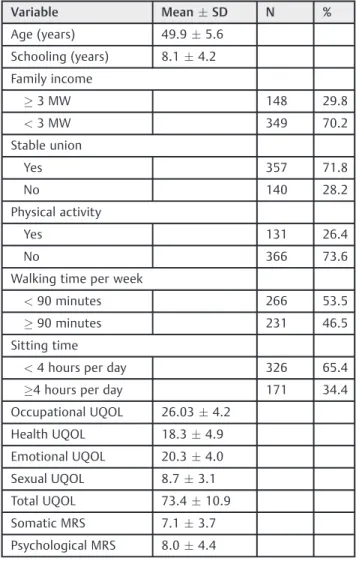
►Table 1shows the characteristics of the sample in terms of independent and dependent variables. The women had a
mean age of 49.95.6 years. The study sample showed a low
level of schooling (8.14.2 years) and a low family income
(70.2% reported having a family income<3 times the MW).
Regarding physical activity, 73.6% of the women reported not exercising regularly.
►Table 2 shows the results of the correlation analysis between menopausal symptoms and the physical
perfor-mance measures. There was a weakly significant negative
correlation between handgrip strength and somatic MRS
(p¼0.002) and total MRS (p¼0.03). Regarding kneeflexor
strength and sit-to-stand time, there was a weakly signifi
-cant correlation with all items of the MRS (p<0.05), except
the psychological domain. The higher the symptom intensity, the worse the physical performance, that is, the lower the strength and more time required to perform the chair stand test.
►Table 3 shows the results of the correlation analysis between the variables of quality of life and physical
perfor-mance. Regarding kneeflexor strength, a weakly significant
correlation was found with occupational (p¼0.001),
emo-tional (p¼0.005) and total UQOL scores (p¼0.01). In
addi-tion, a significant negative correlation was observed
between sit-to-stand time and all areas of the UQOL and
total score (p<0.05); the lower the perceived quality of life,
the worse the physical performance.
Discussion
The objective of this study was to verify the correlation between menopausal symptoms and quality of life in the
physical performance of middle-aged women. Significant
correlations were found between the variables. Worse phy-sical performance was associated with a higher perception of the intensity of menopausal symptoms and worse percep-tion of quality of life. The correlapercep-tion between menopausal stage and physical performance has already been the subject
of previous studies,3,7,14but the specific correlation between
Table 1 Characterization of the sample (N¼497)
Variable MeanSD N %
Age (years) 49.95.6 Schooling (years) 8.14.2 Family income
3 MW 148 29.8
<3 MW 349 70.2
Stable union
Yes 357 71.8
No 140 28.2
Physical activity
Yes 131 26.4
No 366 73.6
Walking time per week
<90 minutes 266 53.5
90 minutes 231 46.5
Sitting time
<4 hours per day 326 65.4
4 hours per day 171 34.4
Occupational UQOL 26.034.2 Health UQOL 18.34.9 Emotional UQOL 20.34.0 Sexual UQOL 8.73.1 Total UQOL 73.410.9 Somatic MRS 7.13.7 Psychological MRS 8.04.4
Abbreviations: MW, minimum wage; MRS, Menopause Rating Scale; N, number; SD, standard variation; UQOL, Utian Quality of Life.
Table 2 Correlation between physical performance and menopausal symptoms (N¼497)
Measures of physical performance
Menopause Symptoms (MRS scores)
Handgrip strength (kgf)
Knee flexors strength (kgf)
Knee extensor strength (kgf)
Sit-and-stand time (s)
Gait speed (m/s)
r p r p r p r p r p
Somatic 0.14 0.002 0.10 0.01 0.08 0.05 0.11 0.01 0.07 0.11 Psychological 0.03 0.42 0.03 0.48 0.03 0.52 0.06 0.15 0.02 0.53 Urogenital 0.06 0.12 0.10 0.02 0.06 0.17 0.15 0.001 0.08 0.07 Total 0.09 0.03 0.09 0.04 0.07 0.12 0.12 0.005 0.06 0.13
menopausal symptoms and physical performance has not
been sufficiently investigated.
In a study that evaluated 1,011 women in different menopausal phases, a correlation was observed between menopausal symptoms and physical activity level. The authors observed that women with a lower physical activity level had higher menopausal symptom scores, both in
fre-quency and intensity.9The fact that women who present
more intense symptoms are physically less active may explain the fact that they also have worse physical perfor-mance, since the practice of physical activity was a predictor of muscle strength loss in a longitudinal study of young
postmenopausal women.22 Moreover, Gonçalves et al23
claimed that women who reported less severe menopausal symptoms presented better quality of life and physical performance results, probably due to the practice of physical
activity.23Thus, it is possible that physical activity improves
quality of life, decrease the climacteric symptoms, increase the willingness to exercise and, consequently, avoid further loss of strength and muscle mass resulting from menopause,
leading to a better physical performance.7,23,24In the present
study, 73.6% of participants reported not being physically active on a regular basis, which may have contributed to the presence of more intense symptoms, lower quality of life, and worse physical performance.
A normal phenomenon in a woman’s lifetime, menopause
is also a critical period of personal, social, and psychological development that is frequently faced with apprehension due to the changes that occur, which can negatively impact
quality of life.25Women must adapt to the multiple physical,
psycho-affective, and sociocultural changes inherent to this process that can have repercussions on health status and
quality of life.26Both depression and fatigue are related to
menopausal symptoms,27 while depressive symptoms are
related to worse physical performance.28 Therefore, there
may be a cycle in which menopausal symptoms discourage women and trigger depressive feelings, fatigue, and other
effects.27This leads these women to avoid physical activity or
reduce their activities, which has the effect of reducing their physical performance. This reduction can induce negative
feedback feelings and intensify this deficit.
Therefore, in this phase of female aging, menopausal symptoms also seem to correlate with worse physical per-formance, which is observed in the present study in terms of
handgrip strength, kneeflexor strength, and sit-and-stand
test time, in which the worst physical performances were observed in women who reported a higher intensity of
menopausal symptoms. Confirming such results, a recent
study showed that as menopausal symptoms worsen, strength gradually decreases, displaying a negative
correla-tion between menopausal symptoms and strength.29
Physical performance, evaluated by both muscle strength
tests and sit-and-stand test time, may be influenced by
clinical and physiological characteristics as well as social
environment.3Moreover, during aging, hormonal changes,
with the consequent onset of symptoms, could be related to muscle strength and mass losses that usually occur during menopause in women. Therefore, these factors may explain the correlation found in this study between greater intensity
of menopausal symptoms and lower muscle strength level.3
The World Health Organization defined the phrase“
qual-ity of life”as an individual’s perception of their position in
life in the context of the culture and value systems in which they live and in relation to their goals, expectations,
stan-dards, and concerns.30The expression“health-related
qual-ity of life” refers to an individual’s perception of the
correlation between their physical (ability to perform phy-sical activities), psychological (emotional stress, anxiety and depression), and social (family interaction, time for friends
and leisure activities) limitations.31
A study of 4,261 individuals aged 20–79 years revealed
that self-perceived quality of life could predict mortality
risk.32It is also known that physical performance reductions
are independently associated with subsequent disability,
fracture, falls, hospitalization and mortality.33,34However,
the correlation between perceived quality of life and physical performance has not been analyzed to date. It is believed that a negative quality of life perception is also correlated with worse physical performance of these women during
meno-pause, which was verified by the significant results in the
present study between occupational, emotional, and total
UQOL and kneeflexion strength as well as between all items
Table 3 Correlation between physical performance and quality of life (N¼497)
Measures of physical performance
Variables Handgrip (kgf)
Knee flexion (kgf)
Knee extension (kgf)
Sit-to-stand (s)
Gait speed (m/s)
Quality of Life (UQOL)
r p r p r p r p r p
Occupational UQOL 0.01 0.83 0.15 0.001 0.06 0.12 0.12 0.008 0.01 0.76 Health UQOL 0.01 0.91 0.02 0.65 0.01 0.91 0.15 0.001 0.02 0.58 Emotional UQOL 0.06 0.17 0.12 0.005 0.07 0.09 0.09 0.03 0.07 0.12 Sexual UQOL 0.09 0.05 0.07 0.10 0.02 0.66 0.09 0.04 0.02 0.56 Total UQOL 0.05 0.22 0.11 0.01 0.05 0.20 0.17 <0.001 0.01 0.78
of the UQOL and total score with the sit-to-stand time. Women with lower quality of life scores had the worst
physical performance levels. Thefinding noted in the present
study can be one of the factors that explain the correlation between self-perceived quality of life and mortality.
The quality of these women’s physical and psychological
lives can be positively influenced by the daily practice of
physical activity, leading to better body–mind harmony.7,24
Therefore, the decrease in menopausal symptoms resulting from the practice of physical activity seems to improve
quality of life,23 which in turn seems to contribute to
improved physical performance. Schooling is another factor
that may be correlated with menopausal symptom severity.6
De Lorenzi et al6 reported that menopausal symptoms
seemed less intense among more highly educated women. Although schooling level was not evaluated in the present study, it can change the perception of menopausal
symp-toms6and interfere with physical performance.35
One of the limitations of the present study is the lack of establishment of a causal relationship due to its transversal design. In addition, it is necessary to consider that our participants were middle-aged women in Northeast Brazil; therefore, one should be cautious about generalizing these results to other populations. These evaluations of menopau-sal symptoms and quality of life were based on the
partici-pants’ self-reports, which can generate bias. However,
validated questionnaires that are easy to apply and widely used in the literature, primarily in the context of epidemio-logical research, were applied here. Unlike independent variables, physical performance could be evaluated
objec-tively usingfive measures, three of force and two that are also
related to muscle power, an important point to be high-lighted in this study.
Conflict of Interest
The authors declare no conflicts of interest.
References
1 Messier V, Rabasa-Lhoret R, Barbat-Artigas S, Elisha B, Karelis AD, Aubertin-Leheudre M. Menopause and sarcopenia: A potential role for sex hormones. Maturitas 2011;68(4):331–336
2 Instituto Brasileiro de Geografia e Estatística [Internet]. Expecta-tiva de vida. 2013 [citado 2015 Jun 13]. Disponível em: http:// teen.ibge.gov.br/noticias-teen/7827-expectativa-de-vida
3 da Câmara SM, Zunzunegui MV, Pirkle C, Moreira MA, Maciel ACC. Menopausal status and physical performance in middle aged women: a cross-sectional community-based study in Northeast Brazil. PLoS ONE 2015;10(3):e0119480
4 Orsatti FL, Dalanesi RC, Maestá N, Náhas EAP, Burini RC. Redução
da força muscular está relacionada à perda muscular em mulheres acima de 40 anos. Rev Bras Cineantropom Desempenho Hum. 2011;13(1):36–42
5 Ferreira VN, Chinelato RSC, Castro MR, Ferreira MEC. [Meno-pause: biopsychossocial landmark of female aging]. Psicol Soc 2013;25(2):410–419Portuguese.
6 Lorenzi DR, Catan LB, Moreira K, Ártico GR. Assistance to the climacteric woman: new paradigms. Rev Bras Enferm 2009;62(2): 287–293
7 Cheng MH, Wang SJ, Yang FY, Wang PH, Fuh JL. Menopause and
physical performance—a community-based cross-sectional study. Menopause 2009;16(5):892–896
8 De Lorenzi DRS, Baracat EC, Saciloto B, Padilha I Jr. Factors related to quality of life in post-menopause. Rev Assoc Med Bras 2006; 52(5):312–317
9 Guimarães ACA, Baptista F. Relationship between physical activ-ity and menopausal symptoms. Rev Bras Ativ Fís Saúde. 2011; 16(2):144–149
10 Brito NMB, Tavares NCS, Macedo LFC, Gonçalves BK. [Evaluation of the quality of life of climateric patients in a unit of health]. Rev Para Med. 2009;23(2):1–7Portuguese.
11 De Lorenzi DRS, Danelon C, Saciloto B, Padilha Júnior I. [Predicting factors of climacteric symptoms]. Rev Bras Ginecol Obstet 2005; 27(1):7–11Portuguese.
12 Aldrighi JM, Aldrighi CMS, Aldrighi APS. [Sistemic changes in climacterium]. Rev Bras Med 2002;59(4):15–21Portuguese. 13 Pierine DT, Nicola M, Oliveira EP. Sarcopenia: alterações
metabó-licas e consequências no envelhecimento. Rev Bras Ciênc Mov. 2009;17(3):96–103
14 Cooper R, Mishra G, Clennell S, Guralnik J, Kuh D. Menopausal status and physical performance in midlife: findings from a British birth cohort study. Menopause 2008;15(6): 1079–1085
15 Fess EE. Grip strength. In: American Society of Hand Therapists. Clinical assessment recommendations. 2nd ed. Chicago: The Society; 1992. p. 41–45
16 Martin HJ, Yule V, Syddall HE, Dennison EM, Cooper C, Aihie Sayer A. Is hand-held dynamometry useful for the measurement of quad-riceps strength in older people? A comparisonwith the gold standard Bodex dynamometry. Gerontology 2006;52(3):154–159
17 Guralnik JM, Simonsick EM, Ferrucci L, et al. A short physical performance battery assessing lower extremity function: as-sociation with self-reported disability and prediction of mor-tality and nursing home admission. J Gerontol 1994;49(2): M85–M94
18 Heinemann K, Ruebig A, Potthoff P, et al. The Menopause Rating Scale (MRS) scale: a methodological review. Health Qual Life Outcomes 2004;2:45
19 Utian WH, Janata JW, Kingsberg SA, Schluchter M, Hamilton JC. The Utian Quality of Life (UQOL) Scale: development and valida-tion of an instrument to quantify quality of life through and beyond menopause. Menopause 2002;9(6):402–410
20 Galvão LLLF. Tradução, adaptação e validação da versão brasileira do questionário utian quality of life (uqol) para avaliação da qualidade de vida no climatério [dissertação]. Natal: Universidade Federal do Rio Grande do Norte; 2007
21 Matsudo S, Araújo T, Matsudo V, et al. Questionário Internacional de Atividade Física (IPAQ): estudo de validade e reprodutibilidade no Brasil. Rev Bras Ativ Fís Saúde. 2001;6(2):5–18
22 Rolland YM, Perry HM III, Patrick P, Banks WA, Morley JE. Loss of appendicular muscle mass and loss of muscle strength in young postmenopausal women. J Gerontol A Biol Sci Med Sci 2007; 62(3):330–335
23 da Silveira Gonçalves AK, Gomes Canário AC, Leitão Cabral PU, et al. Impact of physical activity on quality of life in middle-aged women: a population based study. Rev Bras Ginecol Obstet 2011; 33(12):408–413
24 Llanas AC, Hachul H, Bittencourt LRA, Tufik S. Physical therapy reduces insomnia symptoms in postmenopausal women. Matur-itas 2008;61(3):281–284
25 Nachtigall LE, Nachtigall MJ. Menopausal changes, quality of life, and hormone therapy. Clin Obstet Gynecol 2004;47(2): 485–488
26 Presado MHCV. Climatério/menopausa, relacionamento conjugal e qualidade de vida [tese]. Lisboa: Universidade Aberta; 2013
patients after adjuvant treatments. Psychooncology 2011;20-(11):1211–1220
28 Gomes CdosS, Maciel ACC, Freire AdoN, Moreira MdeA, Ribeiro MdeO, Guerra RO. Depressive symptoms and functional decline in an elderly sample of urban center in Northeastern Brazil. Arch Gerontol Geriatr 2014;58(2):214–218
29 Lee JY, Lee DC. Muscle strength and quality are associated with severity of menopausal symptoms in peri- and post-menopausal women. Maturitas 2013;76(1):88–94
30 World Health Organization [Internet]. International classification of impairments, disabilities, and handicaps: a manual of classi-fication relating to the consequences of disease: published in accordance with resolution WHA29.35 of the Twenty-ninth World Health Assembly, May 1976. Geneva: World Health Organization; 1980 [cited 2015 May 18]. Available from: http:// www.who.int/iris/handle/10665/41003
31 Dennerstein L, Helmes E. The menopausal transition and quality of
life : methodologic issues. Qual Life Res 2000;9(Suppl 1): 721–731
32 Haring R, Feng YS, Moock J, et al. Self-perceived quality of life predicts mortality risk better than a multi-biomarker panel, but the combina-tion of both does best. BMC Med Res Methodol 2011;11:103
33 Sasaki H, Kasagi F, Yamada M, Fujita S. Grip strength predicts cause-specific mortality in middle-aged and elderly persons. Am J Med 2007;120(4):337–342
34 Studenski S, Perera S, Patel K, et al. Gait speed and survival in older adults. JAMA 2011;305(1):50–58