Association between oronasopharyngeal abnormalities
and malocclusion in Northeastern Brazilian preschoolers
Genara Brum Gomes1, Raquel Gonçalves Vieira-Andrade1, Raulison Vieira de Sousa2, Ramon Targino Firmino1, Saul Martins Paiva3, Leandro Silva Marques4, Ana Flávia Granville-Garcia5
Objective: Evidence is contradictory regarding the association between oronasopharyngeal abnormalities and malocclusion. The aim of the present study was to assess the association between oronasopharyngeal abnormalities and malocclusion (anterior open bite and posterior crossbite) in preschoolers. Methods: A cross-sectional study was conducted with a representative sample of 732 preschoolers aged 3-5 years old selected randomly from private and public preschools. Anterior open bite (AOB) and posterior crossbite (PC) were evaluated through a clinical exam. Parents/caregivers answered a questionnaire addressing sociodemographic indicators and oronasopharyngeal issues. Statistical analysis involved descriptive analysis and Poisson regression (p < 0.05). Results: The prevalences of AOB and PC were 21.0% and 11.6%, respectively. Being three years old (PR = 1.244; 95% CI = 1.110-1.394; p < 0.001), being four years old (PR = 1.144; 95% CI = 1.110 – 1.394; p = 0.015), absence of allergy (PR = 1.158; 95% CI = 1.057 – 1.269; p = 0.002), not having undergone nose surgery (PR = 1.152; 95% CI = 1.041 – 1.275; p = 0.006) and having a sore throat more than five times in the same year (PR = 1.118; 95% CI = 1.011 – 1.237; p = 0.030) were significantly associated with AOB. The absence of asthma (PR = 1.082; 95% CI = 1.012 – 1.156; p = 0.020), not having undergone throat surgery (PR = 1.112; 95% CI = 1.068 – 1.158; p < 0.001) and not having undergone nose surgery (PR = 1.114; 95% CI = 1.069 – 1.160; p < 0.001) remained associated with PC. Conclusion: Significant associations were found between oronasopharyngeal-reported abnormali-ties and the presence of AOB and PC in preschoolers.
Keywords: Primary teeth. Epidemiology. Malocclusion. Preschool child.
1 PhD student, Universidade Federal de Minas Gerais (UFMG), Department of
Pediatric Dentistry and Orthodontics, School of Dentistry, Belo Horizonte, Brazil.
2 PhD student, Universidade Federal de Pernambuco (UFPE), Department of
Dentistry, School of Dentistry, Recife, Pernambuco, Brazil.
3 Full Professor, Universidade Federal de Minas Gerais (UFMG), Department
of Pediatric Dentistry and Orthodontics, School of Dentistry, Belo Horizonte, Brazil.
4 Associate Professor, Universidade Federal dos Vales do Jequitinhonha e Mucuri
(UFVJM), Department of Orthodontics, School of Dentistry, Diamantina, Minas Gerais, Brazil.
5 Associate Professor, Universidade Estadual da Paraíba (UEPB), Department of
Dentistry, School of Dentistry, Campina Grande, Paraíba, Brazil.
DOI: http://dx.doi.org/10.1590/2177-6709.21.3.039-045.oar
How to cite this article: Gomes GB, Vieira-Andrade RG, Sousa RV, Firmi-no RT, Paiva SM, Marques LS, Granville-Garcia AF. Association between oro-nasopharyngeal abnormalities and malocclusion in Northeastern Brazilian pre-schoolers. Dental Press J Orthod. 2016 May-June;21(3):39-45.
DOI: http://dx.doi.org/10.1590/2177-6709.21.3.039-045.oar
Submitted: March 03, 2015 - Revised and accepted: August 10, 2015
» The authors report no commercial, proprietary or financial interest in the products or companies described in this article.
Contact address: Ana Flavia Granville-Garcia E-mail: [email protected]
Introdução: não há consenso na literatura quanto à associação entre alterações oronasofaríngeas e as más oclusões. Objetivo: o objetivo do presente estudo foi avaliar a associação entre as alterações oronasofaríngeas e as más oclusões (mordida aberta anterior e mordida cruzada pos-terior) em pré-escolares. Métodos: um estudo transversal foi conduzido com uma amostra representativa de 732 pré-escolares com 3 a 5 anos de idade, aleatoriamente selecionados em pré-escolas privadas e públicas. A mordida aberta anterior (MAA) e a mordida cruzada posterior (MCP) foram avaliadas a partir de exames clínicos. Pais/cuidadores responderam a um questionário relativo a indicadores sociodemográficos e problemas oronasofaríngeos. A análise estatística envolveu análise descritiva e regressão de Poisson (p < 0,05). Resultados: as prevalências de MAA e MCP foram de 21,0% e 11,6%, respectivamente. Ter três anos de idade (RP = 1,244; IC = 1,110 – 1,394; p < 0,001, considerando-se RP = Razões de Prevalência e IC = Intervalo de Confiança 95%), ter quatro anos de idade (RP = 1,144; IC = 1,110 – 1,394; p = 0,015), ausência de alergia (RP = 1,158; IC = 1,057 – 1,269; p = 0,002), não ter se submetido a cirurgias do nariz (RP = 1,152; IC = 1,041 – 1,275; p = 0,006) e ter tido dor de garganta mais de cinco vezes no mesmo ano (RP = 1,118; IC = 1,011 – 1,237; p = 0,030) foram significativamente associados com MAA. Ausência de asma (RP = 1,082; IC = 1,012 – 1,156; p = 0,020), não ter realizado adenoidectomia (RP = 1,112; IC = 1,068 – 1,158; p < 0,001) e não ter se submetido a cirurgias do nariz (RP = 1,114; IC = 1,069 – 1,160; p < 0,001) permaneceram associados à MCP. Conclusão: associações significa-tivas foram encontradas entre as alterações oronasofaríngeas relatadas e a presença de MAA e MCP em pré-escolares.
INTRODUCTION
Anterior open bite (AOB) and posterior cross-bite (PC) are the most common types of malocclu-sion found in the primary dentition, with prevalence
rates of about 46.2 % and 18.2%, respectively.1,2
These conditions have a multifactorial etiology that
includes both genetic and acquired aspects.3
Ac-quired aspects included non-nutritive sucking hab-its, such as pacifier use and thumb sucking, as well as oronasopharyngeal abnormalities (hypertrophy of adenoids/tonsils, deviated septum, nasal obstruction,
sinusitis, allergic rhinitis, bronchitis and asthma).4,5
The literature has shown that the presence of oro-nasopharyngeal abnormalities may contribute to changes in one’s breathing pattern (nasal to mouth), which alters the balance between the tongue and facial musculature/sot tissues, thereby inluencing the
devel-opment of the skull.6,7 This may lead to disharmony
in the growth of orofacial structures, such as maxillary constrictions, higher palatal vault and increased gonial
angle, contributing to occlusal changes.6-9 However,
evidence is conlicting. While some authors have found associations between AOB or PC and mouth breath-ing, allergic rhinitis, asthma and enlarged tonsils/ad-enoids3,10,11,12, others have not.9,13,14
The early identiication of pharyngeal factors that predispose individuals to malocclusion in the primary dentition phase is of fundamental importance, as it may assist in determining an intervention at the appropriate age (before growth spurt), thereby allowing early nor-malization of respiration and both postural and
dento-skeletal abnormalities.15,16
Population-based studies conducted with preschool children have found positive associations between
oro-nasopharyngeal factors and malocclusion,3,11,12,17 but
they have focused on evaluating speciic problems, such as mouth breathing, atypical swallowing and allergic rhinitis. A population-based study has speciically eval-uated the role of other abnormalities, such as hypertro-phied adenoids/tonsils, in the etiology of malocclusion,
failing to ind an association.13 Thus, additional research
is still necessary to clarify this issue.
The aim of the present population-based study was to evaluate the possible association between oronaso-pharyngeal abnormalities and malocclusion (AOB and PC) in the primary dentition of a randomized represen-tative sample of preschool children.
MATERIAL AND METHODS
The present study was conducted in accordance with the Declaration of Helsinki and was independently reviewed and approved by a Human Ethics Research Committee (00460133000-11). A cross-sectional study was carried out involving 732 male and female children, aged between three and ive years old, enrolled at 33 private and public preschools in the city of Campina Grande, Brazil. Participants were selected from a total population of 12,705 children at this age group (cor-responding to 6.6% of the population).
A two-stage sampling method was used to ensure representativeness. Preschools were randomly selected from each health district in the irst stage, and children were randomly selected from each preschool in the sec-ond stage. A total of 18 of the 127 public preschools and 15 of the 122 private preschools in the city were randomly selected. Sample size was calculated based on data acquired in a pilot study, considering a 4% margin of error, a 95% conidence level and a 50.0% prevalence rate of malocclusion. A correction factor of 1.2 was
ap-plied to compensate for the design efect. The minimum
sample size was estimated at 720 schoolchildren, which was deemed suicient for a power of 80%. A further 20% was added to compensate for potential losses, giv-ing a total sample of 864 schoolchildren.
Inclusion criteria were as follows: age between three and ive years old; enrolment in a preschool; absence of systemic disease (according to parents’/caregivers’ re-ports); exclusively in the primary dentition phase; all primary teeth present; no loss of mesiodistal diameter due to dental caries; no history of orthodontic treat-ment; the return of the questionnaires; and cooperation during clinical examination.
of intraexaminer agreement. Cohen’s Kappa coeicients were calculated (K = 0.85 to 0.90 for both interexam-iner and intraexaminterexam-iner agreement). As the Kappa co-eicients were satisfactory, examiners were considered able to perform the epidemiological study.
A pilot study was conducted to calculate sample size and test the methodology and comprehension of the questionnaire on the part of parents/caregivers of 40 chil-dren who were not included in the main sample. Results revealed no misunderstandings regarding the question-naire or any need to make changes in the method.
Parents/caregivers answered a questionnaire ad-dressing sociodemographic data (child’s age and sex, mother’s schooling, monthly income, number of res-idents at home, number of siblings and type of pre-school) and oronasopharyngeal factors (asthma, al-lergy, sinusitis, bronchitis, history of throat surgery, history of nose surgery, stufy nose and history of sore throat). Monthly household income was categorized based on minimum wage in Brazil, which was equal to US$ 301.70 at the time.
Clinical examination was performed ater the return of the questionnaires. Oral examinations were performed by three dentists who were blinded to the responses on the questionnaires. Prior to examination, examiners brushed and lossed the children’s teeth to remove bacte-rial bioilm (plaque) from the tooth surfaces. To this end, the children received a kit containing a toothbrush, luo-ridated toothpaste and dental loss. Examinations were performed by the dentists at the preschools who were in knee-to-knee position, with the aid of a portable lamp at-tached to the examiner’s head (Tikkina 2, Petzl, Rawang, Malasya). Individual cross-infection protection equip-ment was used. Packaged and sterilized mouth mirrors
(PRISMATM, São Paulo, SP, Brazil), OMS probes
(Gol-gran Ind. e Com. Ltda., São Paulo, SP, Brazil) and dental gauze (used to dry the teeth) were used for examination.
During clinical examination, aspects of AOB and PC were recorded. No radiographs were used for
diag-nosis.18,19 The absence of a vertical overlap of maxillary
incisors in relation to mandibular incisors was recorded
as AOB.18 PC was recorded when maxillary molars
oc-cluded in lingual relationship with mandibular molars
in centric occlusion.19
Descriptive and analytical statistics were performed
considering a 5% level of signiicance (p < 0.05).
De-scriptive statistics were used for characterization of the
sample and determination of the prevalence of AOB and PC. Two bivariate Poisson regression models were constructed: one for each type of malocclusion. Sociodemographic indicators and oronasopharyngeal factors were the independent variables. Poisson multi-variate analysis was performed for AOB and PC.
Inde-pendent variables with a p-value < 0.20 in the bivariate
analysis were incorporated into the multivariate models
using the forward stepwise method. Variables with a p
-value < 0.05 were kept in the inal models. Adjusted and unadjusted prevalence ratios (PR) and 95% conidence intervals (CI) were calculated. Data organization and statistical analyses were carried out by means of Statisti-cal Package for Social Science (SPSS for Windows, ver-sion 18.0, SPSS Inc, Chicago, IL, USA).
RESULTS
The sample consisted of 732 children aged between three and ive years old (mean: 46.87 ± 8.70 months), corresponding to a response rate of 84.72 % of the to-tal selected, based on sample size calculation (n = 864). Losses (15.28%) were due to absence from preschool over three times on the days scheduled for clinical ex-amination (n = 76), in addition to lack of cooperation during examination (n = 56). Most children examined were boys (52.5%), studied at a public preschool (51.8%) and had parents/caregivers who were 30 old or young-er (51.3%). Considyoung-ering sociodemographic variables, the majority of parents/caregivers (80.2%) reported a household income lower than or equal to three times the Brazilian minimum wage, and most mothers had more than eight years of schooling (56.1%). The preva-lence of AOB was 21.0% and the prevaThe preva-lence of PC was 11.6%, which was more frequent among children aged 48 months (4 years old).
Table 1 displays the associations between AOB and the independent variables. In the adjusted mul-tivariate regression (Poisson regression), being three years old, being four years old , absence of allergy , not having undergone nose surgery and having a sore throat more than five times in the previous 12 months remained significantly associated with AOB, regard-less of the other variables.
Table 1 - Poisson bivariate analysis and multivariate regression model for anterior open bite (AOB) and independent variables among preschool children aged between three and five years old (n = 732).
* Unadjusted Poisson regression. † Poisson regression adjusted for independent variables and posterior crossbite. 1 Equivalent to elementary and middle school. 2 Categorized based on the median of the crude value.
Variables
AOB Bivariate
Unadjusted prevalence ratio *
Multivariate
Adjusted prevalence ratio †
Present Absent
n (%) n (%) p-value (95% CI) p-value (95% CI)
Sex
Female 76 (21.8) 272 (78.2) -
-Male 78 (20.3) 306 (79.7) -
-Child’s age (years)
3 62 (27.0) 168 (73.0) < 0.001 1.148 (1.079-1.222) < 0.001 1.244 (1.110-1.394) 4 75 (22.0) 266 (78.0) 0.001 1.103 (1.043-1.167) 0.015 1.144 (1.027-1.274)
5 17 (10.6) 144 (89.4) 1.00 1.00
Mother’s schooling1
≤ 8 years of study 91 (28.3) 230 (71.7) < 0.001 1.113 (1.060-1.169) -
-> 8 years of study 63 (15.3) 348 (84.7) 1.00 -
-Monthly income2
≤ 3 times min. wage 141 (24.0) 446 (76.0) < 0.001 1.138 (1.082-1.198) -
-> 3 times min. wage 13 (9.0) 132 (91.0) 1.00 -
-Number of residents at home2
≤ 5 120 (19.4) 497 (80.6) 1.00 -
-≥ 6 33 (30.8) 74 (69.2) 0.013 1.095 (1.019-1.177) -
-Only child
Yes 33 (13.6) 209 (86.4) 1.00 -
-No 121 (24.7) 369 (75.3) < 0.001 1.097 (1.045-1.152) -
-Type of preschool
Public 104 (27.4) 275 (72.6) < 0.001 1.116 (1.064-1.171) -
-Private 50 (14.2) 303 (85.8) 1.00 -
-Birth weight2
< 2500 g 16 (30.8) 36 (69.2) 0.890 1.090 (0.987-1.204) -
-≥ 2500 g 123 (20.0) 493 (80.0) 1.00 -
-Child’s health problems
Respiratory 40 (20.5) 155 (79.5) 1.00 -
-Other 10 (27.8) 26 (72.2) 0.354 1.060 (0.937-1.200) -
-Allergy
Yes 21 (15.0) 119 (85.0) 1.00 1.00
No 30 (32.6) 62 (67.4) 0.002 1.153 (1.055-1.260) 0.002 1.158 (1.057-1.269)
Asthma
Yes 14 (38.9) 22 (61.1) 0.014 1.168 (1.033-1.322) -
-No 37 (18.9) 159 (81.1) 1.00 -
-Sinusitis
Yes 5 (17.2) 24 (82.8) 1.00 -
-No 46 (22.7) 157 (77.3) 0.483 1.046 (0.922-1.187) -
-Bronchitis
Yes 3 (27.3) 8 (72.7) 1.00 -
-No 48 (21.7) 173 (78.3) 0.679 1.046 (0.846-1.292) -
-History of throat surgery
Yes 1 (12.5) 7 (87.5) 1.00 -
-No 153 (21.3) 566 (78.7) 0.473 1.078 (0.878-1.324) -
-History of nose surgery
Yes 1 (8.3) 11 (91.7) 1.00 1.00
No 152 (21.3) 562 (78.7) 0.131 1.120 (0.967-1.296) 0.006 1.152 (1.041-1.275)
Child always has stufed up nose
Yes 43 (26.5) 119 (73.5) 0.061 1.059 (0.997-1.125) -
-No 110 (19.5) 455 (80.5) 1.00 -
-Child always keeps mouth open
Yes 47 (30.5) 107 (69.5) 0.003 1.100 (1.034-1.170) -
-No 107 (18.7) 466 (81.3) 1.00 -
-Child had sore throat more than 5 times in the previous 12 months
Yes 42 (26.2) 118 (73.8) 0.082 1.055 (0.993-1.121) 0.030 1.118 (1.011-1.237)
No 112 (19.6) 458 (80.4) 1.00 1.00
Child had sinusitis in the previous 12 months
Yes 21 (19.6) 86 (80.4) 1.00 -
-No 132 (21.3) 489 (78.7) 0.698 1.014 (0.947-1.085) -
-Oronasopharyngeal abnormalities
Yes 74 (22.8) 250 (77.2) 0.288 1.027 (0.978-1.079) -
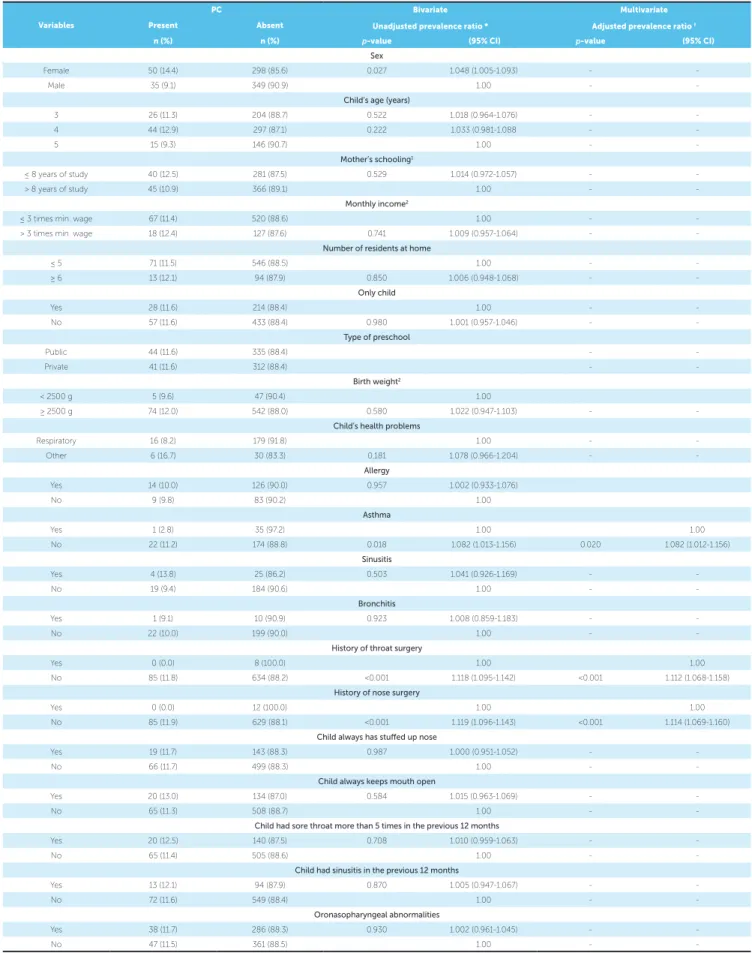
-Table 2 - Poisson bivariate analysis and multivariate regression model for posterior crossbite (PC) and independent variables among preschool children aged between three and five years old (n = 732).
* Unadjusted Poisson regression. † Poisson regression adjusted for independent variables and anterior open bite. 1 Equivalent to elementary and middle school. 2 Categorized based on the median of the crude value.
Variables
PC Bivariate
Unadjusted prevalence ratio *
Multivariate
Adjusted prevalence ratio †
Present Absent
n (%) n (%) p-value (95% CI) p-value (95% CI)
Sex
Female 50 (14.4) 298 (85.6) 0.027 1.048 (1.005-1.093) -
-Male 35 (9.1) 349 (90.9) 1.00 -
-Child’s age (years)
3 26 (11.3) 204 (88.7) 0.522 1.018 (0.964-1.076) -
-4 44 (12.9) 297 (87.1) 0.222 1.033 (0.981-1.088 -
-5 15 (9.3) 146 (90.7) 1.00 -
-Mother’s schooling1
≤ 8 years of study 40 (12.5) 281 (87.5) 0.529 1.014 (0.972-1.057) -
-> 8 years of study 45 (10.9) 366 (89.1) 1.00 -
-Monthly income2
≤ 3 times min. wage 67 (11.4) 520 (88.6) 1.00 -
-> 3 times min. wage 18 (12.4) 127 (87.6) 0.741 1.009 (0.957-1.064) -
-Number of residents at home
≤ 5 71 (11.5) 546 (88.5) 1.00 -
-≥ 6 13 (12.1) 94 (87.9) 0.850 1.006 (0.948-1.068) -
-Only child
Yes 28 (11.6) 214 (88.4) 1.00 -
-No 57 (11.6) 433 (88.4) 0.980 1.001 (0.957-1.046) -
-Type of preschool
Public 44 (11.6) 335 (88.4) -
-Private 41 (11.6) 312 (88.4) -
-Birth weight2
< 2500 g 5 (9.6) 47 (90.4) 1.00
≥ 2500 g 74 (12.0) 542 (88.0) 0.580 1.022 (0.947-1.103) -
-Child’s health problems
Respiratory 16 (8.2) 179 (91.8) 1.00 -
-Other 6 (16.7) 30 (83.3) 0.181 1.078 (0.966-1.204) -
-Allergy
Yes 14 (10.0) 126 (90.0) 0.957 1.002 (0.933-1.076)
No 9 (9.8) 83 (90.2) 1.00
Asthma
Yes 1 (2.8) 35 (97.2) 1.00 1.00
No 22 (11.2) 174 (88.8) 0.018 1.082 (1.013-1.156) 0.020 1.082 (1.012-1.156)
Sinusitis
Yes 4 (13.8) 25 (86.2) 0.503 1.041 (0.926-1.169) -
-No 19 (9.4) 184 (90.6) 1.00 -
-Bronchitis
Yes 1 (9.1) 10 (90.9) 0.923 1.008 (0.859-1.183) -
-No 22 (10.0) 199 (90.0) 1.00 -
-History of throat surgery
Yes 0 (0.0) 8 (100.0) 1.00 1.00
No 85 (11.8) 634 (88.2) <0.001 1.118 (1.095-1.142) <0.001 1.112 (1.068-1.158)
History of nose surgery
Yes 0 (0.0) 12 (100.0) 1.00 1.00
No 85 (11.9) 629 (88.1) <0.001 1.119 (1.096-1.143) <0.001 1.114 (1.069-1.160)
Child always has stufed up nose
Yes 19 (11.7) 143 (88.3) 0.987 1.000 (0.951-1.052) -
-No 66 (11.7) 499 (88.3) 1.00 -
-Child always keeps mouth open
Yes 20 (13.0) 134 (87.0) 0.584 1.015 (0.963-1.069) -
-No 65 (11.3) 508 (88.7) 1.00 -
-Child had sore throat more than 5 times in the previous 12 months
Yes 20 (12.5) 140 (87.5) 0.708 1.010 (0.959-1.063) -
-No 65 (11.4) 505 (88.6) 1.00 -
-Child had sinusitis in the previous 12 months
Yes 13 (12.1) 94 (87.9) 0.870 1.005 (0.947-1.067) -
-No 72 (11.6) 549 (88.4) 1.00 -
-Oronasopharyngeal abnormalities
Yes 38 (11.7) 286 (88.3) 0.930 1.002 (0.961-1.045) -
-DISCUSSION
Oronasopharyngeal abnormalities were signifi-cantly associated with both AOB and PC in the preschool children analyzed. However, comparisons with findings from previous studies are limited due to methodological differences and should therefore be
interpreted with caution.14
Ages three and four years old were significantly as-sociated with AOB. A similar finding is described in
a cross-sectional study conducted in Nigeria,20 which
reports an association between AOB and the age of four. Although no data on non-nutritive sucking habits were collected in the present study, such habits
are common among Brazilian preschool children.21
It is possible that the reduction in these habits, which commonly occurs with the increase in age, contrib-uted to the spontaneous self-correction of this type
of malocclusion.22 The same line of reasoning did not
apply to PC, perhaps because this type of malocclu-sion tends to be transferred from the primary to the
permanent dentition.18
A recent systematic literature review considered at least three episodes of sore throat per year as the
cutoff point to define recurrent sore throat;23 in the
present study, parents/guardians were asked whether their children had throat or nose surgery and whether they had had a sore throat more than five times in the previous 12 months. This information was used as proxy variables for inflamed tonsils/hypertrophied adenoids. Hypertrophied adenoids are one of the
ma-jor causes of upper airway obstruction,24 which can
lead to mouth-breathing habit, thereby
predispos-ing individuals to AOB.12 In agreement with these
findings, significant associations were found in the present study between AOB and both “absence of nose surgery” and “having a sore throat more than five times in the previous 12 months.” In contrast,
Souki et al14 found no association between enlarged
tonsils/adenoids and malocclusion. The authors state that genetic factors may explain why even a consider-able air-flow obstruction may not be enough to cause occlusal alterations in children with low susceptibil-ity to the development of malocclusion. Additional research is needed to clarify this issue.
Events such as recurrent allergies and asthma cause
nasal obstructions and favor mouth breathing;25 they
are therefore considered predisposing factors for
mal-occlusion, such as AOB and PC, due to the efects
produced on craniofacial growth in children.26
Opin-ions in the literature are divergent. While some authors have found an association between both asthma and
allergic rhinitis and AOB,11,27 others have only found
associations with PC.3,10 In the present study, however,
“absence of allergy” was associated with AOB. It is possible that other factors served as confounding vari-ables, such as paciier use or the climate of the city of Campina Grande. Allergy and asthma are commonly
found in locations with low temperatures.28 Campina
Grande is located in Northeast Brazil where a hot, dry climate predominates. This may also explain the asso-ciation between “absence of asthma” and PC.
Chronic obstruction and an altered airway path can lead to the breakdown of normal functional breathing
relationships.29 Not having undergone nose or throat
surgery, which can lead to such a breakdown, was as-sociated with PC in the present study. Indeed, it has been shown that children with enlarged tonsils tend to have more anterior and inferior position of the
tongue.30 This lack of palatal support from the tongue
causes harmful consequences, such as a narrow, short maxilla and a broader mandibular arch, with the
con-sequent development of PC,4 which may explain the
present results. It should be stressed that PC is often found in combination with AOB in the primary
den-tition,29 which may explain the association between
AOB and not having undergone nose surgery. The absence of a normative diagnosis of oronaso-pharyngeal abnormalities and the consequent reliance on parental responses was the main limitation of the present study and may have led to an underestimation of the prevalence. However, the authors believe that the adequate educational level of the parents (> 8 years of study) contributed to a better concern with the child’s health, thereby balancing this issue. It is worth mentioning that confounding variables, such as non-nutritive sucking habits, tong thrust and maxillofacial
alterations,13,22 were not considered in the analysis and
well-designed randomized controlled clinical trials should be carried out to determine the cause-and-effect relationship between oronasopharyngeal fac-tors and the occurrence of malocclusions.
CONCLUSION
Signiicant associations were found between oronaso-pharyngeal-reported abnormalities and the presence of an-terior open bite and posan-terior crossbite in preschool children.
Authors contribution
Conception or design of the study: SMP, AFGG. Data acquisition, analysis or interpretation: GBG, RGVA, RVS, RTF, SMP, LSM, AFGG. Writing of the article: GBG, RGVA, RVS, RTF. Critical revision of the article: SMP, LSM, AFGG. Final approval of the article: AFGG.
1. Peres KG, Barros AJ, Peres MA, Victora CG. Efects of breastfeeding and
sucking habits on malocclusion in a birth cohort study. Rev Saúde Pública. 2007;41(3):343-50.
2. Carvalho AC, Paiva SM, Scarpelli AC, Viegas CM, Ferreira FM, Pordeus IA.
Prevalence of malocclusion in primary dentition in a population-based sample of Brazilian preschool children. Eur J Paediatr Dent. 2011 Jun;12(2):107-11.
3 Luzzi V, Ierardo G, Viscogliosi A, Fabbrizi M, Consoli G, Vozza I, et al. Allergic
rhinitis as a possible risk factor for malocclusion: a case-control study in children. Int J Paediatr Dent. 2013 July;23(4):274-8.
4. Ovsenik M. Incorrect orofacial functions until 5 years of age and their
association with posterior crossbite. Am J Orthod Dentofacial Orthop. 2009 Sept;136(3):375-81.
5. Corrêa-Faria P, Ramos-Jorge ML, Martins-Júnior PA, Vieira-Andrade RG,
Marques LS. Malocclusion in preschool children: prevalence and determinant factors. Eur Arch Paediatr Dent. 2014 Apr;15(2):89-96.
6. Klein JC. Nasal respiratory function and craniofacial growth. Arch Otolaryngol
Head Neck Surg. 1986 Aug;112(8):843-9.
7. Bakor SF, Enlow DH, Pontes P, De Biase NG. Craniofacial growth variations in
nasal-breathing, oral-breathing, and tracheotomized children. Am J Orthod Dentofacial Orthop. 2011 Oct;140(4):486-92.
8. D’Ascanio L, Lancione C, Pompa G, Rebuini E, Mansi N, Manzini M. Craniofacial
growth in children with nasal septum deviation: a cephalometric comparative study. Int J Pediatr Otorhinolaryngol. 2010 Oct;74(10):1180-3.
9. Lopatienė K, Smailienė D, Sidlauskienė M, Cekanauskas E, Valaikaitė R,
Pribuišienė R. An interdisciplinary study of orthodontic, orthopedic, and otorhinolaryngological indings in 12-14-year-old preorthodontic children. Medicina (Kaunas). 2013;49(11):479-86.
10. Faria VC, de Oliveira MA, Santos LA, Santoro IL, Fernandes AL. The efects of asthma on dental and facial deformities. J Asthma. 2006 May;43(4):307-9.
11. Vázquez-Nava F, Quezada-Castillo JA, Oviedo-Treviño S, Saldivar-González AH,
Sánchez-Nuncio HR, Beltrán-Guzmán FJ, et al. Association between allergic rhinitis, bottle feeding, non-nutritive sucking habits, and malocclusion in the primary dentition. Arch Dis Child. 2006 Oct;91(10):836-40. Epub 2006 Jun 12. 12. Hebling SR, Cortellazzi KL, Tagliaferro EP, Hebling E, Ambrosano GM,
Meneghim MC, et al. Relationship between malocclusion and behavioral, demographic and socioeconomic variables: a cross-sectional study of 5-year-olds. J Clin Pediatr Dent. 2008 Fall;33(1):75-9.
13. Góis EG, Ribeiro-Júnior HC, Vale MP, Paiva SM, Serra-Negra JM, Ramos-Jorge ML, et al. Inluence of nonnutritive sucking habits, breathing pattern and adenoid size on the development of malocclusion. Angle Orthod. 2008 July;78(4):647-54.
14. Souki BQ, Pimenta GB, Souki MQ, Franco LP, Becker HM, Pinto JA. Prevalence of malocclusion among mouth breathing children: do expectations meet reality? Int J Pediatr Otorhinolaryngol. 2009 May;73(5):767-73.
15. Valera FC, Travitzki LV, Mattar SE, Matsumoto MA, Elias AM, Anselmo-Lima WT. Muscular, functional and orthodontic changes in pre school children with enlarged adenoids and tonsils. Int J Pediatr Otorhinolaryngol. 2003 July;67(7):761-70.
REFERENCES
16. Nunes WR Jr, Di Francesco RC. Variation of patterns of malocclusion by site of pharyngeal obstruction in children. Arch Otolaryngol Head Neck Surg. 2010 Nov;136(11):1116-20.
17. Emmerich A, Fonseca L, Elias AM, de Medeiros UV. The relationship between oral
habits, oronasopharyngeal alterations, and malocclusion in preschool children in Vitória, Espírito Santo, Brazil. Cad Saúde Pública. 2004 May-Jun;20(3):689-97. 18. Grabowski R, Stahl F, Gaebel M, Kundt G. Relationship between occlusal indings
and orofacial myofunctional status in primary and mixed dentition. Part I: Prevalence of malocclusions. J Orofac Orthop. 2007 Jan;68(1):26-37. 19. Foster TD, Hamilton MC. Occlusion in the primary dentition. Study of children at
2 and one-half to 3 years of age. Br Dent J. 1969 Jan 21;126(2):76-9. 20. Ize-Iyamu IN, Isiekwe MC. Prevalence and factors associated with anterior
open bite in 2 to 5 year old children in Benin city, Nigeria. Afr Health Sci. 2012 Dec;12(4):446-51.
21. Santos RR, Nayme JG, Garbin AJ, Saliba N, Garbin CA, Moimaz SA. Prevalence of malocclusion and related oral habits in 5- to 6-year-old children. Oral Health Prev Dent. 2012;10(4):311-8.
22. Heimer MV, Tornisiello Katz CR, Rosenblatt A. Non-nutritive sucking habits, dental malocclusions, and facial morphology in Brazilian children: a longitudinal study. Eur J Orthod. 2008 Dec;30(6):580-5.
23. Ng GT, Tan S, Vu AN, Del Mar CB, van Driel ML. Antibiotics for preventing recurrent sore throat. Cochrane Database Syst Rev. 2015 July 14;7. [Epub ahead of print].
24. Greenfeld M, Tauman R, De Rowe A, Sivan Y. Obstructive sleep apnea syndrome due to adenotonsillar hypertrophy in infants. Int J Pediatr Otorhinolaryngol. 2003 Oct;67(10):1055-60.
25. Menezes VA, Barbosa AMF, Souza RMS, Freire CVC, Granville-Garcia AF. Occurrence of rhinitis, mouth breathing and orofacial alterations in adolescents with asthma. Rev CEFAC. 2013;15(3):663-71.
26. Esteller Moré E, Pons Calabuig N, Romero Vilariño E, Puigdollers Pérez A, Segarra Isern F, Matiñó Soler E, et al. Dentofacial development abnormalities in paediatric sleep-related breathing disorders. Acta Otorrinolaringol Esp. 2011 Mar-Apr;62(2):132-9.
27. Vázquez Nava F, Vázquez Rodríguez EM, Reyes Guevara S, Barrientos Gómez MC, Vázquez Rodriguez CF, Saldivar González AH, et al. Efect of allergic rhinitis, asthma and rhinobronchitis on dental malocclusion in adolescents. Rev Alerg Mex. 2007 Sept-Oct;54(5):169-76.
28. Saldanha CT, Botelho C. Associações entre variáveis ambientais e asma em crianças menores de cinco anos atendidas em hospital público. Rev Bras Alergia Imunopatol. 2008 Mar-Abr;31(2):50-5.
29. Malhotra S, Pandey RK, Nagar A, Agarwal SP, Gupta VK. The efect of mouth breathing on dentofacial morphology of growing child. J Indian Soc Pedod Prev Dent. 2012 Jan-Mar;30(1):27-31.