Class II malocclusion with accentuated occlusal plane
inclination corrected with miniplate: a case report
Marcel Marchiori Farret1, Milton M. Benitez Farret2
Introduction: A canted occlusal plane presents an unesthetic element of the smile. The correction of this asymmetry has been typically considered difficult by orthodontists, as it requires complex mechanics and may sometimes even require orthognathic surgery. Objective: This paper outlines the case of a 29-year-old woman with Class II malocclusion, pronounced midline deviation and accentuated occlusal plane inclination caused by mandibular deciduous molar ankylosis. Methods: The patient was treated with a miniplate used to provide anchorage in order to intrude maxillary teeth and extrude mandibular teeth on one side, thus eliminating asymmetry. Class II was corrected on the left side by means of distalization, anchored in the miniplate as well. On the right side, maxillary first premolar was extracted and molar relationship was kept in Class II, while canines were moved to Class I relationship. The patient received implant-prosthetic rehabilitation for maxillary left lateral incisor and man-dibular left second premolar. Results: At the end of treatment, Class II was corrected, midlines were matched and the canted occlusal plane was totally corrected, thereby improving smile function and esthetics.
Keywords: Angle Class II malocclusion. Orthodontic anchorage procedures. Orthodontic appliance design.
1 Professor, post-graduation courses, Specialization in Orthodontics, Centro de
Estudos Odontológicos Meridional (CEOM), Passo Fundo, Rio Grande do Sul, Brazil; and Fundação para Reabilitação das Deformidades Crânio-Faciais (FUNDEF), Lajeado, Rio Grande do Sul, Brazil.
2 Professor, Universidade Federal de Santa Maria (UFSM), Santa Maria, Rio
Grande do Sul, Brazil.
Contact address: Marcel Marchiori Farret
Rua Floriano Peixoto 100/113, Santa Maria/RS – CEP: 97.015-370 – Brazil E-mail: [email protected]
DOI: http://dx.doi.org/10.1590/2177-6709.21.3.094-103.oar
How to cite this article: Farret MM, Farret MMB. Class II malocclusion with accentuated occlusal plane inclination corrected with miniplate: a case report. Dental Press J Orthod. 2016 May-June;21(3):94-103.
DOI: http://dx.doi.org/10.1590/2177-6709.21.3.094-103.oar
Submitted: July 31, 2015 - Revised and accepted: November 26, 2015
» The authors report no commercial, proprietary or financial interest in the products or companies described in this article.
» Patients displayed in this article previously approved the use of their facial and in-traoral photographs.
Introdução: o plano oclusal inclinado representa um elemento antiestético para o sorriso. A correção dessa assimetria é normalmente considerada difícil pelos ortodontistas, requerendo mecânica complexa e, algumas vezes, até cirurgia or-tognática. Objetivo: rsse artigo descreve o caso de uma paciente de 29 anos, portadora de má oclusão de Classe II, com considerável desvio das linhas médias e acentuada inclinação do plano oclusal, causada pela anquilose de molar decíduo inferior. Métodos: a paciente foi tratada com ancoragem em miniplaca, para promover a intrusão dos dentes superiores e extrusão dos dentes inferiores em um lado, eliminando a assimetria. A Classe II foi corrigida no lado esquerdo por meio de distalização, também ancorada na miniplaca. No lado direito, o primeiro pré-molar superior foi extraído e a relação de molares de Classe II foi mantida, enquanto os caninos foram movidos para relação de Classe I. A paciente recebeu rea-bilitação por meio de implante e prótese no incisivo lateral superior esquerdo e no segundo pré-molar inferior esquerdo. Resultados: ao término do tratamento, a Classe II foi corrigida, as linhas médias estavam coincidentes e a inclinação do plano oclusal foi totalmente corrigida, melhorando consideravelmente os aspectos funcionais e estéticos da oclusão.
INTRODUCTION
Occlusal plane inclination has always represented a
challenge for orthodontists.1 The common options for
treatment included asymmetric mechanics with
high-pull headgears, asymmetric bite blocks,2,3,4 or even
orthognathic surgery in some cases.5,6,7 In such cases,
conventional mechanics require a long time to be per-formed, and adverse efects are oten present, thus
com-promising and limiting treatment results.2,8,9
Further-more, patients frequently refuse orthognathic surgery and, as such, all treatment options for a canted occlusal
plane have limitations.10
The introduction of skeletal anchorage has increased
the number of treatment options for these cases.2,8,11,12
Mini-implants or miniplates may aid intrusion of a group of teeth, either in the maxillary or mandibular arches, without adverse efects while greatly reducing
total treatment time.9,13 For large asymmetries, it is
pref-erable to use miniplates, owing to the greater stability and success rate obtained with this device in compari-son with mini-implants.2,11,13,14,15
In this paper, correction of occlusal plane inclination by means of skeletal anchorage is discussed. A case is presented in which signiicant asymmetry was corrected with a miniplate as the anchorage unit.
CASE REPORT
Diagnosis and etiology
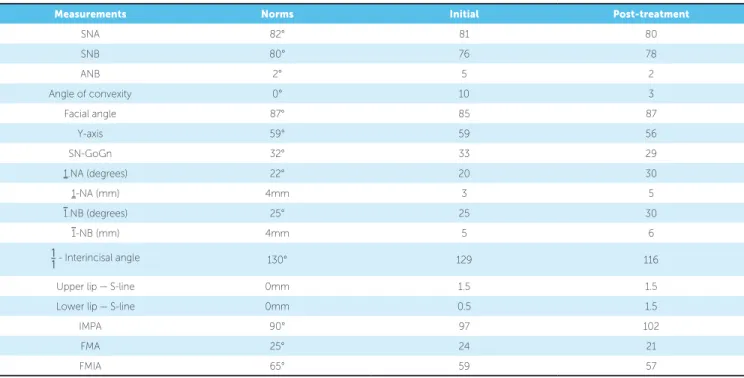
A 29-year-old woman sought orthodontic treatment, complaining about an unesthetic smile due to occlusal plane inclination and midline deviation. This was caused by absence of maxillary let lateral incisor and mandibular let second premolar, with ankylosis of deciduous molar in this region. Facial analysis revealed good symmetry and vertical balance of the facial thirds, a convex proile, and accentuated occlusion plane inclination in a smiling pho-tograph (Fig 1). Intraoral analysis revealed Angle Class II, Division 1 malocclusion, with absence of maxillary let lat-eral incisor, a peg-shaped maxillary right latlat-eral incisor and the presence of mandibular let deciduous ankylosed sec-ond molar, which caused asymmetry on this side in both maxillary and mandibular arches (Figs 2 and 3). Maxillary midline was deviated 2 mm to the let while mandibular midline was deviated 2 mm to the right. Panoramic and periapical radiographs conirmed the absence of maxillary lateral incisor and mandibular second premolar and also revealed mandibular teeth greatly inclined towards the an-kylosed deciduous molar. Initial lateral cephalogram and cephalometric tracing revealed skeletal Class II malocclu-sion, with upright maxillary incisors and well-positioned mandibular incisors (Fig 4 and Table 1).
Figure 3 - Pretreatment dental casts.
Figure 2 - Pretreatment intraoral photographs.
Treatment objectives
The objectives of treatment were as follows: 1. Correct occlusal plane inclination.
2. Obtain molar Class I relationship on the let side and Class II on the right side.
3. Establish canine Class I relationship on both sides. 4. Correct midlines.
5. Extract deciduous molar and replace the tooth with implant-prosthetic rehabilitation.
6. Open space in order to implant a prosthetic reha-bilitation of the maxillary let lateral incisor.
Treatment alternatives
Orthognathic surgery was considered for occlusal plane correction, but the patient refused this option. Therefore, two other alternatives were considered to correct Class II malocclusion and tooth absences. The irst option was to extract the maxillary right lat-eral incisor, replace latlat-eral incisors with canines, and then replace canines with irst premolars. This option was rejected in a meeting with the dentist responsible for the inal rehabilitation. The dentist believed that the esthetic result would be better with implant-pros-thetic rehabilitation of the maxillary lateral incisor, as
maxillary canines had large crowns and were too dif-ferent in color, so as to be used as lateral incisors. The second option was to extract maxillary right irst pre-molar and insert a mini-implant or miniplate on the let side to move the maxillary right dentition poste-riorly. This option was rejected by the patient due to longer treatment time required in comparison to that for irst premolar extraction to distalize all teeth. Thus, in agreement with the patient and the other dentist, it was decided to correct the occlusal plane by means of a miniplate on the maxillary let side, extract the maxil-lary right irst premolar and open space for rehabilita-tion of the maxillary let lateral incisor.
Treatment progress
Treatment began with the bonding of 0.022 × 0.028-in standard Edgewise brackets on both arches, followed by alignment and leveling with 0.012 and 0.014-in Nickel-Titanium archwires and from 0.014-in to 0.020-in stain-less steel archwires. Thereater, maxillary right irst pre-molar and mandibular let second deciduous pre-molar were extracted and maxillary anterior teeth were moved to the right, tooth by tooth, with elastomeric chains, in order to correct maxillary midline and open space, thus allowing
Measurements Norms Initial Post-treatment
SNA 82° 81 80
SNB 80° 76 78
ANB 2° 5 2
Angle of convexity 0° 10 3
Facial angle 87° 85 87
Y-axis 59° 59 56
SN-GoGn 32° 33 29
1.NA (degrees) 22° 20 30
1-NA (mm) 4mm 3 5
1.NB (degrees) 25° 25 30
1-NB (mm) 4mm 5 6
1
1- Interincisal angle 130° 129 116
Upper lip — S-line 0mm 1.5 1.5
Lower lip — S-line 0mm 0.5 1.5
IMPA 90° 97 102
FMA 25° 24 21
FMIA 65° 59 57
the insertion of an implant in the space let by the maxil-lary let lateral incisor. On the maxilmaxil-lary let side, ater correction of premolars rotation, a 2-mm space was cre-ated and both premolar and canine were distalized with elastomeric chains to increase the space for implantation of the maxillary let lateral incisor prosthesis and to par-tially correct Class II. On the mandibular arch, an im-plant was inserted into the space of the missing premo-lar to aid mandibupremo-lar midline correction. That implant was positioned above the proper position, considering that ater occlusal plane correction with maxillary in-trusion and mandibular exin-trusion on this side, the im-plant would be in adequate vertical position. Likewise, the implant was positioned closer to the mandibular let irst molar and away from the let irst premolar, there-by allowing distalization of mandibular let molars and distalization of mandibular anterior teeth, thus correct-ing the midline. Ater that, a miniplate in the shape of an Y was inserted in let zygomatic buttress and used to
intrude all maxillary let teeth, with elastics connected to 0.019 × 0.025-in wire segments inserted into a tube and connected to a miniplate, generating a force of 200 g/f each (Fig 5). Furthermore, the miniplate was used to dis-talize all teeth on the let side, with elastomeric chains connected to a hook welded between the lateral incisor and canine, so as to correct Class II relationship. Ater correction on the maxillary arch, the mandibular arch was extruded with intermaxillary 1/8-in elastics con-nected directly to the miniplate and on the mandibular teeth and archwire (Fig 6). In order to allow mandibu-lar teeth extrusion, the mandibumandibu-lar arch was made by-passing the bracket of provisory crown over the implant. At that time, the space for maxillary let lateral incisor was already well deined and the implant was inserted. Maxillary right lateral incisor was provisionally restored with composite resin before appliance debonding, so as to precisely deine the spaces on the anterior region. Ater 34 months of treatment, the appliance was removed.
Treatment results
At the end of treatment, we noticed an improvement in smile esthetics due to correction of occlusal plane inclination and because the midlines were coincident with the facial midline (Fig 7). The proile remarkably improved as a result of counterclockwise rotation of the mandible, which reduced convexity, thus increasing the prominence of lips and chin (Fig 7). Intraoral and den-tal casts analyses revealed that Class I molar relationship on the let side, Class II molar relationship on the right side and Class I canine relationship on both sides were all obtained, with good intercuspation (Figs 8 and 9).
Panoramic radiograph showed good parallelism among roots, in addition to root resorption on maxillary let central incisor, which will be monitored ater treat-ment. Post-treatment lateral cephalogram, cephalo-metric tracing and superimposition examinations con-irmed accentuated mandibular counterclockwise rota-tion (Fig 10). Furthermore, maxillary let molars were intruded while mandibular molars were uprighted and extruded. Maxillary and mandibular incisors were pro-clined ater treatment. The patient will be monitored every six months in order to have root resorption and treatment stability controlled.
Figure 6 - Intraoral mechanic sequence. (A and B) After maxillary right teeth intrusion, (C and D) elastic mechanics employed to extruded mandibular left teeth, (E to G) after mandibular extrusion, (H to J) after miniplate removal and during the finishing procedures.
A
C
E
H
B
D
F G
Figure 7 - Post-treatment facial photographs.
Figure 9 - Post-treatment dental casts.
DISCUSSION
Occlusal plane inclination is recognized as an
asym-metry that impairs smile esthetics.16,17 Padwa et al17 and
Pereira et al18 studied some variations in occlusal plane
inclination and found that as the degree of this asym-metry increases, the perceived attractiveness decreases. According to the authors, one of the reasons may be gin-gival exposure only on one side. This asymmetry should be corrected either by intrusion on one side, extrusion on the other side or a combination of both, depending
on the diagnosis and treatment planning.8 Intrusion
is directed on the maxillary arch when gingival expo-sure is accentuated, followed by mandibular extrusion on the same side. Otherwise, when there is no gingi-val exposure associated with occlusal plane inclination, intrusion must be carried out on one side of the man-dibular arch, followed by extrusion on the same side of the maxillary arch, considering that intrusion on the maxillary arch could extremely reduce maxillary teeth exposure, impairing smile esthetics. The combination of both procedures may be used in cases with moderate
gingival exposure.8 A precise esthetic diagnosis should
be performed in these cases, including a series of smile photographs and thorough clinical examination. Frontal cephalograms are also an important tool for diagnosis and are essential, mainly when orthognathic surgery is
being considered.6,17
Traditionally, the treatment options for asymmetries in the occlusal plane have been considered to be
ma-jor challenges for orthodontists.1 Despite the
complex-ity of procedures, surgical approaches have always been considered to be a good option, as they have a reduced treatment time and avoid some adverse efects of
con-ventional orthodontic mechanics.5,6,8 However, the
ma-jority of patients refuse orthognathic surgery and treat-ment must therefore focus on orthodontic camoulage. One option is to use a unilateral bite block, which is another alternative for treatment and may provoke a mi-nor intrusion on the side where it is located and a more signiicant extrusion on the other side. The limitation of this treatment modality is that it is not possible to at-tain moderate to high intrusion movements with these devices, in addition to the possibility of developing temporomandibular disorders ater long periods of use. Other option consists in using an asymmetric high-pull headgear; however, it depends on patient’s compliance and has limited results even ater long periods of use.
The main reason for that is because the force between both sides cannot be very diferent in order to prevent displacement of occipital strap.
Skeletal anchorage appeared a few years ago as an excellent alternative for the treatment of asymmetries. It has no adverse efects on mechanics and does not rely on patient’s compliance, meaning that treatment is more
predictable and reliable.11,19 Speciically for occlusal plane
inclination, mini-implants may be the favored option for cases of minor discrepancies and two mini-implants should be preferably used in order to increase retention. Other problems related to mini-implants is the risk of root contact during treatment, as the intrusion
move-ment is performed towards the mini-implant.20 For
these reasons, miniplates may be a better option for the treatment of vertical asymmetries on the occlusal plane, delivering an excellent capacity to intrude a group of teeth without the risk of coming into contact with any
of the roots during treatment.3,4,11,15 However, the
disad-vantage of miniplates is the need for two invasive sur-gical procedures to insert and remove the device, the
reason why patients sometimes refuse miniplates.15
Root resorption may be a consequence of orthodontic treatment. Constant forces usually provoke higher root resorption in comparison with interrupt forces. Other authors agree with it and according to them it happens because the pause in force allows the resorbed
cemen-tum to heal and prevents further resorption.21,22,23
Fur-thermore, intrusion movement is one of the main causes
of resorption as well.24 In the case described herein, the
maxillary arch was intruded on the let side with con-stant forces delivered by elastics connected to the mini-plate, which probably caused some root resorption on maxillary anterior teeth, which was more accentuated on the let side. Ater the end of active orthodontic
treatment, root resorption tends to stop;25,26 therefore,
the patient will be monitored every six months to check whether resorption has indeed stopped.
reorganization of ibers. The retention protocol is the same as that usually used in other cases, with a 3 × 3 mandibular bonded retainer and a wraparound remov-able appliance on the maxillary arch. The patient must be monitored for a long period of time in order to iden-tify any relapse and intercept or treat it.
CONCLUSION
The literature and case presented herein demon-strate that miniplates are a reliable device for the correc-tion of occlusal plane inclinacorrec-tion, eliminating the need for orthognatic surgery in some cases and reducing the complexity of orthodontic mechanics.
1. Burstone CJ. Diagnosis and treatment planning of patients with asymmetries. Semin Orthod. 1998;4(3):153-64.
2. Jeon YJ, Kim YH, Son WS, Hans MG. Correction of a canted occlusal plane
with miniscrews in a patient with facial asymmetry. Am J Orthod Dentofacial Orthop. 2006 Aug;130(2):244-52.
3. Sherwood KH, Burch JG, Thompson WJ. Closing anterior open bites
by intruding molars with titanium miniplate anchorage. Am J Orthod Dentofacial Orthop. 2002 Dec;122(6):593-600.
4. Sherwood KH, Burch J, Thompson W. Intrusion of supererupted molars with
titanium miniplate anchorage. Angle Orthod. 2003 Oct;73(5):597-601. 5. Hashimoto T, Fukunaga T, Kuroda S, Sakai Y, Yamashiro T,
Takano-Yamamoto T. Mandibular deviation and canted maxillary occlusal plane treated with miniscrews and intraoral vertical ramus osteotomy: functional and morphologic changes. Am J Orthod Dentofacial Orthop. 2009 Dec;136(6):868-77.
6. Ko EW, Huang CS, Chen YR. Characteristics and corrective outcome of
face asymmetry by orthognathic surgery. J Oral Maxillofac Surg. 2009 Oct;67(10):2201-9.
7. Takano-Yamamoto T, Kuroda S. Titanium screw anchorage for correction
of canted occlusal plane in patients with facial asymmetry. Am J Orthod Dentofacial Orthop. 2007 Aug;132(2):237-42.
8. Kang YG, Nam JH, Park YG. Use of rhythmic wire system with miniscrews
to correct occlusal-plane canting. Am J Orthod Dentofacial Orthop. 2010 Apr;137(4):540-7.
9. Park YC, Lee SY, Kim DH, Jee SH. Intrusion of posterior teeth using mini-screw implants. Am J Orthod Dentofacial Orthop. 2003 Jun;123(6):690-4. 10. Kuroda S, Sakai Y, Tamamura N, Deguchi T, Takano-Yamamoto T. Treatment
of severe anterior open bite with skeletal anchorage in adults: comparison with orthognathic surgery outcomes. Am J Orthod Dentofacial Orthop. 2007 Nov;132(5):599-605.
11. Cornelis MA, Scheler NR, Nyssen-Behets C, De Clerck HJ, Tulloch JF. Patients’ and orthodontists’ perceptions of miniplates used for temporary skeletal anchorage: a prospective study. Am J Orthod Dentofacial Orthop. 2008 Jan;133(1):18-24.
12. Park HS, Kwon TG, Kwon OW. Treatment of open bite with microscrew implant anchorage. Am J Orthod Dentofacial Orthop. 2004
Nov;126(5):627-36.
REFERENCES
13. Leung MT, Lee TC, Rabie AB, Wong RW. Use of miniscrews and miniplates in orthodontics. J Oral Maxillofac Surg. 2008 July;66(7):1461-6.
14. De Clerck EE, Swennen GR. Success rate of miniplate anchorage for bone anchored maxillary protraction. Angle Orthod. 2011 Nov;81(6):1010-3. 15. Faber, J, Morum, TFA, Leal S, Berto PM, Carvalho CKS. Miniplates allow eicient
and efective treatment of anterior open bites. Dent Press J Orthod. 2008 Sept-Oct;13(5):144-57.
16. Benson KJ, Laskin DM. Upper lip asymmetry in adults during smiling. J Oral Maxillofac Surg. 2001 Apr;59(4):396-8.
17. Padwa BL, Kaiser MO, Kaban LB. Occlusal cant in the frontal plane as a relection of facial asymmetry. J Oral Maxillofac Surg. 1997 Aug;55(8):811-6; discussion 817.
18. Pereira CB, Justus R, Pinzan A, Bastos SHV, Bastos V, Lopes SL. The importance of evaluating the transverse cant of the occlusal plane in intraoral photographs. J World Federation Orthod. 2014;3(1):19-25.
19. Umemori M, Sugawara J, Mitani H, Nagasaka H, Kawamura H. Skeletal anchorage system for open-bite correction. Am J Orthod Dentofacial Orthop. 1999 Feb;115(2):166-74.
20. Kravitz ND, Kusnoto B. Risks and complications of orthodontic miniscrews. Am J Orthod Dentofacial Orthop. 2007 Apr;131(4 Suppl):S43-51.
21. Weiland F. Constant versus dissipating forces in orthodontics: the efect on initial tooth movement and root resorption. Eur J Orthod. 2003 Aug;25(4):335-42. 22. Acar A, Canyürek U, Kocaaga M, Erverdi N. Continuous vs. discontinuous
force application and root resorption. Angle Orthod. 1999 Apr;69(2):159-63; discussion 163-4.
23. Owman-Moll P, Kurol J, Lundgren D. Continuous versus interrupted continuous orthodontic force related to early tooth movement and root resorption. Angle Orthod. 1995;65(6):395-401; discussion 401-2.
24. Han G, Huang S, Von den Hof JW, Zeng X, Kuijpers-Jagtman AM. Root resorption after orthodontic intrusion and extrusion: an intraindividual study. Angle Orthod. 2005 Nov;75(6):912-8.
25. Consolaro A, Furquim LZ. Extreme root resorption associated with induced tooth movement: a protocol for clinical management. Dental Press J Orthod. 2014 Sept-Oct;19(5):19-26.