Facial profile esthetics in operated children
with bilateral cleft lip and palate
Rita de Cássia Moura Carvalho Lauris1, Leopoldino Capelozza Filho2, Louise Resti Calil3, José Roberto Pereira Lauris3, Guilherme Janson3, Daniela Gamba Garib1
Objective: The aim of this study was to evaluate the facial profile esthetics of rehabilitated children with complete bilateral cleft lip and palate (BCLP), comparing the judgment of professionals related and not related to cleft rehabilitation and laypersons. Methods: Thir-ty children in the mixed dentition (24 male; 6 female) with a mean age of 7.8 years were evaluated using facial profile photographs by 25 examiners: 5 orthodontists and 5 plastic surgeons with experience in cleft care, 5 orthodontists and 5 plastic surgeons without experience in oral cleft rehabilitation and 5 graduated laymen. Their facial profiles were classified into esthetically unpleasant (grade 1 to 3), esthetically acceptable (grade 4 to 6), and esthetically pleasant (grade 7 to 9). Intraexaminer and interexaminer errors were evalu-ated using Spearman correlation coefficient and Kendall’s test, respectively. Inter-rater differences were analyzed using Friedman test and Student-Newman-Keuls test for multiple comparisons. Results: Orthodontists dealing with oral clefts rehabilitation considered the majority of the sample as esthetically pleasant. Plastic surgeons of the cleft team and laypersons classified most of the sample as esthetically acceptable. Most of the orthodontists and plastic surgeons not related to cleft care evaluated the facial profile as esthetically unpleasant. The structures associated to unpleasant profiles were the nose, the midface and the upper lip. Conclusions: The facial profile of children with BCLP was classified as esthetically acceptable by laypersons. Professionals related to cleft rehabilitation were more lenient and those not related to cleft care were stricter to facial esthetics than laypersons.
Keywords:Cleft lip. Cleft palate. Esthetics. Rehabilitation.
1 Universidade de São Paulo, Hospital de Reabilitação de Anomalias
Craniofaciais, Departamento de Ortodontia (Bauru/SP, Brasil).
2 Universidade do Sagrado Coração, Programa de Pós-graduação em Ortodontia,
Departamento de Biologia Oral (Bauru/SP, Brasil).
3 Universidade de São Paulo, Faculdade de Odontologia de Bauru,
Departamento de Ortodontia (Bauru/SP, Brasil).
» The authors report no commercial, proprietary or financial interest in the products or companies described in this article.
» Patients displayed in this article previously approved the use of their facial and in-traoral photographs.
DOI: https://doi.org/10.1590/2177-6709.22.4.041-046.oar
How to cite: Lauris RCMC, Capelozza Filho L, Calil LR, Lauris JRP, Janson G, Garib DG. Facial profile esthetics in operated children with bilateral cleft lip and palate. Dental Press J Orthod. 2017 July-Aug;22(4):41-6.
DOI: https://doi.org/10.1590/2177-6709.22.4.041-046.oar
Submitted: April 20, 2016 - Revised and accepted: April 18, 2017
Contact address: Louise Resti Calil
Faculdade de Odontologia de Bauru, Universidade de São Paulo Alameda Octávio Pinheiro Brisolla, 9-75
Bauru/SP, Brasil – CEP: 17.012-901 – E-mail: [email protected]
Objetivo: o objetivo desse estudo foi avaliar a estética do perfil facial de crianças com fissura labiopalatina completa bilateral (FLCB) operadas, com-parando o julgamento de leigos e de profissionais relacionados e não relacionados à reabilitação de fissuras. Métodos: fotografias do perfil facial de trinta crianças na dentadura mista (24 do sexo masculino e 6 do sexo feminino), com idade média de 7,8 anos, foram avaliadas por 25 examinadores: 5 ortodontistas e 5 cirurgiões plásticos com experiência em fissuras, 5 ortodontistas e 5 cirurgiões plásticos sem experiência na reabilitação de fissuras, e 5 leigos com formação superior. Os perfis faciais foram classificados como esteticamente desagradável (grau 1 a 3), esteticamente aceitável (grau 4 a 6) e esteticamente agradável (grau 7 a 9). Para verificar a concordância intraexaminadores e interexaminadores, foram utilizados o Coeficiente de Correlação de Spearman e o Coeficiente de Concordância de Kendall, respectivamente. Para comparação entre as categorias de acordo com os esco-res atribuídos, foram aplicados o teste de Friedman e o teste de Student-Newman-Keuls, para comparações múltiplas. Resultados: os ortodontistas que lidam com reabilitação de fissuras labiopalatinas consideraram a maioria da amostra como esteticamente agradável. Cirurgiões plásticos com experiência em fissuras e leigos classificaram a maioria da amostra como esteticamente aceitável. Grande parte dos ortodontistas e cirurgiões plásticos sem experiência na reabilitação de fissuras classificou o perfil facial como esteticamente desagradável. As estruturas associadas aos perfis desagradáveis foram o nariz, o terço médio da face e o lábio superior. Conclusões: o perfil facial de crianças com FLCB foi classificado como esteticamente acei-tável pelos leigos; já os profissionais relacionados à reabilitação de fissuras foram mais complacentes, em comparação aos profissionais sem experiência na reabilitação de fissuras, que, por sua vez, foram mais rigorosos quanto à estética facial do que os leigos.
INTRODUCTION
Complete bilateral cleft lip and palate (BCLP) is the most severe manifestation of oral clefts,
corre-sponding to 14% of all types of oral clefts.1 BCLP
causes serious esthetical, functional, anatomic and psychosocial disorders requiring early surgery
re-pair.2 The rehabilitation protocol for BCLP includes
lip and palate repair, alveolar bone graft and ortho-dontics, isolated or combined with orthognatic
sur-gery.3 At birth, a patient with complete BCLP
pres-ents severe convex facial profile due to premaxilla
projection.4 After lip repair, protrusion of the
pre-maxilla decreases and pre-maxillary deficiency may be
observed during growth.5 According to Semb,5 in
patients with BCLP, the maxilla is prominent at 5 years of age. At 7 years of age the maxillary promi-nence is similar to individuals without cleft. At 18 years of age, the maxilla shows severe retrusion. Maxillary growth deficiency decreases facial con-vexity in BCLP. Additionally, patients with BCLP show hyperdivergent growth of the mandible
deter-mining a posteriorly positioned chin.3
In patients with BCLP, besides the maxillary defi-ciency, the upper lip scar, columella length and nasal
morphology may impair facial esthetics.6-9 In the few
studies that judged facial esthetics of patients with oral clefts, there is consensus regarding the dissatis-faction with the cosmetic results obtained by the pro-fessionals involved in their rehabilitation, as well as
by the patients themselves.10,11 Chetpakdeechit et al12
analyzed the facial esthetic outcome of patients with BCLP after orthodontic treatment and found that the upper lip, the nose and the scar were negative features affecting the esthetical evaluation. A recent study has evaluated the facial profile esthetics of BCLP af-ter complete rehabilitation and classified most of the
sample as esthetically acceptable.13
Evaluation of facial esthetics is extremely im-portant in order to study the outcome of treatment
protocols.1 The main goals of rehabilitation is
reach-ing good facial esthetics and speech intelligibility.11
The few previous studies on facial esthetics evaluation in CLP were performed in adulthood after complete
rehabilitation.11-16 However, facial appearance in the
school age is very important for children interrela-tionship, sociability, self-esteem and learning
pro-ductivity.17-19 Therefore, the aim of this study was to
evaluate the esthetics of facial profile in children with complete BCLP and compare the assessment of lay-persons and professionals related and not related to cleft rehabilitation.
MATERIAL AND METHODS
This cross-sectional study was approved by the Ethical Committee of our institutional review board (protocol number 438/2002) and an informed con-sent was obtained. The study sample comprised 30 children in the mixed dentition with complete BCLP consecutively selected during the year of 2004 at a single center. The selection was performed during the first orthodontic appointment. The inclusion criteria were: Mediterranean descents and absence of syndromes. The sample included 24 males and 6 females with a mean age of 7.8 years of age (ranging from 5.6 to 10.3 years).
All patients were operated by a plastic surgeon of
Hospital de Reabilitação de Anomalias Craniofaciais team following the current protocol of the hospital which includes one-stage lip repair with Spina technique at 3 to 6 months of age and palate repair with Von Lan-genback technique at 12 months of age. No pre-surgical orthopedics was used. In most cases, nasal columella elongation was performed at 6.3 years of age on average. The evaluation was performed before secondary bone graft procedure.
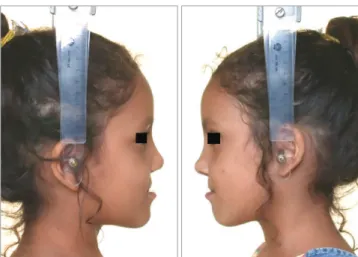
The photographs were taken by the same
exam-iner using a natural head position.20,21 Patients were
instructed to have the teeth occluded and the lips relaxed.
Right and let facial proile photographs were taken from each patient. The obtained images were trans-ferred to a computer and printed in a 10 x 15 cm size. The photographs were evaluated by twenty-ive exam-iners divided into ive groups: 5 orthodontists with ex-perience in rehabilitation of oral clets (ODC), 5 ortho-dontists with no experience in clet treatment (ONC), 5 plastic surgeons with experience in oral clets (PSDC), 5 plastic surgeons with no experience in clet treatment (PSNC) and 5 laypersons (1 veterinarian, 1 engineer, 2 lawyers and 1 agronomist). All the professionals with experience in oral clets worked at the center where the study was conducted.
Figure 1 - Patient who obtained the lowest score (2.8).
Figure 3 - Patient who obtained the highest score (6.2). were positioned in the same page for simultaneous
vi-sualization. No identification of the presence of cleft was provided. The raters were instructed to perform the assessment within approximately 30 seconds for each photograph, assigning scores from 1 to 9
accord-ing to Ferrari Jr. et al.13
Facial profile was considered esthetically un-pleasant for scores 1 to 3; esthetically acceptable for scores 4 to 6, and esthetically pleasant for scores 7 to 9 (Figs 1 to 3, respectively). When the score as-signed was 1 to 3, the examiner was requested to identify the facial structures responsible for the un-pleasant aspect. The photographs were evaluated twice by the 25 examiners with an interval of 30 days between both evaluations.
Method error
Intraexaminer errors were evaluated using Spearman correlation coeicient. Interexaminer error was evalu-ated using Kendall Coeicient of Agreement (W).
Statistical analyses
Inter-rater diferences were compared using Fried-man test and Student-NewFried-man-Keuls test for multiple comparisons. The signiicance level regarded was 5%.
RESULTS
Intraexaminer agreement was statistically signifi-cant for all the rater categories and the coefficient of agreement varied from 0.46 to 0.68 (Table 1). There was statistically significant interexaminer agreement within all categories of raters and the coefficient of agreement varied from 0.55 to 0.74 (Table 2).
There were significant differences among all rater categories except between ONC and PSNC. The ODC and PSDC assigned the highest scores for facial esthetics compared to the other raters (Table 3). ONC and PSNC assigned the lowest scores. Laymen gave intermediate scores between professionals relat-ed and non relatrelat-ed to cleft care.
The frequency of “esthetically unpleasant” scores was very low for ODC and PSDC (Table 4). In con-trast, ONC and PSNC classified more than 50% of the sample as having unpleasant profiles.
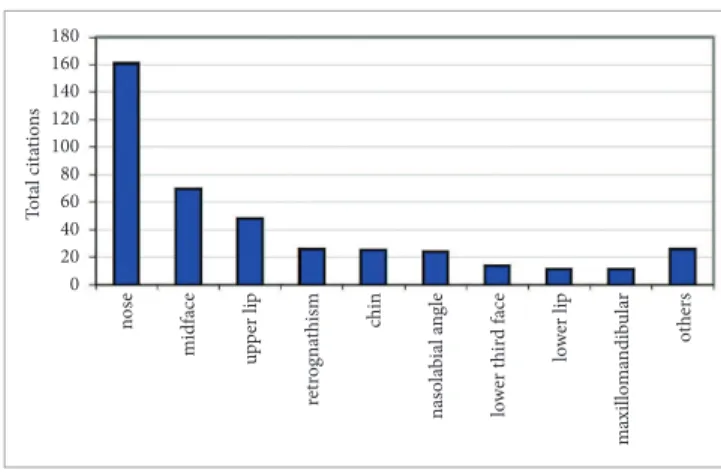
The structures most frequently pointed as respon-sible for the unpleasant profile were the nose and the midface (Fig 4).
DISCUSSION
The concept of beauty is very subjective and
var-ies individually.11 Despite the subjectivity of beauty
interpretation, there was good intra and
interexam-iner agreement.11,13 Previous studies also showed good
reproducibility of the subjective facial analysis
meth-od.11,13 Additionally, splitting the raters by category
may have decreased the variation between them. Differences for the evaluation of facial esthetics were observed for the different types of raters (Ta-ble 3). Orthodontists and plastic surgeons dealing with oral clefts (ODC and PSDC) scored most of the patients as esthetically acceptable even though the mean score was lower for the plastic surgeons. On the other hand, orthodontists and plastic surgeons not re-lated to cleft care (ONC and PSNC) classified the facial profile of the sample as esthetically unpleasant. Laymen attributed an intermediate score between professionals related and not related to cleft care, con-sidering the majority of the sample as esthetically ac-ceptable. From the social point of view, layperson evalu-ation is more important because they represent the way society see the patient. The esthetics that pleases the patient’s fellows has great signiicance in building
self-esteem and inter-personal relationship.22 The layperson
opinion is also very important considering the high
fre-quency of bullying among patients with oral clets.23,24
Why did professionals related to clet care classi-ied the sample with a much better score compared to laypersons? There was also a discrepancy between the frequency of esthetically unpleasant classiication between professionals related to clet care and layper-sons (Table 4). While ODC and PSDC classiied less than 10% of the sample as esthetically unpleasant, lay-men scored 40% of the patients with the worse scores. Previous studies also veriied that professionals related to clet care were more lenient with facial esthetics at
the end of the rehabilitation process.11,13 According
to these studies, professionals dealing with clet reha-bilitation recognize the limitations of treatment and
are more tolerant with morphologic deviations.7,11,13
Category rS p
ODC 0.63 0.0001*
ONC 0.68 0.0001*
PSDC 0.56 0.0001*
PSNC 0.46 0.0001*
L 0.51 0.0001*
Table 1 - Intraexaminer agreement for each category of raters (Spearman cor-relation coefficient).
Table 3 - Interexaminer comparisons for scores of facial profile esthetics (Friedman and Student-Newman-Keuls tests).
Table 2 - Interexaminer agreement for each category of raters (Kendall’s coef-ficient of agreement).
Table 4 - Percentage of patients classified as unpleasant by different category of raters.
*Statistically significant at p < 0.05.
ODC: orthodontists dealing with cleft; ONC: orthodontists with no experi-ence in cleft; PSDC: plastic surgeons dealing with cleft; PSNC: plastic sur-geons with no experience in cleft; L: laymen.
Different letters show statistically significant differences (Student-Newman-Keuls test).
ODC: orthodontists dealing with cleft; ONC: orthodontists with no experience in cleft; PSDC: plastic surgeons dealing with cleft; PSNC: plastic surgeons with no experience in cleft; L: laymen.
*Statistically significant at p < 0.05.
ODC: orthodontists dealing with cleft; ONC: orthodontists with no experi-ence in cleft; PSDC: plastic surgeons dealing with cleft; PSNC: plastic sur-geons with no experience in cleft; L: laymen.
ODC: orthodontists dealing with cleft; ONC: orthodontists with no experi-ence in cleft; PSDC: plastic surgeons dealing with cleft; PSNC: plastic sur-geons with no experience in cleft; L: laymen.
Category W p
ODC 0.74 0.0001*
ONC 0.64 0.0001*
PSDC 0.57 0.0001*
PSNC 0.64 0.0001*
L 0.55 0.0001*
ODC ONC PSDC PSNC L p
Mean (SD) Mean (SD) Mean (SD) Mean (SD) Mean (SD)
6.4 (0.61)a 3.2 (0.74)b 5.1 (0.99)c 3.2 (0.26)b 4.0 (1.26)d 0.0001
Category %
ODC 3.30
ONC 63.3
PSDC 6.70
PSNC 70.0
Only one study found similarity in esthetic evaluation between plastic surgeons related to clet care and lay-persons, however the study considered only the nasal esthetic outcome of BCLP ater secondary nasal
re-construction.25 Both raters considered the nose with
acceptable esthetics even though far from the ideal.25
Professionals not constantly dealing with oral cleft rehabilitation have normality and perfection as com-parative parameters and therefore are more strict in
their evaluation.11 For this reason, they considered
most of the profiles as esthetically unpleasant (Ta-ble 4). This explains the deficient results compared to normality, which is also an important information for cleft care professionals.
Regarding the structures recognized as responsi-ble for the lowest scores, the nose was the most cited for all categories of raters (Fig 4). The nose is largely affected by bilateral cleft lip and palate
demonstrat-ing a very short columella and a flat nose ala at birth.4
These results show the need for nose surgery in these patients, which is frequently performed at the end of
the rehabilitation process, after growth.4 It is
spec-ulated that early plastic surgery of the nose could further impair maxillary growth and therefore it is postponed to the end of the rehabilitation process. The second and third structures most often cited as responsible for unpleasant profiles was the deficient midface and the retruded upper lip (Fig 4). Lip and palate repair cause progressive maxillary retrusion
during growth,5 resulting in retruded midface and
upper lip. These results show that maxillary growth deficiency can influence facial esthetics beginning at an early age. In summary, the structures that impair facial esthetic evaluation are those most affected by the cleft itself or by the primary interventions.
CONCLUSIONS
»
The facial profile of rehabilitated children withcomplete BCLP was most frequently scored as esthet-ically acceptable.
» Professionals related to oral cleft rehabilitation gave better scores for facial esthetics than laypersons and professionals not related to cleft care.
Author contributions
Conception or design of the study: LCF. Data acqui-sition, analysis or interpretation: RCMCL, JRPL Writ-ing the article: RCMCL, LCF, LRC, JRPL, GJ, DGG. Critical revision of the article: GJ, DGG. Final approval of the article: DGG. Obtained funding: RCMCL.
Figure 4 - The structures associated to the worst scores were the nose, the midface and the upper lip.
180
140
80
0 160
100
20 120
40 60
T
o
ta
l ci
ta
tio
n
s
no
se
chin
u
p
p
er li
p
n
as
o
lab
ia
l a
ng
le
midface
ret
rog
n
at
hi
sm
lo
w
er t
hir
d face
lo
w
er li
p
ot
h
er
s
m
axi
llo
m
an
di
b
u
la
1. World Health Organization. Global strategies to reduce the health care burden of craniofacial anomalies: Report of WHO meetings on International Collaborative Research on Craniofacial Anomalies. Cleft Palate Craniof J. 2004 May;41(3):238-43.
2. Garib DG, Santos PBD, Janson G, Assis VH, Battisti MPL. Association between dental arch widths and interarch relationships in children with operated unilateral complete cleft lip and palate. Cleft Palate Craniofac J. 2015 Nov; 52:e196-200. 3. Freitas JAS, Garib DG, Oliveira M, Lauris RCMC, Almeida ALPF, Neves LT, et al.
Rehabilitative treatment of cleft lip and palate: experience of the Hospital for Rehabilitation of Craniofacial Anomalies-USP (HRAC-USP)-Part 2: Pediatric Dentistry and Orthodontics. J Appl Oral Sci. 2012 Apr;20(2):272-85.
4. Freitas JAS, Neves LT, Almeida ALPF, Garib DG, Trindade-Suedam IK, Yaedú RYF, et al. Rehabilitative treatment of cleft lip and palate: experience of the Hospital for Rehabilitation of Craniofacial Anomalies/USP (HRAC/USP)-Part 1: overall aspects. J Appl Oral Sci. 2012 Oct;20(1):9-15.
5. Semb G. A study of facial growth in patients with bilateral cleft lip and palate treated by the Oslo CLP team. Cleft Palate Craniofac J. 1991 Jan;28(1):22-39. 6. Vargervik K. Growth characteristics of the premaxilla and orthodontic treatment
principles in bilateral cleft lip and palate. Cleft Palate J. 1983 Oct;20(4):289-302. 7. Silva Filho OG, Valladares Neto J, Capelloza Filho L, Freitas JAS. Inluence of lip repair on craniofacial morphology of patients with complete bilateral cleft lip and palate. Cleft Palate Craniofac J. 2003 Mar;40(2):144-53.
8. Tobiasen JM. Social judgments of facial deformity. Cleft Palate J. 1987 Oct;24(4):323-27.
9. Anderson SL, Adams G, Plaut VC. The cultural grounding of personal
relationship: the importance of attractiveness in everyday life. J Pers Soc Psychol. 2008 Aug;95(2):352-68.
10. Oosterkamp BC, Dijkstra PU, Remmelink HJ, van Oort RP, Goorhuis-Brouwer SM, Sandham A, et al. Satisfaction with treatment outcome in bilateral cleft lip and palate patients. Int J Oral Maxillofac Surg. 2007 Oct;36(10):890-5.
11. Almeida AM, Capelozza Filho L, Ferrari Junior FM, Lauris RCMC, Garib DG. Evaluation of facial esthetics in rehabilitated adults with complete unilateral cleft lip and palate: a comparison between professionals with and without experience in oral cleft rehabilitation. ISRN Plastic Surgery. 2013(2013):ID 357568, 7 pages. 12. Chetpakdeechit W, Wahss J, Woo T, Hugander M, Mohlin B, Hagberg C. Esthetic
views on facial and dental appearance in young adults with treated bilateral cleft lip and palate (BCLP). A comparison between professional and non-professional evaluators. Swed Dent J. 2011;35(3):151-7.
REFERENCES
13. Ferrari FM Júnior, Ayub PV, Capelozza Filho L, Pereira Lauris JR, Garib DG. Esthetic evaluation of the facial proile in rehabilitated adults with complete bilateral cleft lip and palate. J Oral Maxillofac Surg. 2015 Jan;73(1):169.e1-6. 14. Reis SAB, Abrão J, Capelozza Filho L, Claro CAA. Análise facial subjetiva.
Rev Dental Press Ortod Ortop Facial. 2006 Set-Out;11(5):159-72.
15. Noar JH. A questionnaire survey of attitudes and concerns of three professional groups involved in the cleft palate team. Cleft Palate Craniofac J. 1992 Jan;29(1):92-5.
16. Starr P. Physical attractiveness and self-esteem ratings of young adults with cleft lip and/or palate. Psychol Rep. 1982 Apr;50(2):467-70.
17. Hunt O, Burden D, Hepper P, Stevenson M, Johnston C. Self-reports of psychosocial functioning among children and young adults with cleft lip and palate. Cleft Palate Craniofac J. 2006 Sept;43(5):598-605.
18. Tiemens K, Nicholas D, Forrest CR. Living with diference: experiences of adolescent girls with cleft lip and palate. Cleft Palate Craniofac J. 2013 Mar;50(2):e27-34.
19. Sharif MO, Callery P, Tierney S. The perspectives of children and young people living with cleft lip and palate: a review of qualitative literature. Cleft Palate Craniofac J. 2013 May;50(3):297-304.
20. Cooke MS, Wei SH. The reproducibility of natural head posture:
a methodological study. Am J Orthod Dentofacial Orthop. 1988 Apr;93(4):280-8. 21. Peng L, Cooke MS. Fifteen-year reproducibility of natural head posture: a
longitudinal study. Am J Orthod Dentofacial Orthop. 1999 July;116(1):82-5. 22. Farkas LG, Kolar JC. Anthropometrics and art in the aesthetics of women’s faces.
Clin Plast Surg. 1987;14(4):599-616.
23. Chetpakdeechit W, Hallberg U, Hagberg C, Mohlin B. Social life aspects of young adults with cleft lip and palate: grounded theory approach. Acta Odontol Scand. 2009 July;67(2):122-8.
24. Havstam C, Laakso K, Ringsberg KC. Making sense of the cleft young adults’ accounts of growing up with a cleft and deviant speech. J Health Psychol. 2011;16(1):22-30.