AR
TICLE
1 Departamento de Enfermagem, Centro de Ciências da Saúde, Universidade Federal do Espírito Santo (UFES). Av. Marechal Campos s/n, Maruípe. 29000-000 Vitoria ES Brasil. francielemarabotti@ gmail.com 2 Departamento de Ciências da Saúde, Centro Universitário Norte do Espírito Santo, UFES. Vitoria ES Brasil.
3 Vigilância Epidemiológica, Hospital Universitário Cassiano Antônio de Moraes. Vitória ES Brasil. 4 Programa de Pós-Graduação em Epidemiologia, Universidade Federal de Pelotas. Pelotas RS Brasil.
Analysis of the female mortality trend due to assault
in Brazil, States and Regions
Abstract This study aimed to analyze time trend of female mortality due to assault in Brazil, re-gions and states from 2002 to 2012. This is an eco-logical times series study with secondary data from women aged 20-59 years who died due to assault. Mortality rates were analyzed by simple linear re-gression and stratified by region, Gini Index and Human Development Index (HDI). The trend of female rate of mortality due to assault was stable in the country, with differences between states and regions. The Midwest had the highest rates and stagnation trend. There was an increased trend in the North, Northeast and South and a decreased trend in the Southeast. The states of the tertile with the highest HDI evidenced a declining trend and stabilization in the first and second tertiles. An increased mortality rate was recorded in states with greater social inequality. Notwithstanding the national stabilization behavior, results point to the need for social policies appropriate to the specificities of states and regions.
Key words Violence against women, Assault, Mortality rate, Time series studies, Mortality re-cords
Franciele Marabotti Costa Leite 1
Keila Cristina Mascarello 2
Ana Paula Santana Coelho Almeida 2
Juliana Lopes Fávero 3
Andréia Soprani dos Santos 2
Inácio Crochemore Mohnsam da Silva 4
L
eit
e FMC
Introduction
Violence is a serious problem and a major chal-lenge to the health sector, due to its repercussions and impacts in all spheres of life of individuals,
groups and nations1. As a multifactor and complex
phenomenon, violence relates to cultural practices throughout society, regardless of income or edu-cation and is constantly revised as social values
and norms evolve2. In addition, the
determina-tion of violence is linked to historical, contextual,
structural, cultural and interpersonal factors3.
In this context, in the midst of the various forms of violence, that which is perpetrated against women encompasses the types of violence
arising from unequal relations between genders4
established and based on cultural determinants rooted in the construction of male and female
roles that legitimize male power over women5.
Female murders, known as femicides are a domi-nation form, power and control over women and
are the maximum violation of women’s rights6,7.
In Brazil, more than 90,000 women have been murdered over the past 30 years. Data show that the rate of female homicide increased from 2.3
per 100,000 in 1980 to 4.6 in 20108. It is also worth
noting that 40% of female homicides occur in the household, against 15% of male homicides. This fact indicates the occurrence of violent deaths of women, caused by greater interpersonal contact, as well as suggests that marital violence is central to the characterization of this phenomenon and that death is often the outcome of stories marked
by violence9.
It is believed that one of the ways to pre-vent the occurrence of violence against wom-en, and consequently of deaths due to assault is the adoption of intersectoral measures aimed at the dissemination and compliance with Law 11.340/2006, known as the Maria da Penha Law10,11. This law is a landmark in Brazilian
leg-islation and aims to curb all forms of violence against women, be it physical, moral, sexual,
psy-chological, injury or death11 and plays an
import-ant role in gender equalization.
Given the above, considering the importance of addressing violence against women and the need for data that reveal the issue and its devel-opment, this study aimed to analyze the time trend of female mortality rates due to assault in Brazil, regions and states in the period 2002-2012. We also intended to analyze the behavior of the mortality rate according to human develop-ment (Human Developdevelop-ment Index – HDI) and inequity (Gini Index) of the federative states.
Methodology
This is a time series study based on data extract-ed from the Mortality Information System of the Ministry of Health. To gather data for the calcu-lation of mortality rates, we selected death of fe-males in the 20-59 years age group, as it is a group
with a high homicide rate8, whose basic cause of
death was assault, classiied as codes X85 and Y09
of Chapter XX of the 10th Revision of the
Interna-tional Classiication of Diseases, Health Related Problems (ICD-10). The denominator consisted of the total number of women between 20 and 59 years of age by state, for each year of the study period. The rates of female mortality by assault for Brazil, regions and states were analyzed af-ter standardization by direct method using age group of the country population in the 2010
Census as reference12.
Mortality rates were adjusted based on the percentage of deaths due to ill-deined causes, with a proportional redistribution strategy, aim-ing at reducaim-ing the impact of underestimation of deaths. A percentage of 9.3% of ill-deined deaths
reclassiied as external causes in another study13
was used as a parameter13, extracting from them
the percentage represented by assaults in each age group, year and state of the studied period. Fur-ther details on the rate adjustment are available
from a previous study13.
In addition to the stratiication by geograph-ic regions, state mortality rates were analyzed by HDI tertiles and the Gini Index. These indexes were extracted from the publication Atlas of
Hu-man Development in Brazil14. HDI measures the
aúd
e C
ole
tiv
a,
22(9):2971-2978,
2017
Data used were initially organized in Excel for Windows and later analyzed in the statistical program Stata 13.0. Time trend analyses were performed using linear regression, after identify-ing the non-correlation between standard errors over time, using the Breusch-Godfrey test. In the simple linear regression analysis, mortality rates due to assault, tertiles of Gini index and HDI were considered as dependent variables (y) and the years of the period as independent variable (x).
In order to estimate the increase or decrease of mortality rates, the regression coeficients, their 95% conidence intervals and the respec-tive p-values of statistical signiicance tests were shown. In addition, the annual percentage varia-tion was calculated by the ratio of the regression coeficient in relation to the mortality rate at the beginning of the analyzed period. Variations of the mortality rate due to assault were consid-ered signiicant with a signiicance level of =5% in linear regression. The fractional polynomials model was used to conirm the use of the linear regression model, in which it was observed that even with ive degrees, the best model is not dif-ferent from the linear model (p = 1.0).
For temporal observation and presentation of the dependent variable, three maps with stan-dardized state mortality coeficients were also constructed for 2002, 2007 and 2012 using Tab-win and Excel programs.
This is a research using exclusively public domain secondary data and is exempt from sub-mission and approval by the Ethics Committee of Research with Human Beings, according to Resolution Nº 466/2012 of the National Health Council.
Results
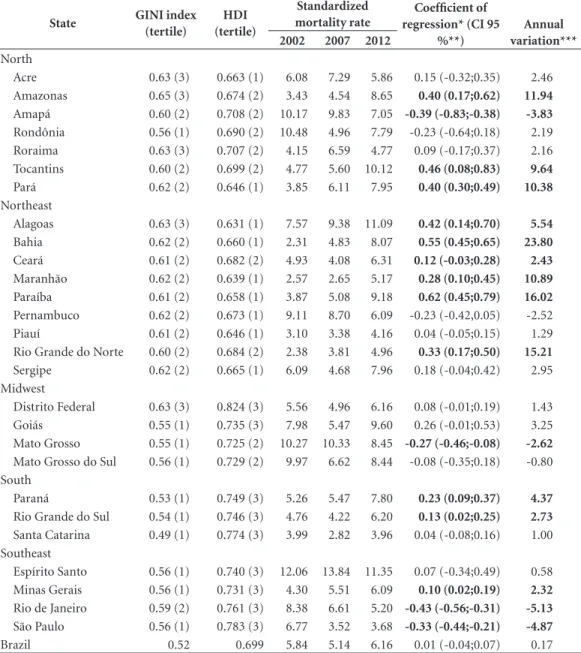
In Brazil, the mortality rate due to assault of fe-males in the 20-59 years group increased from 5.84 (2002) to 6.16 per 100,000 women in 2012. It is worth emphasizing that Espírito Santo was the state that recorded the highest female death rates due to assault in 2002, 2007 and 2012, and the states of Alagoas, Tocantins, Paraíba, Bahia, Amazonas, Maranhão, Pará, Paraná and Minas Gerais showed substantial increase in their rates in the period (Table 1). The distribution of mor-tality in 2002, 2007 and 2012 throughout the Bra-zilian territory can be viewed in Figure 1.
Analyzing mortality rates due to assault in the Brazilian geographic regions, we highlight
the high mortality rate in the Midwest compared to other regions, with a trend towards stagnation of this indicator in the study period. There was an upswing in the North, Northeast and South regions, evidenced by increases of 5.74%, 5.49% and 2.92% in the yearly mortality rate, respec-tively. On the other hand, there was an average annual decline of 3.41% (p < 0.05) (Table 2 and Figure 2a) in the Southeast.
Reviewing women death rates due to assault according to the HDI, a stable trend is noted in the irst and second tertile. This is possibly ex-plained by a mortality rate downswing in the period 2005-2008, which is characterized by the only rate declining period compared to other periods (2002-2004 and 2008-2012) that express an apparent increased female mortality due to assault (Figure 2b). However, in the third tertile, time evaluation evidenced a falling trend with an average yearly reduction of 1.58% per year during the period evaluated (Table 2).
In relation to the Gini index, there was an in-crease in the rate of female mortality due to as-sault in the states with the highest social inequal-ity, with an average annual rate increase of 1.70% in the second tertile and 4.83% in the third tertile (Table 2). The states belonging to the irst tertile showed a stable trend in this period. At the be-ginning of the period, this tertile had the highest mortality rate (2002), while it recorded the low-est female mortality rate in 2012 (Figure 2c).
Discussion
Data of this study show a stable trend in the fe-male mortality rates due to assault in the period 2002-2012 in Brazil. This is possibly explained by the decline during the period in the Southeast re-gion and increases in the North, Northeast and South regions. In addition to regional inequali-ties in the time trend of female mortality due to assault, speciic socioeconomic aspects were also observed. States in the lower HDI tertiles and those belonging to the tertiles with the highest inequality had a higher mortality rate.
The stable female mortality rate due to as-sault at the national level seems to follow some patterns evidenced in other countries as well. A recent study reveals a stagnant mortality of women due to homicide in the country, which is also evidenced in the United States, Ecuador and
Chile15. On the other hand, in Italy, female
ho-micide is on the rise, accounting for 30.9% of all
L
eit
e FMC
over time and socioeconomic and geographical differences, we highlight the high rates of female mortality due to assault in Brazil. According to the Map of Violence, in 2012, the country ranked seventh in the female homicide world ranking, where El Salvador, Trinidad and Tobago and
Guatemala8 held the irst three spots.
Some states report a trend of increased rates, as observed in Bahia, Paraíba, Rio Grande do Norte, Maranhão, Amazonas, Pará and
Tocan-tins. Similar data were found in a study on
fe-micides in Brazil from 2003 to 200717. It is also
worth considering that female deaths due to as-sault are an indicator of gender violence, since women are more penalized in societies that are more violent. Conditions of violence in society favor gender inequality, resulting in high rates of
female mortality due to assault18, as seen in the
states of Espírito Santo and Alagoas, which also
have high rates of male homicides19.
Table 1. Gini Index, HDI, crude and standardized rates and mortality trend due to assault for women aged 20-59 years in Brazil by Federative Unit, 2002, 2007, 2012).
State GINI index
(tertile)
HDI (tertile)
Standardized mortality rate
Coefficient of regression* (CI 95
%**)
Annual variation***
2002 2007 2012
North
Acre 0.63 (3) 0.663 (1) 6.08 7.29 5.86 0.15 (-0.32;0.35) 2.46 Amazonas 0.65 (3) 0.674 (2) 3.43 4.54 8.65 0.40 (0.17;0.62) 11.94
Amapá 0.60 (2) 0.708 (2) 10.17 9.83 7.05 -0.39 (-0.83;-0.38) -3.83
Rondônia 0.56 (1) 0.690 (2) 10.48 4.96 7.79 -0.23 (-0.64;0.18) 2.19 Roraima 0.63 (3) 0.707 (2) 4.15 6.59 4.77 0.09 (-0.17;0.37) 2.16 Tocantins 0.60 (2) 0.699 (2) 4.77 5.60 10.12 0.46 (0.08;0.83) 9.64
Pará 0.62 (2) 0.646 (1) 3.85 6.11 7.95 0.40 (0.30;0.49) 10.38
Northeast
Alagoas 0.63 (3) 0.631 (1) 7.57 9.38 11.09 0.42 (0.14;0.70) 5.54
Bahia 0.62 (2) 0.660 (1) 2.31 4.83 8.07 0.55 (0.45;0.65) 23.80
Ceará 0.61 (2) 0.682 (2) 4.93 4.08 6.31 0.12 (-0.03;0.28) 2.43
Maranhão 0.62 (2) 0.639 (1) 2.57 2.65 5.17 0.28 (0.10;0.45) 10.89
Paraíba 0.61 (2) 0.658 (1) 3.87 5.08 9.18 0.62 (0.45;0.79) 16.02
Pernambuco 0.62 (2) 0.673 (1) 9.11 8.70 6.09 -0.23 (-0.42,0.05) -2.52 Piauí 0.61 (2) 0.646 (1) 3.10 3.38 4.16 0.04 (-0.05;0.15) 1.29 Rio Grande do Norte 0.60 (2) 0.684 (2) 2.38 3.81 4.96 0.33 (0.17;0.50) 15.21
Sergipe 0.62 (2) 0.665 (1) 6.09 4.68 7.96 0.18 (-0.04;0.42) 2.95 Midwest
Distrito Federal 0.63 (3) 0.824 (3) 5.56 4.96 6.16 0.08 (-0.01;0.19) 1.43 Goiás 0.55 (1) 0.735 (3) 7.98 5.47 9.60 0.26 (-0.01;0.53) 3.25 Mato Grosso 0.55 (1) 0.725 (2) 10.27 10.33 8.45 -0.27 (-0.46;-0.08) -2.62
Mato Grosso do Sul 0.56 (1) 0.729 (2) 9.97 6.62 8.44 -0.08 (-0.35;0.18) -0.80 South
Paraná 0.53 (1) 0.749 (3) 5.26 5.47 7.80 0.23 (0.09;0.37) 4.37
Rio Grande do Sul 0.54 (1) 0.746 (3) 4.76 4.22 6.20 0.13 (0.02;0.25) 2.73
Santa Catarina 0.49 (1) 0.774 (3) 3.99 2.82 3.96 0.04 (-0.08;0.16) 1.00 Southeast
Espírito Santo 0.56 (1) 0.740 (3) 12.06 13.84 11.35 0.07 (-0.34;0.49) 0.58 Minas Gerais 0.56 (1) 0.731 (3) 4.30 5.51 6.09 0.10 (0.02;0.19) 2.32
Rio de Janeiro 0.59 (2) 0.761 (3) 8.38 6.61 5.20 -0.43 (-0.56;-0.31) -5.13
São Paulo 0.56 (1) 0.783 (3) 6.77 3.52 3.68 -0.33 (-0.44;-0.21) -4.87
Brazil 0.52 0.699 5.84 5.14 6.16 0.01 (-0.04;0.07) 0.17
aúd
e C
ole
tiv
a,
22(9):2971-2978,
2017
Another relevant aspect are the regional ferences shown in this study, which imprint dif-ferent mortality patterns in the country. There are high rates of female mortality due to assault in the Midwest and an increased trend in the North, Northeast and South. Studies show that femicide is found in both urban areas, where drug traficking and armed conlicts prevail, and rural areas, border areas and land conlicts,
frequent-ly seen in the north and Midwest regions17. It is
worthwhile to consider that some regions show an overvalued male sexual role, a deep-seated patriarchal role and female subordination, which
leads to increased gender inequality18. On the
other hand, since regional socioeconomic dif-ferences are important in our country, exploring death rates by HDI and Gini Index favors a better understanding of the time trend of this indicator. In this study, federative states with greater social inequality showed marked trends of increased
fe-Figure 1. Distribution of mortality due to assault for women aged 20-59 years in Brazil, 2002, 2007 and 2012.
Table 2. Coeficients of regression and percentage change in mortality rates due to assault for women aged 20-59 years in Brazil by region, tertiles of Gini coeficient and HDI, 2002-2012.
Coefficient CI 95%* P-value % variation Trend
Region
Northeast 0 .25 0.18;0.32 < 0.001 5.49 increase
North 0.28 0.20;0.35 < 0.001 5.74 increase
Midwest 0.05 -0.12;0.23 0.482 0.60 stable
Southeast -0.23 -0.29;-0.16 < 0.001 -3.41 reduction
South 0.14 0.04;0.25 0.01 2.92 increase
HDI
1º 0.16 -0.15;0.48 0.272 3.51 stable
2º -0.04 -0.41;0.31 0.766 -0,66 stable
3º -0.10 -0.17;0.03 0.006 -1,58 reduction
GINI Tertiles
1º -0.64 -0.14;0.01 0.094 -3.51 stable
2º 0.09 0.03;0.16 0.010 1.70 increase
3º 0.27 0.16;0.37 < 0.001 4.83 increase
Brazil 0.01 -0.04;0.07 0.558 0.17 stable
L
eit
e FMC
male mortality due to assault between 2002 and 2012. States with lower development are stable, however, with higher rates in relation to the states with the highest HDI.
When analyzing the regional trends of HDI and Gini Index, some exceptions like Espírito Santo call attention, since they have better hu-man development and inequality indicators, but also high mortality rates compared to oth-er states. Thus, while socioeconomic issues are strongly linked to female mortality due to assault, factors that permeate violence transcend pover-ty and social inequalipover-ty. These indings reinforce the idea of violence against women as a multifac-torial phenomenon, which includes an interac-tion of individual, relainterac-tional, social, cultural and
environmental factors20, in this context, there is a
need to perform studies that unravel the possible factors that predispose the high rates of femicides in that State.
Another issue that deserves to be clariied in this discussion is the Maria da Penha Law. A recent
study21 evaluated the effectiveness of this Law and
demonstrated that it has played an important role
in containing gender violence, although its efica-cy has not been uniform in the country. The im-plementation and wide dissemination of this Law occurred concurrently with falling rates of mor-tality due to assault in Brazil in 2006, followed by an increase in 2007, according to the indings of this study. This increase is possibly related to the limited implementation of services provided for in the Law, thus contributing to the lower pun-ishment of the perpetrator and perpetration of
violence21. Another possible justiication may be
the immediate increase of notiications and great-er encouragement to report. Howevgreat-er, it should be pointed out that coercive measures alone are not capable of reducing violence against women and that educational activities and activities that
recognize women in society are necessary22.
Thus, in order to contribute to reducing vi-olence against women, health services should be integrated into a broader social service, sup-porting the actions of Public Security and Justice agents, playing an important role in addressing this phenomenon. Some measures have been proposed to recognize violence as a public health
aúd
e C
ole
tiv
a,
22(9):2971-2978,
2017
problem. The World Health Organization guides and reinforces the need to notify cases of domes-tic violence, which is a mandatory procedure, as well as the reception and recognition of the
in-tegrity of women as subjects with human rights23.
It is worth pondering over some limitations of this study. While the Mortality Information System has advanced in the last decades, there are still differences in the quality of information among states due to inadequate completion of death certiicates, as well as misdiagnoses. Stud-ies show that several homicides are deemed acci-dents or suicides, a factor that may underestimate
these measures of occurrence16,24. On the
oth-er hand, it is questioned whethoth-er the increased trend in some states is a relection of the real hike of the mortality rate or improvement in death registration. It is important to highlight that, in the case of improved registration, it is worth em-phasizing its importance in the ight against
vio-lence, enabling a better knowledge of the reality and adoption of measures and the elaboration of policies based on the mortality proile.
Considering the results, one can see that, while the rates of female mortality due to assault in Brazil are generally stable, regional and state rates show important differences in the mortality pattern. Socioeconomic factors expressed by the HDI and the Gini Index highlight social inequal-ities in the occurrence and development of this mortality. In addition, these indings portray a considerable amount of violence in the country, which points to a serious public health problem at the national level. In this context, reducing conditions that favor violence becomes relevant in all Brazilian states, with special attention to local regional and socioeconomic differences, as well as the integration of health, education, so-cial, economic and judicial assistance sectors to-wards addressing violence against women.
Collaborations
L
eit
e FMC
References
1. Souza ER, Melo AN, Silva JG, Franco SA, Alazraqui M, González-Pérez GJ. Estudo multicêntrico da mortali-dade por homicídios em países da América Latina. Cien
Saude Colet 2012; 17(12):3183-3193.
2. Organización Panamericana de la Salud, Oicina Re-gional para las Américas. Informe mundial sobre la
vio-lencia y la salud. Washington: OMS; 2002.
3. Guimarães CF, Meneghel SN, Zwetsch BE, Silva LB, Grano MS, Siqueira TP, Oliveira CS. Homens apenados e mulheres presas: estudo sobre mulheres de presos.
Psicologia & Sociedade 2006; 18(3):48-54.
4. Lucena KDT, Silva ATMC, Moraes RM, Silva CC, Bezerra IMP. Análise espacial da violência domésti-ca contra a mulher entre os anos de 2002 e 2005 em João Pessoa, Paraíba, Brasil. CadSaude Publica 2012; 28(6):1111-1121.
5. Lamoglia CVA, Minayo MCS. Violência conjugal, um problema social e de saúde pública: estudo em uma de-legacia do interior do Estado do Rio de Janeiro. Cien
Saude Colet 2009; 14(2):595-604.
6. Campbell JC, Glass N, Sharps PW, Laughon K, Bloom T. Intimate partner homicide: review and implications of research and policy. Trauma Violence Abuse 2007; 8(3):246-269.
7. Taylor R, Jasinski JR. Femicide and the feminist per-spective. Homicide Stud 2011; 15(4):341-362. 8. Waiselisz JJ. Mapa da violência 2012 atualização:
Ho-micídios de mulheres no Brasil. Rio de Janeiro:
CEBELA-FLACSO; 2012.
9. Machado MRA, Matsuda FE, Giannattasio ARC, Couto MCG, Tozi TS, Carli e Silva ML, Pryzbylski LC, Chrys-saidis LC. A violência doméstica fatal: o problema do feminicídio íntimo no Brasil. Brasília: Ministério da Justiça; 2015.
10. Garcia LP, Freitas LRS, Höfelmann DA. Avaliação do impacto da Lei Maria da Penha sobre a mortalidade de mulheres por agressões no Brasil, 2001-2011. Epidemiol
Serv Saúde 2013; 22(3):383-394.
11. Brasil. Lei nº 11.340, de 07 de agosto de 2006. Cria mecanismos para coibir a violência doméstica e fami-liar contra a mulher, nos termos do § 8o do art. 226 da Constituição Federal, da Convenção sobre a Eli-minação de Todas as Formas de DiscriEli-minação con-tra as Mulheres e da Convenção Interamericana para Prevenir, Punir e Erradicar a Violência contra a Mu-lher; dispõe sobre a criação dos Juizados de Violência Doméstica e Familiar contra a Mulher; altera o Código de Processo Penal, o Código Penal e a Lei de Execução Penal; e dá outras providências. Diário Oficial da União 2006; 8 ago.
12. Instituto Brasileiro de Geograia e Estatística (IBGE).
Censo Demográfico 2010. [acessado 2015 abr 19].
Dis-ponível em: http://www. censo2010.ibge.gov.br
13. França E, Teixeira R, Ishitani L, Duncan BB, Cortez-Es-calante JJ, Morais OL, Szwarcwald CL. Ill-deined caus-es of death in Brazil: a redistribution method based on the investigation of such causes. RevSaude Publica 2014; 48(4):671-681.
14. Programa das Nações Unidas para o Desenvolvimento.
Atlas do Desenvolvimento Humano no Brasil. Brasília:
IPEA; 2013. [acessado 2015 abr 19]. Disponível em: http://www.atlasbrasil.org.br/2013/pt/consulta/ 15. Gawryszewski VP, Sanhueza A, Martinez-Piedra R,
Escamilla JA, Souza MFM. Homicídios na região das Américas: magnitude, distribuição e tendências, 1999-2009. Cien Saude Colet 2012; 17(12):3171-3182. 16. Bonanni E, Maiese A, Gitto L, Falco P, Maiese A, Bolino
G. Femicide in Italy: national scenario and presenta-tion of four cases. Med Leg J 2014; 82(1):32-37. 17. Meneghel SN, Hirakata VN. Femicídios: homicídios
fe-mininos no Brasil. RevSaude Publica 2011;45(3):564-574.
18. Leites GT, Meneghel SN, Hirakata VN. Homicídios fe-mininos no Rio Grande do Sul, Brasil. Rev Bras Epide-miol 2014; 17(3):642-653.
19. Waiselisz JJ. Mapa da violência 2013: mortes matadas
por arma de fogo. Rio de Janeiro: Cebela-Flacso; 2013.
20. Dahlberg LL, Krug EG. Violência: um problema global de saúde pública. Cien Saude Colet 2006; 11(Supl.):1163-1178.
21. Cerqueira D, Matos M, Martins APA, Pinto Júnior J.
Avaliando a efetividade da Lei Maria da Penha. Brasília:
Instituto de Pesquisa Econômica e Aplicada; 2015. 22. Amaral NA, Amaral CA, Amaral TLM. Mortalidade
fe-minina e anos de vida perdidos por homicídio/agressão em capital brasileira após promulgação da Lei Maria da Penha. Texto Contexto-Enferm 2013; 22(4):980-988. 23. World Health Organization (WHO). Multi-country
study on women’s health and domestic violence against
women. Geneva: WHO; 2005.
24. Coeli CM. Sistemas de Informação em Saúde e uso de dados secundários na pesquisa e avaliação em saúde.
Cad Saúde Colet 2010;18(3):335-336.
Article submitted 14/09/2016 Approved 16/03/2017