CLINICAL SCIENCE
A real-life study of the effectiveness of different
pharmacological approaches to the treatment of
smoking cessation: re-discussing the predictors of
success
Gustavo Faibischew Prado, Elisa Maria Siqueira Lombardi, Marco Antoˆnio Bussacos, Frederico Leon Arrabal-Fernandes, Ma´rio Terra-Filho, Ubiratan de Paula Santos
Divisa˜o de Pneumologia, Instituto do Corac¸a˜o, Hospital das Clı´nicas da Faculdade de Medicina da Universidade de Sa˜o Paulo, Sa˜o Paulo, Brazil.
OBJECTIVE: To evaluate the effectiveness of nicotine replacement therapy (NRT), bupropion, nortriptyline and combination therapy and describe factors associated with treatment success.
INTRODUCTION:Clinical trials clearly demonstrate the efficacy of pharmacotherapy in smoking cessation. However, it is only after its use in real-life settings that clinical effectiveness and limitations of a treatment are fully known.
METHODS:Patients attended a four-session cognitive-behavioral program and received medicines free of charge. Abstinence from smoking was assessed at each visit.
RESULTS:A total of 868 smokers (68.8% women) were included. Their mean age was 49.6 years; the amount smoked was 25 cigarettes/day and the Fagerstro¨m Score was 6.6. Abstinence rates after 6 months and 1 year were 36.5% and 33.6%. In univariate analysis, male gender, age (.50), higher number of cigarettes smoked, cardiovascular comorbidities, longer interval from the last cigarette and combined treatment of nortriptyline plus NRT were predictive of abstinence, while neuropsychiatric comorbidities and the answer ‘‘yes’’ to the question ‘‘Do you smoke more often during the first hours after waking’’ were correlated with failure. In a multivariate model, predictors of abstinence were neuropsychiatric comorbidities, the answer ‘‘yes’’ to the question ‘‘Do you smoke more often during the first hours after waking’’ and combined treatment of nortriptyline plus NRT. Male gender and a longer period from the last cigarette were correlated with lower abstinence rate.
CONCLUSION: Satisfactory success rates were obtained in a teaching hospital. Factors such as age, daily cigarette consumption, number of pack-years and dependency score were not reliable markers of abstinence. The combination nortriptyline+NRT was independently associated with higher abstinence rates.
KEYWORDS: General practice; Nortriptyline; Cognitive-behavioral; Combined therapy; Weight gain.
Prado GF, Lombardi EMS, Bussacos MA, Arrabal-Fernandes FL, Terra-Filho M, Santos UP. A real-life study of the effectiveness of different pharmacological approaches to the treatment of smoking cessation: re-discussing the predictors of success. Clinics. 2011;66(1):65-71.
Received for publication onSeptember 16, 2010;First review completed onOctober 8, 2010;Accepted for publication onOctober 15, 2010 E-mail: [email protected]
Tel.: 55 11 3069-5695
INTRODUCTION
Cigarette smoking remains one of the primary healthcare concerns world wide and continues to be the major cause of morbidity and mortality in the world. Five million people die yearly world wide owing to tobacco-related diseases. If current trends continue, tobacco will kill 1000 million people prematurely during this century.1 Several studies have reported that 60–70% of smokers want to quit2 and intend to stop, but only 3–5% of them remain abstinent for a
year after an unassisted attempt.3 ‘‘Offer help to quit tobacco use’’ in people addicted to nicotine is one of the six proven policies identified by WHO to expand the fight against the tobacco epidemic.
Pharmacological treatment is an important resource in smoking cessation. Several randomized, double-blind, pla-cebo-controlled trials have reported significantly higher abstinence rates with first-line, and some second-line, drugs compared with placebo. These clinical trials provide scientific evidence of the efficacy and safety of nicotine replacement therapy (NRT),4 bupropion (BUP),5,6 vareni-cline7,8 and nortriptyline (NOR),9 a dopaminergic tricyclic antidepressant used as second-line smoking cessation therapy; however, the effectiveness and limitations of these drug regimens in real-life settings are still poorly docu-mented.
among smokers motivated to quit attending the pulmonary division of Hospital das Clinicas, University of Sa˜o Paulo Medical School (Sa˜o Paulo, SP, Brazil) Smoking Cessation Clinic from 2003 to 2008. These smokers were included in the study, independently of the number of cigarettes smoked a day, number of pack-years or number of previous attempts to quit. All patients freely signed an informed consent form. Exclusion criteria were pregnancy and impossibility of attending the four sessions of the cogni-tive-behavioral program. Consultations were always held in the afternoons.
All smokers received a standardized program for smok-ing cessation includsmok-ing pharmacological and cognitive-behavioral interventions, consisting of four 60-minute structured group sessions (dealing with aspects of smok-ing-related morbidity and mortality, key issues of nicotine addiction and the development of a specific action plan for stopping smoking) during the pretreatment period. Pharmacotherapy consisted of NRT, NOR, BUP and NRT combined with NOR or BUP and was assigned depending on availability (supplied by the public health system, free of charge) and physician’s discretion. Treatment always began 2 weeks before the target quit day for BUP and NOR users and on the day before quitting for patients receiving NRT. Pharmacological therapy was prescribed for at least 12 weeks.
Patients attended follow-up control visits at weeks 2, 4, 8 and 12 after the scheduled quit day and monthly until the sixth month. Abstinence at 1 year was assessed, when possible, by telephone call.
Patients who missed their appointments or did not answer the phone calls were considered smokers (inten-tion-to-treat analysis).
At baseline a detailed smoking history and health data, using a three-domain structured anamnesis, were gathered. Questionnaires included questions on gender, age, cigarette initiation, number of cigarettes per day and Fagerstro¨m test for nicotine dependence (FTND), time from last cigarette, previous attempts to quit, presence of other smokers in the household and former and current diseases and medica-tions. Self-reported cigarette consumption, exhaled CO level (COex), weight and possible adverse effects were measured at all follow-up visits. Effectiveness was measured as 7-day point prevalence abstinence rate confirmed by COex levels of#9 ppm from week 2 through the sixth month.
Psychiatric comorbidity was assessed using the Diag-nostic and Statistical Manual of Mental Disorders,11fourth edition (DSM-IV) and self-reported diagnostics. Weight was
confidence interval) associated with abstinence. Models were fitted, including all factors associated with the outcome, in a stepwise procedure. Factors were subse-quently eliminated from the model if the x2 statistic of likelihood ratio test indicated no statistical significance.
RESULTS
Of a total of 1112 patients who attended the first appointment and began the treatment, 244 (21.9%) refused to participate in the structured program and did not attend the following meetings for group therapy.
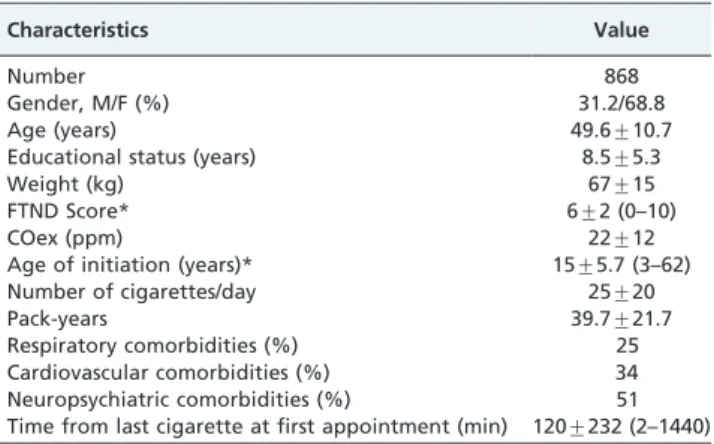
Of the 868 patients who were assisted by the program, 597 were women (68.8%) and 271 men (31.2%), with a mean age of 49.6 years (range 21–82), who smoked an average of 25 cigarettes per day and 39.7 pack-years.
Baseline information and demographic characteristics of the participants are reported in Table 1.
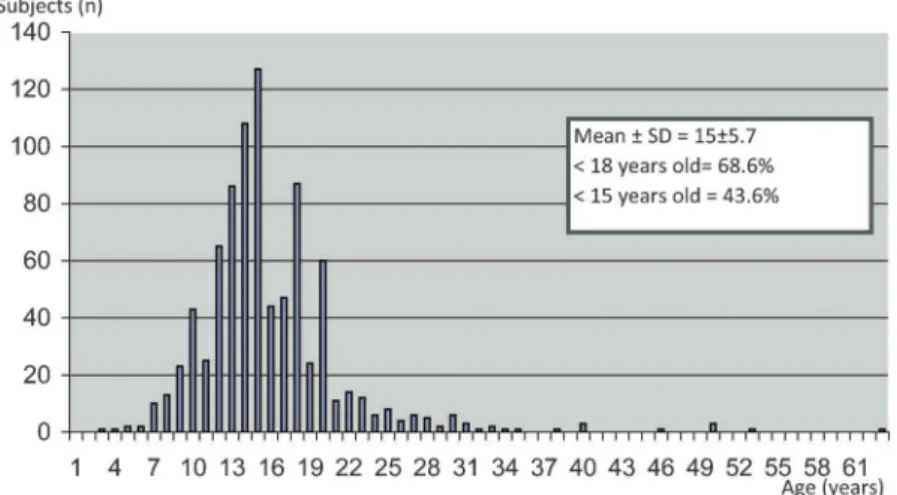
The mean age of initiation was 15 years (SD 5.7); the distribution of subjects according to age of initiation is shown in Figure 1.
The results of the FTND (Figure 2) showed a sample of individuals with a moderate-to-high degree of dependence (mean score 6; median 7; SD 2).
About 81.8% of patients had made at least one previous attempt to stop smoking.
Of the women who had at least one pregnancy (n = 379), 272 (71.8%) smoked during gestation.
Table 1 -Demographic data and descriptive analysis
Characteristics Value
Number 868
Gender, M/F (%) 31.2/68.8
Age (years) 49.6¡10.7
Educational status (years) 8.5¡5.3
Weight (kg) 67¡15
FTND Score* 6¡2 (0–10)
COex (ppm) 22¡12
Age of initiation (years)* 15¡5.7 (3–62)
Number of cigarettes/day 25¡20
Pack-years 39.7¡21.7
Respiratory comorbidities (%) 25 Cardiovascular comorbidities (%) 34 Neuropsychiatric comorbidities (%) 51 Time from last cigarette at first appointment (min) 120¡232 (2–1440)
*Expressed in mean¡SD (range).
More than a third of subjects had an associated disease (25% respiratory, 34% cardiovascular and 51% psychiatric comorbidity). Of those subjects, 82.5% had made at least one previous attempt to quit smoking and 41.8% had another smoker (or smokers) at home.
The distribution of treatment options was as follows: 74% NRT (n = 642), 8% NOR (n = 69), 8% NOR plus NRT (n = 70), 6% BUP plus NRT (n = 52) and 4% BUP alone (n = 35).
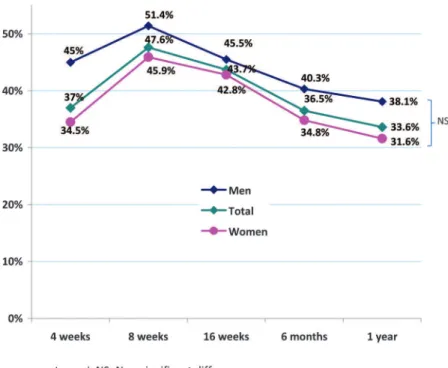
Success rates at 4 weeks, 8 weeks, 16 weeks, 6 months and 1 year are summarized in Figure 3.
For the variable ‘‘time from last cigarette at first appointment’’, values above and below the cut-off point at the median (120 min) were chosen in order to make this variable categorical. Intervals were also described as quartiles to study trends.
In the logistic procedure for multivariate analysis, there were no statistically significant differences in 7-day point prevalence at 1 year for age, gender, COex, FTND Score, pack-years, comorbidities (cardiovascular, mental and respiratory) and type of drug therapy used. Only the time
from last cigarette at first appointment.120 min (OR = 1.17; 95% CI 1.07–1.28, p,0.0001) was a predictor of success. There was a linear relationship between the time from the last cigarette (separated into quartiles) at first visit and abstinence rate after 1 year (Cochran–Armitage Trend Test, p = 0.0038). The greater the time, the greater the success rate (Figure 4)
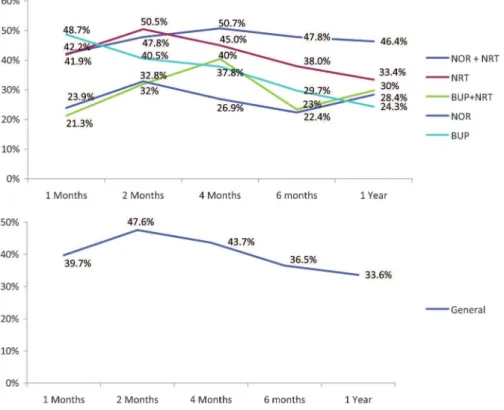
Having analyzed the success rates according to the combination of drugs used, we obtained the results shown in Figure 5. The combination of NOR+NRT was the most effective option (46.4% in 1 year). There was a statistically significant difference between the result of this combination and other treatment options (OR = 1.6; 95% CI 1.1–2.4, p,0.05). There was no statistically significant difference among the other treatment options.
Weight gain was an important concern in our study (Table 2), affecting 79.5% and 57.4% of patients, after 6 months and 1 year, respectively. From those who showed a weight increase, the mean gain was 7.5% (SD 6.1%) or 4.9 kg, at 6 months and 6.8% (SD 8%) or 5 kg, after 1 year. A Figure 1 -Age of initiation (years).
comparison of people who had stopped smoking with those who continued to smoke showed a statistically significant difference in both period.
In univariate analysis (Table 3), gender (male), age (.50 years), cigarettes smoked (above the median of 35 pack-years), the presence of cardiovascular comorbidities, the interval from the last cigarette smoked before the first consultation (fourth quartile versus others) and the com-bined treatment of NOR+NRT were predictive of abstinence after 1 year, while the existence of neuropsychiatric comorbidities and the answer ‘‘yes’’ to the question ‘‘Do you smoke more often during the first hours after waking than during the rest of the day?’’ of Fagerstro¨m’s Questionnaire were predictive of failure.
In the multivariate model, however, only five of these factors were correlated with the outcome. The presence of neuropsychiatric comorbidities, the answer ‘‘yes’’ to the
question ‘‘Do you smoke more often during the first hours after waking than during the rest of the day?’’ and the combined treatment of NOR+NRT predicted higher odds of abstinence at 1 year. Male gender and longer period from last cigarette at the first attendance were correlated with lower odds of abstinence at 1 year.
DISCUSSION
This retrospective study shows data on tobacco absti-nence after a period of clinical treatment for smoking cessation with real-life pharmacological schemes and cognitive-behavioral intervention and, also, analyzes mar-kers of success in an off-trial clinical context.
The effectiveness data presented in this study are slightly better than those reported in the original clinical trials.12 The corresponding real-setting abstinence rates at Figure 3 -Seven-day point prevalence abstinence rates at 4 weeks, 8 weeks, 16 weeks, 6 months and 1 year, according to gender.
52 weeks ranged from 38.1% for men to 31.6% for women, with no statistically significant difference between the two groups.
Identification of individual characteristics that predict success in smoking cessation is highly desirable, but not always feasible. A number of common predictors have been described as personal, social and psychological factors. In our population, however, age of initiation, educational status, dependency score (FTND), cigarette consumption, exhaled carbon monoxide level and the existence of respiratory comorbidities did not predict smoking cessation. We observed data on gender differences that are similar to those found in previously published reports. There is evidence that women are more likely to seek assistance in their attempts to quit than are men3, but there is some controversy about whether women benefit from specific pharmacological interventions (NRT, for instance) as much as men.13,14
Our study clearly demonstrates an early initiation into smoking, with over 68% of patients having started smoking before the age of 18 years. The median smoking initiation age in our group was similar to that described by Menezes and colleagues,15both for the city of Sa˜o Paulo (16.2 and 18.3
years for boys and girls, respectively) and for the average of other Latin American cities studied (18.2 years).
Weight gain in our population was also similar to that in other studies, such as that reported by Klesges et al.,16 which demonstrated a mean increase of 5 kg in abstinent patients after 1 year. In contrast to data published by Williamson and colleagues,17weight gain, which is strongly related to smoking cessation, occurred in the majority of those who stopped smoking. Some potential cosmetic effects of weight gain may negatively interfere with attempts to quit and thus, should be considered as an important problem in a cognitive-behavioral approach and counseling, especially for women.
In our center, with highly motivated patients, many of them with comorbidities, a high Fagerstro¨m Score was not a predictor of lower abstinence rates. Another intriguing finding was that smoking more in the early hours of the day was not confirmed in multivariate analysis as a factor related to treatment failure. Perhaps the restrictions on smoking indoors (which can directly influence the number of cigarettes smoked during the day and times at which one smokes more—possibly after the work shift) may explain these findings and signal the eventual need for future Figure 5 -Seven-day point prevalence abstinence rates according to drug options. BUP = bupropion; NOR = nortriptyline; NRT = nicotine replacement therapy.
Table 2 -Weight gain in 6 months and 1 year, according to subgroup analysis.
6 Months 1 Year
Absolute gain (kg¡SD) Percentage gain (%¡SD) Absolute gain (kg¡SD) Percentage gain (%¡SD)
General 4.3¡4.6 5.8¡7.1 1.5¡7.5 2.2¡10
Abstinent* 4.2¡4.3 6.8¡6.7 5.0¡7.0 7.1¡9.8
Present smokers 5.1¡2.4 3.7¡7.7 -0.4¡5.7 -0.4¡6.7
*p
reviews of the questionnaire and its descriptors in light of recent changes in the pattern of cigarette consumption.
In univariate analysis, the variable defined as the time elapsed since the last cigarette and the first visit proved to be a predictor of success, which encourages the hypothesis that this factor could be recognized as an indicator of dependence (ie, the shorter the time, the higher the degree of dependence). However, this hypothesis was not con-firmed in the multivariate model, indicating the need for confirmation in prospective studies.
A particular aspect of our study is the use of NOR, a tricyclic antidepressant with some evidence of efficacy in smoking cessation in small studies,18,19,20 but classified in guidelines as a second-line drug owing to its side effects profile and conflicting results in larger controlled trials.21 From our point of view, and in agreement with the findings from the meta-analysis of Wagena and colleagues,22it is a significant treatment option, given its efficacy (comparable to those first-line options), safety and, especially, its low cost and wide availability. Perhaps, considering the threat of a global tobacco epidemic—and even more significant impacts on the less affluent nations—the inclusion of NOR in the therapeutic arsenal of smoking cessation may be a promising step towards a wider access to treatment, especially in developing countries.
Based on our findings, we propose the inclusion of NOR among the list of first-line drugs for smoking cessation.
The major limitation of this report is that it was retrospective, uncontrolled and not randomized. The avail-able options of treatment regimens were chosen by individual criteria on a case-by-case basis or according to the availability of medicines in the public health system.
Another significant limitation of our study was that the sample size allocated to each treatment group was very different, which may have compromised, to some extent, the validity of the comparison between them and, eventually, the reliability of these data.
Nevertheless, the proof of results previously demon-strated in randomized controlled clinical trials shows that
treatment of smoking cessation in clinical practice is feasible and effective.
CONCLUSIONS
Despite the broad therapeutic armamentarium available, smoking cessation is still a therapeutic challenge all around the world. The different individual or combined pharma-cotherapy regimens provide modest success rates—around 30–35% in 1 year. Another potential difficulty is translating the results observed in clinical trials into daily clinical practice, which in part can be explained by the fact that ‘‘real’’ patients do not always resemble those subjects participating in randomized controlled studies.
In a teaching hospital with students in training, our group has achieved satisfactory success rates, treating patients with high levels of dependence and high prevalence of comorbidities. Combining NRT with NOR yielded more favorable results.
Factors such as gender, age, number of pack-years, dependency score were not good predictors of success or markers of lower abstinence rates in smoking cessation treatment in this particular group of patients.
REFERENCES
1. Frieden TR, Bloomberg MR. How to prevent 100 million deaths from tobacco. Lancet. 2007;369:1758-61, doi: 10.1016/S0140-6736(07)60782-X. 2. Aveyard P, West R. Managing smoking cessation. BMJ. 2007;335:37-41,
doi: 10.1136/bmj.39252.591806.47.
3. Zhu S, Melcer T, Sun J, Rosbrook B, Pierce JP. Smoking cessation with and without assistance: a population-based analysis. Am J Prev Med. 2000;18:305-11, doi: 10.1016/S0749-3797(00)00124-0.
4. Stead LF, Perera R, Bullen C, Mant D, Lancaster T. Nicotine replacement therapy for smoking cessation. Cochrane Database Syst Rev 2008;(1): CD000146.
5. Jorenby DE, Leischow SJ, Nides MA, Rennard SI, Johnston JA, Hughes AR, et al. Controlled trial of sustained-release bupropion, a nicotine patch, or both for smoking cessation. N Engl J Med. 1999;340:685-91, doi: 10.1056/NEJM199903043400903.
6. Hays JT, Hurt RD, Rigotti NA, Niaura R, Gonzales D, Durcan MJ, et al. Sustained-release bupropion for pharmacologic relapse prevention after smoking cessation: a randomized, controlled trial. Ann Intern Med. 2001;135:423-33.
the day? (Yes)
Time from last cigarette at first appointment (4th quartile vs. others) 1.37 1.14–1.66 0.62 0.46–0.84
BUP vs. others 0.71 0.40–1.27 Not included
NRT vs. others 0.97 0.79–1.20 Not included
NOR vs. others 0.83 0.56–1.23 Not included
BUP+NRT vs. others 0.87 0.56–1.37 Not included
NOR+NRT vs. others 1.37 1.03–1.81 1.69 1.01–2.83
7. Nides M, Oncken C, Gonzales D, Rennard S, Watsky EJ, Anziano R, et al. Smoking cessation with varenicline, a selective {alpha}4beta2 nicotinic receptor partial agonist: results from a 7-week, randomized, placebo-and bupropion-controlled trial with 1-year follow-up. Arch Intern Med. 2006;166:1561-8, doi: 10.1001/archinte.166.15.1561.
8. Gonzales D, Rennard SI, Nides M, Oncken C, Azoulay S, Billing CB, et al. Varenicline, an alpha4beta2 nicotinic acetylcholine receptor partial agonist, vs sustained-release bupropion and placebo for smoking cessation. JAMA. 2006;296:47-55, doi: 10.1001/jama.296.1.47.
9. Prochazka AV, Weaver MJ, Keller RT, Fryer GE, Licari PA, Lofaso D. A randomized trial of nortriptyline for smoking cessation. Arch Intern Med. 1998;158:2035-9, doi: 10.1001/archinte.158.18.2035.
10. Hajek P, West R, Foulds J, Nilsson F, Burrows S, Meadow A. Randomized comparative trial of nicotine polacrilex, a transdermal patch, nasal spray, and an inhaler. Arch Intern Med. 1999;159:2033-8, doi: 10.1001/archinte.159.17.2033.
11. American Psychiatric Association, Diagnostic and Statistical Manual of Mental Disorders (DSM IV), 4th ed, Washington, DC: American Psychiatric Association. 1994.
12. Fiore MC, Jae´n CR, Baker TB, Bailey WC, Benowitz NL, Curry SJ, et al. Treating tobacco use and dependence: 2008 update. Clinical Practice Guideline. Rockville, MD: U.S. Department of Health and Human Services. Public Health Service. May 2008.
13. Perkins KA, Scott MA. Sex differences in long-term smoking cessation rates due to nicotine patch. Nicotine Tob Res. 2008;10:1245-51, doi: 10. 1080/14622200802097506.
14. Munafo` M, Bradburn M, Bowes L, David S. Are there sex differ-ences in transdermal nicotine replacement therapy patch effica-cy? A meta-analysis. Nicotine Tob Res. 2004;6:769-76, doi: 10.1080/ 14622200410001696556.
15. Menezes AM, Lopez MV, Hallal PC, Muin˜o A, Perez-Padilla R, Jardim JR, et al. Prevalence of smoking and incidence of initiation in the Latin American adult population: the PLATINO study. BMC Public Health. 2009;9:151-8, doi: 10.1186/1471-2458-9-151.
16. Klesges RC, Winders SE, Meyers AW, Eck LH, Ward KD, Hultquist CM, et al. How much weight gain occurs following smoking cessation? A comparison of weight gain using both continuous and point prevalence abstinence. J Consult Clin Psychol. 1997;65:286-291, doi: 10. 1037/0022-006X.65.2.286.
17. Williamson DF, Madans J, Anda RF, Kleinman JC, Giovino GA, Byers T. Smoking cessation and severity of weight gain in a national cohort. N Engl J Med. 1991;324:739-45, doi: 10.1056/NEJM199103143241106. 18. Haggstra¨m FM, Chatkin JM, Sussenbach-Vaz E, Cesari DH, Fam CF,
Fritscher CC. A controlled trial of nortriptyline, sustained-release bupropion and placebo for smoking cessation: preliminary results. Pulm Pharmacol Ther. 2006;19:205-9, doi: 10.1016/j.pupt.2005.05.003. 19. Prochazka AV, Kick S, Steinbrunn C, Miyoshi T, Fryer GE. A
randomized trial of nortriptyline combined with transdermal nicotine for smoking cessation. Arch Intern Med. 2004;164:2229-33, doi: 10.1001/ archinte.164.20.2229.
20. Costa CL, Younes RN, Lourenc¸o MTC. Stopping smoking: a prospective randomized, double-blind study comparing nortriptyline to placebo. Chest. 2002;122:403-8, doi: 10.1378/chest.122.2.403.
21. Aveyard P, Johnson C, Fillingham S, Parsons A, Murphy M. Nortriptyline plus nicotine replacement versus placebo plus nicotine replacement for smoking cessation: pragmatic randomised controlled trial. BMJ. 2008;336:1223-7, doi: 10.1136/bmj.39545.852616.BE. 22. Wagena EJ, Knipschild P, Zeegers MP. Should nortriptyline be used as a