CASE REPORT
Congenital aneurysmal circumflex coronary artery
fistula in a pregnant woman
Meliza Goi Roscani, Silmeia Garcia Zanati, Pericles S. Salmazo, Fabio C. Carvalho, Claudia G. Magalha˜es, Vera T.M. Borges, Edson A. Bregagnollo, Beatriz B. Matsubara, Joa˜o Carlos Hueb
Universidade Estado de Sa˜o Paulo (UNESP), Botucatu Medical School, Department of Internal Medicine, Botucatu/SP, Brazil.
Email: [email protected] Tel.: 55 14 3882-2969
INTRODUCTION
Coronary artery fistula (CAF) is an abnormal commu-nication between an epicardial coronary artery and a single or multiple cardiac chambers, large vessels or other vascular structures (1). Although it is a rare condition, it is the most frequent congenital coronary anomaly (2), and it accounts for 0.2-0.4% of congenital cardiac anomalies. Approximately 50% of pediatric coronary vasculature anomalies are coronary artery fistulae. Small fistulae remain clinically silent and are recognized during routine echocardiography or at autopsy. Larger fistulae enlarge progressively over time, and complications, such as congestive heart failure, arrhythmias, infectious endocarditis, aneurysm formation, rupture, and death, are more likely to arise in older patients. The most common feature is a right coronary artery fistula connecting to the right ventricle. Reports on the clinical repercussions of CAFs in pregnancy are uncommon (3,4). We describe a pregnant woman with a congenital aneur-ysmal circumflex coronary artery fistula to the right ventricle and discuss the appropriate management for this situation.
CASE DESCRIPTION
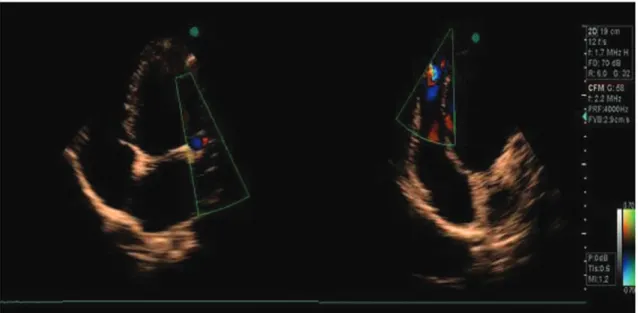
A 23-year-old woman was admitted at the general hospital for a prenatal examination in her 10th week of pregnancy. She was asymptomatic, and a physical examina-tion found that her blood pressure was 110/80 mmHg, her heart rate was 80 bpm, and her respiration rate was 18 ipm. Heart auscultation revealed a grade 2 continuous murmur along the left sternal border. There were no signs of congestive heart failure. Electrocardiography showed nor-mal sinus rhythm and no specific changes in the ST segment or T wave. Transthoracic echocardiography showed a slightly enlarged left ventricle and a markedly dilated left coronary artery. Additionally, there was an abnormal flow to the right ventricle, suggesting the diagnosis of a coronary fistula to a right cardiac chamber (Figure 1). Cardiac catheterization performed in the second trimester of
pregnancy showed normal pulmonary artery pressure and no significant increase in oxygen saturation in the right side of the heart. Coronary angiography revealed a markedly dilated tortuous circumflex coronary artery connected to the right ventricle, indicating a coronary artery fistula (Figure 2). Aspirin (100 mg/day) and endocarditis prophylaxis were initiated. A cesarean section was performed at the 37thweek of pregnancy without complications, and the health of the newborn was satisfactory. Six months after delivery, surgical treatment was recommended to correct the fistula. However, the patient refused treatment and was lost to follow-up. Two years later, she returned in the third trimester of pregnancy. The delivery occurred without complications, and the patient did not agree to treatment. She remains asymptomatic under clinical management.
DISCUSSION
We discussed an asymptomatic young pregnant woman with the rare condition of an aneurysmal circumflex coronary artery connecting to the right ventricle.
Congenital CAFs are defined as an abnormal precapillary communication between one or several normally originat-ing coronary arteries and any cardiac vein, chamber or large thoracic vessel that bypasses the myocardial capillary bed (1).
Fistulae arise from the right coronary artery (60%) or left anterior descending artery (30%) and terminate in the right side of the heart (90%). The most frequent termination sites, in descending order, are the right ventricle, right atrium, coronary sinus, and pulmonary vasculature. The circumflex coronary artery is rarely affected (2).
CAFs are isolated in 55% to 80% of cases and associated with other congenital heart diseases in 20% to 45% (1). The most frequently associated anomalies are tetralogy of Fallot, atrial septal defects, patent ductus arteriosus, ventricular septal defects, and pulmonary atresia with an intact ventricular septum.
The natural history of a coronary fistula is unknown. There is a consensus that this anomaly does not typically produce symptoms before the age of 30 years (5), and in some cases, only a continuous murmur is audible, with no other signs. However, if the CAF is sufficiently large to cause a considerable left-to-right shunt, symptoms of angina, syncope, dizziness and fatigue may be present and typically occur after the fourth decade of life (6).
Electrocardiography (ECG) is normal in approximately 50% of cases and shows left or right hypertrophy in the Copyrightß2012CLINICS– This is an Open Access article distributed under
the terms of the Creative Commons Attribution Non-Commercial License (http:// creativecommons.org/licenses/by-nc/3.0/) which permits unrestricted non-commercial use, distribution, and reproduction in any medium, provided the original work is properly cited.
No potential conflict of interest was reported.
CLINICS 2012;67(12):1523-1525 DOI:10.6061/clinics/2012(12)30
other 50%. Atrial fibrillation and an ischemic pattern are rarer manifestations (5).
Chest x-rays are typically normal, but cardiomegaly may be present if there is a large left-to-right shunt (5).
Typically, two-dimensional and color Doppler echocar-diography are not useful for establish a definitive diagnosis or determining the course of the coronary fistula; however, these methods are useful for demonstrating the dilation of the affected coronary, the related chamber enlargement and the drainage site. Transesophageal echocardiography (TEE) is better than transthoracic echocardiography for identifying the precise origin and drainage site (1,5).
Cardiac catheterization is considered the gold standard for the diagnosis of CAF and should be performed to
determine the hemodynamic significance of the lesion and provide a detailed angiographic assessment of the abnormal anatomy (1,5,7).
It is recommended that endocarditis prophylaxis and aspirin be provided to prevent thrombosis for all patients (8). Asymptomatic patients with small fistulae should be monitored clinically for signs of growth and increasing flow. Typically, lesions enlarge progressively and warrant opera-tive repair, either by transcatheter or surgical techniques. Both techniques are associated with an excellent prognosis, and the choice of the procedure depends on the morphology of the fistula.
Patients with large and tortuous fistulae, multiple open-ings, or significant aneurysmal dilatation may not be optimal candidates for transcatheter closure, and a poten-tially curative surgical treatment is preferred (9,10). Older patients with large fistulae that are not tortuous or aneurysmal may benefit from transcatheter closure.
Studies on CAFs have not emphasized the hazards of this condition when it is associated with pregnancy, although this association may cause overt heart failure, which may occur due to volume overload (3). Fistula dissection and rupture are described as rare (11).
The optimal time for intervention in pregnant women is not clear. An asymptomatic patient should be treated using a multidisciplinary approach during the prenatal period. If symptoms of myocardial ischemia are present, surgical intervention should be performed during pregnancy.
In the present case, although the patient was asympto-matic, we recommended surgery after her cesarean section based on studies emphasizing that the incidence of symptoms and complications in aneurysmal arteries increases with age, including coronary thrombosis causing myocardial infarction and angina and symptomatic cardi-omyopathy. Therefore, corrective treatment should be performed prior to these events.
In conclusion, we describe a rare case of the discovery of an aneurysmal circumflex artery in pregnancy and advocate that the approach to management and therapeutic strategy Figure 1 -A transthoracic echocardiogram showing the markedly dilated left coronary artery (left) and an abnormal flow to the right ventricle, suggesting the diagnosis of a coronary fistula to a right cardiac chamber (right).
Figure 2 -Coronary angiography revealing a markedly dilated tortuous circumflex coronary artery connected to the right ventricle, indicating a coronary artery fistula.
Fistula in pregnancy
Roscani MG et al. CLINICS 2012;67(12):1523-1525
be based on symptoms, pathological changes and possible complications.
AUTHOR CONTRIBUTIONS
Roscani MG wrote the manuscript. Zanati SG helped with the literature review. Carvalho FC and Bregagnollo EA performed the hemodynamic study and assisted in obtaining the figures. Matsubara BB helped with the literature review and reviewed the manuscript. Hueb JC performed the echocardiogram and assisted in obtaining the figures. Salmazo PS helped with the literature and assisted in obtaining the figures.
REFERENCES
1. Chirantan V, Mangukia MBBS. Coronary artery fistula. Ann Thorac Surg. 2012;93(6):2084-92.
2. Levin DC, Fellows KE, Abrams HL. Hemodynamically significant primary anomalies of the coronary arteries. Angiographic aspects. Circulation. 1978;58(1):25-34.
3. Tay SM, Ong BC, Tan SA. Cesarean section in a mother with uncorrected congenital coronary to pulmonary artery fistula. Canadian journal of
anaesthesia = Journal canadien d’anesthesie. 1999;46(4):368-71, http:// dx.doi.org/10.1007/BF03013230.
4. Hipona FA. Congenital coronary arterial fistula to a persistent left superior vena cava. The American journal of roentgenology, radium therapy, and nuclear medicine. 1966;97(2):355-8.
5. Qureshi SA. Coronary arterial fistulas. Orphanet J Rare Dis. 2006;1:51, http://dx.doi.org/10.1186/1750-1172-1-51.
6. Canga Y, Ozcan KS, Emre A, Kul S, Guvenc TS, Durmus G, et al. Coronary artery fistula: review of 54 cases from single center experience. Cardiology J. 2012;19(3):278-86, http://dx.doi.org/10.5603/CJ.2012.0050. 7. Vavuranakis M, Bush CA, Boudoulas H. Coronary artery fistulas in adults; incidence, angiographic characteristics,natural history. Cathet Cardiovasc Diagn. 1995;35(2):116-20, http://dx.doi.org/10.1002/ccd.1810350207. 8. Kasravi B, Reid CL, Allen BJ. Coronary artery fistula presenting as
bacterial endocarditis. J Am Soc Echocardiogr. 2004;17(12):1315-6. 9. Chamberlain MH, Henry R, Brann S, Angelini GD. Surgical management
of a gigantic circumflex coronary artery aneurysm with fistulous connection to the coronary sinus. Eur J Cardiothorac Surg. 2001; 20(6):1255-7, http://dx.doi.org/10.1016/S1010-7940(01)00998-8. 10. Mastroroberto P, Olivito S. Giant congenital fistula of the circumflex coronary
artery with drainage into right atrium. Heart Lung Circ. In press 2012. 11. Rajs J, Brodin LA, Hertzfeld I, Larsen FF. Death related to coronary artery
fistula after rupture of an aneurysm to the coronary sinus. Am J Forensic Med Pathol. 2001;22(1):58-61, http://dx.doi.org/10.1097/00000433-200103000-00011.
CLINICS 2012;67(12):1523-1525 Fistula in pregnancy
Roscani MG et al.