AR
T
CILE
1 Faculdade de Saúde Pública, Universidade de São Paulo. Av. Dr. Arnaldo 715, Cerqueira César. 01246-904 São Paulo SP Brasil. [email protected] 2 Escola Nacional de Saúde Pública Sérgio Arouca, Fundação Oswaldo Cruz. Rio de Janeiro RJ Brasil. 3 Faculdade de Medicina, Universidade Federal de Juiz de Fora. Juiz de Fora MG Brasil.
4 Instituto de Saúde Coletiva, Universidade Federal Fluminense. Rio de Janeiro RJ Brasil. 5 Instituto de Saúde Coletiva, Universidade Federal da Bahia. Salvador BA Brasil.
6 Faculdade de Medicina, Universidade de São Paulo. São Paulo SP Brasil.
Primary health care and the coordination of care
in health regions: managers’ and users’ perspective
Abstract This paper aims to analyze the he-althcare coordination by Primary Health Care (PHC), with the backdrop of building a Health Care Network (RAS) in a region in the state of São Paulo, Brazil. We conducted a case study with qualitative and quantitative approaches, procee-ding to the triangulation of data between the per-ception of managers and experience of users. We drew analysis realms and variables from the three pillars of healthcare coordination – informational, clinical and administrative/organizational. Stroke was the tracer event chosen and therapeutic itine-raries were conducted with users and questionnai-res applied to the managers. The central feature of the construction of the Health Care Network in the studied area is the prominence of a philanthropic organization. The results suggest fragility of PHC in healthcare coordination in all analyzed realms. Furthermore, we identified a public-private mix, in addition to services contracted from the Unified Health System (SUS), with out-of-pocket pay-ments for specialist consultation, tests and reha-bilitation. Much in the same way that there is no RAS without a robust PHC capable of coordina-ting care, PHC is unable to play its role without a solid regional arrangement and a virtuous articu-lation between the three federative levels.
Key words Primary Health Care,
Regionaliza-tion, CoordinaRegionaliza-tion, Therapeutic itineraries
Aylene Bousquat 1
Ligia Giovanella 2
Estela Márcia Saraiva Campos 3
Patty Fidelis de Almeida 4
Cleide Lavieri Martins 1
Paulo Henrique dos Santos Mota 1
Maria Helena Magalhães de Mendonça 2
Maria Guadalupe Medina 5
Ana Luiza d’Ávila Viana 6
Márcia Cristina Rodrigues Fausto 2
B
ousq Introduction
The consolidation of universal national health systems in different countries has required the establishment of health regions that can provide organicity and concreteness to the functioning of such systems1. In Brazil, the proposed
im-plementation of health regions and networks is gaining political relevance at the beginning of the 21st century, with the aim of fighting against
fragmentation of care, increasing access and en-suring equity and universality. However, health regionalization in the country is a very complex guideline, considering the regional inequalities and diversities, the State’s comprehensive attri-butions in health, the triune federative arrange-ment and multiple stakeholders (governarrange-mental and nongovernmental, public and private) con-ducting and delivering of health care.
In the policy recently implemented in the country, the Health Care Network (RAS) is the non-hierarchical organization of the set of health services linked to each other by a cooperative ac-tion aimed at ensuring the provision of continu-ous and comprehensive care to a given popula-tion2. In this RAS, Primary Health Care (PHC)
is expected to be the preferred gateway, the main care provider and care coordinator3. The
estab-lishment of health networks with these charac-teristics has been associated with better, more cost-effective quality actions and services, with greater user satisfaction and better global health indicators in different realities4-6.
The centrality of PHC coordination in the organization of health systems and networks has been increasingly evident in literature. It has a strong association with increased access, con-tinuity and quality of care, patient satisfaction, better use of available financial resources and positive impacts on the health of the popula-tion7-11. Thus, it has been considered central for
the management of patients with chronic
diseas-es12,13, an increasingly common condition in the
population due to demographic and epidemio-logical transitions. This part of the population is increasingly in urgent and lifelong need of fre-quent access to several points of the healthcare network, of being in touch with different profes-sional categories and benefiting from continuous promotion and prevention actions. This setting requires a robust PHC that can coordinate users’ therapeutic course and facilitate the timely pro-vision of health services and actions at the right place14,15.
The debate in international literature endors-es the importance of care coordination, strongly supported by systems that facilitate communi-cation between providers. However, the need to adapt to different contexts, based on the univer-salization of access with quality in health care is emphasized. It is recognized that coordination means different things to different stakeholders and that there is no broadly developed defini-tion16. Literature reflects dissent even as to how
to name it, whether ‘coordination between levels of care’ or ‘coordination of care’17. Indiscriminate
use of the terms continuity, coordination and in-tegration is also observed, which is reflected in the different ways of measuring this attribute18,19.
We assume in this text a conception of the coordination of care that considers it as a harmo-nious articulation between different profession-als and health services, whose common objective is to ensure comprehensive and quality care to users according to their needs20. The effective
coordination of care rests on three pillars: infor-mation coordination, clinical coordination and administrative / organizational coordination. The first includes the various actions that ensure that user’s information is available at all points of care and for all professionals involved. Clinical coordination draws on a robust and strength-ened PHC, which allows the provision of sequen-tial and complementary care between care levels. Administrative coordination corresponds to the organizational processes and flows of the health care network that allow integration among the different levels of the health system21.
In the SUS with its decentralized regime and competing responsibilities, there are additional barriers to the coordination of care. In the per-spective of an integrated system, the construction of a regionalized network implies planning and management strategies shared by the federated entities to confront the set of health problems that transcend the managerial capacity of only one subnational sphere22. Hence, there is a need
for further studies to analyze in the scope of health networks and regions the potentialities of PHC teams to assume coordination both at the local level and beyond the municipal boundaries, in the regional space23. This paper aims to analyze
e C
ole
tiv
a,
22(4):1141-1154,
2017
Methodology
This paper shows some of the results of the re-search “Policy, Planning and Management of Health Care Regions and Networks in Brazil”, which analyzes the building process of region-al RAS from macro dimensions of the policy, structure and organization. The results refer to PHC, especially in its role of coordinating care in the regionalized network. It was based on the premise that PHC is one of the determinants of regional health dynamics and is essential for the establishment of health networks. We performed a case study with quantitative and qualitative ap-proaches and data triangulation, especially be-tween managers’ perception and the experience of the users affected by the chosen tracer event, as well as documentary and secondary data review.
The realms and variables used to analyze the three pillars of care coordination (informa-tion, clinical, administrative/organizational) are shown in Chart 1. These realms include central elements to the implementation of coordination already used in other studies24: place occupied by
the PHC in the system; PHC’s resolution capac-ity; organizational and administrative structure of the health services network; integration be-tween teams and services; organization of flows between PHC and Specialized Care (SC) and with the Urgent and Emergency Network (RUE); and informational continuity tools.
For the users, we used the mapping of the therapeutic itineraries (TI), a methodology that has potentialities for the analysis of health service networks, still little explored in the national liter-ature25. Two different logics appear in the
com-position of the itinerary: that of health services and that of users and their families. The former is materialized through professional practice and the organization of the health system. On the other hand, the logic of users and their families is determined by perceived needs and possible choices or options. It is expressed in own path-ways built from the use of different health ser-vices and other points of care outside the health system26. In this investigation, we prioritized
the patient’s trajectory and behavior within the health system, identifying the different points and ways of accessing services.
We chose a tracer for the development of TIs, as proposed by Kessner27, which assumes that
some health problems can be particularly useful for the analysis of service delivery and the inter-action between providers, users and society. The selected disease was stroke (CVA) due to
system-ic hypertension (SH), due to its high prevalence, which could be avoided by PHC and because it has established flows among the different levels of care28.
Study location
The definition of the location of study drew from the typology of the 431 Brazilian health re-gions elaborated based on the socioeconomic sit-uation and the complexity and supply of health services29. The Norte-Barretos health region
lo-cated in the north of the State of São Paulo was intentionally chosen among the regions classified as high socioeconomic development and high service supply. This option has ensured the ex-clusion of regions with such poor structures that by themselves would not allow a priori PHC’s co-ordination of care.
However, the pre-field identified the exis-tence of a unified regional dynamics, both from the political point of view and the structure and organization of services between the regions cor-responding to the Norte-Barretos and Sul-Bar-retos Regional Interagency Commissions (CIR). We decided to carry out the research in the two regions, hereinafter known as Barretos.
With 18 municipalities, the population of the Barretos regions is 410,000 inhabitants with so-cioeconomic indicators lower than the State of São Paulo and higher than the national average (IBGE 2010). The PHC network consists of 97 PHC Facilities (UBS), with an average of 4.7 fa-cilities per 20,000 inhabitants; the coverage of the Family Health Strategy (ESF) is 56.7%, with the support of seven teams from the Family Health Support Center (NASF).
B
ousq
Chart 1. Coordination of care: pillars, realms and variables used in the analysis, Barretos, SP, 2015.
Pillars Realms Variables
Clínica PHC position in the
system
PHC as the preferred gateway in the region Access to SC depends on PHC referral Responsible for coordinating care PHC resolution
capacity
Tests collection at UBS ECG at UBS
Dispensing of SH drugs at UBS Sufficient stock of SH drugs
Orientation for healthy food and physical activities Main responsible for people with SH
CHW perform active search for users with SH BP measurement in all consultations Cardiovascular risk stratification Kidney disease risk evaluation
Specific health education groups for people with SH Use of SH clinical protocol
Organization of care to patient with SH based on risk classification Resolution capacity
after CVA
Monitoring all patients with CVA in the area Supply of rehabilitation actions
CHW performs home visit after hospitalization
Doctor or nurse performs home visit after hospitalization NASF's support
Administrativa/ organizacional
Administrative and Organizational structure
Public-Private Composition of Secondary Care, SADT and Rehabilitation
Flow organization for SC
Ensuring timely referral to other levels of care Defined care flows in place
Services integration in the region
Timely referral to cardiology, neurology and rehabilitation Referral to SC of patients with severe, refractory or secondary SH Standardized and facilitated pathway for patient access to SC SC queue monitoring in place
PHC integration in the RUE Team-services
integration
PHC team is notified of patient's hospitalization PHC doctors monitor patients at hospitalization
PHC team receives hospital discharge report with therapeutic plan. On discharge, user is advised to seek PHC
PHC doctors contact SC specialists to exchange information Specialist doctors contact PHC doctors to exchange information PHC team receives written information of consultations with specialists
Joint education activities of PHC-SC professionals PHC team is notified of user care in the RUE Continuidade
informacional
Informational continuity tools
Use of Medical Records Use of Clinical Protocol
e C
ole
tiv
a,
22(4):1141-1154,
2017
Interviews with administrators/managers and users
We carried out interviews with 18 adminis-trators/managers (municipal and regional ad-ministrators, municipal PHC coordinators and PHC facilities managers) with the application of questionnaires.
Interviews were distributed in five of the 18 municipalities of the region: the hub municipal-ity; two municipalities with a greater number of health facilities, excluding the hub; two munic-ipalities with fewer health facilities. Thus, anal-ysis of different distribution of managers in the regional dynamics was ensured. The choice of UBS for managers’ interviews covered the most common structure characteristics in the region30.
The structured questionnaire included ques-tions regarding the coordination of care in gen-eral, the patient with systemic hypertension (SH) and care after cerebrovascular accident (CVA). With different questions formats (yes/no; Likert’s scale; semi-open questions), answers were ana-lyzed in percentages in the case of yes/no ques-tions, and the questions answered in the Likert’s Scale converted into numbers (ranging from al-ways = 5 to never = 1), with means calculated and shown in charts.
In order to identify the potential respondents, we selected Hospitalization Authorizations (HA) of the Barretos region with a main diagnosis of CVA occurring within a period of up to seven months prior to field work performed in August 2015. Of the three hospitals that attended these hospitals patients, one did not authorize access to the research team. Initially, medical records were analyzed, excluding patients with a primary cause not related to SH or with significant cog-nitive and/or speech impairment. Coincidentally, all the selected people resided in the municipal-ities of Barretos or Bebedouro that concentrate the greater part of the population. Addresses registered in the HAs enabled the identification of the reference UBS, which were visited for the analysis of the medical records.
We conducted six interviews with users and main caregivers, all at home. Users were aged between 47 and 70 years, predominantly male, none affiliated with the private sector and gener-ally with low socioeconomic conditions.
A guiding script stimulated the interview; saturation was obtained by the identification and repetition of points of care accessed by these users. The interviews were recorded, transcribed and later reconstituted in narrative form in
or-der to provide an in-depth unor-derstanding in a temporal perspective. We performed a cross-sec-tional reading, prioritizing the identification of the analytical categories expressed in Chart 1. To systematize the analysis of the coordination in the region, the results of the interviews with managers were contrasted with the pathways ex-perienced by users.
The ethics committee, Faculty of Medicine, University of São Paulo approved this study.
Results
The construction of RAS in Barretos has as a central feature the leading role of a philanthropic entity, the Pio XII Foundation, in the organiza-tion, management of health services and regional governance. In addition to the management and provision of health services, it assumes the train-ing of doctors in its own medical school, medical residency and postgraduate studies with import-ant research component; it also counts on a carts factory adapted to offer mobile cancer preven-tion and diagnosis services. The institupreven-tion’s hu-man resources policy includes a dedicated career plan and clinical staff; it only serves SUS patients, although 40% of the funding is through the di-rect contribution of society. It can be character-ized as a health sector holding company.
With the management of AMEs, the need to establish a RAS with a robust PHC was evident for the managers of Pio XII: if we manage here, at the Cancer Hospital, to give an internationally rec-ognized service of excellent quality, why can’t PHC have a similar service?
Thus, in the region, the Pio XII Foundation is related to PHC in all municipalities in the re-gion, especially through screening tests for gy-necological cancers performed in mobile units, says a SUS manager: They perform for us those two screenings: Papa collection and all follow-up .... and mammography ... through the Department of Prevention. This supply competes with that of the UBS, since the population knows the period-icity of the mobile units and prefers this service, as one manager says: women have become accus-tomed to this collection.
B
ousq waiting times in municipalities. Exemplifying
this project, one respondent reports: There was a very large demand for endocrine and pneumology .... We talked to the doctors and asked them: Why is it that you refer everything? ‘Oh, I thought it was to refer to the specialist’ ...Conclusion: municipality PHC doctors called those patients back on the list and eliminated the queue.
PHC appropriate position in a system
There is a consensus among managers that PHC should be the gateway to the system; how-ever, they recognize the existence of obstacles to this implementation. Some of the difficulties mentioned were preference of the population for timelier and quicker visits; political and financial prioritization by management; lack of doctors with adequate general training; difficult access to UBS (especially hours of operation); and the low resolution capacity of the UBS.
Graphic 1 shows that managers consider ac-cess to the SC conditional on referral by PHC. In the case of the Network for the Care of People with Chronic Diseases (RAPDC), the preferential gateway would also be, most of the time, PHC.
PHC’s resolution capacity
The managers’ perspective on the PHC’s resolution capacity for hypertensive users and those who suffered from stroke is also shown in Graphic 1. In the hypertension-oriented activi-ties, it is noteworthy that only two of the 13 in-dicators had a high score (above 4): ‘active search by CHW’ and ‘BP assessment in all consultations’. Some essential activities (‘drug dispensing’, ‘ECG tests’, ‘and food and physical activity guidelines’) obtained very low scores, suggesting that such ac-tivities are infrequent.
Managers believe that PHC would display good or regular resolution capacity following CVA (score equal to or higher than 3.5 for four of the five indicators), however, NASF support is infrequent.
Organizational and administrative structure of the health services network
The PHC network is publicly owned, pre-dominantly with statutory officials; specialized medical consultations are provided by different types of services and contracting: public services with statutory employees, public services man-aged by OSS (in particular, state AMEs), as well
as contracted private services. Imaging diagnos-tic services fall under this profile, with greater weight for the public managed by OSS. However, biochemical tests have a clear predominance in the contracted private services.
Organization and flows in the RAS
Some 83% of managers say that RAS installed capacity in the region is insufficient, especially for specialized consultations and Auxiliary Ser-vices for Diagnosis and Therapy (SADT), which is reflected in problems in the care flows. Man-agers indicate that referrals to cardiology and neurology are not performed in a timely manner most of the time; however, access to physical re-habilitation services has a slightly better profile.
According to 75% of managers, the flow of care is defined and there is integration between services in the region. However, the aforemen-tioned means of integration are practically re-stricted to traditional referral and counter-re-ferral mechanisms, such as records, recounter-re-ferral pro-tocols and the regulatory service. When asked about the integration between PHC and emer-gency services, the percentage is lower (59%), and there is almost a consensus on the fact that counter-referral from RUE to PHC does not oc-cur (83%).
There is no single form for the referral of a PHC user to SC. The most cited modalities were the appointment requested by the patient him-self to the UBS’ appointment scheduling center, with subsequent communication to the patient. There is also no queue monitoring for SC and SADT and, of course, risk criteria are not used for their management.
In the case of secondary or refractory SH, managers think that most patients are always – or usually – referred to the SC.
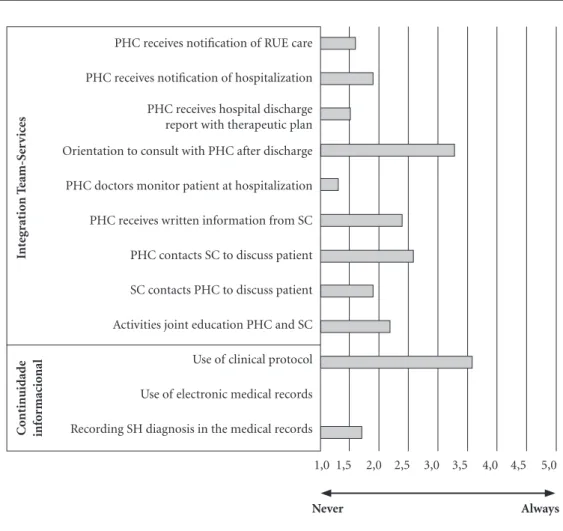
Team-services integration
and informational continuity tools
e C
ole
tiv
a,
22(4):1141-1154,
2017
“recording the SH diagnosis in the medical re-cord” are precarious.
Therapeutic Itineraries (TI)
The narratives of users were organized from the CVA event. All respondents identified the symptoms as a serious, life-threatening condi-tion. It should be noted that this identification was more a result of life experience than of health service guidelines, since no respondents had been
informed about the warning signs of SH compli-cations, such as stroke or acute myocardial in-farction (AMI).
Four respondents said that the Mobile Emer-gency Care Service (SAMU) triggered by family members or neighbors through a telephone call was an important resource. This care service ar-rived quickly, taking the patients to SH reference hospitals in the region. The use of own transport means occurred in two itineraries, such as the car of neighbors or relatives. Regardless of the type
Graphic 1. Primary Health Care’s response capacity in the follow-up of users with Systemic Arterial Hypertension and post Cerebrovascular Accident, as perceived by managers, Barretos, SP, 2015.
1,5 2,0 2,5 3,0 3,5 4,0 4,5 5,0
1,0
Never Always
Tests collection at the UBS
ECG at the UBS
Dispensation of drugs for SH at the UBS
Suicient stocks of drugs for SH
Orientation for healthy food and physical activities
Main responsible for people with SH
CHW perform active search for uses with SH
BP measurement in all consultations
Stratiication of cardiovascular risk
Risk assessment of kidney disease
Health education groups for people with SH
Perform Fundoscopy
Organization of care for patient with SH based on risk classiication PHC as the preferred gateway in the region
Access to SC only through PHC referral
Responsible for the coordination of care
PHC R
esol
u
tio
n
capacit
y f
ol
lo
w
ing CV
A
PHC p
osit
io
n
in the sy
st
em
PHC r
esol
u
tio
n capacit
y f
o
r SH
NASF support
Monitors all the patients with CVA in the area
Supply of rehabilitation actions
CHW visits ater hospitalization
B
ousq
of transportation, the existence of a support net-work of relatives and neighbors was noted.
Even patients who arrived at the emergen-cy unit in their own vehicles were received, and there were no cases of pilgrimage in search of ur-gent care. All were referred for admission to the ward or ICU after emergency care, and they pos-itively evaluated care.
Five of the respondents performed Comput-ed tomography (CT), a mandatory test for all patients with suspected stroke. According to the timing referred by patients and the analysis of medical records, none was performed within the period recommended by the Ministry of Health for this clinical condition31. It is noteworthy that,
in two cases, patients, hospitalized under the SUS had to pay for the CT. They were removed by ambulance from the institution where they were
hospitalized, sent to a private clinic, which after direct payment performed the test, returning im-mediately to the hospitalization location.
At hospital discharge, no patient was referred to the PHC; some referrals, several informally, occurred for neurology and rehabilitation ser-vices. In all cases where patients sought rehabil-itation services, they considered that access had occurred in a timely manner. When reporting on the ways in which they obtained this access, we observed a multiplicity of paths used: payment of medical consultation to receive a referral for rehabilitation in the public service; direct sched-uling in the rehabilitation service by influence of known people; onset of physical therapist treat-ment in the private sector; and attendance car-ried out free of charge at a physiotherapy school clinic in the region.
1,5 2,0 2,5 3,0 3,5 4,0 4,5 5,0
PHC receives notification of RUE care
PHC receives notification of hospitalization
PHC receives hospital discharge report with therapeutic plan
Orientation to consult with PHC after discharge
PHC doctors monitor patient at hospitalization
PHC receives written information from SC
PHC contacts SC to discuss patient
SC contacts PHC to discuss patient
Activities joint education PHC and SC
Use of clinical protocol
Use of electronic medical records
Recording SH diagnosis in the medical records
Int
eg
rat
io
n T
eam-S
er
v
ic
es
C
o
nt
in
uidad
e
inf
o
rmacio
nal
1,0
Never Always
e C
ole
tiv
a,
22(4):1141-1154,
2017
After the stroke and its rather small sequel-ae, all respondents and their families started searching for specialized medical consultations for treatment, especially of sequelae, not SH, and even for the granting of social security rights. This search was carried out autonomously by families and patients according to their possibil-ities and knowledge and not guided by a health service. The public-private mix can be clearly seen in these searches. Private services sought were mainly medical specialties (neurology and cardiology) and in some cases physiotherapy. Two forms of direct disbursement were iden-tified: to the chosen doctor or physiotherapist or to the doctor referred by the “funeral plan”. Funeral homes include in their services a list of doctors from various specialties; their insured can visit their offices and pay for a consultation with a discount. This access went hand in hand with the use of public sector services and in dis-orderly fashion. Even the patient receiving home visits from doctors and nurses from the ESF ac-cessed other medical specialists through the “fu-neral plan”. Private care was also valued: Everyone then said: go to Dr. J., make a consultation... he is a good doctor who treats diabetes, he graduated in the United States.
Half of the patients regularly attended SUS’ SC services. This access started before the stroke episode. When they were attended in the special-ized services, they linked to them because they had a better and timely response to their needs: No, he is not going back to the tiny health center. Now everything is done at the AME. Thank God, it was a God sent blessing, you know? ... You have a neurologist ... you do not have to go elsewhere to do the test, you do everything there. Hence, SC appears in TI as an important point of care. It is worth mentioning that the AME has an active stance with its users, calling to remind them of scheduled appointments and ascertaining the health status of their patients.
Even after the CVA, the UBS was not respon-sible for regular care, except for one respondent who had frequent home visits from the entire team. In one case, it was pointed out that the CHW visit was bureaucratic, just stepping in and asking if everything was fine. In none of the cases had the UBS been advised of the hospital-ization: They did not know. They became aware after we informed them... Respondents, in gen-eral, did not recognize a service or professional that coordinated their care. Some physiotherapy professionals were perceived as reference health professionals.
Even before the stroke episode, UBS was not a regular point of care for the respondents, ex-cept for two. For the others, the UBS appeared in the pathways as a place of renewal of medical prescriptions, obtaining medicines and mainly of measuring blood pressure (BP). The reference to prevention and promotion actions carried out by PHC was practically inexistent; only one user participated in promotion and prevention groups.
Private pharmacies were also identified as another point of care. In addition to acquiring medications, the patients used them to monitor SH by measuring BP: I have been monitoring SH in pharmacies for 35 years…
Chart 2 systematizes the main findings, con-trasting the managers’ opinions and users’ expe-riences seeking care, through the realms of care coordination analysis assumed in this paper.
Discussion
The methodology used, by including TI as a tool, made it possible to identify the users’ log-ic to obtain their own care, whlog-ich envisages the rationale of services and provided little used in-formation in the management of health services and systems. Conill et al.32 identified in a
differ-ent setting a similar situation: users’ pathways do not often necessarily respect the agreements and norms previously established in the planning of health actions and services.
Despite the different logics, the narratives an-alyzed suggest a weak PHC role in the coordina-tion of care for patients with chronic condicoordina-tions; these findings are in line with other studies on the subject in Brazil and in Latin America21,33,34.
In the studied region, PHC fragility is evi-dent both in establishing itself as a preferential gateway into the system and in offering resolute health care. The managers’ view reproduces the line of arguments provided for in the national guidelines for the organization of PHC services. However, this perspective is not confirmed in the user’s experience.
B
ousq
or medication acquisition. This profile is similar to that found by Cecilio et al.35 with highly
fre-quent service users in the municipalities of São Paulo state.
PHC clinical resolution capacity identi-fied was also low. Insufficient essential tests and drugs, among others, are examples of this fragil-ity. The lack of adequate structural conditions is
Chart 2. Coordination of care in tracer event in the perspective of managers and users’ experience, Barretos, SP,
2015.
Realms Administrators Users - Therapeutic Itinerary
Position held by PHC in the system
PHC is recognized as the ideal gateway, but with serious difficulties of implementation.
PHC is not a regular point of care, neither before nor after the CVA
PHC is recognized as the gateway to the Network of Care for patients with chronic diseases.
PHC is not a gateway
Access to SC depends on PHC referral PHC resolution
capacity for SH
PHC is able to intervene / monitor cases of CNCD.
User identifies UBS as the place for the exchange of drug prescriptions and BP measurement.
Diverse team actions such as active search, promotion activities, risk stratification occur more often.
PHC is not recognized as a space for health promotion and prevention of chronic noncommunicable diseases.
Fragility in the collection of tests, dispensing of medicines, fundoscopy and ECG.
PHC is not recognized as a clinical treatment space.
PHC resolution capacity following CVA
No shared responsibility between PHC and SC.
PHC monitoring is still not a priority point of care
APS seen as capable of maintaining care after the stroke.
Insufficient NASF support Administrative–
organizational structure
Public PHC services. Link between PHC and attached population
are not explicit. SC services, specialized
consultations and imaging tests carried out by own public services; Services managed by OSS (AME); Contracted private services.
Private-public mix for consultations, specialized tests and rehabilitation: SC consultations via funeral insurance; SUS hospitalization with CT paid in another service
Biochemical examinations performed almost exclusively by contracted private services. Insufficient installed capacity of RAS,
especially in SADT and SC. especialmente em SADT e AE. Organization of
flows
Bureaucratic definition of flows. They do not identify the care flow from PHC.
They use various gateways for SC and tests. No monitoring and evaluation of
queues for SADT and AE.
Linkage or desire to be linked to the secondary level, especially to the AME / SES-SP.
Good accessibility to SAMU in urgency. Team-Services
Integration
Lack of formal mechanisms established for integration.
Lack of communication between services and professionals.
Informational Continuity Mechanisms
e C
ole
tiv
a,
22(4):1141-1154,
2017
an important hurdle to PHC assuming its role of coordinating care not only in the region stud-ied, but also in a large part of the country30. Even
the CHWs’ actions appear bureaucratic in users’ words, not evidencing the potential performance of this professional.
The private-public mix identified in the path-ways, besides the services contracted by the SUS, was made through direct disbursement, mainly for the accomplishment of tests and rehabilita-tion services. It is worth remembering that these expenses added to the purchase of drugs were an economic burden for the families. The sup-ply profile, coupled with the lack of therapeutic back-up, especially in the provision of specialized services, weakens the coordination capacity of PHC, a nodal point for the organization of net-works, in several aspects23. This setting is
com-mon to other health regions, heavily dependent on the private sector23. In these, insufficient
sup-ply and public underfunding, coupled with the sometimes-inadequate use of existing resources and disarticulation among providers are factors that make it difficult for PHC to be a robust and resolutive practice23. In contrast to the user’s
per-spective, managers and professionals have a re-stricted view of the public-private relationship, as they are not active stakeholders in the process of obtaining the necessary care.
In addition to the lack of organized flows be-tween PHC and SC, the results suggest the exis-tence of a logic in which SC, especially services linked to the Pio XII Foundation “invade” both PHC’s expected spaces of action and the very re-gional management of RAS. This role does not only stem from the demonstrated shortcomings of PHC in the region, but is also based on the population’s valuation of the specialized medical practice space and the production of symbolic value for the health care offered by the AME/SES-SP, which is better qualified.
Breaking with the compartmentalized logic of health service operations is not an easy task;
Feo et al.36 have identified that even after 20 years
of the PHC reform in Spain, SC remained a wa-tertight compartment, a fragmented functioning rationale that facilitates the emergence of diag-nostic errors and inadequate treatments36.
The SAMU ensured quick and timely access to the first care after the stroke, and no pilgrimage situations in search of relief were identified. The pilgrimage is an experience that, unfortunately, several Brazilians have faced in recent years37; the
regional organization of RAS is key to its over-coming. Machado et al38 explore a two-way role
of SAMU; if on the one hand, it demands region-al arrangements such as centrregion-al regulation, on the other hand, it contributes to the daily/effec-tive establishment of RAS. However, mechanisms for coordinating care between PHC and points of the Urgent and Emergency Network are prac-tically non-existent in the reality studied.
The lack of computerized and integrated medical records also minimizes the possibilities of interprofessional communication, one of the realms of care coordination39. The evaluation of
managers and users is synchronous in indicat-ing the fragility of this function. As other studies indicate, the traditional referral and counter-re-ferral guides are conservative and bureaucratic instruments, insufficient for the organization of health care networks with informational conti-nuity and coordination by PHC teams40.
B
ousq Collaborations
e C
ole
tiv
a,
22(4):1141-1154,
2017
References
1. Kuschnir R, Chorny A. Redes de atenção à saúde: contextualizando o debate. Cien Saude Colet 2010; 15(5):2307-2316.
2. Brasil. Ministério da Saúde (MS). Portaria 4.279, de 30 de dezembro de 2010. Estabelece diretrizes para a or-ganização da Rede de Atenção à Saúde no âmbito do Sistema Único de Saúde (SUS). Diário Oficial da União
2010; 31 dez.
3. Mendes E. A construção social da atenção primária à
saúde. Brasília: CONASS; 2015.
4. Kringos DS, Boerma WG, Bourgueil Y, Cartier T, Hasvold T, Hutchinson A, Lember M, Oleszczyk M, Pavlic DR, Svab I, Tedeschi P, Wilson A, Windak A, De-deu T, Wilm S. The European primary care monitor: structure, process and outcome indicators. BMC family practice 2010; 11:81.
5. Strandberg-Larsen M, Krasnik A. Measurement of integrated healthcare delivery: a systematic review of methods and future research directions. Int J Integr Care 2009; 9:e01.
6. Saltman R, Rico A, Boerma W. Primary care in the
driv-er’s seat? New York: Open University Press; 2006.
7. Hansen J, Groenewegen PP, Boerma WG, Kringos DS. Living In A Country With A Strong Primary Care Sys-tem Is Beneficial To People With Chronic Conditions.
Health affairs Sep 2015; 34(9):1531-1537.
8. Tricco AC, Antony J, Ivers NM, Ashoor HM, Khan PA, Blondal E, Ghassemi M, MacDonald H, Chen MH, Ezer LK, Straus SE. Effectiveness of quality improve-ment strategies for coordination of care to reduce use of health care services: a systematic review and me-ta-analysis. CMAJ 2014; 186(15):E568-578.
9. Wagner EH, Sandhu N, Coleman K, Phillips KE, Sugar-man JR. Improving care coordination in primary care.
Med Care 2014; 52(11 Supl. 4):S33-38.
10. Kringos DS, Boerma WG, Hutchinson A, van der Zee J, Groenewegen PP. The breadth of primary care: a sys-tematic literature review of its core dimensions. BMC health services research 2010; 10:65.
11. Boerma W. Coordination and integration in European primary care. In: Saltman DC, Rico A, Boerma W, edi-tors. Primary care in the driver’s seat? Berkshire: Univer-sity Press; 2007. p. 3-21.
12. Hudon C, Chouinard MC, Diadiou F, Lambert M, Bouliane D. Case Management in Primary Care for Frequent Users of Health Care Services With Chronic Diseases: A Qualitative Study of Patient and Family Ex-perience. Ann Fam Med 2015; 13(6):523-528. 13. Lamothe L, Sylvain C, Sit V. Multimorbidity and
pri-mary care: Emergence of new forms of network orga-nization. Sante Publique 2015; 27(Supl. 1):S129-135. 14. Haggerty JL. Ordering the chaos for patients with
mul-timorbidity. BMJ 2012; 345:e5915.
15. Tarrant C, Windridge K, Baker R, Freeman G, Boul-ton M. ‘Falling through gaps’: primary care patients’ accounts of breakdowns in experienced continuity of care. Family practice 2015; 32(1):82-87.
16. McDonald K, Schultz ELA, Albin L, Pineda N, Lonhart J, Sundaram V, Smith-Spangler C, Brustrom J, Malcolm E, Rohn L, Davies S. Care Coordination Atlas Version 4 (Preparedby Stanford University under subcontract to American Institutes for Research on Contract
No.HH-SA290-2010-00005I). Rockville: Agency for Healthcare
Research and Quality; 2014. AHRQ Publication No. 14-0037-EF.
17. Almeida P, Giovanella L, Mendonça M, Escorel S. Desa-fios à coordenação dos cuidados em saúde- estratégias de integração entre níveis assistenciais em grandes cen-tros urbanos. Cad Saude Publica 2010; 26(2):286-298. 18. Haggerty J, Reid R, Freeman G, Starfield B, Adair C,
McKendry R. Continuity of care: a multidisciplinary review. BMJ 2003; 327(7425):1219-1221.
19. Alkmim MB, Marcolino MS, Figueira RM, Sousa L, Nunes MS, Cardoso CS, Ribeiro AL. Factors associated with the use of a teleconsultation system in Brazilian primary care. Telemed J E Health 2015; 21(6):473-483. 20. Terraza Nunez R, Vargas Lorenzo I, Vazquez
Navar-rete ML. Coordination among healthcare levels: sys-tematization of tools and measures. Gaceta sanitaria / S.E.S.P.A.S. 2006; 20(6):485-495.
21. Vargas I, Mogollon-Perez AS, De Paepe P, Ferreira da Silva MR, Unger JP, Vazquez ML. Barriers to health-care coordination in market-based and decentralized public health systems: a qualitative study in healthcare networks of Colombia and Brazil. Health Policy Plan
2016; 31(6):736-748.
22. Hartz Z, Contandriopoulos A. Integralidade da atenção e integração de serviços de saúde: desafios para avaliar a implantação de um “sistema sem muros”. Cad Saude
Publica 2004; 20(Supl.2):S331-336.
23. Almeida P, Santos A, Santos V, Silveira Filho R. Inte-gração assistencial em região de saúde: paradoxo entre necessidades regionais e interesses locais. Saúde Soc.
2016; 25(2):320-335.
24. Almeida PF, Giovanella L, Mendonca MH, Escorel S. Challenges for healthcare coordination: strategies for integrating levels of care in large cities. Cad Saude Pu-blica 2010; 26(2):286-298.
25. Cabral A, Martinez-Hemáez A, Andrade E, Cher-chiglia M. Itinerários terapêuticos: o estado da arte da produção científica no Brasil. Cien Saude Colet 2011; 16(11):4433-4442.
26. Bellato R, Araujo L, Castro P. O itinerário terapêutico como uma tecnologia avaliativa da integralidade em saú. In: Pinheiro R, Silva Jr A, Mattos R, organizadores.
Atenção básica e integralidade: contribuições para
es-tudos de práticas avaliativas em saúde. Rio de Janeiro:
IMS/UERJ; 2008. p. 167-185.
27. Kessner DM, Kalk CE, Singer J. Assessing health qual-ity-the case for tracers. N Eng J Med 1973; 288(4):189-194.
B
ousq 29. Viana ALD, Bousquat A, Pereira APCM, Uchimura
LYT, Albuquerque MV, Mota PHS, Demarzo MMP, Ferreira MP. Tipologia das regiões de saúde: condi-cionantes estruturais para a regionalização no Brasil.
Saude soc. 2015; 24(2):413-422.
30. Giovanella L, Bousquat A, Fausto MCR, Fusaro E, Mendonca M, Gagno J. Tipologia das Unidades Básicas de Saúde Brasileiras. Brasília: Região e Redes; 2015. 31. Brasil. Ministério da Saúde Saúde (MS). Manual de
rotinas para atenção ao AVC. Brasília: Editora do MS; 2013.
32. Conill EM, Pires D, Sisson M, Oliveira M, Boing A, Fertonani H. O mix público-privado na utilização de serviços de saúde: um estudo dos itinerários terapêuti-cos de beneficiários do segmento de saúde suplementar brasileiro. Cien Saude Colet 2008; 13(5):1501-1510. 33. Doubova S, Guanais F, Pérez-Cuevas R, Canning D,
Macincko J, Reich M. Attributes of patient-centered primary care associated with the public perception of good healthcare quality in Brazil, Colombia, Mexico and El Salvador. Health Policy Plan 2016; 13:139. 34. Gerhardt T, Rotoli A, Riquinho D. Itinerários
terapêuti-cos de pacientes com câncer: encontros e desencontros da Atenção Básica à alta complexidade nas redes de cuidado. In: Pinheiro R, Silva Junior A, Mattos R, orga-nizadores. Atenção básica e integralidade: contribuições para estudos de práticas avaliativas em saúde. Rio de Ja-neiro: CEPESC; IMS/UERJ, Abrasco; 2008. p. 167-187. 35. Cecilio L, Andreazza R, Carapinheiro G, Araújo EC,
Oliveira LA, Andrade MGG, Meneses CS, Pinto NRS, Reis DO, Santiago S, Souza ALM, Spedo SM. A Atenção Básica à Saúde e a construção das redes temáticas de saúde: qual pode ser o seu papel? Cien Saude Colet
2012; 17(11).
36. Feo J, Campo J, Camacho J. La coordinación entre Atención Primaria y Especializada: reforma del sistema sanitario o reforma del ejercicio profesional? Rev Adm Sanit 2006; 4(2):357-382.
37. Mussi F, Passos L, Menezes A, Caramelli B. Entraves no acesso à atenção médica: vivências de pessoas com infarto agudo do miocárdio. Rev Assoc Med Bras 2007; 53(3):234-239.
38. Machado C, Salvador F, O’Dwyer G. Serviço de Atendi-mento Móvel de Urgência: análise da política brasileira.
Rev Saude Publica 2011; 45(3):519-528.
39. Schang L, Waibel S, Thomson S. Measuring care
coordi-nation: health system and patient perspectives. London:
LSE Health; 2013.
40. Almeida P, Santos A. Diálogos em busca de coorde-nação do cuidado: linha de chegada ou novo itin-erário? In: Almeida P, Santos A, organizadores. Atenção Primária à Saúde na coordenação do cuidado em Regiões
de Saúde. Salvador: EDUFBA; 2015. p. 277-303.
Article submitted 01/06/2016 Approved 04/08/2016