w w w. s b f g n o s i a . o r g . b r / r e v i s t a
Original
Article
Constituents
of
Corynaea
crassa
“Peruvian
Viagra”
Gonzalo
R.
Malca
Garcia
a,∗,
Lothar
Hennig
a,
Joachim
Sieler
a,
Rainer
W.
Bussmann
baInstitutfürOrganischeChemieandInstitutfürAnorganischeChemie,FakultätfürChemieundMineralogie,UniversitätLeipzig,Johannisallee29,04103Leipzig,Germany bWilliamL.BrownCenter,MissouriBotanicalGarden,P.O.Box299,St.Louis,MO63166-0299,USA
a
r
t
i
c
l
e
i
n
f
o
Articlehistory:
Received9September2014
Accepted24February2015
Availableonline23March2015
Keywords:
-Amyrone
-Amyrine
Corynaeacrassa Huanarpo Lupenone
Lupeol/-sitosterol
a
b
s
t
r
a
c
t
Aphytochemicalinvestigationofmethanolandn-hexaneextractsoftuber/rootsofCorynaea crassa
Hook. f., Balanophoraceae, led to the isolation and characterization of -sitosterol, lupenone, -amyrone, lupeol,and-amyrine.Unusualcomplex1:1mixturesoflupenone/-amyroneandlupeol/-amyrine obtainedfromtheextractswereidentifiedbyNMRandHR-MSexperiments.Thestructureofthe1:1 lupenone/-amyronemixturewasconfirmedbyX-rayanalysis.Thesetriterpeneketonederivatives, onlydistinguishedeitherby5-or6-memberedEring,co-crystallizeinonecommonunitcellinthesolid state.
© 2015 Sociedade Brasileira de Farmacognosia. Published by Elsevier Editora Ltda. All rights reserved.
Introduction
Medicinal plants with aphrodisiac activity are used for the treatmentoferectiledysfunctionallovertheworld.Avarietyof botanicalssuchas TribulusterrestrisL., Zygophyllaceae, Aframo-mum melegueta (Roscoe) K. Schum., Zingiberaceae, Eurycoma longifoliaJack,Simaroubaceae,Cnidiummonnieri(L.)Cusson, Api-aceae,FerulahermonisBoiss.,Apiaceae,Mucunapruriens(L.)DC., Fabaceae,Lepidiummeyenii Walp.,Brassicaceae,Passiflora incar-nataL.,Passifloraceae,andsomecompoundslikeyohimbinewere reportedtohave beneficial effects onsexualfunction, support-ing older claims and offering new hope (Hosseinzadeh et al., 2008).
Likewise,incontemporaryPeruvianfolkmedicineaverylarge numberofmedicinalplantsareusedforaphrodisiacalpurposes,a fewhundredofthemtomodulatefertility,ortoinducesterility (Pachacuti-Yamqui, 1992). Plant mixtures and magic are com-monlyappliedtoincrease ortodecreaselibido(Elferink,2000). Oneoftheplantsusedintheseaphrodisiacmixturesiscommonly knownasChutarpo(orhuanarpo),forwhichthereisafemaleand maledesignation. JatrophamacranthaMüll.Arg., Euphorbiaceae (BussmannandSharon,2007;Pardo,2002;DeFeo,1992;Brack Egg, 1999; Desmarchelier et al., 1996a,b; Oshima et al., 2003; Tincoetal.,2011;Benavidesetal.,2006;Okuyamaetal.,1996;
∗ Correspondingauthor.
E-mail:[email protected](G.R.MalcaGarcia).
Schultes, 1980) and Corynaea crassa Hook. f., Balanophoraceae (BussmannandSharon,2006,2007;BussmannandGlenn,2010) areboth underthemale designation“Huanarpo macho”. “Hua-narpomacho”istraditionallyusedstrictlyasamaleaphrodisiac, whilethe“Huanarpohembra”Cnidoscolusperuvianus(Müll.Arg.) J.F.Macbr.,Euphorbiaceae,thefemaledesignation,isusedstrictly asafemaleaphrodisiac.Theuseofanyofthesebytheopposite sexisthoughttohaveanti-aphrodisiaceffect(Pachacuti-Yamqui, 1992).
AdetaileddescriptionofpreparationanduseofC.crassa “Hua-narpomacho”inanalcoholicbeverageisgivenin(Bussmannetal., 2011a,b).InPeruthisplantcanbefoundintheregionsofCajamarca (San Ignacio, Chota and Jaén), Amazonas (Bagua), Lambayeque (Chiclayo),LaLibertad(Trujillo),Pasco(Oxapampa)andCusco(La Convención)(BrakoandZarucchi,1993;Tropicos).
C. crassa is a hemi-parasitic plant, which grows on roots of other species. Likewise Balanophoraceae family consists of 17 genera and approximately 50 species (Tupac Otero et al., 2009). The natural distribution reaches from Costa Rica to Bolivia and theplant grows at altitudes from 1250 to 3600m (Tupac Otero et al., 2009). C. crassa is not only an aphro-disiac plant there are also reports from ethanolic extracts which have shown biological activity against Staphylococcus aureus (Bussmann et al., 2010, 2011a,b). The ethanolic extract exhibit a toxicity of 116g/ml using a brine-shrimp lethality assay however, the water extract was found to be non-toxic (<10,000g/ml) for the same lethality assay (Bussmann et al., 2011a,b).
http://dx.doi.org/10.1016/j.bjp.2015.02.007
Currently,there is littleinformation aboutconstituentsofC. crassa(Duffand Nickrent,1997;Nickrentetal.,1997).A phyto-chemicalinvestigationofthewholeplantsofC.crassawasthus performedaspartofourworkonthediscoveryofbioactive com-poundsfromPeruvianherbalmedicines.Thisledtoisolationand characterizationof-sitosterol,lupenone,-amyrone,lupeol,and -amyrine.
Inthis work,theisolation andstructure elucidationofthese constituentsaredescribed.
Materialsandmethods
UsedNMR,MSandHPLCmachinesandmethods
NMRspectra(1H,13C,APT,H,H-COSY,HSQC,andHMBC)were recordedonaVarianMercury400plus(400MHzfor1H,100MHz for13C)andaVarianMercury300plus(300MHzfor1H,75MHz for13C)spectrometer,respectively,at26◦CandtheuseofCDCl
3as asolvent.Thechemicalshiftsarereportedrelativetothe resid-ualsolventpeak,which wasusedas aninternalreference (1H: 7.26ppm,13C:77.16ppm).Chemicalshiftsaregiveninıvalues, couplingconstantsJinHz;HR-MSspectrawereperformedwitha BrukerDaltonicsESI-FT-ICR-MSAPEXII[7T]andHPLCVarianPro star360,vp250/2Nucleosilcolumn50-7.
Preparationofextracts
Isolationandstructuralelucidationofsteroids
Thetubers/rootsofCorynaeacrassaHook.f.,Balanophoraceae, wereboughtattheMayoristaMarketinTrujilloandtheModelo MarketinChiclayoinNorthernPeru.Driedandpowderedroots (200g)ofC.crassawereextractedfor4daysatroomtemperature, usingsolventsofincreasingpolarity,namely,1.5Ln-hexaneand 1.5Imethanol.Thesolventwasthenevaporated underreduced pressure,then-hexaneextractyielded1.062gandthemethanol extract4.240gofcrudeproduct.Liebermann’sreagentenabledus todetermineremainingsteroidsandtriterpenesinthe methano-licextract,which wasre-dissolvedinwater andextracted with dichloromethaneyielding906mg.Bothextractswerecombined forasaponificationprocesswith5%NaOHandweobtainedintotal 209mgofsteroidsandtriterpenes(TS1).
TheplantmaterialwastakenfromBussmannandSharon’s col-lection(Voucher:Supportinginformation,p.19).
Isolationbychromatography
TS1(209mg)wasfractionatedbycolumnchromatographyon silicagelelutingwithn-hexane/dichloromethanegradientsystem (10:0.5→ 10:1→ 10:1.5→ 10:2→ 10.2.5→ 10:3)togivefive frac-tions.Fraction1containedtracesoftwosteroids(5.3mg)seemed ontheTLCplateand1HNMRbuttheywerenotpossibletoseparate byCCandHPLC.
Fraction 2 (20.1mg) was subjected to further HPLC with pure n-hexane (Rf: 0.81); After several purifications a lot of material was lost. Then the finally material was recrys-tallized from methanol/chloroform to yield -amyrenone/ lupenone (10.8mg). Fractions 3 and 4 (62.9mg) were fur-ther purified (Silica gel, n-hexane/DCM=5:0.06→ 5:0.1→ 5:0.2→ 5:0.3→ 5:0.4) to yield 12.5mg of -sitosterol. And finallyfraction5 (18.8mg)waspurified byflash CC(n-hexane/ DCM=10:0.1→10:0.3→10:0.4→10.5→10:6→10:0.7) and HPLC (n-hexane/isopropanol=9:0.0–9:0.02) then recrystallized frommethanol/chloroformtoyield15.3mgof-amyrine/lupeol (Rf: 0.24). Finally, 2.8mg of lupeol (1) was isolated by HPLC
(n-hexane/isopropanol=9:0.1).
HO
1
23 24 8 25
27 18
28 19
22 21 29 30
1 2
4 5 6
7 9
11 12
13 14
15 16 17
3 10
26
Lupeol (1): White powder; MP. 215◦C; [˛]
D=+26,4 (c=0.4, CHCl3);1H NMR(400MHz,CDCl3):ı(ppm)=0.69 (1H,m,H-5), 0.77(1H,s,H-24),0.80(1H,s,H-28),0.84(1H,s,H-25),0.94(1H, m,H-1b),0.96(1H,m,H-15b),0.96(1H,s,H-27),0.97(1H,s,H-23), 1.04(1H,s,H-26),1.10(1H,m,H-12b),1.19(1H,m,H-22),1.27(1H, m,H-21),1.29(1H,m,H-11b),1.30(1H,m,H-9),1.38(1H,m,H-7), 1.39(1H,m,H-6b),1.39(1H,m,H-18),1.43(1H,m,H-11a),1.48 (1H,m,H-16),1.52(1H,m,H-6a),1.61(1H,m,H-15a),1.61(1H,m, H-2),1.62(1H,m,H-13),1.64(1H,m,H-1a),1.70(1H,m,H-12a), 1.70(1H,s,H-30),2.38(1H,m,H-19),3.18(1H,dd,J=11.0;5.3Hz, H-3),4.56(1H,s,H-29b),4.68(1H,s,H-29a).
13C NMR (100MHz,CDCl
3): ı(ppm)=14.8(CH3, C-27), 15.6 (CH3,C-24),16.1(CH3,C-26),16.2(CH3,C-25),18.1(CH3,C-28), 19.0(CH2,C-6),19.8(CH3,C-30),21.2(CH2,C-11),25.3(CH2,C-12), 27.2(CH2,C-15),27.5(CH2,C-2),28.4(CH3,C-23),30.1(CH2,C-21), 34.2(CH2,C-7),35.9(CH2,C-16),37.2(C,C-10),38.5(CH,C-13), 38.7(CH2,C-1),39.8(C,C-4),40.3(CH2,C-22),41.1(C,C-8),42.8(C, C-14),43.2(C,C-17),47.8(CH,C-19),48.5(CH,C-18),50.9(CH, C-9),55.5(CH,C-5),79.3(CH,C-3),109.5(CH2,C-29),151.2(C,C-20); HR-MS:m/z449.43[M+Na]+,forformulaC
30H50O. ˇ-SitosterolHR-MS:m/z437.41[M+Na]+,forformulaC
29H50O.
Lupenone/ˇ-amyroneHR-MS:m/z447.40[M+Na]+,forformula C30H48O.
Lupeol/ˇ-amyrine HR-MS: m/z 449.43 [M+Na]+, for formula C30H50O.
X-raycrystallography
Recrystallization of the lupenone/-amyrone mixture from methanol/chloroform(1:0.3)gives colorlessprisms.A crystalof thedimensions0.3mm× 0.15mm× 0.15mmwasusedfor anal-ysis.TheintensitiesweremeasuredonanIPDS1diffractometer (Fa.STOE)andwerecorrectedforLorentzandpolarizationeffects. Thestructurewassolvedbydirectmethods,andtherefinement was performed with SHELX-97 (Sheldrick, 1997). Crystal data:
a=11.203 ˚A, b=14.956(2) ˚A, c=30.513(6) ˚A, V=5112.5 ˚A3, space group P2(1)2(1)2(1), Z=8, Dcalc=1.103mg/m3, =0.71073 ˚A, (MoK␣)=0.064mm−1,F(000)=1888,andT=213(2)K,thetotalof 38,852reflections(9556independent,Rint=0.082)intherangeof 2.2◦≤ ≤ 26.1◦and559refinedparameters.Thefinalparameters wereR1=0.0442,R2=0.0948for3195observedreflections with
I>2(I)andagoodness-of-fit=0.558.
Crystallographicdataforthestructuredeterminedinthispaper have beendepositedatCambridge CrystallographicData center (CCDCreferencenumberisCCDC1008248)andcanbeobtained freeofchargefromCambridgeCrystallographicDataCentreCCDC, 12UnionRoad,CambridgeCB21EZ,UK;fax:+4401223336033;
Resultsanddiscussion
150.80 145.29 121.58 109.51 4000 3800
3600
3400
3200
3000
2800
2600
2400
2200
2000
1800
1600
1400
1200
1000
800
600
400
200
220 215 210 205 200 195 190 185 180 175 170 165 160 155
f1 (ppm) lupenone β-amyrone
b a
a′
b′
c′
c, c′ a′
a b′
b
c
o o
150 145 140 135 130 125 120 115 110 0
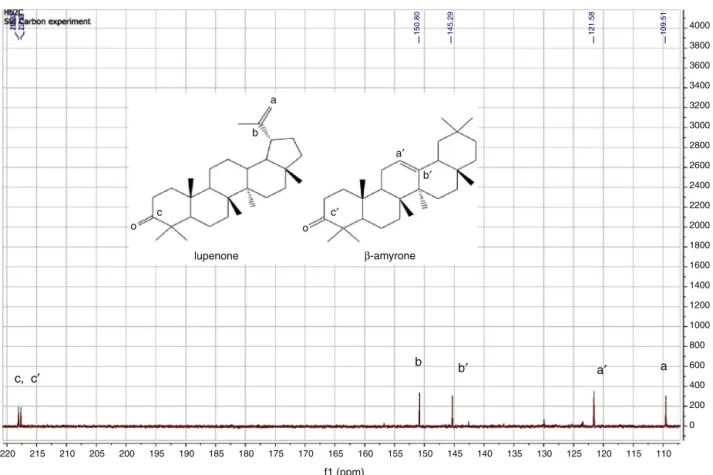
Fig.1.Characteristicalpartofthe13CNMRspectrumofthe1:1lupenone/-amyronemixture.
151.04 145.30 121.86 109.47 79.12 79.10 3400
3200
3000
2800
2600
2400
2200
2000
1800
1600
1400
1200
1000
800
600
400
200
160 155 150 145 140 135 130 125 120 115 110 105 100 95 90 85 80 f1 (ppm)
lupeol
β-amyrine
HO a
a′
b′
b
c
HO
b
0
b′ a′ a c
c′
c′
A
A
O1AC3A
C23A
C4A C5A
C6A C24A
C2B
C1B
C25B
C10B
C11B
C12B
C13B
C19B C30B C29B
C20B C18B
C17B
C21B
C22B C28B C16B C15B
C9B C1B
C3B
C23B
C4B
C5B
C24B
C6B C7BC26B
C27B
C14B C8B
C8A
C14A C27A
C15A
C16A
C28A C22A
C17A C21A
C19A C20A
C29A C30A
C18A C13A C12A C11A
C9A C10A C1A C2A
C25A
C7AC26A
B
B
A
C
D
B
C
D
Fig.3. Molecularstructuresoflupenone(A)and-amyrone(B)(ellipsoidswith50%probability).
describedin(Dominguez,1973;Harborne,1984).Wehave iden-tifiedsteroids, triterpenes, flavonoids, cardiotonics,tannins and anthocyanines,whereasalkaloidshavenotbeendetected. Accord-ing toLiebermann–Burchard’s tests, the experimentsalso have shown anintensegreen darkcoloration for steroidsand triter-penes,indicatingthatthesesecondarymetabolitesareinthecrude extract.
Thesteroid-sitosterol,wasoneofthemainproductsisolated fromthe n-hexaneextract and purificationby chromatography withn-hexane/dichloromethane.-Sitosterolitselfiswidely dis-tributedintheplantkingdomandusedinherbaltherapy,especially forbenignprostatichyperplasia(BPH)(Bergesetal.,1995).The structurewasconfirmedbyNMR,HR-MSandcomparisonwiththe literatureresults(Wrightetal.,1978;Faizietal.,2001).
Ina nextstep,then-hexaneextractfurnisheda1:1mixture ofthepentacyclicisomerictriterpeneslupenoneand-amyrone. It was not possible to separate both compounds using chro-matographicmethods.Finally,weweresuccessfultoidentifythe structureofthecomplexmixturebyuseof1Dand2DNMR spec-troscopy,X-rayandHR-MS.Ourresultsareinagreementwiththe literaturedata(Wenkertetal.,1978;Carpenteretal.,1980).These isomerictriterpeneketonederivativesareonlydistinguishedinits structurebytheir5-and6-memberedEring,respectively,andgive thesamehighresolutionmassspectrum.Inthe1HNMRspectrum ofthemixtureweobservedthreesignalsofolefinicprotonsina ratio1:1:1.Thesignalat5.18ppmwasassignedtothemethine pro-tonin-amyrone(Fig.1),whilethesignalsat4.66and4.54ppm, respectively,resultfromthemethyleneprotonsoflupenone.
The 13C NMR spectrumshows typical signals at218.03 and 217.65ppm corresponding to thecarbonyl groups. The olefinic carbon atoms appear at 109.51 ( CH2) and 150.80ppm ( C ) (lupenone), and at 121.59 ( CH ) and 145.29ppm ( C ) ( -amyrone)(Fig.1).
We were able to recrystallize the triterpene mixture using methanol/chloroform(1:0.2)togivecrystalsenoughsuitablefor X-rayanalysis.Thecrystalstructureunambiguouslyconfirmsthe interpretation of the spectra and the structure of the isolated products.Intheorthorhombicunitcelltherearetwostructural con-stitutionisomersoftheformulaC30H48O:lupenoneand-amyrone (Fig.3).
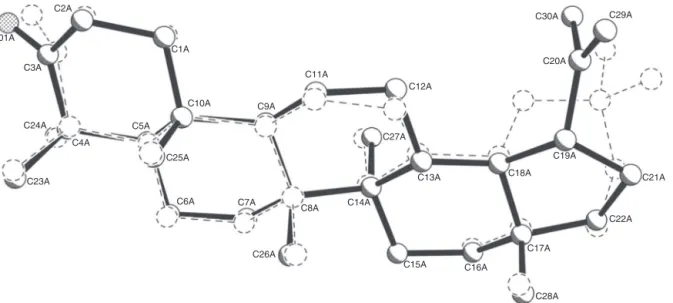
Theformationofa1:1mixedcrystalisduetotheclose resem-blanceoftheconformationwiththeringsA,B,CandD.Acalculation ofthepuckeringparametersaccordingto(CremerandPople,1975) givesparameterswhichagreewithaC(chair)–conformation.Only theC-ringof-amyronehasanE(envelope)–configuration.The reasonforthisdifferenceisthedoublebondbetweenC12B–C13B (1.335(5)Å).Afittingofbothmolecularstructuresshowsthebroad consistencybetweentheringsA,B,CandD(Fig.4).
OurX-raydataareinagreementwiththeX-raystructuresof lupenoneand-amyroneobtainedasseparatedcompoundsby iso-lationfromotherplants(Dampawanetal.,1977;Yanetal.,1989; Jaiswaletal.,2004).
01A
C1A
C10A
C5A
C4A C24A
C23A
C25A
C6A C7A C8A
C26A
C14A
C15A C16A
C17A
C22A C21A C19A
C18A C13A
C12A
C20A
C30A C29A
C27A C11A
C9A
C28A C3A
C2A
Fig.4.Fittingofthemolecularstructuresoflupenoneand-amyrone.Inthecrystalstructurethetwodifferentmoleculesalsoformseparatehelicalarrangementsalongthe
b-axis.
techniques,MSmeasurementsandcomparisonwiththeliterature results(Wenkertetal.,1978;Carpenteretal.,1980).Inthe1HNMR spectrumtheolefinicprotonsappearat5.18( CH of-amyrine), 4.68and4.56( CH2oflupeol),andadditionallythetypicalCH O absorptionsat3.20ppm.Inthe13Cspectrumtheolefiniccarbons appearnearlyunchanged(151.03,145.29,121.85and109.45ppm) incomparisontothespectrumofthelupenone/-amyrone mix-ture.ButinsteadofcarbonylsignalsnowtwocloselyrelatedCH O signalsappearat79.12and79.10ppm.
AfteradditionalHPLCpurificationofthismixtureitwas possi-bletoisolatelupeolasnearlypurecompoundforseparateNMR characterization.
Interestingly, the common appearance of the combinations lupenone/-amyroneandlupeol/-amyrinewasobservedforfirst time.Incontrast,thecombinationoflupanone/lupeolalreadywas foundinTamarindusindicaL.,Fabaceae(Mathur,2012),andthe combinationof-amyrone/-amyrinewasisolatedand character-izedfromDiospyrosmorrisianaHance,Ebenaceae(Yanetal.,1989). The formation of both lupenone/-amyrone and lupeol/ -amyrineeach in a 1:1ratio wasunexpected becauselupenone andlupeolwereformedviathesamelupenylcation,whereas -amyrineand-amyronewereformedviatheoleanylcationinthe proposedbiosyntheticalpathway(GalloandSarachine,2009;Seo etal.,1981).
Acomplexmixtureofallthese4pentacyclictriterpenesfromthe sameplanthasneverbeenobservedbefore.Otherwise,the individ-ualcompoundshavebeenisolatedanddescribedasconstituentsin differentaphrodisiacplants(Mathur,2012;Mazumderetal.,1999; Corrêaetal.,2009;Immanetal.,2007).
Conclusion
Thepresentpaperdescribestheisolationandcharacterization offiveconstituentsfromC.crassa:-sitosterolandtwointeresting 1:1mixtures oftriterpenes:lupenone/-amyroneand lupeol/ -amyrine.Theresultsmaybehelpfulinfurtherinvestigationsofthe biologicalactivityofthesenaturalcompounds.
Authors’contribution
GRMG(PhDstudent)contributedincollectingplantsampleand identification,runningthelaboratorywork,anddraftedthepaper; LHdidtheNMRinvestigations;JSperformedtheX-rayanalysis;
RWBcontributedincollectingplantsampleandidentification.All theauthorshavereadthefinalmanuscriptandapprovedthe sub-mission.
Conflictsofinterest
Theauthorsdeclarenoconflictsinterest.
Acknowledgments
TheauthorsaregratefultoMrs.RamonaOehme(Universityof Leipzig,InstituteofAnalyticalChemistry,Germany)forthe mea-surementoftheMSspectra.
AppendixA. Supplementarydata
Supplementarydataassociatedwiththisarticlecanbefound,in theonlineversion,atdoi:10.1016/j.bjp.2015.02.007.
References
Benavides,A.,Montoro, P.,Bassarello,C.,Piacente,S.,Pizza,C.,2006.Catechin
derivativesinJatrophamacranthastems:characterisationandLC/ESI/MS/MS qualitative–quantitativeanalysis.J.Pharm.Biomed.Anal.40,639–647.
Berges,R.R.,Windeler,J.,Trampisch,H.J.,Senge,T.,1995.Randomised,
placebo-controlled,double-blindclinicaltrialof-sitosterolinpatientswithbenign prostatic hyperplasia. Beta sitosterol Study Group. Lancet 345 (8964), 1529–1532.
BrackEgg,A.,1999.DicionarioEnciclopedicodePlantasutilesdelPerú.CBCCentro
deEstudiosRegionalAndinos.In:BartolomédelasCasas.,pp.175.
Brako,L.,Zarucchi,J.L.,1993.CatalogueoftheFloweringPlantsandGymnosperms
ofPeru.MonographsinSystematicBotany,vol.45.MissouriBotanicalGarden, St.Louis,MO,pp.1286.
Bussmann,R.W.,Sharon,D.,2006.TraditionalmedicinalplantuseinNorthernPeru:
trackingtwothousandyearsofhealingculture.J.Ethnobiol.Ethnomed.2,47.
Bussmann,R.W.,Sharon,D.,2007.PlantsoftheFourWinds:TheMagicandMedicinal
FloraofPeru.EditorialGRAFICARTsrl,Trujillo-Peru,pp.176.
Bussmann,R.W.,Glenn,A.,2010.MedicinalplantsusedinNorthernPerufor
repro-ductiveproblemsandfemalehealth.J.Ethnobiol.Ethnomed.6,30.
Bussmann,R.W.,Glenn,A.,Sharon,D.,Chait,G.,Díaz,D.,Pourmand,K.,Jonat,B.,
Somog,S.,Guardado,G.,Aguirre,C.,Chan,R.,Meyer,K.,Rothrock,A.,
Towne-smith,A.,2011a.Provingthattraditionalknowledgeworks:theantibacterial
activityofNorthernPeruvianmedicinalplants.Ethnobot.Res.Appl.9,67–96.
Bussmann,R.W.,MalcaGarcía,G.R.,Glenn,A.,Sharon,D.,Chait,G.,Díaz,D.,
Pour-mand,K.,Jonat,B.,Somogy,S.,Guardado,G.,Aguirre,C.,Chan,R.,Meyer,K.,
Kuhlman,A.,Townesmith,A.,2010.Minimuminhibitoryconcentrationsof
medicinalplantsusedinnorthernPeruasantibacterialremedies.J. Ethnophar-macol.132,101–108.
Bussmann,R.W.,MalcaGarcía,G.R.,Glenn,A.,Sharon,D.,Nilsen,B.,Parris,B.,Dubose,
Towne-smith,A.,2011b.Toxicityofmedicinalplantsusedintraditionalmedicinein NorthernPeru.J.Ethnopharmacol.137,121–140.
Carpenter,R.S.,Sotheeswaran,S.,Sultanbawa,M.U.S.,Ternai,B.,1980.13CNMR
studiesofsomelupaneandtaraxeranetriterpenes.Org.Magn.Reson.14(6), 462–465.
Corrêa,R.S.,Coelho,C.P.,dosSantos,M.H.,Ellena,J.,Doriguetto,A.C.,2009.Lupeol.
ActaCrystallogr.C65,97–99.
Cremer,D.,Pople,J.A.,1975.Ageneraldefinitionofringpuckeringcoordinates.J.
Am.Chem.Soc.97,1354–1358.
Dampawan,P.,Huntrakul,C.,Reutrakul,V.,1977.ConstituentsofClinacanthusnutans
andthecrystalstructureofLup-20(29)-ene-3-one.J.Sci.Soc.Thai.3,14–26.
DeFeo,V.,1992.MedicinalandmagicalplantsinthenorthernPeruvianAndes.
Fitoterapia5,417–440.
Desmarchelier,C.,Mongelli,E.,Coussio,J.,Giccia,G.,1996a.Studiesonthe
cytotox-icity,antimicrobialandDNA-bindingactivitiesofplantsusedbytheEseéjas.J. Ethnopharmacol.50,91–96.
Desmarchelier,C.,Gurni,A.,Ciccia,G.,Giulietti,A.M.,1996b.Ritualand
medici-nalplantsoftheEse ´ejasoftheAmazonianrainforest(MadredeDiosPerú).J. Ethnopharmacol.52,45–51.
Dominguez,X.A.,1973.Métodosdeinvestigaciónfitoquímica,1sted.Editorial
Limusa,México.
Duff,R.J.,Nickrent,D.L.,1997.Characterizationofmitochondrialsmall-subunit
ribo-somalRNAsfromholoparasiticplants.J.Mol.Evol.45(6),631–639.
Elferink,J.G.R.,2000.Aphrodisiacuseinpre-ColumbianAztecandIncacultures.J.
Hist.Sex.9,25–36.
Faizi,S.,Ali,M.,Saleem,R.,IrfanullahBibi,S.,2001.Complete1Hand13CNMR
assign-mentsofstigma-5-en-3O--glucosideanditsacetylderivative.Magn.Reson. Chem.39,399–405.
Gallo,M.B.C.,Sarachine,M.J.,2009.Biologicalactivitiesoflupeol.Int.J.Biomed.
Pharm.Sci.3(1),46–66.
Harborne,B.J.,1984.PhytochemicalMethods:AGuidetoModernTechniquesof
PlantAnalysis,2nded.ChapmanandHall,NewYork.
Hosseinzadeh,H.,Ziaee,T.,Sadeghi,A.,2008.Theeffectofsaffron,Crocussativus
stigma,extractanditsconstituents,safranalandcrocinonsexualbehaviorsin normalmalerats.Phytomedicine15,491–495.
Imman,S.,Azhar,J.,Hasan,M.M.,Ali,M.S.,Ahmed,S.W.,2007.Twotriterpenes
lupanoneandlupeolisolatedandidentifiedfromTamarindusindicaLinn.Pak.J. Pharm.Sci.20(2),125–127.
Jaiswal,S.,Singh,S.V.,Singh,B.,Singh,H.N.,2004.Plantsusedfortissuehealingof
animals.NISCAIROnlinePeriod.Repository3(4),284–292.
Mathur,M.,2012.Herbalaphrodisiactheirneed,biologyandstatus:globaland
regionalscenario.J.Nat.Prod.5,131–146.
Mazumder,U.K.,Gupta,M.,Maiti,S.,1999.Chemicalandpharmacologicalevaluation
ofHygrophilaspinosaroot.IndianJ.Pharm.Sci.61,181–183.
Nickrent,D.L.,Duff,R.J.,Konings,D.A.M.,1997.Structuralanalysesofplastid-derived
16SrRNAsinholoparasiticangiosperms.PlantMol.Biol.34(5),731–743.
Okuyama,E.,Okamoto,Y.,Yamazaki,M.,Satake,M.,1996.Pharmacologicallyactive
componentsofaPeruvianmedicinalplantHuanarpo(Jatrophacilliata).Chem. Pharm.Bull.44(2),333–336.
Oshima,M.,Gu,Y.,Tsukada,S.,2003.EffectsofLepidiummeyeniiwalpandJatropha
macranthaonbloodlevelsofestradiol-17,progesterone,testosteroneandrate ofembryoimplantationinmice.J.Vet.Med.Sci.65(10),1145–1146.
Pachacuti-Yamqui,S.,deSantaCruz,J.,1992.Relacióndeantigüedadesdestereino
delPerú.In:Varios.AntigüedadesdelPerú.CronicasdeAmerica70.Historia, Madrid,pp.16.
Pardo,O.,2002.EthobotanicadealgunascataceasysuculentasdelPeru.Chloris
Chilensis5,1.
Seo,S.,Tomita,Y.,Tori,K.,1981.Biosynthesisofoleanene-andursene-type
triter-penesfrom[4-13C]mevalonolactoneand[1,2-13C2]acetateintissue.Culturesof IsodonjaponicusHara.J.Am.Chem.Soc.103,2075–2080.
Schultes,R.E.,1980.RuizasanethnopharmacologistinPeruandChile.Bot.Museum
Leafl.28(1),104.
Sheldrick,G.M.,SHELX-97,1997.ProgramforStructureSolutionandRefinement.
Univ.ofGöttingen,Göttingen,Germany.
Tinco,A.,Arroyo,J.,Bonilla,P.,2011.EfectodelextractometanólicodeJatropha
macranthaMüll.Argenladisfuncióneréctilinducidaenratas.An.Fac.Med.72 (3),161–168.
TupacOtero,J.,Mora,M.,Costa,J.F.,2009.Firsthostrecordfortherootparasite
Corynaeacrassa(Balanophoraceae).ActaBoil.Colomb.14(3),199–204.
Tropicos.http://www.tropicos.org/(accessed11.02.14).
Wenkert,E.,Baddeley,G.V.,Burfitt,I.R.,Moreno,L.N.,1978.Carbon-13nuclear
magneticresonancespectroscopyofnaturallyoccurringsubstances:LVII. Triter-penesrelatedtolupaneandhopane.Org.Magn.Reson.11(7),337–343.
Wright,J.L.C.,McInnes,A.G.,Shimizu,S.,Smith,D.G.,Walter,J.A.,Idler,D.,Khalil,
W.,1978.IdentificationofC-24alkylepimersofmarinesterolsby13Cnuclear
magneticresonancespectroscopy.Can.J.Chem.56,1898–1903.
Yan,X.Z.,Kuo,Y.H.,Lee,T.J.,Shih,T.S.,Chen,C.H.,McPhail,D.R.,McPhail,A.T.,Lee,
K.H.,1989.CytotoxiccomponentsofDiospyrosMorrisiana.Phytochemistry28