RESEARCH
Selma Regina de Andrade
I, Talita Piccoli
I, Andriela Backes Ruoff
I,
Janara Caroline Ribeiro
II, Fernando Miguel de Sousa
II Universidade Federal de Santa Catarina, Postgraduate Program in Nursing. Florianópolis, Santa Catarina, Brazil. II Municipal Health Secretariat of Blumenau. Blumenau, Santa Catarina, Brazil.
How to cite this article:
Andrade SR, Piccoli T, Ruoff AB, Ribeiro JC, Sousa FM. Normative grounds of health care practice in Brazilian nursing. Rev Bras Enferm [Internet]. 2016;69(6):1020-8. DOI: http://dx.doi.org/10.1590/0034-7167-2016-0228
Submission: 05-24-2016 Approval: 06-28-2016
ABSTRACT
Objective: to understand the normative grounds of health care practice in Brazilian nursing. Method: qualitative study with the use of document research, carried out based on resolutions of the Federal Nursing Council. From a total of 263 resolutions,
in the period from 1975 to 2015, 38 which were in accordance with the objective of the study were selected. Results: three
analytical categories were systematized: Normative grounds of health care practice by the nursing team, under coordination/ supervision of the nurse; Normative grounds of the care performed privately by the nurse; and Management and administrative
aspects which affect and permeate the practice of health care in nursing. Conclusion: the set of normative grounds of health care
practice by the nursing team leads to the refl ection on the possible overlapping of attributions between professional levels and requires expansion to the other fi elds of nursing which are coherent with the health care network model.
Descriptors: Professional Practice; Nurse; Resolutions; Nursing Assistance; Standard of Care.
RESUMO
Objetivo: compreender como se defi nem os fundamentos normativos para a prática do cuidado realizado pela enfermagem
brasileira. Método: estudo qualitativo, do tipo pesquisa documental, realizado com base nas resoluções do Conselho Federal de
Enfermagem. De um total de 263 resoluções, no período de 1975 a 2015, foram selecionadas 38 que atenderam ao objetivo do
estudo. Resultados: foram sistematizadas três categorias analíticas: Fundamentos normativos para a prática do cuidado realizado
pela equipe de enfermagem, sob a coordenação/supervisão do enfermeiro; Fundamentos normativos para o cuidado realizado privativamente pelo enfermeiro; e Aspectos gerenciais e administrativos que condicionam e permeiam a prática do cuidado de
enfermagem. Conclusão: o conjunto dos fundamentos normativos da prática do cuidado da equipe de enfermagem conduz à
refl exão sobre a possível sobreposição de atribuições entre os níveis profi ssionais e requer ampliação para os demais campos de atuação da enfermagem, coerentes ao modelo de rede de atenção à saúde.
Descritores: Prática Profi ssional; Enfermeiro; Resoluções; Assistência de Enfermagem; Padrão de Cuidado.
RESUMEN
Objetivo: comprender cómo defi nir las bases normativas para la práctica de los cuidados proporcionados por la enfermería brasileña. Método: estudio cualitativo de la investigación de tipo documental, basado en las resoluciones del Consejo Federal de Enfermería.
En un total de 263 resoluciones en el período 1975-2015, se seleccionaron 38 que cumplieron el objetivo del estudio. Resultados:
fueron sistematizadas tres categorías analíticas: Bases normativas para la práctica de los cuidados proporcionados por el personal de enfermería, bajo la coordinación/supervisión de un enfermero; Bases normativas para los cuidados proporcionados exclusivamente por los enfermeros; y Los aspectos administrativos y de gestión que infl uyen e impregnan la práctica de los cuidados de enfermería.
Conclusión: el conjunto de bases normativas de la práctica de los cuidados del personal de enfermería lleva a la refl exión acerca de la posible superposición de responsabilidades entre los niveles profesionales y requiere la expansión a otros campos de la actividad de enfermería, en consonancia con el modelo de red de cuidado de la salud.
Descriptores: Práctica Profesional; Enfermero; Resoluciones; Cuidados de Enfermería; Atención Estándar.
Normative grounds of health care practice in Brazilian nursing
Fundamentos normativos para a prática do cuidado realizado pela enfermagem brasileira
Bases normativas para la práctica de los cuidados proporcionados por la enfermería brasileña
Selma Regina de Andrade E-mail: [email protected]
INTRODUCTION
The National Health Policy, exercised through the Brazilian Unified National Health System (SUS), guides the conduction of promotion, protection, prevention, recovery and rehabilita-tion practices, based on a universal, total and equitable access model. The organizational arrangement made to put the model into effect has incorporated the concept of health care networks as a strategy to overcome the fragmentation of health care and management, considering its attributes for improvement of the
quality of the care provided to the users of the system(1).
Brazilian nursing, in its condition of largest work force in the health field, acts in most scenarios of the network of pro-vision of health practices and services, and may contribute decisively to the effectiveness of the SUS, through the articula-tion between care, management, educaarticula-tion and investigaarticula-tion
processes, axes that compose the professional practice(2).
As a profession that is responsible for human, individual and collective health care, nursing care involves the performance of direct assistance to human beings and management of the pro-vided services and assistances by the nursing team. It is guided by ethical and legal provisions, in order to ensure quality to the
welfare of people and/or restoration of their health(3).
Understanding nursing care as an intentional phenomenon
that is essential to life, and that occurs in human interaction(4),
health care practice is associated to the ethical responsibility that accompanies the professional duties. It goes beyond the common sense of punctual and episodic care to be configured
as continuous, systematized and contextualized care(1).
Under a perspective of adherence to the health care net-work model, the improvement of the practices of nursing care demands an internal look towards the normative outlines that regulate the profession. In that sense, as a profession, nursing is regulated from vocational training up to its competencies and fields of expertise, its professional practice being policed by a competent body.
The Brazilian Nursing Association (ABEn), the first entity to represent the profession, was responsible for creating a Profes-sional Council to perform the role of an advisory body of public
authorities in all that concerned it(5), which occurred in 1973
with the creation of the Federal Nursing Council (Cofen)(6).
The Professional Councils are autarchies, public law entities with administrative and financial autonomy that are responsible for ensuring the quality of professionals and for the legal
ful-fillment of professional practice(7). In the condition of collegiate
bodies, the Professional Councils have their decisions registered through Resolutions, a type of normative act with the force of Decree, adopted with the fundamental purpose of making them public to the people to whom they are destined.
In light of the reality of the activities of nurses and of the nursing team in the organizations which compose the health care network, it is possible to say that the political-professional guidance concerning nursing care, which is outlined by the body related to the field, is still fragmented.
Considering that nursing regulation – including professional qualification, competencies and fields of expertise – is made by Cofen; that it is through it that the attributions of the nurse
and of the nursing team are defined; and that there is a norma-tive dispersion regarding the policy which is basis for the health care practice performed by the profession, this study is justified by the necessity of deepening the understanding of the set of resolutions adopted by this body, which concern the normative grounds of the practice of nursing care in the country.
Based on these considerations, this study aims to answer the following research question: how are the normative grounds of health care practice in Brazilian nursing established? Ob-jectively, and based on the resolutions from Cofen, this study aims to understand how the normative grounds of the health care practice performed by Brazilian nursing are defined.
METHOD
Ethical aspects
For this research project, presentation in a Research Ethics Committee was not necessary, since it was based on online public documents. However, the project received the approv-al of the Federapprov-al University of Santa Catarina and the ethicapprov-al aspects of authorship were considered during the processes of selection, organization, analysis and reference of the docu-ments addressed in this study.
Methodological referential
Document research is a modality that allows the indirect investigation of a determined issue, through the study of docu-ments produced by human beings, which reveal their way of
being, living and understanding a social fact(9). It uses a
com-prehensive and complex set of data as basis for the selection of elements that can be manipulated, in order to establish
rela-tions and obtain conclusions(10).
Type of study
Qualitative approach study, of exploratory-descriptive nature, with use of document research, performed based in the Resolu-tion from Cofen, from its first ediResolu-tion in October 4th 1975 up to the last edition available in December 17th 2015, resulting in a 40 year period of this type of normative production.
Methodological procedures
Study scenario
In a broad manner, the scenario encompasses the virtual identity of Cofen, which can be seen in the web portal that has the legislation which guides the exercise of the profession of nurses, technicians and assistants in nursing.
Source, collection and organization of the data
The source of data encompassed the legislation contained
in the Cofen web portal, available online(www.cofen.gov.br/
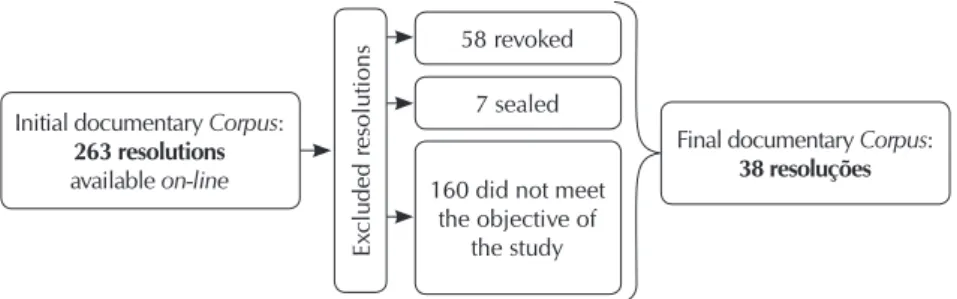
58 revoked
7 sealed
160 did not meet the objective of
the study
Final documentary Corpus: 38 resoluções Initial documentary Corpus:
263 resolutions available on-line
Ex
cluded r
esolutions
Figure 1 – Flowchart of the selection of documents
The search for documents was concluded in February 2016, and 263 resolutions were found. Following this survey, all the documents were individually read by two researchers, and 38 were selected. Figure 1 presents the flowchart of the selection of documents.
Data analysis
The documents were analyzed through the document analysis technique, which consists of two phases: document
systematization and information synthesis(10).
In the first phase, systematization, a table was created in
Microsoft Word® in order to preliminarily evaluate the
docu-ments, considering context, author, authenticity and
reliabil-ity, nature, key concepts and internal logic of the text(10). In
this case, it was considered that the author is represented by the advisory board of Cofen, which is the legal and legitimate body that represents the profession, and also the producer of the published resolutions, which establish regulations for guidance of processes in Brazilian nursing. For resolutory texts, focus was given to their content, considering what are known as key concepts for the practice of nursing care.
In the second phase the synthesis of the information from the documents was obtained, by extracting contents (key concepts) and comparing them to the elements contained in the
docu-ment corpus, which allowed recognizing similarities, relations
and differences. The document syntheses were analyzed with
the support of the MaxQDA® software, and three categories
resulted from it: Normative grounds of health care practice by the nursing team, under the coordination/supervision of the nurse; Normative grounds of the care privately performed by the nurse; and Management and administrative aspects which affect and permeate the practice of health care in nursing.
RESULTS
From a total of 263 resolutions available on-line in the period from 1975 to 2015, 38 were selected. Of those, 15 serve as basis to the exercise of health care practiced by the nursing team, the nurse being the co-ordinator/supervisor of the care performed by the team, 13 establish the private at-tributions of the nurse for the practice of health care and ten define management and administrative norms that condition and permeate health care in nursing. Thus, based on the similarity and relation between their contents, three categories were originated: Normative grounds of health care practice by the nursing team, under the coordination/supervision of the nurse; Normative grounds of the health care privately per-formed by the nurse; and Management and administrative aspects which affect and permeate the practice of health care in nursing.
Normative grounds of the health care performed by the nursing team, under coordination/supervision of the nurse
The normative grounds that guide the functions of nursing teams are the ones over which competences and responsibili-ties are shared. The performance of health care performed by the nursing team is understood based on the grounds which define its attributions and field of expertise, guiding the care provided by it. It includes specific designations for the professionals with secondary and higher education. Regarding the latter, it includes those which are private to the nurse, characterized by planning, execution, coordination, supervision and evaluation of the care and of the nursing team for which they are responsible. Box 1 presents the 15 resolutions that regulate health care practice by the nursing team.
To be continued
Box 1 – Normative grounds of the practice of health care performed by the nursing team, under coordination/supervision of the nurse, 1975-2015
Federal Nursing Council (Cofen) Resolution number
Year Health care practice performed by the nursing team
197 1997 Establishes and recognizes alternative therapies as a specialty and/or qualification of the nursing professional.
210 1998 Concerns the performance of nursing professionals who work with antineoplastic chemotherapeutics.
211 1998 Concerns the performance of nursing professionals who work with ionizing radiation.
Normative grounds of the health care practice privately performed by the nurse
This category addresses the set of normative grounds which define the private attributions, competences and responsibilities of the nurse regarding the care of individuals and population
groups. The forms of care performed privately by the nurse are those of higher technical complexity, which require scientific knowledges and immediate decision-making to their perfor-mance. 13 resolutions that regulate this practice have been se-lected and are presented in Box 2.
Federal Nursing Council (Cofen) Resolution number
Year Health care practice performed by the nursing team
219 1999 Concerns the creation of a network of volunteers, composed of professionals in nursing, to provide care for populations affected by climate catastrophes or that are experiencing post-war calamities.
277 2003 Concerns the ministration of parenteral and enteral nutrition.
292 2004 Regulates the actions of the nurse in the procurement and transplanting of organs and tissues.
306 2006 Regulates the performance of the nurse in hemotherapy.
358 2009 Concerns the systematization of care in nursing and the implementation of the nursing process in environments, public or private, in which professional nursing health care takes place, and provides other measures.
375 2011 Concerns the presence of the nurse in prehospital and inter-hospital service, in situations of known or unknown risk.
376 2011 Concerns the participation of the nursing team in the process of patient transportation in environments that are internal to health services.
422 2012 Regulates the performance of nursing professionals in orthopedic health care and in procedures of orthopedic immobilization.
427 2012 Regulates the nursing procedures for deployment of mechanical contention of patients.
464 2014 Regulates the performance of nursing teams in home care.
501 2015 Approves and establishes the regulation over the competence of the nursing team regarding wound care.
Box 2 – Private attributions of the nurse for health care, 1975-2015
Federal Nursing Council (Cofen) Resolution number
Year Private attributions of the nurse for health care practices
159 1993 Decides that in all health assistance levels, both in public and in private institutions, nursing consultation must be necessarily performed in nursing care.
195 1997 Concerns the requests for routine and complimentary examinations by nurses.
223 1999 Concerns the performance of nurses in care for women during the pregnancy - puerperal period.
257 2001 Adds mechanism to the regulation approved by Resolution 210/98, designating the preparation of antineoplastic chemotherapeutics drugs to the nurse.
258 2001 Decides that the insertion of central peripheral catheter by the nurse is licit.
295 2004 Concerns the utilization of the therapeutic toy technique by the nurse in the care of hospitalized children.
nursing team in relation to the regulations that permeate the provided care, so as to ensure a safe, legal, and systematized practice. 10 resolutions compose this category, which are pre-sented in Box 3.
Management and administrative aspects which affect and permeate health care practice in nursing
The category of management and administrative aspects concerns the normative grounds that guide the actions of the
Federal Nursing Council (Cofen) Resolution number
Year Private attributions of the nurse for health care practices
304 2005 Concerns the performance of the nurse in the collection of blood from the umbilical and placental cord.
326 2008 Authorizes the autonomous use of acupuncture by a nurse in his/her professional practice, after the approval of his/her specific technical qualification by the Cofen.
385 2011 Regulates the performance, by the nurse, of the collection of material for oncologic colpocytology through the pap smear method.
388 2011 Regulates the performance, by the nurse, of venous access through umbilical catheterization.
423 2012 Regulates, within the scope of the Cofen system/regional nursing councils, the participation of the nurse in the activity of classification of risks.
468 2014 Concerns the performance of the nurse in genetic counseling.
477 2015 Concerns the performance of nurses in care for pregnant, parturient and puerperal women.
Box 3 – Management and administrative aspects that affect and permeate health care practice in nursing, 1975-2015
Federal Nursing Council (Cofen) Resolution number
Year Management and administrative aspects related to health care in nursing
194 1997 General management of health units by nurses.
266 2001 Approves the activities of the nurse auditor.
293 2004 Fixes and establishes parameters for the dimensioning of the nursing team in healthcare units of health institutions and similar.
303 2005 Concerns the authorization for the nurse to assume the coordination, as technical manager, of the waste management plan of health services – PGRSS.
311 2007 Approves the Reformulation of the Ethics Code of nursing professionals.
424 2012 Regulates the attributions of the nursing professionals in material and sterilization centers (CME) and in healthcare products processing companies.
429 2012 Concerns the recording of professional practices in the patient record, and in other documents pertinent to nursing, independently of the media used - traditional or electronic.
447 2013 Approves and adopts the manual of procedures for standardization of care routines for nursing professionals.
458 2014 Regulates the conditions for recording of technical responsibility by the nursing service and defines the attributions of the technician nurse manager.
478 2015 Regulates the performance and civil responsibility of the obstetrician nurse in birth centers and provides other measures.
DISCUSSION
The regulation and normalization of the nursing activity contributes to the expansion of the professionals’ field of ex-pertise, considering that the nurse and the nursing team begin to legally act in many sectors due to it. The normative grounds defined by the Cofen guide the practice of health care per-formed by the nursing team, under the coordination of the nurse, assigning specific activities to them. Many other roles are privately attributed to the nurse, besides all the practices performed by the other members of the staff, which have been published in exclusive resolutions or alongside norms that are directed to the entire team. In this regard, it is clear that, when establishing the health care practices to be performed by the team, save for the clauses of exclusivity of actions to the pro-fessional of academic qualification, turmoil could be caused by the assigning to these professionals, in addition to their private functions, of integral care in daily services.
Nursing consultation, which is included in the private activi-ties of the nurse both in private and public institutions, utilizes components of the scientific method to identify conditions of the health-disease process and, based on clinical decisions, proposes promotion, protection, and recovery measures. It is an activity that is performed in a deliberate, systematic and
indi-vidualized manner, according to the patient’s characteristics(11),
and is part of a process carried out in variable intensities and modalities in the many locations where the practice of health care in nursing is present. As an example, nursing consultation in urgency and emergency services is performed through risk assessment methodologies. About the application of one of those methodologies, a study concerning the perception of the nurses in the South region of Brazil has revealed benefits such as improvement in flow organization and in the quality of the provided care, despite the precariousness of the flow of referral
to the health care network(12).
Systematization of Nursing Care (SAE) is the currently ad-opted name for the terminologies of nursing process, care process, care methodology, assistance process and nursing consultation, synonym terms that assign the same goal to the nurse’s work: applying a scientific method in the planning of nursing actions. Despite Cofen making the implementation of SAE in health institutions mandatory, there are still many dif-ficulties for its execution, difdif-ficulties that involve not only lack of resources, but the way the professional assimilates knowl-edge. Even with the efforts of the nursing field, it is a form of knowledge that, despite being introduced in Brazil in the 1970s, still has a large gap between its production and
appli-cability in the daily practices of the nurse(13).
Home care represents one of the many scenarios of per-formance of the nursing team; regulated by Cofen, it may be supported by the analytical logic of the SAE, in order to comprise a set of actions in health promotion, prevention and treatment of diseases and rehabilitation that are provided at
the patient’s house(14). This assistance modality offers new
pro-duction modes for health care and intervention at different points of the network, enabling the continuity and integrabil-ity of care. However, it still has frailties to be faced, mainly in
what concerns the complementarity of services and their in-terdependency, revealing that the network is an organizational
strategy that is not yet completely effective(15).
Besides distinct assistantship levels, the nursing team acts in situations with patient profiles of different complexities. Of the health care practices by the nursing team that are regulat-ed by Cofen, the attributions and procregulat-edures in hemotherapy services, organs and tissues procurement and transplantation, parenteral and enteral nutrition, antineoplastic chemotherapy and wounds care stand out.
In what concerns the attributions in hemotherapy, it is necessary to consider that this service has been growing in the country for the last few decades due to new findings and technological innovation. Such evolution is a challenge for the nursing team, because it requires specialized knowledges on the blood cycle process, which includes from transfusion performed in a general hospital to blood donation in a blood
center(16). In Paraná, a study has demonstrated that the nurses
know very little about the regulating norms of this service and that they do not receive training on the subject, reasons why the development of qualification programs on transfusion therapy are recommended, as strategy to qualify assistance
and comply with the legislation(17).
As in the donation of blood products, the nursing team, especially the nurse, provide care to organ and tissue donors. The nurses’ contribution to the success of transplantations has been acknowledged, especially in what concerns their private role in planning, executing, coordinating, supervising and as-sessing the programs for procurement of donors. A literature review has shown that nurses acting in organ and tissue trans-plantation care need comprehensive scientific knowledge and that their participation alongside multi-professional teams contributed to a complete assistance to donors, recipients and
families undergoing organ donation processes(18).
The nursing care for people unable to orally ingest enough nutrients also requires a joint action by the nursing team and other health professionals. The nurse and the nursing team are the ones responsible for administering and monitoring the diets of people who depend on feeding, within the hospital environment or not, being also responsible for assuring the access to the gastrointestinal tract, its maintenance and for the
response to complications inherent in therapy(19-20). Regarding
the work of the nursing team in nutritional therapy, a study performed in Paraná revealed deficiency in professional en-hancement, asserting the importance of implementing care
protocols in order to prevent complications(21).
The necessity for qualification and assessment of the de-veloped actions was also demonstrated in relation to the ad-ministering of antineoplastic drugs, presented in an integra-tive literature review, which recommended measures aimed at education not only of nurses, but of all professionals involved with the area. Antineoplastic chemotherapeutic administering is a relevant practice of the nursing team in the oncology field, and it requires a team that is qualified and able to perform
val-idation, preparation and dispensing of chemotherapeutics(22).
the team in wounds care. The access to adequate supplies, to specific training and to the development of an interdisciplin-ary effort was considered an indispensable factor to the viabil-ity and establishment of therapeutic actions that are effective
for wounded individuals(23).
Institutional scenarios may require the performance of nurs-ing professionals under very specific work conditions. Some of these conditions are normatively covered, including environ-ments with ionizing radiation, surgical instruenviron-ments, pre-hospital and inter-hospital care, orthopedic care and orthopedic immo-bilization procedures, mechanical contention of patients and transportation of patients in environments that are internal to health services. Attributions of peripheral and central catheter insertion and request of routine and complimentary examina-tion were privately delegated to the nurse. An integrative litera-ture review revealed the importance of the supervisor nurse in the work environment as a facilitating health care practice agent,
who is responsible for the continuous guidance of the team(24).
Finally, Cofen has regulated a set of attributions for the health care practice performed by the nursing team in emerg-ing fields, such as, for instance, specialization in alternative therapies, authorizing the nursing professionals to include acupuncture in their professional conducts.
In the analyzed Resolution, there is solid regulation over the performance of the nurse in health care for women and chil-dren, specially in what concerns the collection of material for oncologic colpocytology; the care of women in the pregnancy-puerperal cycle; genetic counseling; collection of blood from the umbilical and placental cord; venous access via umbilical cath-eterization and the utilization of the therapeutic toy technique.
Nursing has become an entrepreneurial profession, made viable through socially relevant practices, collaborating with the reversion of health indicators, such as mother and child mortality. In order to improve these indicators, the nurse works with the aspects of health promotion and prevention within the context of prenatal, parturition, puerperial practic-es and care of newborns, dpractic-espite the emphasis still being
at-tributed to the performance of technical procedures(25). Nurses
are considered key professionals in the health care for mother and child populations since, besides technical qualification and legal support, they contribute to ensuring the quality in prenatal care and assess obstetric risk, from a holistic,
educa-tional, management and assistance perspective(25).
In child care, the performance of complex procedures that impose risks to the patient and which require technical-scientif-ic abilities are the nurse’s responsibility. For the performance of procedures in pediatric patients, which differ in level of cognitive development, the nurse may apply the therapeutic toy technique as a way of communicating with the child. A study performed in a children’s hospital in Paraíba evidenced the technique as a communication skill that is developed during the process of child care, assisting on the child’s recovery and promoting care
individ-ualization, minimizing the stress of the hospitalization process(26).
The health care practice performed by the nursing team or privately by the nurse is affected and permeated by man-agement and administrative aspects that provide support so that the care may occur in a systematized and safe manner.
Besides establishing the ethics code, the resolutions guide the constitution of the minimum staff, based in the dimensioning of personnel, as well as the recording of professional actions in the patient record and the adoption of the manual proce-dure for standardization of routine services.
Ethical professional practice is enforced through guiding prciples for the exercise of nursing in its many field of action,
in-volving teaching, research, management and assistance(27). Thus,
the importance of quality in the nursing record is evident, be-ing it an ethical-legal duty of the professionals. The records are documentation sources for the actions performed by the nursing team, becoming a way to ensure and prove both the provision it-self and the quality of the care provided. Adverse situations such as the incorrect filling of a patients’ identification data, absence of prescription verification, absence of signature and incomplete
notes(28), are worth of reflection on the ethical-professional
com-mitment. The manuals for norms, routines and procedures, as well as the clinical assistance protocols, are fundamental for the assessment of services and, therefore, for the quality of care. The nursing protocol are technological products that enable system-atization, facility of the work process, guidance and, specially,
humanization of health care(29).
Other attributions that are private to nurses have been regu-lated, making evident their competence as technical managers of nursing services in all the assistance environments, in waste management, birth centers and material and sterilization cen-ters, as well as in auditing and management of health institu-tions. It is noted that, in these cases, nursing practice is focused on the management of care and of service, processes that mainly encompass the management of human and material resources to meet organizational goals. In that sense, the health care practice by the nurse is revealed as a broad process, which encompasses actions in health care, management, education and research, which are shared with the nursing team, converging to the pa-tient’s benefit. This practice is not transferable and requires pro-fessional criteria from planning to execution, in compliance with
ethical, legal and technical-scientific standards(27).
FINAL CONSIDERATIONS
The results of this study enabled the understanding of the way Brazilian nursing is regulated by the respective Profes-sional Council in demonstrating the normative grounds of the health care practice performed by the nurse and the nursing team. The analyzed documents define the normative grounds, specifying the care performed by the nursing team, of which the nurse is coordinator/supervisor, the private attributions of the nurse and management and administrative norms that af-fect and permeate nursing care.
technical-scientific knowledge for rapid and effective deci-sion-making. Among them, nursing consultation stands out, which is performed during the nursing process, and the health care related to women and children.
The normative grounds require expansion to other nursing fields of expertise, since the resolutions refer to health care
practice in specific fields. That way, it is relevant to consider the promotion of a debate to consolidate, in a unified manner, the assistance policy of the profession, integrating assistance, management, teaching and research processes with the health care levels and with the assumptions and guidelines of the health care network model.
REFERENCES
1. Erdmann AL, Mello ALSF, Andrade SR, Drago LC. Orga-nization of care practices in the health network. Online Braz J Nurs [Internet]. 2011[cited 2016 May 17];10(1). Available from: http://www.objnursing.uff.br/index.php/ nursing/article/view/j.1676-4285.2011.3220.1
2. Santos RM, Almeida LMWS, Trezza MCSF. (Re) creation and innovation of nursing care. Rev Bras Enferm [Inter-net]. 2011[cited 2016 May 17];64(4):628. Available from: http://www.scielo.br/pdf/reben/v64n4/en_a01v64n4.pdf 3. Silva RS, Santos DT, Carvalho SS, Lisboa ACFN. Código de
Ética dos Profissionais de Enfermagem: uma pesquisa do-cumental. Enferm Foco [Internet]. 2012[cited 2016 May 10];3(2):62-6. Available from: http://revista.portalcofen.gov. br/index.php/enfermagem/article/view/256
4. Vale EG, Pagliuca LMF. Construção de um conceito de cuidado de enfermagem: contribuição para o ensino de graduação. Rev Bras Enferm [Internet]. 2011[cited 2016 May 10];64(1):106-13. Available from: http://www.scielo. br/pdf/reben/v64n1/v64n1a16.pdf
5. Garcia CLLM, Moreira A. The Brazilian association of nursing and professional development council in Brazil. Rev Pesqui: Cuid Fundam [Internet]. 2009[cited 2016 Apr 17];1(1):97-110. Available from: http://www.seer.unirio. br/index.php/cuidadofundamental/article/view/314 6. Conselho Federal de Enfermagem. Resoluções. Brasília.
[Internet]. 2016 [cited 2015 Dec 17]; Available from: http://www.cofen.gov.br/categoria/legislacao
7. Carvalho VD, Oliveira TA, Silva DC. Valores organizacionais em instituições públicas brasileiras: percepções dos servidores em diferentes posições hierárquicas e tipos de entidade da ad-ministração indireta. Rev Adm Mackenzie [Internet]. 2013[cit-ed 2015 Dec 15];14(4)74-103. Available from: http://2013[cit-edito rarevistas.mackenzie.br/index.php/RAM/ar ticle/ view/5159/4490
8. Santa Catarina. Secretaria do Estado da Administração. Diretoria da Imprensa Oficial e Editora de Santa Catarina Gerência de Gestão Documenta. Padronização e redação dos atos oficiais. 3. ed. Florianópolis; 2013.
9. Flick U. Introdução à pesquisa qualitativa. 3a ed. Porto Alegre: Artmed; 2009.
10. Cellard A. Análise documental. In: Poupart, et al. A pes-quisa qualitativa: enfoques epistemológicos e metodoló-gicos. 3a ed. Rio de janeiro: Vozes; 2012.
11. Lima DAQ, Cassemir AVL, Mendes RS, Branco CSNB, Pam-plona AP. Consulta de enfermagem ao portador de hansení-ase. Rev Enferm Contemp [Internet]. 2015[cited 2016 Apr 19];4(2):199-208. Available from: https://www5.bahiana.
edu.br/index.php/enfermagem/article/view/387
12. Bohn MLS, Lima MADS, Duro CLM, Abreu KP. Nurses’ per-ception on the use of the Manchester risk classification sys-tem protocol. Cienc Cuid Saúde [Internet]. 2015[cited 2016 Apr 19];14(2):1004-10. Available from: http://periodicos. uem.br/ojs/index.php/CiencCuidSaude/article/view/21359 13. Silva EGC, Oliveira VC, Neves GBC, Guimarães TMR.
Nurses’ knowledge about nursing care systematization: from theory to practice. Rev Esc Enferm USP [Internet]. 2011[cited 2016 Apr 10];45(6)1380-6. Available from: http://www.scielo.br/pdf/reeusp/v45n6/en_v45n6a15.pdf 14. Senna MH, Andrade SR. Indicators and information on lo-cal health planning: vision of nurses of family health strat-egy. Texto Contexto Enferm [Internet]. 2015[cited 2016 Apr 10];24(4):950-8. Available from: http://www.scielo. br/pdf/tce/v24n4/pt_0104-0707-tce-24-04-00950.pdf 15. Brito MJM, Andrade AM, Caçador BS, Freitas LFC,
Pen-na CMM. Home care in the structuring of the healthcare network: following the paths of comprehensiveness. Esc Anna Nery Rev Enferm [Internet]. 2013[cited 2016 Apr 10];17(4):603-10. Available from: http://www.scielo.br/ pdf/ean/v17n4/en_1414-8145-ean-17-04-0603.pdf 16. Silva GEM, Valadares GV. Knowing blood donation
sur-roundings: Implications for nurse service in hemother-apy. Rev Bras Enferm [Internet]. 2015[cited 2016 Apr 10];68(1):32-9. Available from: http://www.scielo.br/pdf/ reben/v68n1/0034-7167-reben-68-01-0032.pdf
17. Barbosa HB, Nicola AL. Enfermagem na terapia transfu-sional e hemovigilância: análise da conformidade em um hospital de ensino. Rev Saúde (Santa Maria) [Internet]. 2014[cited 2016 Apr 15];40(2):97-104. Available from: http://periodicos.ufsm.br/revistasaude/article/view/13074 18. Mendes KDS, ROZA BA, Barbosa SFF, Schirmer J, Galvão
CM. Transplante de órgãos e tecidos: responsabilidades do enfermeiro. Texto Contexto Enferm [Internet]. 2012[ci-ted 2016 Apr 15];21(4):945-53. Available from: http:// www.scielo.br/pdf/tce/v21n4/en_27.pdf
19. Colaço AD, Nascimento ERP. Nursing intervention bundle for enteral nutrition in intensive care: a collective construc-tion. Rev Esc Enferm USP [Internet]. 2014[cited 2016 Apr 15];48(5):844-50. Available from: http://www.scielo.br/pdf/ reeusp/v48n5/pt_0080-6234-reeusp-48-05-844.pdf 20. Passos SSS, Carvalho ESS, Sadigursky D, Nobre VPCC, Pereira
21. Santos AFL, Carvalho AC, Silva IS, Oliveira AS. Conhe-cimento do enfermeiro sobre o cuidado na administra-ção da nutriadministra-ção enteral e parenteral. Rev Interd [Internet]. 2013[cited 2016 Apr 15];6(4):44-50. Available from: http://revistainterdisciplinar.uninovafapi.edu.br/index. php/revinter/article/view/206
22. Ribeiro TS, Santos VO. Patient Safety in Administering An-tineoplastic Chemoteraphy: an Integrative Review. Rev Bras Cancerol [Internet]. 2015[cited 2016 Apr 19];61(2):145-53. Available from: http://www.inca.gov.br/rbc/n_61/v02/ pdf/09-revisao-de-literatura-seguranca-do-paciente-na-adm inistracao-de-quimioterapia-antineoplasica-uma-revisao-i ntegrativa.pdf
23. Sehnem GD, Busanello J, Silva FM, Poll MA, Borges TAP, Rocha EM. Difficulties faced by nurses in nursing care for individuals with wounds. Cienc Cuid Saúde [Internet]. 2015[cited 2016 Apr 19];14(1):839-46. Avail-able from: http://www.periodicos.uem.br/ojs/index.php/ CiencCuidSaude/article/view/20949
24. Nascimento ACEC, Pinto ALR, Pereira CRA, Souza FEP, Vieira ZRS, Andrade GDB, Cruz RSBLC. A importância da supervisão de enfermagem nas instituições de saúde. Rev Saúde Pesq [Internet]. 2013[cited 2016 Apr 19];6(2):339-43. Available from: http://periodicos.unicesumar.edu.br/ index.php/saudpesq/article/view/2908
25. Campos DS, Divino EA, Miranda EF, Nascimento AOB. O
enfermeiro no contexto da saúde da família frente à pre-venção da mortalidade materna. UNI Ciências [Internet]. 2010[cited 2016 Apr 19];14(2):159-75. Available from: http://www.pgsskroton.com.br/seer/index.php/uniciencias/ article/view/759
26. Marques DKA, Silva KLB, Cruz DSM, Souza IVB. The Therapeutic Toy and playful in the vision of nursing team. Rev Arq Ciênc Saúde [Internet]. 2015[cited 2016 Apr 19];22(3):64-8. Available from: http://www.unip.br/ comunicacao/publicacoes/ics/edicoes/2012/04_out-dez/ V30_n4_2012_p354a358
27. Santos JLG, Pestana AL, Guerreiro P, Meirelles BHS, Er-dmann AL. Nurses’ practices in the nursing and health care management: integrative review. Rev Bras Enferm [In-ternet]. 2013[cited 2016 Apr 19];66(2):257-63. Available from: http://www.scielo.br/pdf/reben/v66n2/16.pdf 28. Maziero VG, Vannuchi MTO, Haddad MCL, Vituri DW,
Tada CN. Quality control of patients’ monitoring re-cords in a university hospital. Rev Min Enferm [Internet]. 2013[cited 2016 Apr 19];17(1):165-70. Available from: http://www.reme.org.br/artigo/detalhes/587