Mortality information system for
identifying underreported cases
of tuberculosis in Brazil
Uso do sistema de informação
sobre mortalidade para identiicar
subnotiicação de casos de
tuberculose no Brasil
Gisele Pinto de Oliveira
I,IIRejane Sobrino Pinheiro
ICláudia Medina Coeli
IDraurio Barreira
IIStefano Barbosa Codenotti
III Instituto de Estudos em Saúde Coletiva da Universidade Federal do Rio de
Janeiro.
II Programa Nacional de Controle da Tuberculose da Secretaria de Vigilância em
Saúde do Ministério da Saúde.
Correspondência: Gisele Pinto de Oliveira.SQSW Quadra 304 Bloco C apto. 205, Sudoeste, Brasí-lia, DF, CEP 70.643 – 403. E-mail: [email protected]
Abstract
The aim of the study was to analyze the underreporting of deaths from tuberculosis (TB) in Brazil, as well as to assess the impact these cases would cause in the reporting rate and proportion of TB deaths in 2006. We ana-lyzed the deaths recorded in the Mortality Information System (SIM) in 2006 and all reports of TB in Brazil during the 2001 to 2006 period. The variables used for the rela-tionship were: report number, city and State of residence, patient name, date and year of birth, sex, mother’s name and address. Six blocking steps were performed. Scores above 12.4 were considered pairs, and those below 9.7, doubtful pairs. After each step, we performed a manual review of doubtful pairs. The Reportable Disease Information System (Sinan) had 547,589 records. The SIM had 6,924 records, 39.3% (n = 2,727) of which were not found in Sinan during the period evaluated. We observed that 64.5% (2,707) of deaths were reported in 2006 and after analyzing the proportion of deaths un-derreported by region and federal units, we found that the highest percentage was in the Northern region, followed by the Southeast and Northeast. The addition of deaths that had not been reported to the Sinan database increased the reporting rate 3.7%. Regarding the proportion of deaths due to TB, such in-clusion was responsible for a 60.7% increase in this indicator. The relationship between both databases seems to be an important strategy for improving the quality of the TB surveillance system.
Keywords: Tuberculosis. Cause of death.
Resumo
O objetivo desse trabalho foi analisar a sub-notificação dos óbitos por tuberculose (TB) no Brasil, assim como verificar o impacto que esses casos causariam na taxa de notifi-cação de casos novos e proporção de óbitos por TB em 2006. Foram analisados os óbitos registrados no Sistema de Informação sobre Mortalidade (SIM) no ano de 2006 e todas as notificações de TB do país no período de 2001 a 2006. As variáveis utilizadas para o relacionamento foram: número da notifi-cação, município e UF de residência, nome do paciente, data, ano de nascimento, sexo, nome da mãe e endereço. Foram realizados seis passos de blocagem. Os escores su-periores a 12,4 foram considerados pares, enquanto os inferiores a - 9,7, não-pares. Ao final de cada passo, foi realizada a revisão manual dos pares duvidosos. O Sistema de Informação de Agravos de Notificação (Sinan) dispunha de 547.589 notificações, enquanto o SIM tinha 6.924 registros. Desses, 39,4% (n = 2.727) não foram en-contrados no Sinan no período avaliado. Observou-se que 64,5% (2.707) dos óbitos foram notificados em 2006 e, ao analisar a proporção de óbitos subnotificados por região e unidades federadas, verificou-se que o maior percentual foi na região Norte, seguida das regiões Sudeste e Nordeste. O acréscimo dos óbitos que não foram rela-cionados à base de dados do Sinan eleva a taxa de notificação de casos novos em 3,7%. Quanto à proporção de óbitos por TB, essa inclusão foi responsável pelo aumento em 60,7% desse indicador. O relacionamento entre bases de dados configura-se como uma estratégia importante para a melhoria da qualidade do sistema de vigilância da TB.
Palavras-chave: Tuberculose. Causa de
morte. Vigilância. Sistemas de informação. Subnotificação. Relacionamento proba-bilístico de registros.
Introduction
Brazil is among a group of 22 countries that account for 82% of the world’s tuber-culosis (TB) cases and has 35% of the cases reported in the Americas 1.
According to estimates by the World Health Organization (WHO), Brazil has an annual incidence of 43 cases per 100 thousand inhabitants (85 thousand new cases per year), an incidence for the smear-positive pulmonary form of 26/100 thou-sand inhabitants (49 thouthou-sand new cases per year), and a mortality rate of 2.6/100 thousand inhabitants (5 thousand cases per year). However, in 2010, according to data submitted by the National Tuberculosis Control Program (PNCT) to the WHO, the notification rate for new TB cases in Brazil was 38/100 thousand inhabitants (approxi-mately 72 thousand new cases) for all forms, 20/100 thousand inhabitants for smear-positive pulmonary TB (approximately 35 thousand new cases), and a death notifica-tion rate of 2.5/100 thousand inhabitants (4.8 thousand deaths). Based on this dif-ference, WHO estimates that Brazil had a detection rate of 88% in 2008 1.
To reach the targets estimated by the World Health Organization, it is necessary to identify the bottlenecks in TB surveillance to determine at what moment the TB cases are not being captured (and thus not being reported).
Failure to report a case of a disease of compulsory notification refers to a case that meets the criteria set by surveillance and that has been identified by a health professional, but has not been reported to the public health service, thus reflecting the health service’s incapacity to capture the event 2.
TB prevention and control. The Mortality Information System (SIM) was created in 1975 to obtain regular and comprehensive mortality data in Brazil through the comple-tion of Death Certificates 4. Considering that TB mortality and case-fatality are important parameters for evaluating the severity of the endemic, delays in case detection and initiation of treatment and problems with effectiveness, use of the SIM is extremely important for evaluating the TB surveillance system 5.
The aim of the current study was to ana-lyze underreporting of TB deaths in Brazil by region and State and the impact of these cases on the notification rate for new cases and TB case-fatality.
Methods
We selected deaths that occurred in Brazil and were recorded in the SIM data-base in the year 2006 with TB codes (ICD-10 – 10th revision, A15 to A19) as underlying or associated cause. The SINAN data used in this study consisted of all TB reports in the country with the reporting year included from 2001 to 2006. TB cases ending in death and that were not reported were defined as those for which the year of death was 2006 and which had not been recorded in the SINAN database from 2001 to 2006, that is, up to five years prior to the year of death, according to the definition of new case from the Ministry of Health epidemiological sur-veillance guidelines6. Access to the databas-es was kindly provided by the Department of Situational Health Analysis (DASIS) and the National Tuberculosis Control Program (PNCT) of the Ministry of Health.
The TB information system allows pa-tients to be reported several times over the course of their lives. Multiple entries of the same case may assist surveillance of the disease, but can also generate countless duplicate records in a mistaken way. The identification and removal of these records were performed in two steps: true duplicate entries were removed using the algorithm developed by Bierrenbach et al. (2007),
which conserves the repetitions referring to cases of relapse and reentry after drop-out for subsequent analyses with SINAN; starting with this base, the remaining repetitions were eliminated, maintaining only the oldest notification for analysis of under-recording.
Since the databases used in this study do not have a univocal identifying field, the probabilistic record linkage method was used. Based on the combined use of common fields present in the respective da-tabases, one estimates the probabilities that given records in the two databases belong to the same persons. Thus, it is possible to verify the likelihood that a pair of records refers to the same individual 8,9.
Linkage used the third version of the Reclink program 10. The variables used to perform the linkage were: notification number, municipality (county) of residence, State of residence, patient’s name, birth date, sex, mother’s name, street name, street number, apartment number, neighborhood, and year of birth. Six blocking steps were performed sequentially with the combina-tion of fields. The starting point was a more restricted key, with a subsequent decrease in the restriction, seeking to minimize the loss of pairs, i.e., the occurrence of false-negatives:
1 - Soundex (first name) + soundex (last name) + sex + State of residence; 2 - Soundex (first name) + sex + State of residence; 3 - Soundex (last name) + sex + State of residence; 4 - Soundex (first name) + sex; 5 - State of residence + sex; 6 - Municipality of residence + sex.
For comparison and calculation of scores, all the steps used the following fields: patient’s name, mother’s name, and birth date.
(hit probability: 97.7984; miss probability: 0.00158924), mother’s name (hit probability: 75.3206; miss probability: 0.00820691), and birth date (hit probability: 96.5851; miss probability: 1.67448).
The maximum and minimum limits set for the scores were 19.7907 and -12.3714, respectively. Scores above 12.4 were consid-ered pairs, while those below - 9.7 were con-sidered non-pairs, while the rest remained as doubtful pairs.
A manual revision of the doubtful pairs was performed at the end of each step by a single researcher, according to the fol-lowing tiebreaking criteria: patient’s name, mother’s name, birth date, and municipality of residence. The other variables were used in the visual comparison to assist classi-fication of the pairs when the presence of missing fields prevented classifying the pair. A list of neighboring municipalities along the borders between Brazilian States was used during the manual revision to aid clas-sification of a pair as belonging to the same individual when there was disagreement between residential addresses between the records for a possible true pair.
We opted to define as a pair a paired record that remained doubtful after the manual revision process, in the sense of minimizing false-negative errors. Thus, the observed results can be interpreted as a conservative estimate of the underreport-ing of deaths.
We calculated the proportion of under-reporting of deaths from/with TB for Brazil as a whole and by State. To verify whether the inclusion of cases retrieved from the SIM modifies the national TB indicators, we calculated the original and corrected notification rate for new TB cases and the proportion of new TB cases ending in death. The original notification rate was calcu-lated by dividing the total number of new TB cases reported in 2006 by the number of inhabitants in the same year, multiplied by 100,000. The corrected notification rate was calculated by adding to the numerator of the original rate the deaths that occurred in 2006 and that were not recorded in the
SINAN database. The estimated population was taken from the DATASUS website13. The proportion of new TB cases ending in death was calculated by adding those ending in death and deaths from other causes in 2006, divided by the total number of reported new cases, in the case of the original indicator. For the corrected indicator, we added into the numerator and denominator the num-ber of unreported cases retrieved from the Mortality Information System.
Data processing and analysis used the software programs EpiInfo [TM] version 3.3.2 and Stata version 9.0®. The study was approved by the National Commission on Research Ethics (CONEP) on April 12, 2009.
Results
SINAN included 571,336 TB notifications from 2001 to 2006. Removal of duplicate entries left 547,589 notifications (95.8%). The Mortality Information system had 6,953 records that presented TB as one of the causes of death in the year 2006. Twenty-nine records from the Mortality Information System were excluded because the name, mother’s name, and address had not been completed or had been completed incor-rectly, to the point of impeding the linkage process.
A total of 5,569 pairs were found through linkage of the Mortality Information System with SINAN: 4,493 pairs (83.7%) were found in the first blocking key, 623 (11.6%) in the second, and 121 (2.3%) in the fifth step (Table 1).
After elimination of the repeated pairs generated by the Mortality Information System records that formed pairs more than once (cases of relapse or reentry, for example), a total of 4,197 pairs were identi-fied. Of the 6,924 TB death records analyzed, 39.3% (n=2,727) were not found in the SINAN database from 2001 to 2006.
6.6% (277) in 2004, and 12.1% (508) from 2001 to 2003. Analysis of the proportion of unreported deaths stratified by State showed the highest percentage in the North, followed by the Southeast and Northeast of Brazil. The South showed a lower underre-porting rate, despite having more total TB deaths than the North.
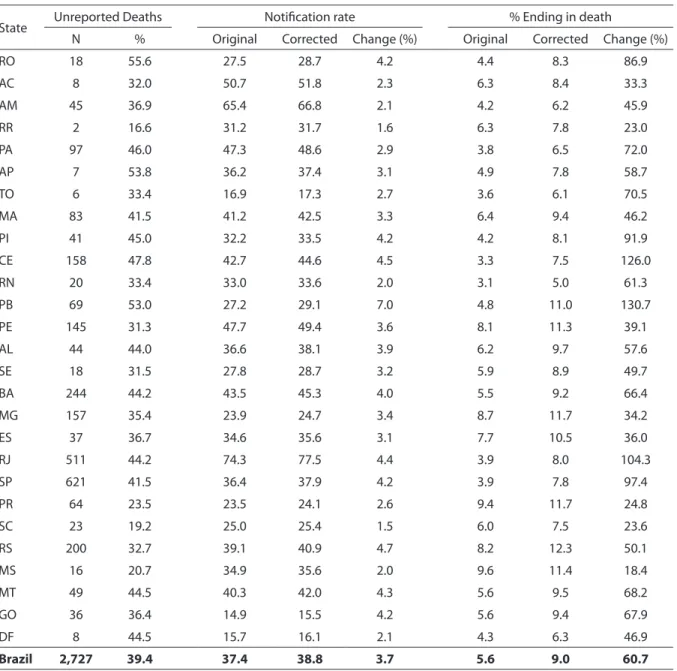
This indicator behaved differently not only between regions, but also between States in the same region, with variations ranging from 16.6% to 54.5% in the same region (Table 2). Rondônia, Amapá, and Paraíba showed values greater than 50%, and in 12 States this proportion was higher than the Brazilian national mean. The low-est values were in Paraná (23.4%), Mato Grosso do Sul (20.7%), Santa Catarina (19.1%), and Roraima (16.6%).
Adding the deaths that were not linked to the SINAN database would increase the notification rate for new TB cases in the year 2006 by up to 3.7%. It would also increase the TB case-fatality rate by 60.7%, increasing from 5.6% to 9.0% in that same year (Table 2). These increases differed between States, i.e., from 1.5% to 7% for the notification rate of new cases and from 18.4% to 130.7% for cases reported in SINAN and ending in death.
Discussion
The high proportion of underreporting and changes in the proportion of deaths and
in the notification rate for new cases due to the inclusion of deaths on case records were the main results of this study.
Since death is a final outcome for TB cases, the fact that 39.4% of deaths from TB or associated with it fail to appear in the case records points to an evident mismatch be-tween TB epidemiological surveillance and TB care, since they represent severe cases that were not reported, even at the time of death.This also reflects the low coverage of the TB epidemiological surveillance system, corroborating other Brazilian and interna-tional studies that linked mortality records and case records 14,15,16,17.
Problems related to access and diagnosis should also be taken into consideration. Deaths due to TB may be considered a sentinel event, a concept defined as the oc-currence of an avoidable disease, disability, or death, which can reveal the individual’s high vulnerability due to low socioeco-nomic, occupational, or environmental status or adverse health conditions such as lack of adequate or timely action by health services 18,19.
Unemployment, low schooling, and low income are individual factors that increase vulnerability to TB and may thus also influ-ence access to health services as well as to quality diagnosis 20,21. Since TB is historically associated with poverty, individuals with more schooling may not be diagnosed cor-rectly, as discussed by Sousa and Pinheiro 22. In addition, contextual aspects may be Table 1 - Proportion of pairs found according to the blocking steps in the probabilistic record linkage between the SIM (2006) and Sinan (2001-2006) - Brazil.
Tabela 1 - Proporção de pares encontrados segundo os passos de blocagem no relacionamento probabilístico entre o SIM (2006) e o Sinan (2001 a 2006) - Brasil.
Blocking Steps N %
Step 1: Soundex (irst name) + Soundex (last name) + sex + State 4,493 83.7
Step 2: Soundex (irst name) + sex + State 623 11.6
Step 3: Soundex (last name) + sex + State 0 0.0
Step 4: Soundex (irst name) + sex 40 0.7
Step 5: sex + State 121 2.3
Step 6: sex + municipality of residence 92 1.7
related to the use of health services. The first is the supply of health care or services by States and municipalities. Considering that in Brazil, TB is a disease that falls under the responsibility of primary care and that timely uptake of cases does not require high-complexity care, there should be no obstacles to access. However, a TB control program that fails to recommend active
case search in the community or in health units (a basic strategy to increase case up-take) may present flaws in surveillance of the disease and underreporting of cases. Another hypothesis for the occurrence of underreporting could relate to the volume of reported cases. The highest proportion of reported TB cases occurs in the Southeast (45%) and Northeast regions (29%), which
Table 2 - Comparison of the indicators, new TB cases reporting rate and proportion of TB cases closed as death, before and after the inclusion of non-reported deaths in Sinan. Brazil, 2006.
Tabela 2 - Comparação dos indicadores taxa de notiicação dos casos novos de TB e proporção de casos de TB com encerramento óbito antes e depois da inclusão dos óbitos não notiicados no Sinan. Brasil e unidades federadas (UF), 2006.
State Unreported Deaths Notiication rate % Ending in death
N % Original Corrected Change (%) Original Corrected Change (%)
RO 18 55.6 27.5 28.7 4.2 4.4 8.3 86.9
AC 8 32.0 50.7 51.8 2.3 6.3 8.4 33.3
AM 45 36.9 65.4 66.8 2.1 4.2 6.2 45.9
RR 2 16.6 31.2 31.7 1.6 6.3 7.8 23.0
PA 97 46.0 47.3 48.6 2.9 3.8 6.5 72.0
AP 7 53.8 36.2 37.4 3.1 4.9 7.8 58.7
TO 6 33.4 16.9 17.3 2.7 3.6 6.1 70.5
MA 83 41.5 41.2 42.5 3.3 6.4 9.4 46.2
PI 41 45.0 32.2 33.5 4.2 4.2 8.1 91.9
CE 158 47.8 42.7 44.6 4.5 3.3 7.5 126.0
RN 20 33.4 33.0 33.6 2.0 3.1 5.0 61.3
PB 69 53.0 27.2 29.1 7.0 4.8 11.0 130.7
PE 145 31.3 47.7 49.4 3.6 8.1 11.3 39.1
AL 44 44.0 36.6 38.1 3.9 6.2 9.7 57.6
SE 18 31.5 27.8 28.7 3.2 5.9 8.9 49.7
BA 244 44.2 43.5 45.3 4.0 5.5 9.2 66.4
MG 157 35.4 23.9 24.7 3.4 8.7 11.7 34.2
ES 37 36.7 34.6 35.6 3.1 7.7 10.5 36.0
RJ 511 44.2 74.3 77.5 4.4 3.9 8.0 104.3
SP 621 41.5 36.4 37.9 4.2 3.9 7.8 97.4
PR 64 23.5 23.5 24.1 2.6 9.4 11.7 24.8
SC 23 19.2 25.0 25.4 1.5 6.0 7.5 23.6
RS 200 32.7 39.1 40.9 4.7 8.2 12.3 50.1
MS 16 20.7 34.9 35.6 2.0 9.6 11.4 18.4
MT 49 44.5 40.3 42.0 4.3 5.6 9.5 68.2
GO 36 36.4 14.9 15.5 4.2 5.6 9.4 67.9
DF 8 44.5 15.7 16.1 2.1 4.3 6.3 46.9
also appeared in this study with the highest underreporting rates23. This result corrobo-rates the findings by Braga, who noted that these regions had numerous municipali-ties with apparently insufficient TB control activities, indicating the existence of TB underreporting and precarious functioning of State TB control programs 24.
However, the indicator’s variation between States of Brazil calls attention to other factors which may have influenced this finding. The fact that two States from the same region (Rondônia and Roraima), with similar epidemiological, demographic, and cultural characteristics, present-ed discordant values may be explainpresent-ed in part by the deficient coverage of the Mortality Information System. The North and Northeast regions presented less than 80% coverage in the target year. Coverage in Rondônia was less than in Roraima, suggesting that cases may not be captured even by the Mortality Information System, generating lower underreporting rates 25,26. However, in States with high coverage rates, like Rio de Janeiro and Rio Grande do Sul, worrisome values were found. The propor-tion of TB cases received and diagnosed in hospitals (a common situation in the coun-try’s large State capitals) should be taken into account to improve underreporting. According to Selig et al., 49% of TB deaths from September 2005 to August 2006 in two public general hospitals with open emer-gency departments in Rio de Janeiro were not recorded in the SINAN database from 1995 to 2006 27. Recording error for causes of death in the Mortality Information System might explain part of the under-recording. However, this hypothesis appears less con-vincing to the extent that attributing a TB diagnosis to cases without proof appears unlikely.
Structural and organizational issues in the health services, the SINAN flow-chart, and the organization of the Unified National Health System (SUS), as described by Ferreira et al., may explain part of the underreporting of TB cases to the surveil-lance system 28. Although the data flow is
documented by Ministry of Health and is known to all the States of the country, each municipality (county) adds minor modi-fications to this flow according to its local reality, while the health units create their own shortcuts, which can produce unfavor-able results.
The addition of unreported deaths to the SINAN database can impact important epidemiological indicators for the Program. The new TB case notification rate and the proportion of TB deaths among cases re-ported in the year 2006 were considerably modified for the country. The increases in these two indicators differed greatly be-tween States, with variations greater than fivefold between the smallest and largest increases. This result points to different degrees of implementation of TB surveil-lance in Brazil.
By correcting the proportion of cases ending in death, one-fourth of the States practically doubled their original value. Interestingly, this list includes Rio de Janeiro and São Paulo, with a major portion of the country’s TB burden29, which leads one to assume greater experience with case sur-veillance, not demonstrated in this study.
While the elimination of double entries in the SINAN database led to a 6.3% reduc-tion in the TB incidence rate in Brazil in 200612, the inclusion of unreported deaths increased this rate by 3.7%. Other national information systems in Brazil record TB cas-es, like the Hospital Information System of the Unified National Health System. Record linkage with this database was not one of the current study’s objectives, but it could lead to a larger increase in TB incidence 22.
manual revision of pairs. The occurrence of missing data in the variables used for the linkage and the presence of common names or homonyms may have caused a reduction in the number of pairs formed.
Since TB treatment is provided mainly in the primary healthcare network where links between patients and the health unit should be well-established, TB patients do not nor-mally move between States to obtain treat-ment. However, to minimize the negative impact of the linkage process, we opted to use the State and municipality of residence in the blocking steps. The adoption of well-defined tiebreaking criteria and the use of a list of neighboring municipalities along State borders to support the manual revision were strategies to minimize possible pairing errors that could occur when patients failed to properly inform their residential address. The strategy of including among pairs the paired records that remained doubtful during the manual revision decreased the likelihood of false negatives, while a 39.4% rate of unreported deaths is a conservative estimate of underreporting of deaths in this study.
Linking the Mortality Information System to five years of the SINAN database and following all the respective blocking steps increased the certainty of the oc-currence of underreporting. However, we observed that searching for deaths in the Mortality Information System using only the cases recorded in the two previous years in the SINAN database and processing only the first two blocking steps as routine TB surveillance accounted for a high percent-age of retrieval of cases (81.3% and 95.3%, respectively), a strategy that would reduce the workload for services, with a high impact on improvement of TB reporting quality.
The largest proportion of deaths found
in SINAN was reported in the same year as the death (64.5%). This result appears to relate more to the case uptake and late di-agnosis, with a reduction in patient survival and treatment efficacy.
The World Health Organization has recommended that quality assessment of notification systems should be done rou-tinely by countries to make the TB epide-miological and operational indicators more trustworthy, thus impacting public health decision-making 29. TB incidence in Brazil is estimated by multiplying the number of TB deaths in the Mortality Information System by the case-fatality rate (calculated by the number of deaths in the Mortality Information System and the number of cases in the SINAN database, with appropri-ate adjustments due to the systems’ cover-age).Case-fatality is calculated by using the linkage between databases, since there is no certainty that the individuals are re-corded in both bases 1,34. Routine use of this technique is important to ensure estimates that as close to reality as possible. However, the introduction of the field for TB death among the closure situations in the SINAN database in 20063 simplified calculation of this indicator, facilitating its use in planning TB control activities. Likewise, the use of da-tabase linkage helps improve case closure, besides ensuring that a case ending in death is recorded in SINAN.
References
1. World Health Organization. Global Tuberculosis Control
2011: WHO report 2011. Geneva: WHO; 2011.
2. Modesitt SK, Hulman S, Feming D. Evaluations of active
versus passive surveillance in Oregon. American Journal
of Public Health 1990; 80(4): 463-4.
3. Brasil. Ministério da Saúde. Secretaria de Vigilância em Saúde. Departamento de Vigilância Epidemiológica.
Sistema de Informação de Agravos de Notificação – Sinan:
normas e rotinas.2ª edição. Brasília; 2007; 67 p.
4. Brasil. Ministério da Saúde. Secretaria de Vigilância em Saúde. Departamento de Análise de Situação de
Saúde. Coordenação Geral de Informações e Análise
Epidemiológica. Sistema de Informação de Mortalidade.
Disponível em: http://portal.saude.gov.br/SAUDE/ visualizar_ texto.cfm?idtxt=21377. [Acessado em 27 de julho de 2008]
5. Façanha MC. Tuberculose: subnotificação de casos
que evoluíram para óbito em Fortaleza-CE. Rev Bras
Epidemiol 2006; 32(6): 553-8.
6. Brasil. Ministério da Saúde. Secretaria de Vigilância em Saúde. Departamento de Vigilância Epidemiológica.
Guia de Vigilância Epidemiológica2009; 7ª ed: 39-60.
7. Bierrenbach AL, Stevens AP, Gomes AB, Noronha EF, Glatt R, Carvalho et al. Efeito da remoção de notificações repetidas sobre a incidência da tuberculose no Brasil.
Rev Saúde Pública 2007; 41(S1): 67-76.
8. Teixeira CLS, Block KV, Klein CH, Coeli CM. Método de relacionamento de bancos de dados do Sistema de Informação sobre Mortalidade e das autorizações de internação hospitalar no Sistema Único de Saúde, na investigação de óbitos de causa mal-definida no Estado
do Rio de Janeiro, Brasil, 1998. Epidemiol Serv Saúde
2006; 15(1): 47-57.
9. Camargo Jr KR, Coeli CM. Reclink: aplicativo para o relacionamento de bases de dados, implementando o
método probabilistic record linkage. Cad Saúde Pública
2000; 16(2): 439-47.
10. Camargo Jr KR, Coeli CM. Reclink III versão 3.1.6.3160.
Guia do Usuário. 2007. Disponível em http://www.iesc.
ufrj.br/reclink [Acessado em 15 de junho de 2008]
11. Junger WL. Estimação de parâmetros em
relacionamento probabilístico de banco de dados: uma
aplicação EM para o Reclink. Cad Saúde Pública 2006;
14 (2): 225-32.
12. Bierrenbach AL, Oliveira GP, Codenotti S, Gomes ABF, Stevens AP. Duplicates and misclassification of TB notification records increased the notification rates of
new TB cases in Brazil from 2001 to 2007. Int J Tuberc
Lung Dis 2010; 14(5): 593-9.
13. BRASIL. Ministério da Saúde. Departamento de
Informática do SUS. Tabnet: abulador naweb. Disponível em http://www2.datasus.gov.br/DATASUS/ index.php [Acessado em 15 de julho de 2009]
14. Brasil. Ministério da Saúde. Secretaria de Vigilância em Saúde. Programa Nacional de DST e Aids. A subnotificação de casos de AIDS em municípios brasileiros selecionados: uma aplicação do método de
captura-recaptura. Boletim Epidemiológico AIDS 2004,
1(1): 7-9. Disponível em www.aids.gov.br [Acessado em 29 de julho de 2008]
15. Washko RM, Frieden TR. Tuberculosis Surveillance using
death certificate data, New York City, 1992. Public Health
Reports 1996; 3: 251-255.
16. Crofts JP, Pebory R, Grant A, Watson, JM, Abubakar I. Estimating tuberculosis case mortality in England and
Wales, 2001-2002. Int J Tuberc Lung Dis 2008; 12(3):
308-13.
17. Selig L, Belo M, Cunha AJLA, Teixeira EG, Brito R, Luna AL, Trajman A. Óbitos Atribuídos à Tuberculose no
Estado do Rio de Janeiro. J BrasPneumol 2004; 30(4):
417-24.
18. Rutstein DD, Berenberg W, Chalmers TC, Child CG, Fishman AP, Perrin EB. Measuring the quality of medical
care. A clinical method. N Engl J Med 1976; 294(11):
582-8.
19. Rutstein DD, Mullan RJ, Frazier TM, Halperin WE, Melius JM, Sestito, JP. Sentinel Health Events (occupational): a basis for physician recognition and public health
surveillance. Am J Public Health 1983; 73(9): 1054-62.
20. Waaler HT. Tuberculosis and poverty. Int J Tuberc Lung
Dis 2002; 6(9): 745-6.
21. Bates I et al. Vulnerability to malaria, tuberculosis, and HIV/AIDS infection and disease. Part I – Part II: determinants operating at individual and household
level. Lancet 2004; 4: 267-77.
22. Sousa LMO, Pinheiro RS. Óbitos e internações por tuberculose não notificados no município do Rio de
Janeiro. Rev Saúde Pública 2011; 45(1): 31-9.
23. Brasil. Ministério da Saúde. Secretaria de Vigilância em Saúde. Departamento de Vigilância Epidemiológica.
Programa Nacional de Controle da Tuberculose.
Disponível em http://portal.saude.gov.br/portal/saude/ visualizar_texto.cfm?idtxt=28055). [Acessado em 25 de janeiro de 2010]
24. Braga JU. Vigilância Epidemiológica e o sistema de
informação da tuberculose no Brasil, 2001 – 2003. Rev
25. Brasil. Ministério da Saúde. Secretaria de Vigilância em Saúde. Departamento de Análise de Situação de
Saúde. Coordenação Geral de Informações e Análise
Epidemiológica. Documento técnico contendo a
cobertura do Sistema de Informação sobre Mortalidade no Brasil. [Falta inserir data]
26. Paes NA. Avaliação da cobertura dos registros de óbitos
dos Estados brasileiros em 2000. Rev Saúde Pública
2005; 39(6): 882-90.
27. Selig L, Kritski A, Guedes R, Braga JU, Trajman A. Uses of tuberculosis mortality surveillance to identify program
errors and improve database reporting. Int J Tuberc Lung
Dis 2009; 13: 982-8.
28. Ferreira VMB, Portela MC, Vasconcelos MTL. Fatores associados à subnotificação de pacientes com Aids, no
Rio de Janeiro, RJ, 1996. Rev Saúde Pública 2000; 34(2):
170-7.
29. BRASIL. Ministério da Saúde. Secretaria de Vigilância em Saúde. Departamento de Vigilância Epidemiológica. Programa Nacional de Controle da Tuberculose.
Situação epidemiológica. Disponível emhttp://portal.
saude.gov.br/portal/saude/profissional/area. cfm?id_ area=1527 [Acessado em 31 de julho de 2011]
30. Ferreira VMB, Portela MC. Avaliação da subnotificação de casos de AIDS no município do Rio de Janeiro com base em dados do sistema de informações hospitalares
do Sistema Único de Saúde. Cad Saúde Pública 1999;
15(2): 317-24.
31. Drumond EF, Machado CJ, França E. Subnotificação de nascidos vivos: procedimentos de mensuração a partir
do Sistema de Informação Hospitalar. Rev Saúde Pública
2008; 42(1): 55-63.
32. Cavalcante MS, Ramos Jr AN, Pontes LRSK.
Relacionamento de sistemas de informação em saúde: uma estratégia para otimizar a vigilância das gestantes
infectadas pelo HIV. Epidemiol Serv Saúde 2005; 14(4):
127-33.
33. Lemos KRV, Valente JG. A declaração de óbito como
indicador de sub-registro de casos de AIDS. Cad Saúde
Pública 2001; 17(3): 617-26.
34. Dye C, Bassili A, Bierrenbach AL, Broekmans JF, Chadha VK, Glaziou P et al. Measuring tuberculosis burden,
trends, and the impact of control programmes. Lancet
Inf Dis 2008; 8(4): 233-43.
35. Van Hest NAH, Story A, Grant AD, Antonie D, Crofts JP, Watson JM. Record-linkage and capture-recapture analysis to estimate the incidence and completeness of reporting of tuberculosis in England 1999-2002.
Epidemiol. Infect 2008; 136(12): 1606-16.
36. Tilling, K., Sterne, JAC., Wolfe, CDA. Estimation of stoke using a capture-recapture model including covariates.
Int J Epidemiol 2001; 30: 1351-9.