Arq Neuropsiquiatr 2006;64(4):1030-1032
1N e u rology Division of the Internal Medicine Department, Hospital de Clínicas, Universidade Federal do Paraná, Curitiba, Brazil; 2Center for Poisoning Control of the State of Paraná Health Office, Curitiba, Brazil.
Received 6 September 2005, received in final form 28 June 2006. Accepted 15 August 2006.
Dr. Pedro André Kowacs - Serviço de Neurologia / Departamento de Clínica Médica / Hospital de Clínicas da Universidade Federal do Paraná - Rua General Carneiro 181 / 12º andar / sala 1236 - 80060-900 Curitiba PR - Brasil. E-mail: [email protected]
FATAL INTRACEREBRAL HEMORRHAGE SECONDARY
TO
LONOMIA OBLIQUA
CATERPILLAR ENVENOMING
Case report
Pedro André Kowacs
1, Juliana Cardoso
1, Marlene Entres
2,
Edison Mattos Novak
1, Lineu César Werneck
1ABSTRACT - The case of a 70 year-old, previously healthy woman who developed a severe bleeding diathe-sis shortly after touching a Lonomia obliqua caterpillar and finally died from multiple intracerebral hem-o rrhages is described. Brain hemhem-orrhages are the leading cause hem-of death in patients envenhem-omed by the Lonomia species. The pertinent literature is reviewed and the most relevant clinical features highlighted, with emphasis on diagnosis. The use of new therapeutic options such as anti-Lonomia serum is discussed.
KEY WORDS: intracerebral hemorrhage, Lonomia obliqua, caterpillar envenoming.
Hemorragia intracerebral fatal causada por acidente com Lonomia obliqua: relato de caso
RESUMO - O caso de uma mulher de 70 anos, previamente hígida, que desenvolveu diátese hemorrágica grave após contato com uma lagartaLonomia obliqua,resultando em óbito por hemorragia intracere b r a l é relatado. Hemorragias cerebrais são uma das causas de morte em acidentes por Lonomia. A literatura p e rtinente é revisada, sendo as características clínicas e laboratoriais mais relevantes discutidas com ênfase para o diagnóstico, e o uso de novas abordagens terapêuticas como o soro anti-Lonomia.
PALAVRAS-CHAVE: hemorragia intracerebral, Lonomia obliqua, envenenamento, lagartas urticantes.
First described by Arocha-Pinango and Layrisse in Venezuela in 19671, the hemorrhagic diathesis caused
in humans by touching theLonomiaspecies begins with inflammatory changes at the site of envenom-ing, followed by systemic symptoms such as headache, f e v e r, vomiting and malaise. After 24 hours, a severe bleeding disorder ensues, leading to echimosis, hema-turia, pulmonary and intracranial hemorrhages, and acute renal failure2. Two species ofLonomia a re
known to cause the hemorrhagic syndrome,L o n o m i a achelous,found in Venezuela and the north of Brazil, andLonomia obliqua,found in the south of Brazil1 , 3 , 4.
Although there are diff e rences in the effect of the venom of both species, both venoms may lead to intense fibrinolytic activity associated with consump-tion coagulopathy, resembling a diffuse intravascu-lar coagulation5 - 7. A case of accidentalLonomia obli
-quaenvenoming is described, and its implications a re discussed. The re p o rt was approved by the insti-tutional regulatory committee.
CASE
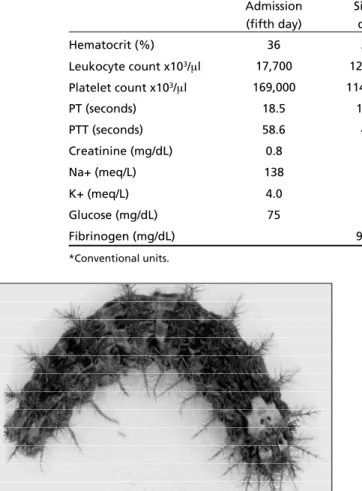
A 70 year-old, previously healthy woman developed a sudden coma. Four days before, she had started to pre s e n t hematuria. Shortly after admission, her coma was rated as Glasgow 3. Physical examination revealed several skin hem-o rrhages, and grhem-oss hematuria was present. Based hem-on infhem-or- infor-mation in a note left by the patient, two small hyperemic lesions were identified on the tip of her left toe. Along with the note w as the the green caterpillar (Fig 1) which was hidden inside of her slipper. CT-scan imaging re v e a l e d multiple intracerebral hemorrhages (Fig 2). She died sev-en days after being sev-envsev-enomed. Her laboratory data is sum-marized in the Table.
DISCUSSION
polychondri-Arq Neuropsiquiatr 2006;64(4) 1031
tis, chronic osteoarthritis and acute scleritis); d) oph-thalmia nodosa (caused by specific families of cater-pillars); and e) comsumptive coagulopathy with sec-ondary fibrinolysis8.
The clinical manifestations of Lonomia sp e n v e n-oming can include a local inflammatory re a c t i o n , which starts immediately after contact; systemic re a c-tions such as headache, fever, vomiting and asthe-nia, which start some hours after exposure; and a bleeding diathesis, characterized by hematomes and ecchymoses, hematuria, pulmonary hemorrh a g e , i n t r a c e rebral hemorrhage and acute renal failure2 , 7 , 9.
Due to their greater exposure to the enviro n m e n t , men are more frequently envenomed than women. The site of envenoming usually involves the upper limbs, as the catterpillars live in fru c t i f e rous tre e s4 , 1 0.
The severity of the envenoming is related not only to the number of caterpillars involved but also to the intensity of the exposure, since the venom is pre s e n t not only in the caterpillars’ spines but also in their skin, which consists of a complex tegument with sev-eral cuticular specializations such as spicules or
sco-l i1 1 , 1 2. The best characterized toxin in this venom is
known by its acronym LOPA P,Lonomia obliquap ro-thrombin activator protease13.
Lonomiae n v e n o m i n g is frequent in Brazil. In the state of Paraná alone, in the south of Brazil, 354 cas-es were re p o rted between 1989 and 20051 4. In the
same State, lethality has been decreasing, and fell from 20% in 1995 to 1.5% in 1998, but, interesting-ly enough, intracranial hemorrhage was confirm e d as the leading cause of death in three out of the six fatal cases re p o rted. In the remaining three fatal cas-es this data was unavailable due to insuffient ancil-lary support in the rural areas10,14.
Attempts to clarify the underlying mechanisms of intracranial hemorrhage focused on the blood-brain barrier in Wistar rats six hours after exposure to Lo
-Table. Laboratory results.
Admission (fifth day)
Sixth day
Seventh day
Reference values
Hematocrit (%) 36 28 30.3 35 - 45
Leukocyte count x103/µl 17,700 12,100 8,500 4,800 - 10,800
Platelet count x103/µl 169,000 114,000 110,000 150,000 - 450,000
PT (seconds) 18.5 19.7 17.5 11-15
PTT (seconds) 58.6 47 >100 25 - 35
Creatinine (mg/dL) 0.8 – 1.1 0.6 - 1.2
Na+ (meq/L) 138 135 - 145
K+ (meq/L) 4.0 3.5 - 5.0
Glucose (mg/dL) 75 60 - 110
Fibrinogen (mg/dL) 92.4 175 - 433
*Conventional units.
Fig 1. Lonomia obliqua caterpillar.
1032 Arq Neuropsiquiatr 2006;64(4)
nomia obliquavenom. Hippocampal and cere b e l l a r edema were observed, and these resolved 72 hours after the envenoming. Only a single rat out of 2 8 , h o w e v e r, developed intracerebral hemorrh a g e1 5. In
another study, the venom could not be traced in the brain 6 and 18 hours after administration, but could be found in the kidneys and liver. This evidence sug-gests that the brain is less vulnerable to LOPAP and that toxins other than LOPAP may also be the cause of brain damage inLonomiaenvenoming. It also points to an interaction between both the venom and individual factors1 5. Indeed, until the pre s e n t
case, intracranial hemorrhages leading to death had only been described in cases of severe envenoming after exposure to multipleLonomiacaterpillars at the same time.
L a b o r a t o ry findings include a normal platelet count, anemia, a prolonged prothrombin time (PT), and decreased fibrinogen, plasminogen, factor V and factor XIII levels associated with increased fibrin degradation products.
The clinical and laboratory manifestations of envenoming in the case described above are similar to those described in previous re p o rt s5 , 6. There was
an increase in the PT and activated partial thro m b o-plastin time (PTT), a reduction in fibrinogen and a mild reduction in the platelet count (Table). Zannin et al.7also described a significant reduction in
coag-ulation factors V, XIII and VIII, pre k a l l i k rein, plasmino-gen,-antiplasmin and protein C in patients with fib-rinogen levels below 50 mg/dL. They concluded that the hemorrhagic syndrome is the result of consump-tion coagulopathy and secondary fibrinolisys.
Therapy with whole blood or fresh frozen plas-ma usually results in a sharp decrease in platelet count, leading to renal insufficiency and death. A m o re reasonable approach is the administration of antifibrinolytics agents on their own or in combina-tion with cry o p recipitate or purified fibrinogen1 6.
The prognosis is related not only to the severity of the envenoming but also to early intervention.
In the 90’s, Silva et al.1 7demonstrated that
hors-es could produce effective antibodihors-es against Lono -mia obliquaspine venom. Since then, the antilonom-ic serum (SaLon) produced at Instituto Butantan has p roven effective for treating envenomed individu-a l s1 7 - 1 9and has been approved by the Brazilian re
g-u l a t o ry agency. Caovilla and Barro s2 0have re c e n t l y
p roven its efficacy in 44 envenomed individuals, with either 17.5 mg or 10.5 mg doses. The latter dose was chosen as the ideal one. They also observed that
ear-ly intervention lead to fewer hemorrhagic complica-tions.
Acknowledgements –The authors express their thanks
to Giselia Burigo Guimarães Rubio, Chefe da Divisão de Zo-onoses da Saúde do Estado do Paraná, for releasing SESA datafiles for analysis.
REFERENCES
1. A rocha-Piñango CL, Layrisse M. Fibrinolysis produced by contact with a caterpillar. Lancet 1969;1:810-812.
2. Veiga ABG, Pinto AFM, Guimarães JA. Fibrinogenolytic and pro c o a g-ulant activities in the hemorrhagic syndrome caused byLonomia obli -quacaterpillars. Thromb Res 2003;111:95-101.
3. L e m a i re C. Révision du genre Lonomia Walker (Lep.Attacidae). A n n Soc Entomol France 1972;8:767-861.
4. Fariha Neto H, Ballarini AJ, Leão RNQ, Costa D Jr , Dias LB. Síndro m e hemorrágica por contato com larvas de mariposa (Lepidóptera, Saturnidae). Instituto Evandro Chagas, 50 anos de contribuição às ciên-cias biológicas e à medicina tropical. Fundação SESP 1986;2:811-820. 5. A rocha-Piñango CL, Blumenfeld-Bosch N, Nouel AL, et al. Fibrinolytic
and procoagulant agents from a saturniidae moth caterpillar. In Pirkle H, Markland FS Jr (eds). Hemostasis and animal venoms. Hematology 1988;7:223-240.
6. G u e r re ro BAG, A rocha-Piñango CL, Gil A.Lonomia achelousc a t e r p i l-lar venom (LACV) selectively inactivates blood clotting factor XIII. Thromb Res 1997;87:83-93.
7. Zannin M, Lourenco DM, et al. Blood coagulation and fibrinolytic fac-tors in 105 patients with hemorrhagic syndrome caused by accidental contact withLonomia obliquacaterpillar in Santa Catarina, Southern Brazil. Thromb Haemost 2003;89:355-364.
8. Diaz JH. The envolving global epidemiology, syndromic classification, manegement, and prevention of caterpillar envenoming. Am J Tro p Med Hyg 2005;72:347-357.
9. Duarte AC, Crusius PS, Pires CAL, Schilling MA, Fan HW. Intracere b r a l h e m o r rhage after contact withLonomiacaterpillars. Lancet 1996; 348:1033.
10. Rubio GB. Epidemiological surveillance distribution of the caterpillar
Lonomiaoblique Wa l k e r, 1855, in the State of Parana, Brazil. Cad Saúde Pública 2001;17:1036.
11. Pinto AFM, Dobrovolski R, Veiga ABG, Guimarães JA. Lonofibrase, a novel alpha-fibrinogenase fromLonomia obliquacaterpillars. Thro m b Res 2004;113:147-154.
12. Veiga ABG, Blochtein B, Guimarães JA. Stru c t u res involved in pro d u c-tion, secretion and injection of the venom produced by the caterpillar
Lonomia obliqua (Lepidoptera, Saturniidae). Toxicon 2001;39:1343-1351. 13. Reis CV, Portaro FC, Andrades SA, et al. A prothrombin activator ser-ine protease fromLonomia obliquacaterpillar venom (Lopap): bioche-mical characterization. Thromb Res 2001;102:427-436.
14. Banco de Dados das Notificações de Animais Peçonhentos, SESA/ISEP/ DVPS/CESA/Divisão de Zoonoses e Toxicologia, Curitiba jun 2005. 15. Silva GH, Hyslop S, Cruz-Höfling.Lonomia obliquacaterpillar venom
i n c reases permeability of the blood-brain barrier in rats. Toxicon 2004; 44:625-634.
16. Arocha-Piñango CL, Guerrero B. Hemorrhagic syndrome induced by caterpillars: clinical and experimental studies. Rev Invest Clin 2003; 44:155-163.
17. Silva WD, Campos ACMR, Gonçalves LRC, et al. Development of an antivenom against toxins ofLonomia obliquacaterpillars. Toxicon 1996; 34:1045-1049.
18. Gonçalves MLC, Siqueira-Batista R, Artemenko SR, Gomes AP, Igreja R P. Acidentes por outros animais peçonhentos. In Siqueira-Batista R, Gomes A P, Igreja RP, Huggins DW (eds). Medicina tropical: abord a g e m atual das doenças infecciosas e parasitárias. Rio de Janeiro: Cultura Médica 2001;149-166.