106 Brazilian Journal of Physics, vol. 37, no. 1, March, 2007
Small-
x
Physics at Coherent
pA
/
AA
Interactions at LHC
Victor P. Gonc¸alves
Instituto de F´ısica e Matem´atica, Universidade Federal de Pelotas Caixa Postal 354, CEP 96010-090, Pelotas, RS, Brazil
Magno V. T. Machado
Centro de Ciˆencias Exatas e Tecnol´ogicas, Universidade Federal do Pampa - UNIPAMPA Campus de Bag´e. Rua Carlos Barbosa. CEP 96400-970. Bag´e, RS, Brazil
Received on 29 September, 2006
We report on our recent investigations in photonuclear production of heavy quarks and vector mesons in ultraperipheral collisions at nucleus-nucleus and proton-nucleus reactions. They are initiated by quasi-real photons coming from one of the nuclei or hadron in interactions taking place at large impact parameter. We focus on the role played by the high energy theoretical/phenomenological approaches in photon-nuclei scattering, namely the strength of parton saturation phenomenon and high energy nuclear shadowing. In particular, our theoretical predictions are compared with the recent experimental measurements on coherentρ (STAR) andJ/Ψ(PHENIX) photoproduction at RHIC and estimates for LHC are given.
Keywords: Heavy Ion Collisions; Quantum Chromodynamics; Parton Saturation Effects
I. INTRODUCTION
In the last years, there has been a lot of interest in the description of electron-nucleus collisions at high energies. The results of current analysis show that future electron-nucleus colliders at HERA and RHIC, probably could deter-mine whether parton distributions saturate and constrain the behavior of the nuclear gluon distribution in the full kinemati-cal range [1, 2]. However, until these colliders become reality we need to consider alternative searches in the current and/or scheduled accelerators which allow us to constrain the QCD dynamics. In this contribution, we summarize our investiga-tions in Refs. [3–5] about the possibility of using ultraperiph-eral heavy ion collisions (UPC’s) as a photonuclear collider and study the heavy quark and/or vector meson production assuming distinct approaches for the QCD evolution.
A special class of events in nucleus-nucleus (or proton-nucleus) reactions at high energies is their coherent interac-tion. The scatterings take place at larger impact parameter of the collision,b≫RA+RB, whereRiare the radii of the inter-acting nuclei (or charged hadrons),i=A,B. This is the rea-son they are called ultraperipheral collisions. The final state is characterized by low particle multiplicity and dominance of low-pT transverse momenta. The interaction between the nuclei is predominantly electromagnetic in this case, where they have an associated flux of equivalent (quasi-real) pho-tons. This flux is computed through the quantity called num-ber of equivalent photons, dN/dω, whereω is the center of mass photon energy. Then, real-photons from one of nuclei initiate photonuclar reactions. In heavy ion collisions, the large number of photons coming from colliding nuclei will allow to study photoproduction, with energiesWγA reaching about 1 TeV at LHC. Therefore, while studies of photopro-duction at HERA are limited to photon-proton center of mass energies of about 200 GeV, photon-proton interactions at LHC can reach one order of magnitude higher on energy.
Conse-quently, studies ofγp(A)interactions at LHC could provide valuable information on the QCD dynamics at high energies. The photonuclear cross section for coherent nucleus-nucleus collisions is given by the convolution between the photon flux from one of the nuclei and the cross section for the photon-nucleus scattering. The expression for the production of a given final stateY (Y =QQ,V) ultraperipheral heavy ion col-lisions is then given by,
σAA→AY X
³p SNN
´ =
∞
Z
ωmin
dωdN(ω) dω σγA→Y X
¡
WγA¢, (1)
whereωmin=MY2/4γLmp, √SNN is the c.m.s energy of the nucleus-nucleus system andγL is the Lorentz boost of a sin-gle beam. The Lorentz factor for LHC isγL=2930, giving the maximum c.m.s. γAenergyWγA≤950 GeV. For the case of coherent proton-nucleus collision, where the real-photons from the nucleus interacts with a proton, we now have,
σpA→Y X
¡p SpN
¢ =
∞
Z
ωmin
dωdN(ω) dω σγp→Y X
¡ Wγp
¢
. (2)
The requirement that photoproduction is not accompanied by hadronic interaction (ultraperipheral collision) can be done by restricting the impact parameterbto be larger than twice the nuclear radius,RA=1.2A1/3fm, in theAAcase and than
(Rp+RA)in thepAcase. An analytic approximation forAA collisions can be obtained using as integration limitb>2RA, producing
dN dω =
2Z2αem
π ω ·
¯
ηK0(η¯)K1(η¯) + ¯
η2 2
¡
K12(η¯)−K02(η¯)¢ ¸
,(3)
Victor P. Gonc¸alves and Magno V. T Machado 107
computing the production of the specific final stateY at UPC’s is the information about its cross section in photon-nuclei in-teractions,σγA→Y X, as defined in Eq. 1 or in photon-proton interactions,σγp→Y X, as defined in Eq. 2. In what follows, we perform phenomenology on heavy quarks and vector mesons production using the available high energy approaches. The emphasis is placed in the energies and experimental cuts for LHC.
II. HEAVY QUARK PRODUCTION
For our further analysis on photonuclear production of heavy quarks we will consider distinct high energy ap-proaches, which are contrasted against the collinear approach [3]: (a) semihard formalism, (b) saturation model (within the color dipole formalism) and (c) Color Glass Condensate (CGC) approach. The main goal is a comparison among those approaches and show whether the production at UPC’s allows disentangle the underlying QCD dynamics at high energies.
(a)Semihard formalism: In thek⊥-factorization (semihard) approach, the relevant QCD diagrams are considered with the virtualities and polarizations of the initial partons, car-rying information on their transverse momenta. The scatter-ing processes are described through the convolution of off-shell matrix elements with the unintegrated parton distribu-tion,
F
(x,k⊥). Considering only the direct component of the photon, the cross section reads as (See, e.g. Ref. [6]),σsemihardγA→QQX¯ =
αeme2Q
π
Z
dz d2p1⊥d2k⊥αs
F
nuc(x,k 2 ⊥)k2⊥ ×
(
A(z) µ
p1⊥ D1
+(k⊥−p1⊥)
D2
¶2 +m2Q
µ
1 D1
+ 1
D2
¶2)
,(4)
whereD1≡p21⊥+m2QandD2≡(k⊥−p1⊥)2+m2QandA(z) =
[z2+ (1−z)2]. The transverse momenta of the heavy quark (antiquark) are denoted by p1⊥ and p2⊥= (k⊥−p1⊥), re-spectively. The heavy quark longitudinal momentum fraction is labeled byz. For the scale µin the strong coupling con-stant we use the prescription µ2 =k2⊥+m2Q. We use also the simple ansatz for the unintegrated gluon distributions,
F
nuc=∂xGA(x,k2 ⊥)
∂lnk2⊥ wherexGA(x,Q
2)is the nuclear gluon dis-tribution (see Ref. [3] for details in the numerical calcula-tions).
(b)Saturation model: Based on the color dipole formalism, it can be extended toeAthrough Glauber-Gribov formalism. In this model the cross section for the heavy quark photopro-duction on nuclei targets is given by [7, 8],
σdipoleγA→QQX¯ =
Z 1
0 dz
Z
d2r|ΨT(z,r,Q=0)|2σAdip(x˜,r;A), (5) where the transverse wave function is known [8, 9]. The nu-clear dipole cross section is given by [7, 8],
σA dip=2
Z
d2b ½
1−exp
·
−1
2A TA(b)σ p dip(x˜,r
2)
¸ ¾
, (6)
wherebis the impact parameter of the center of the dipole rel-ative to the center of the nucleus and the integrand gives the total dipole-nucleus cross section for fixed impact parameter. The nuclear profile function is labeled byTA(b). The para-meterization for the dipole cross section takes the eikonal-like form,σSATdip−MOD(x˜,r2) =σ0[1−exp¡−Q2s(x˜)r2/4
¢
], where one has used the parameters from saturation model, which in-clude the charm quark with massmc=1.5 GeV and the de-finition ˜x= (Q2+4m2Q)/Wγ2A. The saturation scaleQ2s(x) = (x0/x)λ GeV2, gives the onset of the saturation phenomenon to the process. The equation above sums up all the multiple elastic rescattering diagrams of theqqpair and is justified for large coherence length, where the transverse separationrof partons in the multiparton Fock state of the photon becomes as good a conserved quantity as the angular momentum, namely the size of the pairrbecomes eigenvalue of the scattering ma-trix.
(c)Color Glass Condensate: The regime of a CGC is char-acterized by the limitation on the maximum phase-space par-ton density that can be reached in the hadron/nuclear wave-function (parton saturation) and very high values of the QCD field strengthFµν≈1/αs(For a review see, e.g, [1]). The large values of the gluon distribution at saturation suggests the use of semi-classical methods, which allow to describe the small-x gluons inside a fast moving nucleus by a classical color field. For our phenomenological purpose here, one takes a parame-terization for the dipole cross section which takes into account the main features of the CGC theory. It reads as [10],
σCGC
dip (x,r) =σ0
(
N
0³
¯
τ2
4
´γeff(x,r)
, for ¯τ≤2, 1−exp£
−aln2(bτ¯)¤
, for ¯τ>2, where ¯τ=rQsat(x)and the expression for ¯τ>2 (saturation region) has the correct functional form, as obtained from the theory of the Color Glass Condensate (CGC) [1]. For the color transparency region near saturation border (¯τ≤2), the behavior is driven by the effective anomalous dimension
γeff(x,r) =γsat+lnκ λ(2/yτ˜), whereγsat=0.63 is the LO BFKL anomalous dimension at saturation limit.
108 Brazilian Journal of Physics, vol. 37, no. 1, March, 2007
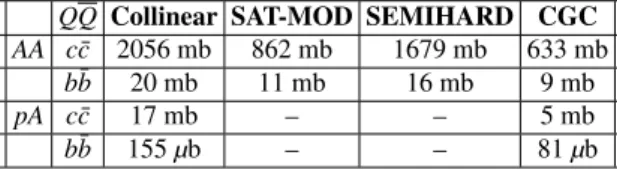
QQ Collinear SAT-MOD SEMIHARD CGC
AA cc¯ 2056 mb 862 mb 1679 mb 633 mb
bb¯ 20 mb 11 mb 16 mb 9 mb
pA cc¯ 17 mb – – 5 mb
bb¯ 155µb – – 81µb
TABLE I:Heavy quark integrated cross sections for coherent AA and pA interactions at LHC.
be noticed that we have computed the integrated cross section by integrating all rapidities. Experimental cuts should dimin-ish their magnitude, but they are still large. The experimental signal should be clear. Since photon emission is coherent over the entire nucleus and the photon is colorless we expect that the events to be characterized by one rapidity gap in heavy quark production. Finally, the CGC and color dipole calcula-tions are more stable concerning changes in the quark mass (a few percent difference). Moreover, the value of central value for quark mass is determined by a fit to accelerator data rather than being a free parameter.
In Table I we also present the results for coherent proton-nucleus collisions at LHC. For comparison, we present the predictions from the linear dynamics (collinear), which is cal-culated assuming that the collinear factorization is valid and that the gluon distribution can be described by the GRV98 pa-rameterization. At LHC we can observe a large difference be-tween the predictions and having high rates. For instance, for charm quark CGC gives a cross section a factor 3 lower than collinear and a factor 2 for bottom. This deviation holds even in case of experimental cuts on rapidity. This has been veri-fied in the case of vector meson production when considering experimental cuts [4]. Therefore, photoproduction of heavy quarks should provide a feasible and clear measurement of the underlying QCD dynamics at high energies. Since RHIC is obtaining data fordAuinteractions and LHC is to be commis-sioned, these processes could be analyzed in the next years. The advantages are a clear final state (rapidity gap and low momenta particles) and no competing effect of dense nuclear environment if compared with hadroproduction.
III. VECTOR MESON PRODUCTION
Let us consider the scattering processγA→VAin the QCD dipole approach, where V stands for both light and heavy mesons. The main motivation for using this approach is the easy intuitive interpretation and its successful data description in the proton case. The scattering process can be seen in the target rest frame as a succession in time of three factorizable subprocesses: i) the photon fluctuates in a quark-antiquark pair (the dipole), ii) this color dipole interacts with the tar-get and, iii) the pair converts into vector meson final state. In the color dipole formalism, the corresponding imaginary part of the amplitude at zero momentum transfer reads as [13, 14],
I
mA
γA→VA=∑
h,h¯Z
dz d2rΨγ
h,h¯,σ target dip (x˜,r)Ψ
V∗
h,h¯, (7)
HEAVY ION J/Ψ(3097) φ(1019) ω(782) ρ(770)
AA Ca 436µb 12 mb 14 mb 128 mb
Pb 41.5 mb 998 mb 1131 mb 10069 mb
pA Pb 95µb – – 14mb
TABLE II:Integrated cross sections for vector meson production in coherent AA and pA interactions at LHC energy.
whereΨγh,¯h(z,r)andΨVh,h¯(z,r)are the light-cone wavefunc-tions of the photon and vector meson, respectively. The quark and antiquark helicities are labeled byhand ¯hand reference to the meson and photon helicities are implicitly understood. The variablerdefines the relative transverse separation of the pair (dipole) andz(1−z)is the longitudinal momentum frac-tions of the quark (antiquark).
In the dipole formalism, the light-cone wavefunctions
Ψh,h¯(z,r)in the mixed representation(z,r)can be completely determined using light cone perturbation theory. On the other hand, for vector mesons, the light-cone wavefunctions are not known in a systematic way and they are thus obtained through models (For a recent detailed discussion see Ref. [12]). Here we follows the analytically simple DGKP ap-proach [15], which assumes that the dependencies onr and zof the wavefunction are factorised, with a Gaussian depen-dence onr. We keep the original parameters of the model. The main shortcoming of this approach is that it breaks the rota-tional invariance between transverse and longitudinally polar-ized vector mesons [12]. However, as it describes reasonably the HERA data for vector meson production, as pointed out in Ref. [16], we will use it here.
The corresponding parameters for the meson wavefunctions are presented in Table 1 of Ref. [11]. Following Ref. [14], we have estimated contribution from real part for the photopro-duction of vector mesons: it is about 3% for light mesons and it reaches 13% forJ/Ψ[11]. Additionally for heavy mesons we have taken into account the skewness effects, associated to off-forward features of the process, which are increasingly important in this case. Finally, the photonuclear cross section is given by
σtot
γA→VA=
£
I
mA
γA→VA¤2 16π (1+β2)Z ∞ tmin
dt|F(t)|2, (8) withtmin= (m2V/2ω)2. The quantityβ is the ratio between the imaginary and real part of the amplitude. We have used an analytical approximation[17] of the Woods-Saxon distri-bution as a hard sphere, with radiusRA, convoluted with a Yukawa potential with rangea=0.7 fm in order to compute the nuclear form factor,F(t).
Victor P. Gonc¸alves and Magno V. T Machado 109
50 100 150 200
WNN [GeV]
101
102
103 104
σ
(AA−−>
ρ
0 AA) [mb]
STAR DATA
CUTS: t < 0.02
|y| < 3
−3 −2 −1 0 1 2 3
y 0
20 40 60 80 100
d
σ
/dy [
µ
b]
J/Ψ(3097)
PHENIX with nuclear breakup
(a) (b)
FIG. 1: (a) Energy dependence of coherentρphotoproduction at RHIC. (b) Rapidity distribution of coherentJ/Ψphotoproduction (with nuclear breakup) at RHIC (see text).
Collaboration has measurements of the cross section for co-herentJ/Ψphotoproduction in UPC at midrapidity at√s=
200 GeV [19], accompanied by nuclear breakup. The rapid-ity distribution is shown in Fig 1-b in comparison with our prediction. The theoretical estimation givesdσ/dy|y=0=58 µb, which is in agreement with the PHENIX measurement dσPHENIX/dy|y=0=48±16(stat)±18(syst)µb. Finally, in Table II one shows the predictions for the integrated cross sec-tions for coherent nucleus-nucleus interacsec-tions at LHC. The experimental feasibility and signal separation on the reaction channels presented here are reasonably clear, namely apply-ing a (low) transverse momentum cut pT <1 GeV and two rapidity gaps in the final state for the meson case. In contrast, for heavy quarks we have only one rapidity gap.
In Table II we also present the result for coherent
proton-nucleus reactions at LHC, considering both light (Ar) and heavy (Pb) ions. It should be noticed that the coherent produc-tion of mesons is currently measured at RHIC for theAAcase. Therefore, the present estimation could be tested indAu col-lisions with a good experimental feasibility. Disregarding the parton saturation phenomenon, we have that the predictions forJ/Ψproduction are somewhat similar to the linear pQCD approach, which is expected, since the heavy vector meson production is dominated by small pair separations, where the saturation physics does not contribute significantly. On the other hand, the photoproduction ofρ mesons is dominated by physics below saturation scale. The difference is huge, as shown in Ref. [5], reaching 3 orders of magnitude in ra-pidity distribution, which demonstrate the importance of the saturation physics on this process.
[1] V. P. Goncalves and M. V. T. Machado, Mod. Phys. Lett.19, 2525 (2004).
[2] V. P. Goncalves and M. V. T. Machado, J. Phys. G: Nucl. Part. Phys.32, 295 (2006).
[3] V.P. Goncalves and M.V.T. Machado, Eur. Phys. J. C31, 371 (2003).
[4] V. P. Goncalves and M. V. T. Machado, Eur. Phys. J. C40, 519 (2005).
[5] V. P. Goncalves and M. V. T. Machado, Phys. Rev. C73, 044902 (2006).
[6] Bo Anderssonet al.[SmallxCollaboration], Eur. Phys. J. C25, 77 (2002).
[7] N. Armesto, Eur. Phys. J. C26, 35 (2002).
[8] N. N. Nikolaev and B. G. Zakharov, Z. Phys. C49, 607 (1991). [9] V. Barone and E. Predazzi, High-Energy Particle Diffraction,
Springer-Verlag, 2002.
[10] E. Iancu, K. Itakura, and S. Munier, Phys. Lett. B590, 199 (2004).
[11] V. P. Goncalves and M. V. T. Machado, Eur. Phys. J. C38, 319 (2004).
[12] N. N. Nikolaev, Comments Nucl. Part. Phys.21, 41 (1992); I. P. Ivanov, N. N. Nikolaev and A. A. Savin, Phys. Element. Part. Atom. Nucl.37, 1 (2006).
[13] B. Z. Kopeliovich, J. Nemchick, N. N. Nikolaev, and B. G. Za-kharov, Phys. Lett. B309, 179 (1993); Phys. Lett. B324, 469 (1994)
[14] J. Nemchik, N. N. Nikolaev, and B. G. Zakharov, Phys. Lett. B 341, 228 (1994); J. Nemchik, N. N. Nikolaev, E. Predazzi, and B. G. Zakharov, Z. Phys. C75, 71 (1997)
[15] H. G. Dosch, T. Gousset, G. Kulzinger, and H. J. Pirner, Phys. Rev. D55, 2602 (1997).
[16] J. R. Forshaw, R. Sandapen, and G. Shaw, Phys. Rev. D69, 094013 (2004).
[17] S. R. Klein, J. Nystrand, Phys. Rev. C60, 014903 (1999). [18] C. Adler et al. [STAR Collaboration], Phys. Rev. Lett. 89,
272302 (2002).