Brazilian Journal of Physics, vol. 39, no. 2A, August, 2009 435
Nonextensive statistical mechanics applied to protein folding problem: kinetics aspects
J. P. Dal Molin,∗ Marco Antonio Alves da Silva, I. R. da Silva, and A. Caliri Universidade de S˜ao Paulo, FCFRP, Departamento de F´ısica e Qu´ımica,
Av. do Caf´e S/N, Monte Alegre, 14040.903, Ribeir˜ao Preto, SP, Brasil (Received on 23 December, 2008)
A reduced (stereo-chemical) model is employed to study kinetic aspects of globular protein folding process, by Monte Carlo simulation. Nonextensive statistical approach is used: transition probabilitypi jbetween
config-urationsi→ jis given bypi j= [1+ (1−q)∆Gi j/kBT]1/(1−q), whereqis the nonextensive (Tsallis) parameter.
The system model consists of a chain of 27 beads immerse in its solvent; the beads represent the sequence of amino acids along the chain by means of a 10-letter stereo-chemical alphabet; asyntax(rule) to design the amino acid sequence for any given 3Dstructure is embedded in the model. The study focuses mainly kinetic aspects of the folding problem related with the protein folding time, represented in this work by the concept of first passage time(FPT). Many distinct proteins, whose native structures are represented here by compact self avoiding (CSA) configurations, were employed in our analysis, although our results are presented exclusively for one representative protein, for which a rich statistics was achieved. Our results reveal that there is a specific combinations of value for the nonextensive parameterqand temperatureT,which gives the smallest estimated folding characteristic timehti.Additionally, forq=1.1,htistays almost invariable in the range 0.9≤T≤1.3, slightly oscillating about its average valuehti=27±σ,whereσ=2 is the standard deviation. This behavior is explained by comparing the distribution of the folding times for the Boltzmann statistics (q→1), with respect to the nonextensive statistics forq=1.1, which shows that the effect of the nonextensive parameterqis tocut offthe larger folding times present in the original (q→1) distribution. The distribution of natural logarithm of the folding times for Boltzmann statistics is a triple peaked Gaussian, while, forq=1.1 (Tsallis), it is a double peaked Gaussian, suggesting that a log-normal process with two characteristic times replaced the original pro-cess with three characteristic times. Finally we comment on the physical meaning of the present results, as well its significance in the near future works.
Keywords: Protein folding problem, Stereo-chemical model, Monte Carlo simulation,q-Gaussian, Protein folding time
1. INTRODUCTION
Globular proteins are peptide chains identified by their amino acid sequence. Under physiological condition, each protein naturally folds over itself in a compact and precise 3D structure (its native structure) [1]; remarkably, such proteins are soluble in polar solvents [2, 3]. The number of differ-ent proteins found in the nature is very large [4]; only in the human body about 105different types of proteins are found; actually, they correspond to half of the dry weight of the hu-man body. On the other hand, the set of structural patterns, named as protein folds1, from which all known protein struc-tures can be ensembled, is much smaller; there are little more the one thousand registered folds. A globular protein works properly only when it is meet in its native structure, which is reached through a process named protein folding [1]; the folding problem is a fundamental process in molecular biol-ogy without yet a complete explanation [6–9].
Here the protein system, comprehended by the chain and its solvent, is characterized by its heterogeneity (chain plus solvent) and complex energetic interactions (intra-chain and solvent-chain interactions) under the effects of its nanoscopic size. Therefore, the use of simplified (or reduced) models is imperative in order to handle the folding process in a gen-eral form, through fundamental physics [10]. An important characteristic of such minimalist approach is that a
signifi-∗Electronic address:[email protected]
1Folds are resultant forms - for example,α-helix,β-sheets, turns and oth-ers - of complex interaction among the elements presents in the folding process [5].
cant amount of data can be generated, so that statistical anal-ysis becomes viable, for instance, on kinetic processes, fa-cilitating the use of experimental results. Therefore, a mini-malist model, namely the stereo-chemical model, is employed to study kinetic aspects of the protein folding problem [11– 13]. Due the number of distinct aspects of the protein folding problem the stereo-chemical model can be applied, and it can be considered as areduced parallel worldregarding the glob-ular protein system.
The model is treated by Monte Carlo (MC) simulation with the nonextensive statistical approach; the transition proba-bility pi j between configurations i→ j is given by pi j =
[1+ (1−q)∆Gi j]1/(1−q)[14, 15]. Our main objective in this work is to analyze the behavior of the folding characteristic time as a function of the temperatureT and the parameterq; the folding time for each protein and for each run, is taken as the first passage time. A representative native structure was utilized to illustrate our results, but many distinct structures were also considered. Our work is organized as follows: a brief description of the stereo-chemical model and the moti-vations to use theq-exponential function are given in the next section; in the third section the results are presented and, fi-nally, the last topic is dedicated to comments and perspectives for future works.
2. THE STEREO-CHEMICAL MODEL
infin-436 J. P. Dal Molin et al.
-2.1 -2.0 -1.9 -1.2 -1.1 -1.0 -1.0 -0.9 -0.8 + 0.8
R A H B G F I E D C
R A H R A H B G FR A H G I E A A H A C H C H C D C F I E D C
0 1 2 3
s
p
e
c
if
ic
it
ie
s
h :m
class: A
B 866 868
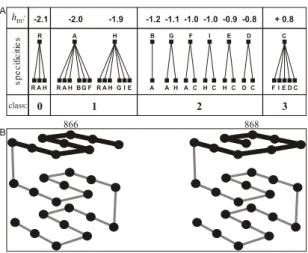
FIG. 1: Steric specificities and hydrophobic level (A). Connected letters indicate that these residue types are allowed to contact as lat-tice first neighbors. On B, two maximally compacted (CSA) config-urations representing distinct native structures.
ity cubic lattice, while the remainder sites, named assolvent sites, are filled out byeffective solvent molecules, which in-teract explicitly with the chain. Inin-teractions that count for the present model are intended to represent the inter-residue sterical specificities and the hydrophobic effect. Therefore, additionally to the trivial excluded volume restriction for sol-vent and chain elements, the intra-chain interactions present specific pairwise steric constraints, and the chain interacts with the solvent according to the hydrophobic level of their residues, as summarized in Fig.1A[11, 12].
As native structures, we consider configurations from a cataloguewith 51.704 distinct compact self avoiding (CSA) structures, which form cubes 3x3x3 for a chain with 27 residues. For each protein in the cataloguethere is a cor-responding specific sequence of residues, taken from a reper-tory of ten distinct types, that is: different hydrophobic levels and steric specificities define a 10-letter alphabet, see Fig.1A [12]. A syntax, or rule to design the protein, given each par-ticular CSA structure (native), is also provided for the stereo-chemical model [13].
The system is described in the context of microcanonical ensemble. Its configurations (chain and solvent) all have the same weight p=1/Γo, but note that for the same chain con-figuration there is a huge number of distinct concon-figurations for the solvent. So, if the chain is consideredfrozenin a par-ticular configuration, say configurationa, the system entropy is reduced by an amountδSa; therefore a weightpa=eδSa/k is associated with that configuration a, (k: Boltzmann con-stant). Next, the transition probability W(a→b) of con-figurationa to configurationb is given by detailed balance: W(a→b) =e−∆Sba/k, where∆S
ba=δSb−δSa. Finally, as there are no variations on the system internal energy, we write W(a→b) =e∆Gba/kT [16].
Formally, the interactions between parts of the system are:
(i)−intra-chain interactions: excluded volume and specific restrictions between first neighbors, Fig.1A; (ii)− solvent-solvent interactions: excluded volume;(iii)−chain-solvent: excluded volume and hydrophobic effect. The latter, in spite of being due to the direct interaction between each residue
and the solvent, in practice, for lattice models in which the solvent density does not fluctuate, the chain-solvent interac-tions can be exactly represented by the addictive hydrophobic potential,gm,n= (hm+hn), between first neighbors, Fig.1A. The hydrophobic levelhm represents the free energy change to transfer the residue type-mfrom a polar environment (sol-vent) into an apolar medium (protein interior). Thus, for a given chain configurationa, the free energy of the system can be considered asG=Go+∑gm,n(a), whereGois a constant. Details about target configurations and 10-letter alphabet are found in [11–13].
The finite nature of the system (nanometric structures) and the complex interactions between its parts (which can gen-erate a rough free energy landscape), suggest that thermal fluctuations are preponderant factors of the system’s behavior. Therefore, the Boltzmann weighte−∆Gba/kT[17] is exchanged
by theq-exponential, namely[1+ (1−q)∆Gba/kT]1/1−q[14] (which embeds the Boltzmann factor forq→1), in order to examine the effect of the nonextensive parameterqon the ki-netic characteristics of the folding process. Specifically, we perform many independent Monte Carlo experiments, which generate large sets of folding times for different temperatures T, and for different values of nonextensive parameterq. More general motivations for using Tsallis statistics include the fact that: (i)−the protein folding process is a stochastic process out of thermodynamical equilibrium [18, 19] and(ii)−there is evidence that, to thermostatistically approach living sys-tems, the nonextensive statistical mechanics can be a conve-nient choice [15].
3. RESULTS
In order to get the precise meaning of the results presented here, we first describe, with some detail, the computational experiments carried out in this work. First, in the real ex-perimental approach, one considers a collection ofN open denatured protein molecules of the same type, in diluted so-lution; the proteins are by identified by labels 1,2, ...,i, ...,N. So, once folding conditions have been established, protein 1 finds the native structure in the timet1, protein 2 att2, and so on; that is,ti is thefolding timeof the proteini. Then, after some timehti, half of the proteins, that isN/2 proteins, reach the native state, and the amounthtiis identified as the folding characteristic timeof that type of protein2. Accordingly, in our MC simulations for each particular protein, the concept of first passage time (FPT) is adopted as the folding time, that is: the time spent, in units of MC steps for a particular MC simu-lation, to find the native structure by the first time. Therefore, N independent simulations of a given protein produce a set {ti}ofNfolding times, with which one determines the fold-ing characteristic timehtifor that protein, such as in an real experiment. If the folding process is multi-exponential time dependent,htiis found by solving numerically the transcen-dental equationN/2=∑imie−hti/ti, for given{ti}and{mi}, constrained with∑imi=N. At last, the folding rate for that
Brazilian Journal of Physics, vol. 39, no. 2A, August, 2009 437
FIG. 2: Folding characteristic timehtifor two distinct native struc-ture (A: CSA 866; B: CSA 41943). There are strong correlation between folding times (up side) and structural patterns of the na-tive structure, as shown in the center and down side of figure; CSA structures and Contact Maps, respectively.
protein is then defined asτ=1/hti.
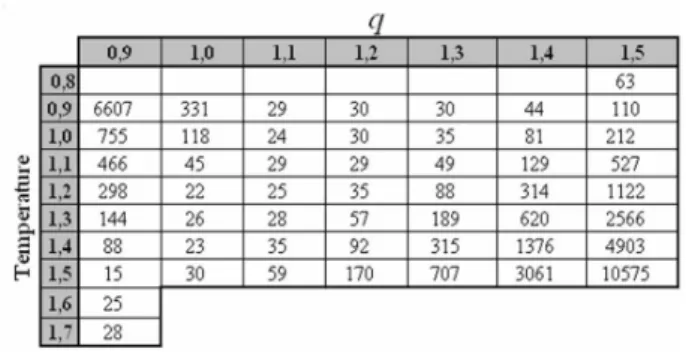
The structure identified by the label 866 was chosen to rep-resent our results regarding the behavior of folding charac-teristic timehtifor two reasons. First, similarly to real pro-teins, it is rich in secondary structure-like (indeed it presents the largest possible content of secondary structure among all CSA configurations of catalogue), as shown in Fig.2A, through its contact map. Second, as a consequence of its structure peculiarity, it presents the smallest hti which im-plies in an optimized CPU time. The results are summarized in Fig.3, which show the characteristic timehtias a function of temperatureT (arbitrary units) in the model-significative interval 0.9≤T ≤1.5 and of the nonextensive parameterq, also in the interval 0.9≤q≤1.5. For each pair(T,q), six hundred distinct MC simulations were performed. The small-esthtiare obtained for specific combinations ofTandq, pro-ducing avalleyin which the folding characteristic time is al-ways smaller than 50 (MC units of time) Fig.3A. However, as shown in Fig.3B, only forq=1.1, one getshti<50 for practically every temperature in the interval 0.9≤T ≤1.4.
The behavior ofhtiwhenqchanges withT fixed, seems to be similar to that in whichqis fixed atq→1 (Boltzmann) and T changes. However only forq=1.1 the folding character-istic time stays almost invariable in the range 0.9≤T ≤1.3; see Fig.3; indeedhtislightly oscillates about its average value hti=27±σ, whereσ=2 is the standard deviation; see TA-BLE I.
That behavior is explained by Fig.4: when the distribution
FIG. 3: A linear relation betweenT andqroughly describes avalley in whichhti is always smaller than 50; partA. Forq=1.1, hti obtains its smaller values, which are smaller than 50 for practically the entire range ofT, as shown in partB; see also TABLE I. The two lines in part B emphasize the results for Boltzmann (q→1)and Tsallis (q=1.1) statistics. Note also that the distance between the lines that confine the valueshti<50, part A, reduces systematically asT increases andqdecreases.
438 J. P. Dal Molin et al.
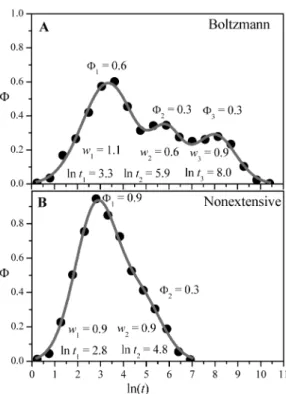
FIG. 4: Distribution of the natural logarithm of the folding time (structure 866) for T =1.0 andq→1 (Boltzmann statistics, fig-ureA) andq=1.1 (Tsallis statistics, figureB). Tsallis weight seems to allow stronger fluctuations, efficiently removing the system from eventual stereo-energetic traps.
of natural logarithm of the folding times for the Boltzmann statistics (q→1, Fig.4A) is compared with the nonextensive statistics for q=1.1. (Fig.4B), one can see that the effect on varyingq is tocut off the larger folding times from the distribution. Indeed, the original distribution (Fig.4A, Boltz-mann) can be seen as a triple peaked Gaussian, suggesting a log-normal process with three characteristic times. In the same way, forq=1.1 (Fig.4B, Tsallis), it also suggests a log-normal process, but now with two characteristic times. That is, using the Tsallis statistics, the third peak that appears in
the Boltzmann distribution iscut off. However, the two other processes are essentially preserved with their respective char-acteristic frequencies accordingly increased. Differences on the mean values of the folding time -actually ln(t)as shown in Fig.4, and on the width of the distributions, with respect to the two statistics, possibly are due to the fact that the num-ber of simulations is insufficient to determine those results accurately; for both cases (q→1, andq=1.1), about 104 independent MC experiments were carried out.
4. COMMENTS AND PERSPECTIVES
The folding transition for globular two-state proteins oc-curs in a relatively small temperature range∆T; out of this domain the folding characteristic time increases significantly. Experimentally, this fact is observed by a rapid change of the equilibrium constantKeq= [N]/[U], where[N]and[U]are the folded (native) and unfolded protein concentration, respec-tively, when the system temperature is out of the range∆T. However, in the interval∆T, the folding reaction is robust, withKeq practically constant [20] as it is reproduced when the nonextensive statistics is used, specifically forq=1.1. Indeed, the folding time distribution is broad because the free energy landscape is rough, trapping the chain in local free energy minima or some steric entanglement. Tsallis weight seems to be efficient to quickly remove the system from such traps, and so folding routes with longer folding times are cut off from the distribution; Fig.4. A computational conse-quence of this results is that simulations become much more faster, opening the possibility to trace a strategy to extend the study of the effect of Tsallis statistics to others kinetic matters of the folding problem, such as on the correlation between the folding rates and global structural parameters of native struc-tures (contact order, for instance) [21], and on the stability of the native state.
Acknowledgements
We thank CNPq and FAPESP (grant No. 2007/04220−4) for funding.
[1] C.B. Anfinsen, Science181, 223 (1973). [2] D. Chandler, Nature417, 491 (2002).
[3] L.F.O. Rocha, M.E. Tarrag´o Pinto, and A. Caliri, Braz. J. Phys. 34(1), 90 (2004).
[4] C. Chothia, Nature357, 543 (1992).
[5] A.M. Lesk, G.D. Rose, Proc. Natl. Acad. Sci. USA78, 4304 (1981).
[6] E.E. Lattman, G.D. Rose, Proc. Natl. Acad. Sci. USA90, 439 (1993).
[7] L.S. Itzhaki, P.G. Wolynes, Curr. Opin. Struct. Biol.18, 1-3 (2008).
[8] A.C. Clark, A.B.B.469, 1-3 (2008).
[9] K.A. Dill, S.B. Ozkan, M.S. Shell, T.R. Weikl, Annu. Rev. Bio-phys.37, 289 (2008).
[10] T. Head-Gordon, S. Brown, Curr. Opin. Struct. Biol.13, 160 (2003).
[11] R.A. da Silva, M.A.A. da Silva, A. Caliri, J. Chem. Phys. 114(9), 4235 (2001).
[12] M.E.P. Tarrag´o, L.F.O. Rocha, R.A. da Silva, A. Caliri, PRE 67, 031901-1 (2003).
[13] I.R. Silva, L.M. dos Reis, A. Caliri, J. Chem. Phys.123(15), 154906-1, (2005).
[14] C. Tsallis, J. Stat. Phys.52, 479 (1988). [15] C. Tsallis, Phys. Life. Rev.3, 1 (2006).
[16] L.F.O. Rocha, M.A.A. da Silva, A. Caliri, Phys. Lett. A220, 178 (1996).
[17] N. Metropolis, A.W. Rosenbluth, M.N. Rosenbluth, A.H. Teller, J. Chem. Phys.21(6), (1953).
[18] N. Go, J. Stat. Phys.30(2), 413 (1983). [19] E.M. Popov, IUBMB Life47(3), 443 (1999).
[20] M.L. Scalley, D. Baker, Proc. Natl. Acad. Sci. USA94, 10636 (1997).