STABLE ISOTOPE/TEST SIZE RELATIONSHIP IN Cibicidoides wuellerstorfi
Paula Franco-Fraguas*, Karen Badaraco Costa and Felipe Antonio de Lima Toledo
1
Instituto Oceanográfico da Universidade de São Paulo (Praça do Oceanográfico, 191, 05508-120 São Paulo, SP, Brasil)
*Corresponding author: [email protected]
Descriptors: Stable isotopes, Test size, Cibicidoides wuellerstorfi. Descritores: Isótopos estáveis, Tamanho testa, Cibicidoides wuellerstorfi.
Stable isotope (δ18O and δ13C) measurements in foraminifera tests are widely used for paleoceanographic interpretations (WEFER et al., 1999; ROHLING; COOKE, 1999). This is attained since during calcification foraminifera registered in their tests the stable isotope signature and environmental conditions of seawater of their local of calcification in a somehow predictable way (ROHLING; COOKE, 1999).
Foraminifera test size is an important source of stable isotope variability found in sediment samples. Some of this variability is associated to foraminifera physiological effects (e.g., symbiotic photosynthesis, respiration and calcification) which can vary along ontogeny and affect stable isotope measurements in foraminifera tests (ZEEBE et al., 1999). Regional environmental variables can also affect simultaneously both stable isotope values and foraminifera test size resulting in another source of test size/stable isotope variability (DEUSER et al., 1981). Although it is especially important in planktonic foraminifera (RAVELO; FAIRBANKS, 1995), some studies have found test size/stable isotope variation in benthic foraminifera (CORLISS et al., 2002). This test size/stable isotope variability can result in offsets from predicted values having important implications when choosing test size fractions for paleoceanographic interpretations (OPPO; FAIRBANKS, 1989).
Cibicidoides wuellerstorfi is an epibenthic
foraminifera species of great importance in stable isotopic paleoceanographic studies (MACKENSEN; LICARI, 2003). Nevertheless its paleoceanographic importance no stable isotope (δ18O and δ13C) test size relationship studies in this species are found in the literature.
Generally δ13C measurements in C. wuellerstorfi are related in a 1:1 ratio with δ13C values in deep water (δ13CDIC) (MACKENSEN; LICARI, 2003). Positive δ13C offsets in C. wuellerstorfi have been observed in regions of high surface productivity and low carbonate sediment concentration and were explained by the undersaturation of bottom water conditions (MACKENSEN; LICARI, 2003). In some oligotrophic regions, including the Brazilian Continental Margin, positive δ13C offsets have been
observed for this species (MCCORKLE et al., 1998; OPPO; HOROWITZ, 2000) and are yet not explained. If local environmental conditions induce C.
wuellerstorfi test size /stable isotope related variability
in the study area it may be possible that the positive
δ13
C offset observed for this species in the region is result of the test size fraction selected for these studies. The present work explored stable isotope (δ18O and
δ13
C) relationship with test size fractions of C.
wuellerstorfi and its relation with predicted values of
calcite in equilibrium with deep water (δ18OEQ and
δ13
CDIC) in three core top samples of the Brazilian Continental Margin in order to verify if δ13C offsets observed in the region can be explained by the δ13C variation related to size.
Piston core KF-G was recovered at 1957 meters water depth at 20º51`S, 39º08`W in the South Atlantic Brazilian Continental Margin (southwestern South Atlantic). Three core top samples were selected: 1.5 cm, 9 cm and 16 cm. Accelerator Mass Spectrometer (AMS) radiocarbon dating was performed on Globigerinoides ruber tests of sample 1.5 cm. δ18O values in C. wuellerstorfi were used to check Holocene interglacial conditions of 9cm and 16cm samples (COSTA et al., 2006).
Samples were washed with distilled water in 63µm mesh size and dried at 50ºC. Samples were then separated in four mesh size ranges: 150-250µm, 250-300µm, 300-355µm and >355µm. Stable isotope measurements were conducted in single C. wuellerstorfi test. Replicate samples were performed
in the 150-250µm size fraction.
Stable isotopes analyses were made in Woods Hole Oceanographic Institution micropaleontology laboratory using a Finnigan MAT253 mass spectrometer. Isotope values are represented in standard δ notation relative to the Vienna Pee Dee Belemnite (PDB) for calcite and Vienna Standard-Mean-Water (VPDB) for sea water. Calibration of the PDB is via the NBS-19 and the precision is ±0.07 for δ18O and ±0.03 for δ13C.
used for identifying deep water mass based on Silveira et al. (2000), for estimating stable oxygen isotopes values in seawater (δ18OW) and in equilibrium with seawater (δ18OEQ). δ18OW was estimated based on annual salinity WOA05 data and δ18O/salinity NADW equation from Legrand and Schmidt (2006). δ18OEQ was estimated based on δ18O
W and annual temperature WOA05 using Kim and O’Neil (1997) paleotemperature equation. δ18OEQ (SMOW) was converted to δ18OEQ (VPDB) after Hut (1987). δ
13 CDIC was obtained from a deep water GEOSECS station 55 (18ºS, 31ºW) (BAINDBRIDGE, 1981) next to the core location.
In general, δ18O measurements in foraminiferal tests have less offsets from predicted values than δ13C measurements (GROSSMAN, 1987). Moreover, in the study area C. wuellerstorfi calcify in
δ18
O equilibrium with seawater using Kim and O’Neil (1997) paleotemperature equation (COSTA et al., 2006).
Thus, δ18O values can be used to evaluate
δ13
C offsets in C. wuellerstorfi. δ18O and δ13C values
measured in C. wuellerstorfi were compared with
δ18
OEQ and δ13CDIC, respectively from the location and depth of KF-G core in order to evaluate offsets from predicted values.
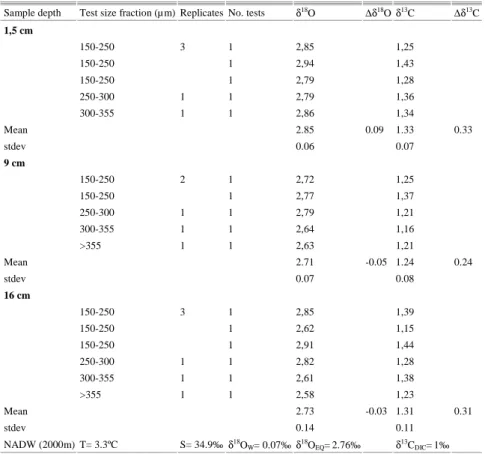
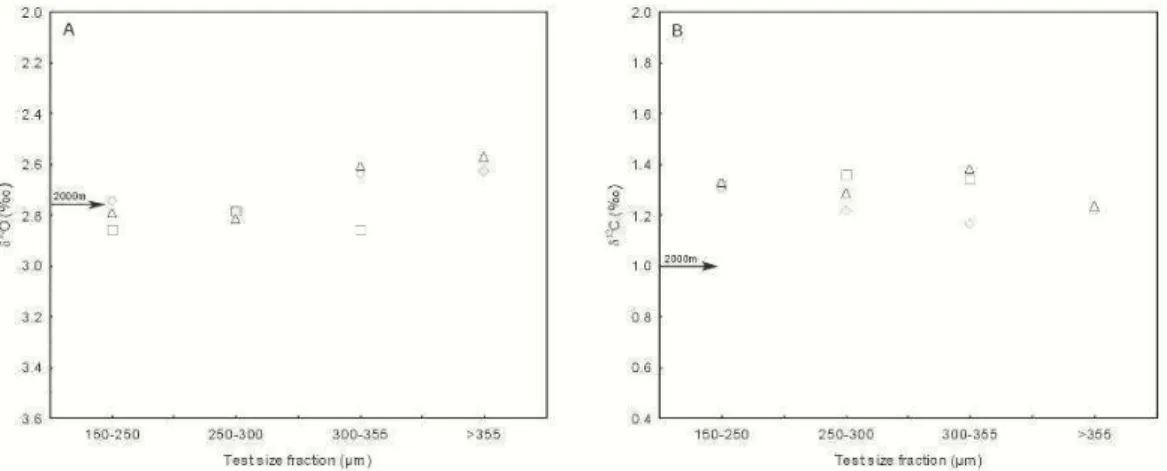
Core top location is bathed by North Atlantic Deep Water (NADW) waters (Table 1). No systematic stable isotopic (δ18Oand δ13C) change with test size fraction was observed (Fig. 1). Radiocarbon dating confirmed Holocene age for sample 1.5cm (3540 radiocarbon age, 3482 calendar age). C. wuellerstorfi
δ18
O mean values are in equilibrium with δ18OEQ values (∆δ18O values between -0.05‰ and 0.09‰) (Table 1, Fig. 1) corroborating with the radiocarbon data and indicating that all three core top samples are representative of Holocene conditions (COSTA et al., 2006). δ13C mean values are higher than δ13CDIC values(∆δ13C values between +0.24‰ and +0.33‰) (Table 1, Fig. 1). Maximum intraspecific variability (i.e. between a single size fraction and between size fractions) is 0.34‰ and 0.29‰ for δ18O and δ13C, respectively.
Table 1. δ18O (‰) and δ13C (‰) measurements in C. wuellerstorfi test size fractions. δ18O and δ13C values are δ18O EQ and
δ13
CDIC values subtracted from mean test δ18O and δ13C measurements, respectively.
Sample depth Test size fraction (µ m) Replicates No. tests δ18O ∆δ18O δ13C ∆δ13C
1,5 cm
150-250 3 1 2,85 1,25
150-250 1 2,94 1,43
150-250 1 2,79 1,28
250-300 1 1 2,79 1,36
300-355 1 1 2,86 1,34
Mean 2.85 0.09 1.33 0.33
stdev 0.06 0.07
9 cm
150-250 2 1 2,72 1,25
150-250 1 2,77 1,37
250-300 1 1 2,79 1,21
300-355 1 1 2,64 1,16
>355 1 1 2,63 1,21
Mean 2.71 -0.05 1.24 0.24
stdev 0.07 0.08
16 cm
150-250 3 1 2,85 1,39
150-250 1 2,62 1,15
150-250 1 2,91 1,44
250-300 1 1 2,82 1,28
300-355 1 1 2,61 1,38
>355 1 1 2,58 1,23
Mean 2.73 -0.03 1.31 0.31
stdev 0.14 0.11
NADW (2000m) T= 3.3ºC S= 34.9‰ δ18O
Fig. 1. Mean (A) δ18
O and (B) δ13
C measurements in C. wuellerstorfi in core KF-G related to test size fraction. In left margins δ18O
EQ (A) and δ13CDIC (B) values obtained at 2000 water depth are shown for
comparison with foraminifera measurements.
As opposed to planktonic foraminifera where size related stable isotope variability is generally observed (RAVELO; FAIRBANKS, 1995; ELDERFIELD et al., 2002), few deep sea benthic foraminifera species have shown stable isotope variation with test size (SCHMIEDL et al., 2004; MCCORKLE et al., 2008). Variation in the stable isotope signature of different size fractions of deep sea foraminifera are explained by one of two mechanisms. One the one hand, kinetic fractionation during calcification of foraminifera tests and/or the incorporation of metabolic CO2 during calcification can modify the stable isotope signature registered in foraminifera tests (WOLF-GLADROW et al., 1999). Then, variable metabolic rates during ontogeny can be reflected in stable isotope variability related to test size (BERGER et al., 1978; DUNBAR; WEFER, 1984) Other possibility is that fossil foraminifera in a sample represent a range of ages and that different local environmental conditions prevailing over an interval of time (e.g., organic matter fluxes) preferentially affect any particular size fraction (CORLISS et al., 2002). In epibenthic deep sea foraminifera no stable isotope variation with test size has been observed (VINCENT et al., 1981; DUNBAR; WEFER, 1984; CORLISS et al., 2002). This has been attributed to the low temperature and stability of deep sea together with longer life cycles and slower growth rates of deep sea benthic foraminifera when compared to planktonic foraminifera (SCHMIEDL et al., 2004). The lack of test size stable isotope variation in C. wuellerstorfi observed in this study corroborated other epibenthic findings and suggests low ontogenetic related physiological effects and/or lack of local environmental size related control for this species in the region. Moreover, it indicates that the test size fraction is not a limiting factor for paleoceanographic
studies based on oxygen and carbon stable isotopes values of C. wuellerstorfi.
In general the number of deep sea benthic foraminifera tests is a limiting factor for paleoceanographic studies. Thus, paleoceanographic interpretations using stable isotope measurements in deep sea benthic foraminifera usually use between one and three tests per stable isotope analysis (e.g. CORLISS et al., 2002; MACKENSEN; LICARI, 2003; COSTA et al., 2006). The stable isotope analysis of single test reflects maximum stable isotope variability (BILLUPS; SPERO, 1995). In this case single test analyses (both within a single size fraction and between test size fractions) indicate relatively low oxygen (0.34‰) and carbon (0.29‰) stable isotope intraspecific variability. However, improvement in paleoceanographic precision can be obtained using more than one test per analysis.
C. wuellerstorfi stable isotopes range of
variation from predicted equilibrium generally accepted in the literature is ±0.2‰ for both δ18O (COSTA et al., 2006) and δ13C (MACKENSEN; LICARI, 2003). Present offset observed for C.
of high productivity and low sediment carbonate concentration (c.a. 5%) Mackensen and Licari (2003) explained the high δ13C offsets in C. wuellerstorfi with the undersaturation of the carbonate ion in deep waters. This is based in the effect that the carbonate ion concentration produces in both δ13C and δ18O fractionation in foraminifera (SPERO et al., 1997). Oligotrophic surface waters (BRANDINI, 2006), deep-sea sediment carbonate values (c.a. 18%; BARIANI,personal communication) and the lack of positive δ18O offsets in C. wuellerstorfi (this study) suggests the carbonate ion effect is not influencing
δ13
C fractionation in the area. However, this needs further investigation. Thus, factors influencing this
δ13
C offset still need to be understood.
A
CKNOWLEDMENTSThis work was supported financially by the Coordenação de Aperfeiçoamento de Pessoal de Nível Superior(CAPES). We thank Petrobras for providing the samples. The study benefited greatly from the comments of the two anonymous reviewers.
R
EFERENCESANTONOV, J. I.; LOCARNINI, R. A.; BOYER, T. P.; MISHONOV, A. V.; GARCIA, H. E. World Ocean Atlas, 2005, v. 2: Salinity. LEVITUS, S. (Ed.). NOAA Atlas NESDIS G2. Washington, D. C.: U.S. Government Printing Office, 2006. 182 p.
BAINBRIDGE, A. E. GEOSECS Atlantic Expedition, Hydrographic Data, 1972-1973, v. 1. Washington, D.C.: US Government Printing Office, 1981. 121 p. BERGER, W. H.; KILLIKGLEY, J. S.; VINCENT, E. Stable
isotopes in deep-sea carbonates: Box core ERDC-92, West Equatorial Pacific. Oceanol. Acta, v. 1, n. 2, p.203-215, 1978.
BILLUPS, K.; SPERO, H. J. Relationship between shell size, thickness and stable isotopes in individual planktonic foraminifera from two equatorial Atlantic cores. J. foram. Res., v. 25, n. 1, p. 24-37, 1995.
BRANDINI, F. P. Hidrografia e produção biológica na região sudeste-sul do Brasil no contexto do programa Revizee. In: ROSSI-WONGTSCHOWSKI, C.L.D.B.; MADUREIRA, L.S.-P. (Ed.). O Ambiente oceanográfico da plataforma continental e do talude na região sudeste-sul do Brasil. São Paulo: Edusp, 2006. p. 459-466.
CORLISS, B. H.; MCCORKLE, D. M.; HIGDON, D. M. A time series study of the carbon isotopic composition of deep-sea benthic foraminifera. Paleoceanography, v. 17, n. 3, p. 1-27, 2002.
COSTA, K. B.; TOLEDO, F. A. L.; PIVEL, M. A. G.; MOURA, C. A. V.; CHEMALE, F. JR. Evaluation of two genera of benthic foraminifera for down-core paleotemperature studies in the western South Atlantic. Braz. J. Oceanogr., v. 54, n. 1, p. 75-84, 2006.
DEUSER, W. G.; ROSS, E. H.; HEMLEBEN, C.; SPLINDLER, M. Seasonal changes in species composition, numbers, mass, size, and isotopic composition of planktonic foraminifera settling into the deep Sargasso Sea. Palaeogeogr. Palaeoclimatol. Palaeoecol., v. 33, p. 103-127, 1981.
DUNBAR, R. B.; WEFER, G. Stable isotope fractionation in benthic foraminifera from the Peruvian continental margin. Mar. Geol., v. 59, p. 215-225, 1984.
ELDERFIELD, H.; VAUTRAVERS, M.; COOPER, M. The relationship between test size and Mg/Ca, Sr/Ca, δ18O and δ13C of species of planktonic foraminifera. Geochem., Geophys., Geosystems, v. 3, n. 8, 2002.
GROSSMAN, E. T. Stable isotopes in modern benthic foraminifera: a study of vital effect. J. foram. Res., v. 17, n. 1, p. 48-61, 1987.
KIM, S. T.; O´NEIL, J. R. Equilibrium and nonequilibrium oxygen isotope effects in synthetic carbonates. Geochim. cosmochim. Acta, v. 61, p. 3461-3475, 1997.
LEGRANDE, A. N.; SCHMIDT, G. A. Global gridded data set of the oxygen isotopic composition in seawater. Geophysical research letters, 33, L12604, doi:10.1029/2006GL026011, 2006.
LOCARNINI, R. A.; MISHONOV, A. V.; ANTONOV, J. I.; BOYER, T. P.; GARCIA, H. E. World Ocean Atlas, 2005, v. 1: Temperature. LEVITUS, S. (Ed.). NOAA Atlas NESDIS G1. Washington, D. C :U.S. Government Printing Office, 2006. 182 p.
MACKENSEN, A.; LICARI, L. Carbon isotopes of live benthic foraminifera from the South Atlantic: Sensitivity to bottom water carbonate saturation state and organic matter rain rates. In: WEFER, G.; MULITZA, S. RATMEYER, V. (Ed.). South Atlantic in the Late Quaternary: Reconstruction of material budgets and current systems. Berlin: Springer-Verlag, 2003. p. 623-644.
MCCORKLE, D. C.; HEGGIE, D. T.; VEEH, H. H. Glacial and Holocene stable isotope distribution in the southeastern Indian Ocean. Paleoceanography, v. 13, n. 1, p. 20-34, 1998.
MCCORKLE, D. C.; BERNHARD, J. M.; HINTZ, C. J.; BLANKS, J. K.; CHANDLER, G. T.; SHAW, T. J. The carbon and oxygen stable isotopic composition of cultured benthic foraminifera. Geolog. Soc., London, Special Publications, v. 303, p. 135-154, 2008. OPPO, D. W.; FARIBANKS, R. G. Carbon isotope
composition of tropical surface water during the past 22.000 years. Paleoceanography, v. 4, n. 4, p. 333-351, 1989.
OPPO, D. W.; HOROWITZ, M. Glacial deep water geometry: South Atlantic benthic foraminiferal Cd/Ca and δ13C evidence. Paleoceanography, v. 15, n. 2, p.
147-160, 2000.
RAVELO, A. C.; FAIRBANKS, R. G. Carbon isotopic fractionation in multiple species of planktonic foraminifera from core-tops in the Tropical Atlantic. J. foram. Res., v. 25, n. 1, p. 53-74, 1995.
SILVEIRA, I, C; SCHMIDT, A. C. K; CAMPOS, E. J.; GODOI, S. S.; IKEDA, Y. A corrente do Brasil ao largo da Costa Leste Brasileira. Rev. Bras. Oceanogr., . v. 48, n. 2, p. 171-183, 2000.
SCHMIEDL, G.; PFEILSTICKER, M.; HEMLEBEN, C.; MACKENSEN, A. Environmental and biological effects on the stable isotope composition of recent deep-sea benthic foraminifera from the western Mediterranean Sea. Mar. Micropaleontol., v. 51, p. 129-152, 2004.
SPERO, H. J.; BIJMA, J.; LEA, D. W.; BEMIS, B. E. Effect ion seawater carbonate concentration on the foraminiferal carbon and oxygen isotopes. Nature, v. 390, p. 497-500, 1997.
VINCENT, E.; KILLINGLEY, J. S.; BERGER, W. H. Stable isotope composition of benthic foraminifera from the equatorial Pacific. Nature, v. 289, p. 639-643, 1981.
WEFER, G.; BERGER, W. H.; BIJMA, J. & FISCHER, G. Clues to Ocean History: a Brief Overview of Proxies. In: Fischer, G. Wefer, G (Eds.). Use of Proxies in Paleoceanography: Examples from the South Atlantic. Springer-Verlag Berlin Heidelberg, 1999, p. 1-68
WOLF-GLADROW, D. A.; BIJMA, J.; ZEEBE, R. E. Model simulation of the carbonate chemistry in the microenvironment of symbiont bearing foraminifera. Mar. Chem., v. 64, p. 181-198, 1999.
ZEEBE, R. E.; BIJMA, J.; WOLF-GLADROW, D. A. A diffusion-reaction model of carbon isotope fractionation in foraminifera. Mar. Chem., v. 64, p. 199-227, 1999.