DOI: 10.1590/1809-5844201636
Carlos d’Andréa
(Universidade Federal de Minas Gerais, Faculdade de Filosoia e Ciências Humanas, Programa de Pós-Graduação em Comunicação. Belo Horizonte – MG, Brasil)
Abstract
The article discusses the emergence of retweet (RT) networks on Twitter during the FIFA World Cup 2014 semiinal match between Brazil and Germany. The aim is to analyze the major retweet networks brokered by the #vergonhabrasil (shameonbrazil) hashtag during and after the match in order to identify the range of issues and the extent to which the networks brokered by the hashtag generated a temporary “hybrid forum”. Based in Actor-Network Theory, we consider this mega sporting event as a controversial project, and we verify that Brazil’s 1–7 defeat set off a sub-controversy on social me -dia, fostering debates that encompassed discussions concerning party politics and national identity. In considering the hybridization of the controversies within the media platforms in which they take place, we produce visualizations of the main RTs networks from a dataset containing 37,029 retweets to discuss how the associations between the proiles changed during ive hours of debate.
Keywords: Controversy. World Cup. Twitter. Actor-Network Theory. Hashtag.
While perceived initially as an opportunity for Brazil, the organization of the 2014 FIFA World Cup became, especially after the massive street protests in June 2013, a project marked by intense debates about the mega sporting event that transcended sports. By provoking heterogeneous actors to speak and making possible the formation of new collectives, the World Cup held in Brazil can be taken as a controversy which leveraged various hybrid forums on some of the country’s urgent issues, among which the struggle against corruption and demands for better public services. Among the various socially-relevant situations linked to the World Cup, in this article, we focus on the unfolding events of the football’s 7-1 defeat to Germany in the tournament’s semiinals. In addition to a humiliating defeat on the ield, the episode became, during the match, a sub-controversy (referred to here as “Goal for Germany!”) which, especially on Twitter, took the form of
The aim of the article is to analyze the major retweet networks brokered by the hashtag #vergonhabrasil during and after the match so as to identify the range of issues raised by the most retweeted tweets as well as the extent to which the networks articulated by this hashtag generated a temporary hybrid forum. We begin the article by characterizing the 2014 World Cup as a controversy which, based on the application of Science and Technology Studies (STS) and Actor-Network Theory (ANT), demonstrates social formations from the associations of heterogeneous actors created in different hybrid forums (CALLON; LASCOUMES; BARTHE, 2011). In a dialogue with Venturini et al. (2015), we point out the relevance of discussing the controversies in relations to broader issues (meta-controversies) and more speciic ones (sub-controversies). Recognizing the contemporary process of mediatization of agencies (HEPP, 2013) and also the hybridization of the controversies with the media platforms (MARRES; MOATS, 2015), the online social networks can be considered as privileged locus for the emergency of sub-controversies.
By adopting the ANT perspective, we consider a network as the associations triggered by the ability of human and non-human agencies to carry, shift, and circulate different types of material or symbolic elements under speciic sociotechnical conditions. In a platform such as Twitter, countless association networks emerge among human and non-human actors within a short period of time. The interest here is in the sociotechnical networks triggered by hashtags, which while brokering intermedia networks (D’ANDRÉA; ALZAMORA; ZILLER, 2015), give rise to temporary hybrid forums that harbor intense discussions and promote more extensive and complex networks.
For the empirical study, 68.988 tweets in the #vergonhabrasil hashtag were collected during and after the match. Among these, 37,029 were retweets. After processing the data with scripts, we generated, using Tableau Public and Gephi softwares, two different types of data visualization: a stacked bar chart and two network graphs of the RT networks related to the 15 most retweeted tweets. This procedure was inspired by the dialogues between
cartography of controversies (VENTURINI; JACOMY; PEREIRA, 2014, among others)
and the “digital methods” perspective (ROGERS, 2015). Using these methods allowed us to discuss how the range of issues changed minute-by-minute (bar graph), as well as spacialization of the RTs networks (network graphs).
actors, such as fandoms and the fake proiles @dilmabolada (which means Angry Dilma), are highlighted, along with those of mediators arising from the mass media, such as @ paniconaband.
This work is the result of a research project underway at PPGCOM/UFMG, which focuses on the study of the inter-media connections between live audiovisuals and online social networks during two scheduled events: the World Cup and the 2014 presidential elections.
2014 FIFA World Cup: a mediatized controversy
The impacts of preparing for and conducting the World Cups are an emblematic example of “material and symbolic importance” (CORREIA; SOARES, 2015, p.14 – Our translation) of the mega sporting events in the countries that host them. According to these authors, while Brazil’s hosting the 1950 World Cup helped the state to consolidate a “‘Brazilianity’ through links between football and civic virtues” (CORREIA; SOARES, 2015, p.16 – Our translation), the 2014 World Cup was singled out as one of the “instruments of demarcation and consolidation of the State on the international scene, and as an attempt to build the image of a competent manager of a strong economy with a vocation for economic development” (CORREIA; SOARES, 2015, p.19 – our translation).
In the following years, however, the atmosphere of optimism and pride gave way to dissatisfaction and frustration triggered by, among other factors, cancellations and delays in infrastructure constructions, complaints about overbilling, and reports of the violation of rights (for example, the displacement of residents at the host cities) (DAMO; OLIVEN, 2013). In the days after the so-called June Journeys in 2013, when hundreds of thousands of Brazilians occupied the streets of dozens of cities during the Confederations Cup to protest about various political problems in the country (D’ANDRÉA and ZILLER, 2015), the World Cup began to be discussed not only from its sporting and festive aspects, but mostly in the light of the country’s social and political issues. On the other hand, during the tournament, the teams’ matches were the main focus of the conversations triggered by the mega event. Brazilians’ interest turned not only to the matches, but also to the various ludic appropriations derived from them, such as the formation of fandoms in honor of some players and the proliferation of jokes and memes referring to events on and off the ield, which led to the tournament being recurrently referred to as the “Copa da Zueira” (Mockery Cup) (ZAGO, 2014).
lack of consensus on a project and engage in publicizing their arguments with the intention of convincing or persuading other agents. At this point, the “black box” is opened, and the positions of the agents regarding the topic are made known. Expanding on the original perspective of the Science and Technology Studies and the Actor-Network Theory, which focuses on the study of controversies in techno-scientiic projects, we believe that it is possible to analyze the 2014 World Cup as a controversy to the extent that its implementation sparked discussions that transcend it, bringing up new issues, fostering new clusters, etc.
Callon, Lascoumes, and Barthe (2011, p.31 – our translation) emphasize “the power of socio-technical controversies to reveal the multiplicity of stakes associated with one issue, but also to make the network of problems it raises both visible and debatable”. The public spaces in which the controversies unfold are referred to as hybrid forums - open-access spaces, where groups can join to discuss solutions of common interest. The hybrid forums are also characterized by the heterogeneity of the spokespersons in action and include the participation of non-specialists in the debate.
Venturini et al. (2015) suggest the relevance of thinking in terms of “levels” of controversy on the basis of speciic characteristics, such as its duration, scope of negotiations, and the diversity of actors involved. According to Venturini et al. (2015), “every controversial topic will always be part of other broader meta-controversies and always composed of several smaller sub-controversies”. If one assumes the World Cup in Brazil as a controversy, one can identify as meta-controversies the preceding tensions involving national identity, corruption in Brazilian and world football, public-private corruption in Brazil, and urban interventions driven by the private sector in big cities, among others. After the World Cup, these issues found different hybrid forums, which renewed or reassigned meaning to permanent debates, bringing them closer to a localized and engaged public.
Sub-controversy: “Goal for Germany!” on Twitter
Among several sub-controversies that allow us to monitor the social situations triggered by the World Cup, we ind especially interesting the identiication of Brazilians’ reactions during and soon after the defeat of the Brazil national football team by Germany by 7 goals to 1 in the semiinal played on July 8th, 2014. Repeated ad nauseam by sports
announcers and fans during and after the game, expressions such as “Goal for Germany” and “7 to 1” came to not only symbolize the most humiliating defeat of the team ever, but has also been used – even markedly so – to denote the country’s failure to recognize or react to their everyday problems.
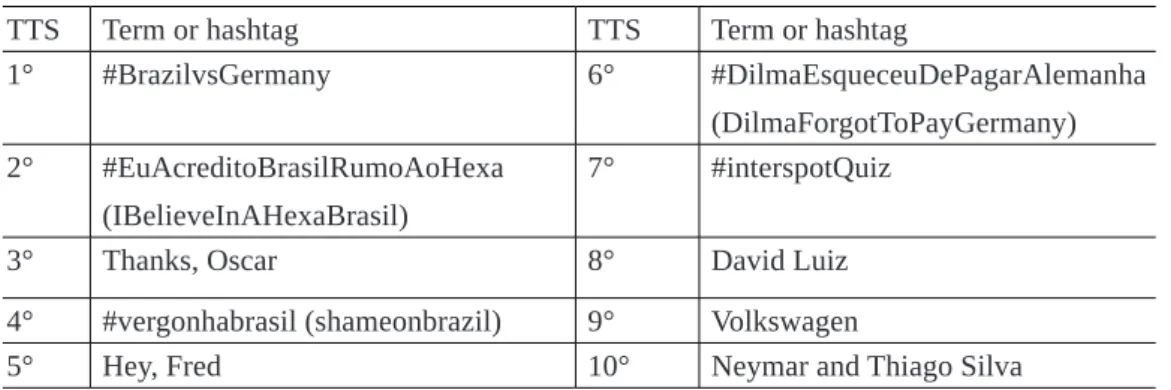
We consider social media to be a privileged locus for the observation of sub-controversies, in particular in their intermedia connections with live audiovisual broadcasts (D’ANDRÉA, 2015). Oftentimes conversations and debates in self-organizing platforms such as Twitter critique the “festive experience” typical of high visibility television events (DAYAN; KATZ, 1992), triggering intense debates and reassigning meaning to controversies. According to oficial information from Twitter, the Brazil-Germany match was, to date, the sporting event with the greatest impact on this social medium (35.6 million tweets).1 As expected, the humiliating defeat of the Brazilian team dominated Trending
Topics Brazil. At 7:30 pm – about 40 minutes after the end of the match – nine of the 10 most discussed terms on Twitter were related to the game. See Table 1.
Table 1 – Trending Topics Brazil at 7:30 pm on July 8th, 2014
ttS Term or hashtag ttS Term or hashtag
1° #BrazilvsGermany 6° #DilmaEsqueceuDePagarAlemanha
(DilmaForgotToPayGermany) 2° #EuAcreditoBrasilRumoAoHexa
(IBelieveInAHexaBrasil)
7° #interspotQuiz
3° Thanks, Oscar 8° David Luiz
4° #vergonhabrasil (shameonbrazil) 9° Volkswagen
5° Hey, Fred 10° Neymar and Thiago Silva
The diversity of topics centered on the match in Brazil Trending Topics is a good example of the wealth of themes related to the World Cup and the articulation of the mega event with issues that transcend the sports competition itself. The references to players David Luiz and Oscar (protagonists of very active fandoms), the striker Fred (the main
target of criticism of the team’s performance) and President Rousseff (reassigning meaning to the political “rumor” of corruption since the beginning of the tournament) stand out. The reference to “Volkswagen” refers to one of the memes that emerged with the defeat: not even the car manufacturer could make as many “goals” (a reference to the popular vehicle of the same name) as the German national football team.
The sub-controversies that emerged on social media were characterized by hybridization with the media platforms in which they unfolded, since, as Marres (2015) points out, controversies emerge according to the “effects of media technology”. Considering the incompleteness of a methodology that chooses to study the effects of media technologies or the dynamics of debates of an issue in these platforms, Marres and Moats (2015) propose a third approach. Taking ownership of the “principle of symmetry”, as coined in ANT and
STS, they defend the non-separation, in methodological terms, of the “medium” and the “content”. The point is, ultimately, to map the controversies with, and not just in, social
media.From this perspective, we believe that the consequences of controversial projects in social media must be treated as mediatized sub-controversies. In line with Hepp (2013), we speak of mediatized cultures as cultures that are “shaped” by the media, i.e., as situations in which social proliferation takes place in line with the speciic socio-technical platforms of the media where they occur.
#vergonhabrasil retweets network
Among the countless association networks involving human and non-human actors that emerge on Twitter are the socio-technical networks triggered by hashtags, which, as they become agency resources for intermedia networks (D’ANDRÉA; ALZAMORA; ZILLER, 2015) act as mediators capable of triggering hybrid forums. Despite being temporary, the hashtags are public spaces that leverage sub-controversies and give visibility to group arguments with different forms of involvement and interest in the controversy. A similar perspective has been adopted by Burgess, Galloway, and Sauter (2015) in studying the appropriation of the hashtag #agchatoz for discussions around agriculture in Australia.
Considering that an actor never acts alone, that is, that the strength of an actor is in its ability to become an actor-network, the strength of chains of translations triggered by retweets (RTs) depends on mediators’ proiles causing others to act. Upon retweeting, an actor’s role is shifted, and he, she or it assigns to another the role of spokesperson.
This dynamics potentially contributes to a negotiation around themes, points of view of greater visibility on Twitter, and in their intermedia connections. Potentially, then, hashtags inaugurate hybrids forums in which the actors act with the platforms sociotechnical
Due the simetry between the controversial issues and the platforms in which they take place (MARRES; MOATS, 2015), our interest was to use methods that explore the speciicities of the digital environment. According to Rogers (2015), the development of the “digital methods” approach is related to the impacts of the “computational turn” into the social sciences and humanities. More speciicaly, we are interested in the approximations between this perspective and controversies mapping, which is “established primarily as a set of methods to visually represent and analyze the themes from the traces left by the actors in digital networks” (PEREIRA, BOECHAT, 2014, p.560 – our translation).
Using the yourTwapperKeeper tool, 68,988 tweets with the hashtag #vergonhabrasil were collected between 6:00 pm (UTC – 3:00 pm) on July 8th and 1:45 pm on July 9th, 2014.
After conversion by the Parse Tweets2 and Graph Tweets3 scripts, the dataset generated a graph
comprising 37,029 retweets, that is, 53.67% of tweets collected were associations in which a proile served as the spokesperson for another. In all, 29,177 proiles comprised the set of RT networks to be parsed. Inspired by the procedures proposed by Venturini et al. (2015) and Venturini, Jacomy, and Pereira (2014), we initially sought to identify and categorize “what” was said in the retweets collected, as well as “who” was talking. To make the analysis feasible, we identiied the 15 most retweeted tweets, which together comprised 27.39% of the total RTs. These 15 tweets were associated with the ive categories deined retrospectively on the basis of the argument of the original tweet regarding Brazil’s defeat (TABLE 2).
Table 2 – Categories assigned to the tweets of the 15 most retweeted tweets
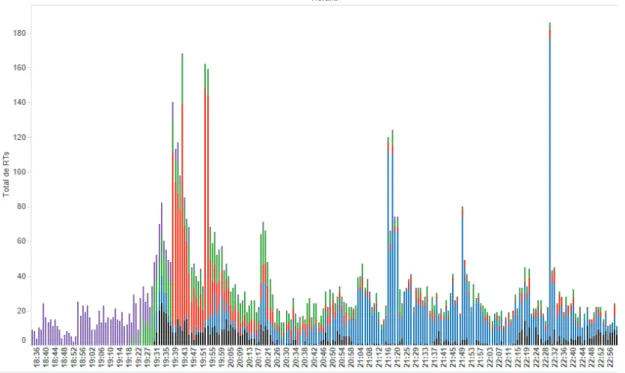
In a irst analytical movement, we identiied how RT associations among Twitter proiles occurred during the irst ive hours. During this intense period of the sub-controversy “Goal for Germany!”, 76% of the total RTs from the dataset occurred. Figure 1 was generated in Tableau Public software and displays the distribution of 15 RT networks (minute by minute) between 6:00 pm and 11:00 pm on July 8th. The ive colors assigned to
the most retweeted tweets are the same as in Table 2.4
Figure 1 – RTs by the minute in the interval between 6:00 pm and 11:00 pm on July 8th, 2015
The variation in colors in the stacked bar chart along the ive most intensive hours allows us to identify how the debate brokered by the #vergonhabrasil hashtag changed during that period. Considering the ifteen most popular tweets, a irst round of debates took place between 6:34 pm (in the second half of the game) and 7:19 pm, during which we identify only tweets that are critical and ironic about the country and the government (purple color). All four tweets in this category were posted in this time interval. The irst was published by @doideiravcs, who wrote “Turn off the lights at the stadium Dilma! Say there is a rationing going on and spare us this embarrassment. #vergonhabrasil”. The post
4 For a full interactive version of this, see https://public.tableau.com/views/RTsvergolhabrasilBrasil1x7Alemanhabkp/Sheet1?:embe
jokes with the wish of inishing the game alleging the energy rationing caused by the water shortage crisis that had already reached some parts of the country.
Minutes later, the proile @portalRBD (referencing the Mexican musical group, RBD, from the soap-opera Rebeldes) posted a tweet also portrayed President Dilma Rousseff. Along with an image of her dressed as comedian Sergio Mallandro, the tweet said: “They thought I had bought the Cup and that Brazil was going to be CHAMPION! #BrazilvsGermany #vergonhaBrasil 11 Freds”5. Sérgio Mallandro is famous for his pranks.
This way, @portalRBD implies that the rumor that the World Cup had been bought by the Government was actually a hoax.
Two other tweets posted in this time period focused on the mocking of Brazil’s national football team. The same @portalRBD posted a meme that refers to the movie, “The Sixth Sense”, in which the boy played by the actor Haley Joel Osment, instead of saying “I see dead people”, says “I see Germany’s goal ... every minute”6. On the other hand, the @
paniconaband proile (linked to a popular comedy program aired on TV and radio) posted an image that simulated a WhatsApp group, in which Germany is the “Administrator”,
several teams had been “removed from the group”, and Brazil was “humiliated”. The verbal
text “REALITY; #vergonhabrasil #BRA”7 ends the tweet.
At 7:20 pm, two tweets were posted and, similarly, attempted to defend the Brazilian team and the hosting of the World Cup (green bars in Fig. 2). The tweet from @beilibas has an image of a series of trophies that shows that the Brazilian team alone has won more World Cup and Confederations Cup titles than Argentina, Germany, and France combined. Along with the image is the text:“YOU’RE ASHAMED OF THAT? BECAUSE I’M NOT #vergonhabrasil”8.A tweet from @biebereffort shows an image with text praising the
“unique moment”of following “a World Cup being played in my country” and the efforts
of the Brazilian national team during the tournament. At the end of the text, the tweet says, “and I will always love this team, which is not to blame for anything that’s happening in my country”.This perspective can be identiied as a irst effort to separate the team from the
“embarrassments” of the country, in an indirect reference to the controversies surrounding the World Cup.9
Among the 15 most retweeted tweets, the irst (at 7:30 pm) to express support for a speciic player (black bars) was presenter and comedian Marcos Mion (@MarcosMionzinho), who wrote: “Oh, I really like this guy. No need to apologize. You were the best. Thanks
5https://twitter.com/PortalRBD/status/486620178059624449 6 https://twitter.com/PortalRBD/status/486625326978441216
7https://twitter.com/PanicoNaBand/status/486629292961714176
David Luiz! #vergonhabrasil”10. The text is followed with a picture of the defender crying
and brokenhearted. Another tweet in clear support of the player David Luiz (and, by extension, the Brazilian national team) was posted nearly three hours later (10:16 pm) by @jileybiba, who wrote: “ashamed of it? Never! What I am is PROUD #vergonhabrasil #DavidOBrasilTeAma (DavidBrazilLovesYou)”. The posting also included a photo of the
Brazilian players happy and hugging each other on the ield.11
The most retweeted message (red bars), with the hashtag #vergonhabrasil, was posted at 7:38 pm by proile Dilma Bolada (@dilmarousselff), who wrote: “Cutting government subsidies for whoever posts #vergonhabrasil”12. In this posting, the fake and authorized
proile of President Rousseff seize the ironic version of the sub-controversy “Goal for Germany!”, by relating it to another controversy (the Family Allowance program13) in an
attempt to change the focus of the ongoing criticisms. The predominance of red bars in the stacked bar chart (Fig. 2) for at least 20 minutes after posting gives the impression that the perspective presented by proile Dilma Bolada changed the negative connotation that predominated in the initial period and brought a new tone to the discussions.
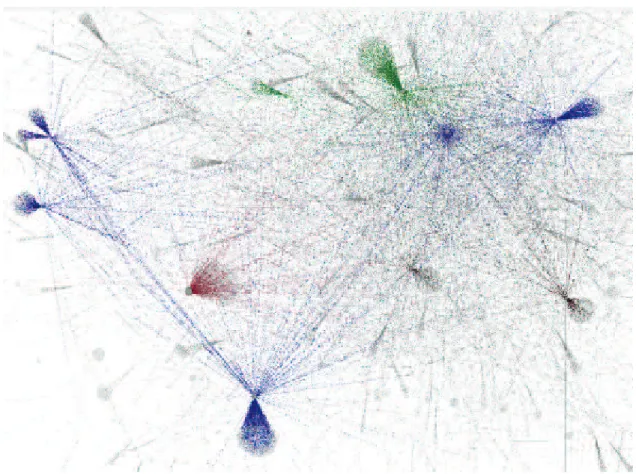
Going beyond the temporal representation of RTs networks, we also explored the spacialization of the associations between the proiles. A network graph (Figure 2) was generated with Gephi software (version 0.8.2-beta) using Force Atlas 2 distribution. In this layout, the visual spacialization of the network is related to the associations (in this case, retweets) between the nodes (proiles that retweeted or were tweeted). Then, in this visualization the nodes that link to the same edges that are closest to one another, so the closeness of proiles indicates the emergency of collectives articulated by #vergonhabrasil hashtag.
As we visualize the RT networks between 6:00 pm 8:00 pm as a graph, we observe that the mobilization around the tweet from @dilmarousselff (in red, bottom left) is quite concentrated and peripheral. In the same sense, the three retweet networks in purple (at the top of the image) are also isolated, signaling a big distance between some of the major RT networks brokered by the #vergonhabrasil hashtag since then.
Back to temporal perspective (Figure 1), we identify that from 8:00 pm (a little more than one hour after the end of the match), there were practically no more retweets of ironic criticism posts and it had decreased the RTs of the tweet by Dilma Bolada. Gradually, tweets directly opposed to the initial reaction of the Brazilian fans to the defeat gained popularity. Highlighted in blue bars, two tweets (by @demibrng and @lacranaio) published
10https://twitter.com/MarcosMionzinho/status/486638436586385409 11https://twitter.com/tropapurpose/status/486680107076308992 12 https://twitter.com/DilmaRousselff/status/486640398606299136
13 Implemented by then President Lula in 2004, the Bolsa Família (Family Allowance) Program is an income transfer program that aims to
Figure 2 – Partial view of RT network #vergonhabrasil between 6:00 pm and 8:00 pm the same montage of two photos of fans who had burned the Brazilian lag 35 minutes after singing the national anthem embraced to it. At 7:30 pm, @demibrng posted, along with this image, the text: “TRUE EMBARRASSMENT IS SEEING THIS AND I AM EVEN MORE EMBARRASSED FOR BEING IN THE SAME COUNTRY AS THESE KINDS OF PEOPLE”,while at 7:52 pm, @lacranaio wrote next to the montage: “I’m not ashamed of losing this game, this is what I am ashamed of #vergonhabrasil”.
The most retweeted tweet displaying this perspective was posted at 9:03 pm by @ juancarloswd that, along with the text “#vergonhabrasil???”, posted an image with a text that
condemned the criticism made by “people who never recognize anything, who never accept defeat, all they want is to win, win and win”, just like “their politicians, all they want is to win too”, and saying at the end: “those in Congress are a relection of who’s at the ballot box. Think about it”14.A very similar tweet was published at 8:41 pm by the proile @_meuluquinhas, but
with greater emphasis on the “celebrations”with which other teams (France, Colombia, and
Costa Rica) had been received in their countries after their eliminations.15
By displaying the interval between and 8:00 pm and 11:00 pm, Figure 4 – also a network graph made with Force Atlas 2 algorithm – allows us to identify that the RT network (blue) regarding the tweet from @_meuluquinhas is more central and less polarized than the other networks brokered by #vergonhabrasil. The graph allows us to see the spatial distribution of the others RT networks in blue, indicating a certain capillarity of the proiles that were articulated around the criticism of the criticism made against the Brazil national team and the country.
Figure 3 – Partial view of RT network #vergonhabrasil between 8:00 pm and 11:00 pm
Analysis and inal considerations
The analysis centering on the different perspectives presented by the most popular tweets during the ive most intensive hours indicates signiicant changes in the posting arguments. The tweets posted during the match invoke ironic criticism of the government and the Brazilian national team by combining issues related to the World Cup controversies with the recurrent “mockery” during the event. After the game, the tone of the debates brokered by #vergonhabrasil changed signiicantly. There were efforts to defend the tradition of the Brazilian national team, the national lag, and some players, especially the defender David Luiz. The tweets that defended the team and the country almost always did by criticizing politicians. In defending national symbols (such as the football team and the lag), the criticisms directed at the irst postings compares them to the politicians’ opportunism – according to the tweet by @juancarloswd, “all they want is to win, win and win”,None of the 15 most retweeted tweets by #vergonhabrasil were aimed directly at the
Brazilian team.
In a complementary way, a spacial distribution analysis generated by the algorithm Force Atlas 2 shows a signiicant dispersion of the RT networks. This means that most proiles retweeted just one tweet. The contrast between this dispersion and a sequence of arguments associated with #vergonhabrasil suggests the aggregation potential of the hashtag. This technical resource may have made possible the emergence of a hybrid forum in which a negotiation took place, or at least a meaning dispute around the sub-controversy in question. For this discussion, the combination of two forms of data visualization seemed essential for a more complex understanding of the articulations between the topic under discussion and the media platform in which it took place – this illustrates the contribution of digital methods for studying controversies and other media phenomena.
Concerning the hybridization between “medium” and “content”, it is important to note that the politicization of the defeat occurred as a result of groupings and a set of practices typical of social media. One should note, for example, the activities of various groups of fans (such as @portalRBD, which also acted at other times during the World Cup16) and the
appropriation of native digital resources, such as the simulated use of WhatsApp interface to reconstruct the “humiliating” elimination of Brazil. This mediatization process, however, does not end with these internet cultures, since proiles linked to radio and TV programs (@paniconaband) and people with high visibility in the mass media (@marcosMionzinho) were also important mediators in the #vergonhabrasil network.
Far from allowing us to make any kind of generalization, this case study makes visible some speciicities of the World Cup controversy and its articulation with the
sub-16 the fans of RBD on Twitter acted during the games. In the match between Brazil and Mexico, for example, the hashtag #AculpaÉDa
controversy regarding the rout suffered by the Brazilian national team. In this episode, issues like dissatisfaction with the Government and institutionalized politics gained new features, and were renewed and had their meanings reassigned. In addition to the data presented here, one can even conclude that the “shameful” defeat in the World Cup represented a hardening of the political discussions triggered by the mega event, in a process that would be accentuated, for example, in the presidential election that took place three months later. Among the challenges that stand out in the research, we highlight the possibility of analyzing others hashtags related to a given sub-controversy, which would make it possible to observe the emergence of different temporary hybrid forums and the articulations that occur between them.
References
BURGESS, Jean; GALLOWAY, Anne; SAUTER, Theresa. Hashtag as Hybrid Forum: The Case of #agchatoz. In: RAMBUKKANA, Nathan (Org.). Hashtag publics. The Power and Politics of Discursive Networks. Nova
York, Peter Lang, 2015. p.61-76.
CALLON, Michel. Entrevista: Dos estudos do laboratório aos estudos de coletivos heterogêneos, passando pelos gerenciamentos econômicos. Sociologias, Porto Alegre, a.10, n.19, p.302, jan./jun. 2008.
CALLON, M; LASCOUMES, Pierre; BARTHE, Yannick. Acting in an uncertain world. An essay on
technical democracy. MIT Press, 2011.
CORREIA, Carlus; SOARES, Antônio.Aproximações distanciamentos entre as copas de 1950 e 2014: apontamentos no futebol e no Brasil. Recorde, Rio de Janeiro, v.8, n.1, p.1-24, jan./jun. 2015.
DAMO, Arlei; OLIVEN, Ruben. O Brasil no horizonte dos megaeventos esportivos de 2014 e 2016: sua cara, seus sócios, e seus negócios. Horizontes Antropológicos, Porto Alegre, a.19, n.40, p.19-63, jul./dez. 2013.
D’ANDRÉA, Carlos. Conexões intermidiáticas entre transmissões audiovisuais e redes sociais online:
possibilidades e tensionamentos. Comunicação Midiática (Unesp), v.10, n.2, p.61-75, maio/ago. 2015.
_______. Controvérsias midiatizadas no Twitter durante transmissões televisivas ao vivo: a rede “exoesqueleto” na abertura da Copa 2014. Revista Famecos, Porto Alegre, PUC-RS, v.23, n.2, p.1-21, maio-ago. 2016.
________; ALZAMORA, Geane. ZILLER, Joana. Hashtags as Intermedia Agency Resources before FIFA
World Cup 2014 in Brazil. In: RAMBUKKANA, Nathan (Org.). Hashtag publics. The Power and Politics of
Discursive Networks. Nova York, Peter Lang, 2015. p.115-125.
DAYAN, Daniel; KATZ, Elihu. Media Events – the live broadcast of history. Cambridge: Harvard University
Press, 1992.
JACOMY, M. et al. ForceAtlas2, a Continuous Graph Layout Algorithm for Handy Network Visualization Designed for the Gephi Software. PLoS ONE, São Francisco/Cambridge , v.9, n.6, p.1-12, 2014.
MARRES, Noortje. Why map issues? On controversy analysis as a digital method. Science, Technology &
Human Values, v.40, n.5, p.655-686, 2015.
________.; MOATS, David. Mapping Controversies with social media: The case for Symmetry. Social Media
+ Society, Chicago, v.1, n.2, p.1-17, jul./dez. 2015.
PEREIRA, Débora; BOECHAT, Marina. Apenas siga as mediações: desaios da Cartograia de Controvérsias entre a Teoria Ator-Rede e as mídias digitais. Contemporânea - Comunicação e Cultura, Salvador, UFBA,
v.12, n.03, p.556-575, set/dez 2014.
ROGERS, Richard. Digital Methods for Web Research. In: SCOTT, R.; KOSSLYN, S. Emerging trends in
the social and behavioral sciences. Chichester, SAGE Publications: 2015.
SECCO, Lincoln. As Jornadas de Junho. In: MARICATO, E. et al. Cidades rebeldes. São Paulo: Carta Maior/
Boitempo, 2013. p.71-78.
VENTURINI, Tommaso. Diving in magma: how to explore controversies with actor-network theory. Public
Understanding of Science, v. 19, n.3, p.258-273, maio./2010.
_______; JACOMY, Mathieu; PEREIRA, Debora. Visual Network Analysis. 2014 (prelo).
_______; RICCI, D., MAURI, M., KIMBELL, L.; MEUNIER, A. Designing Controversies and their Publics.
Design Issues, Massachusetts, v.31, n.3, p.74-87, 2015.
ZAGO, Gabriela. Enquanto você lia este título, a Alemanha fez mais um gol: a Copa da zoeira nos sites de rede social. Estudos de Jornalismo e Mídia, Florianópolis, UFSC, v.11, n.2, p.415-423, 2014.
Carlos d’Andréa
Professor in the Graduate Program in Communication Studies (PPGCOM) and in the Department of Social Communication at the Federal University of Minas Gerais (UFMG), Brazil. He has an undergraduate degree in Journalism, has a PhD in Applied Linguistics from PosLin/UFMG (Lan -guage and Technology) and a Masters in Information Science from ECI/UFMG. He is a member of the Intermidia Connections Research Group (NucCon), which is linked to the CNPq research group “New Media Convergence Center” (CCNM). Coordinates the research project17 “The webTVs in
-termedia connections: social-technical networks in journalistic coverage of two scheduled events” which is funded by CNPq (Universal Tender 14/2013) and Fapemig (Universal Demand 2013). The translation of this article was funded by Pró-Reitoria de Pesquisa da UFMG (UFMG Research Dean). Email: [email protected].
Received on: 05.17.2016 Accepted on: 09.17.2016
17 The research team is comprised of undergraduate students: Leonardo Melgaço, Marco Túlio Guimarães, Nathane Veloso (Fapemig