DOI: 10.1590/0004-282X20130122
ARTICLE
Multiple sclerosis starting before the age
of 18 years: the Brazilian experience
Esclerose múltipla com início antes dos 18 anos de idade: a experiência brasileira
Yara Dadalti Fragoso1, Maria Lucia Brito Ferreira2, Nivea de Macedo Oliveira Morales3,
Walter Oleschko Arruda4, Joseph Bruno Bidin Brooks1, Denise Sisterolli Diniz Carneiro5,
Margarete de Jesus Carvalho6, Elizabeth Regina Comini-Frota7, Eber Castro Correa8,
Carlos Augusto de Albuquerque Damasceno9, Renan Barros Domingues10,
Alessandro Finkelsztejn11, Paulo Diniz da Gama12, Sidney Gomes13,
Marcus Vinicius Magno Gonçalves14, Anderson Kuntz Grzesiuk15,
Jussara Mathias Netto Khouri16, Damacio Ramon Kaimen-Maciel17,
Maria Fernanda Mendes18, Rogerio de Rizo Morales3, Sonia Beatriz Felix Ribeiro19,
Taysa Alexandrino Gonsalves Jube Ribeiro5, Livia Brito Bezerra de Albuquerque2,
Andrea Anacleto1,20, Juliana Finkelsztejn11, Rodrigo Assad Diniz da Gama12, Josiane Lopes17,
Celso Luis Silva Oliveira1, Francisco Tomaz Meneses Oliveira13, Leopoldo Antônio Pires9,
Patricia Correia de Oliveira Saldanha10, Adélia Henriques Souza2, Alex Eduardo da Silva19
1Universidade Metropolitana de Santos, Santos SP, Brazil;
2Hospital da Restauração, Recife PE, Brazil;
3Universidade Federal de Uberlândia, Uberlândia MG, Brazil;
4Universidade Federal do Paraná, Curitiba PR, Brazil;
5Universidade Federal de Goiás, Goiânia GO, Brazil;
6Fundação ABC, Santo André SP, Brazil;
7Universidade Federal de Minas Gerais, Belo Horizonte MG, Brazil;
8CLINEN – Neurologia e Endocrinologia, Brasília DF, Brazil;
9Universidade Federal de Juiz de Fora, Juiz de Fora MG, Brazil;
10Faculdade de Ciências da Saúde, Santa Casa de Vitória, Vitória ES, Brazil;
11Hospital de Clínicas de Porto Alegre, Porto Alegre RS, Brazil;
12Pontifícia Universidade Católica de São Paulo, Campus Sorocaba, Sorocaba SP, Brazil;
13Hospital Beneicência Portuguesa and Hospital Paulistano, São Paulo SP, Brazil;
14Universidade da Região de Joinville, Joinville SC, Brazil;
15Centro de Reabilitação Center Dom Aquino Correa, Cuiabá MT, Brazil;
16Universidade Federal do Rio de Janeiro, Macaé RJ, Brazil;
17Universidade Estadual de Londrina, Londrina PR, Brazil;
18Santa Casa de São Paulo, São Paulo SP, Brazil;
19Universidade Federal do Triângulo Mineiro, Uberaba MG, Brazil;
20Hospital Ana Costa de Santos, Santos SP, Brazil.
Correspondence: Yara Dadalti Fragoso; Department of Neurology / Medical School, UNIMES; Rua da Constituição 374; 11015-470 Santos SP - Brasil; E-mail: [email protected]
Conflict of interest: There is no conlict of interest to declare. ABSTRACT
Multiple sclerosis (MS) starting in childhood and adolescence poses a challenge for diagnosis and management of the disease. The aim of the present study was to assess the characteristics of early onset MS in Brazilian patients. Methods: Retrospective data collection from specialized MS units. Results: From 20 MS units in 11 Brazilian states, 117 cases of MS starting before the age of 18 years were collected. These patients had an average of 10 years of disease duration, still typically with low disability and one relapse every 2.5 years. The mean age for disease onset was 13.7 years. Conclusion: The present study introduces a large series of Brazilian cases of pediatric MS. Although some patients presented a very severe form of MS, on the whole the group of patients with MS starting in childhood or adolescence presented a relatively mild form of this disease in Brazil.
Multiple sclerosis (MS) is a chronic inlammatory and de
-generative neurological disease that typically afects young adults. MS usually appears between the ages of 20 and 40
years, and an early start of MS (<18 years old) is relatively un
-common1. Diagnosis and management of these patients re
-quire special attention2–5. Few case series on the epidemio
logy and characteristics of MS starting in childhood and ado lescence have been published in the world. Except for
four papers6–9, other publications have presented fewer than
100 cases each in their series10–23.
When MS in Brazilian children and adolescents is con
-sidered, it is possible that some aspects are diferent from MS of European, Asian, North African, and North American counterparts. In Brazil, children have a more mixed genetic background, more frequent infestations by helminths, and
high sun exposure since early life. hese are genetic and envi
-ronmental factors that may positively afect MS development and evolution. he present study aimed to better understand
the epidemiological proile of earlyonset MS in Brazilian pa
-tients. A speciic database was set up to collect data from patients with MS whose disease started before the patient reached his/her 18th birthday.
METHOD
he present study was approved by the Ethics Committee of Universidade Metropolitana de Santos, SP, under number CAAE 13499913.7.0000.5509. Further approvals were obtai ned from institutions participating in the study that required additional submission to their Ethics Committees. No public, governmental, or private inancial support was received for creating this database and for preparing this paper.
Brazilian neurologists and neuropediatricians caring for patients with MS were invited to participate in the study. he study was based on the medical records of patients under the care of the physicians sending the information. A speciic ile with demographic and clinical information on each patient was sent to the authors, and data collection took place bet ween October and December 2012. Only cases with complete information were included in the analysis. Cases resembling
acute disseminated encephalomyelitis, neuromyelitis optica
(NMO), or spectrum disorders of NMO (NMOSD) were ex
-cluded from this assessment.
All cases fulilled McDonald’s diagnostic criteria, revised
for the pediatric population3, and the recommendations of
the expert consensus for diagnosing pediatric MS24. No cases
of demyelinating diseases other than MS were included in the present study. Disability was assessed using the Expanded
Disability Scale Score (EDSS)25 and the clinical presentations
of MS were deined as relapsing–remitting, secondary pro
-gressive, and primary progressive26.
Statistical analysis was carried out using Student’s t-test
for continuous data, and Fisher’s exact test and the chi square test for categorical data. Whenever correlations were required, Pearson’s correlation test was used. However, due to the characteristics of the study, many results are presented only in a descriptive manner.
RESULTS
Data were collected from 20 MS units in diferent cities in 11 Brazilian states. Together, these MS units had 2290 MS patients registered and 125 of them (5.5%) presented MS star ting before the age of 18 years. A summary of the demogra phic and clinical data on these patients is presented in Table 1.
he average age at the time of disease onset was 13.7±3.4 years (range 4–17 years). In 19 patients (15%) the disease started when they were children, i.e. before reaching 11 years of age (onset of MS ranging from 4 to 10 years of age; mean 7.7±2.0 years). In the remaining 108 patients (85%) the disea
se started after 11 years of age. In this group of older chil
-dren the age of onset of the disease was 14.8±1.6 years (range 11–17 years). For the purpose of most analyses in this study, these two age groups were considered to be a single group of patients with MS starting in childhood or adolescence.
he total group consisted of 38 boys and 87 girls (1:2.3), and their ethnic background was either Caucasian (57 cases, 45.6%) or African descent (68 cases, 54.4%). here were no cases of children or adolescents descended from Asians or
RESUMO
Esclerose múltipla (EM) com início na infância e adolescência constitui um desaio para o diagnóstico e manejo da doença. A proposta do presente estudo foi avaliar as características da EM de início precoce em pacientes brasileiros. Métodos: Coleta de dados retrospectiva de arquivos de unidades especializadas em atendimento da EM. Resultados: A partir de 20 unidades de EM de nove estados brasileiros, foram coletados 117 casos de EM com início antes dos 18 anos de idade. Estes pacientes tinham uma média de 10 anos de duração da doença, de maneira geral apresentavam pouca incapacidade , com um surto a cada dois anos e meio. A média de idade no início da doença era 13,7 anos. Conclusão: O presente estudo apresenta uma grande série de casos brasileiros de EM pediátrica. Embora alguns pacientes tenham apresentado forma grave de EM, de maneira geral o grupo de pacientes cuja EM iniciou-se na infância ou adolescência apresentou uma forma relativamente leve da doença no Brasil.
indigenous ancestors. All the children were born between the latitudes of 7° 9′ 28′′ south and 30° 2′ 77′′ south. At present, the average age of these patients is 23.3±9.3 years.
Despite an average age of 13.7 years for disease onset, conirmation of MS was only possible at an average age of 15.7±6.2 years. he initial presenting sign or symptom was most frequently multifocal (30 cases), involving the brainstem in 11 cases and/or the cerebellum in eight cases. When these
occur separately, the most frequent presentations were sen
-sory symptoms (22 cases), brainstem involvement (18 cases), cerebellar signs (17 cases), optic neuritis (16 cases), motor signs (16 cases), and spinal cord disease (three cases). hree cases were atypical, with one case of mental confusion, one of seizure, and one of hemianopsia. Motor presentation was either pyramidal (10 cases) or extrapyramidal (6 cases).
At the time of writing, 117 cases were in the form of relap sing–remitting MS, while six cases were secondary progressive MS. Two children died during the course of the disease.
he patients had sufered from MS for an average of 10.5±8.4 years and their current EDSS was, on average, 1.96±2.24. here was a moderate correlation between disease duration and degree of disability assessed by EDSS (r=0.519). It is of interest to note that EDSS≥6.0 was signiicantly as
-sociated with MS starting before age 11 years (Fisher’s exact test p=0.011). he average disease duration for patients with EDSS≥6.0 in the present group was 23.3±17.6 years. he di
sease duration among the more disabled patients was signii
-cantly longer (p=0.0009) than that of patients currently with EDSS≤6.0.
Ninetyeight patients had normal intelligence and were
currently doing well in school, whereas 11 patients were re
-ported to have excelled at school. Fourteen patients present
-ed moderate diiculties at school, but had not fail-ed. Four of
these required additional private tuition. Two patients had been attending special schools for the disabled and were ha ving great diiculties with their education.
At the time of writing, with an average of about 10 years of MS duration, the patients had experiences an average of
4.2±2.4 disease relapses (median=4). Twelve patients pre
-sented 10 or more relapses during their disease. here was no correlation between disease duration and number of relapses
(r=0.229) or disability and number of relapses (r=0.240).
Disease progression among patients who started MS in childhood (≤10 years ) was compared with progression among those with MS starting later in childhood (≥11 years). Patients starting MS before age 11 years presented EDSS=1.5±2.8 after 5.5 years of disease duration. hose star ting the disease after 11 years of age presented EDSS=1.0±2.0 after 14 years of di
sease duration (p=0.51).
Regarding treatment, 113 patients were currently recei
ving immunomodulatory and/or immunosuppressive medi
-cations for MS. here were 10 patients who for a variety of reasons were not treated, but mainly because they (and their families) did not want MS drug treatment. he remaining two patients died during the course of the disease.
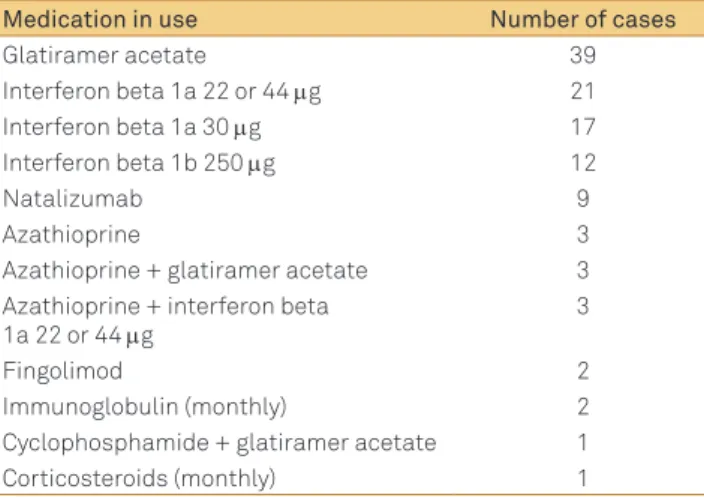
he therapeutic options for these patients were extreme
-ly variable and are summarized in Table 2. Fortyone patients
(32.8% of the total sample) were on their second or third dif
-ferent therapeutic scheme because of failure or intolerance.
All patients had received at least one pulse of corticoste
-roids during the course of the disease. Seven patients had been diagnosed with depression and were receiving antide pressants. Among other drugs used by the patients were sildenail and baclofen, both for rare and speciic cases. Use
of physiotherapy and hydrotherapy was reported by 15 pa
-tients (12% of the cases).
here were no cases of other immunological diseases diag nosed among the patients of this group. hree patients
had other cases of MS in the family (the mother of one pa
-tient and the cousin of two diferent pa-tients).
DISCUSSION
While the present database does not represent the whole of Brazil, it covers a large geographical region incorporating several states and many professionals working in MS units in this country. here is no national database for registration of MS and other demyelinating diseases, and two previous Brazilian case series have reported on speciic areas of the
country16,22. he present study is the irst large national series
of cases of MS starting in childhood or adolescence.
he percentage of earlyonset MS cases in Brazil, namely 5.5% of all MS cases, is in accordance with the worldwide lite
rature9, although some authors reviewing the subject consi
der it to be below 5%4. he present study did not analyze the
Table 1. Demographical and clinical characteristics of 125 patients with multiple sclerosis starting before the 18th birthday.
n=125
Age of onset 13.7±3.4 (range 4–17) years 15% started MS before completing 11 years
85% started MS after 11th birthday
Gender 38 males, 87 females
Ethnicity Caucasians, n=57
African descent, n=68 Initial
presentation
Multifocal, n=30 Sensitive symptoms, n=22
Brainstem signs, n=18 Cerebellar signs, n=17 Optic neuritis, n=16 Spinal cord signs, n=3
Atypical, n=3 Disease duration 10.5±8.4 years Present EDSS 1.96±2.24 (range 0–10)
Relapses 4.2±2.4 during the disease
Annual relapse rate=0.34±0.27
prevalence of childhood and adolescence MS in the diferent regions of the country. he numbers are too small to reach
conclusions and, therefore, only the prevalence of earlier on
-set MS in relation to later on-set MS can be discussed. he
analyses on these data did not taken into consideration envi
-ronmental or genetic factors that might inluence the indings. he overall results from the present study showed that those patients who started MS before the age of 18 years
References
1. Chabas D, Strober J, Waubant E. Pediatric multiple sclerosis. Curr Neurol Neurosci Rep 2008;8:434-441.
2. Ghezzi A. Childhood-juvenile multiple sclerosis: clinical characteristics and treatment. Expert Rev Neurother 2005;5:403-411.
3. Polman CH, Reingold SC, Edan G, et al. Diagnostic criteria for multiple sclerosis: 2005 revisions to the ‘‘McDonald Criteria’’. Ann Neurol 2005;58:840-846.
4. Renoux C, Vukusic S, Confavreux C. The natural history of multiple sclerosis with childhood onset. Clin Neurol Neurosurg 2008;110:897-904.
5. Ghezzi A, Banwell B, Boyko A, et al. The management of multiple sclerosis in children: a European view. Mult Scler 2010;16:1258-1267.
6. Mikaeloff Y, Caridade G, Assi S, Suissa S, Tardieu M. Prognostic factors for early severity in a childhood multiple sclerosis cohort. Pediatrics 2006; 118:1133-1139.
7. Renoux C, Vukusic S, Mikaeloff Y, et al. Natural history of multiple sclerosis with childhood onset. N Engl J Med 2007;356:2603-2613.
8. Stark W, Huppke P, Gartner J. Paediatric multiple sclerosis: the experience of the German Centre for Multiple Sclerosis in Childhood and Adolescence. J Neurol 2008; 255(Suppl 6):S119-S122.
9. Harding KE, Liang K, Cossburn MD, et al. Long-term outcome of paediatric-onset multiple sclerosis: a population-based study. J Neurol Neurosurg Psychiatry 2013;84:141-147.
10. Brass SD, Caramanos Z, Santos C, Dilenge ME, Lapierre Y, Rosenblatt
B. Multiple sclerosis vs acute disseminated encephalomyelitis in childhood. Pediatr Neurol 2003;29:227-231.
11. Ozakbas S, Idiman E, Baklan B, Yulug B. Childhood and juvenile onset multiple sclerosis: clinical and paraclinical features. Brain Dev 2003;25:233-236.
12. Shiraishi K, Higuchi Y, Ozawa K, Hao Q, Saida T. Clinical course and prognosis of 27 patients with childhood onset multiple sclerosis in Japan. Brain Dev 2005;27:224-227.
13. Weng WC, Yang CC, Yu TW, Shen YZ, Lee WT. Multiple sclerosis with childhood onset: report of 21 cases in Taiwan. Pediatr Neurol 2006;35:327-334.
14. Xiong H, Zhang YH, Zhou R, et al. Clinical features and management of multiple sclerosis in children. Zhonghua Er Ke Za Zhi 2007;45:568-573.
15. Etemadifar M, Nasr-Esfahani AH, Khodabandehlou R, Maghzi AH. Childhood-onset multiple sclerosis: report of 82 patients from Isfahan, Iran. Arch Iran Med 2007;10:152-156.
16. Ferreira ML, Machado MI, Dantas MJ, Moreira AJ, Souza AM. Pediatric multiple sclerosis: analysis of clinical and epidemiological aspects according to National MS Society Consensus 2007. Arq Neuropsiquiatr 2008;66:665-670.
17. Neuteboom RF, Ketelslegers IA, Boon M, Catsman-Berrevoets CE, Hintzen RQ. Barkhof magnetic resonance imaging criteria predict early relapse in pediatric multiple sclerosis. Pediatr Neurol 2010;42:53-55.
were not severely disabled after the average disease duration
of 10 years. Other authors have remarked that MS in child
-hood typically predicts a favorable short to mediumterm
prognosis27, which can account for the relatively low degree
of disability among our patients. In fact, after sufering from MS for 30 years, 50% of these children are likely to enter the
secondary progressive phase of the disease27. he patients in
our cohort also had a good history of schooling, no associated diseases, and about one relapse every 2.5 years. Although isolated cases in our series progressed in a severe manner,
the vast majority of the Brazilian patients starting MS be
-fore the age of 18 years were not particularly complicated ca ses. heories that may account for the better disease course among Brazilian children and adolescents with MS include those relating to helminthic infections in childhood28, sun
-light exposure29, and the typical national mixed race genetic
background30.
Finally, the rich variety of signs and symptoms of MS pre
-senting during childhood and adolescence needs to be tho
roughly known and understood by pediatricians31. Delays in
diagnosing and treating these patients may negatively afect the disease course, and close monitoring of these patients by neurologists and neuropediatricians is very important. he average typical delay of 2 years to obtain the diagnosis of MS in our population of youngsters needs to be decreased in the near future.
Table 2. List of medications currently in use for multiple sclerosis in 113 patients. Eleven patients were not using any drugs and two patients had died at the time of this assessment.
Medication in use Number of cases
Glatiramer acetate 39
Interferon beta 1a 22 or 44 mg 21
Interferon beta 1a 30 mg 17
Interferon beta 1b 250 mg 12
Natalizumab 9
Azathioprine 3
Azathioprine + glatiramer acetate 3 Azathioprine + interferon beta
1a 22 or 44 mg
3
Fingolimod 2
Immunoglobulin (monthly) 2
Cyclophosphamide + glatiramer acetate 1
18. Torisu H, Kira R, Ishizaki Y, et al. Clinical study of childhood acute disseminated encephalomyelitis, multiple sclerosis, and acute transverse myelitis in Fukuoka Prefecture, Japan. Brain Dev 2010;32:454-462.
19. Cocco E, Sardu C, Massa R, et al. Epidemiology of multiple sclerosis in south-western Sardinia. Mult Scler 2011;17:1282-1289.
20. Achiron A, Garty BZ, Menascu S, Magalashvili D, Dolev M, Ben-Zeev B, Pinhas-Hamiel O. Multiple sclerosis in Israeli children: incidence, an clinical, cerebrospinal luid and magnetic resonance imaging indings. Isr Med Assoc J 2012;14:234-239.
21. Peña JA, Ravelo ME, Rubio E, Pirela D, Soto A, Nava CM. Pediatric multiple sclerosis in Venezuela. Arq Neuropsiquiatr 2012;70:267-270.
22. Fragoso YD, Brooks JBB, Leal TMS. Descriptive proile of multiple sclerosis starting until the age of 16 in the reference center of the state of São Paulo. Rev Paul Pediatr 2012;30:617-620.
23. Al-Hamadani HA, Abdalla AS, Al-Saffar AJ. The course of early-onset multiple sclerosis in Iraqi children. World J Pediatr 2012;8:47-51.
24. Krupp LB, Banwell B, Tenenbaum S. Consensus deinitions proposed for pediatric multiple sclerosis and related disorders. Neurology 2007;68(Suppl 2):S7-S12.
25. Kurtzke JF. Rating neurologic impairment in multiple sclerosis: an expanded disability status scale (EDSS). Neurology 1983;33:1444-1452.
26. Lublin FD, Reingold SC. Deining the clinical course of multiple sclerosis: results of an international survey. National Multiple Sclerosis Society (USA) Advisory Committee on Clinical Trials of New Agents in Multiple Sclerosis. Neurology 1996;46:907-911.
27. Banwell B, Ghezzi A, Bar-Or A, Mikaeloff Y, Tardieu M. Multiple sclerosis in children: clinical diagnosis, therapeutic strategies, and future directions. Lancet Neurol 2007;6:887-902.
28. Elliott DE, Weinstock JV. Helminth-host immunological interactions: prevention and control of immune-mediated diseases. Ann N Y Acad Sci 2012;1247:83-96.
29. D’hooghe MB, Haentjens P, Nagels G, Garmyn M, De Keyser J. Sunlight exposure and sun sensitivity associated with disability progression in multiple sclerosis. Mult Scler 2012;18:451-459.
30. Kallaur AP, Kaimen-Maciel DR, Morimoto HK, Watanabe MA, Georgeto SM, Reiche EM. Genetic polymorphisms associated with the development and clinical course of multiple sclerosis. Int J Mol Med 2011;28:467-479.