AR
TIGO ORIGINAL / ORIGINAL AR
TICLE
INTRODUCTION
Preoperative carbohydrate (CHO) treatment 2h before the induction of anesthesia over traditional preoperative fasting of 6-8 hours is one of modern pre-scription recommended by evidence-based multimodal protocols to enhance postoperative recovery(1, 5, 11, 15, 26). The practice of overnight fasting, also known as “nil per oral”(NPO) after midnight was based on a retro-spective study in non-elective surgery patients carried out by Mendelson in 1946(21). The rationale for this is the minimization of the risks of bronchial aspiration of gastric contents during anesthesia(19).
However, prolonged preoperative fasting in-creases insulin resistance and the organic response to trauma(2, 23). In addition, perioperative symptoms such as nausea, vomiting, hunger, thirst and anxiety are also related to prolonged fast(10, 16, 22).On the other hand, it has been consistently demonstrated that CHO-enriched drinks empty the stomach in around one hour and are safe(22, 23). In agreement various
GASTRIC RESIDUAL VOLUME BY
MAGNETIC RESSONANCE AFTER INTAKE
OF MALTODEXTRIN AND GLUTAMINE:
a randomized double-blind, crossover study
Luigi R
BRIANEZ
1, Cervantes
CAPOROSSI
1, Yure W de
MOURA
2, Lorena A
DIAS
2,
Regis V
LEAL
1and José E de
AGUILAR-NASCIMENTO
1ABSTRACT - Context - The addition of glutamine in preoperative drinks may enhance the beneits of carbohydrate alone. Objective - To evaluate the gastric residual volume after the intake of a beverage containing carbohydrate plus glutamine. Methods - Eleven healthy volunteers (24-30 years-old) were randomized in a crossover fashion to intake 400 mL (4h before) and 200 mL (2h before) of a beverage containing either 12.5% maltodextrin (carbohydrate group) or 12.5% maltodextrin plus 15 g of glutamine (glutamine group) in two different moments 7 days apart. Magnetic ressonance was performed to measure the gastric residual volume (mL) 120 and 180 minutes after the last ingestion. Results - Gastric residual volume similar to basal condition was found after 2h and 3h of the intake of beverages. There was no difference in the mean ±SD GRV (mL) found at 120 minutes (carbohydrate group: 22.9±16.6 and glutamine group: 19.7±10.7) and at 180 minutes (carbohydrate group: 21.5±24.1 and glutamine group: 15.1±10.1) between the two drinks. Conclusion - Gastric emptying is eficient, and occurs in up to two hours after the intake of a beverage containing either carbohydrate alone or carbohydrate associated with glutamine. The addition of glutamine to carbohydrate-enriched drink seems to be safe for the use up to 2h before an operation.
HEADINGS - Gastric emptying. Preoperative care. Carbohydrates. Glutamine. Magnetic resonance imaging.
Declared conflict of interest of all authors: none
1 Departamento de Cirurgia, Faculdade de Medicina, Universidade Federal de Mato Grosso, Cuiabá, MT, Brasil; 2 Instituto de Diagnósticos em Medicina - IMEDI, Hospital
Santa Rosa, Cuiabá, MT, Brasil.
Correspondence: Luigi Rodrigues Brianez. Gastroclínica. Rua Marechal Deodoro, 582, Centro, 78100-005, Cuiabá, MT, Brasil. E-mail: [email protected]
societies of anesthesiologists have modiied their guidelines and are now recommending the intake of clear liquids or CHO-based drinks up to 2 hours before an anesthetic procedure(20).
Glutamine (GLN) is the most abundant amino acid in the human organism, and may improve in-sulin sensitivity and reduce lean body mass. GLN is considered an essential amino acid during stress and critical illness, and also the main substrate for enterocytes, hepatocytes, lymphocytes, and
mac-rophages(3). Glutamine supplementation may
However, only a few studies have assessed the safety of beverages containing GLN to be used as preoperative treat-ment 2h before an operation(7, 18). This scarce information urges for new data on the status of gastric residual volume (GRV) after the ingestion of CHO-based drink plus GLN. Thus, the aim of this study was to assess the GRV in healthy young volunteers after the intake of a beverage containing CHO and GLN.
METHODS
This was a prospective randomized double blind crossover clinical trial, carried out at the Várzea Grande Magnetic Res-onance Institute (Várzea Grande, Brazil), during the period from March to June 2012. The Research Ethics Committee at the Júlio Müller University Hospital approved the study design (protocol No. 998/2011) which is in accordance with the ethics principals set out by the Declaration of Helsinki (2000). The volunteers were invited to participate in this research and signed an Informed Consent Form.
We included 11 male young volunteers (aged between 21 and 30 years-old) with body mass index (BMI) between 20 and 35 kg/m2 and without either acute or chronic illness in the last 3 months. The criteria for exclusion were non-adherence to any phase of the study protocol, gastroesophageal relux disease, previous history of intolerance to lactose, gastropa-resis or history of poor gastric emptying, diabetes mellitus, and previous abdominal surgery.
Procedures
Each volunteer was randomized for participation in the study in a blind fashion. All subjects underwent two different protocols before magnetic ressonance (MRI) with an interval of seven days between them. Both phases took place after an overnight fast of eight hours. The volunteers ingested 400 mL (4 hours before the exam was carried out) at 8:00am and 200 mL (2 hours before the exam was car-ried out) at 10:00am of a beverage containing either water plus 12.5% maltodextrin (Phloraceae, Cuiabá, Brazil; CHO group) or the same beverage plus 15g of GLN (Phlora-ceae, Cuiabá, Brazil; GLN group). The participants were instructed not to ingest alcohol, medication, and caffeine within 24 hours of the study, nor do any vigorous physical activity during that time.
In both phases the individuals were blind to the speciic drink and they were told to ingest the beverage in a maximum period of 5 minutes and T0 was deined as the moment they complete the intake of the solution.
The powdered products (maltodextrin alone and malto-dextrine plus glutamine) were packed in coded opaque sachets and the content was only known by the pharmacist who manipulates it. The sachets were diluted with water immediately before the ingestion. The radiologist in charge for the MRI analysis was also blind for the study design and phases. The results were decoded only after the end of the experiment. The characteristics and composition of the solutions ingested by the participants can be seen in Table 1.
All the participants in the study underwent magnetic resonance of the upper abdomen at 12:00am and 01:00pm. The GRV observed during the irst exam was deined as T120 and the second exam as T180. All exams were performed by the same magnetic resonance equipment (Intera 1.5T; Philips Healthcare, Eindhoven, Holland). Each volunteer was placed in supine position, with a (SENSE) body coil to capture the signal. Transversal acquisitions with 40 cuts (perpendicular in relation to the body’s longitudinal axle) were performed in rapid sequences in balanced turbo ield-echo (BTFE) with width of cuts of 4.0 mm at intervals of 3.0 mm. This BTFE (TR [repetition time] 3.64 ms, TE [echo time] 1.82 ms) se-quence visualizes the liquids with hyper signal, opposing the low signal of the adjacent organs. Each acquisition of a set of images was acquired during an 18 seconds of apnea. Two sequences of exams were carried out for each individual, in the two phases: the irst one being 120 minutes after the in-take of the solution (T120) and the second, after 180 minutes (T180). The data obtained were analyzed in a work station (Extended Brilliance Workspace; Philips Medical Systems, Holland). GRV was assessed by tracking around the region of interest (ROI) in each cut, forming a volume via the sum of all the ROIs.
Statistical package for social sciences (SPSS) for Windows 11.0 was used for the analyses. The GRV was compared using repeated measures Anova. Categorical data was compared by Fischer test. For statistical comparisons we estimate in all cases the GRV at T0 equals to 200 mL. A 5% (P<0.05) level was established for statistical signiicance.
RESULTS
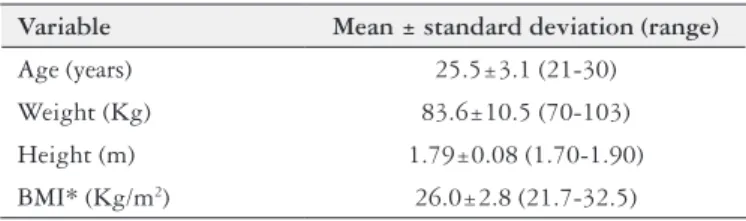
The clinical characteristics of the volunteers can be seen in Table 2. All participants completed both phases of the
TABLE 2. Characteristics of the volunteers
Variable Mean ± standard deviation (range)
Age (years) 25.5±3.1 (21-30)
Weight (Kg) 83.6±10.5 (70-103)
Height (m) 1.79±0.08 (1.70-1.90)
BMI* (Kg/m2) 26.0±2.8 (21.7-32.5)
*BMI: body mass index
TABLE 1. Composition of the solutions
CHO Group 200 mL
CHO Group 400 mL
GLN Group 200 mL
GLN Group 400 mL
Energy (Kcal) 100 200 160 260
Maltodextrin (g) 25 50 25 50
Glutamine (g) 0 0 15 15
Ph 4.8 4.8 5.2 5.2
Density (g/mL) 1.023 1.012 1.043 1.036
Osmolarity (mOsm/L) 232 232 315 315
study and there were no episodes of nausea or vomiting after intake of the beverage. There were no complications during the course of the MRI which was done without sedation in all cases.
Comparison at 120 minutes
The GRV found at T120 with the two beverages can be seen in Figure 1. At T120 the mean ± SD of GRV was similar in the two groups (CHO group: 22.9±16.6 mL and GLN group: 19.7±10.7 mL; P>0.05). Gastric emptying as shown in Figure 2 was 88.6 ±8.3% completed in the CHO group and 90.1 ±5.4% in the GLN group (P>0.05).
Comparison at 180 minutes
At T180, 89.2±12.0% of the beverage in the CHO group and 92.5 ±5.0% in the GLN group had been evacuated from the gastric chamber (Figure 2). The GRV measured by MRI (Figure 1) was similar with the two formulas (CHO group: 21.5 ±24.1 mL and GLN group: 15.1 ±10.1 mL; P>0.05).
At T0 the volume ingested was 200 mL. At T120 and T180 there was emptying of around 90% of gastric residue (P<0.05) in both groups (Figure 3A and 3B). There was no signiicant difference (P>0.05) between the two time points (within group comparison) in the two groups.
FIGURE 1. Gastric residual volume in the two groups 2h (T120) and 3h (T180) after the intake of the beverage. Data represent the mean and standard deviation. CHO: beverage with carbohydrate; GLN: beverage with carbohydrate plus glutamine. P>0.05 in all the comparisons.
FIGURE 2. Percentages of gastric emptying in the two groups 2h (T120) and 3h (T180) after the intake of the beverage. Data represent the average. CHO: bevarage with carbohydrate; GLN: beverage with carbohydrate plus glutamine. P>0.05 in all comparisons.
A
B
FIGURE 3. Gastric residual volume after carbohydrate drink (A) and after glutamine drink (B). Data represent the mean. T0: time immediately after intake of the beverage (estimated value); T120 = 120 minutes after the intake of the beverage; T180 = 180 minutes after intake of the beverage. *P<0.05 T0 vs T120 and T180.
DISCUSSION
The overall results haves show that the goals of this study were attained. The indings showed that gastric emptying was satisfactory 2 and 3 hours after the intake of both drinks. This is particularly important because it implies in safety CHO
GLN
CHO
for the addition of GLN in CHO-enriched drinks 2h before anesthesia.
MRI was a good weapon and perfectly applicable for this type of study. In fact, MRI seems to be one of the most eficient methods described for the assessment of gastric emp-tying. Several studies have report the eficacy of this exam to assess gastric volume in real time(9). In addition, MRI is a non-invasive exam and avoid collateral effects from radia-tion(9, 18). Other methods such as aspiration of the volume via nasogastric tube(7), ultrasonography(24), videoluoroscopy(12), and scintigraphy(13) are also considered less precise than MRI. Gastroscopy is a reliable method to assess gastric emptying but is invasive and may require sedation(25). MRI is an excel-lent but an expensive tool for the study of gastric emptying. Thus, we are not recommending the use of such a method in clinical basis.
The use of beverages containing carbohydrates has al-ready been recommended by several anesthesiology societies around the world(20). Our indings add new data to increase evidence of safety for the use of hydrolyzed proteins or glu-tamine in the formulation of these preoperative drinks. The addition of nitrogenous nutrients can increase the beneits of beverage containing only carbohydrates and still modulate the immune response. Other possible beneits of the preop-erative use of proteins would be to enhance the control of insulin resistance, improve function and muscle strength in the postoperative period as well as reduce the loss of lean body mass(4, 27).
Safety gastric emptying 2-3h after the intake of GLN-enriched drinks have been recently reported by Lobo et al. and by Dock-Nascimento et al. Lobo and his colleagues us-ing MRI reported a good gastric emptyus-ing after a beverage containing 50 g carbohydrate and 15 g GLN 3 hours after being ingested by human volunteers(18). Dock-Nascimento et al., in a randomized controlled study, in video-laparoscopic cholecystectomy reported similar GRV during the induction
of anesthesia in groups receiving traditional fast or 2h pre-treatment with either water, CHO or CHO plus 50g GLN(7). The two drinks tested differed in their osmolarity. How-ever, the higher osmolarity of the beverage used in GLN group did not inluenced the gastric emptying in our study. This was probably found because the difference in osmolarity of the two drinks was not expressive. In addition, osmolar-ity of CHO drinks did not affected gastric emptying in a human study. The authors concluded that gastric emptying of CHO-enriched solutions is triggered by the CHO-energy drink content(8).
However, the indings in our study deserve some criti-cism. Firstly, the volunteers were young and healthy and not candidates for any either clinical or surgical treat-ment. In addition the sample was very small and limited to 11 individuals. Thus, extrapolation of these indings for clinical application should be done with caution. However, crossover studies are adequate and valid in current literature to reply to this type of questioning proposed. Controlled randomized crossover type studies are very important in medical studies. This design enables the subjects to be compared with themselves guaranteeing adequate control groups. This signiicantly reduces biases and confounding variables of other randomized studies. Finally, we can say that they are statistically eficient, cheap and require few individuals in their design(17). In addition, the use of a tool such as MRI provided trustworthy data for analysis of the results found(9).
Summing up, the results of this study showed that gastric emptying is eficient, and occurs in up to 2 hours after the intake of a beverage containing either CHO alone or CHO associated with GLN. Thus, the addition of glutamine to CHO-enriched drink seems to be safe for the use up to 2h before an operation. These indings with drinks containing GLN should be furtherly supported by new randomized trials in surgical patients.
Brianez LR, Caporossi C, Moura YW, Dias LA, Leal R, Aguilar Nascimento JE. Volume gástrico residual após ingestão de maltodextrina e glutamina: estudo randomizado, duplo-cego, cruzado. Arq Gastroenterol. 2014,51(2):123-7.
RESUMO - Contexto - A adição de glutamina à bebidas de pré-operatório pode aumentar os benefícios do carboidrato isolado. Objetivo - Avaliar o volume gástrico residual após ingestão de bebida contendo carboidrato mais glutamina. Métodos - Onze voluntários saudáveis (de 24 à 30 anos) foram randomizados em um estudo cruzado para ingerirem 400 mL (4h antes) e 200 mL (2h antes) de bebida contendo 12,5% de maltodextrina (grupo carboidrato) ou 12,5% de maltodextrina mais 15 g de glutamina (grupo glutamina), em dois momentos distintos, com intervalo de 7 dias entres eles. A ressonância magnética foi realizada para medir o volume gástrico residual (mL) 120 e 180 minutos após a última ingestão. Resultados - Foi encontrado um volume gástrico residual semelhante à condição basal de jejum após 2h e 3h da ingestão das bebidas. Não houve diferença na média ±DP do volume gástrico residual (mL) encontrada aos 120 minutos (grupo carboidrato: 22.9±16.6 e grupo glutamina: 19.7±10.7; P>0.05) e aos 180 minutos (grupo carboidrato: 21.5±24.1 e grupo glutamina: 15.1±10.1; P>0.05) entre as duas bebidas. Conclusão - O esvaziamento gástrico é eiciente e ocorre em até 2h apos a ingesta de bebida contendo apenas carboidrato ou carboidrato associado à glutamina. Assim, a adição de glutamina à bebidas enriquecidas com carboidrato parece ser segura para uso até 2h antes da operação.
REFERENCES
1. Aguilar-Nascimento JE, Bicudo-Salomão A, Caporossi C, Silva RM, Cardoso EA, Santos TP. Enhancing surgical recovery in Central-West Brazil: The ACER-TO protocol results. e-SPEN, The European e-Journal of Clinical Nutrition and Metabolism. 2008;3:e78-e83.
2. Aguilar-Nascimento JE, Perrone F, de Assunção Prado LI. Preoperative fasting of 8 hours or 2 hours: what does evidence reveal? Rev Col Bras Cir. 2009;36:350-2. 3. Al Balushi RM, Cohen J, Banks M, Paratz JD. The clinical role of glutamine
supplementation in patients with multiple trauma: a narrative review. Anaesth Intensive Care. 2013;41:24-34.
4. Awad S, Lobo DN. What’s new in perioperative nutritional support? Curr Opin Anaesthesiol. 2011;24:339-48.
5. Bicudo-Salomão A, Meireles MB, Caporossi C, Crotti PL, de Aguilar-Nascimento JE. Impact of the ACERTO project in the postoperative morbi-mortality in a university hospital. Rev Col Bras Cir. 2011;38:3-10.
6. Blass SC, Goost H, Tolba RH, Stoffel-Wagner B, Kabir K, Burger C, et al. Time to wound closure in trauma patients with disorders in wound healing is shortened by supplements containing antioxidant micronutrients and glutamine: a PRCT. ClinNutr. 2012;31:469-75.
7. Borges Dock-Nascimento D, Aguilar-Nascimento JE, Caporossi C, Sepulveda Magalhães Faria M, Bragagnolo R, Caporossi FS, et al. Safety of oral glutamine in the abbreviation of preoperative fasting; a double-blind, controlled, randomized clinical trial. NutrHosp. 2011;26:86-90.
8. Brouns F, Senden J, Beckers EJ, Saris WH. Osmolarity does not affect the gas-tric emptying rate of oral rehydration solutions. JPEN J Parenter Enteral Nutr. 1995;19:403-6.
9. Carbone SF, Tanganelli I, Capodivento S, Ricci V, Volterrani L. Magnetic resonance imaging in the evaluation of the gastric emptying and antral motion: Feasibility and reproducibility of a fast not invasive technique. Eur J Radiol. 2010;75:212-4.
10. Faria MS, de Aguilar-Nascimento JE, Pimenta OS, Alvarenga LC Jr, Dock-Na-scimento DB, et al. Preoperative fasting of 2 hours minimize insulin resistance and organic response to trauma after video-cholecystectomy: a randomized, controlled, clinical trial. World J Surg. 2009;33:1158-64.
11. Fearon KC, Ljungqvist O, Von Meyenfeldt M, Revhaug A, Dejong CH, Lassen K, et al. Enhanced recovery after surgery: a consensus review of clinical care for patients undergoing colonic resection. ClinNutr. 2005;24:466-77.
12. Firman CM, Costa MM, Costa ML, Lemme E. Qualitative and quantitative eval-uation of gastric emptying using a videoluoroscopic method. Arq Gastroenterol. 2000;37:81-8.
13. Gentilcore D, Hausken T, Horowitz M, Jones KL. Measurements of gastric emp-tying of low-and-high-nutrient liquids using 3D-ultrasonography and scintigraphy in healthy subjects. Neurogastroenterol Motil. 2006;18:1062-8.
14. Grau T, Bonet A, Miñambres E, Piñeiro L, Irles JA, Robles A, et al. The effect of l-alanyl-l-glutamine dipeptide supplemented total parenteral nutrition on infection morbidity and insulin sensitivity in critically ill patients. Crit Care Med. 2011;39:1263-8.
15. Gustafsson UO, Ljungqvist O. Perioperative nutritional management in digestive tract surgery. Curr Opin Clin Nutr Metab Care. 2011;14:504-9.
16. Hausel J, Nygren J, Thorell A, Lagerkranser M, Ljungqvist O. Randomized clinical trial of the effects of oral preoperative carbohydrates on postoperative nausea and vomiting after laparoscopic cholecystectomy. Br J Surg. 2005;92:415-21. 17. Jones B; Kenward MG. Design and analysis of cross-over trials. 3rd ed. London:
Chapman and Hall. 2012.
18. Lobo DN, Hendry PO, Rodrigues G, Marciani L, Totman JJ, Wright JW, et al. Gastric emptying of three liquid oral preoperative metabolic preconditioning regimens measured by magnetic resonance imaging in healthy adult volunteers: A randomized double-blind, crossover study. Clin Nutr. 2009;28:636-41. 19. Maltby JR. Fasting from midnight - the history behind the dogma. Best Pract
Res Clin Anaesthesiol. 2006;20:363-78.
20. Malty JR. Preoperative fasting guidelines. Can J Surg. 2006;49:138-9. 21. Mendelson CL. The aspiration of stomach contents into the lungs during obstetric
anesthesia. Am J Obstet Gynecol. 1946;52:191-205.
22. NygrenJ, Thorell A, Jacobsson H, Larsson S, Schnell PO, Hylén L, et al. Preop-erative gastric emptying. Effects of anxiety and oral carbohydrate administration. Ann Surg. 1995;222:728-34.
23. Nygren J. The metabolic effects of fasting and surgery. Best Pract Res Clin An-aesthesiol. 2006;20:429-38.
24. Perlas A, Chan VW, Lupu CM, Mitsakakis N, Hanbidge A. Ultrasound assessment of gastric content and volume. Anesthesiology. 2009;111:82-9.
25. Perlas A, Mitsakakis N, Liu L, Cino M, Haldipur N, Davis L, et al. Validation of a mathematical model for ultrasound assessment of gastric volume by gastroscopic examination. Anesth Analg. 2013;116:357-63.
26. Varadhan KK, Lobo DN, Ljungqvist O. Enhanced recovery after surgery: the future of improving surgical care. Crit Care Clin. 2010;26:527-47.
27. Weitzel LR, Wischmeyer PE. Glutamine in critical illness: the time has come, the time is now. Crit Care Clin. 2010;26:515-25.
28. Zheng Y, Li F, Qi B, Luo B, Sun H, Liu S, et al. Application of perioperative immunonutrition for gastrointestinal surgery: a meta-analysis of randomized controlled trials. Asia Pac J Clin Nutr. 2007;16:253-7.