Migration: The Case of the Barnacle Goose
Rudy M. Jonker1,4*, Go¨tz Eichhorn2,3, Frank van Langevelde1, Silke Bauer4,5
1Resource Ecology Group, Wageningen University, Wageningen, The Netherlands,2IPHC-DEPE, Universite´ de Strasbourg, Strasbourg, France,3CNRS, Strasbourg, France, 4Department of Animal Ecology, Netherlands Institute of Ecology (NIOO-KNAW), Maarssen, The Netherlands,5Swiss Ornithological Institute, Sempach, Switzerland
Abstract
Understanding stopover decisions of long-distance migratory birds is crucial for conservation and management of these species along their migratory flyway. Recently, an increasing number of Barnacle geese breeding in the Russian Arctic have delayed their departure from their wintering site in the Netherlands by approximately one month and have reduced their staging duration at stopover sites in the Baltic accordingly. Consequently, this extended stay increases agricultural damage in the Netherlands. Using a dynamic state variable approach we explored three hypotheses about the underlying causes of these changes in migratory behavior, possibly related to changes in (i) onset of spring, (ii) potential intake rates and (iii) predation danger at wintering and stopover sites. Our simulations showed that the observed advance in onset of spring contradicts the observed delay of departure, whereas both increased predation danger and decreased intake rates in the Baltic can explain the delay. Decreased intake rates are expected as a result of increased competition for food in the growing Barnacle goose population. However, the effect of predation danger in the model was particularly strong, and we hypothesize that Barnacle geese avoid Baltic stopover sites as a response to the rapidly increasing number of avian predators in the area. Therefore, danger should be considered as an important factor influencing Barnacle goose migratory behavior, and receive more attention in empirical studies.
Citation:Jonker RM, Eichhorn G, van Langevelde F, Bauer S (2010) Predation Danger Can Explain Changes in Timing of Migration: The Case of the Barnacle Goose. PLoS ONE 5(6): e11369. doi:10.1371/journal.pone.0011369
Editor:Sean Rands, University of Bristol, United Kingdom
ReceivedJanuary 13, 2010;AcceptedJune 3, 2010;PublishedJune 30, 2010
Copyright:ß2010 Jonker et al. This is an open-access article distributed under the terms of the Creative Commons Attribution License, which permits unrestricted use, distribution, and reproduction in any medium, provided the original author and source are credited.
Funding:Rudy Jonker was funded by the Dutch Faunafonds and the Koninklijke Nederlandse Jagersvereniging. Go¨tz Eichhorn was supported by ESF travel grants and scholarships from the ‘Marianne und Dr. Fritz Walter-Fischer Stiftung’, Germany, and the ‘Ubbo Emmius Programme’ of Groningen University. Silke Bauer received support from The Netherlands Organisation for Scientific Research, Earth & Life Sciences (NWO-ALW) project grant 816.01.007. The funders had no role in study design, data collection and analysis, decision to publish, or preparation of the manuscript.
Competing Interests:The authors have declared that no competing interests exist.
* E-mail: [email protected]
Introduction
In migratory species, flexibility allows dealing with a continu-ously changing environment. Illustratively, Sutherland [1] pre-sented an overview of bird species that showed flexibility in their migratory behavior to changing environmental conditions. He described changes in the use of wintering, breeding and staging areas, occurring in a wide range of families. Recently, Jonze´n et al. (2006) suggested a climate-driven evolutionary change in the timing of spring migration for a number of long-distance passerine migrants [2] but see [3]. Changes in migration can also be caused by factors other than climate. Gill et al. [4] for example, showed that an increasing population of Black-tailed godwitsLimosa limosa islandica, wintering in the UK, established new wintering sites on less suitable sites than the original wintering sites. They suggested that the carrying capacity of the original sites was reached, forcing the Black-tailed godwits to winter elsewhere. Additionally, Klaassen et al. [5] adopted a dynamic state variable model and
showed that Pink-footed geese Anser brachyrhynchus respond to
scaring practices by farmers in Norway by changing their use of stopover sites. Alerstam & Lindstro¨m [6] discussed minimization of time, energy and predation during migration as the main drivers of evolution in migratory behavior. The aforementioned examples of migratory change might represent responses to changes in one or more of these factors. Identifying possible causes of these changes, is essential for understanding flexibility in migratory behavior.
Since the early 1990s, an increasing number of Barnacle geese
Branta leucopsisbreeding in the Russian Arctic have delayed their departure from their wintering site in the Netherlands by approximately one month. The geese reduced their staging duration in the next stopover area in the Baltic (traditionally used by the entire population) according to the delay from the Netherlands, such that some migrants virtually skip the Baltic stopover site altogether [7,8]. Because of these changes, the question arose what has caused the delayed departure from the wintering site and decreased use of the Baltic stopover site. Compared to changes in (migration) phenology in other bird species [2,9,10,11], the rate of change of approximately 3 days/year as observed in the Barnacle goose is unprecedently large. One important consequence of the delayed migration of Barnacle geese is an increased agricultural damage in the Netherlands of approximatelyJ350,000 annually,
and this figure is growing rapidly [12]. Successful management actions require the identification of factors and processes affecting departure and staging decisions. Therefore, we have formulated three possible explanations for the delay: Barnacle geese have delayed their departure as a consequence of changes in (i) onset of spring, (ii) potential food intake rates, and (iii) predation danger [13].
(i) Advanced onset of spring
advanced laying dates [14], advanced spring arrival dates [2,10,15] or increased rate of spring migration [9]. Climate change could result in higher spring temperatures in some regions, leading to earlier growth of the vegetation. Barnacle geese are thought to schedule their migration according to the ‘‘green wave’’ of fresh plant growth along the flyway [16]. However, this relationship might not be that straightforward, because geese may prioritize other factors, such as safety or food quality. Therefore, the potential effect of onset of spring is investigated in this study.
(ii) Decreased intake rate
The potential intake rate at a stopover site, i.e. the intake per day a goose can gain if foraging at maximum intensity, limits the rate at which geese can replenish their energy reserves [17]. Earlier studies have shown that decreased availability and reduced quality of food can make a stopover site less attractive [18]. Van der Graaf [19] reported lower intake rates in the Baltic as compared to the Netherlands. Moreover, as the total population of Barnacle goose passing through the Baltic has increased drastically over the past thirty years [20], the competition for food at the Baltic stopover site may also have intensified [21]. Additionally, desertion of farmland, and thus reduced facilitation by cattle grazing, in these regions may also have decreased intake rates [22]. For these reasons, decreased potential intake rates at the Baltic stopover site may cause Barnacle geese to reduce staging time or even completely skip this site. Then, the geese could fly directly to one of the next stopover sites in Russia; however, since food there becomes available only later in spring, they have to delay their departure from the Netherlands until spring starts in the arctic stopover sites in Russia.
(iii) Increased predation danger
Increased predation danger can reduce the attractiveness of a site because of its lethal and non-lethal effects [23,24]. Although safety has long been acknowledged as potentially important for successful migration [6], it has received little attention so far and the few studies on the impact of predation danger on migration have not led to unambiguous conclusions [25,26]. While a number of studies indeed demonstrated the effects of predators on body mass, stopover duration and site usage [27,28], some of the results are difficult to interpret [29], and others even deny at least some of the suggested effects of predation danger [30].
In this study, we used a dynamic state variable model to analyze whether these three hypotheses can explain the observed changes in migratory behavior of Barnacle geese.
Methods
We used a dynamic state variable model to predict the migration strategy of the Barnacle goose that maximizes expected lifetime reproductive success under different environmental circumstances. This type of model is most suitable as it includes future goals (maximising long term reproductive success) when defining decisions that lead to achieving these goals [31,32]. We used an already existing model (see for more details [5,33,34]) which we parameterized for the Barnacle goose. We shortly explain the model here to give insight in the logic of the used parameters and to facilitate understanding our predictions.
The dynamic state variable model
The state of the goose in the model was characterized by its energy storesx and its locationi. At each time step of one day,
t= 0,1…T, the state of body reserves was calculated, and
according to state, location and time decisions for optimal
migration was made. For computational reasons, x took only
integer values between 0 and xmax= 100. One unit of x was
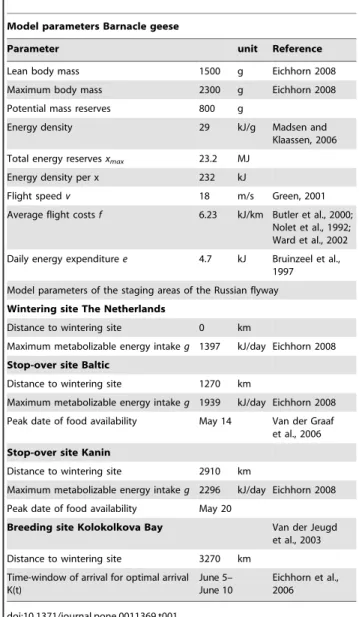
equivalent to 232 kJ, representing 1% of the caloric value of the maximum body reserves (see table 1 for an overview of parameters). If the body reserves fell to zero, the goose died of starvation. We considered 4 different locations: a wintering site in the Netherlands, stopover sites in the Baltic sea region and at the Kanin peninsula in Russia, and a breeding siteNat the Barents Sea coast in Russia [35] (figure 1). Breeding was only possible at the breeding site. At t= 0 (March 1) the goose started at the wintering site and simulations ended when it reached the breeding site or whentreachedT, a predefined endpoint which was set to
t= 121 (June 29), approximately 3 weeks after the optimal time window for breeding. The expected reproductive success of the goose, with body reservesxat timetat locationi, was denoted by
F(x,t,i).
Terminal reward function. The terminal reward was
defined as the reward at T, and served as a starting point for the backward iteration. Upon arrival at the breeding siteNthe expected reproductive successF(x,t,N) depended on the body stores at arrival as well as the timing of arrival [36]. Additionally, a
Table 1.Parameterization of the model.
Model parameters Barnacle geese
Parameter unit Reference
Lean body mass 1500 g Eichhorn 2008
Maximum body mass 2300 g Eichhorn 2008
Potential mass reserves 800 g
Energy density 29 kJ/g Madsen and
Klaassen, 2006
Total energy reservesxmax 23.2 MJ
Energy density per x 232 kJ
Flight speedv 18 m/s Green, 2001
Average flight costsf 6.23 kJ/km Butler et al., 2000; Nolet et al., 1992; Ward et al., 2002
Daily energy expendituree 4.7 kJ Bruinzeel et al., 1997
Model parameters of the staging areas of the Russian flyway
Wintering site The Netherlands
Distance to wintering site 0 km
Maximum metabolizable energy intakeg 1397 kJ/day Eichhorn 2008
Stop-over site Baltic
Distance to wintering site 1270 km
Maximum metabolizable energy intakeg 1939 kJ/day Eichhorn 2008
Peak date of food availability May 14 Van der Graaf et al., 2006
Stop-over site Kanin
Distance to wintering site 2910 km
Maximum metabolizable energy intakeg 2296 kJ/day Eichhorn 2008
Peak date of food availability May 20
Breeding site Kolokolkova Bay Van der Jeugd et al., 2003
Distance to wintering site 3270 km
Time-window of arrival for optimal arrival K(t)
June 5– June 10
Eichhorn et al., 2006
component was added for expected future reproductive successBT
because Barnacle geese are long-lived animals with many years of breeding attempts. Thus:
F(x,t,N)~K(t)K(x)zBT ð1Þ
where K(t) was the function of the timing of arrival, K(x) the
function of the body stores on arrival, and BT was set to 2,
representing the expected future reproductive success given that an individual actually survived at any site untilT. BothK(t)and
K(x)result in 0 reward if an individual had not arrived at breeding site N at T. Subsequently, the effect of timing of arrival was incorporated by a step function, meaning that breeding was only possible if arriving at the breeding grounds within the set time-limits:
K(t)~ 0 ift
vJune6 ortwJune11 1 ifJune6ƒtƒJune11
ð2Þ
[20,36]. The effect of body reserves on breeding success was described by a sigmoidal shape function based on data from the Pink-footed goose [36], indicating that the chance of successful breeding success increased if body stores upon arrival at the
breeding site exceeded a certain threshold xc. We assumed a
similar relationship for Barnacle geese. Thus:
K xð Þ~1
2
ew xð{xcÞ{e{w xð{xcÞ ew xð{xcÞze{w xð{xcÞz1
ð3Þ
where the shape parameterwwas set to 0.028 andxc, the threshold for successful breeding, was set to 15080 kJ (xc= 65)
Backward iteration. At each time step a goose decided
whether to stay at its present location and forage, or to depart to another location. When staying at locationi, the potential intake rate (defined as metabolizable energy intake according to [37]) of the
goose was site- and time-dependent and had predefined stochasticity [g(i,t), kJ day21]. However, the actual intake rate depended on the foraging intensityu, ranging from 0 (no foraging) to 1 (continuous foraging). The actual intake rate minus the energy expendituree[kJ day21] resulted in the energy available for the storage of reserves. However, foraging with a particular intensity and storing reserves had a cost in terms of predation risk, defined byb(x,u):
bðx,uÞ~mbð Þi
xzug ið Þ,t{e
ð Þaz1{xaz1
az1
ð Þðug ið Þ,t {eÞ ð4Þ
wherea, the mass-dependent escape performance exponent, was set to 2 and the site-specific constant attack rate [33]mb(i)is set to 1028.
The parameter mb(i) is the predation danger according to the
definition by [13]. Thus, the goose foraged with the intensity that maximized its expected reproductive successF:
Hfðx,t,iÞ~max
u 1 {bðx,uÞ
ð ÞF xð zug ið Þ,t {e,tz1,iÞ
½ ð5Þ
Alternatively, when departing to another sitej, the goose chose the sitejthat maximizedF:
Hd(x,t,i)~max
j F xa,tz X j{1
z{i Dz=v
!
,j !
" #
ð6Þ
This choice depended on the distance between the sites [Dz(km)], the speed of flight [v(km day21)], and the reserves upon arrival (xa) at sitej. The latter was defined by
xa~ c
2
c{ c 1{ð1zx=xmaxÞ
{0:5
{D
2{1
0
B @
1
C A
:xmax ð7Þ
whereDwas the distance covered. The constantcin this equation was defined by
c~ Dmax
1{ 1zxf=xmax
{0:5 ð8Þ
wherexfwas the level of body reserves available for flight, which equaledxmaxfor Barnacle goose, andDmaxwas the maximum flight distance defined by
Dmax~
xmax
f ð9Þ
wherefwas the average flight cost [kJ km21] [38,39,40]. To find the fitness-maximizing decision, we calculated the fitness conse-quences of the behavioral alternatives, i.e., to forage or depart, for all combinations of state, location and time and chose the one with the highest fitness. The thus obtained optimal decision matrix showed the best decision for each time step and for all possible levels of body reserves and sites, namely:
F xð ,t,iÞ~maxHfðx,t,iÞ,Hdðx,t,iÞ
ð10Þ
Forward simulation. Based on the decision matrix, optimal
migration was simulated for each goose. The simulations started at
Figure 1. Migration route of Russian Barnacle goose. A
schematic overview of the flyway of the Russian population of the Barnacle Goose. In spring (April–May), Barnacle geese depart from The Netherlands to stopover in the Baltic. After a stop of a few days to a few weeks they depart to pre-breeding areas in Northern Russia. The geese arrive at their arctic breeding grounds early June and start breeding immediately.
t= 0, each goose started with a random amount of body reserves between 4640 kJ#x#11600 kJ, and ended when the bird reached the breeding site, died, or passed the time limitTat any other site. In the simulations, we assumed geese had full knowledge of the environment, i.e. the geese experienced the same conditions in the forward simulation for which the optimal decisions were calculated in the backward calculation. The actual experienced potential intake rateg(i,t) for each individual was drawn from a distribution with a predefined stochasticity.
Scenarios
We analyzed the three different hypotheses by step-wisely changing the relevant model-parameters, i.e., onset of spring, intake rates and predation danger. For all scenarios, both backward iteration and forward simulations were run. First, we changed onset of spring in the Baltic staging site from 24 April to 3 June in steps of 5 days. Onset of spring was defined as the point in time when food availability g(i,t) first reached its highest value. Second, we changed food availability in the wintering and Baltic
stop-over site from 1392 kJ d21 to 2784 kJ d21 in steps of
232 kJ d21, and in all possible combinations for both sites. Third, we increased predation danger (mb(i)) in the Baltic site
from 10210 to 1026 with 16 logarithmically equal steps (10210, 1029.75, 1029.5, …, 1026.5, 1026.25, 1026). We choose this range of values based on the value of 1028used by Klaassen et al. [5] and the value of 2?1026used by Weber et al. [33].
We compared the model predictions of the three scenarios with passage data from the Ottenby bird observatory (56u119450N, 16u239560E) from 1970 until 2004 (adapted from [41], see figure 2).
Ottenby is situated on a main migratory corridor for Barnacle geese traveling from the Netherlands to Baltic stopover sites [42]. Because the total population of Barnacle geese also greatly increased during that period, we used the relative cumulative percentage of passed dates. The most plausible predictions were those that showed a delay in departure equivalent to the observed delay of one month. All results were analyzed with R.2.8.1 [43].
Results
Advancing the onset of spring in the Baltic by a given unit of time led to an equally advanced departure date from the wintering site for most of the range tested in our simulations (figure 3). Additionally, the simulations showed that the geese always depart from the Dutch wintering site just before the onset of spring in the Baltic.
Decreasing intake rates in the Baltic stopover sites by 1392kJ/ day led to a delay in departure date from the wintering site of 29 days (mid April–mid May) (figure 4). If, alternatively, the intake rates in the wintering site increased, the geese delayed their departure date by only 16 days (figure 4).
Increasing predation danger in the Baltic above the predation danger of the other sites led to a rapid delay of 28 days (mid April– mid May) in departure date from the wintering site (figure 5). When predation danger was further increased, a growing proportion of geese stopped using the Baltic stopover site (figure 6). However, a small proportion geese still visited the Baltic, and stayed for a few days only. They had low energy reserves, and apparently, could not skip this site as they were in dire need of replenishing their body stores.
Figure 2. Observed delay in onset of spring migration.The departure dates from the wintering grounds in the Netherlands, shown as the relative cumulative percentage of departure as a function of days since the median departure date in the 1970’s. Data points represent per day the mean relative cumulative passage count at Ottenby bird observatory over a certain period (circles: 1970–1979, triangles: 1980–1989, open squares: 1990–1999, solid squares: 2000–2004). The median departure date in the 1970’s was April 12.
Discussion
Our simulations showed that the delayed departure of Barnacle geese from their wintering grounds by up to one month can be explained by either decreased potential intake rates or increased predation danger in the Baltic stopover site. In contrast, an advanced onset of spring fails to explain such a delay. The predicted response to an advanced spring growth is opposite to a delayed departure actually observed in the field. According to our simulations, an advancement of spring of 8 days (as predicted by [19] based on growing degree days) should advance departure by 8 days too. Interestingly, also the Barnacle geese breeding on Spitsbergen have not advanced their departure from Scottish wintering grounds despite an advanced onset of spring at their Norwegian stopover site, in contrast to Pink-footed geese, which largely share the same flyway and have advanced their spring migration [44]. Tombre et al. [44] suggest that Barnacle geese breeding at Spitsbergen cannot predict spring in Norway from their wintering site in the United Kingdom because of the large overseas crossing. The Russian breeding Barnacle geese, however, do not have such a large overseas crossing, and prioritize other factors than responding to advanced onset of spring in the Baltic. Thus, although the timing of high quality food during migration is important for Barnacle geese [16], this result suggests that Barnacle geese may prioritize other factors above the onset of plant growth in spring, and that the observed delay in migration cannot be caused by climatic changes. Theory also predicts that birds should not advance their timing of migration as much as spring advances, because the timing of migration has not only evolved to match the peak of food availability but also in response Figure 3. Predicted delay in onset of spring scenario.The delay in departure (in days since April 12, which was the median departure date in the 1970’s) from the wintering site in the Netherlands as a function of onset of spring. In the model, the geese responded to a change in the peak date of intake rate such that they advance departures with an earlier spring and vice versa, they would depart later from the wintering site if spring in the Baltic would be delayed.
doi:10.1371/journal.pone.0011369.g003
Figure 4. Predicted delay in intake rate scenario.The predicted delay in departure date (in days since April 12, which was the median departure date in the 1970’s) from the wintering site in the Netherlands to a changed intake rate, ranging from 1.4 MJ to 2.8 MJ, at the wintering site and the Baltic stopover site.
to many other factors, such as competition for territories and predation risk [45].
Our assumptions on decreased potential intake rates are supported by empirical studies [16,41]. Both studies suggested a recent decrease in intake rates in a Baltic stopover site. Additionally, Barnacle geese have been observed to colonize new staging sites at several locations in the Baltic. Populations staging at traditional sites remained approximately constant [46], indicating that the traditional sites reached capacity, especially because the total population of geese increased much more than the population staging in the Baltic [7]. Besides, the ongoing urbanization in the Baltic region has led to a general decline in agricultural practice, e.g., cattle farming. Consequently, intake rates may also have decreased as facilitation by large grazers decreased. Altogether, decreased intake rates can be a plausible explanation for the observed delay.
In addition to the importance of fooden route, our simulations showed a particularly strong effect of predation danger on the departure date from the wintering site. When predation danger in the Baltic was only slightly higher compared to the other sites, the geese immediately started delaying departure from the wintering site, reducing staging time at the dangerous site and ultimately, skipping the site with higher predation risk. This is in line with theoretical predictions that a migratory bird should minimize the time spent in a dangerous area [47] and that the loss of future reproductive success by predation is traded off against the benefit of increasing reserves by foraging [48]. Predators can have a strong influence on migratory strategies, e.g. by causing migrants to avoid the predator abundance peak [28]. If the whole Baltic area has become more dangerous due to the recovery of predator
populations, we expect the geese to minimize the time spent in that area. The strong increase in predator numbers such as White-tailed eagles in the Baltic; a fourfold increase in Estonia (from 40 to 150–170 [49]), Latvia and Finland and expansion into Gotland, Sweden [50], indicates that the Baltic has indeed become a more dangerous place for Barnacle geese compared to the Netherlands.
For example, on the island of Saaremaa (2,672km2), Estonia,
which is a major stopover site in the Baltic, there are 28 known White-tailed eagle territories (pers. comm. V. Vo¨lke). Contrast-ingly, there is currently only a single breeding pair in the
Netherlands (41,528km2). For this breeding pair it has been
confirmed that it preys on Greylag geeseAnser anser[51]. Additionally, predation danger caused birds to not take full advantage of available resources, as they take the danger into account in their decision of where to forage [52]. These non-lethal effects of predation can potentially be larger than the lethal effects [24]. Hence, increased predation danger can reinforce the already existing effects of decreased intake rates. The influence of density-dependent effects on this trade-off are not immediately clear. Potentially, danger can cause many geese to shift to safer areas, thereby decreasing the competition for food in the dangerous areas. However, it is known that Barnacle geese facilitate each other while grazing [53]. Consequently, a dangerous and less grazed area does not necessarily lead to better feeding conditions. Our model did not take these density-dependent effects into account.
In conclusion, predation danger, in addition to food availability, can be a key factor in explaining the observed changes in migratory behavior of Barnacle geese. This study only approached the problem from a theoretical point of view, but identified critical factors to be studied empirically in the field. These new insights Figure 5. Predicted delay in danger scenario.The delay in departure (in days since April 12, which was the median departure date in the 1970’s) from the wintering site in the Netherlands as a function of predation danger at the Baltic stopover site. Above a predation danger of 3?1028
, the geese adjusted their migration by abruptly delaying their departure date from the wintering site by up to 28 days.
also suggest that challenging geese with natural predators in the Netherlands, e.g. by creating suitable nesting places for White-tailed Eagles, may improve management of the agricultural conflict. Future empirical research needs to test our predictions by measuring the direct and indirect effects of predator activities on goose behavior. Although this study focused on the case of the Barnacle goose, its conclusions are not limited to goose migration. It is often assumed that timing of migration is synchronized with the phenology of resources [11], resulting in potential mismatches and associated population declines as a result of climate change [54]. These two studies state respectively that looking at predation in addition to resources as explanatory factor is very difficult or do not even mention predation at all as potential explanatory factor. We want to emphasize that in addition to currently well studied factors such as food availability and climatic change, predation danger should be considered in the suite of potential explanatory variables for changes in the migratory behavior of birds.
Acknowledgments
We are grateful to Ron Ydenberg, Herbert Prins, Sean Rands, Zoltan Barta and an anonymous reviewer for comments on predation danger and for improving earlier versions of the manuscript. We thank Tom van der Have and Jan Gert Vink from the Dutch Faunafonds for information on agricultural damage. This is publication 4784 of the Netherlands Institute of Ecology (NIOO-KNAW).
Author Contributions
Conceived and designed the experiments: RMJ GE FVL SB. Performed the experiments: RMJ. Analyzed the data: RMJ FVL. Contributed reagents/materials/analysis tools: SB. Wrote the paper: RMJ GE FVL SB. Provided guidance during the whole study: FVL SB.
References
1. Sutherland WJ (1998) Evidence for flexibility and constraint in migration systems. Journal of Avian Biology 29: 441–446.
2. Jonze´n N, Linden A, Ergon T, Knudsen E, Vik JO, et al. (2006) Rapid advance of spring arrival dates in long-distance migratory birds. Science 312: 1959–1961.
3. Both C (2007) Comment on ‘‘Rapid advance of spring arrival dates in long-distance migratory birds’’. Science 315.
4. Gill JA, Norris K, Potts PM, Gunnarsson TG, Atkinson PW, et al. (2001) The buffer effect and large-scale population regulation in migratory birds. Nature 412: 436–438.
5. Klaassen M, Bauer S, Madsen J, Ingunn T (2006) Modelling behavioural and fitness consequences of disturbance for geese along their spring flyway. Journal Of Applied Ecology 43: 92–100.
6. Alerstam T, Lindstro¨m A (1990) Optimal bird migration: the relative importance of time, energy and safety. In: Gwinner E, ed. Bird migration, physiology and eco-physiology. Berlin: Springer-Verlag. pp 331–350. 7. Eichhorn G, Drent RH, Stahl J, Leito A, Alerstam T (2009) Skipping the Baltic:
the emergence of a dichotomy of alternative spring migration strategies in Russian barnacle geese. Journal of Animal Ecology 78: 63–72.
8. Eichhorn G, Afanasyev V, Drent RJ, van der Jeugd HP (2006) Spring stopover routines in Russian Barnacle geeseBranta leucopsistracked by resightings and geolocation. Ardea 94.
9. Marra PP, Francis CM, Mulvihill RS, Moore FR (2005) The influence of climate on the timing and rate of spring bird migration. Oecologia 142: 307–315. 10. Stervander M, Lindstro¨m A´ , Jonze´n N, Andersson A (2005) Timing of
spring migration in birds: long-term trends, North Atlantic Oscillation and Figure 6. Predicted use of Baltic stopover site in danger scenario.The predicted response to increased predation danger, described as the proportion of the geese that make use of the Baltic as a stopover site. With low predation danger all geese are predicted to use the Baltic stopover site (solid line), i.e. no skipping of the Baltic (broken line). However, with increasing predation danger the majority (+/275%) of the geese skip the site
the significance of different migration routes. Journal of Avian Biology 36: 210–221.
11. Visser ME, Both C (2005) Shifts in phenology due to global climate change: the need for a yardstick. Proceedings of the Royal Society B-Biological Sciences 272: 2561–2569.
12. Faunafonds (2009) Dordrecht: Agricultural damage by Barnacle geese in the months April and May. (in Dutch: Faunaschade door brandganzen in de maanden april en mei.).
13. Lank DB, Ydenberg RC (2003) Death and danger at migratory stopovers: problems with ‘‘predation risk’’. Journal of Avian Biology 34: 225–228. 14. Crick HQP, Dudley C, Glue DE, Thomson DL (1997) UK birds are laying eggs
earlier. Nature 388: 526–526.
15. Gordo O (2007) Why are bird migration dates shifting? A review of weather and climate effects on avian migratory phenology. Climate Research 35: 37–58. 16. Van der Graaf AJ, Stahl J, Klimkowska A, Bakker JP, Drent RH (2006) Surfing
on a green wave - how plant growth drives spring migration in the Barnacle Goose. Ardea 94: 567–577.
17. Beekman JH, Nolet BA, Klaassen M (2002) Skipping swans: Fuelling rates and wind conditions determine differential use of migratory stopover sites of Bewick’s SwansCygnus bewickii. Ardea 90: 437–460.
18. Van der Graaf AJ, Stahl J, Veen GF, Havinga RM, Drent RH (2007) Patch choice of avian herbivores along a migration trajectory - From Temperate to Arctic. Basic and Applied Ecology 8: 354–363.
19. Van der Graaf AJ (2006) Geese on a green wave: Flexible migrants in a changing world. [Phd Thesis]. Groningen: Rijksuniversiteit Groningen. 224 p. 20. Van der Jeugd HP, Eichhorn G, Litvin KE, Stahl J, Larsson K, et al. (2009)
Keeping up with early springs: Rapid range expansion in an avian herbivore incurs a mismatch between reproductive timing and food supply. Global Change Biology 15: 1057–1071.
21. Forslund P, Larsson K (1991) Breeding Range Expansion Of The Barnacle GooseBranta leucopsisIn The Baltic Area. Ardea 79: 342–346.
22. Prins HHT, Gordon IJ (2008) Introduction: Grazers and Browsers in a Changing World. In: Gordon IJ, Prins HHT, eds. THe Ecology of Browsing and Grazing. Berlin Heidelberg: Springer. pp 5–9.
23. Ydenberg RC, Dill LM (1986) The Economics of Fleeing from Predators. Advances in the Study of Behavior 16: 229–249.
24. Cresswell W (2008) Non-lethal effects of predation in birds. Ibis 150: 3–17. 25. Alerstam T, Hedenstro¨m A, A´ kesson S (2003) Long-distance migration:
evolution and determinants. Oikos 103: 247–260.
26. Ydenberg RC, Butler RW, Lank DB (2007) Effects of predator landscapes on the evolutionary ecology of routing, timing and molt by long-distance migrants. Journal of Avian Biology 38: 523–529.
27. Pomeroy AC (2006) Tradeoffs between food abundance and predation danger in spatial usage of a stopover site by western sandpipers,Calidris mauri. Oikos 112: 629–637.
28. Lank DB, Butler RW, Ireland J, Ydenberg RC (2003) Effects of predation danger on migration strategies of sandpipers. Oikos 103: 303–319.
29. Fransson T, Weber TP (1997) Migratory fuelling in blackcaps (Sylvia atricapilla) under perceived risk of predation. Behavioral Ecology and Sociobiology 41: 75–80.
30. Dierschke V (2003) Predation hazard during migratory stopover: are light or heavy birds under risk? Journal of Avian Biology 34: 24–29.
31. Clark CW, Mangel M (2000) Dynamic state variable models in Ecology; Methods and applications. May RM, Pagel MD, eds. Oxford, New York: Oxford University Press. 288 p.
32. Houston AI, McNamara JM (1999) Models of Adaptive Behaviour - An approach based on state. Cambridge: Cambridge University Press. 378 p. 33. Weber TP, Ens BJ, Houston AI (1998) Optimal avian migration: A dynamic
model of fuel stores and site use. Evolutionary Ecology 12: 377–401. 34. Bauer S, Dinther MV, Høgda K-A, Klaassen M, Madsen J (2008) The
consequences of climate-driven stop-over sites changes on migration schedules and fitness of Arctic geese. Journal of Animal Ecology 77: 654–660. 35. Van der Jeugd HP, Gurtovaya E, Eichhorn G, Litvin KY, Mineev OY, et al.
(2003) Breeding barnacle geese in Kolokolkova Bay, Russia: number of breeding pairs, reproductive success and morphology. Polar Biology 26: 700–706.
36. Prop J, Black JM, Shimmings P (2003) Travel schedules to the high arctic: barnacle geese trade-off the timing of migration with accumulation of fat deposits. Oikos 103: 403–414.
37. Bruinzeel LW, Eerden MRV, Drent RH, Vulink JT (1997) Scaling metabolisable energy intake and daily energy expenditure in relation to the size of herbivorous waterfowl: limits set by available foraging time and digestive performance. In: Eerden MRV, ed. Patchwork. Lelystad: Rijkswaterstaat Directie IJsselmeergebied. pp 111–132.
38. Ward S, Bishop CM, Woakes AJ, Butler PJ (2002) Heart rate and the rate of oxygen consumption of flying and walking barnacle geese (Branta leucopsis) and bar-headed geese (Anser indicus). Journal of Experimental Biology 205: 3347–3356.
39. Nolet BA, Butler PJ, Masman D, Woakes AJ (1992) Estimation of Daily Energy-Expenditure from Heart-Rate and Doubly Labeled Water in Exercising Geese. Physiological Zoology 65: 1188–1216.
40. Butler PJ, Woakes AJ, Bevan RM, Stephenson R (2000) Heart rate and rate of oxygen consumption during flight of the barnacle goose, Branta leucopsis. Comparative Biochemistry and Physiology a-Molecular and Integrative Physiology 126: 379–385.
41. Eichhorn G (2008) Travels in a Changing World: Flexibility and Constraints in Migration and Breeding of the Barnacle Goose [Ph.D. Thesis]. Groningen: University of Groningen.
42. Ganter B, Larsson K, Syroechkovsky EV, Litvin KE, Leito A, et al. (1999) Barnacle Goose Branta Leucopsis: Russia/Baltic. In: Madsen J, Cracknell G, Fox T, eds. Goose population of the Western Palaearctic: A review of status and distribution. Ro¨nde, Denmark: National Environmental Research Institute. pp 270–283.
43. R Development Core Team (2009) R: A language and environment for statistical computing. Vienna, Austria R Foundation for Statistical Computing http://www.R-project.org.
44. Tombre IM, Høgda KA, Madsen J, Griffin LR, Kuijken E, et al. (2008) The onset of spring and timing of migration in two arctic nesting goose populations: The pink-footed gooseAnser bachyrhynchusand the barnacle gooseBranta leucopsis. Journal of Avian Biology 39: 691–703.
45. Jonze´n N, Hedenstro¨m A, Lundberg P (2007) Climate change and the optimal arrival of migratory birds. Proceedings of the Royal Society B-Biological Sciences 274: 269–274.
46. Leito A (1996) The Barnacle Goose in Estonia. Estonia Maritima 1: 1–103. 47. Houston AI (1998) Models of optimal avian migration: state, time and predation.
Journal of Avian Biology 29: 395–404.
48. McNamara JM, Houston AI (1994) The effect of a change in foraging options on intake rate and predation rate. American Naturalist 144: 978–1000. 49. Hermann C, Krone O, Stjernberg T, Helander B (2009) Population
Development of Baltic Bird Species: White-tailed Sea Eagle (Haliaeetus albicilla) HELCOM Indicator Fact Sheets Online http://www.helcom.fi/environment2/ ifs/ifs2009/en_GB/White-tailedSeaEagle/Accessed 2010 March 26. 50. Helander B, Marquiss M, Bowerman We. SEA EAGLE (2000) Proceedings
from an international conference at Bjo¨rko¨, Sweden, 13–17 September 2000; 2003; 45 Tryckeri, AB. Stockholm: Swedish Society for Nature Conservation/ SNF & A˚ tta.
51. Roder F, Bijlsma R, Klomp J (2008) Second breeding case of White-tailed Eagle
Haliaeetus albicillain The Netherlands (In Dutch with English abstract: Tweede broedgeval van de ZeearendHaliaeetus albicillain Nederland). De Takkeling 16: 100–123.
52. Pomeroy AC, Butler RW, Ydenberg RC (2006) Experimental evidence that migrants adjust usage at a stopover site to trade off food and danger. Behavioral Ecology 17: 1041–1045.
53. Ydenberg RC, Prins HHT (1981) Spring Grazing and the Manipulation of Food Quality by Barnacle Geese. Journal of Applied Ecology 18: 443–453. 54. Jones T, Cresswell W (2010) The phenology mismatch hypothesis: are declines