Sedative and Cardiovascular Effects of Midazolam and Diazepam
Alone or Combined with Clonidine in Patients Undergoing
Hemodynamic Studies for Suspected Coronary Artery Disease
Jedson dos Santos Nascimento, Norma Sueli Pinheiro Modolo, Roberto Cruz Rocha Silva, Kleber Pimentel Santos,
Heitor Ghissone de Carvalho
Hospital Santa Izabel - Salvador, BA - Brazil
Summary
Background: Sedation during coronary angiography has been rarely studied, and it is important to know which drug is the best to sedate these patients.
Objective: To evaluate the quality of sedation and the effects of midazolam and diazepam alone or combined with clonidine on the heart rate (HR) and blood pressure (BP) of patients with suspected coronary artery disease.
Methods: This is a controlled, randomized, double-blind, prospective clinical study of 160 patients divided into five groups of 32 patients each, according to the drug used: group C (clonidine 0.5 µg/kg); group M (midazolam 40 µg/kg); group MC (combination of midazolam 40 µg/kg and clonidine 0.5 µg/kg); group D (diazepam 40 µg/kg); and group DC (combination of diazepam 40 µg/kg and clonidine 0.5 µg/kg). Sedation was evaluated based on the Ramsay scale and on the use of meperidine 0.04 mg.kg-1. Invasive BP monitoring, HR and the sedation score were analyzed every five minutes at four different time points.
Results: Patients who received midazolam presented higher sedation scores as well as HR and BP variation (p < 0.05). Those who received diazepam or clonidine had lower sedation scores, which were more satisfactory for the performance of the procedure, and presented a lower BP and HR variation (p > 0.05).
Conclusion: Midazolam was associated with a greater sedative and cardiovascular effect, whereas for diazepam these effects were less intense. Clonidine and diazepam had similar effects on BP, HR and sedation. (Arq Bras Cardiol 2007;89(6):365-370)
Key words: clonidine; midazolam; diazepam; counscious sedation.
Mailing address: Jedson dos Santos Nascimento •
Rua Engenheiro José Anasoh, 28 – Brotas – 40275-220 – Salvador, BA – Brazil E-mail: [email protected]
Manuscript received January 22, 2007; revised manuscript received March 31, 2007; accepted June 21, 2007.
Introduction
Clonidine reduces the sympathetic activity and increases the parasympathetic activity, thus consequently reducing heart rate (HR), systemic metabolism, myocardial contractility, and systemic vascular resistance. All these effects result in a lower myocardial oxygen requirement, an aspect that should be considered in patients with coronary heart disease1,2.
Control of the autonomic response in patients with suspected coronary artery disease is already performed with the use of beta-blockers, whose efficacy is well known3.
Alpha-2 agonists such as clonidine have been studied and their benefits on the autonomic control are evident1,2.
Few studies on sedation during coronary angiography are available, and data on the use of alpha-2 agonists are particularly poor1-3. Thus, the objective of this study was to evaluate the
effects of clonidine, and to compare it to two benzodiazepines (midazolam and diazepam), and their combination, observing their effects on blood pressure (BP), HR, and sedation in patients undergoing coronary angiography.
Methods
After approval by the Research Ethics Committee and signature of the informed consent, a controlled, randomized, double-blind, prospective trial was conducted.
Before signing the informed consent, the patients were given information on the service routines and on the objectives of the present study. They were also informed that clonidine or benzodiazepines could be administered, and that their possible benefits during the procedure would be evaluated.
The study included 160 patients of both genders, aged between 18 and 80 years, with myocardial scintigraphy or exercise test positive for ischemia, and who would undergo elective coronary angiography.
continuous electrocardiography and the evaluation was subsequently initiated. HR, BP and sedation were assessed at the beginning of the intravenous injection and at every five minutes until the end of the procedure.
Procedure time ranged from 15 to 90 minutes, depending on the patient and technical difficulty. For this reason, the evaluation had to be made at specific time points in order to correct this aspect. Thus, four time points were chosen for the evaluation of BP, HR and sedation scores in the patients: time point 1 (T1), before the intravenous injection, which was the control time point; time point 2 (T2), five minutes after drug injection; time point 3 (T3), median of the procedure time, which was chosen because it would occur at the middle of the procedure time; and time point 4 (T4), at the end of the procedure.
The complications assessed were bradycardia and hypotension, as well as the prevalence of the use of beta-blockers in the treatment of coronary insufficiency.
In relation to sedation, for ethical reasons, meperidine 0.4 mg/kg was given to the patients who remained agitated or anxious 10 minutes after the beginning of the procedure. The need for the utilization of this drug was one of the parameters of the sedative efficacy of clonidine.
After the end of the procedure, the patients were observed for a minimum of one hour and a maximum of four hours, but they could remain hospitalized if indicated as a result of the severity of their condition or need for rest and immobilization when the femoral approach was used.
Patients undergoing the procedure via the femoral approach were discharged approximately 24 hours after the procedure, obviously provided that the result of the coronary angiography thus permitted.
Outpatients undergoing the procedure via brachial artery dissection were released from hospital unless worsening of the coronary lesions or complications occurring during the procedure justified their hospitalization. These patients were advised to return to hospital should any complication arise.
In the presentation of the results of continuous variables, categorical variables were described by means and medians and expressed as percentages. For inference, the analysis of variance (ANOVA) or the Kruskal-Wallis test were used for continuous variables, and the chi square test or Fisher’s exact test for categorical variables, with an a value set at 5% (type I error).
Results
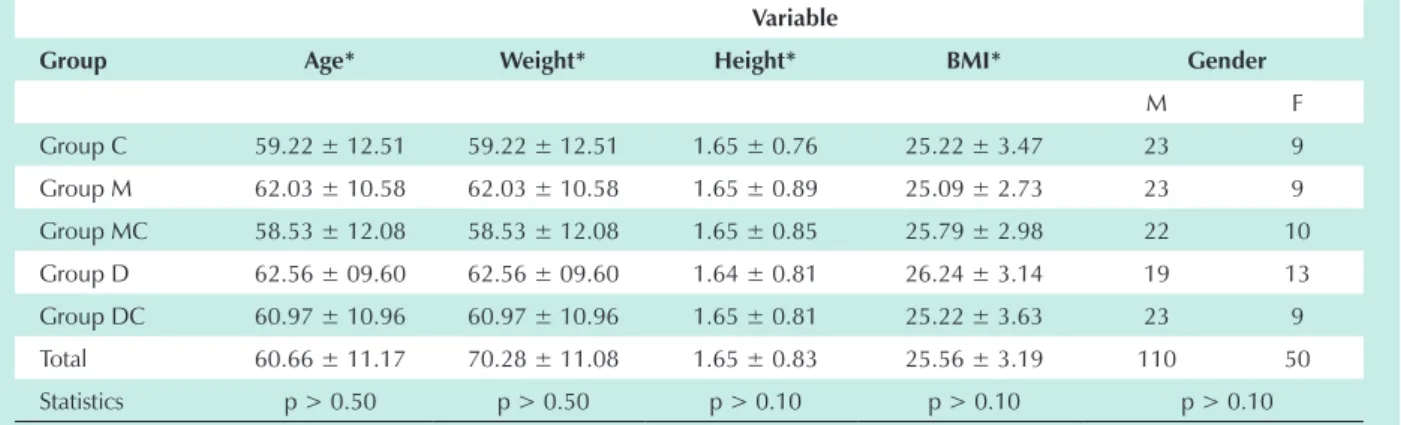
No difference was observed between the groups studied in relation to gender, age, weight, height, or body mass index (Table 2).
The study was conducted for six months, from July to December 2006. The prevalence of the use of beta-blockers was similar between the groups, with no statistically significant difference (p > 0.05).
In relation to HR, according to the statistical analysis of the groups at each time point, T1 validates the sample homogeneity, because no significant differences were found.
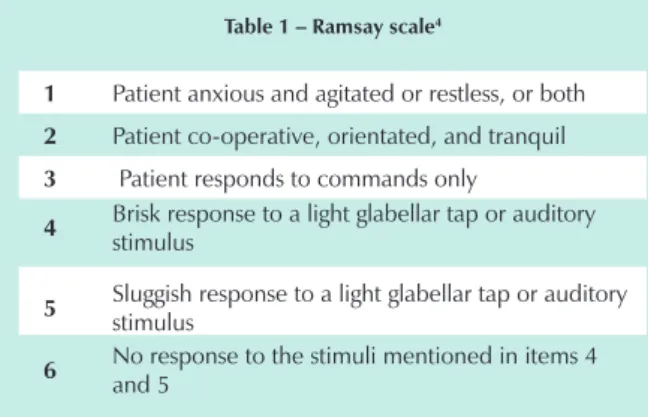
Table 1 – Ramsay scale4
1 Patient anxious and agitated or restless, or both
2 Patient co-operative, orientated, and tranquil
3 Patient responds to commands only
4 Brisk response to a light glabellar tap or auditory
stimulus
5 Sluggish response to a light glabellar tap or auditory
stimulus
6 No response to the stimuli mentioned in items 4
and 5
The parameters used in this study were BP, HR and the sedation score according to the Ramsay scale4 (Table 1).
The patients were monitored in the Catheterization Laboratory with pulse oximetry (Criticare 504DX), continuous six-lead electrocardiogram, and invasive BP via the femoral or brachial artery, depending on the approach used for the procedure (SP12 – TEB™ Polygraph).
All patients fasted for at least eight hours and did not receive any type of anxiolytic drug.
A number 20 catheter was introduced in the cephalic vein of the left upper limb, followed by a standard infusion of saline solution 10 ml/kg/h.
The patients were randomly divided by means of the PEPI software program (Computer Programs for Epidemiologists, J.H. Abramson & Paul M. Gahlinger, version 4.04x, 2001) into five groups, by the drawing of sealed envelopes. The syringes containing the drug were prepared by a researcher who would not evaluate the patients.
For sample size calculation, the following parameters were used: a error of 5%, statistical power of 80%; a mean difference of 16 mmHg in systolic blood pressure (SBP) was observed between the groups, with a standard deviation of 20.22 mmHg in the control group, and of 22.58 mmHg in the test group. With these parameters, a minimum sample size of 30 patients per group was established. To compensate possible losses, we chose to include 32 patients in each group. These parameters were obtained from Nascimento’s masters dissertation5. The author studied the sedative and
cardiovascular effects of clonidine and/or midazolam in patients with suspected coronary artery disease. SBP was used as a parameter because it is one of the important factors in the hemodynamic evaluation of patients with coronary disease.
The patients were divided into five groups of 32 patients each, according to the drug used: group C (clonidine 0.5 µg/ kg); group M (midazolam 40 µg/kg); group MC (combination of midazolam 40 µg/kg and clonidine 0.5 µg/kg); group D (diazepam 40 µg/kg); and group DC (combination of diazepam 40 µg/kg and clonidine 0,5 µg/kg).
At T2, we can observe that the groups that received midazolam presented wider variations (p < 0.05), whereas the groups that received clonidine and/or diazepam, including group MC, presented a trend of greater stability, with no differences in the statistical analysis. T3 and T4 keep the difference pattern only in group M (Figure 1).
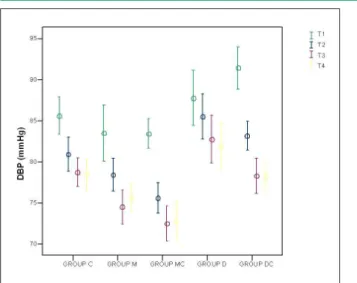
In relation to diastolic blood pressure (DBP), the analysis of the differences between the groups at each time point showed that the groups were similar only at T1. At T2, T3, and T4 group D presented values that were statistically different from those of group MC (p < 0.05). The other groups did not show significant differences (Figure 3).
As regards the sedative effect, the use of meperidine was not different between the groups (p > 0.10) (Figure 2). However, the sedation scores showed statistically significant differences, mainly at T2, T3, and T4, thus proving that there was no homogeneity in the sedative effect (Figures 4 to 6).
In relation to the study time points, the mean procedure time (T4) was 25.44 ± 11.13 minutes, and T3, the median procedure time, was 13.69 ± 5.64 minutes.
No patient presented hypotension requiring treatment. In
Table 2 - Mean and standard deviation of patients’ age and anthropometric variables
Variable
Group Age* Weight* Height* BMI* Gender
M F
Group C 59.22 ± 12.51 59.22 ± 12.51 1.65 ± 0.76 25.22 ± 3.47 23 9 Group M 62.03 ± 10.58 62.03 ± 10.58 1.65 ± 0.89 25.09 ± 2.73 23 9 Group MC 58.53 ± 12.08 58.53 ± 12.08 1.65 ± 0.85 25.79 ± 2.98 22 10 Group D 62.56 ± 09.60 62.56 ± 09.60 1.64 ± 0.81 26.24 ± 3.14 19 13 Group DC 60.97 ± 10.96 60.97 ± 10.96 1.65 ± 0.81 25.22 ± 3.63 23 9 Total 60.66 ± 11.17 70.28 ± 11.08 1.65 ± 0.83 25.56 ± 3.19 110 50 Statistics p > 0.50 p > 0.50 p > 0.10 p > 0.10 p > 0.10
Note: No difference was observed between the five groups in relation to gender, age, weight, height, or BMI; * Values expressed as mean ± standard deviation BMI – body mass index; M – male; F – female .
Fig. 1 - Heart rate – mean and standard deviation of the groups at each time point T1 – time point ; T2 – time point 2; T3 – time point 3; T4 – time point 4; HR – heart rate.
Fig. 2 - Systolic blood pressure – mean and standard deviation of the groups at four time points T1 – time point 1; T2 – time point 2; T3 – time point 3; T4 – time point 4; SBP – systolic blood pressure.
relation to bradycardia, no statistical difference was observed between the groups. However, in group MC, four patients required treatment with atropine 0.01 mg/kg, followed by group M, with two patients, group C and DC, with one patient each, and group D, whose patients did not require treatment.
Discussion
Clonidine proved to be an effective drug in the control of BP and HR with a mild sedative effect, which is desirable in the catheterization laboratory (Figures 1 to 6).
Invasive BP monitoring, via the femoral or brachial approach, is routinely used in coronary angiography, and is a quite reliable method of blood pressure assessment.
The Ramsay scale was used to evaluate sedation. This scale is widely used by several authors in studies on anesthesiology and intensive care, and has proven to be an established method in the assessment of sedation4,6,7 quality .
Since the mean procedure time was 25.44 ± 11.13 minutes, four time point assessments within this interval were enough to encompass most of the variations that occurred.
The 0.5-µg/kg clonidine dose is lower than that used in the literature (usually higher than 1 µg/kg). Some authors support that doses such as those used in this study are effective in the control of BP and HR8-10.
In relation to bradycardia and hypotension, which are the complications most frequently expected with the use of clonidine, no patients with hypotension were observed, and only eight patients presented bradycardia, which was treated with atropine, with no statistically significant difference between the groups.
As regards HR and BP changes, the groups that received midazolam presented significant variations when compared with the other groups. Group MC, in particular, demonstrated that clonidine stabilized the cardiovascular response, and no significant variations occurred, as was observed in group M (Figures 1 to 3).
The assessment at T1 was important, because it validated the homogeneity of the groups prior to the researcher’s Fig. 3 - Diastolic blood pressure – mean and standard deviation of the groups
at four time points; T1 – time point 1; T2 – time point 2; T3 – time point 3; T4 – time point 4; DBP – diastolic blood pressure.
Fig. 4 - Time point 2 – scores and number of patients in each group.
Fig. 5 - Time point 3 – scores and number of patients in each group.
interference, and all parameters assessed were similar between the groups, with no statistically significant difference (p > 0.10).
T2 showed that not only is an immediate effect of clonidine on BP and HR observed, but also that it potentiates the sedative response to benzodiazepines; in other words, clonidine has an early effect that is worth being pointed out in the literature, and it can be safely used in coronary patients (p < 0.05) (Figures 1 to 4).
At T3, the interaction of clonidine particularly with midazolam can still be observed, potentiating the sedative effect and stabilizing the cardiovascular parameters with a statistically significant difference (p < 0.05) (Figures 1 to 4).
At T4, the potentiating effect of clonidine on benzodiazepines was observed, and in the two groups of combination of drugs (DC and MC) the scores were not statistically different, thus corroborating a possible potentiating effect 30 minutes after its administration (Figures 1 to 4).
It is interesting to point out the importance of decreased myocardial oxygen consumption in patients with coronary artery disease, because the higher the HR and BP, the greater the cardiac work and the risk of ischemia in these patients1,11.
A benefit can be verified provided that HR and BP values remain within physiological limits, because if hypotension occurs, the risk of ischemia increases. Since no patient in this group presented hypotension, we can assume that the clonidine and benzodiazepine doses were satisfactory.
Some authors report the potential of alpha-2 agonists, such as clonidine, to reduce cardiovascular morbidity. This is still a controversial issue, however some authors have compared the effect of clonidine to that of beta-blockers on myocardial protection1-3,12. In this study, clonidine
presented a sedative effect similar to that of diazepam, with an autonomic control characteristic of alpha-2 agonists, thus decreasing myocardial work.
Despite the fact that there is no consensus on sedation in catheterization laboratories, Nascimento et al2 demonstrated
the benefit of the use of sedatives on BP and HR. This discussion has now been resumed, since clonidine is being compared to benzodiazepines, particularly with outcomes in cardiovascular stabilization superior to those of midazolam.
Regarding preservation of consciousness, both clonidine and diazepam were superior, because the use of midazolam alone or in combination with clonidine resulted in noncooperative patients, which is not desirable in the catheterization laboratory.
Clonidine has a sedative effect that depends on the dose used, and its site of action is the locus ceruleus, a small neuronal nucleus located in the upper part of the brain stem. This effect has already been described by several authors, and it is important to point out that the sedative effect is neither a consequence of hypotension nor of any cardiovascular effect1-3.
Benzodiazepines have a sedative effect mediated by gamma-amino butyric acid receptors and their cardiovascular effects seem to occur via other mechanisms. Midazolam, for instance, has a depressant effect on the sympathetic response that determines hypotension and, in the present study, a higher incidence of bradycardia. Diazepam, on the contrary, has a cardiovascular stabilization effect, which, moreover, corroborates its use in patients with severe heart failure, because it enhances the inotropic response, probably as a consequence of its phosphodiesterase type 4 inhibitory action13-18.
The choice of meperidine was based on ethical issues because, given that it was a double-blind study, if the patient presented anxiety or agitation a treatment option would be available. This drug, which is widely used for sedation in different procedures, also represented a parameter for the assessment of sedation16,19 quality. In the present study it was
a proof of validation of the sedation quality of clonidine in comparison to benzodiazepines, since no statistical difference was found between them.
The number of Brazilian studies on sedation in coronary angiography is small. With this study, we expect to contribute to an improved care of patients with coronary risk. Also, from the practical point of view, we resume the discussion on an improved medical care for patients undergoing coronary angiography. Currently, there is not even a consensus as to whether these patients should be sedated2,20, and this study demonstrated the benefits of
sedation in the control of BP and HR.
Conclusion
Thus, this study demonstrated that clonidine has a sedative effect comparable to that of diazepam. Midazolam induced very deep sedation, which is not desirable for the performance of coronary angiography. The combination of clonidine and benzodiazepines potentiated the sedative effects and increased the cardiovascular stability provided by these drugs.
Potential Conflict of Interest
No potential conflict of interest relevant to this article was reported.
Sources of Funding
There were no external funding sources for this study.
Study Association
References
1. Wallace AW. Clonidine and modification of perioperative outcome. Curr Opin Anaesthesiol. 2006; 19: 411-7.
2. Nascimento JS, Modolo NSP, Carvalho HG, Dórea EML, Snatos KP. Clonidina na cineangiocoronariografia: efeitos sedativos sobre a pressão arterial e freqüência cardíaca. Arq Bras Cardiol. 2006; 87: 603-8.
3. Wijeysundera DN, Naik JS, Beattie WS. Alpha-2 adrenergic agonists to prevent perioperative cardiovascular complications: a meta-analysis. Am J Med. 2003; 114: 742-52.
4. Ramsay MA, Savege TM, Simpson BR, Goodwin R. Controlled sedation with alphaxalone-alphadolone. Br Med J. 1974; 2: 656-9.
5. Nascimento JS. Efeitos sedativos e cardiovasculares da clonidina e/ou midazolam em pacientes com suspeita de doença arterial coronariana [dissertação]. São Paulo: Universidade Estadual Paulista Julio de Mesquita Filho (UNESP); 2004.
6. De Jonghe B, Cook D, Appere-De-Vecchi C, Guyatt G, Meade M, Outin H. Using and understanding sedation scoring systems: a systematic review. Intens Care Med. 2000; 26: 275-85.
7. Watson BD, Kane-Gill SL. Sedation assessment in critically ill adults: 2001-2004 update. Ann Pharmacother. 2001-2004; 38: 1898-906.
8. Hall JE, Uhrich TD, Ebert TJ. Sedative, analgesic and cognitive effects of clonidine infusion in humans. Br J Anaesth. 2001; 86: 5-11.
9. Bergendahl HTG, Eksborg S, Lönnqvist PA. Low-dose intravenous clonidine in children: plasma concentrations and haemodynamic response. Acta Anaesthesiol Scand. 1997; 41: 381-4.
10. Ambrose C, Sale S, Howells R, Bevan C, Jenkins I, Weir P, et al. Intravenous clonidine infusion in critically ill children: dose-dependent sedative effects and cardiovascular stability. Br J Anaesth. 2000; 84: 794-6.
11. Stevens RD, Burri H, Tramèr MR. Pharmacologic myocardial protection in
patients undergoing noncardiac surgery: a quantitative systematic review. Anesth Analg. 2003; 97: 623-33.
12. Nishina K, Mikawa K, Uesugi T, Obara H, Maekawa M, Kamae I, et al. Efficacy of clonidine for prevention of perioperative myocardial ischemia: a critical appraisal and meta-analysis of the literature. Anesthesiology. 2002; 96: 323-9. 13. Sumim AN, Khairedinova OP, Galimzianov DM. Effects of diazepam on
intracardiac hemodynamics in patients with chronic cardiac failure. Klin Med. 2003; 81: 26-30.
14. Juan-Fita MJ, Vargas ML, Hernandez J. Diazepam enhances inotropic responses to dopamine in rat ventricular myocardium. Anest Analg. 2006; 102: 676-81.
15. Park S, Sohn J, Kim C, Chang KC, Shin II-W, Park K, et al. Diazepam attenuates phenylefrine-induced contractions in rat aorta. Anest Analg. 2006; 102: 682-9. 16. Takada K, Clark DJ, Davies MF, Tonner PH, Bertaccini E, Maze M. Meperidine
exerts agonist activity at the alpha 2B adrenoceptor subtype. Anesthesiology. 2002; 96: 1420-6.
17. Taittonen MT, Kirvella OA, Aantaa R, Kanto J. Cardiovascular and metabolic responses to clonidine and midazolam premedication. Eur J Anaesth. 1997; 14: 190-6.
18. Taittonen MT, Kirvella OA, Aantaa R, Kanto J. The effect of clonidine or midazolam premedication on perioperative responses during ketamine anesthesia. Anest Analg. 1998; 87 (1): 161-7.
19. Marriott P, Laasch H-U, Wilbraham L, Marriott A, England RE, Martin DF. Conscious sedation for endoscopic and non-endoscopic interventional gastrointestinal procedures: meeting patients’ expectations, missing the standard. Clin Radiol. 2004; 59: 180-5.