ASSeSSment oF HYDroCHemiCAL quALitY oF
grounD WAter unDer Some urBAn AreAS WitHin
SAnA’A SeCreteriAt
AL- Ariqi, Wadie S.T1* and Ghaleb, Abduljalil A.D.S2
1Chemistry Department, Faculty of Science, Sana’a university 2Food Scie. & Tech. Department, Faculty of Agric., Sana’a university
P.O. Box 12364 Sana’a Republic of Yemen *[email protected]
Abstract: Groundwater from nine wells of three different districts, located at Sana’a secretariat was analyzed for hydrochemical quality assessment. Measurements of water quality parame-ters including pH, EC, CO32-, HCO
3
-,Cl-,NO
3
-,SO
4
2-,Ca2+, Mg2+, Fe3+, K+, and Na+ were carried
out . Classification of the groundwater samples according to Cl, SO42-, CO
3
2- and HCO 3
-, hard-ness (H), total dissolved solids (TDS), base-exchange, and meteoric genesis was demonstrated. Suitability of ground water samples for irrigation and industrial uses according to sodium adsorption ration (SAR), ratio of dissolved sodium (RDS), residual sodium carbonate (RSC) and saturation index (SI) was also investigated. The results of this study showed that almost all ground water samples were of good quality that makes them suitable for drinking and domestic uses. Results also indicated that even though some of the ground water samples were suitable for irrigation purposes, almost all of them were found not be good for industrial uses. Despite all drawbacks of the sewerage system built around Sana’a secretariat at the beginning of the first decade of the third millennium, the results of this study indicate that there is scope of significant improvement in Sana’a secretariat ground water quality.
intoDuCtion
Groundwater is an important source of water supply in many parts of the world. In Ye-men, groundwater is considered as the main water source for drinking, domestic uses and irrigation purposes. Sana’a secretariat is one of the 22 go-vernorates that comprise the Republic of Yemen. According to the current Yemeni local adminis-trative dividing system, there are 12 districts in
Sana’a secretariat, most of which are classiied to
be urban. Though there are tremendous increa-ses in areal expansion and population growth in
Sana’a secretariat, groundwater wells, with no other considerable alternatives are still being used as a source of water supply for drinking and other purposes.
Ecl. Quím., São Paulo, 35(1): 77 - 84, 2010 78
Artigo Article
Ecl. Quím., São Paulo, 35(1): 77 - 84, 2010 79
Artigo Article
UWSS has covered 95 percent of the urban popu-lation and has improved its standards of delivery tremendously. Previous research on groundwater quality and drinking water supply between 1995 and 2000 has been carried out in Sana’a secretariat (Foppen, et. al., 2005), however ground water as an essential resource in Yemen shall regularly be monitored to ensure its protection from contami-nation.The present study focused on assessment of hydrochemical quality of ground water samples collected from wells located in three district of Sana’a secretariat, to compare the results with the different standards and to illustrate ground water suitability for utilizations in drinking, irrigation and industrial purposes through the calculation of some indices.
mAteriALS AnD metHoDS
Site of wells
Groundwater samples were collected form nine wells located in three districts of Sana’a
se-cretariat. Well no. 1, located at AL- Durai sta -dium, within Al-tahreer district. Wells no. 4, 5,
6, 7, 8 and 9 located at Adhban, Tayseer, 22 May, Bin Maged, AL-Zubairy, AL-Baladiah zones res-pectively, within Al-Wahdah district and wells
no. 2, 3 located at Shamlan and Asser zones res-pectively, within maeen district.
Sampling
Groundwater samples were taken in 2003, 2004 from nine drilled wells located at the three different districts, as mentioned here above, where
Al-tahreer is considered as part of the city center,
but Al-Wahdah and maeen tend to be as part of
the zone located in the western part of the sewered area of Sana’a secretariat, as indicated by Foppen, (2002). Submersible pumps were used to draw the samples into 2.5 letter acid-washed polyethylene bottles, which were thoroughly rinsed several ti-mes with distilled water, followed with a portion of the water sample prior to sampling. Samples were immediately cooled at 4º C using portable
icebox and transported to the laboratory, where they were analyzed within 48 hours maximum.
Measurements and analyses:
All chemicals used in this study were of analytical grade and purchased from local distri-butors of BDH and Sigma companies in Yemen. The various parameters were determined accor-ding to the procedures stated in the American Pu-blic Health Association (APHA), standard metho-ds for the examination of water and wastewater (1998).
indices of calculations
Sodium adsorption ration (SAR), ratio of dissolved sodium (RDS) and residual sodium car-bonate (RSC) indices were calculated according to formulae stated by Eaton, F.M., 1950, and la-tely used by Shaki and Adeloye, (2006), while saturation index (SI)was calculated according to formula stated by Soltan (1998).
reSuLtS AnD DiSCuSSion
1. Physical and Chemical Properties of the
Ground Water Samples
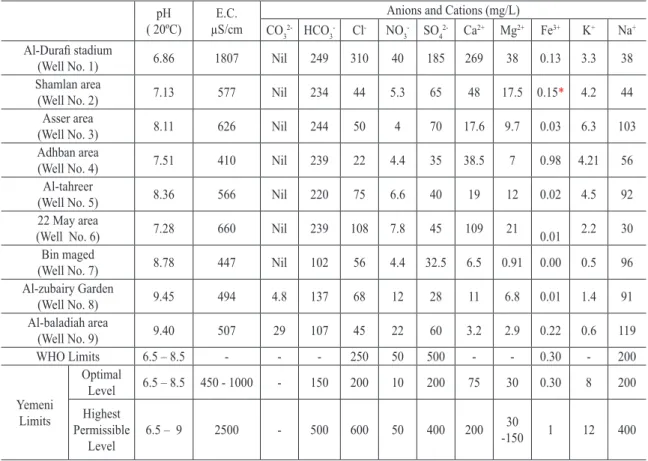
Mean values of the various parameters determined in the ground water samples drawn from the nine wells located at the three different districts, namely: Al-tahreer, Al-Wahdah and maeen, located in Sana’a secretariat, are shown
in table (1).
table 1. Mean values of physical and chemical parameters of ground water samples drawn from wells
lo-cated at different districts in Sana’a secretariat.
pH ( 20ºC)
E.C. µS/cm
Anions and Cations (mg/L) CO32- HCO
3
- Cl- NO 3
- SO 4
2- Ca2+ Mg2+ Fe3+ K+ Na+ Al-Durai stadium
(Well No. 1) 6.86 1807 Nil 249 310 40 185 269 38 0.13 3.3 38 Shamlan area
(Well No. 2) 7.13 577 Nil 234 44 5.3 65 48 17.5 0.15* 4.2 44 Asser area
(Well No. 3) 8.11 626 Nil 244 50 4 70 17.6 9.7 0.03 6.3 103 Adhban area
(Well No. 4) 7.51 410 Nil 239 22 4.4 35 38.5 7 0.98 4.21 56 Al-tahreer
(Well No. 5) 8.36 566 Nil 220 75 6.6 40 19 12 0.02 4.5 92 22 May area
(Well No. 6) 7.28 660 Nil 239 108 7.8 45 109 21 0.01 2.2 30 Bin maged
(Well No. 7) 8.78 447 Nil 102 56 4.4 32.5 6.5 0.91 0.00 0.5 96 Al-zubairy Garden
(Well No. 8) 9.45 494 4.8 137 68 12 28 11 6.8 0.01 1.4 91 Al-baladiah area
(Well No. 9) 9.40 507 29 107 45 22 60 3.2 2.9 0.22 0.6 119 WHO Limits 6.5 – 8.5 - - - 250 50 500 - - 0.30 - 200
Yemeni Limits
Optimal
Level 6.5 – 8.5 450 - 1000 - 150 200 10 200 75 30 0.30 8 200
Highest Permissible
Level
6.5 – 9 2500 - 500 600 50 400 200 30
-150 1 12 400
Each value of the determined parameter represents a mean of three measurements.
nil, means not detectable.
(-), means not available.
The pH mean values of ground water sam-ples determined for this study were in the range of 6.86–9.45, (lowest in well no. 1 and highest in well no. 8). The pH mean value (6.86), seems to be in agreement with what Foppen, J., (2002) concluded regarding pH decrease of ground water samples obtained from wells located in a part of Sana’a secretariat that has been developed between 1975
and 1995, because well no. 1, in Al-durai stadium
is located within this part of Sana’a secretariat. pH mean values of samples collected from wells no. 2 and 3 of maeen district and wells no (4-9) of Al-Wahdah district were ranged from 7.3 to 9.45.
This result also goes along with that indicated by Foppen, J., (2002) in his model for ground water in depth of more than 150m in the aquifer below
Sana’a secretariat, ive years after the year 2000.
Location of these two districts within the western part of Sana’a secretariat, where pit latrines are still very common might be an appropriate
rea-son to be used as a justiication for considering
such pH mean values are relatively comparable with that indicated by Foppen’s model. The range of electrical conductivity (EC), was 410 to 1807 µsimens/cm, (highest in well no. 1 and lowest in well no. 4). Although EC values of the ground water samples of this study are related to those of total dissolved solids (TDS), shown in table (2) here below, the EC values were all, except that of well no. (1) came within the optimal range levels
speciied in the Yemeni standard.
Chloride [Cl-] of the ground water samples
that [Cl-] is a major indicator that might be used to
infer iniltration of waste water from cesspits into
ground water (Foppen, J., 2002), and as it can be noted from table (1), [Cl-] in ground water sample
collected from well no. 1 was approximately equal to 9 mmol/L. Such mean value is considerably high and relatively comparable to the higher limit of [Cl-], reported by Foppen, J., (2002) in ground
water samples collected from wells located at the center and northern part below Sana’a secretariat. Ground water sample of well no. 1, located at
Al-durai stadium in Al-tahreer district within the
city center area is thus very likely contaminated
with waste water that might be iniltrate into it
from surrounded cesspits. This inference might be supported [NO3-], elaborated within the same
table, where it is noted that [NO3-] in the ground
water samples ranges from 4 - 40 mg/L, (highest in well no. 1 also). However, [NO3-] in well no.
1, as 40 mg/L (0.64 mmol/L) was fairly below the lower limit of range 1 to 3 mmol/L in ground wa-ter samples of aquifer below Sana’a secretariat, as reported by Foppen, J., (2002). Yet Fetouani, S. et al.,( 2008) indicated that ground water is con-sidered contaminated with waste water, when its [NO3-] exceeds 0.13 mg/L according to norms
pro-posed by the WHO for drinking water. While lo-west levels of sulphae [SO42-] in well no. 8, as 28
mg/L, the highest level of the [SO42-] was found in
well no. 1 as 185 mg/L.
The highest calcium concentration [Ca2+]
was found in ground water sample of well no. 1, as 269 mg/L and the lowest, in ground water
sample of well no. 9, as 3.2 mg/L. Though [Ca2+]
of ground water sample collected from well no. 1 was beyond the higher Yemeni permissible limit, none of the other ground water samples analyzed in this study for [Ca2+], however exceeded such
limit. Magnesium concentration [Mg2+] in the
ground water samples were in the range of 2.9 and 38 mg/L. The lowest and the highest were in well no. 9 and well no. 1 respectively, but even in well no. 1 [Mg2+] was within the range limits
(30 – 150 mg/L), stated in the Yemeni permissi-ble level. Iron concentrations [Fe3+] in ground
water samples range from zero to 0.98 mg/L, and none of the samples analyzed for iron in this study exceeded the permissible limits of the WHO and Yemen. Mean values of potassium [K+] and
so-dium [Na+] were found to be in the ranges 0.5-6.3
mg/L and 30-103 mg/L respectively. Even thou-gh ground water samples collected from well no. 3, located in maeen district, were of the highest
in concentrations of both potassium and sodium, ground water samples collected from wells no. 6 and 7 were of the lowest concentrations of the two cations. Yet, wells no. 6 and 7 are located in Al-Wahdah district.
2-Classiication of the ground water sam
-ples according to different criteria:
Classiication of the water ground samples
that were under investigation for this study is de-monstrated in table (2).
table (2). Classiication of ground water samples according to different criteria.
Cl- HCO 3
- + CO 3
2- SO
4
2- Hardness TDS (103ºC)
Base
exchange* Met.genesis
meq/l Class meq/l Class meq/l Class meq/l Class mg/l Class meq/l Class meq/l Class
Al-Durai stadium
(Well No.1) 8.73 normal 4.08 normal 3.9 normal 16.67 Very
hard 1175 brackish <1 A <1 deep Shamlan area
(Well No.2) 1.24 normal 3.84 normal 1.35 normal 3.86 Mod.
Hard 375 fresh <1 A <1 deep Asser area
(Well No.3) 1.41 normal 4 normal 1.46 normal 1.69 Soft 304 fresh >1 B >1 surface Adhban aeria
(Well No.4) 0.62 normal 3.92 normal 0.73 normal 2.51 Mod.
Soft 267 fresh >1 B >1 surface Al-tayseer
(Well No.5) 2.11 normal 3.61 normal 0.83 normal 1.95 Soft 275 fresh >1 B >1 surface 22 may area
(Well No.6) 3.04 normal 3.92 normal 0.94 normal 7.2 Mod.
Hard 429 fresh <1 A <1 deep Bin Maged
(Well No.7) 1.58 normal 1.67 normal 0.68 normal 0.41 Soft 291 fresh >1 B >1 surface Alzubairy garden
(Well No.8) 1.92 normal 2.41 normal 0.58 normal 1.12 Soft 239 fresh >1 B >1 surface
Albaldiah area
(Well No.9) 1.27 normal 2.72 normal 1.25 normal 0.4 Soft 330 fresh >1 B >1 surface
* Base exchange, change =
meqlL SO
Cl Na
2 4
A= Na-SO4 type, B = Na-HCO3 type Well
Site & No. Criteria
It is apparent from the table that the con-centrations of Cl-, SO
4 2-, HCO
3
-+ CO3
2-in all
sam-ples were found to be < 15 meq/L, < 6 meq/L, and (2–7 meq/L) respectively. Hence and according to the American Public Health Association (1992)
criteria, the samples are classiied as normal chlo -ride, normal sulphate and normal carbonate and
bicarbonate. Depending on mean values relec -ting degree of hardness in table (2) and according
to classiication of ground water proposed by
Klimentov, (1983), the ground water samples of the wells no. (2 and 5) are considered moderately hard, while that the well no. (1) is very hard, but those of the wells no.( 3, 5, 7, 8 and 9) are soft, and that of the well no. (4) is moderately soft. As it can be noted from table (2), the ranges of total dissolved solids (TDS) were 239 to 1175 mg/L, (highest in well no. 1 and lowest in well no. 8). In other words, the TDS mean values of all ground water samples, except that of well no. (1), were
below the optimal value (650) deined within the
Yemeni standards, and they were far below the
lo-wer limit (1000), speciied in the WHO standards.
Hence, ground water samples of the wells no. (2,
3, 4, 5, 6, 7, 8, 9), when the criteria speciied by
Davis, and De Wiest, (1967) is considered, would
be classiied as fresh, however that of the well no.
(1), would be brackish.
According to the base exchange values, calculated based on the formula proposed by Mat-thess, (1982) and shown below table (2), the pre-dominate water type of samples, drawn from well
no. (1, 2, and 6) in, located in Al-Durai stadium,
Shamlan area and 22 May area respectively, are Na-SO4, while Na-HCO3 water type is predomina-te in the other samples drown from well locapredomina-ted in Adban, AL-Tayseer, Bin Maged, AL-Zubairy Gar-den and Albaladiah areas. Ground water samples, drawn from well no. (1, 2, and 6) in, located in
Ecl. Quím., São Paulo, 35(1): 77 - 84, 2010 82
Artigo Article
Ecl. Quím., São Paulo, 35(1): 77 - 84, 2010 83
Artigo Article
respectively, were classiied to be deep meteoric water percolation type, and those of well no. (3, 4, 5, 7, 8, & 9) were classiied as surface and shallow meteoric water percolation type. Such classiication was
judged based on the values of hydrochemical parameters rK/Cl, rNa/rCl, rMg/rCl, rCa/rCl, and rSO4/rCl of the ground water samples under study, where (r = mq/L) for these parameters in each sample compa-red with that of the standard values of sea water as demonstrated by Abdel Moneim, A.A. (1998).
3- Suitability of the ground water samples for irrigation and industrial purposes:
Table (3) shows values of parameters that are typically used as indices for inferring suitability of ground water for irrigation and industrial uses.
table (3). Parameters indicating suitability of the ground water samples for irrigation and industrial uses.
Well site & No.
Parameter
SAR (meq/l)
RDS (Na%)
RSC
(meq/l) SI
Al-Durai stadium
(Well No.1) 0.57 9.0 - 12.54 0.3
Shamlan area
(Well No.2) 1.38 32.5 - 0.02 - 0.21
Asser area
(Well No.3) 4.87 70.8 2.31 0.35
Adhban aeria
(Well No.4) 2.17 48.2 1.41 0.08
Al-tayseer
(Well No.5) 4.05 66 1.66 0.6
22 may area
(Well No.6) 0.69 15.2 - 3.28 0.31
Bin Maged
(Well No.7) 9.26 90.9 1.26 0.21
Alzubairy garden
(Well No.8) 5.29 77.4 1.29 1.28
Albaldiah area
(Well No.9) 11.50 92.5 2.32 0.73
Sodium Adsorption Ratio (SAR) AR)
2 )
(
Mg Ca
Na m
meq/L
Ratio of dissolved sodium (RDS) Na%
Na% =
Ca Mg K
Na
Na 2 2
× 100
Residual sodium carbonate (RSC) = (CO32- + HCO 3
-) – (Ca2+ + Mg2+),
(-) Value indicates no residual carbonate, and (+) Value indicates presence of residual carbonate. Saturation Index (SI) is pHc= ( pk2 – pks) + pCa2+ + pAlk
(-) Value indicates suitability for industrial purposes, and (+) Value indicates unsuitability for industrial purposes.
Sodium adsorption ratio (SAR), ratio of dissolved sodium (RDS) as na%, or residual sodium carbonate (RSC) might equally be used for calculating a value which can be utilized as an index of ground water suitability for irrigation purposes (Shaki and Adeloye, 2006). All three parameters were employed in this study; however SAR is the most commonly one used for evalua-ting ground water suitability for irrigation purpo-ses (Ayers and Westcot, 1985). As it can be no-ted from table (3), SAR values of samples drawn from wells no. (1, 2, 4, 5and 6) ranged from 0.57 to 4.05. Such values indicated that these wells’ water is considered as good for irrigation purpo-ses at any types of soil (Soltan, 1998). SAR va-lues of the water samples drawn from wells no. (3, 7, 8 and 9) ranged from 4.87 to 11.50 and this may imply the presence of a hazard to soil and crop, when used such ground water source used for irrigation. That is because excessive sodium concentration in irrigation water would result in substantial decrease in soil permeability (Soltan, 1998; Shaki and Adeloye, 2006). This also can be supported through taking into consideration the RDS values of the water samples drawn from wells no. (3, 7, 8 and 9) shown within the same ta-ble, where it was proved that they all exceed 70% Na. Moreover, it is clear from table (3) that these ground water samples had RSC indices of positive value, implying that the cumulative concentration of the (CO32-and HCO
3
-) is higher than the com-bined (Ca2+ and Mg2+) concentration. This would
indicate there is a residual carbonate to react with sodium, presenting sodium hazard to soil when ir-rigated with such water.
As for testing the ground water suitability of this study for industrial purposes, the saturation index (SI) was used to speculate the extent to
whi-ch water lowing through pipes will precipitate or
dissolve calcium carbonate. According to Rhades
and Bernstein (1971), this index is deined as the
actual pH of a water sample (pHw) minus the pH calculated, which the water would have equili-brium with calcium carbonate pHc as follows:
pHc = ( pk2 – pks) + pCa2+ + pAlk
Where pk2 is the negative logarithms of the second dissociation constant of H2CO3, pks is the solubi-lity product constant of calcium carbonate, pCa2+
is the molar concentration of calcium and pAlk is
the equivalent concentration of CO32- plus HCO 3
-. If the saturation index is positive, CaCO3 will pre-cipitate, but if it is negative, CaCO3 will dissolve. By applying this index to the data of the samples shown in table (3), it was found that samples dra-wn from wells no. (1, 3, 4, 5, 6, 7, 8 and 9) had positive values, while that of well no. (2) had
ne-gative value. Such inding exhibit tendency for all
ground water samples, except that of well no. (2) to precipitate CaCO3 in pipes. Therefore, almost all ground water of wells used for this study appe-ared not to be suitable for industrial purposes.
Conclusion
Based on criteria limits speciied in the
standards of the WHO, and according to the stan-dards of the Yemeni Guideline for drinking water quality, ground waters of all wells, except that of well no. (1), which belongs to Al-tahreer
dis-trict, were considered suitable for drinking and domestic uses. Although ground water samples of this study were found to be good for irrigation purposes at any types of soil, only that of well no. (2) was found to be suitable for industrial uses.
reFerenCeS
Abdel Moneim,A.A. (1998). Hydrogeology of the Nile ba-[1]
sin Solag province, MSc. Thesis,Geol. Dept., Fac.Sci, Assuit Univ., Assiut Egypt.
American Public Health Association, APHA, (1998). [2]
Standard methods for the Examination of water and wastewa-ter 20th APHA, Washington, DC,USA.
Ayers, R.S., Westcot, D.W., (1985). Water quality for [3]
agriculture. In: FAO Irrigation and Drainage paper 29 Rev. 1, FAO, Rome.
Chgue’-Goff, C., Rosen, M. R. and Eser, P., (1999). Sewa-[4]
ge effluent discharge and geothermal input in natural wetland, Tongariro Delta, New Zealand. Ecological Eng., 12, 149 – 170.
Davis, S.N. and De Wiest, R.J., (1967). Hydrogeology (2
[5] nd
Edn) p.463. willey New York.
Eaton, F.M., 1950. Significance of carbonate in irrigation [6]
waters. Soil Sci. 69, 123- 133.
Fetouani, S., M. Sbaa, M. Vanclooster, B. Bendra (2008). [7]
Volume 35, número 1, 2010
(north-east Morocco). Agricultural water management, 95: 133-142.
Foppen, J. W. A., (2002). Impact of high-strength was-[8]
tewater infiltration on groundwater quality and drinking water supply: the case of Sana’a, Yemen.
Foppen, J. W. A., Naaman, M., Schijven, J. F., (2005). [9]
Managing water under stress in Sana’a, Yemen. The Arabian Journal for Science & Engineering, 30, (2C): 69 – 83.
Klimentov, P.K., (1983). General hydrology (1
[10] st Edn),
pp.101- 112. Russian ends Moscow.
Matthess, G. (1982). The properties of Ground water (1
[11] st
Edn), John Wiley & Sons, New York.
Mattiesen, H., (2008). Detailed chemical analyses of [12]
groundwater as a tool for monitoring urban archaeological deposits: results from Bryggen in Gergen. J. Archaeological Science, 35, 1378 – 1388.
Rhades, J.D and Bernstein, L., (1971). Chemical, phy-[13]
sical and biological characteristics of irrigation and soil wa-ter, In water and water pollution (Edited by Ciaccio, L.L.), chap.3. Marcel Dekker Inc., New York.
Shaki, A. A. and Adeloye, A. J. (2006). Evaluation of [14]
quantity and quality of irrigation water at Gadowa irrigation project in Murzuq basin, southwest Lybia. Agricultural Water Management, 84:193-201.
Sultan, M. E., (1998). Characterization, classification, [15]
and evaluation of some ground water samples in upper Egypt. Chemosphere, 37, (4): 735 – 745.
WHO (World Health Organization), (2006). Guideline [16]
for drinking water quality recommendation.
Yemeni Guideline (2000), for drinking water quality re-[17]
commendation.
Artigo/Article
oPtimiZAtion oF nmP eXtrACtion in 1,
3-ButADiene ProDuCtion Line
H.R.Mortaheb*, M.Mai*, B.Mokhtarani*, K.Khosravi**, F.Mashkini*
* Faculty of Chemical Engineering &Physical Chemistry
** Department of Analytical Chemistry
Chemistry & Chemical Engineering Research Institute of Iran 25 Km. Karaj High way, Pajoohesh blvd. Keywords: NMP, Extraction, n-heptane, Distillation
1To whom correspondence should be addressed, khosravik @ yahoo.com
Abstract: N-methylpyrrolidone is a powerful solvent for variety of chemical processes due to its vast chemical properties. It has been used in manufacturing processes of polymers, detergents, pharmaceuticals rubber and many more chemical substances. However, it creates large amount of residue in some of these processes which has to be dealt with. Many well known methods such as BASF in rubber producing units have tried to regenerate the solvent at the end of each run, however, there is still discarding of large amount of residue containing NMP, which over time, could cause environmental concerns. In this study, we have tried to optimize regeneration of the NMP extraction from butadiene production. It is shown that at higher temperatures NMP is separated from the residue with close to 90% efficiency, and the solvent residue proved to be the most effective with a 6: 1 ratio.
introduction
N-methylpyrrolidone is a weak base and is an aprotic solvent with low volatility and toxicity (1).It is a powerful solvent for a wide range of chemicals, and Due to its thermal stability and its relatively high dielectric constant, it is extensive-ly used in poextensive-lymer industries (2,3).Its numerous advantageous qualities such as being environmen-tally friendly substance, carcinogenicity, non-corrosiveness, and low solvent loss have given a widespread use in pharmaceutical products(4), detergent industries, polymer and rubber produ-cing plants (5,6), and many more usages are being found everyday. N-methylpyrrolidione is used in series of processes such as degassing, distillation, and solvent regeneration in rubber manufacturing as solvent for the extraction of 1,3-butadiene due to its high merit as a solvent, with the
extracta-bility of more than 99%; later the NMP and the residue is discarded or managed in a biologically equipped industrial waste treatment units which
itself requires extra process and inancial resour -ces (5,6,7). Recently, however, efforts have been invested in reviewing and revising the current
method. Our goal in this study was to ind a way
to extract NMP from the discarding residue of 1,3-Butadiene line to a higher percentage.
experimental