1 Universidade Federal de Campina Grande, campus Cajazeiras. Rua Sérgio Moreira de Figueiredo, s/n. Casas
Populares, Cajazeiras, PB, Brasil. 58.900-000. [email protected]
2 Département de Géographie, Université de Montréal. Montréal, QC, Canadá. 3 Fundação Universidade Regional de Blumenau. Blumenau, SC, Brasil.
OF THE MATA ATLÂNTICA BIOME
A riqueza biológica do bioma Mata Atlântica
nas representações das crianças
Maria Luiza Schwarz1 Pierre André2 Lucia Sevegnani3
Abstract: This paper aims to examine the representations of Brazilian children from Joinville Region of biodiversity in the Mata Atlântica. We interviewed 112 girls and 90 boys from a school in the city of Joinville, in the Brazilian state of Santa Catarina. These 6 to 14 year old students from grade 1 to 8 were requested to estimate the abundance of plants, animals and microorganisms in the region, and to name the species they know. Our results show that children are aware of the high level of biodiversity in their region, but they had difficulty in naming native species.
Keywords: Mata Atlântica. Joinville (SC). Children representation.
Resumo: Este artigo examina as representações de crianças brasileiras da região de Joinville sobre a
biodiversidade da Mata Atlântica. Foram entrevistados 112 meninas e 90 meninos de uma escola particular da cidade de Joinville, Santa Catarina. Os participantes eram estudantes de 1ª a 8ª Séries do Ensino Fundamental, com idades entre seis a 14 anos. Eles estimaram a abundância de plantas, ani-mais e micro-organismos da região e o nome das espécies que conhecem. Os resultados revelam que as crianças estão cientes da elevada quantidade de espécies que a região onde vivem possui, mas têm dificuldades para nomear as espécies que são nativas.
Introduction
The Mata Atlânticawhich extends the Brazilian coast from the Rio Grande do Sul to
the Rio Grande do Norte is the second most threatened biome on the planet. Nowadays, it only remains 11.2% of its original area and it is highly fragmented (RIBEIRO et al., 2009). The vegetation of the region is the result of approximately 12,000 years of evolution and its characteristics are closely related to its biota as well as local temperature, radiation and lumi-nosity (LEITE, 1991).
There are about 1.8 million different species in Brazil (LEWINSOHN; PRADO, 2005). A great part of these species can be found in the Mata Atlântica; it holds about 15,000 plant species and approximately 8,000 are considered endemic to this biome (STEHMANN et al., 2009). The Mata Atlântica is one of the five main biodiversity hotspots in the world and shelters many endemic species (MYERS et al., 2000; MITTERMEIER et al., 2005).
The destruction and unsustainable use of the Mata Atlântica began with the arrival of the Europeans, who used local resources in order to develop human habitats and install the first regional economic cycle which ended in mid 20th century (MONTEIRO, 1992). The resulting deforestation was the first observable effect of human activities on this regional ecosystem. According to Ficker (1965), it was in 1882 that deforestation was noted in the Joinville region. However, it was mainly in the 20th century that deforestation reached alarm-ing levels, and it is still progressalarm-ing (DEAN, 1995). The region of Joinville, our study area, is located in the Mata Atlântica biome (Figure 1).
Fonte: Maria Luiza Schwarz, 2007.
As we evoke the plants, animals and microorganisms of the Joinville region in class-room environment, we will use the term mental representation instead of perception (BAILLY 1985; BAUD et al., 2003). Perception is the function through which the mind represents objects that are real and perceivable, while the mental representation evokes objects that are not necessarily directly perceivable. Since mental imaging proceeds from a creative process, the resulting constructs are marked by a distance between the representation and the immedi-ate experience of an object on place.
We know that mental representations of an environment are linked to numerous variables such as gender, age, a possible naturalistic intelligence (GARDNER, 1995), econom-ic conditions, mass media influence, and environmental education. In this paper, we will ad-dress two main variables, those of gender and age.
A range of studies suggest that boys and girls perceive their environment differently. Bee (1996) argues, for example, that boys and girls do not differ according to an intellectual capacity standpoint, but differ in some sub-abilities. For example, boys appear to have a stron-ger aptitude in terms of interpreting space. In her study on children’s perception of biodiver-sity, Lindemann-Matthies (2002) shows that girls cite more animal and plant species than boys. Tunnicliffe (1998) demonstrates in a study with children visiting zoological parks that girls show a greater interest for plants than boys. Girls and boys have different spatial experiences in reason of the flexible radius of action in their neighbourhood they are allowed to use, and of the expectancies of their parents and society. Culture appears also as a crucial element in the gender differentiation, a fact that contributes to representations of landscape and biodi-versity (SCHWARZ; SEVEGNANI; ANDRÉ, 2007; SCHWARZ, 2007; RODRIGUES, 2001). Age is among the most important variables influencing children’s images of the biodi-versity. It is not only related to psychological development and expanding communication capabilities, but it is also linked to deeply lived and imagined experiences. In his seminal paper, Piaget (1947) shows that child development progresses with age. He observed, for example, a concrete operations period between 6 and 12 years old, and a formal operations period, repre-senting the final stage of cognitive development, beginning at the age of 12 and continuing throughout adolescence. Lindemann-Mathies (1999) shows that pupils must first observe their immediate environment, second become familiar with local species, and finally learn how to evaluate biodiversity. After these three stages, children can understand the functions and eco-logical importance of species within the ecosystem. They start to perceive biodiversity and then represent it in accordance with specific age-related abilities.
Methods
We have studied children’s mental representation of regional biodiversity in Joinville, as a part of Mata Atlântica. We have examined the potential differences in mental representa-tion among urban boys and girls, and of children at different stages of progress through elementary school. Following Lindemann-Matthies (1999), the data were collected using a questionnaire applied to selected age categories. For validation, the questionnaire was first tested on a girl and a boy from each age group. Later, it was applied in a private catholic school of the Joinville area, managed by the Sisters of Divina Providência. Overall, 90 boys and 112 girls between 6 and 14 years of age were interviewed, representing 30% of the school’s total population. The questionnaire, available on request, was applied to children both collectively and individually. In the case of children between 6 and 7, the examiner took notes paying specific attention to the names of animals, plants, and microorganisms quoted by the children. We applied the questionnaires according to grade. In Brazil, basic education starts with grade 1 and ends with grade 8 (called séries). We used the grade system to facilitate the contacts with girls and boys from different age groups. To be selected for this study, the children needed to be Brazilian, and to be born in the region of Joinville. These conditions were applied in order to increase group homogeneity by involving children from the same neighbourhood and so-cio-economic level. As a result, the children selected also have access to the same technolog-ical resources and transportation options. The statisttechnolog-ical differences have been tested through the use of the Chi-square test (χ²), using SPSS version 11.0.
Results
Image of biological abundance
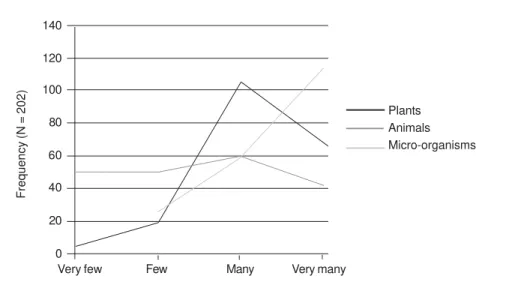
Children were asked to evaluate the relative abundance of plants, animals and micro-organisms of the Joinville area. More than 88.1% of the children answered that there are very many (55.9%) or many (32.2%) plants in their region (Figure 2). For the abundance of ani-mals, 49.5% of the answers are between many (29.3%) or very many (20.3%). The abundance of microorganisms received a higher rating than those of plants and animals.
Fonte: Maria Luiza Schwarz, 2007.
1 2 3 4 5 6 7 8
Grade 100
90
80 70 60
50
40 30
20
10 0
Animals: Very few - Few Very many - Many
Percentage (N = 202)
Percentage (N = 202)
1 2 3 4 5 6 7 8
Grade 100
90
80 70 60
50
40 30
20
10 0
Plants: Very few - Few Very many - Many
Percentage (N = 202)
1 2 3 4 5 6 7 8
Grade 100
90 80 70 60
50
40 30
20
10 0
Micro-organisms: Very few - Few Very many - Many
Figure 3. Estimate of the abundance of plants, animals and microorganisms in the region of Joinville according to the school grade.
Fonte: Maria Luiza Schwarz, 2007.
Observe the plants (animals and micro-organisms) when you take a walk for the region of Joinville. In your opinion, does Joinville possess: very many different species of plants (animals and organisms), many different species of plants (animals and organisms), few different species of plants (animals and organisms), very few different species of plants (animals and micro-organisms), or only one plant (animal and micro-organism) species? 140
120
100
80
60
40
20
0
Very few Few Many Very many
Plants Animals Micro-organisms
Frequency (N = 202)
Mental representation of biological richness
Flora
The mean number of plants cited was 5.5 taxa per child. A taxon (pl. taxa) is defined as a group or category at any level in a system for classifying plants or animals. The youngest children cite more exotic plants (73.1%) followed by native plants. The total number of native plant citations is equal to 298 distributed into 45 different taxa. The most frequently cited native taxon (Table 1) is the orchid, followed by the yellow trumpet (ipê - Tabebuia umbellata) and the coconut palm. When the name was very generic, such as shrubs and grasses, we considered that the child intends to represent native species.
Table 1. Plants cited by children from Joinville region.
Portuguese name Rosa Margarida Palmeira real Laranja Orquídea Banana Violeta africana Girassol Pinheiro Madeira Ipê Coqueiro Copo-de-leite Limão Pau-Brasil Goiabeira Samambaya Hortelã Araucária Mangueira Bromélia Árvore Sombreira Lixo Abacateiro Other taxa N<10
Total N citations
English name Rose Daisy Palm tree Orange Orchid Banana Violet Sunflower Pine tree Apple tree Yellow trumpet Coconut palm White calla lily
Lemon Brazil-wood Guava Fern Spearmint Parana Pine Mango tree Bromeliad Trees Sombreiro Lilies Avocado
Scientific name *
Rosa rosa Chrysanthemum leucanthemum Roystonea regia Citrus sinensis Fam. Orchidaceae Musa paradisiaca Saintpaulia ionantha Helianthus annuus Pinus elliotti Malus domestica Tabebuia umbellate Syagrus romanzoffiana Zantedeschia aethiopica Citrus limon Caesalpinia echinata Psidium guajava Pteridium aquilinum Mentha spicata Araucaria angustifolia Mangifera indica Vriesea incurvata Terminalia catappa Hemerocalis flava Persea americana
*: The scientific names refer to the more common taxa in the Joinville region.
Fonte: Maria Luiza Schwarz, 2007.
N 111 65 65 49 49 46 39 38 35 30 26 25 23 23 23 22 22 19 17 16 15 13 12 11 10 308 1112 % 9,0 5,7 5,7 4,3 4,3 4,1 3,5 3,4 3,2 2,8 2,3 2,2 2,0 2,0 2,0 1,9 1,9 1,7 1,5 1,4 1,3 1,1 1,0 0,9 0,8 30 100 Native No No No No Yes No No No No No Yes Yes No No Yes Yes Yes No Yes No Yes Yes No No No
Following botanical classifications, the children named primarily angiosperms, with 1,040 citations, followed for gymnosperms, with 52 citations, and cryptogams, with 23 cita-tions.
We have grouped the plants by their origin, potential use, and botanical classification. Whether these classifications are limited to native species or not, there are no significant differences between genders (p= 0.05).
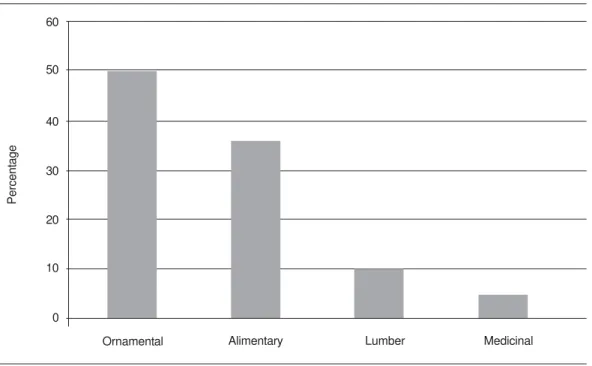
In relation to age, there is no significant difference according to the botanical classi-fication (p= 0.05), but there is one according to plant origin and potential. Children mainly cite angiosperms and exotic plants whatever their age (Figure 5). The children from grade 3 were the only group that cited more plants of alimentary properties (mainly exotic plants) than ornamental plants. There is a progression from grade 6 in the amount of cited medicinal plants. The majority of the cited plants that can be used for lumber were native such as araucaria and Brazilwood.
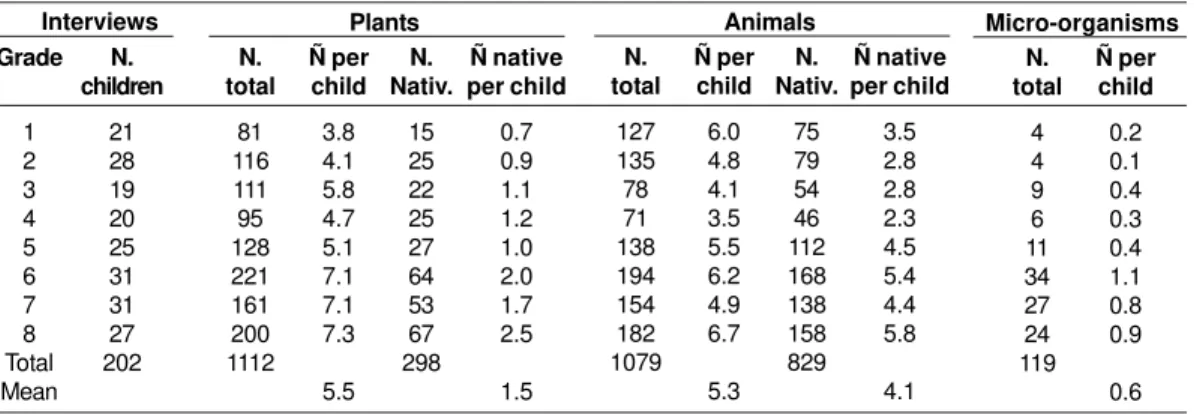
There are significant differences (p= 0.05) between grades for the average number of plants cited. Children from grade 8 surpassed the average (5.5) with 7.3 taxa per child, and children from grade 1 have shown the least number with 3.8 taxa per child. The individual highest score was 24 taxa. Table 2 shows a general increase of the total amount of plants cited with age, with exception of grade 3 that surpassed the average of grade 5. This pattern is maintained if we take into account only native plants, but it seems less regular throughout children’s development.
Fonte: Maria Luiza Schwarz, 2007. 60
50
40
30
20
10
0
Percent
age
Ornamental Alimentary Lumber Medicinal
Fonte: Maria Luiza Schwarz, 2007. Native Exotic 100 90 80 70 60 50 40 30 20 10 0 Grade
Percentage (N = 1
112)
1 2 3 4 5 6 7 8
Ornamental Alimentary Lumber Medicinal 100 90 80 70 60 50 40 30 20 10 0
1 2 3 4 5 6 7 8
Grade
Percentage (N = 1
112)
Fonte: Maria Luiza Schwarz, 2007.
Table 2. Number of taxa of plants, animals and micro-organisms cited in relation to grade.
Interviews Grade 1 2 3 4 5 6 7 8 Total Mean N. children 21 28 19 20 25 31 31 27 202 Plants N. total 81 116 111 95 128 221 161 200 1112 Ñ per child 3.8 4.1 5.8 4.7 5.1 7.1 7.1 7.3 5.5 N. Nativ. 15 25 22 25 27 64 53 67 298 Ñ native per child 0.7 0.9 1.1 1.2 1.0 2.0 1.7 2.5 1.5 Animals N. total 127 135 78 71 138 194 154 182 1079 Ñ per child 6.0 4.8 4.1 3.5 5.5 6.2 4.9 6.7 5.3 N. Nativ. 75 79 54 46 112 168 138 158 829 Ñ native per child 3.5 2.8 2.8 2.3 4.5 5.4 4.4 5.8 4.1 Micro-organisms N. total 4 4 9 6 11 34 27 24 119 Ñ per child 0.2 0.1 0.4 0.3 0.4 1.1 0.8 0.9 0.6 Fauna
The children cited animals more easily than plants even if we only requested animals native to the Mata. As for plants, when a child cited a general taxon such as snake, because different species of snakes occur in the region, we considered that they were referring to it as a native species. Out of the total (n= 1,079), 76.8% of citations were native species pertaining to 97 different taxa, the remaining being exotic species such as lion (n= 49), tiger (n= 35) and elephant (n= 10). Table 3 collates the most frequently cited taxa. Following zoological
fication, mammals were most often cited (n= 499), followed by birds (n= 210), amphibians (n= 120), arthropods (n= 119), reptiles (n= 99) and annelids, clams and fishes (n= 32).
Table 3. Animals cited by children from Joinville region.
Portuguese name Cobra Macaco Onça Leão Jacaré Ave Tigre Arara Capivara Tucano Gato-do-mato Lagarto Aranha Sapo e rã
Gambá Urso Bugio Tartaruga Coruja Anta Elefante Leopardo Papagaio Peixe Other taxa N<10
Total N citations Native N citations
English name Snake Monkey Jaguar Lion Alligator Bird Tiger Hyacinth macaw Capybara Toucan Spotted cat Lizard Spider Toad and frog
Skunk Bear Hauling monkey Turtles Owls Tapir Elephants Leopard Parrots Fishes
Scientific name *
Sub-ord. Serpents Ord. Primates Panthera onca Panthera leo Caiman sp. Cl. Aves Panthera tigris Anodorhynchus hyacinthinus Hydrochaerus hydrochaeris Ramphastos vitellinus Leopardus tigrinus Ord. Squamata Ord. Araneae Cl. Amphibia Didelphis ssp. Fam. Apidae Alouatta guariba Ord. Testudinata Ord. Strigiformes Tapir terrestris Fam. Elephantidae Panthera pardus Fam. Psittacidae Cl. Pisces
*: The scientific names refer to the more common taxa in the Joinville region.
Fonte: Maria Luiza Schwarz, 2007.
N 99 90 59 49 48 35 35 28 26 25 23 22 19 17 15 12 12 12 11 11 10 10 10 10 391 1079 829 % 9,2 8,4 5,4 4,5 4,4 3,2 3,2 2,5 2,4 2,3 2,1 2,0 1,7 1,7 1,3 1,1 1,1 1,1 1,0 1,0 0,9 0,9 0,9 0,9 37,3 100 Native Yes Yes Yes No Yes Yes No Yes Yes Yes Yes Yes Yes Yes Yes Yes Yes Yes Yes Yes Yes No Yes Yes
We tested the significance of animals named according to zoological classification and exotic or native origin. For both tests, there are no significant differences between girls and boys (p=0.05, d.f.=1).
and richness represented by grade 5 to 8 in comparison to the younger groups. Children from grade 1 to 4 cited more mammals, and those from grade 5 to 7, more birds. Children from grade 8 have cited the highest proportion of arthropods.
Fonte: Maria Luiza Schwarz, 2007. 100
90
80
70
60
50
40
30
20
10
0
Gender
Percentage (N = 202)
Girls (N=112) Boys (N=90)
Zoological classification Reptiles
Mammals Birds Arthropods Annelids, molluscs, fishes, amphibians
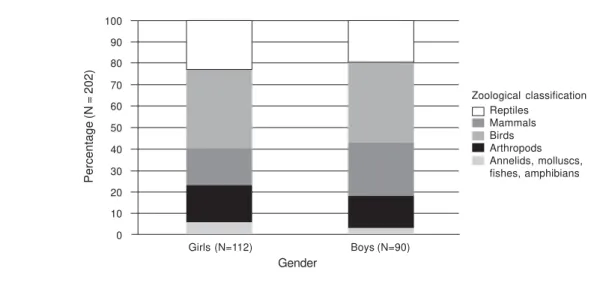
Figure 6. Comparison between boys and girls according to the zoological classification of cited animals.
Fonte: Maria Luiza Schwarz, 2007.
Zoological classification 100
90
80
70
60
50
40
30
20
10
0
1 2 3 4 5 6 7 8
Grade
Percentage (N = 1079)
Exotic Native
Mammals Birds Reptiles Arthropods
Annelids, molluscs, fishes, amphibians 100
90
80
70
60
50
40
30
20
10
0
Grade
Percentage (N = 829)
1 2 3 4 5 6 7 8
Microorganisms
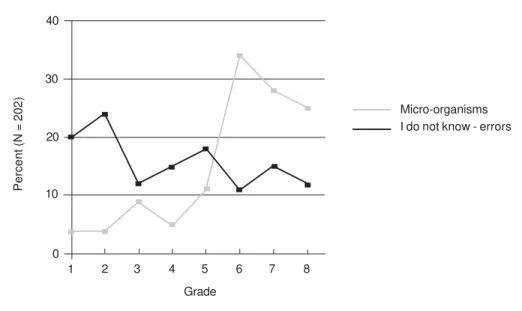
Children demonstrated significant difficulty in answering the questions about micro-organisms. More than half of the children said that they did not know or left the answer blank. There were only 119 citations of microorganisms among the respondents (Figure 8). There was no significant difference between boys and girls according to their classification of micro-organisms (p=0.05, d.f.=1), but there was one between the age groups (p=0.05, d.f.=7). Chil-dren from grade 1 to 5 demonstrated more difficulties in citing microorganisms than chilChil-dren from grade 6 and above.
Fonte: Maria Luiza Schwarz, 2007. 40
30
20
10
0 1
Micro-organisms I do not know - errors
Percent (N = 202)
2 3 4 5 6 7 8
Grade
Discussion
Flora
Children cited 45 different taxa of native plants and qualified the plants in the Join-ville region as very abundant. But, they had difficulties in naming different plant species, particularly native plants. Lindemann-Matthies (1999) observed the same result in Switzer-land, where children mentioned plants as more abundant than animals. In Joinville, the most often mentioned plants are exotic plants which have been present in the region since the colonization of Santa Catarina by Europeans, and which are known for their ornamental or food properties. These plants are mainly from the angiosperm group which is the most visible
botanical category throughout the world (WANDERSEE; SCHUSSLER, 2001) and have flow-ers and fruits which make them very remarkable. They are consequently represented by the children with ease.
The cited native plants such as the orchid, coconut palm, yellow trumpet, guava and fern are frequently used in the urban area. These plants are common in the children’s neigh-borhoods. This observation confirms that the space of representation is a living space with cultural heritage, a space of action and living situations (GIL FILHO, 2003). The most cited ornamental plants are generally colourful such as the rose, daisy and orchid, some of which also have a pleasant perfume.
This mental representation of the plant world reflects certain preferences by the chil-dren for specific species. The food plants, which are second after the ornamental ones, are fructiferous plants with fruits of diverse forms and colors (HERSHEY, 2002). In third place, the plant species with lumber properties, the araucaria followed by the Brazilwood, are tall and common trees that are easy to see. The frequent references to common species indicate rela-tively little knowledge of the regional flora (CARNIELLO; GUARIM NETO, 1997). Gender had no significant influence on the estimation of abundance of plants in the region of Join-ville. Both genders have cited more exotic plants than native, with ornamental or alimentary properties.
With respect to the abundance of plants, mental representations are quite similar between children from 6 to 14 years old; all confirm that there are many or a lot of plants in the Joinville region. But when we asked them to name plants, there was a significant increase with age. This observation contradicts the previous study from Lindeman-Matthies (1999) which had observed a diminution in the number of taxa named by teenagers. In terms of this general tendency, we have noted one exception: the 8 year olds cited more plants than the 10 year olds. To explain this observation, three hypotheses are offered. First, the augmentation of the ability to name species increases throughout the different phases of intellectual develop-ment of the child (PIAGET; INHELDER, 1948). This phenomenon may be influenced through social interactions and education. Second, there are specific ages at which a child shows more interest to the study of flora as in our study at age 8. Third, education has a great influence at this age. This may be related to educational programs, the way botany is incorporated in these programs, and the emphasis these programs put on plants and their role for alimentation.
Fauna
The children named a higher number of animals than plants. Many authors have shown that children are more attentive to animals than plants (HERSHEY, 1996, 2002; FLAN-NERY, 1991; LINDEMAN-MATTHIES, 1999). What draws children’s attention seems to be the fact that animals move (DARLEY, 1990). About 75% of the 97 animal taxa were cited more than 10 times. This may suggest that many of these species live in the children’s neigh-borhood. Mammals dominate the number of citations with about 50% of the total. In the study conducted by Lindemann-Matthies (2005), mammals were most frequently cited as well. According to Kellert (1985), mammals have always been perceived by both children and adults as sympathetic beings; morphologically, they look like humans (MORRIS; MORRIS, 1966).
(1996, 2002), this may be due to long-held “zoo-chauvinism” and “plant neglect” of people in general. For this author, zoo-chauvinism places plants in the background, being considered simply habitats for animals. It is also evident that nowadays the globalized-media place far greater emphasis on animals. For Wandersee and Schussler (2001), the main reason that peo-ple have more interest in animals than in plants is “due to the inherent constraints of their visual information processing system”; consequently, they coined the term plant blindness (see also WANDERSEE; CLARY, 2006; HERSHEY, 2002). Whatever the main reason is, it is clear from our study that native animals are easier to name by children than native plants.
In our study, the most cited animals in decreasing order of importance are snake, monkey, and jaguar. The snake may have been cited most frequently because it is an animal that can cause repulsion, fear and even terror (CONSORTI, 2004), as well as danger for people (LINDEMANN-MATTHIES, 2005; MORRIS; MORRIS, 1965). In a study on Brazil-ian ecosystems by Seniciato and Cavassan (2004), 5% of children participating in field courses showed fear of snakes. The monkey is seen by the children as an active, funny animal and it is frequently sighted in the Joinville region. The jaguar, an endangered species, is a much feared animal. Patto (1999), based on informal conversation with people living close to the Mata Atlântica, found out that individuals named the jaguar most frequently. For him, this is due to a lack of knowledge about this species that rarely attacks human beings.
Children living in urban context evoke negative connotations with respect to animals living in woods and forest ecosystems (MACHADO, 2004; SENICIATO; CAVASSAN, 2004). Most of the animals have been identified in very general terms. This shows a lack of
zoolog-ical knowledge, as education is mainly limited to didactic books (VASCONCELOS; SOUTO,
2003), and as urban children never encounter animals in their habitats (KELLERT, 1985; COSTA, 2005).
Following the jaguar in decreasing order of importance, children cited the lion. This species was cited more frequently by 6-8 year old children, and girls show higher number of cited species than boys. Kellert (1985) argues that children receive this knowledge through the media. There are many fictitious animals such as the Lion King, Donald Duck, Bambi and Winnie the Pooh which appear in books, cartoons and films (CHIPENIUK, 1995; HER-SHEY, 1996). These stars are known and appreciated by many children throughout the world, including Brazil. In a study on Brazilian children’s books, Machado (2004) found that the lion came in fifth place in order of appearance, after the elephant, the wolf, the bear, and the monkey. In our study, the elephant is also more cited by younger children than by older ones. Older children had a lower rate of misclassification with respect to both exotic and native animals. This may be related to a maturation of individual knowledge with age. The few citations of exotic animals by teenagers that did occur may be explained by two hypotheses. Firstly, the young may have confused one animal with another, for example a lion with another
Felidae. Secondly, this misclassification may be related to the teenage years, a period marked by contestation.
There are differences between genders according to the cited taxa. Girls have men-tioned a higher variety of animals than boys. They have cited, after mammals, more reptiles, arthropods, annelids, molluscs and fishes. This may be the result of both attraction and repul-sion to different species (LINDEMANN-MATTHIES, 2005); it may also reflect concern, revulsion or fear of the unknown. In United States, Souza and Czerniak (2002) have shown that girls are afraid of arthropods, mainly insects, and that they see them negatively. Boys mentioned more birds than girls. This may be related to cultural practices; as elsewhere, men and boys hunt birds in this region of Brazil. Furthermore, our interviews were carried out in the school yard, a place where many birds come eat crumbs left by the kids. If the same children were moving through a forest ecosystem, it would be normal that the animals will hide with the exception of birds. In the study by Seniciato and Cavassan (2004), a girl said that: “the animals do not appear; only the birds do”.
We have found a general improvement in mental representation of animal biodiversi-ty with age. While Lindemann-Matthies (1999) has shown a diminution in the number of taxa with teenagers, our research shows that it is the teenagers (grade 8) that the higher results both for the number of taxa and for the quality of their classification (fewer exotic species) ap-peared. Thirteen year olds quantified few numbers of animals in the region of Joinville, but they cited the highest number of species of all groups. Eight year olds cited more plants than animal taxa. This may be due to the fact that in grade 3, children have more botany and zoology classes, and that there is a higher interest for plants than animals at this age.
Microorganisms
The quantity of microorganisms cited by children shows no relationship to the num-ber of taxa named. This may be as a result of the fact that children know the existence of microorganisms, but cannot classify them easily. As they are very small and not easily seen, these taxa are hard to identify and to classify; they are always less attractive for people (LEWIN-SOHN, 2001). Generally speaking, children are convinced that microorganisms exist in large numbers, but they have difficulties in representing them.
Conclusion
Our results show that children from Joinville living in proximity from different eco-systems pertaining to the Mata Atlântica may easily access information through the media and environmental education, but they have a very limited knowledge of the regional biodiversity. Even if they recognize the biological abundance in their region, they show difficulties in nam-ing native species, particularly for plants and microorganisms. The plants better represented are those having ornamental or food properties. Children have a better knowledge of fauna.
classification. These results may reflect our sample of pupils who come from an exclusively urban context. This variable might be significant if we repeat this study with children from rural or forested areas.
According to age, we observed a clear progression in the mental representation of biodiversity with childhood development. The younger children appeared to overestimate the abundance of animals, and to have difficulties in naming plants, animals and microorganisms, particularly native species. Consequently, they considered most exotic species, coming from their world of fantasy, as native species.
As has been highlighted in many national and international conferences, educational efforts remain a priority in order to address the ecological degradation and loss of biodiversity in areas such as the Mata Atlântica. To improve children’s knowledge of native biodiversity, we draw attention to the importance of focusing on regional flora, fauna and microorganisms in formal and informal education programs.
Acknowledgments
This work has been supported in part by CAPES (Coordenação de Aperfeiçoamento de Pessoal de Nível Superior). The authors would like to thank Dr. Patricia Martin for a critical review of a previous version of this article and Dr. Kathryn Furlong for the English review of this paper.
References
BAILLY, A. Distances et espaces: vingt ans de géographie des représentations. L’espace
géographique, Paris, v. 14, n. 3, p. 197-205, 1985.
BAUD, P. et al. Dictionnaire de géographie. Paris: Hatier, 2003.
BEE, H. A criança em desenvolvimento. São Paulo: Artes Médicas, 1996.
CARNIELLO, M.; GUARIM NETO, G. As plantas na percepção dos alunos do primeiro
grau em uma escola pública da Universidade do Mato Grosso. Revista Científica da
Universidade do Mato Grosso, Cuiabá, v. 6, n. 10, p. 9-19, 1997.
CHIPENIUK, R. Childhood foraging as a means of acquiring competent human cognition about biodiversity. Environment and Behavior, Beverly Hills, v. 7, n. 4, p. 490-512, 1995.
CONSORTI, G. F. R. Levantamento dos mitos e medos envolvendo serpentes na
cidade de Sorocaba. 2004. 15 p. Trabalho de Conclusão de Curso (Graduação em Biolo-gia) – Centro de Ciências Médicas e Biológicas de Sorocaba, Pontifícia Universidade Católica, Sorocaba, 2004.
DARLEY, W.M. The essence of ‘plantness’. The American Biology Teacher, Reston, v. 52, p. 354-35, 1990.
DEAN, W. With broadax and firebrand: the destruction of the Brazilian Atlantic Forest.
Berkeley: University of California Press, 1995.
FICKER, C. Crônicas da Colônia Dona Francisca. Joinville: Ipiranga, 1965.
FLANNERY, M.C. Considering plants. The American Biology Teacher, Reston, v. 53, n.
5, p. 306-309, 1991.
GARDNER, H. Inteligências múltiplas. Porto Alegre: Artes Médicas Sul, 1995.
GIL-FILHO, S. F. Espaço de representação: uma categoria-chave para a análise cultural em Geografia. In: ENCONTRO SUL-BRASILEIRO DE GEOGRAFIA, 1., 2003, Curitiba.
Anais... Curitiba: Associação dos Geógrafos do Brasil. 2003. Available at: <http:// www.geografia.ufpr.br/gilfilho/documentos/espacoderepresentacao.pdf>. Accessed on: 22 Jul. 2011.
HERSHEY, D. R. Plant blindness: “we have met the enemy and he is us”. Plant Science
Bulletin, Columbus, v. 48, p. 78-84, 2002.
______. A historical perspective on problems in botany teacher. The American Biology
Teacher, Reston, v. 58, p. 340-347, 1996.
KELLERT, S.R. Attitudes towards animals: age-related development among children.
Journal of Environmental Education, Washington, v. 6, n. 3, p. 29-39, 1985.
LEITE, P.V.M.C. Os ecossistemas da região de Joinville, seus problemas e a
ne-cessidade da educação ambiental. Joinville: FUNDEMA, 1991.
LEWINSOHN, T. M. A evolução do conceito de biodiversidade. ComCiência, 2001.
Available at: <http://www.comciencia.br/reportagens/biodiversidade/bio09.htm>. Ac-cessed on: 22 Jul. 2011.
LEWINSOHN, T. M.; PRADO, P. I. How many species are there in Brazil? Conservation
Biology, Boston, v. 19, n. 3, p. 619-624, 2005.
LINDEMANN-MATTHIES, P. ‘Loveable’ mammals and ‘lifeless’ plants. How children’s interest in common local organisms can be enhanced through observation of nature.
International Journal of Science Education, London, v. 7, n. 6, p. 655-677, 2005.
______. Children’s perception of biodiversity in everyday life and their preferences
for species. 1999. 145 p. PhD thesis (Natural Sciences) –University of Zurich, Zurich, 1999.
______. The influence of educational program on children’ perception of biodiversity.
Journal of Environmental Education, Washington, v. 33, n. 2, p. 22-31, 2002.
MACHADO, A. Quem lê e gosta, protege. In: CONGRESSO BRASILEIRO DE
MITTERMEIER, R.A., et al. Hotspots revisited: earth’s biologically richest and most endangered terrestrial ecoregions. 2. ed. Boston: University of Chicago Press, 2005.
MONTEIRO, J. M. Os Guaranis e a história do Brasil Meridional. In: CUNHA, M. C.
(Org.). História dos índios do Brasil. São Paulo: SMC: Companhia das Letras, 1992. p.
475-498.
______. Men and pandas. London: Sphere Books, 1966.
MORRIS, R.; MORRIS, D. Men and snakes. London: Hutichinson, 1965.
MYERS, N. et al. Biodiversity hotspots for conservation priorities. Nature, London, v. 403, n. 6772, p. 853-858, 2000.
PATTO, C. Os perigos da selva. Available at:
<http://www.webventure.com.br/cobertu-ras/dakar2009/conteudo/noticias/index/id/2302?pag=2>. Accessed on: 15 Jul. 2011.
PIAGET, J. La représentation du monde chez l’enfant. Paris: Presses Universitaires de
France, 1947.
PIAGET, J.; INHELDER, B. La représentation de l’espace chez l’enfant. Paris: Presses
Universitaires de France, 1948.
RIBEIRO, M. C. et al. The Brazilian Atlantic Forest: how much is left, and how is the remaining forest distributed? Implications for conservation. Biological Conservation, Essex, v. 142, n. 6,p.1141-1153, 2009.
RODRIGUES, G. S. de S.C. Representações da paisagem do Parque Nacional da
Serra da Canastra - MG: o olhar do viajante, da população local e do geógrafo. 2001. 98 f. Dissertação (Mestrado em Geografia) – Faculdade de Filosofia, Letras e Ciências Hu-manas, Universidade de São Paulo, São Paulo, 2001.
SCHWARZ, M. L.; SEVEGNANI, L.; ANDRÉ, P. Representations of the Atlantic Rain-forest and its biodiversity through children’s drawings. Ciência & Educação, Bauru, v. 13, n. 3, p. 369-388, 2007.
SCHWARZ, M. L. As representações de crianças e adolescentes da biodiversidade de
Mata Atlântica na região de Joinville (Santa Catarina-Brasil). 2007. Tese (Doutorado em Geografia) – Departmento de Geografia, Universidade de Montréal, Montréal, 2007.
SENICIATO, T.; CAVASSAN, O. Aulas de campo em ambientes naturais e aprendizagem
em ciências – Um estudo com alunos do ensino fundamental. Ciência & Educação,
Bauru, v. 10, n. 1, p. 133-147, 2004.
SOUZA, J. M. S.; CZERNIAK, C. M. Social behaviours and gender differences among preschoolers: implications for science activities. Journal of Research in Childhood Education, Wheaton, v. 16, n. 2, p. 175-188, 2002.
STEHMANN, J. R. et al. Plantas da Floresta Atlântica. Rio de Janeiro: Jardim Botânico,
TUNNICLIFFE, S. D. Boy talk: girl talk – Is it the same at animal exhibits? International Journal of Science Education, London, v. 7, n. 7, p. 795-811, 1998.
VASCONCELOS, E. D.; SOUTO, E. O livro didático de Ciências no ensino fundamental – proposta de critérios para análise do conteúdo zoológico. Ciência & Educação, Bauru, v. 9, n. 1, p. 93-104, 2003.
WANDERSEE, J. H.; CLARY, R. M. Advances in research towards a theory of plant blindness. In: INTERNATIONAL CONGRESS ON EDUCATION IN BOTANIC
GARDENS, 6., 2006, London. Proceedings... London: Botanic Gardens Conservation
International, 2006. Available at: <http://www.bgci.org/files/Worldwide/Education/ Edu_congress_proceedings/success_for_nature__proceedings__part_1_v2.pdf >. Access-ed on: 29 Sep. 2006.
WANDERSEE, J.H.; SCHUSSLER, E. Toward a theory of plant blindness. Plant Science
Bulletin, Columbus, v. 47, n. 1, p. 2-9, 2001.