320 Rev. Bras. Pesq. Tur. São Paulo, 11(2), pp. 320-346, maio/ago. 2017.
Touris i age a d ide tity related to ultural pra ti es
a d heritage per ei ed y reside ts: perspe ti es fro the
ity of Blu e au, “a ta Catari a, Brazil
Imagem e identidade turísticas relacionadas às práticas e bens
culturais percebidas pelos residentes: perspectivas a partir da cidade
de Blumenau, Santa Catarina, Brasil
Imagen e identidad turísticas relacionadas a las prácticas y bienes
cul-turales percibidos por los residentes: perspectivas a partir de la
ciudad de Blumenau, Santa Catarina, Brasil
Fabricia Durieux Zucco1
Cynthia Morgana Boos de Quadros2
Juliane Regina Schmitt3
Thamires Foletto Fiuza4
Abstract: Proposal: The growth of tourism leads to a large increase of tourism products offered in the market. Before travel decision making, and among the many options available, the tourist seeks infor-mation about the various destinations. The destination image created in this search process is a key driver for tourists. Despite the variety of factors that make up a given destination image, the cultural identity is composed of the destination own heritage. Also, to create an identity of a place involves the participation of the residents of the destination. Objective: This study seeks to analyze the brewing culture, as a possible cultural identity of the city of Blumenau and therefore considers the attitudes of the residents. Methodological Design: The research is considered exploratory and descriptive, with
1 University of Vale do Itajaí (UNIVALI). Balneário Camboriú, SC, Brazil and Regional University of Blumenau (FURB). Guidance to the conception and design of the scientific work, statistical treatment of data, data anal-ysis, and validation of hypotheses.
2 Regional University of Blumenau (FURB). Blumenau, SC, Brazil. Conception of the theoretical foundation, design of the scale, coordination of all the fieldwork/tabulation activities, and critical review of the final work. 3 Regional University of Blumenau (FURB). Elaboration of the theoretical framework, data collection, data
analysis, writing of the paper.
4 University of Vale do Itajaí (UNIVALI). Elaboration of the theoretical foundation, critical review, writing and preparation of the paper.
321 Rev. Bras. Pesq. Tur. São Paulo, 11(2), pp. 320-346, maio/ago. 2017.
quantitative approach. From the review of the literature on the subject, we established twelve hypoth-eses. We performed data collection and analysis using the following statistical procedures: Cronbach's Alpha, Spearman's correlation, and the hypothesis test, using SSPS software. Results: The results ob-tained in the research, confirmed seven of the twelve hypotheses, indicating the existence of positive relations between the influence of the habits of the residents and the dimensions of the identity of Blumenau. Originality: It is concluded that it is possible to use the brewery culture as a cultural identity of the city, thus suitable for tourism promotion.
Keywords: Cultural identity. Brewing culture. Tourism promotion.
Resumo: Propósito do tema: O crescimento do turismo proporcionou um grande aumento dos produtos turísticos que são ofertados no mercado. Antes de tomar a decisão, acerca de sua viagem e diante de tantas opções, o turista busca se informar sobre os mais variados destinos. A imagem de destino, criada por meio dessa busca, é um estímulo fundamental para o turista. Embora exista uma variedade de fatores que compõem uma imagem de determinado destino, são os seus elementos próprios que constituem a sua identidade cultural. Criar uma identidade de um lugar, envolve também a participação dos residentes do destino. Objetivo: Esse estudo busca analisar a cultura cervejeira, como uma possível identidade cultural de Blumenau e, para tanto, leva em conta as atitudes dos residentes. Metodologia e abordagem: A pesquisa é considerada exploratória e descritiva, com método quantitativo. A partir da revisão da literatura sobre o assunto, doze hipóteses foram estabelecidas. Realizou-se a coleta e análise de dados que contou com os seguintes procedimentos estatísticos: Alfa de Cronbach, a Correlação de Spearman e o teste de hipóteses, por meio do programa SSPS. Resultados: Os resultados, obtidos na pesquisa, confirmaram sete, das doze hipóteses, o que indica a existência de relações positivas entre a influência dos hábitos dos residentes e as dimensões da identidade de Blumenau. Originalidade: Conclui-se que é possível a utilização da cultura cervejeira como uma identidade cultural da cidade, o que a torna adequada à sua promoção turística.
Palavras-chave: Identidade cultural. Cultura Cervejeira. Promoção turística.
322 Rev. Bras. Pesq. Tur. São Paulo, 11(2), pp. 320-346, maio/ago. 2017.
de éstos. Los procedimientos estadísticos utilizados fueron: Alfa de Cronbach, la Correlación de Spear-man y la prueba de hipótesis, por medio del programa SSPS. Resultados: Los resultados, obtenidos en la investigación, señalan que se confirmaron siete de las hipótesis establecidas lo que indica que exis-ten relaciones positivas entre la influencia de los hábitos o costumbres de los habitantes y las dimen-siones de identidad de la ciudad de Blumenau. Originalidad: Se concluye que es posible el uso de la cultura cervecera como una identidad cultural de dicha ciudad, lo que la deja adecuada a hacerle pro-paganda turística.
Palavras clave: Identidad cultural. Cultura Cervecera. Propaganda turística.
1 INTRODUCTION
The evolution of tourism has led to an increase of tourism product diversity (Pérez-Nebra & Rosa, 2008). Currently, there are many reasons to move from a place to an-other and this generates growth in the seg-ment. Within the economy, world tourism generated more than US$ 1 trillion in 2014 and, in Brazil, the segment represents 3.6% of GDP - Gross Domestic Product (Neto, 2015). The Statistical Yearbook of Tourism of 2015 (Brasil, 2015) revealed that more than 6.4 million tourists passed through Brazil in 2014, and in Santa Catarina the number of tourists amounted to more than 156 thou-sand.
Tourism promotion aiming to create a consistent destination image and cultural identity is key to the destination perfor-mance, by emphasizing positive features and promoting the place (Lavandoski, Tonini, & Barretto, 2012). Recent research in the field of tourism and destination image, as well as i ultural ide tity a d reside ts parti ipa-tion underlines and justifies this importance.
Different research approaches re-garding destination image and identity are
mentioned by authors such as Azambuja and
Mecca (2017), Azevedo, Paes and Andrade
(2014), Banducci Junior and Barreto (2001), Dias and Cassar (2006), Echtner and Ritchie (1991), Gallarza, Saura and García (2002), Pé-rez-Nebra (2005), Stets and Biga (2003) and Williams (1995).
‘egardi g the reside ts per eptio s, Besculides, Lee and Mccormick (2002) con-sider that tourism brings numerous cultural benefits. Other relevant studies on this sub-ject are those by Andereck, Valentine, Knopf and Vogt (2005) that used the social ex-change theory or by Carniello and Santaella (2012), Choo and Park (2011), Lavandoski, Tonini and Barretto (2012), Nunkoo and Gur-soy (2012) that used the social exchange the-ory and the identity thethe-ory. Fernandes, Cas-tillo and Gândara (2016), Plummer, Telfer, Hashimoto and Summers (2005), Wang and Chen (2015), Williams, McDonald, Riden and Uysal (1995) and Zhang, Ryan and Cave ha e also studied the reside ts per-spective on tourism.
323 Rev. Bras. Pesq. Tur. São Paulo, 11(2), pp. 320-346, maio/ago. 2017.
Days & Cassar, 2006; Fernandes et al., 2016), we can assume that residents who enjoy and know the tourism product of their city per-ceive a greater relationship between this and the destination.
In keeping with the ideas presented, we can examine the extent to which the brewery culture is associated to the city of Blumenau, Santa Catarina (Brazil) and to its inhabitants. Beer has become ideal for
pro-oti g the ity hi h is k o as the Brazil-ia eer apital .
In what refers to the image of Blu-menau, it is important to know the reality fro the reside ts ie poi t a d erify if they identify the brewery culture as an ele-ment of identity of the city. This study pro-vides the public and private entities working on tourism promotion with data about desti- nation image and identity, thus contributing to a consistent communication.
The aim of this study is to analyze, fro the reside ts attitudes, the re ery culture as part of the cultural identity of Blu-menau and as key element of tourism pro-motion. Using hypothesis tests, developed based on the literature, we verified how the identification and habits of the residents, in relation to beer and craft draft beer, influ-ence the perception about the image of Blu-menau, their participation in cultural events and knowledge about tourism products.
The municipality of Blumenau is in the region of Vale do Itajaí, Santa Catarina, Brazil (Figure 1). The city has about 334,002 inhab-itants and it became an inducer destination of the Tourist Region of the European Valley (Prefeitura Municipal de Blumenau, 2015).
According to the Blumenau Municipal Tour-ism Plan (Prefeitura Municipal de Blumenau, 2015), the destination presents many traits of German culture, visible in different parts of the city in the architecture, predominantly
Enxaimel (timber framing), handicrafts, food, and various German-related cultural mani-festations.
The existence and valuation of such German heritage in the municipality as well as the city image as the national capital of beer have prompt the massive appearance of German-inspired attractions, craft breweries, and events. Among these, the Oktoberfest
stands out as the major product of the desti-nation. It is considered the second biggest German traditional festival in the world (Pre-feitura Municipal de Blumenau, 2015) and at- tracts thousands of tourists to the city. More-over, the city has a school offering courses and training on beer production; hosts the annual Brazilian Beer Festival; has the first "micro-malt house" of the country; and is the headquarters location of many national and international awarded micro-breweries.
324 Rev. Bras. Pesq. Tur. São Paulo, 11(2), pp. 320-346, maio/ago. 2017.
identity, and seek to contribute to future re-search on the subject.
Figure 1 – Location of the city of Blumenau, Santa Catarina
Source: Wikipedia (2017)
2 TOURISM PRODUCT AND DESTINATION IDENTITY
The tourism product is different from that we find on store shelves. It is not possi-ble to take and consume the tourism product anywhere or try it before the buying decision is made. Due to this fact Miranda and Mi-randa (1999: 122) argue that a tourist at-traction is more dependent on promotion than any other consumption produ t , e-cause, unlike the tourism product, that prod-uct on the shelf does not always need promo-tional material to encourage the purchase.
Tourist attractions are part of the tourism product, and may also reflect the in-trinsic, distinctive, and unique character of a
community, both in terms of cultural and en-vironmental aspects. (Santos, Ferreira, & Costa, 2014). Within this context, a study with tourists and residents of Algarve, Portu-gal, identified that the core resources of the destination referred to elements of the cul-tural and nacul-tural landscape. As a conclusion, the development of innovative tourism prod-ucts should be based on the concept of cul-tural landscape (Santos et al., 2014).
325 Rev. Bras. Pesq. Tur. São Paulo, 11(2), pp. 320-346, maio/ago. 2017.
these products can also help promote and enhance the local identity. The authors also point out that the manufacturing sites of the traditional products can be considered tour-ist attractions of the place. People visiting such sites become aware of the brand and image of the destination.
Beer, as a characteristic product of a destination, can be represented in visitation to breweries, participation in beer festivals and beer shows, wherein it is possible to taste the product of the region, which often is the motivating factor for visiting a destina-tion. Plummer et al. (2005) investigated the results of the tourist flow in the breweries of Ontario, Canada. They surveyed the profile of visitors to the breweries in the region and how they obtained information about the destination. They also assessed the im-portance of these visits in the itinerary of non-resident tourists. Such information con-tributes to the recognition of the role of tour-ism for breweries.
The local cuisine and drink are em-bedded in the tourism product of the desti-nation, which makes significant the resi-de t s identification with the characteristic product of the place and its knowledge, since tourists seek to consume what is specific to the city (Plummer et al., 2005). Residents identify themselves with the local product if its features are related with the image of the destination that will be promoted (Buosi, Lima, & Silva, 2017; Pérez-Nebra, 2005). In keeping with these ideas, we put forward the following hypotheses:
H1 - The higher the frequency of craft beer and draft beer consumption,
the greater the knowledge about the tourism products of Blumenau; H2 - The greater the number of
well-known brands of craft beer and draft beer, the greater the knowledge about the tourism products of Blu-menau;
H3 - The greater the expertise about craft beer and draft beer, the greater the knowledge about the tourism prod-ucts of Blumenau;
H4 - The greater the identification with craft beer and draft beer, the greater the knowledge about the tourism products of Blumenau.
Following Gallarza, Saura and García (2002) regarding the use of destination ima- ge we can refer that there are three dimen-sions that relate the variables for measuring image: the perception of the individual; the dimension of objects or destinations; and the attributes or characteristics. The authors consider that there are a set of factors com-posing the identity of destination image, which have become an important line of re-search.
326 Rev. Bras. Pesq. Tur. São Paulo, 11(2), pp. 320-346, maio/ago. 2017.
psychological factors that influence the de-velopment of an advertising campaign.
Carniello and Santaella (2012) verified in their study the existence of three types of tourism images: global, traditional, and cur-rent. Global image is related to the general view that tourists have of the destinations they want to know; the traditional image re-sults from previous experiences; and the cur-rent image represents the destinations cre-ated by the media. Despite the role of adver-tising in tourism, the findings of the survey conducted with tourists by Carniello and San-taella (2012) show that the perceived desti-nation image is more linked to social relation-ships and to attributes than to the discourse of the media.
The conceptual model of determinan- ts of a tourism destination image, proposed by Mazzon and Vera (2008), highlighted the fa tor satisfa tio as a te ede t to loy-alty a d o it e t . The odel esta -lishes that the image may be considered a mediator between quality, satisfaction, and loyalty, because it represents post-consump-tion expectapost-consump-tions. From another point of view, Neiman, Geerdink and Pereira (2011) carried out a study that reveals how photog-raphy is a determinant motivational drive for tourism when compared to a description of the same destination. The results suggest that expectations, perceptions, and motiva-tions are embedded in a set of internalized sensations and experiences. The meanings attributed to this set can be positive, nega-tive, or neutral.
Echtner and Ritchie (1991) show that destination image influences tourism behav-ior and that destinations with more positive images tend to be chosen by tourists in the decision-making process. We can point out that tourist satisfaction depends on the com-parison between the images formed, based on the expectations and the image of the re-ality found. Another aspect regarding the im-age of the destination perceived by the tour-ist, is the relationship between the individual and their space. After the decision to travel, the tourist develops basic and prestige needs that, combined with the characteristics of the place, will create a perception about the des-tination, which will define or not their visit to the place (Neiman, Geerdink, & Pereira, 2011).
Stets and Biga (2003) in their identity theory studies establish three impressions. First is the standard, a set of meanings at-tached to a destination identity. Second is ap-praisal, based on the feedback from others. The third is the situation resulting from the comparison between perception and the standard, and registers the degree of discrep-ancy between the two. The discrepdiscrep-ancy is ex-pressed in terms of emotions, i.e. the greater the discrepancy the more intense the nega-tive emotion. Finally, the emotion results from the comparison between perceptual in-put and the identity
standard
327 Rev. Bras. Pesq. Tur. São Paulo, 11(2), pp. 320-346, maio/ago. 2017.
ing population. This increase of residents, along with poor planning by destination man-agers, leads to a loss of identity and culture of the region. In this way, one can conclude that residents established for a longer time in each environment, are responsible for pre-serving the local identity and culture. How-ever, Dias and Cassar (2006) consider that the isitor s re o aissa e of the character-istics of the locality and their association with the benefits is a step toward building loyalty. The creation of destination identity depends on its residents who must assume it so that this destination consolidates the image of the tourist (Dias & Cassar, 2006; Fernandes et al., 2016).
Regarding the influence of the identi-fication of the residents with the place and regional identity, in what refers to tourism development, Williams et al.s (1995) studies confirm that the length of residence is more strongly correlated with the sense of commu- nity than with any community or regional identity. Research with residents of cities near Mt. Rogers National Recreation Area (NRA), located in Virginia, found that tour-ism-friendly residents are more likely to ex-press stronger ties to the regional character of the destination than to the community. The study shows a higher correlation be-tween length of residence and sense of com-munity and a poor correlation between length of residence and regional identity.
The resident also plays a role in iden-tifying elements that make the region unique. Santos et al. (2014), consider that the resources identified by residents and tourists are key resources and can support the deve-
lopment of innovative tourism products. The authenticity of destination image depends greatly on the presence of the residents in the places, their relationship and identifica-tion with them. Lavandoski, Tonini and Bar-retto (2012) identify the value that wine has for the region of the Vale dos Vinhedos, strengthening the local identity of people of Italian descend. With time, wine has become an asset and a tourist attraction in the region. In another study on wine as a tourism product, it is possible to acknowledge its at-traction value for the British Columbia re-gion. From the perspective of tourism devel-opment, data presented by Williams and Kelly (2001) show the growth of the wine in-dustry in both quantity and quality in its pro-duction and suggest the existence of consid-erable opportunities for wineries to attract visitors to these rural destinations. The au-thors state that wine region residents tend to be more loyal to wine product and
their wine region.
Silva and Junior (2016) developed re-search on the factors that influence resi-de ts support for the development of Reli-gious tourism in Santa Cruz (RS). The results show that the more residents perceive tour-ism benefits, the greater the propensity for community support for the development of Religious tourism.
328 Rev. Bras. Pesq. Tur. São Paulo, 11(2), pp. 320-346, maio/ago. 2017.
both complement each other in the evalua-tion of this attitude. A friendly interacevalua-tion be-tween visitors and residents, for example, creates a significant effect on visitor satisfac-tion with the destinasatisfac-tion. Often the interest of the visitors is put ahead of the needs and concerns of the residents and that can pro-voke conflicts. In this way, it crucial to take the residents' point of view into account to maintain their support for tourism.
A study by Nunkoo and Gursoy (2012) carried out in Mauritius, found that resi-dents' support for tourism development is based on the expected benefits and that the gender also influences the support. Thus, the inclusion of sociodemographic factors in the studies can improve the prediction of basic behavior, since the theory of identity as-sumes that individuals do not behave accord-ing to discrete and personal decisions. They are embedded in a social structure that influ-ences their behavior.
Regarding branding destination strat-egies, Choo and Park (2011) point out that the relationship between the resident and the tourism destination brand has been little explored in tourism research. In their studies, they sought to empirically test the role of res-idents in shaping the destination brand. They have examined how the identification of the residents with the place influences their be-havior. The survey results indicate that the more the resident identifies with the destina-tion brand, the more positively they recom-mend the place wherein they reside, act kindly with visitors, and enjoy more tourism/ leisure activities in their place.
It is understood that destination im-age and identity are related to cultural prac-tices and heritage that identify its residents. According to some authors (Andereck et al., 2005; Azevedo et al., 2014; Dias & Cassar, 2006), it can be assumed that residents, who enjoy and know the characteristic product of their region, perceive a greater relationship between the characteristic product with the destination. Thus, we elaborate the following hypotheses:
H5 - The greater the frequency of con-sumption of craft beer and draft beer, the greater the perception of the relationship between craft brew-ery and Blumenau;
H6 - The greater the number of well-known brands of craft beer and draft beer, the greater the perception of the relationship between craft brew-ing and Blumenau;
H7 - The greater the expertise about craft beer and draft beer, the greater will be the perception of the relationship between craft brewing and Blu-menau;
H8 - The greater the identification with craft beer and draft beer, the greater the perception of the rela-tionship between craft brewing and Blumenau.
329 Rev. Bras. Pesq. Tur. São Paulo, 11(2), pp. 320-346, maio/ago. 2017.
opportunities to generate revenue for the destination. For residents, they represent op-tions for leisure activities and cultural ex-change. In this case, there are two different views on the purpose of an event or festival: pro oters a d residents perspe ti es. If the event is organized solely to generate profit, its authenticity is compromised, in addition to problems such as overcrowding. Discrep-ancies between these views may generate dissatisfaction (Gursoy, Kim, & Uysal, 2004).
Gursoy, Kim and Uysal (2004) argue that residents consider events and festivals as opportunities for leisure activities and sharing culture. The studies of Zhang et al. (2016) also address the influence of a place on the lives of residents. This place can be considered a leisure option, entertainment, and a repository of culture. The Choo and Parks (2011) theory complements this view and adds: the more the residents identify with the destination brand, the more they enjoy from tourism/ leisure activities in their place.
Based on these conceptions, we as-sume that residents consider festivals and events as recreational activities. Enjoying these activities can favor the well-being and identification of a cultural repository, in which culture can be shared. Festivals and events boost the economy (Jackson, 2008) through the commercialization of tourism products. Based on the ideas presented, we outline the following:
H9 - The greater the frequency of con-sumption of craft beer and draft beer, the greater the attendance at tourism events in Blumenau;
H10 - The greater the number of well-known brands of craft beer and draft beer, the greater the attend-ance at tourism events in Blu-menau;
H11 - The greater the expertise about craft beer and draft beer, the greater the attendance at tourism events in Blumenau;
H12 – The greater the identification with craft beer and draft beer, the greater the attendance at tourism events in Blumenau;
3 METHODOLOGY
This study was carried out in four stages: literature and documentary review; selection of data and variables necessary to achieve the proposed objectives; analysis of collected data; considerations and refer-ences.
We assessed the importance of deve- loping studies on tourism promotion related to destination culture and identity through literature and documentary review. Moreo-ver, the review provided the researchers with an overview of emerging research on the subject and allowed the elaboration of hy-potheses. After this first stage, we realized that the survey, through the application of a questionnaire, would be the best available instrument for data collection for analyzing the brewing culture, as a cultural identity in the city of Blumenau.
330 Rev. Bras. Pesq. Tur. São Paulo, 11(2), pp. 320-346, maio/ago. 2017.
to the problem. Samara and Barros (2002) re-fer that this method is used to answer the question "How much/ many?", for each ob-jective adopted. It is carried out from the elaboration of a sample that represents the population. In quantitative research, the data is obtained from a large number of respond-ents.
We designed the data collection in-strument based on the following theoretical-methodological cutting: consumption habits (Solomon, 2002); knowledge of tourism products (Plummer, et al., 2005; Santos et al., 2014; Zhang et al., 2016); the relationship be-tween the city and the characteristic identity product (Azevedo et al., 2014, Gallarza et al., 2002, Lavandoski et al., 2012, Merrilees, Mil-ler & Herington, 2009, Pérez-Nebra, 2005, Plummer, et al. ); knowledge of the tourism products of the city (Santos et al., 2014, Sol-omon, 2002, Zhang et al., 2016); and the at-tendance at identity events of the city (Choo and Park, 2011, Gursoy et al., 2004, Zhang et al, 2016).
Data collection took place between May 18 and June 9, 2015. The survey sample consisted of 400 residents of the city of Blu-menau, aged over 18 years, who frequently drink craft beer or draft beer with some fre-quency. Snowball sampling was used, i.e. we have chosen volunteers and these indicated "acquaintances" with the same profile to re-spond to interviews or questionnaires, thus creating referral networks. The data collec-tion team was composed of 27 researchers from the Focus Project of the Regional Uni-versity of Blumenau.
In order to reach this sample, we ini-tially submitted the participants to four filter questions: 1) Do you drink craft beer or draft beer with any frequency? 2) Do you live in Blumenau? 3) Are you 18 or older? 4) What is your favorite craft beer/ draft beer brand? We excluded from the sample the respond-ents who answered negatively the first three questions and who mentioned a commercial brand as if it were a brand of craft beer.
We verified the reliability and internal consistency of the constructs using Microsoft Excel Software for data encoding and tabula-tion. Subsequently, we performed data pro-cessing and analysis using Statistical Package for Social Science (SPSS). Statistical analysis were descriptive and multivariate. The first were used, essentially, to present frequen-cies and the characterization of the respond-ents.
Subsequently, we evaluated the brewing culture as a cultural identity of Blu-menau using “pear a s Correlation. Ac-cording to Hair, Black, Babin, Anderson, and Tatham (2009), the value of the Spearman's Correlation coefficient typically presents, as a result, a lower coefficient. However, it is still considered a more conservative statistic. The use of this statistical analysis is justified, since it is the most appropriate for cases in which the data do not fit a normal curve, that is, they are non-parametric, as pointed out by the Kolmogorov-Smirnov test, previously used in this study (P <0.050 in all variables).
pre-331 Rev. Bras. Pesq. Tur. São Paulo, 11(2), pp. 320-346, maio/ago. 2017.
sent in the hypotheses. Multiple linear re-gression analysis involves the investigation of several variables to explain the existing rela-tionships between the data. The technique of applied statistics, allows to determine the validation, or not, of the hypotheses. Three sets of models were presented, one for each dependent variable. Each set involved the re-lationship between a dependent variable, with four independent variables, testing each of the four hypotheses formulated.
The internal consistency reliability of the identified factors was assessed by Cronbach's alpha coefficient (Hair Jr. et al., 2009). The test identified a Cronbach's alpha of 0.845, considered acceptable value for the validation of the convergence of the ques-tionnaire. Based on the parameters proposed by Cronbach (1951), values above 0.70 are acceptable for validating the convergence of data collection instruments. However, Hair Jr. et al. (2009) consider that, in exploratory research, the acceptable value can be re-duced to 0.60.
4 DISCUSSION OF RESULTS
The sample of this research consists of 400 residents of the municipality of Blu-menau, Santa Catarina, SC. The sample is pre-dominantly composed of men (63%). Regard-ing age, people between 18-25 years are 50% of the sample, followed by 26-35 years (23%) and 46-55 years (12%). The residents over 56 years of age are the ones with the lowest re-sponse rate (4%). In relation to the average family income of the respondents, the large majority reported receiving between R$
3,001.00 to R$ 5,000.00 (23%), followed by R$ 5,001.00 to R$ 8,000.00 (20%), above R$ 8,000.00 (21%) and, finally, up to R$ 3,000.00 (16%).
Regarding the frequency of consump-tion of craft beer or draft beer the results show that the majority of sampled individu-als drink craft beer or draft beer frequently. Most respondents claim to drink those types of beer once a week (35%), while 25% do it once a month. For 22% of respondents, the average consumption is once every fortnight. Only 8% consume craft beer or draft beer every three months or less. Lastly, 7% claim to consume once every two months.
We asked the respondents which craft brand they knew best. As shown in Ta-ble 1, the best-known brands are Eisenbahn (98%), Bierland (95%), Das Bier (93%), Wunder Bier (86%), Opa Bier (76%). Follow-ing, in order of number of answers, appear the brands Oktobier, Saint Bier, and Borck, with more than 200 referrals. Below this number of mentions appear other well-known brands, among them Schornstein, with 195, and Zehn Bier with 189.
332 Rev. Bras. Pesq. Tur. São Paulo, 11(2), pp. 320-346, maio/ago. 2017.
As to the alcohol content, the analysis is less rigorous, 196 participants (49%) say that they analyze this characteristic. The place of origin is evaluated as a determining factor by half of the research participants (50%). The label is considered by 64% of re-spondents, but the ingredients seem to mat-ter little, since less than half evaluated this
aspect (42%). Even less assessed the nutri-tional values, with only 32 positive re-sponses, corresponding to 8% of respond-ents. The results indicate that beer drinkers are demanding, since at least 50% of re-spondents consider important five of the eight aspects.
Table 1 – Regional draft beer brands known by Blumenau, SC residents Brands
Know
Frequency Percentage
Eisenbahn 393 98%
Bierland 381 95%
Das Bier 371 93%
Wunder Bier 344 86%
Opa Bier 304 76%
Oktobier 245 61%
Saint Bier 217 54%
Borck 204 51%
Schornstein 195 49%
Zehn Bier 189 47%
Container 149 37%
Heimat 88 22%
Königs Bier 74 18%
Handwerk 69 17%
Volksbier 66 16%
Source: Data from Focus Project (2015)
The respondents were also surveyed about the brewing culture, e.g. if they know or have heard of the Craft Brewery Route, the Brewery Museum, and the main Brewery in the Blumenau region. The results show that most respondents know about the existence of such tourism products (54%), 31% of the residents do not know or have never heard of it, and only 52 respondents (representing 13%) know and have done the Route.
Re-spondents who cannot say, or do not remem-ber, represent 2%. With these results, it is possible to conclude that the majority of craft beer and draft beer lovers know the tourism products of the city of Blumenau, but do not go to such places.
333 Rev. Bras. Pesq. Tur. São Paulo, 11(2), pp. 320-346, maio/ago. 2017.
charged by most craft breweries in the Blu-menau region, 196 residents (49%) partly agree that they are compatible with the qual-ity of products; 171 (43%) totally agree and 29 (7%) disagree. Of the 400 respondents, the majority, equivalent to 58%, totally agree with the statement that, compared to the beers of major brands, craft beers are un-doubtedly of superior quality. Respondents who partly agree amount to 119 (30%), and those who disagree were 36 respondents (9%), the remainder do not know how to re-spond.
Regarding the statement "the rela-tionship between Blumenau destination and craft beer", the clear majority of respondents stated that they totally agree (83%); 15% partly agree; only 1% disagreed; and the re-mainder cannot tell. The majority (67%) to-tally agree that the region Blumenau stands out, at the national level, in the production of craft beers; 25% partly agree; only 4% disa-gree. The other 5% cannot say.
About the statement Blumenau is the city of craft beer , 40% of respondents partly agree; 37% totally agree; those who disagree account for 14%; and 9% cannot say. Vis-à-vis the identification of the residents of Blumenau with beer-related events, the ma-jority (77%) totally agree, and 20% partly agree. Only 2% of the sample disagree.
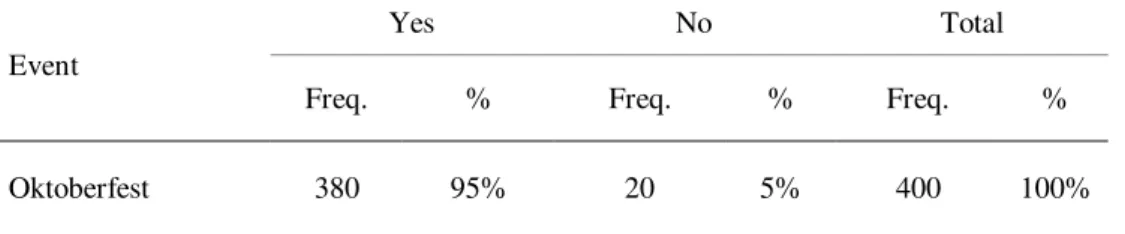
Aiming to identify the residents' inter-est in German-related beer activities and events in the municipality of Blumenau, re-spondents were invited to demonstrate their attendance at five local events related to the theme (Table 2). Regarding the Oktoberfest, most of the respondents (95%) said they par-ticipate in the program; many residents (78%) also report attending Sommerfest. A smaller number of respondents say that they attend Stammtisch (69%). The Festival of Bo-tecos appears in fourth place with 61%, the
Bailes do Chopp (Draft beer dances) appear with the smallest participation, only 21% of the residents say they attend this event.
Table 2 – Frequency of the presence in beer-related events in the city
Event
Yes No Total
Freq. % Freq. % Freq. %
334 Rev. Bras. Pesq. Tur. São Paulo, 11(2), pp. 320-346, maio/ago. 2017.
Bailes do Chopp 84 21% 316 79% 400 100%
Sommerfest 312 78% 88 22% 400 100%
Stammtisch 276 69% 124 31% 400 100%
Festival of Botecos 244 61% 156 39% 400 100%
Source: Data from Focus Project (2015)
The correlation between the pre-sented variables was assessed through Spearmans orrelation coefficient. The re- sults, as presented in Table 3, indicate that the expertise about craft beer and draft beer is positively correlated with the frequency of craft beer or draft beer consumption (0.162 **) and the number of regional brands known (0,110 *). This correlation indicates that the greater the expertise about craft beer and draft beer, the greater the individu-als consumption of craft beer or draft beer and the greater the number of regional brands they know. The knowledge of tourism products and expertise are also positively correlated (0.116*), which indicates that the more people know about Blumenau's tour-ism products, the greater their expertise about craft beer and draft beer. On the other hand, the identification with craft beer and draft beer is positively related to the fre-quency of consumption (0.108*), the number of regional brands known (0.107*) and ex-pertise about craft beer and draft beer (0.231**), i.e. there is a correlation between these variables which indicates that the greater the identification of the individual with craft beer or draft beer, the greater the
335 Rev. Bras. Pesq. Tur. São Paulo, 11(2), pp. 320-346, maio/ago. 2017.
Table 3 – Spearmans orrelatio
Freq. of con-sumption of craft
beer and draft beer
No. of regional brands known by respondents
Expertise: craft beer and draft
beer
Know the tourism products
Identification with craft beer and draft beer
Relationship be-tween Blumenau and craft beer and
draft beer
Attendance at beer-related events in the
city
Gender (H) Age Income
Freq. of consumption of craft
beer and draft beer 1.000
No. of regional brands known
by respondents 0.011 1.000
Expertise: craft beer and draft
beer 0.162** 0.110* 1.000
Know the tourism products
0.055 0.018 0.116* 1.000
Identification with craft beer
and draft beer 0.108* 0.107* 0.231** 0.076 1.000
Relationship between Blu-menau and craft beer and draft beer
0.138** 0.003 0.114* 0.064 0.266** 1.000
Attendance at beer-related
events in the city 0.270** -0.017 0.110* 0.316** 0.133** 0.170** 1.000
Gender(H) 0.085 0.093 0.086 -0.005 -0.043 0.045 0.038 1.000
Age 0.072 0.061 0.149** 0.150** 0.087 0.032 0.030 0.015 1.000
Income 0.039 0.084 -0.016 0.044 0.051 0.037 0.014 -0.014 0.202** 1.000
336 Rev. Bras. Pesq. Tur. São Paulo, 11(2), pp. 320-346, maio/ago. 2017.
The Spearman's correlation also showed that there is a positive correlation between the variable of the relationship of Blumenau and craft beer and draft beer and the variables frequency of consumption (0.138**), expertise (0.114*) and, mainly, with the variable identification with craft beer and draft beer (0.266**). This correla-tion determines that the more people under-stand the relationship between Blumenau, craft beer and draft beer, the greater the fre-quency of consumption of the characteristic product, the expertise about craft beer and draft beer, and the identification with the characteristic product.
The attendance at beer-related events in Blumenau, in turn, is positively cor-related with the variables frequency of con-sumption (0.270**), expertise (0.110*), knowledge of tourism products (0.316**), identification (0.133**), and the relationship of the city with craft beer and draft beer (0.170 **). This result indicates that the more the people attend to beer-related events in the city of Blumenau, the greater their fre-quency of consumption of craft beer and
draft beer. The greater the attendance in beer-related events in the city, the greater their expertise, i.e., the more they appraise and know the characteristics of craft beer and draft beer, and, also, the greater is their knowledge of tourism products. This result stands out for having a greater positive result than the other variables. We also verify that the greater the attendance at events, the greater the identification with craft beer and draft beer, and the greater the reside ts per-ceived relationship between Blumenau and the characteristic product.
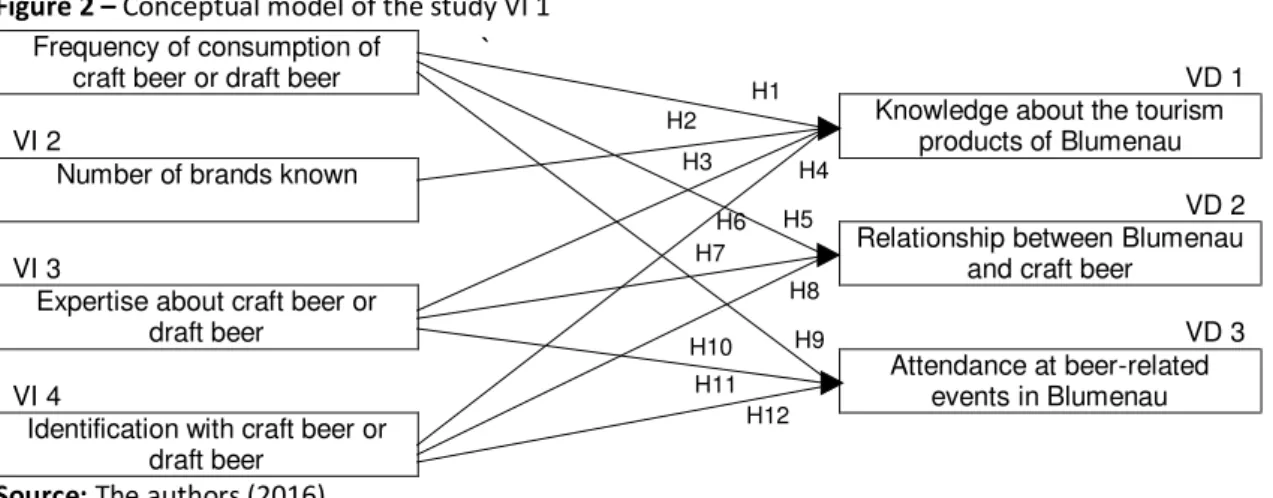
From the exploratory research, we developed twelve hypotheses, grounded on the theories presented throughout this study. Hair Jr. et al. (2009) consider that a hy-pothesis is an unverified assumption or prop-osition that attempts to explain certain facts or phenomena. These hypotheses are char-acterized as directional hypotheses that es-tablish a relationship between two groups or variables. Based on the previous discussion, Figure 2 presents the twelve hypotheses pro-posed, tested in the present study.
Figure 2 – Conceptual model of the study VI 1
Frequency of consumption of
craft beer or draft beer ` VD 1 VI 2
Knowledge about the tourism products of Blumenau Number of brands known
VD 2
VI 3
Relationship between Blumenau and craft beer
Expertise about craft beer or
draft beer VD 3
VI 4
Attendance at beer-related events in Blumenau Identification with craft beer or
draft beer Source: The authors (2016)
H1
H4 H3
H2
H5 H6
H8 H7
H9 H10
337 Rev. Bras. Pesq. Tur. São Paulo, 11(2), pp. 320-346, maio/ago. 2017.
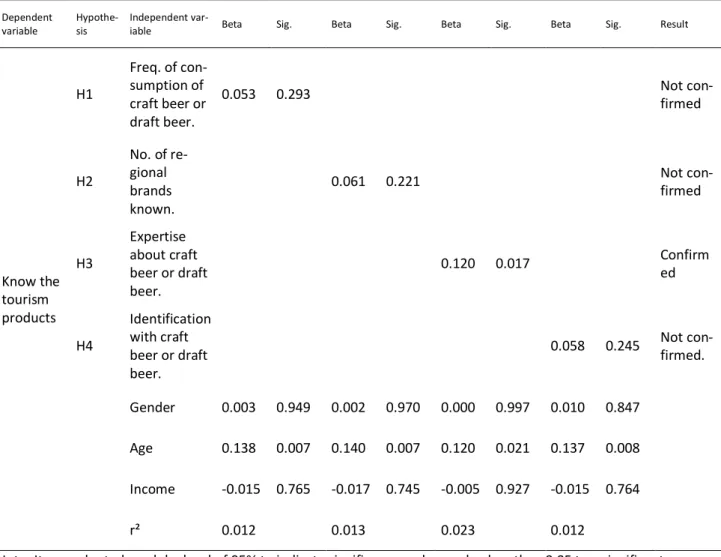
Table 4 presents the first set of hy-potheses tested, based on the relationship between the dependent variable of knowledge of tourism products and the inde-pendent variables. The results indicate that
only hypothesis 3 was confirmed. This states that the greater the resident's expertise about craft beer and draft beer, the more the knowledge about the tourism products of Blumenau
Table 4 - Test of hypotheses for the variable of the tourist set
Dependent variable
Hypothe-sis
Independent
var-iable Beta Sig. Beta Sig. Beta Sig. Beta Sig. Result
Know the tourism products
H1
Freq. of con-sumption of craft beer or draft beer.
0.053 0.293 Not
con-firmed
H2
No. of re-gional brands known.
0.061 0.221 Not
con-firmed
H3
Expertise about craft beer or draft beer.
0.120 0.017 Confirm
ed
H4
Identification with craft beer or draft
beer.
0.058 0.245 Not con-firmed.
Gender 0.003 0.949 0.002 0.970 0.000 0.997 0.010 0.847 Age 0.138 0.007 0.140 0.007 0.120 0.021 0.137 0.008 Income -0.015 0.765 -0.017 0.745 -0.005 0.927 -0.015 0.764
r² 0.012 0.013 0.023 0.012
Note: It was adopted an alpha level of 95% to indicate significance and a p-value less than 0.05 to a significant relationship.
Source: The authors (2016).
Although supported on studies by Santos et al. (2014), Pérez-Nebra (2005) and Plummer et al. (2005), which show that resi-dents, besides culinary and beverage, are an integral part of the intrinsic character of the tourism product, only one of the hypotheses was validated. Thus, within this study, it is
338 Rev. Bras. Pesq. Tur. São Paulo, 11(2), pp. 320-346, maio/ago. 2017.
and the identification with craft beer or draft beer, have no relevant results to indicate the existence of a positive correlation with the knowledge of tourism products.
It is possible to meet some aspects of the theory advanced by Santos et al. (2014), in which they refer that the tourism setting is composed of tourist attractions and that the characteristics of the destination influence its development. In this case, the resident who recognizes the specific characteristics of the craft beer or draft beer has a greater knowledge about the tourism products of the city since these are related to craft beer and draft beer.
Moreover, there is a relation with Plummer et al.s (2005) assertions that the manufacturing sites of the characteristic products of the destination can be tourist at-tractions of a region. The person who visits these places becomes aware of the destina-tion brand and of its quality image. Transfer-ring these findings to Blumenau, we can high-light the Beer Route which includes, in addi-tion to the Beer Museum, the breweries where craft beer and draft beer are made.
Hence, if the inhabitants of Blumenau know the tourism products, they will become aware of the city image and identity. It is worth mentioning that Zhang et al. (2016) consider the presence of residents important to convey authenticity to tourism activities, as well as the influence that the place has on the life of residents, when it acts as a leisure option and a repository of culture.
Table 5 presents the second set of hy-potheses tested, based on the relationship between the dependent variable of the rela-tionship between Blumenau and craft beer
and the independent variables. The results indicate that only hypothesis 6 was not con-firmed. This hypothesis states that the greater the number of regional brands of craft beer and draft beer known by the resi-dent, the greater the resident's perception of the relationship between Blumenau and craft beer. Therefore, the number of brands that the residents of Blumenau know does not in-fluence their perception of the relationship between Blumenau and craft beer and draft beer.
339 Rev. Bras. Pesq. Tur. São Paulo, 11(2), pp. 320-346, maio/ago. 2017.
Table 5 - Test of hypotheses for the variable relationship between Blumenau and craft beer
Dependent variables Hypothesis Independent variables Beta Sig. Beta Sig. Beta Sig. Beta Sig. Result
Relationship between Blumenau and craft beer
H5 Freq. of consumption of craft beer or
draft beer. 0.134 0.008 Confir.
H6 No. of regional brands known. 0.007 0.891 Not confirmed
H7 Expertise about craft beer or draft
beer. 0.137 0.007 Confir.
H8 Identification with craft beer or draft
beer. 0.290 0.000 Confir.
Gender 0.020 0.692 0.031 0.534 0.023 0.650 0.040 0.407
Age 0.001 0.981 0.003 0.959
-0.020 0.704 -0.009 0.848
Income 0.065 0.208 0.071 0.168 0.081 0.116 0.057 0.246
r² 0.014 0.004 0.015 0.081
Note: It was adopted an alpha level of 95% to indicate significance and a p-value less than 0.05 to a significant relationship
340 Rev. Bras. Pesq. Tur. São Paulo, 11(2), pp. 320-346, maio/ago. 2017.
According to Gallarza, Saura and Gar-cía (2002), the residents perception of ob-jects or destinations, in relation to certain at-tributes or characteristics, is a dimension that relates the variables to the image measure-ment. Therefore, the frequency of consump-tion, expertise, and identification suggest the existence of a relationship between the char-acteristic product and Blumenau, hence its image encompasses this relationship. Mer-rilees, Miller and Heringtons (2009) theory is in line with the findings of this set. In their study, the authors verify that, based on resi- dents' perceptions, it is possible to assign characteristics to the destination that are generally related to culture, heritage, or cul-tural activities.
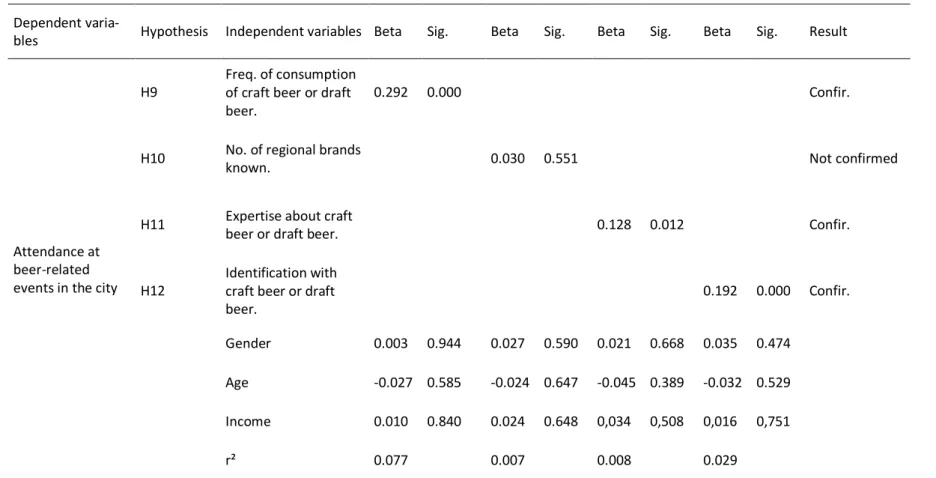
Finally, Table 6 presents the third set of hypotheses tested, based on the relation-ship between the dependent variable attend-ance at beer-related events in the city and the independent variables. The results indi-cate that only hypothesis 10 is not confirmed. This hypothesis proposes that the greater the number of regional brands known, the greater the attendance at tourism events in the city. Therefore, the number of regional brands of craft beer and draft beer that the residents know, has little influence on their attendance in beer-related events in Blu-menau.
The results supported the other hy-potheses of this set, as shown in Table 6 and indicate that the higher the frequency of con-sumption, expertise, and identification with craft beer or draft beer, the greater the at- tendance of residents at tourist events in the city. These findings are similar to those ob-tained by Choo and Park (2011); Gursoy, Kim,
341 Rev. Bras. Pesq. Tur. São Paulo, 11(2), pp. 320-346, maio/ago. 2017.
Table 6 - Test of hypotheses for the variable attendance at beer-related events in Blumenau Dependent
varia-bles Hypothesis Independent variables Beta Sig. Beta Sig. Beta Sig. Beta Sig. Result
Attendance at beer-related events in the city
H9
Freq. of consumption of craft beer or draft beer.
0.292 0.000 Confir.
H10 No. of regional brands
known. 0.030 0.551 Not confirmed
H11 Expertise about craft
beer or draft beer. 0.128 0.012 Confir.
H12
Identification with craft beer or draft
beer.
0.192 0.000 Confir.
Gender 0.003 0.944 0.027 0.590 0.021 0.668 0.035 0.474
Age -0.027 0.585 -0.024 0.647 -0.045 0.389 -0.032 0.529
Income 0.010 0.840 0.024 0.648 0,034 0,508 0,016 0,751
r² 0.077 0.007 0.008 0.029
Note: It was adopted an alpha level of 95% to indicate significance and a p-value less than 0.05 to a significant relationship
342 Rev. Bras. Pesq. Tur. São Paulo, 11(2), pp. 320-346, maio/ago. 2017.
In the present study, the relationship between brand and identity is verified, be-cause the more Blumenau resident identifies with craft beer and draft beer, the greater is their attendance at beer-related events in the city. According to Zhang et al. (2016), the reside ts participation in such events, strengthens the identity and culture of the destination, since festivals and events are linked to cultural exchange and symbolically show what makes up the society in which these events occur. Zhang et al. (2016) also point out that such events are leisure and en-tertainment options for residents, as well as repositories of culture.
In the context of tourism advertising and promotion, it is necessary that both act as effective strategies and consistent with destination image and positioning (Buosi et al., 2017). Continuous destination brand building is important and it must be based on place identity. The culture and characteristics of a destination act as useful identity ele-ments for advertising within marketing ac-tions.
5 CONCLUSIONS AND RECOMMENDATIONS
The objective of the present work was to analyze, from the residents' attitudes, the brewing culture as part of the cultural iden-tity of Blumenau, for the tourism promotion of the city. Through research, we obtained variables and then, using correlation tests we identified the relationships between them. Given the correlations, the hypothesis test verified the validation of the proposed as-sumptions, based on the literature review. The literature present the social exchange
theory, the process of destination image for-mation, the participation of the residents and how tourism affects their perception. In con-trast, this study demonstrates a new per-spective.
In summary, this study builds on pre- vious theories to offer a new perspective: the identification and proximity of the resident with the brewing culture, aiming to embed the craft beer and draft beer into the identity of Blumenau and, thus, making craft brewery a promoter of tourism
By studying the results of the hypoth-esis test, in which seven of the twelve hy-potheses were confirmed, it was verified that the brewing culture is present in the identity of the city of Blumenau, in view of the atti-tudes and identification of the resident. The residents consume craft beer and draft beer and, at the same time, they have knowledge about this subject and identify themselves with it. In addition to seeing the importance of breweries as a tourism product for Blu-menau, the residents attend to beer-related events and consider this image suitable for the city.
343 Rev. Bras. Pesq. Tur. São Paulo, 11(2), pp. 320-346, maio/ago. 2017.
become more visible to the residents. On the other hand, their habits make the relation-ship between Blumenau and craft beer stronger, as well as their attendance at beer-related events, without being essential the knowledge of all regional brands. The large attendance at the events adds to the resident knowledge on the diversity of breweries, types of beers and draft beers.
Regarding the identification of the re-lationship between habits and customs of the resident and the knowledge about the tour-ism products of Blumenau, this study con-firmed only one of the four hypotheses of this set. This hypothesis proposed the follow-ing: the greater the resident's expertise about the characteristic product of the city, the greater the knowledge about the city's tourism products, i.e., the greater the exper-tise of the inhabitant of Blumenau about craft beer and draft beer, the greater will be their knowledge of the city's tourism prod-ucts.
In identifying the resident's percep-tion of the relapercep-tionship between Blumenau and craft beer and draft beer, the data indi-cate positive results for three out of four hy-potheses in this set, in which only one was not confirmed. The other hypotheses of this set were supported by the results and indi-cated: the higher the frequency of consump-tion, the expertise, and identification with craft beer or draft beer, the greater the per-ceived relationship between Blumenau and craft beer.
When identifying the relationship be-tween the residents habits and customs and the attendance at tourism events in Blu-menau, the results were also positive for
three of the four hypotheses of this set. Only one hypothesis was not confirmed. It stated that the greater the number of regional brands of craft beer and draft beer known by the resident, the greater the attendance at tourism events in the city. Therefore, the number of regional brands that the resident of Blumenau knows, has little influence on the attendance at beer-related events in the city. The other hypotheses of this set were supported by the results and indicated that the higher the frequency of consumption, the expertise, and identification with craft beer or draft beer, the greater the attendance of residents at tourism events in the city.
Specifically, we collected data from residents of Blumenau who drink craft beer or draft beer. In this way, they are likely to have answered the questionnaire based on their experiences in Blumenau. Therefore, the results of this study cannot be general-ized beyond the sample examined. Future studies, with larger samples at different sites, can be used to prove hypothesis and be adapted to different destinations. Future re-searchers may also consider incorporating other dimensions of identity, relevant to their area of study, such as tourism percep-tion, for example. Another suggestion is to adapt the hypotheses to other destinations. Despite the above limitations, the study makes some useful theoretical contributions to the literature.
REFERENCES
344 Rev. Bras. Pesq. Tur. São Paulo, 11(2), pp. 320-346, maio/ago. 2017.
tourism research, 32(4), 1056-1076.
Azambuja, V. A., & Mecca, M. S. (2017). Os componentes da identidade de marca de Gramado/Brasil que geram sua imagem de
desti o turísti o odelo e os
relacionamentos da marca com os
stakeholders internos. Revista Brasileira de Pesquisa em Turismo, 11(1), 1-18.
Azevedo, D. S., Paes, T. A., & Andrade, P. B. (2014) Reflexões sobre as identidades-consumo na América Latina sobre a ótica da atividade turística. Ambivalências: Revista do Grupo de Estudos e Pesquisa Processos Identitários e Poder, 2(3), 218 – 237.
Banducci Júnior, Á.; Barretto, M. (2001) Turismo e identidade local: uma visão antropológica. Papirus, Campinas.
Besculides, A., Lee, M. E., & Mccormick, P. J. (2002) Residents' perceptions of the cultural benefits of tourism. Annals of tourism research, 29(2), 303-319.
Brasil, Ministério do Turismo (2015) Anuário Estatístico 2015: Ano Base 2014. Recuperado
em 02 mar. 2016, de
http://www.dadosefatos.turismo.gov.br/e xport/sites/default/dadosefatos/anuario/d ownloads_anuario/Anuario_Estatistico_T urismo_2015_Ano_base_2014_Divulgac ao_2.pdf .
Buosi, M. C. de A., Lima, S. H. de O., & Silva, Á. L. L. da (2017) Relación entre la percepción del desarrollo sustentable y la imagen del lugar según los residentes de un destino de
turismo internacional. Estudios y perspectivas en turismo, 26(1), 128-149.
Carniello, M. F. & Santaella, L. (2012) Imagem turística de São Sebastião (SP). Caderno Vir-tual de Turismo 12(3), 287-308.
Choo, H. & Park, S. (2011) The influence of the resident's identification with a tourism destination brand on their behavior. Journal of Hospitality Marketing & Management
20(2), 198-216.
Dias, R. & Cassar, M. (2006) Fundamentos do marketing turístico. Person Prentice Hall, São Paulo.
Echtner, C. M. & Ritchie, J.R. B. (1991) The meaning and measurement of destination image. The Journal of Tourism Studies 2(2), 2-12.
Fernandes, D. F., Lacay, M. A. C., & Gândara, J. M. G. (2016) La influencia de la seguridad pública en la satisfacción y en la formación de la imagen de Curitiba (Brasil) para el visitante y los visitados. Estudios y perspectivas en turismo, 25(4), 416-438.
Gallarza, M. G., “aura, I. G., & Gar ía, H. C. (2002) Destination image: Towards a conceptual framework. Annals of tourism re-search, 29(1), 56-78.
Gursoy, D., Kim, K., & Uysal, M. (2004) Per-ceived impacts of festivals and special events by organizers: an extension and validation.
Tourism management, 25(2), 171-181.
345 Rev. Bras. Pesq. Tur. São Paulo, 11(2), pp. 320-346, maio/ago. 2017.
R. E., & Tatham, R. L. (2009) Análise multiva-riada de dados. Bookman Editora, Porto Ale-gre.
Jackson, L. A. (2008) Residents' perceptions of the impacts of special event tourism.
Journal of Place Management and development 1(3), 240-255.
Lavandoski, J., Tonini, H., & Barreto, Margarita (2012) Uva, vinho e identidade cultural da Serra Gaúcha (RS, Brasil). Revista Brasileira de Pesquisa em Turismo 6(2), 216-232.
Mazzon, J. A., & Vera, L. A. N. (2008) A opinião dos turistas de negócios sobre a Imagem da Cidade de São Paulo. Revista Tur-ismo em Análise, 19(3), 345-368.
Merrilees, B., Miller, D., & Herington, C. (2009) Antecedents of residents' city brand attitudes. Journal of Business Research, 62(3), 362-367.
Miranda, R. L. & Miranda, R. De A. (1999)
Marketing voltado para o turismo.APMS Books, São Paulo.
Neiman, Z., Geerdink, S., & Pereira, J. C. (2011) A imagem como agente motivador para o ecoturismo. Revista Turismo em Análise, 22(1), 71-95.
Neto, V. (2015) Turismo contribui com 9% do PIB mundial. EMBRATUR. Recuperado em 02
mar. 2016, de
http://www.embratur.gov.br/piembratur-new/opencms/salaImprensa/artigos/arqu
ivos/Turismo_contribui_com_9_do_PIB_ mundial.html.
Nu koo, ‘. & Gursoy, D. ‘eside ts support for tourism: An identity perspective.
Annals of Tourism Research 39(1), 243-268. Pérez-Nebra, A. R. (2005) Medindo a imagem do destino turístico. Dissertação (mestrado) - Universidade Federal de Brasília, Brasília, Brasil.
Pérez-Nebra, A. R. & Rosa, C. J. (2008) As novas estratégias de promoção do Brasil no exterior: estudo de caso. Revista Turismo em Análise, 19(3), 450-471.
Plummer, R., Telfer, D., Hashimoto, A., & Summers, R. (2005) Beer tourism in Canada along the Waterloo–Wellington ale trail.
Tourism Management, 26(3), 447-458.
Prefeitura Municipal de Blumenau (2015)
Plano Municipal de Turismo de Blumenau. Recuperado em 22 mar. 2016 de
http://www.blumenau.sc.gov.br/downloa ds/sectur/pmt.pdf.
Samara, B. S.; Barros, J. C. de. (2002) Pesquisa de marketing: conceitos e metodologia
Pearson/Ptentice Hall, São Paulo.
Santos, M. M., Ferreira, A. M., & Costa, C. (2014) Identificação dos recursos nucleares do destino como suporte para o desenvolvimento de produtos turísticos inovadores. Revista Turismo & Desenvolvimento, 21(4), 315-330.
346 Rev. Bras. Pesq. Tur. São Paulo, 11(2), pp. 320-346, maio/ago. 2017.
que afetam o apoio dos residentes para o desenvolvimento do turismo religioso: o caso
de Santa Cruz (RN), Brasil. Revista Brasileira
de Pesquisa em Turismo, 10(3), 497-515.
Solomon, M. R. (2002) Comportamento do consumidor: comprando, possuindo e sendo. 5a ed. Porto Alegre: Bookman.
Stets, J. E. & Biga, C. F. (2003) Bringing iden-tity theory into environmental sociology. So-ciological Theory21(4), 398-423.
Wang, S., & Chen, J. S. (2015) . The influence of
place identity on perceived tourism impacts.
An-
nals of Tourism Research, 52, 16-28.
Williams, D. R., McDonald, C. D., Riden, C. M., & Uysal, M. (1995) Community attachment, regional identity and resident attitudes to-ward tourism. In: Annual Travel And Tourism Research Association Conference Proceed-ings, 424-428.
Williams, P. W., & Kelly, J. (2001) Cultural wine tourists: Product development consid-erations for British Columbia's resident wine tourism market, International Journal of Wine Marketing, 13(3), 59-76.
Zhang, X., Ryan, C., & Cave, J. (2016) Resi-dents, their use of a tourist facility and con-tribution to tourist ambience: Narratives from a film tourism site in Beijing. Tourism Management, 52, 416-429.
____________
Information on the authors:
Fabricia Durieux Zucco
PhD in Administration from the University Nove de Julho (UNINOVE). Master s Degree i Ad i -istration from the Regional University of Blu-menau (FURB). Marketing specialist from the
Re-gio al U i ersity of Blu e au FU‘B . Ba helor s
Degree in Publicity and Advertising from the Re-gional University of Blumenau (FURB). Professor in the Master and PhD program in Tourism at the University of Vale do Itajaí (UNIVALI). Professor at the department of Communication at the Re-gional University of Blumenau (FURB). Email: [email protected]
Cynthia Morgana Boos de Quadros
PhD in Regional Development from the Regional
U i ersity of Blu e au FU‘B . Master s Degree
in Language Sciences from the University of South Santa Catarina (UNISUL). Ba helor s De-gree in Publicity and Advertising from the Re-gional University of Blumenau (FURB). Professor in the Communication Department at the Re-gional University of Blumenau (FURB). Email: [email protected]
Juliane Regina Schmitt
Researcher in Communication. Ba helor s De-gree in Publicity and Advertising from the Re-gional University of Blumenau (FURB) (FURB). Email: [email protected]
Thamires Foletto Fiuza
‘esear her i Touris . Master s Degree i