DOI: http://dx.doi.org/10.7784/rbtur.v11i2.1310
I stitutio al theo y i tou is esea h: e
oppo tu ities f o a e ol i g theo y
Teoria institucional na pesquisa em turismo: novas oportunidades de
uma teoria em evolução
La teoría institucional en la investigación del turismo: nuevas
oportunidades de una teoría en evolución
Christian Falaster1
Luis Miguel Zanin2 Luiz Antonio Guerrazzi3
Abstract: In this perspective paper, we bring institutional theory to the attention of tourism research as a valid and evolving theory that can contribute to tourism analysis. We show that institutional theory is still underused in tourism and we develop a series of propositions on how it can be helpful for analyzing destination image and the fit between destination image for tourists and for the local population. Specifically, we show how the central institutional concepts of legitimacy, isomorphism, hybridization, and categorization influence the image strate-gies of destinations. We contribute to institutional theory by discussing the use of an institutional approach in tourism and to tourism research by providing the analysis of traditional issues with the use of institutional theory.
Keywords: Institutional theory. Tourism. Destination image. Destination strategy. Legitimacy.
Resumo: Neste artigo de perspectiva, trazemos a teoria institucional para a atenção da pesquisa em turismo como uma teoria válida e em evolução que pode trazer contribuições para análises no turismo. Mostramos que a teoria institucional ainda é subutilizada no turismo e desenvolvemos uma série de proposições sobre como a teoria institucional pode ser útil para analisar a imagem do destino e a adequação entre a imagem de destino para os turistas e para a população local. Especificamente, mostramos como os conceitos institucionais centrais de legitimidade, isomorfismo, hibridização e categorização influenciam as estratégias de destinos quanto à sua imagem. Contribuímos para a teoria institucional discutindo o uso de uma abordagem institucional no turismo, fornecendo a análise de questões tradicionais com o uso da teoria institucional.
Palavras-chave: Teoria institucional. Turismo. Imagem de destino. Estratégia de destino. Legitimidade.
1 University Nove de Julho (UNINOVE). São Paulo, SP, Brazil. Conceptualization of the study, elaboration of
in-troduction, propositions, and discussion.
2 University Nove de Julho (UNINOVE). São Paulo, SP, Brazil. Elaboration of literature review and propositions. 3 University Nove de Julho (UNINOVE). São Paulo, SP, Brazil.Elaboration of bibliometrics and literature review,
and review of the paper.
Resumen: En este artículo de perspectiva, llevamos la teoría institucional a la atención de la investigación turís-tica como una teoría válida y en evolución que puede aportar contribuciones a los análisis en el turismo. Demos-tramos que la teoría institucional sigue siendo subutilizada en el turismo y desarrollamos una serie de proposi-ciones sobre cómo la teoría institucional puede ser útil para analizar la imagen de destino y el ajuste entre la imagen de destino para los turistas y para la población local. Específicamente, mostramos cómo los conceptos institucionales centrales de legitimidad, isomorfismo, hibridación y categorización influyen en las estrategias de destinos a su imagen. Contribuimos a la teoría institucional discutiendo el uso de un enfoque institucional en el turismo y la investigación turística al proporcionar el análisis de temas tradicionales con el uso de la teoría insti-tucional.
Palabras clave: Teoría Institucional. Turismo. Imagen de destino. la estrategia de destino. Legitimidad.
1 INTRODUCTION
Institutional theory has been one of the key theories in several research areas, such as social sciences (Scott, 1987), institu-tional economics (North, 1990), internainstitu-tional business (Meyer, 2001; Peng, 2002), and management (DiMaggio & Powell, 1983). However, research in tourism using institu-tional theory as main argument is still incipi-ent, with few exceptions (Pavlovich, 2003; Wilke & Rodrigues, 2013). In this paper, we propose how institutional theory and its ram-ifications explain tourist flows, destination image, and the fit between the tou ists i -age of the destination and that of residents.
Institutional theory has several com-ponents that can be used to better under-stand the logics behind tourism using an al-ternative view. It is important to point out that institutional theory is an evolving the-ory. Tourism is a field that can be examined through neo-institutional theory – analyzing homogenization of practices and structures among entities (Meyer & Rowan, 1977; Di-Maggio & Powell, 1983). Specifically,
isomor-phism explains why entities take similar ac-tions and assume similar shapes based on in-stitutional pressures (DiMaggio & Powell, 1983). Hence, isomorphism can explain ele-ments of destination communication and marketing strategies that are common to var-ious destinations.
be composed of competing or complemen-tary logics, which requires a set of strategies and actions as a response to this complexity (Greenwood et al., 2015).
Institutional decoupling happens when organizations decouple their formal structure from their activities to preserve le-gitimacy to the institutions of the environ-ment (Meyer & Rowan, 1977). The common disassociation between the image of a desti-nation that tourists have and the image that the local population has can be alternatively explained by institutional decoupling. Institu-tional hybridization, on the other hand, ex-plains how firms cope with institutional pres-sures from different agents (Besharov & Smith, 2014). Hence, tourism research can use hybridization to understand conflict res-olutions between local population interests and destination strategies. Institutional cate-gorization can be used to explain how enti-ties can change the meanings of cultural cat-egories (Ocasio et al., 2015). By using catego-rization, tourism researchers can explain the changes in image promoted by destination strategies.
Thus, in this paper we give some in-sights into how institutional theory can ex-plain strategies in tourism. Specifically, we show the incipient nature of institutional the-ory in tourism and how the thethe-ory can be used in this field. The guiding question of this pape is ho a tou is esea h use i nsti-tutio al theo y? We de elop ou ai a gu-ment about institutional theory having been underexplored in the tourism field by using bibliometric analysis. Then, we show some possible applications of institutional theory to explain tourism phenomena using propo-
sitions.
This paper is divided into four sec- tions other than this introduction. First, we provide a literature review that has the basic developments of institutional theory (neo and old) and bibliometric analysis that shows how institutional theory has been used in tourism research. In the propositions section, we show how five key elements of institu-tional theory (legitimacy, isomorphism, de-coupling, hybridization, and categorization) can be used in a broad sense to investigate issues in tourism. Finally, in the discussion and conclusion sessions, we show the main contributions of using institutional theory in tourism research and show a series of re-search avenues that can be opened by this possibility.
2 LITERATURE REVIEW
2.1 Old and Neo-institutionalism
1991).
An early concept for institutional the- ory, according to Scott (2014), is that both current actors and events are, for the most part, shaped by the actions and fruits of the past. It is worth noting that the author makes this statement about the evolution of institu-tional theory itself, as a theory construction. However, this assertion is also valid for an in-itial attempt to conceptualize what institu-tional theory is. The replication of past ac-tions several times can generate norms and rules, formal or otherwise, that are incorpo-rated into everyday life, generating new fu-ture patterns (Meyer & Rowan, 1977, Scott, 2014, Thornton, Ocasio, & Lounsbury, 2012). Scott (2014) identified three pillars that make up the institutions: regulative sys
tem, normative system, and cultural-cogni- tive system. In this division, the regulative system is composed of laws and rules whose fulfillment, or not, generates rewards or sanctions and its main actors are the states and agencies. In turn, the normative system creates standards that must be followed and are sources of legitimacy to the same group with common interests and is commonly as-sociated with the professions. Finally, the cul-tural-cognitive system concerns shared meanings that give meaning to social life, ac-tions that are in accordance with these shared meanings are also sources of legiti-macy (Scott, 2014, Thornton et al., 2012). Frame 1 details these pillars and their com-ponents.
Frame 1 - Three pillars of institutions
Regulative Normative Cultural-Cognitive
Basis of compliance Expedience Social Obligation Taken-for-grantedness, Shared understanding Basis of order Regulative rules Binding expectations Constitutive Schema
Mechanisms Coercive Normative Mimetic
Logic Instrumentality Appropriateness Orthodoxy
Indicators Rules, Laws, Sanctions Certification/Accredita-tion
Common beliefs, Shared logics of action,
Isomorphism
Affect Fear, Guilt/Innocence Shame/Honor Certainty/Confusion
Basis of legitimacy Legally Sanctioned Morally governed Comprehensible, Rec-ognizable, Culturally
supported Source: Scott (2014)
Institutions can be seen both as su-pra-organizational patterns by which individ-uals conduct their material life and locate it in time and space, as well as a system of sym-bols by which individuals categorize and give
These norms and rules can be divided into practices, models, and policies to be fol-lowed (Pacheco, York, Dean, & Sarasvathy, 2010). Institutions can normally be seen as normative, laws, for example, but as a social fact, in the sense proposed by Durkheim, as ways of acting, thinking and feeling that are external to individuals and that have great power of coercion (Durkheim, 2013), which must be taken into account by the actor in their actions (Meyer & Rowan, 1977). In this sense, institutions partially manage conflict resolution, mediating individual socioeco-nomic interests against collective rules (Man-tzavinos, 2011). For Mantzavinos (2011), the main reason and function of institutions is to be a solution to the problems and social con-flicts.
Institutions also have the function of structuring daily actions, giving meaning to social life and reducing uncertainties (Kalantaridis & Fletcher, 2012). That is, in ad-dition to their normative and coercive as-pects, institutions produce meaning for life and social structure, their cultural-cognitive aspect (Scott, 2014). In this way, the institu-tion can be considered something limiting and deterministic, even though, by nature, institutions are resistant to change (Giddens, 2009). However, this limiting and determinis-tic character does not fully define the term institution, because for Machado-da-Silva et al. (2010) beyond regularities, institutions produce possibilities, since, for these au-thors, the institution is also a condition for the existence of relationships between social structure and agency. For Barley and Tolbert (1997), these norms will generate behaviors with different degrees of conformity with
them, that is, not all norms will be accepted in the same way by all. Moreover, this set of rules allows actors to interpret social phe-nomena in their own way and act according to this interpretation (Kalantaridis & Fletcher, 2012).
Based on the definitions presented and these dichotomies between the institu-tion being something deterministic and, at the same time, something that generates the changes, it is worth to expose the differences between new and old institutionalism. While the former focuses on influence, coalitions, values, power, and informal structures occu-pying a central position (Selznick, 1996), the new one considers legitimacy, its insertion into its organizational fields and classifica-tions, routines, norms occupying a central position (Greenwood & Hinings, 1996). For DiMaggio and Powell (1983), this new institu-tionalism is a source, or continuity, for the Weberian bureaucracy. In fact, the new insti-tutionalism has shifted the culture-domi-nated focus to the notion that rational actors are limited in their actions by institutional-ized practices in their organizational field (Beckert, 1999) in both focuses, but the new institutionalism has a deterministic charac-ter, according to Machado-da-Silva et al. (2010).
tions of Bandura (2006) and Emirbayer and Mische (1998), maintaining the standards may be an intended goal and, as put by Di-Maggio and Powell (1983), be equal facili- tates the legitimacy of the action or organiza-tion.
For Clegg (2010), institutional theory brings back issues of power and agency and places the concept of auditory society, that is, it places legitimacy at the center, which is a central point of neo-institutional theory (Machado-da-Silva et al., 2010). In other def-initions the authors seek to explain the ac-tions of firms to make sense or justify their movements (Suddaby, 2010).
Legitimacy can be understood as the general expectation that an action is in ac-cordance with legal, moral or model assump-tions or with socially and culturally con-structed roles (Scott, 2014). Legitimacy is central to the isomorphism proposed by Di-Maggio and Powell (1983), in which organiza-tions exhibit similar behaviors and replicate models known as a quest for legitimation. This legitimacy guarantees the company ac-cess to different resources and is associated with better performance in several studies (see Heugens & Lander, 2009)
If, on the one hand, legitimacy guar-antees the maintenance of institutions, it is also a key concept in institutional change, since questioning the institution begins by questioning its legitimacy (Machado-da-Silva et al., 2010). Even in older institutions, their own contradictions over time may result in a loss of legitimacy (Greenwood & Suddaby, 2006).
While institutions limit and direct be-haviors, they also differentiate between
groups of individuals, giving different pow-ers, privileges, roles, and responsibilities to different actors and stakeholder groups (Scott, 2014). In this way, this differentiation and, in a sense, imbalance, offers opportuni-ties for new forms that alter these configura-tions and, consequently, changes occur (Owen-Smith & Powell, 2008, Scott, 2014).
2.2 The new new institutionalism
Institutional theory has been evolving over time, gaining ground from the old insti-tutionalism to the new instiinsti-tutionalism. How-ever, the new institutionalism itself has been changing and gaining new themes. One of these themes is institutional logic, which can be considered as the broad set of beliefs that define the boundaries of a field, as well as roles and identities, and organizational ar-rangements (Suddaby & Greenwood, 2009). In addition, institutional logic acts as a guide to practical actions (Rao, Monin, & Durand, 2003), which are common to participants in the same field (Owen-Smith & Powell, 2008). That is, agents give meanings to actions and delimit these actions in time and space through or under the influence of institu-tional logics (Thornton et al., 2012).
one at a time, will give meaning to their ac-tions and shape their cognition and behavior. Thus, an organization, or individual, can be influenced by more than one logic, genera- ting different meanings, beliefs, and prac-tices according to the dominant logic at that time (Greenwood, Raynard, Kodeih, Micelotta, & Lounsbury, 2011; McPherson & Sauder, 2013), so that there is no uniformity of responses of organizations and individuals in a same context (Greenwood, Diaz, Li, & Lorente, 2010).
Most studies on institutional logic have focused on understanding how institu-tional logics work at their macro level, influ-encing the institutions, strategies, and prac-tices of organizations within these institu-tions (McPherson & Sauder, 2013). Little at-tention has been given to how institutional logics affect the actions of actors in their daily lives and their daily practices (Currie & Spyri-donidis, 2016; McPherson & Sauder, 2013). In this case, it is first noticed a recognition of actors' agency, unlike the deterministic view of neo-institutionalism, that is, actors will act not only on the influence of these diverse logics, but on their interpretation and how to reach their objectives in this field (Delbridge & Edwards, 2013, Emirbayer & Mische, 1998).
At its micro level, institutional logics are highly related to the individual's social position. In a more prominent position, the actor has the possibility to influence the in-terpretation of the institutional logics that people in the position of minor will do (Currie & Spyridonidis, 2016). In addition, the cen-trality of their position, the greater their ca-pacity to lead to change, and the more pe-
ripheral their social position, the greater the cost to escape institutional pressures (Currie & Spyridonidis, 2016).
Meeting the definition of agency by Emirbayer and Mische (1998) as the individ-ual action that happens through a temporally embedded process of social engagement, de-rived from past interactions and habits, ori-ented toward the future through the visuali-zation of alternative possibilities. Recent re-search indicates that institutional logics rein-force that the individual's relations with insti-tutional logics in the past will not only define their interpretation of new logics in the fu-ture, but also how to deal with these logics and the desire to modify them (Bertels & Lawrence, 2016).
with less power and external to the organiza-tion using identities (Edman, 2016).
There is also the emergence of the vi-sion of hybrid logic. In this case, the option to solve this situation of institutional complexity is to mix elements of several logics in order to meet the expectations of diverse institu-tional demands. Thus, organizations that suc-ceed in this strategy achieve greater legiti-macy and access to resources (Delbridge & Edwards, 2013), as well as being an alterna-tive to decoupling, since it does not generate a negative feeling of not fulfilling institutional demands (Bromley & Powell, 2012; Pache & Santos, 2013).
In order to perform this process of analysis of the institutional environment, one of the assumptions of this line of thought is that actors have a higher level of agency, since actors have to align their objectives, be-ing well aware of them, with institutional de-mands (Currie & Spyridonidis, 2016; McPher-son and Sauder, 2013). In addition, space is opened for the micro level of analysis, identi-fying the decision makers and how they act in this hybridization process (Almandoz, 2014; Voronov et al., 2013).
Although it seems antagonistic to the view of competing logics, this view is comple-mentary, in the sense of pointing to research that considers institutional logics as comple-mentary elements. In addition, the studies should consider the actor's degree of agency and, once the agency is considered, although little considered in the cluster, it is expected that research will lead to reflexivity of struc-ture and consequent changes in logic and in-stitutions (Gawer & Phillips, 2013).
Finally, one of the main emerging
themes in institutional theory that has great relation with the field of tourism is the cate- gorization and institutional change. In this case, institutional change happens through the creation, or change, of common catego-ries through agents within the field and through consensus among them against common needs (Ansari et al., 2013). Or, insti-tutional change can happen by changing the meaning ascribed to cultural categories, which are structures built from certain words that have a common meaning to a certain group of people (Loewenstein et al., 2012), and change the meaning of these categories. Change happens at the level of and in the in-stitutional logics themselves (Ocasio et al., 2015).
By changing the discourse and/ or rhetoric associated with the logics and prac-tices resulting from it, this view resumes a fundamental feature of the logics, as a pro-vider of meaning for practices and discourses (Friedland & Alford, 1991; Thornton et al., 2012). Thus, by tinkering with the most fun-damental aspects of logics, one's own logics and field change. However, in this case, there is not much agency involved and much of this transformation happens through the recur-rence of practices and institutional complex-ity, making changes more fruitful than at-tending practices, than a deliberate action of the actors (Jones et al. 2012).
3 BIBLIOMETRICS
sis. Bibliometrics is a statistical analysis of ac-ademic production that aims to quantify and classify the knowledge of a given subject and is recommended to understand how it is structured (Pritchard, 1969). It is used to help in understanding the relationship between research fields, disciplines, and publications, identifying the way the area of study is struc-tured, the main approaches used and the main works (Vogel, & Güttel, 2013, Zupic, & Čate , . Bi lio et i s ha e ee used i tourism articles to research specific aspects of the field. For instance, Jiménez-Caballero and Molina (2016) studied the impact of the financial aspects associated with tourism and Sánchez, Rama and García (2016) examined the activities related to wine tourism. In this article, we used bibliometrics to investigate the influence of Institutional Theory in Tour-ism studies and the bibliometric technique used was the citation analysis.
Citation analysis involves counting the number of times a work is referenced in other works and was obtained with Bibexcel software (Pilkington, 2006). The underlying concept is that only articles that are related to a specific topic are cited, and therefore, the more cited, the more they influence re-
search on the subject (Ramos-Rodrigues, & Ruiz-Navarro, 2004; Tahai, & Meyer, 1999).
Data was obtained from the Web of Science database of Thomson Reuters (www.webofknowledge.com). This basis was chosen for its comprehensiveness and for making the data available in a format that op-timizes the collection and operationalization effort. Through its search tool, works that used institutional theory in tourism studies were identified through the following key-words: institutional*; Isomorphism; Decou-pling. Hybridization and legitimation, in the field "topic" that does the search in the title, abstract, and keywords of the articles. The asterisk leads to the search for all the deriva-tions of a word. No time limit was set for ar-ticles. The search focused on articles pub-lished in the main journals on tourism, con-sidering its impact factor published by the Journal Citation Reports, in the ISI - Web of Knowledge portal (Table 1).
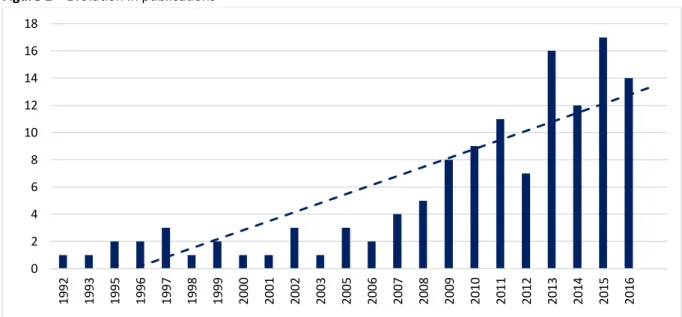
We identified 131 papers that were validated by reading their title, abstract, and introduction. Figure 1 shows the number of articles published per year of our sample. There is a growing trend in annual publica-tions on the subject of this article (Figure 1). Table 1 – Articles using institutional theory in tourism
Impact Factor 2015 Papers in Sample
Tourism Management 3.14 43
Annals of Tourism Research 2.275 29
Journal of Sustainable Tourism 2.48 28
International Journal of Contemporary Hospitality Management 1.775 12
International Journal of Hospitality Management 3.199 11
Journal of Service Management 2.233 4
Journal of Travel Research 2.905 2
Cornell Hospitality Quarterly 2.408 2
Figure 1 – Evolution in publications
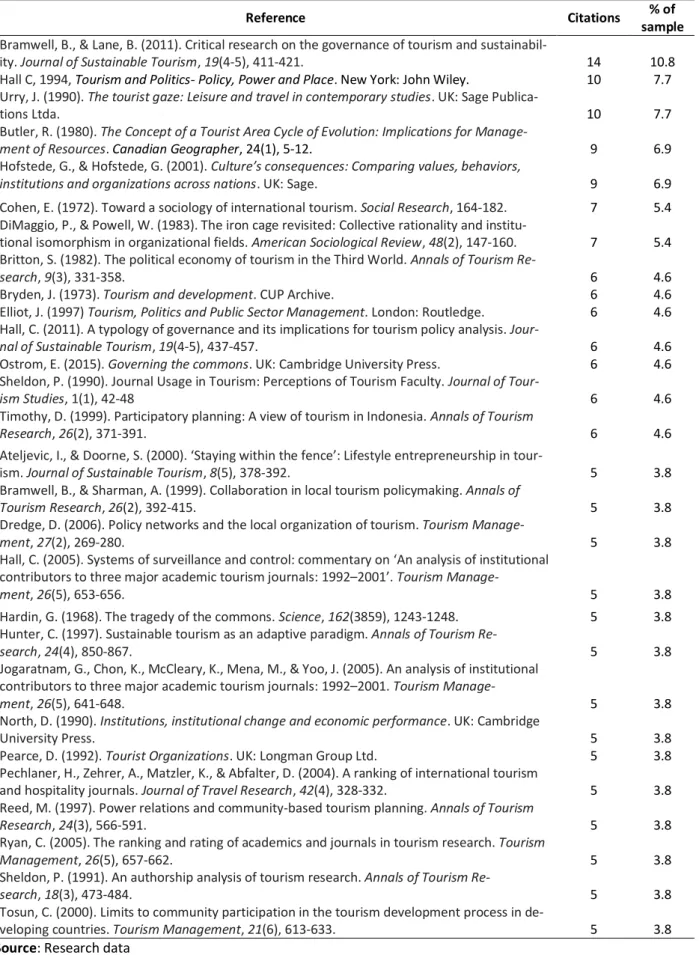
The 131 articles of the sample used 8200 references. Table 2 contains the 30 most cited works. The columns show the number of citations in absolute and relative values, considering the amount of papers in the sample. For example, the article by Bram-well and Lane (2011) was the most cited among the references used in all 130 articles in the sample, was cited 14 times, in about 11% of the sample.
Based on the results pointed out by bibliometrics it is possible to affirm that tour-ism research uses relatively little institutional theory in its scientific production. Only 131 articles published in high-impact journals in the field of tourism dealing directly with some aspect of institutional theory were found. Thus, we confirm that although tour-ism is a well-developed field, and institu-tional theory is a very popular theoretical line in other fields, the intersection of these two lines is not common and can be better ex-plored.
There is, however, a tendency to in-crease the use of institutional theory in tour-ism in the last years of the sample, although incipient, the tourism area started to use in-stitutional theory for some lines of research. By observing Table 2, it is possible to con-clude that there are, in summary, three fields of institutional theory in tourism. The first, to discuss issues of ecotourism and sustainabil-ity, such as the article by Bramwell and Lane (2011), the most cited within the sample. This line of research deals more specifically with questions of legitimacy based on the sustain-ability of tourism destinations and ecotour-ism. A second strand apparent in Table 2 would be on social and economic issues for tourism, as for example in the articles using Hall (1994) and Cohen (1972). Finally, we see a third strand with the studies that use Hof-steade and HofHof-steade (2001), which clearly denotes an analysis of culture and its effects on tourism.
0 2 4 6 8 10 12 14 16 18
19
92
19
93
19
95
19
96
19
97
19
98
19
99
20
00
20
01
20
02
20
03
20
05
20
06
20
07
20
08
20
09
20
10
20
11
20
12
20
13
20
14
20
15
20
Table 2 – Papers that have the highest number of citations from the sample
Reference Citations % of
sample
Bramwell, B., & Lane, B. (2011). Critical research on the governance of tourism and
sustainabil-ity. Journal of Sustainable Tourism, 19(4-5), 411-421. 14 10.8
Hall C, 1994, Tourism and Politics- Policy, Power and Place. New York: John Wiley. 10 7.7
Urry, J. (1990). The tourist gaze: Leisure and travel in contemporary studies. UK: Sage
Publica-tions Ltda. 10 7.7
Butler, R. (1980). The Concept of a Tourist Area Cycle of Evolution: Implications for
Manage-ment of Resources. Canadian Geographer, 24(1), 5-12. 9 6.9
Hofstede, G., & Hofstede, G. (2001). Cultu e’s o se ue es: Co pa i g values, ehavio s,
institutions and organizations across nations. UK: Sage. 9 6.9
Cohen, E. (1972). Toward a sociology of international tourism. Social Research, 164-182. 7 5.4
DiMaggio, P., & Powell, W. (1983). The iron cage revisited: Collective rationality and
institu-tional isomorphism in organizainstitu-tional fields. American Sociological Review, 48(2), 147-160. 7 5.4
Britton, S. (1982). The political economy of tourism in the Third World. Annals of Tourism
Re-search, 9(3), 331-358. 6 4.6
Bryden, J. (1973). Tourism and development. CUP Archive. 6 4.6
Elliot, J. (1997) Tourism, Politics and Public Sector Management. London: Routledge. 6 4.6
Hall, C. (2011). A typology of governance and its implications for tourism policy analysis.
Jour-nal of Sustainable Tourism, 19(4-5), 437-457. 6 4.6
Ostrom, E. (2015). Governing the commons. UK: Cambridge University Press. 6 4.6
Sheldon, P. (1990). Journal Usage in Tourism: Perceptions of Tourism Faculty. Journal of
Tour-ism Studies, 1(1), 42-48 6 4.6
Timothy, D. (1999). Participatory planning: A view of tourism in Indonesia. Annals of Tourism
Research, 26(2), 371-391. 6 4.6
Atelje i , I., & Doo e, “. . “tayi g ithi the fe e : Lifestyle e t ep e eu ship i tou
-ism. Journal of Sustainable Tourism, 8(5), 378-392. 5 3.8
Bramwell, B., & Sharman, A. (1999). Collaboration in local tourism policymaking. Annals of
Tourism Research, 26(2), 392-415. 5 3.8
Dredge, D. (2006). Policy networks and the local organization of tourism. Tourism
Manage-ment, 27(2), 269-280. 5 3.8
Hall, C. (2005). Systems of surveillance and control: commentary on An analysis of institutional contributors to three major academic tourism journals: 1992– .Tourism
Manage-ment, 26(5), 653-656. 5 3.8
Hardin, G. (1968). The tragedy of the commons. Science, 162(3859), 1243-1248. 5 3.8
Hunter, C. (1997). Sustainable tourism as an adaptive paradigm. Annals of Tourism
Re-search, 24(4), 850-867. 5 3.8
Jogaratnam, G., Chon, K., McCleary, K., Mena, M., & Yoo, J. (2005). An analysis of institutional contributors to three major academic tourism journals: 1992–2001. Tourism
Manage-ment, 26(5), 641-648. 5 3.8
North, D. (1990). Institutions, institutional change and economic performance. UK: Cambridge
University Press. 5 3.8
Pearce, D. (1992). Tourist Organizations. UK: Longman Group Ltd. 5 3.8
Pechlaner, H., Zehrer, A., Matzler, K., & Abfalter, D. (2004). A ranking of international tourism
and hospitality journals. Journal of Travel Research, 42(4), 328-332. 5 3.8
Reed, M. (1997). Power relations and community-based tourism planning. Annals of Tourism
Research, 24(3), 566-591. 5 3.8
Ryan, C. (2005). The ranking and rating of academics and journals in tourism research. Tourism
Management, 26(5), 657-662. 5 3.8
Sheldon, P. (1991). An authorship analysis of tourism research. Annals of Tourism
Re-search, 18(3), 473-484. 5 3.8
Tosun, C. (2000). Limits to community participation in the tourism development process in
de-veloping countries. Tourism Management, 21(6), 613-633. 5 3.8
3.1 Propositions
As institutional theory has yet to be largely used in tourism research, there are some areas of tourism research wherein re-searchers can apply institutional theory in or-der to have an alternative analysis. For exam-ple, destination image might be one of the most important aspects of a destination (Chon, 1991; Govers, et al., 2007). Institu-tional theory can explain several aspects that compose the destination image and its con-sequences, such as the flow of tourists, strat-egies, and locals versus tourists image.
3.2 Legitimacy
One of the central concepts in institu-tional theory is legitimacy. Legitimacy can be defi ed as a ge e alized pe eptio o as-sumption that the actions of an entity are de-sirable, proper, or appropriate within some socially constructed system of norms, values, eliefs, a d defi itio s (Suchman, 1995 p. 574). Legitimacy has become one of the key elements in research regarding stakeholders (Mitchell, Agle & Wood, 1997), environmen-tal corporate responsibility (Bansal & Roth, 2002), adaptation to local institutions (Gel-buda, Meyer, & Delios, 2008; Ferreira & Serra, 2015) amongst many fields of re-search. In tourism, on the other hand, the el-ement of legitimacy has attracted little atten-tion, only coming through in research regard-ing ecotourism (Lawrence, Wickins & Phillips, 1997).
The pinnacle concept of legitimacy is that entities (firms, governments, destina-tions, organizations) are not naturally born with it. These entities must follow the trails
set y olde , o e legiti ate pee s i o de to be accepted by the public (Suchman, 1995). Legitimacy is divided into three types, pragmatic (where the entity has to act ac-cording to the expectations of their immedi-ate public), normative (acting according to the moral standards) and cognitive (acting according to what works best and what their peers do) (Aldrich & Fiol, 1994). As entities, destinations will also have degrees of legiti-macy under institutional logics that will de-termine how governments and businesses will compose destination image.
Destinations that have a certain im-age associated with them (for instance, a his-torical destination for cultural tourism, or a destination that has been a business center for decades for business tourism) are the ones that will set the standard for new desti-nations, having more legitimacy due to their traditional status. On the other hand, desti-nations that are striving to become cultural or business destinations will face liabilities of newness (Freeman et al., 1983). These desti-nations will have more difficulties in finding legitimacy then their traditional peers.
since they cannot change completely what they are and where they are, but it is possible to select the public that best fits their infra- structure. Strategies to change the environ-ment are also unlikely for new destinations, since the gap between tourists flow and the very legitimacy between traditional and new destinations is very large. This gap makes it almost impossible for a new destination to sho the o ld a e est p a ti e i o -der to change the environment. Hence, we propose:
Proposition 1: New destinations are more likely to choose strategies that pro-mote the conformity of their image to the en-vironment, while are less likely to choose se-lection and change strategies.
3.3 Isomorphism
While destinations that are already established as accepted to their specific types of tourism have an intrinsic legitimacy to their image, places that wish to become established destinations must cope with the liabilities of newness (Freeman et al., 1983). These will result in reduced legitimacy to the entities (Suchman, 1995). Hence, destina-tions that seek to establish themselves as valid and legitimate to certain publics will have to undertake legitimacy-seeking strate-gies.
One of the most common legitimacy-seeking strategies is isomorphism (Deephouse, 1996). Isomorphism is charac-terized by homogenization, where entities will resemble other (more legitimate) entities in their structure and actions (DiMaggio &
Powell, 1983). Evidences suggest that iso- morphism effectively increases legitimacy of entities (Deephouse, 1996).
There are three forms that isomor-phism act. First, in mimetic isomorisomor-phism, firms, organizations, governments, and enti-ties in general will mimic more legitimate (or successful) peers when they do not know how to act, will have to cope with laws and regulations by coercive isomorphism, and will have to adapt to industry standards and est p a ti es by normative isomorphism (DiMaggio & Powell, 1983). As destinations can build their image by using marketing strategies and new destinations will be more susceptible to these institutional pressures because of legitimacy-seeking behavior (Freeman et al., 1983) there will be isomor-phic pressures that make destinations posi-tion their image as resembling more legiti-mate peers, hence:
Proposition 2: New destinations are more likely to be affected by institutional pressures for isomorphism and will choose to mimic the image of more legitimate peers to seek legitimacy.
3.4 Hybridization
logic to the detriment of another, but merge several logics, granting more access to re- sources to organizations that choose this form of identity (Greenwood et al., 2011).
The work of Amoamo (2011) reflects a cultural face because it is a whole ethnic group, nevertheless, by adopting this hybrid-ization of both Maori and colonizers logi s, the operators managed to overcome contra-dictions. Such behavior is expected in organ-izations that adopt the hybridization of insti-tutional logics. As previously stated, organi-zations in this context are expected to achieve greater legitimacy and access to re-sources (Delbridge and Edwards, 2013), as well as being an alternative to decoupling, as it does not generate a negative feeling of not meeting institutional demands (Bromley & Powell, 2012; Pache & Santos, 2013).
It is important to reinforce that in the case of hybridization the actors are more aware of their actions and choices, that is, there is no pressure and an automatic re-sponse from the actor. These perceive the pressures of the environment and manage to structure a response aligned with the institu-tional demands (Currie & Spyridonidis, 2016; McPherson & Sauder, 2013). Based on this, and on methodological issues, this has open space for the micro level analysis, identifying the decision makers and how they act in this hybridization process (Almandoz, 2014; Vo-ronov et al., 2013).
We can assume that many tourism or-ganizations must reconcile global and local logics, and they must be globally recognized, but they must show the uniqueness of the sites offered (Ambrosie, 2015, Elbe & Emmoth, 2014, Kanemasu, 2013). Such a
context, by itself, justifies a plural environ-ment, composed of several logics and, as a basis for the articles cited here. It is not a good choice to privilege one to the detriment of others, all the works cited above show that hybridization, even some rather than all, con-tributes to the legitimization process.
Local characteristics should be main-tained as a means of differentiating compet-itors, or, in this case, other destinations (Am-brosie, 2015; Kanemasu, 2013). In addition, if there is a loss of uniqueness of the local char-acteristics in this hybridization process, there is not only loss in the competitive sense, be-cause the locality does not differ in relation to the others, but also, if local stakeholders perceived this loss, there is loss of Legitimacy vis-à-vis them (Voronov, Clercq, et al., 2013; Voronov, De Clercq, & Hinings, 2013). Based on these assumptions, we put forward the following propositions:
Proposition 3a: The destinations and organizations that adopt a hybridization strategy will have access to more resources and legitimacy vis-à-vis more stakeholders.
Proposition 3b: The destinations and organizations that lose the unique character-istics in the hybridization process will lose le-gitimacy compared to local stakeholders.
3.5 Categorization
meaning attributed to cultural categories, which are structures assembled from certain words that have a common meaning to a cer-tain group of people (Loewenstein et al., 2012) and change the meaning of these cate-gories, change happens at the level of and in the institutional logics themselves (Ocasio et al., 2015).
By changing the discourse and/or rhetoric associated with the logics and prac-tices resulting from it, categorization takes up a fundamental feature of institutional logics as a provider of meaning and meaning to practices and discourses (Roger Friedland & Alford, 1991; Thornton et al., 2012). Thus, by tinkering with the most fundamental as-pects of logics, own logics and field change are possible. However, in this case, there is little agency involved and much of this trans-formation happens through the recurrence of practices and institutional complexity, making changes more fruitful than attending practices than a deliberate action of the ac-tors (Jones et al. 2012). However, such a practice may also reveal a more deliberate action by agents, bringing this movement closer to institutional entrepreneurship (Jones & Massa, 2013).
Another element associated with cat-egorization is that it starts from the assump-tion that meaning in a society is socially con-structed and that meaning itself is an im-portant constituent element of society itself (Berger & Luckmann, 1966; Giddens, 2009). Thus, by changing the meaning of a category, the category itself changes. That is, mute meaning, but also the elements that will gen-erate legitimacy, as well as the expectations of behaviors associated with that category it-
self. Another point that can be seen associ-ated with categorization is the symbolic and cultural aspects associated with the category. Thus, by changing categories and the logics associated with them, the vocabulary and practices change. In doing so, the approaches of Bourdieu's concepts of habitus and sym-bolic capital must be observed. That is, the change does not happen only practically, but also changes, deliberately or not, the position of the actors within this institutional field (Bourdieu, 1977, 2005; Friedland, 2009). In this way, we have proposition 4:
Proposition 4: Institutional changes in tourism, when deliberate, will be associated with changes in the categories associated with the modified elements in the field.
4 DISCUSSION
cal community.
As destinations develop their legiti-macy, they are better able to be considered by the public as valid destinations for their choice. The institutional analysis in tourism adds an important dimension for the image of a destination, as legitimacy can be one of the key elements of destination image along with natural attractions, cost, environment, nightlife, and many others (Echtner & Richie, 1991). Hence, the analysis of institutional as-pects in tourism can help tourism researchers to better understand the image of a destina-tion.
For practitioners, an institutional analysis can also help to develop the destina-tion image for countries, cities, and regions that need to obtain or maintain legitimacy. The acts of the governments, government agencies, travel agencies, hotels and virtually every stakeholder in the tourism economy will influence the institutional environment wherein these stakeholders are included. Hence, with a better institutional analysis, the stakeholders with greater power can be able to promote changes in the institutional environment and on their destination image in order to build toward a more legitimate status.
In addition to developing the image, and even the tourism sector itself, institu-tional theory can contribute to understand-ing the changes in the sector, through con-cepts such as institutional logics and institu-tional complexity. And, from a more practical perspective, to help to profoundly modify the industry through strategies, deliberate, cate-gorization, and hybridization.
From the point of view of the user,
questions such as isomorphism may be im-portant, as it helps not only to build legiti-macy but to give meaning to destinations as social constructs. That is, new destinations that use elements of famous destinations, can facilitate the tourist in their understand-ing and generation of expectations. On the other hand, decoupling can help to under-stand the variability of experiences and rat-ings in websites and rankrat-ings, since destina-tions and elements of these have only super-ficially adapted to the characteristics and el-ements requested by websites and certifica-tion organizacertifica-tions.
Our article also contributes to institu-tional theory to the extent that this is an evolving theory, old compared to other theo-ries, but developing further additions to an-swer new questions. Our main contribution is that we propose a field of study to further de-velop institutional theory. Tourism is a field wherein several institutional logics act simul-taneously, affecting various stakeholders. Thus, it is an appropriate field to study some aspects of institutional theory, specifically, isomorphism, decoupling, concurrent logics, hybridization, and categorization.
(Bourdieu, 2005, 2006; Friedland, 2009). For international tourism is increasingly present for less privileged portions of the population or even less open to tourism are embracing this practice. Thus, both the transfer of capi-tal and the space occupied by them in their fields are changing along with the field.
Nevertheless, institutional theory is always evolving and has presented itself un-der many forms (institutional economics, new institutional economics, new institu-tional theory, neo-instituinstitu-tional theory, etc.). Hence, it is notable that institutional theory is a theory that changes. It has evolved from a more economic basis into a very sociologi-cal basis over the last years. These develop-ments are important for future studies in tourism, since the evolution of institutional theory will provide new lenses that can be used to understand phenomena.
5 FUTURE RESEARCH
Future research in tourism can cap-ture the basic concepts of institutional theory and use it to analyze objectives in tourism. In-stitutional theory can be of use in tourism by analyzing much more than destinations and stakeholders. Economic, sociological, and po-litical settings that touch tourism in some way can also be analyzed using institutional analyses. In this paper, we build three future research agendas in this sense.
First, researchers can use institutional theory concepts to analyze how government and tourism agencies of governments decide how to invest in destinations. Countries can have multiple destinations that can have dif-ferent characteristics and difdif-ferent types of
tourism involved. However, governments have to invest in these destinations to, for stance, promote their image or building in-frastructure. Institutional aspects can deter-mine where governments will spend their funds investing in tourism by analyzing how destination legitimacy plays a role in govern-ment expenditure in destinations. This re-search could contribute to governments by explaining some of the decisions they make, as well as to institutional theory by building a bridge between legitimacy and government investment.
Second, the use of isomorphism as a basis of analysis. As all organizations, destina-tions, governments, and other entities suffer pressures from the environment, there will always be some level of isomorphism in their structure, shape, and actions. The use of iso-morphism as a basis of analysis that can help tourism researchers to better analyze desti-nation image, more specifically, the image that a destination intends to build using its communication and marketing strategies. This image will be highly influenced by the environment, as peers that are more legiti-mate will influence entities to adopt similar behavior and form. The analysis of form that entities build for themselves is important be-cause it has implications for several publics, such as tourists, governments, firms, and the local population.
logics or categorized into new meanings in order to promote the balance between logics. These movements will determine not only destination image, but also the ac-ceptance of this image between the many stakeholders, its legitimacy between these stakeholders and these factors may have great impact on the economy of destinations as more legitimate destinations will have an advantage against less legitimate peers.
6 CONCLUSION
Although institutional theory is a de-veloped and widely accepted theory, there is significant space for new research of its use in other in several areas of research. In tour-ism, for instance, we see a strong area that has scarcely resorted to institutional theory for analysis. The combination of tourism and institutional theory can bring strong contri-butions for both lines. We hence call for the attention of researchers in tourism to resort more to institutional theory on their analysis, as well as we call for the attention of institu-tionalists to resort to the tourism area as an important object to test and develop new theory in the future.
REFERENCES
Aldrich, H. E., & Fiol, C. M. (1994). Fools rush in? The institutional context of industry cre-ation. Academy of Management Review, 19(4), 645-670.
Almandoz, J. (2014). Founding Teams as Carriers of Competing Logics: When I stitutio al Fo es P edi t Ba ks ‘isk
Exposure. Administrative Science Quarterly, 59(3), 442–473.
http://doi.org/10.1177/0001839214537810
Ambrosie, L. M. (2015). Myths of tourism institutionalization and Cancún. Annals of Tourism Research, 54, 65–83.
http://doi.org/10.1016/j.annals.2015.06.002
Amoamo, M. (2011). Tourism and hybridity: Re- isiti g ha ha s thi d spa e. Annals of Tourism Research, 38(4), 1254–1273.
http://doi.org/10.1016/j.annals.2011.04.002
Ansari, S. (Shaz), Wijen, F., & Gray, B. (2013). Constructing a Climate Change Logic: An I stitutio al Pe spe ti e o the T agedy of the Co o s. Organization Science, 24(4), 1014–1040.
http://doi.org/10.1287/orsc.1120.0799
Bandura, A. (2006). Toward a psychology of human agency. Perspectives on
Psychological Science, 1(2), 164–180. http://doi.org/10.1111/j.1745-6916.2006.00011.x
Bansal, P., & Roth, K. (2000). Why compa-nies go green: A model of ecological respon-siveness. Academy of Management Journal, 43(4), 717-736.
Barley, S. R., & Tolbert, P. S. (1997). Institutionalization and structuration: studying the links between action and institution. Organization Studies, 18(1), 93– 117.
Bascle, G. (2016). Toward a Dynamic Theory of Intermediate Conformity. Journal of Management Studies, 53(2), 131–160. http://doi.org/10.1111/joms.12155
Beckert, J. (1999). Agency, entrepreneurs, and institutional change. The role of strategic choice and institutionalized practices in organizations. Organization Studies, 20(5), 777–799.
http://doi.org/10.1177/0170840699205004
Berger, P. L., & Luckmann, T. (1966). The social construction of reality: A treatise in the sociology of knowledge. New York: Anchor Books.
Bertels, S., & Lawrence, T. B. (2016). Organizational responses to institutional complexity stemming from emerging logics: The role of individuals. Strategic
Organization, 14(4), 336–372.
http://doi.org/10.1177/1476127016641726
Besharov, M. L., & Smith, W. K. (2014). Multiple institutional logics in organizations: Explaining their varied nature and
implications. Academy of Management Review, 39(3), 364-381.
Bitektine, A., & Haack, P. (2015). The a o a d the i o of legiti a y: Toward a multilevel theory of the legitimacy process. Academy of Management Review, 40(1), 49–75.
http://doi.org/10.5465/amr.2013.0318
Bourdieu, P. (1977). Outline of a theory of practice. Cambridge: Cambridge University
Press.
Bourdieu, P. (2005). A economia das trocas simbólicas (6a). São Paulo: Perspectiva.
Bourdieu, P. (2006). A distinção: crítica social do julgamento (2a). Porto Alegre:
Zouk.
Bromley, P., & Powell, W. W. (2012). From Smoke and Mirrors to Walking the Talk: Decoupling in the Contemporary World. The Academy of Management Annals, 6(1), 483– 530.
http://doi.org/10.1080/19416520.2012.684 462
Clegg, S. (2010). The state, power and agency: Missing in action in institutional theory? Journal of Management Inquiry, 19(1), 4–13.
http://doi.org/10.1177/1056492609347562
Currie, G., & Spyridonidis, D. (2016). Interpretation of Multiple Institutional Logics on the Ground: Actors Position, their Agency and Situational Constraints in Professionalized Contexts. Organization Studies, 37(1), 77–97.
http://doi.org/10.1177/0170840615604503
Delbridge, R., & Edwards, T. (2013). Inhabiting institutions: Critical realist refinements to understanding institutional complexity and change. Organization Studies, 34(7), 927–947.
http://doi.org/10.1177/0170840613483805
Iron Cage Revisited: Institutional
Isomorphism and Collective Rationality in Organizational Fields. American Sociological Review, 48(2), 147–160.
http://doi.org/10.2307/2095101
DiMaggio, P. J., & Powell, W. W. (1991). Introduction. In W. W. Powell & P. J.
DiMaggio (Eds.), The New Institutionalism in Organizational Analysis (pp. 1–40). Chicago: The University of Chicago Press.
Durkheim, É. (2013). O que é um fato social? In A. Botelho (Ed.), Essencial Sociologia. São Paulo: Penguin Classics Companhia das Letras.
Edman, J. (2016). Cultivating Foreignness: How Organizations Maintain and Leverage Minority Identities. Journal of Management Studies, 53(1), 55–88.
http://doi.org/10.1111/joms.12129
Elbe, J., & Emmoth, A. (2014). The use of rhetoric in legitimation strategies when mobilizing destination stakeholders. Journal of Destination Marketing & Management, 3(4), 1–8.
http://doi.org/10.1016/j.jdmm.2014.08.001
Emirbayer, M., & Mische, A. (1998). What is agency? The American Journal of Sociology, 103(4), 962–1023.
Ferreira, M. P., & Serra, F. R. (2015). Aborda-gem Conceitual às Estratégias de Internacio-nalização sob Pressões Institucionais Duais para Legitimidade e Conformidade. Revista de Administração Contemporânea, 19(4), 440.
Friedland, R. (2009). The Endless Fields of Pierre Bourdieu. Organization, 16(6), 887– 917.
http://doi.org/10.1177/1350508409341115
Friedland, R., & Alford, R. R. (1991). Bringing society back in: Symbols, practices, and institutional contradictions. In W. W. Powell & P. J. DiMaggio (Eds.), The New
Institutionalism in Organization Analysis. Chicago: The University of Chicago Press.
Gawer, A., & Phillips, N. (2013). Institutional Wo k as Logi s “hift: The Case of I tel s Transformation to Platform Leader. Organization Studies, 34(8), 1035–1071. http://doi.org/10.1177/0170840613492071
Gelbuda, M., Meyer, K. E., & Delios, A. (2008). International business and institu-tional development in Central and Eastern Europe. Journal of International Manage-ment, 14(1), 1-11.
Geng, X., Yoshikawa, T., & Colpan, A. M. (2016). Leveraging foreign institutional logic in the adoption of stock option pay among Japanese firms. Strategic Management Journal, 37(7), 1472–1492.
http://doi.org/10.1002/smj.2391
Giddens, A. (2009). A constituição da sociedade (3a). São Paulo: WMF Martins
Fontes.
Science, 21(2), 521–539.
http://doi.org/10.1287/orsc.1090.0453
Greenwood, R., & Hinings, C. R. (1996). Understanding Radical Organizational Change: Bringing together the Old and the New Institutionalism. The Academy of Management Review, 21(4), 1022. http://doi.org/10.2307/259163
Greenwood, R., Raynard, M., Kodeih, F., Micelotta, E. R., & Lounsbury, M. (2011). Institutional Complexity and Organizational Responses. Academy of Management Annals, 5(1), 317–371.
http://doi.org/10.1080/19416520.2011.590 299
Greenwood, R., & Suddaby, R. (2006). Institutional entrepreneurship in mature fields: The big five accounting firms. Academy of Management Journal, 49(1), 27–48.
http://doi.org/10.5465/AMJ.2006.20785498 Habermas, J. (1976). Legitimation Crisis. Cambridge: Polity Press.
Haveman, H. a. (1993). Follow the Leader: Mimetic Isomorphism and Entry Into New Markets. Administrative Science Quarterly, 38(4), 593. http://doi.org/10.2307/2393338
Heugens, P. P. M. a. R., & Lander, M. W. . “t u tu e ! Age y ! A d othe quarrels): Meta-analysing institutional theories of organization. Academy of Management Journal, 52(1), 61–85.
http://doi.org/10.5465/AMJ.2009.36461835
Jones, C., Maoret, M., Massa, F. G., & Svejenova, S. (2012). Rebels with a Cause: Formation, Contestation, and Expansion of the De No o Catego y Mode
A hite tu e, -1975. Organization Science, 23(6), 1523–1545.
http://doi.org/10.1287/orsc.1110.0701
Jones, C., & Massa, F. G. (2013). From Novel Practice to Consecrated Exemplar: Unity Temple as a Case of Institutional
Evangelizing. Organization Studies, 34(8, SI), 1099–1136.
http://doi.org/10.1177/0170840613492073
Kalantaridis, C., & Fletcher, D. (2012). Entrepreneurship and institutional change: A research agenda. Entrepreneurship & Regional Development, 24(3–4), 199–214. http://doi.org/10.1080/08985626.2012.670 913
Kanemasu, Y. (2013). Social construction of touristic imagery: Case of Fiji. Annals of Tourism Research, 43, 456–481.
http://doi.org/10.1016/j.annals.2013.06.004
Lee, M.-D. P., & Lounsbury, M. (2015). Filtering Institutional Logics: Community Logic Variation and Differential Responses to the Institutional Complexity of Toxic Waste. Organization Science, 26(3), 847–866. http://doi.org/10.1287/orsc.2014.0959
86.
http://doi.org/10.1080/19416520.2012.660 763
Machado-da-Silva, C. L., Fonseca, V. S. Da, & Crubellate, J. M. (2010). Estrutura, agência e interpretação: elementos para uma
abordagem recursiva do processo de institucionalização. Revista de
Administração Contemporânea, 14(spe), 77– 107.
http://doi.org/10.1590/S1415-65552010000600005
Mantzavinos, C. (2011). Institutions. In I. C. Jarvie & J. Zamora-Bonilla (Eds.), The Sage Handbook of Philosophy of Social Science (pp. 399–412). London: Sage Publications Ltd.
McPherson, C. M., & Sauder, M. (2013). Logics in Action: Managing Institutional Complexity in a Drug Court. Administrative Science Quarterly, 58(2), 165–196.
http://doi.org/10.1177/0001839213486447
Mitchell, R. K., Agle, B. R., & Wood, D. J. (1997). Toward a theory of stakeholder identification and salience: Defining the principle of who and what really counts. Academy of Management Review, 22(4), 853-886.
Meyer, J. W., & Rowan, B. (1977). Institutionalized Organizations: Formal Structure as Myth and Ceremony. American Journal of Sociology, 83(2), 340–363.
http://doi.org/10.2307/2778293
Meyer, K. E. (2001). Institutions, transaction costs, and entry mode choice in Eastern
Europe. Journal of international business studies, 32(2), 357-367.
North, D. C. (1990). Institutions, institutional change and economic performance.
Cambridge university press.
Ocasio, W., Loewenstein, J., & Nigam, A. (2015). How Streams of Communication Reproduce and Change Institutional Logics: The Role of Categories. Academy of
Management Review, 40(1), 28–48. http://doi.org/10.5465/amr.2013.0274
Owen-Smith, J., & Powell, W. W. (2008). Networks and institutions. In R. Greenwood, C. Oliver, K. Sahlin, & R. Suddaby (Eds.), Sage Handbook of Organizational Institutionalism (pp. 596–623). London: Sage Publications Ltd.
Pache, A.-C., & Santos, F. (2013). Inside the Hybrid Organization: Selective Coupling as a Response to Competing Institutional Logics. Academy of Management Journal, 56(4), 972–1001.
http://doi.org/10.5465/amj.2011.0405
Pacheco, D. F., York, J. G., Dean, T. J., & Sarasvathy, S. D. (2010). The Coevolution of Institutional Entrepreneurship: A Tale of Two Theories. Journal of Management, 36(4), 974–1010.
htp://doi.org/10.1177/0149206309360280
Pilkington, A. (2006). Bibexcel – Quick Start Guide to Bibliometrics and Citation Analysis. Lawrence, T. B., Wickins, D., & Phillips, N. (1997). Managing legitimacy in ecotourism. Tourism Management, 18(5), 307-316.
Rao, H., Monin, P., & Durand, R. (2003). Institutional Change in Toque Ville: Nouvelle Cuisine as an Identity Movement in French Gastronomy. American Journal of Sociology, 108(4), 795–843.
Reay, T., & Hinings, C. R. R. (2009). Managing the Rivalry of Competing Institutional Logics. Organization Studies, 30(6), 629–652.
http://doi.org/10.1177/0170840609104803
Scott, W. R. (1987). The adolescence of institutional theory. Administrative science quarterly, 493-511.
Scott, W. R. (2014). Institutions and Organizations: Ideas, Interests, and Identities (4a). London: Sage Publications
Ltd.
“elz i k, P. . I stitutio alis Old a d Ne . Administrative Science Quarterly, 41(2), 270–277.
http://doi.org/10.2307/2393719
Suchman, M. C. (1995). Managing legiti-macy: Strategic and institutional
ap-proaches. Academy of Management Review, 20(3), 571-610.
Suddaby, R. (2010). Challenges for
Institutional Theory. Journal of Management
Inquiry, 19(1), 14–20.
http://doi.org/10.1177/1056492609347564
Suddaby, R., & Greenwood, R. (2009). Methodological issues in researching institutional change. In D. A. Buchanan & A. Bryman (Eds.), The SAGE Handbook of Organizational Research Methods (pp. 176– 195). London: Sage Publications Ltd.
Thornton, P. H., Ocasio, W., & Lounsbury, M. (2012). The institutional logics perspective: A new approach to culture, structure and process. Oxford: Oxford University Press.
Voronov, M., Clercq, D. De, & Hinings, C. (Bob). (2013). Institutional complexity and logic engagement: An investigation of Ontario fine wine. Human Relations, 66(12), 1563–1596.
http://doi.org/10.1177/0018726713481634
Voronov, M., De Clercq, D., & Hinings, C. R. (2013). Conformity and Distinctiveness in a Global Institutional Framework: The Legitimation of Ontario Fine Wine. Journal of Management Studies, 50(4), 607–645. http://doi.org/10.1111/joms.12012
________________
Information on the authors
Christian Falaster
Holds a degree in Social Communication from the Regional University of Blumenau (FURB) , aste s deg ee i Ad i ist atio from the Nove de Julho University (2015) and PhD student of Administration at Nove de Julho University. Visiting professor in the MBA program Administration at Nove de Julho University. Email: [email protected]
Luis Miguel Zanin
PhD student of Business Administration at Nove de Julho U i e sity. Maste s Deg ee in
Business Administration from the Nove de Julho University- Uninove. Ba helo s deg ee in Business Administration from the Presby-terian Mackenzie University. Partner in
Co uista , Jogos e Di â i as usi ess. Email: [email protected]
Luiz Antonio Guerrazzi
Maste s deg ee a d PhD stude t of Admin-istration at Nove de Julho University - UN-INOVE - SP, research line in strategy. Gradu-ated in Production Engineering from the Uni-versity of São Paulo (1980). Postgraduate sensu lato in Administration from the EAESP - FGV in Marketing and Finance. Email: